(www.rdmodernresearch.com) Volume 2, Issue 1, 2017
17
SPLIT AND NON SPLIT TWO DOMINATION NUMBER
OF A GRAPH
Dr. A. Mydeen Bibi
Department of Mathematics, The Standard Fireworks Rajaratnam College for Women, Sivakasi, Tamilnadu
Cite This Article: Dr. A. Mydeen Bibi, “Split and Non Split Two Domination Number of a Graph”, International Journal of Scientific Research and Modern Education, Volume 2, Issue 1, Page Number 17-23, 2017.
Copy Right: © IJSRME, 2017 (All Rights Reserved). This is an Open Access Article Distributed Under the Creative Commons Attribution License, Which Permits Unrestricted Use, Distribution, and Reproduction in any Medium, Provided the Original Work is Properly Cited.
Abstract:
A Subset D of V is called a dominating set in G if every vertex in V-D is adjacent to at least one vertex in S. A Dominating set is said to be two dominating set if every vertex in V-D is adjacent to atleast two vertices in D. The minimum cardinality taken over all, the minimal two dominating set is called two domination number and is denoted by γ2(G). In this paper, we introduce the concept of split two domination number and non split
two domination number of a graph. A Dominating set D V of a graph G is a Split two dominating set if the induced subgraph <V-D> is disconnected and every vertex in V-D is adjacent to atleast two vertices in D. The Split two domination number γs2 (G) is the minimum cardinality of a Split two dominating set. A Dominating
set D V of a graph G is a Non Split two dominating set if the induced subgraph <V-D> is connected and every vertex in V-D is adjacent to atleast two vertices in D. The Non Split two domination number γns2 (G) is the
minimum cardinality of a Non Split two dominating set. We found this parameter for some standard classes of graphs also we obtain some bounds for the above said parameter.
Key Words: Split Two Domination Number & Non Split Two Domination Number
1. Introduction:
Let G = (V, E) be a simple undirected graph. The degree of any vertex u in G is the number of edges incident with u and is denoted by d(u).The minimum and maximum degree of a vertex is denoted by (G) and
(G) respectively. Pn denotes the path on n vertices. The vertex connectivity (G) of a graph G is the minimum
number of vertices whose removal results in a disconnected graph. A subset S of V is called a dominating set in G if every vertex in V-S is adjacent to atleast one vertex in S. The minimum cardinality taken over all dominating sets in G is called the domination number of G and is denoted by.A dominating set is said to be two dominating set if every vertex in V-S is adjacent to atleast two vertices in S. The minimum cardinality taken over all the minimal two dominating set is called two domination number and is denoted by 2(G). A
Dominating set D V of a graph G is a Split (Non Split) two dominating set if the induced subgraph <V-D> is disconnected (connected) and every vertex in V-D is adjacent to atleast two vertices in D. The Split (Non Split) two domination number γs2 (G) (γns2 (G)) is the minimum cardinality of a Split (Non Split) two dominating set. 1.1 Notations:
A triangular snake graph is obtained from a path v1, v2, ....vn by joining Vi and Vi+1 to a new vertex wi
for i = 1,2,..., n-1 and denoted by mC3-snake. Any cycle with a pendant edge attached at each vertex is called crown graph and is denoted by Cn+. Any path with a pendant edge attached at each vertex is called Hoffman tree and is denoted by Pn+. Any wheel with a pendant edge attached at each vertex is denoted by Wn+. Any
complete graph with a pendant edge attached at each vertex is Kn+. Any fan with a pendant edge attached at each
vertex is denoted by Fn+. The Book Bn is the graph SnPm where Sn is the star with n+1vertices. The graph Cn(t)
denote the one point union of t cycles of length n. If n=3, it is called the Dutch t-windmill or friendship graph. The graph Pn(t) denote the one point union of t paths of length n.Kn(Pm) denotes the graph obtained from Kn by
attaching the end vertex of Pm to anyone vertex of Kn. Kn(m1,m2,m3,…..mk ) denotes the graph obtained from Kn
by attaching m1 edges to the vertex ui of Kn,m2 edges to the vertex uj for i≠j of Kn ……….,mk edges to all the
distinct vertices of Kn. S(K1,m) is a graph obtained from K1,m by subdividing ant one edge of K1,m. The Corona
of two graphs G×H is defined as, by taking one copy of G and takingG copies of H and join every ith vertex of G to all vertices of different copies of H.
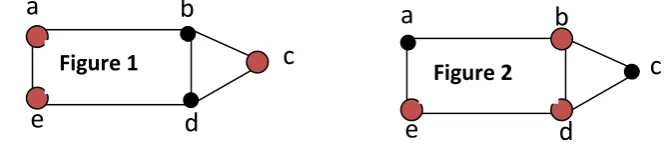
1.2 Example:
In figure 1, D= { a,c,e } and V-D = {b,d}. Hence <V-D> is connected, γns2 (G) = 3.
e
d
c
b
a
e
d
c
b
a
18
For all paths, γns2 (Pn) = n-2 for n 4 andγs2 (Pn) = n+1/2, if n is odd
n+2/2 , if n is even
For all cycles, γns2 (Cn) = n-2 for n 6 andγs2 (Cn) = n+1/2, if n is odd
n/2 , if n is even
For all complete graphs,γns2 (Kn) =2, for n 3
For all wheel graphs, γns2 (Wn) = n-1, for n 5andγs2 (Wn) = n/2 , if n is even, for n 6
n+1/2 , if n is odd, for n 5
For all complete bipartite graphs,γs2 (Km,n) = min { m,n }, for m,n 2
For all star graphs, γns2 (K1,n) = n and γs2 (K1,n) = n for all n 2.
For a bistar, γs2 (Bm,n) = m+n-1, γns2 (Bm,n) = m+n-2.
For all trees, γns2 (T) = n-2for all n 5 and γs2 (T) = n-1 for all n 3.
γns2 (Kn+) = n+2, for n 3
For all book graphs, γs2 (Bn) = n+1 for all n 2 and γns2 (Bn) =2n
γs2 (B2) = 3 γs2 (B3) = 4
γns2 (B2) = 4 γns2 (B3) = 6
γs2 (B4) = 5 γs2 (B5) = 6
γns2 (B4) = 8 γns2 (B5) = 10
For all Hoffman trees, γns2 (Pn+) = 2n-2 if n is even2n-1 if n is odd for n>2 γs2 (Pn+) = n+2 if n is even
2n-2 if n is odd for n>2
γs2 (P2+) = 3 γs2 (P3+) = 4 γs2 (P4+) = 6
(www.rdmodernresearch.com) Volume 2, Issue 1, 2017
19
γs2 (P5+) = 8 γs2 (P6+) = 8
γs2 (P5+) = 9 γs2 (P6+) = 10
For all triangular snake, γns2 (mC3) = m+2, for n 2 andγs2 (mC3) = m+1, for n 2
γs2 (2C3) =3 γs2 (3C3) =4 γs2 (4C3) =5
γns2 (2C3) =4 γns2 (3C3) =6 γns2 (4C3) =6
γs2 (5C3) =6 γs2 (6C3) =7
γns2 (5C3) =7 γns2 (6C3) =8
γns2 (Wn+) = n+2 , for n 3 and γs2 (Wn+) = n+4, for n≥3γs2 (W2+) = 5 γs2 (W3+) = 7 γs2 (W4+) = 8
γns2 (W2+) = 4 γns2 (W3+) =5 γns2 (W4+) = 6
For all crown graphs, γns2 (Cn+) = 2n-2 andγs2 (Cn+) = n+2
γs2 (C3+) = 5 γs2 (C4+) = 6 γs2 (C5+) = 7
γns2 (C3 +
) = 4 γns2 (C4 +
) = 6 γns2 (C5 +
) = 8
y
y1
x1
x
w1
v1
u1
w
v
u
z1
z
y
y1
x1
x
w1
v1
u1
w
v
20
γs2 (C6 +
) =8 γs2 (C8 +
) =12 γns2 (C6+) =10 γns2 (C8+) =14
For all fan graphs γns2 (Fn) = n-1 , for n 4 andγs2 (Fn) =2n/3 , for n ≥4
γs2 (F3) = 2 γs2 (F4) = 3 γs2 (F5) =3
γns2 (F3) = 3 γns2 (F4) = 3 γns2 (F5) =4
γs2 (F6) = 4 γs2 (F7) =4
γns2 (F6) = 5 γns2 (F7) =6
γns2 (Fn+) = n+3 for 4 n 6n+4 for n >6 and γs2 (Fn+) = n+4 for 4 n 6
n+5 for n >6
γs2 (F3+) =6 γs2 (F4+) = 8 γs2 (F5+) = 9
(www.rdmodernresearch.com) Volume 2, Issue 1, 2017
21
γs2 (F6+) = 10 γs2 (F7+) =12
γns2 (F6 +
) = 9 γ ns2 (F7 +
) =11
γs2(S(K1,n)) = n+1 and γns2(S(K1,n)) =2n
γs2 (S(K1,2)) =3 γs2 (S(K1,3)) =4 γs2 (S(K1,4)) =5
γns2 (S(K1,2)) =3 γns2 (S(K1,3)) =4 γns2 (S(K1,4)) =5
For all γns2 (Cn(t)) = (n-1)t for n3 andγs2 (Cn(t)) = t+1 for n=3,
=(n-3)t+1 for n4 If n=3, it is friendship graph.
γs2 (C3(2)) =3 γs2 (C3(3)) = 4 γs2 (C3(4)) =5
γns2 (C3(2)) =4 γns2 (C3(3)) = 6 γns2 (C3(4)) =8
γs2 (C4(2)) =3 γs2 (C4(3)) = 4 γs2 (C4(4)) =5
γns2 (C4(2)) =6 γns2 (C4(3)) = 9 γns2 (C4(4)) =12 2. Main Results:
Observation: γs2(G) γns2 (G). C4+ is the graph for whichγs2(G) = γns2 (G) =4. Theorem 2.1: For any graph G, γ (G) γs2 (G), andγ(G) γns2 (G)
Proof: Since every Split two dominating set is a dominating set of G, γ (G) γs2 (G), similarly, every Non Split
22
Theorem 2.2: For any graph G, γ (G) min {γs2 (G), γns2 (G)}Proof: Since every Split two dominating set and every Non Split two dominating set of G are the dominating set of G, we have γ (G) γs2 (G) and γ (G) γns2 (G) and hence γ (G) min {γs2 (G), γns2 (G)}
Theorem 2.3: For any graph G, γs2 (G) n- (G), where (G) is the minimum degree among the vertices of G. Note: For any tree T, (T) = 1, hence γs2 (G) n- 1
Theorem 2.4: For any graph G, γns2 (G) = n if and only if γs2 (G) contains either a pendant vertex of G or has
two vertices of degree two or both.
Proof: Assume that γns2 (G) = 0, then there exists no non split two dominating set in G. If D is a split two
dominating set, then the induced subgraph <V-D> is disconnected and every vertex in <V-D> is adjacent to atleast two vertices in D. As G is a tree, |E (G)| |V (G)|, it is clear that D has a pendant vertex or it has two vertices of degree two or both. Conversely assume that Split two dominating set satisfies the sufficient condition. If D contains a pendant vertex, then it will not be present in the induced subgraph <V-D>. If D contains a two vertices u,v of degree two, then u,v will not belong to the induced subgraph <V-D>. Thus in both the cases, the induced subgraph <V-D> is disconnected. Therefore D is Split two dominating set with the sufficient condition. Hence γns2 (G) = n.
Corollary 2.5: For any tree t γns2 (G) = n
Proof: Every Split two dominating set of T contains a pendant edge of T; the result follows from the sufficient part of the previous theorem.
Note: If H is any spanning subgraph of G, then γ (G) γ(H).
Theorem 2.6: Let G be a graph which is not a cycle with atleast four vertices. If H is a connected spanning subgraph of G, then γs2 (G) γs2 (H).
Proof If G is connected, then any spanning tree T of G is minimally connected subgraph of G such that, γs2 (G) γs2 (T) γs2 (H). Hence the result.
Theorem 2.7: Let G be a graph which is not a cycle with atleast five vertices. If H is a connected spanning subgraph of G, then γns2 (G) γns2 (H).
Proof: The result follows from the previous theorem.
3. Bounds onγs2 (G) and γns2 (G):
Theorem 3.1: If T is a tree which is not a star, then γns2 (G) = n and γs2 (G) = n – 1 for all n 3.
Proof: Since T is not a star, there exists two adjacent cut vertices u and v with degree u and degree v 2. This implies that V – {u,v} is disconnected. Thus the theorem is true.
Characterization of Minimal Split and Non Split Two Dominating Set:
Theorem 3.3: A Split two dominating set is minimal if and only if for each vertices u,v D, one of the following condition is satisfied:
(i) There exists a vertex w V-D such that Ns2(w) D = {u,v}
(ii) v is not an isolated vertex in <D> (iii) (<V-D> {u,v}) is connected.
Proof: Suppose D is a minimal split two dominating set such that {u,v} does not satisfy any of the above conditions. Then by (i) and (ii) D-{u,v} is a domination set, also since (iii) is not satisfied, <V-D> is disconnected. Therefore D-{u,v} is a Split two dominating set contradicting the minimal of D. Hence v satisfies one of the above conditions, and the bound is sharp.
Theorem 3.4: For all trees, γs2 (G) (n(G)) / ((G)+1)
Proof: Let D be a Split two dominating set of G, since D is minimal for every vertices {u,v}D, (<V-D> {u,v}) is connected. Therefore |V-D| 2, <V-D> is a two dominating set of G.
γ2(G) |V-D| n-γs2 (G). But γ2 (G) γ(G) n / +1.Hence γs2 (G) n-γ2 (G) n- [ n/ +1] = (n+n-n)/(+1)
= n/ +1. Hence γs2 (G) n (G) / (G) +1.
Theorem 3.5: For any tree G, γs2 (G) q, where q be the number of edges.
Proof: Any edge set containing q edges is clearly a Split two dominating set of G, which proves the result.
The Following Nordhaus – Gaddum Type Result is Immediate from the Above Theorem: Theorem 3.6: Let G be a (p,q) tree graph such that G and its complement G are connected. Then
(i) γs2 (G) + γs2 (G) ½ [p(p-1) – 4]
(ii) γs2 (G) + γs2 (G) ½ [pq(p-1) – 2 (q2 + q) ]
Proof: Let q be the size of G, then the size ofG is [p (p-1)/2] – q – 1. By the previous theorem γs2 (G) q and γs2 (G) [p (p-1)/2] – q – 1. The results are immediate.
Theorem 3.7: If κ(G) >β0, then γns2 (G) = γ(G), where κ(G) is the connectivity of G and β0(G) is the
independence number of G.
Proof: Let D be a γ set of G, since κ(G) > β0(G) γ(G), it implies that <V-D> is connected. This proves that D
(www.rdmodernresearch.com) Volume 2, Issue 1, 2017
23
Theorem 3.8: For any graph G, γns2 (G) p- (G) + 1, where (G) is the clique number of G.Proof: Let D be a set of vertices of G such that <D> is complete with D = (G). Then for any uD, (V-D) {u} is a nonsplit two dominating set of G. Thus γns2 (G) V-D +1 V-D+1 p-(G) +1.
Theorem 3.9: For any graph G, p- q/2 + q0/2 γs2 (G), where G is a (p,q) graph and q0 = min q(<D>), where
D {minimal split two dominating sets of G}.
Proof: Let D be a minimal split two dominating set of G. Then for any point uV-D, there exist atleast two edges from u to D and there exists atleast 2V-D edges from V-D to D. Then the number of edges of G, q 2V-D+q0=2V-2D+q0 (or) 2D 2V-q+q02D 2p-q+q0D p-q/2+q0/2 which implies γs2 (G)
p-q/2+q0/2.
Theorem 3.10: For any graph G, γs2 (G) 2p/+2
Proof: Every vertex in V-D contributes two to the degree sum of vertices of D, since 2V-Dd(u) for uD, where D is a split two dominating set. Therefore 2V-Dd(u) γs2. , which implies 2V-2D γs2. , which
implies 2p-2γs2 γs2. , which implies γs2( +2) 2p which implies γs2 2p/ (+2). Hence γs2 (G) 2p/+2. 4. Conclusion:
The tools of number theory enable us to develop a simple method of constructing a graph with a given cardinality of the spilt dominating set with amazing ease. It is also amazing to observe how such a graph with a given domination number can be enlarged to include more vertices and edges in a methodical, simple manner without affecting the domination number. We can apply this to many applications such as to eradicate pests in Agriculture, to control viruses which produces diseases in an epidemic form, to maintain confidential in transferring the information, especially very useful for Defense sector. To some extent this may be due to the ever growing importance of computer science and its connection with graph theory.
5. References:
1. Chartrand G. and Lesniak L. (1996). Graphs and Digraphs. Chapman and Hall /CRC.
2. Chartrand G. and Schuster S. (1974). On the Independence number of complementary graphs. Trans. of the New York Acad. of Sci. Series II, 36. No. 3pp.247-251.
3. Cockayne, E. J. and Hedetniemi S. T. (1977). Towards a theory of domination in graphs Networks, Vol.7.pp.241-267.
4. Cockayne, E. J., Dawes R. M. and Hedetniemi S. T. (1980). Total domination in graphs. Networks, Vol.10.pp.211-219.
5. Kulli, V. R. and Janakiram B. (1997). The split domination number of a graph. Graph Theory notes of New York. New York Academy of Sciences, XXXII. pp. 16-19.
6. Kulli, V. R. and Janakiram B. (2000). The non- split domination number of a graph. The Journal of Pure and Applied Math. 31(5). pp. 545-550.
7. Nordhaus, E.A. and Gaddum J.W. (1956). On complementary graphs. Amer. Math. Monthly, 63. pp. 175-177.