Vol.6 (2016) No. 6
ISSN: 2088-5334
Detection on Straight Line Problem in Triangle Geometry Features for
Digit Recognition
N. A. Arbain
#, M. S. Azmi
#, S. S. S. Ahmad
#, R. Nordin
*, M. Z. Mas'ud
#, M. A. Lateh
##
Faculty of Information and Communication Technology,
Universiti Teknikal Malaysia Melaka, Hang Tuah Jaya, Durian Tunggal, 76100 Melaka, Malaysia E-mail: [email protected], {sanusi, sakinah, zaki.masud}@utem.edu.my, [email protected]
*
Centre for Languages and Human Development,
Universiti Teknikal Malaysia Melaka, Hang Tuah Jaya, Durian Tunggal, 76100 Melaka, Malaysia Email: [email protected]
Abstract— Geometric object especially triangle geometry has been widely used in digit recognition area. The triangle geometry
properties have been implemented as the triangle features which are used to construct the triangle shape. Triangle is formed based on three points of triangle corner A, B, and C. However, a problem occurs when three points of triangle corner were in parallel line. Thus, an algorithm has been proposed in order to solve the straight line problem. The Support Vector Machine (SVM) and Multi-Layer Perceptron (MLP) were used to measure based on the classification accuracy. Four datasets were used: HODA, IFCHDB, MNIST, and BANGLA. The comparison results in classification demonstrated the effectiveness of our proposed method.
Keywords— classification; digit recognition; feature extraction; image processing; triangle geometry
I. INTRODUCTION
Research in digit recognition has been actively explored since four decades ago [1]. Many methods and techniques have been used to recognize digit recognition such as Hidden Markov Model, Neural Network, et cetera. Nowadays, triangle method has become a popular method that has been used in recognizing the digit images. The study in digit recognition has been expanded due to demand to identify the pattern, style, and signature of handwriting. Generally, the study in digit recognition has been explored in numerous languages, for example, Hebrew, Roman, Chinese, Indian, Jawi, Arabic, and Latin.
The Modified NIST dataset (MNIST) is a ROMAN handwriting that has known as the largest dataset compared to HODA dataset. The MNIST dataset was developed as a result of handwritten digit classification competition which has been held in summer of 1992 [2]. The studies of digit recognition had evolved rapidly along with improvement made on prior methods and techniques [3]–[10].
In 2009, characterization loci and mixture of experts were proposed by [11] in order to recognize the Farsi handwritten digits. The characterization loci were used as a main feature
and mixture of experts as the classification stage. The characteristic loci features were used by [11] to extract the features while mixture experts were used for recognizing the digit handwriting. The HODA database was used to be extracted using proposed method by [11] in the experiment.
[12] Proposes new features from triangle properties by using the triangle geometry method to extract digit images. Geometrical properties are the medium to form geometric by modeling them as an object. In object recognition, the properties of geometry can be implemented. The triangle geometry method also has been widely applied in biometric research such as face recognition and fingerprint recognition [13]–[16]. Besides, the triangle geometry also had been implemented in intrusion, vehicle detection and digit recognition [12], [17]–[20]. Research in digit recognition has been conducted on several datasets such as MNIST [2], HODA [33] and IFCHDB [34].
This paper is organized as follows. In Section II, we discuss the material and method used in this paper. In Section III, the result and discussion are covered. Finally, in Section IV, we conclude the paper.
A. Triangle Geometry
Triangle shape forms based on three points where the three segments are linking to each other. Besides, it also is known as a three-sided polygon. The types of triangles are divided into four types, namely equilateral triangle, isosceles triangle, right triangle, and scalene triangle. For scalene triangles, there are three types of scalene triangles namely acute scalene triangle, obtuse scalene triangle, and isosceles right triangle. The triangle properties are divided into eight types which are vertex, base, altitude, median, area, perimeter, interior angles and exterior angles [21]. In triangle geometry, each of triangle type has different properties. For example, three angles of an equilateral triangle are equal which is congruent to each other. Unlike isosceles triangle, it only has two equal angles and two equal sides.
The triangle properties can be used to produce some features vector. Vertex or vertices are a corner of the triangle. Every type of triangle has three vertices. Base in context of the triangle is a drawn at the bottom. The base of a triangle can be any one of the three sides. Usually, the base is used as a reference side for calculating the area of a triangle. For example, the base of an isosceles triangle is at unequal side. Altitude of a triangle is the perpendicular from the base to the opposite of vertex. Since there are three possible bases, thus there are also three possible altitudes. These altitudes are intersecting at a single point, which called as orthocenter of the triangle. Orthocenter of a triangle also known as one of a triangle’s points of concurrency. Commonly, orthocenter is not always within the triangle. For example, the orthocenter for obtuse is at outside. Nevertheless, there are three other types of triangle centers namely incenter, circumcenter, and centroid.
The median of a triangle is a contour from a vertex to the midpoint of the contradictory side. Since there are three points of corner thus there are also three medians that meet at a single point which called as the centroid of the triangle. Area of a triangle is the number of square units it takes to fill the interior of a triangle. The perimeter of a triangle is the distance around the triangle. The interior angles of a triangle are the three angles of the triangle at each of vertex. Lastly, exterior angles of a triangle are the angle between a side of a triangle and the extension of an adjacent side.
The triangle points of the corners can be calculated using the basic formula, which is Pythagorean Theorem. The theorem was a fundamental importance in Euclidean Geometry where it assists as a root for the description of distance between two points [22]. Fig. 1 shows the triangle shape using Pythagorean Theorem. In algebraic terms, where c is the hypotenuse while a and b are the legs of a triangle.
Fig. 1 Triangle shape using Pythagorean Theorem
In trigonometric terms, the Pythagorean Theorem emphasizes that in a triangle ABC, the equality of
1 is equivalent to the angle at C being right. The Euclidean distance was been used to measure the distance in the plane. The Euclidean distance formula is as follows:
, , , (1)
Besides the distance in a triangle, the gradient of corner also can be calculated. The gradient, which also known as the slope of a straight line. The gradient of corner plays an important role to determine the position of three triangle coordinates (x, y). The formula for the gradient of a line is as follows:
or (2)
Next, the ratio of triangle’s sides also can be computed. In two similar triangles, the perimeters of two triangles are in the same ratio as the sides. Besides, the corresponding sides, median, and altitudes in the same ratio. Since a triangle has three sides, thus there are also have three altitudes and three medians. The formula for ratio of sides is as follows:
!, "#"$ (3)
Where r is a ratio of sides. The symbol of A represents as point A of triangle and symbol of B is represented as point B of triangle. The symbol used in equation 3 can be referred in Fig. 2.
Fig. 2 Triangle shape
B. Feature Extraction
Before performs the feature extraction process, images need to be processed by transforming them into binary form through a binarization process. The binarization process was performed in the pre-processing stage. The outcome of the pre-processing stage will be used as the input to the feature extraction process.
In [12], the dataset images have been converted into binary form through a binarization process in a pre-processing stage. In binarization process, the Otsu threshold method [35] is used to convert the images into a binary form. Then, the outcome of the pre-processing stage is used as an input to the next process, which is feature extraction. In the feature extraction, the zoning method is used to extract the features from triangle properties. The zoning method is also known as 33 zones [12]. The 33 zones are represented as 33 triangles for an image.
The zoning method used are Cartesian Plane Zone (CPZ), Vertical Zone (VZ), Horizontal Zone (HZ) and Zoning Based 45 Degree (Z45d). Each of zoning method produces a different total number of features. The total number of features produced by CPZ is 45 features, VZ is 54 features, HZ is 126 features and Z45d is 72 features. Therefore, the total number of features for zoning method is 297 features. On the other hand, the total number of triangles is produced as 33 triangles which have 297 features for an image.
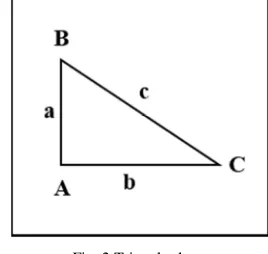
According to [12], one triangle can produce nine features. These features are angle, ratio, and gradient. The formula can be expressed for each of triangle points as shown in Table 1, Table 2, and Table 3. An example of a triangle object denoted A, B and C is shown in Fig. 3. Next, the formula to calculate the length of a triangle is shown in equation 4, 5 and 6.
1 % 1 1 (4)
1 1 (5)
%1 % %1 (6)
Fig. 3 Triangle object [12]
TABLE I
FORMULA FOR TRIANGLE POINT A [12]
Properties Triangle Point A
Angle
∠ ! 2
Ratio : )
Gradient
∆ %%
TABLE II
FORMULA FOR TRIANGLE POINT B [12]
Properties Triangle Point B
Angle
∠ ! 2
Ratio : )
Gradient
∆ %
TABLE III
FORMULA FOR TRIANGLE POINT C [12]
Properties Triangle Point C
Angle
∠% !
2
Ratio : )
Gradient
∆% %%
C. Straight Line Problem in Constructing Triangle Shape
A straight line problem triggered when the chosen points of geometry in a triangle shape do not comply with the geometrical properties. This also can be referred when the value of triangle’s gradient is zero. Hence, a formation of a triangle geometry cannot be formed when the coordinates of point A, B and C are in one line.
In the formation of a triangle, the corner points of triangle A, B and C need to be in different positions to construct a triangle line between the points. A problem in constructing a triangle shape is located at three triangle points that may cause the straight line occurs when constructing the triangle shape.
There are six shapes whereas the triangle geometry’s coordinates can be formed [12]. This also can be referred as a normal condition when forming a triangle shape. For an abnormal condition, there are four possible conditions that may trigger the straight line problem when forming the triangle. Fig. 4 shows the normal condition when forming a triangle shape while Fig. 5 shows the abnormal condition of straight line problem that occurs in forming a triangle shape. Table 4 shows the position of y coordinate for point C.
TABLE IV
POSITION OF Y COORDINATE FOR POINT C [12]
Position Position of y coordinate
1 + % +
2 + + %
3 , % ,
4 , , %
5 + , %
Fig. 4 Normal condition in a triangle formation [12]
Fig. 5 Abnormal condition in a triangle formation [12]
II. MATERIAL AND METHOD
A. Data Collection
In this paper, four types of digit dataset were used. There are as follows:
• HODA [33] • IFCHDB [34] • MNIST [2] • BANGLA [36]
In 1992, MNIST dataset was developed and known as the National Institute of Standard Technology (NIST) in beginning. The dataset, then was naming as MNIST after some improvement were made [2]. The MNIST dataset is
the handwritten Roman digits. The sample of MNIST
dataset can be downloaded at
http://yann.lecun.com/exdb/mnist/. An example of MNIST dataset has shown in Fig. 8.
HODA dataset was developed in 2005. The article about it was published in 2007 by [33]. HODA dataset contains Arabic handwriting. The sample of HODA dataset can be downloaded at http://FarsiOCR.ir. An example of HODA dataset has shown in Fig. 6.
In 2006, IFCHDB dataset was introduced by the Department of Electric Engineering, AmirKabir University in Tehran [34]. IFCHDB is known as Isolated Farsi Character Handwritten Database. IFCHDB dataset contains characters and digits in Farsi/Arabic which were gained from high school examination entry forms [34]. The IFCHDB can be acquired by filling the agreement form before the samples are sent through email. An example of IFCHDB dataset has shown in Fig. 7.
BANGLA dataset was developed by Pattern Recognition Unit and Vision Computer, Institute of Indian Statistic. The BANGLA dataset consists of digit Bangla handwriting. Similar as IFCHDB dataset, an agreement form is required to be filled in before the samples will be sent through email. An example of BANGLA dataset has shown in Fig. 9.
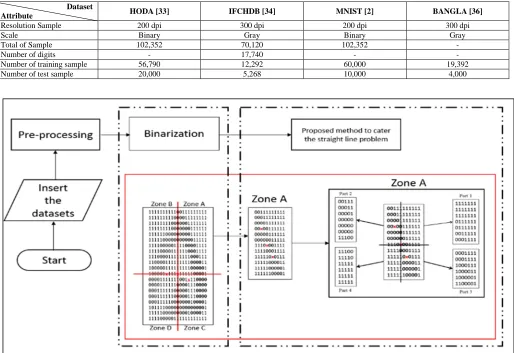
Each dataset consists of 10 test classes and 10 training classes. Besides, these datasets have general characteristic and contain the benchmark for this study. Table 5 shows the description for each dataset.
Fig. 6 Example of HODA dataset [33]
Fig. 7 Example of IFCHDB dataset [34]
Fig. 8 Example of MNIST dataset [2]
TABLE V
DESCRIPTION OF DATASET USED
Dataset
Attribute HODA [33] IFCHDB [34] MNIST [2] BANGLA [36]
Resolution Sample 200 dpi 300 dpi 200 dpi 300 dpi
Scale Binary Gray Binary Gray
Total of Sample 102,352 70,120 102,352 -
Number of digits - 17,740 - -
Number of training sample 56,790 12,292 60,000 19,392
Number of test sample 20,000 5,268 10,000 4,000
Fig. 10 The flow of pre-processing phase
B. Proposed Method
The proposed method was applied to solve the straight line problem when forming the triangle shape for images. The proposed method was developed using java code and stand-alone as a basic platform.
A straight line detection was performed by identifying which coordinates of point A, B and C would lead to the straight line problem. The straight line problem was identified based on the position of y coordinate which has shown in Table 4. After identifying which points and coordinates, the proposed method would be applied to solve the straight line problem. The proposed method was applied in a pre-processing stage as shown in Fig. 10.
Based on Fig. 10, the pre-processing process began when the datasets were converted into a binary image using the Otsu’s method [35]. In binary form, the foreground image is known as ‘0’ while the background image is known as ‘1’ [27]. Then, the zoning method was applied to extract the features. The further explanation for zoning method can be referred in [12].
In this paper, the triangle features from [12] were used. The 297 features were produced after applying zoning method. Based on the explanation in Section I (B), 33 zones were represented as 33 triangles for an image. Each zone (33
zones) was divided into four parts. In the pre-processing stage (refer to Fig. 10), the digit image from HODA dataset was converted into a binary form.
For example, the binary form (refer to Fig. 10) was split into four zones using Cartesian plane zone. These four zones were named as Zone A, Zone B, Zone C and Zone D as shown in Fig. 10. Then, each zone was divided into four parts namely part1, part2, part3, and part4. In this case, part1, part2, part3 and part4 will be used in solving straight line problem. The number of pixels (only foreground images) for each partition will be count. The comparison will be performed between partition (part1, part2, part3 and part4) in order to produce new coordinate for selected triangle point (that has straight line problem). The new coordinate for selected triangle point will be determined by a total number of pixel of partition. The highest total of pixels will move the coordinate of x and y to up (add by one). However, if the total number of pixels were less, then the coordinate of x and
y will be going down (minus by one).
TABLE VI
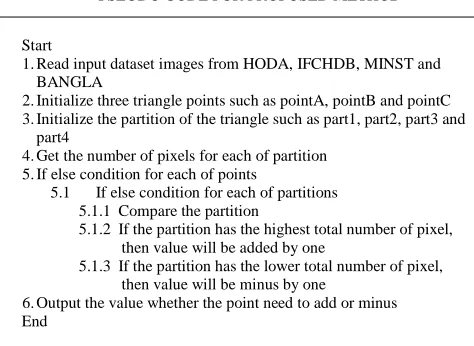
PSEUDO CODE FOR PROPOSED METHOD
Start
1.Read input dataset images from HODA, IFCHDB, MINST and BANGLA
2.Initialize three triangle points such as pointA, pointB and pointC 3.Initialize the partition of the triangle such as part1, part2, part3 and
part4
4.Get the number of pixels for each of partition 5.If else condition for each of points
5.1 If else condition for each of partitions 5.1.1 Compare the partition
5.1.2 If the partition has the highest total number of pixel, then value will be added by one
5.1.3 If the partition has the lower total number of pixel, then value will be minus by one
6.Output the value whether the point need to add or minus End
III.RESULT AND DISCUSSION
The experiments were conducted using Support Vector Machine (SVM) and Multi-Layer Perceptron (MLP). For SVM technique, the cost and gamma values were obtained from a grid search using libSVM function. For MLP technique, the learning rate (LR) was 0.2 which was obtained using heuristic search from [12]. All datasets (HODA, IFCHDB, MNIST and BANGLA) were used in this experiment. The results of classification accuracy were
compared with previous research. The comparison was made between [12] and the present proposed method. This is because the proposed method used in [12] implements the triangle geometry and zoning methods to extract the features. Table 7 shows the comparison results of classification accuracy.
Based on the findings, the results for the present proposed method using SVM technique showed some improvement compared to the result for proposed method in [12]. The classification accuracy for SVM technique increased for HODA (98.3342%), IFCHDB (95.794%) and BANGLA (90.95%). However, the result of MNIST dataset showed decreased which was 94.595%. The results for our proposed method using MLP technique produced poor results except for BANGLA dataset which has shown an improvement. The results of the classification accuracy might possibly be biased because of the pattern of handwritten itself.
Our proposed method was successfully applied to solve the straight line problem that has been triggered in a triangle formation. The results in Table 7 has shown good results for SVM technique while poor results were obtained using MLP technique. The formula used in MLP technique was complex which is one of the factors that influenced the results of classification accuracy. Besides that, the nature of handwritten itself also has effected the results.
TABLE VII
COMPARISON RESULTS OF CLASSIFICATION ACCURACY (%)
Method Techniques Datasets
HODA IFCHDB MNIST BANGLA
M. S. Azmi (2013) [12] SVM 97.295 93.641 95.4 90.275
MLP 99.695 94.856 94.06 88.775
Present Proposed Method SVM 98.3342 95.794 94.595 90.95
MLP 96.375 94.1913 93.58 89.2
IV.CONCLUSION
This paper presents the proposed method to cater the straight line problem in a triangle formation in order to increase the result of classification accuracy. The straight line problem was detected through three triangle points. By solving the straight line problem, the triangle shape can be remodeled. By focusing in digit recognition area, there are four datasets (HODA, IFCHDB, MNIST and BANGLA) which contain digit form used in this experiments.
Two techniques namely SVM and MLP have been used in the experiments. The results of classification accuracy demonstrate the effectiveness of our proposed method. In general, while SVM technique is more suitable to be applied for HODA, IFCHDB and BANGLA to measure the accuracy, MLP technique is suitable to measure the accuracy for BANGLA dataset only.
Feature extraction is an important factor in the presentation of digit recognition. An influential classifier such as SVM and MLP may produce much different accuracy based on the different features of patterns. The high recognition accuracy can be shaped by selecting the suitable low-complexity classifier and suitable data extraction. The
best final result is attained not only from the combination of good classifier but also from the features itself. The enhancement on features supports to achieve high recognition accuracy. The proposed method is a suitable method to solve the straight line problem when triangle formation in digit images. The proposed method of this study can be used in other recognition work that is based on the pixel of images (binary form). Further research is needed to increase performance when constructing a triangle shape.
ACKNOWLEDGMENT
The authors would like to thank the Ministry of Education
for funding the study through
REFERENCES
[1] A. L. Knoll, “Experiments with ‘Characteristic Loci’ for Recognition of Handprinted Characters,” IEEE Trans. Comput., vol. 18, no. April, pp. 366–372, 1969.
[2] A. Borji, M. Hamidi, and F. Mahmoudi, “Robust handwritten character recognition with features inspired by visual ventral stream,” Neural Process. Lett., vol. 28, no. 2, pp. 97–111, 2008.
[3] E. Kussul and T. Baidyk, “Improved method of handwritten digit recognition tested on MNIST database,” Image Vis. Comput., vol. 22, no. 12 SPEC. ISS., pp. 971–981, 2004.
[4] K. Labusch, K. Labusch, E. Barth, E. Barth, T. Martinetz, and T. Martinetz, “Simple Method for High-Performance Digit Recognition Based on Sparse Coding,” Neural Networks, IEEE Trans., vol. 19, no. 11, pp. 1985–1989, 2008.
[5] K. Labusch, K. Labusch, E. Barth, E. Barth, T. Martinetz, T. Martinetz, R. M. O. Cruz, G. Cavalcanti, T. Ren, and J. Malik, “Handwritten digit recognition using multiple feature extraction techniques and classifier ensemble,” Int. Conf. Syst. Signals Image Process., vol. 19, no. 11, pp. 215–218, 2010.
[6] C. L. Liu, K. Nakashima, H. Sako, and H. Fujisawa, “Handwritten digit recognition: Benchmarking of state-of-the-art techniques,” Pattern Recognit., vol. 36, no. 10, pp. 2271–2285, 2003.
[7] C.-L. Liu, K. Nakashima, H. Sako, and H. Fujisawa, “Handwritten digit recognition: investigation of normalization and feature extraction techniques,” Pattern Recognit., vol. 37, no. 2, pp. 265–279, 2004.
[8] M. Moradi, M. A. Pourmina, and F. Razzazi, “FPGA-Based farsi handwritten digit recognition system,” Int. J. Simul. Syst. Sci. Technol., vol. 11, no. 2, pp. 17–22, 2010.
[9] G. Mirsharif, M. Badami, B. Salehi, Z. Azimifar, and a D. Collection, “Recognition of Farsi Handwritten Digits Using a Small Feature Set,” Int. J. Comput. Electr. Eng., vol. 4, no. 4, pp. 588–591, 2012. [10] V. Sundaresan and J. Lin, “Recognizing Handwritten Digits and
Characters,” 1998.
[11] R. Ebrahimpour, M. R. Moradian, A. Esmkhani, and F. M. Jafarlou, “Recognition of Persian handwritten digits using Characterization Loci and Mixture of Experts,” Int. J. Digit. Content Technol. its Appl., vol. 3, no. 3, pp. 42–46, 2009.
[12] M. S. Azmi, “Fitur Baharu Dari Kombinasi Geometri Segitiga Dan Pengezonan Untuk Paleografi Jawi Digital,” Doctoral dissertation, Universiti Kebangsaan Malaysia, 2013.
[13] Z. Jin, A. B. Jin Teoh, T. S. Ong, and C. Tee, “Secure minutiae-based fingerprint templates using random triangle hashing,” Lect. Notes Comput. Sci. (including Subser. Lect. Notes Artif. Intell. Lect. Notes Bioinformatics), vol. 5857 LNCS, pp. 521–531, 2009.
[14] M. M. M. Tin, M. M. Sein, and H. Township, “Multi Triangle Based Automatic Face Recognition System By,” I2MTC 2009 - Int. Instrum. Meas. Technol. Conf., no. May, pp. 5–7, 2009.
[15] C. H. Lai and S. A. Suandi, “Fingerprint Reference Point Detection Using Triangle ’ s Angle,” 2011 IEEE Reg. 10 Conf., pp. 354–358, 2011.
[16] L. Gao and Y. Xu, “Face orientation recognition based on multiple facial feature triangles,” Proc. - 2012 Int. Conf. Control Eng. Commun. Technol. ICCECT 2012, pp. 928–932, 2012.
[17] S. Mozaffari, K. Faez, and V. M\"argner, “Application of Fractal Theory for On-Line and Off-Line Farsi Digit Recognition,” Mach. Learn. Data Min. Pattern Recognit., pp. 868–882, 2007.
[18] A. Haselhoff and A. Kummert, “A Vehicle Detection System Based on Haar and Triangle Features,” in Intelligent Vehicles Sysmposium, 2009, pp. 261–266.
[19] R. Ebrahimpour, A. Esmkhani, and S. Faridi, “Farsi handwritten digit recognition based on mixture of RBF experts,” IEICE Electron. Express, vol. 7, no. 14, pp. 1014–1019, 2010.
[20] P. Tang, R. Jiang, and M. Zhao, “Feature selection and design olintrusion detection system based on k-means and triangle area support vector machine,” Second Int. Conf. Futur. Networks ICFN’10, pp. 144–148, 2010.
[21] E. W. Weisstein, “Triangle.” Wolfram Research, Inc.
[22] J. D. Page, “Math Open Reference citations.” [Online]. Available: http://www.mathopenref.com/site/cite.html. [Accessed: 19-Nov-2015].
[23] N. A. Arbain, M. S. Azmi, L. B. Melhem, A. K. Muda, and H. Rashaideh, “Enhancement of Triangle Coordinates For Triangle Features For Better Classification,” Jordanian J. Comput. Inf. Technol., vol. 2, no. 2, pp. 108–119, 2016.
[24] M. S. Azmi, M. F. Nasrudin, K. Omar, and K. W. M. Ghazali, “Farsi/Arabic Digit Classification Using Triangle Based Model Features with Ranking Measures,” 2012 Int. Conf. Image Inf. Process. (ICIIP 2012), vol. 46, no. Iciip, pp. 128–133, 2012.
[25] M. S. Azmi, M. F. Nasrudin, K. Omar, C. W. S. B. C. W. Ahmad, and K. W. M. Ghazali, “Exploiting features from triangle geometry for digit recognition,” 2013 Int. Conf. Control. Decis. Inf. Technol. CoDIT 2013, pp. 876–880, 2013.
[26] M. S. Azmi, K. Omar, M. F. Nasrudin, B. Idrus, and K. Wan Mohd Ghazali, “Digit Recognition for Arabic/Jawi and Roman using Features from Triangle Geometry,” AIP Conf. Proc., vol. 1522, pp. 526–537, 2013.
[27] M. S. Azmi, N. A. Arbain, A. K. Muda, Z. Abal Abas, and Z. Muslim, “Data Normalization for Triangle Features by Adapting Triangle Nature for better Classification,” IEEE Jordan Conf. Appl. Electr. Eng. Comput. Technol., pp. 1–6, 2015.
[28] M. M. M. Tin and M. M. Sein, “Multi Triangle Based Automatic Face Recognition System,” in I2MTC 2009 - International Instrumentation and Measurement Technology Conference, 2009, no. May, pp. 5–7.
[29] C. Lin and K. Fan, “Human face detection using geometric triangle relationship,” Proc. 15th Int. Conf. Pattern Recognition. ICPR-2000, vol. 2, pp. 941–944.
[30] A. Jain and M. V. N. K. Prasad, “Clustering Based Fingerprint Indexing Using Triangle Spiral,” 2015 11th Int. Conf. Signal-Image Technol. Internet-Based Syst., pp. 81–88, 2015.
[31] A. Gago-Alonso, J. Hernández-Palancar, E. Rodríguez-Reina, and A. Muñoz-Briseño, “Indexing and retrieving in fingerprint databases under structural distortions,” Expert Syst. Appl., vol. 40, no. 8, pp. 2858–2871, 2013.
[32] W. Yang, J. Hu, S. Wang, and J. Yang, “Cancelable Fingerprint Templates with Delaunay Triangle-Based Local Structures,” Cybersp. Saf. Secur., pp. 81–91, 2013.
[33] H. Khosravi and E. Kabir, “Introducing a very large dataset of handwritten Farsi digits and a study on their varieties,” Pattern Recognit. Lett., vol. 28, no. 10, pp. 1133–1141, 2007.
[34] S. Mozaffari, K. Faez, F. Faradji, M. Ziaratban, and S. M. A Golzan, “ A Comprehensive Isolated Farsi/Arabic Character Database for Handwritten OCR Research,” Tenth Int. Work. Front. Handwrit. Recognit., pp. 385–389, 2006.
[35] P. Smith, D. B. Reid, C. Environment, L. Palo, P. Alto, and P. L. Smith, “A Threshold Selection Method from Gray-Level Histograms,” IEEE Trans. Syst. Man. Cybern., vol. 9, no. 1, pp. 62–66, 1979. [36] U. Bhattacharya and B. B. Chaudhuri, “Handwritten numeral
![TABLE II FORMULA FOR TRIANGLE POINT B [12]](https://thumb-us.123doks.com/thumbv2/123dok_us/10048818.1991322/3.595.308.552.64.349/table-ii-formula-for-triangle-point-b.webp)
![Fig. 4 Normal condition in a triangle formation [12]](https://thumb-us.123doks.com/thumbv2/123dok_us/10048818.1991322/4.595.44.283.52.304/fig-normal-condition-triangle-formation.webp)