ISSN 1392-2785 ENGINEERING ECONOMICS. 2006. No 4 (49)
THEECONOMICCONDITIONSOFENTERPRISEFUNCTIONING
Theory of Constraints and its Usage to Evaluate the Governmental Support for
Business
Remigijus
Č
iegis, Edmundas Jasinskas
VU Kauno humanitarinis fakultetas Muitinės g. 8, LT-44280, Kaunas
The affirmations of the theory of Constraints (TOC) have a wide usage in the evaluation of different aspects of management. The evaluation of economic processes of the country was not a key to the representatives of this theory. The scientific and practical novelty of this article lies in that the governmental trade support was evaluated with the application of the TOC.
The article gives the domains analyzed by the repre-sentatives of the TOC. This theory is well employed to tackle the aspects of strategy development, project man-agement, marketing, finance, quality manman-agement, pro-duction timing and other sides of company’s administra-tion. The main affirmations of the Theory of Constraints are also revealed here. They are extended and related to the evaluation aspects of the governmental trade support. With the application of the chain allegory of the Theory of Constraints it was settled that the support would gain effectiveness only if it increased the permeability in the weakest chain of the industry.
Despite the fact that such kind of support is substan-tiated one must consider possible issues that may result in failure to increase permeability in the weakest chain (in the Bottleneck). This article gives the analysis of the issues that induce danger when allotting the support not to increase the permeability of the industry:
• The support will not increase the permeability once it is dedicated to the other branch rather than the Bottleneck.
• The governmental trade support can turn to a problem itself. It can cause constraint if the gov-ernment gives the support to individual companies that run the Bottleneck business of the branch. The companies having gained no support can en-counter restricted permeability of themselves. • Increased income of the Bottleneck business of the
branch not necessarily can stay with the Bottle-neck as the support gained can be repartitioned among the stronger chain participants.
• Increased income of the Bottleneck business of the branch not necessarily can be used to enlarge the permeability. They can present additional source of income that will not be invested anywhere. Evaluating trade support with the aid of the TOC af-firmations it was found that one of the favorable forms of the governmental trade support can be scientific re-searches sponsored by the government.
Keywords: theory of Constraints (TOC), governmental trade support.
Introduction
Theory of Constraints suggests different viewpoint to issues of a company. It recommends that managers do not strive to solve all problems in turn, but try to determine the essential constraint and focus on it. This theory gives a broader comprehension of company’s limits rather than the theory of traditional management. With a broader comprehension of a company one can try to apply the philosophy of this theory to solve economic issues relat-ing to the governmental trade support.
The aim of this article is to give the evaluation of trade support by using the Theory of Constraints.
The goals of the article are the following ones:
• to describe the practical aspects of the TOC;
• to set out the essential affirmations of the TOC;
• to relate TOC affirmations to the economic do-main analyzed;
• to identify the existence of the support repartition issue among chain participants;
• by using the affirmations of the TOC to establish the causes of inefficient support.
The methods such as scientific literature analysis to give the evaluation of trade support by applying the TOC and the Interview method to estimate fertilizers price fluctuation tendencies are applied in this article.
The core of Theory of Constraints and its ap-plications
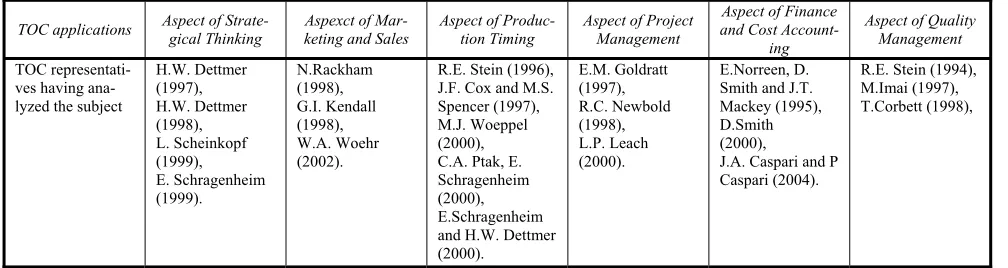
One of the TOC originators Eliyahu M. Goldratt to-gether with his colleagues Jeff Cox and Eli Schragen-heim wrote the book cycle “The Goal” (1994, 2002, 2003) that was dedicated to the Theory of Constraints. This theory features a wide range of issues analyzed. It can be applicable to solve strategy development, project management, marketing, finance, quality management, production timing and other sides of company’s admini-stration. Issues analyzed by the TOC representatives are shown in table.
Table
Theory of Constraints and its applications
TOC applications Aspect of Strate-gical Thinking keting and Sales Aspexct of Mar- Aspect of Produc-tion Timing Aspect of Project Management
Aspect of Finance and Cost
Account-ing
Aspect of Quality Management
TOC representati-ves having ana-lyzed the subject
H.W. Dettmer (1997), H.W. Dettmer (1998), L. Scheinkopf (1999), E. Schragenheim (1999).
N.Rackham (1998), G.I. Kendall (1998), W.A. Woehr (2002).
R.E. Stein (1996), J.F. Cox and M.S. Spencer (1997), M.J. Woeppel (2000), C.A. Ptak, E. Schragenheim (2000), E.Schragenheim and H.W. Dettmer (2000).
E.M. Goldratt (1997), R.C. Newbold (1998), L.P. Leach (2000).
E.Norreen, D. Smith and J.T. Mackey (1995), D.Smith (2000),
J.A. Caspari and P Caspari (2004).
R.E. Stein (1994), M.Imai (1997), T.Corbett (1998),
Theory of Constraints similar to other management theories gives the analysis of the directions of the effec-tiveness of a company. According to the TOC represen-tatives, a company could compete effectively with the other ones only under condition that it is able to control two indicators, that is company’s expenditures and per-meability11. The indicators complement each other and
reflect company’s profit. They are both important. If the company has small costs and no sales and, on the con-trary, meet high income but they will equal costs the company gains no profit in both cases.
E.M. Goldratt (1997) in the book “Critical chain” and H.W. Dettmer (1997) in the book “Goldratt’s Theory of Constraints: a systems approach to continuous improve-ment” compare the company to a chain and every single subdivision determine as a separate chain element.
According to E.M. Goldratt (1994, 1997, 2002, 2003) and T.B.C. McMuller (1998) company’s expenditures equal the expenditures sum of all subdivisions in the same way as a whole chain weight equals the weight sum of all its elements. Thus, following this allegory, reducing expenditures in one subdivision the reduction is achieved in total expenses as well. That is, the chain weights less. This affirmation gives the warrant to the philosophy of local optimum researches, or in another words as the TOC representatives call to the philosophy of theworld of costs.
But, however, as it was mentioned above, the main goal of the company is not the reduction of expenses. To gain a better profit company must earn more income. The latter grows when the company buys raw materials and quickly turns them into product, and as fast as possible sells it to a customer. E.M. Goldratt (1994, 1997, 2002, 2003) and T.B.C. McMullen (1998) called this process
the permeability of the company. By applying chain’s allegory one can imagine the permeability of the com-pany as the solidity of a chain. The permeability of the company (the solidity of the chain) depends on the weak-est subdivision (the weakweak-est chain element). That is why having only, improved the performance of the weakest subdivision, there is a hope to increase the permeability of the whole company. Thus, in accordance with the permeability world rules one must search for and focus
1 Permeability is the speed by which company’s raw
mate-rials are turned into products and sold to a customer
on the constraint. Sometimes constraint is determined as the Bottleneck or Funnel.
Eliyahu M. Goldratt (1994, 1997, 2002, 2003), H.W. Dettmer (1997) and T.B.C. McMullen (1998) specify the essential management issue, that is the compatibility of the evaluation rates of the company’s activity. In line with the world of costs rules the only way to achieve good expense rates is to have all local rates high, and following the permeability world rules there is no way how to achieve good permeability rates due to high all local rates. The foregone assumption stands on the man-agement account theory and the latter refers to the TOC theory.
The company adjusting performance of other subdi-visions to the Bottleneck will not increase permeability but will start expense controlling. This happens because the stock quantity at the Bottleneck is controlled under the Bottleneck permeability speed. Thus, the assumption that the only way to achieve good company rates is high all local rates turn to be false.
According to the TOC representatives the main issue of the companies lies in that managing directors follow wrong assumption and try to increase all local rates ig-noring the point of permeability constraint. Accumulated stock processing cannot exceed the Bottleneck permeabil-ity speed, despite what the Bottleneck speed is the com-pany’s stock flood into the Bottleneck. This increases costs for new raw material purchasing and unfinished goods (stock) warehousing. But having improved subdi-vision performance that had no constraint, the permeabil-ity rate would not be enhanced anyway. Due to these rea-sons, it is necessary to identify the Bottleneck and subor-dinate all system to the Bottleneck speed.
Company’s constraint can be both physical (the lack of outfits, equipment, personnel, etc.) and nonphysical (improper company’s strategy, production quality uncon-formable to market needs, innovation shortage, etc.). The representatives of Theory of Constraints affirm that physical constraint is easy to notice. However, companies often face nonphysical constraints.
The applications of the Theory of Constraints to evaluate governmental support
then production made is purchased by wholesales and finally retailers sell to the final customer. The production brought ex factory in bookkeeping papers is recorded as sold goods. But actually they will be sold when the final customer purchases goods from the retailer. It is impor-tant that permeability will speed equally in all chain ele-ments, that is both in the factory and in wholesaler’s or retailer’s place and nowhere stock will be accumulated. If one of the chain participants – supplier, factory, whole-saler or retailer – has the permeability declining then automatically the permeability of other chain participants will start decreasing as well. Affirming above TOC rep-resentatives keep in view all companies’ group operating in that branch. This is one of the contact points with economy.
From our point of view the partners operating in the
branch can be reckoned as the individual subdivisions of the integrated company where suppliers can be referred to the first subdivision, factories to the second one and sell-ers to the third one. The allotment can be more detailed. Though there is a competition between the same business running companies but the seller of the production of the factory turns to be the partner of the factory. The supplier (the partner) will not sell his raw materials until the fac-tory (the partner) calls for them. And the demand will come after the sellers (the partners) sell goods to the final customers. Thus, the supplier practically sells his raw materials once the sellers realize production to final cus-tomer. The integrated partners company of the branch will have the immediate constraint of the Bottleneck (of a participant of the companies partners group) that has the smallest permeability (see figure 1).
Source: By the author in reference with the Goal I, the Goal II, the Goal III, Critical chain
Figure 1. The integrated partners company of the branch
Consequently, the company has its own capacities to re-adjust to the capacities of the Bottleneck partners group in order they do not accumulate stock and do not grow costs.
One of nonphysical constraint of the company can become the government policy and support gained by other companies. Such support can distort market and reduce the permeability of more efficient company. Due
to this reason the governmental trade support will not be substantiated if it is allotted to individual chain participants but not to all Bottleneck business running companies. In this case companies running the same business face different conditions, that is the ones with no support gained will encounter the governmental support made constraint.
Figure 2. Support repartition in the partners company of the branch Goods Raw
materials
Products
Final Customer Sellers –
partners group
Constraint
Raw mate-rial suppli-ers – part-ners group
Manufac-turers – partners group
The government
Direct Support
Raw mate-rial suppli-ers – part-ners group
Manufac-turers – partners group 1
Products Raw
materials Products
The Bottleneck Support
benefit
Manufac-turers – partners group 2
Support benefit
Sellers – partners group
Support benefit
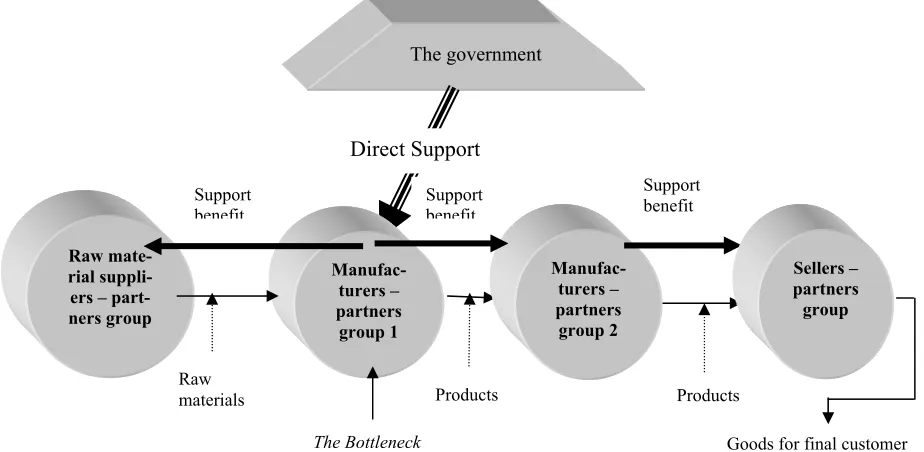
The government supports different trade branches such as agriculture or developing and promising branches, and allots support to all entrepreneurs running that business. The support pursuant to the Theory of Constraints might be substantiated provided that the branch Bottleneck was promoted (see figure 2). Due to this reason the whole branch permeability will expand and the branch will turn to a more competitive one. In the figure 2 the Bottleneck is the manufacturers part-ners group 1. Having gained the governmental support manufacturers would acquire productive equipment and that would enable to increase their permeability, and ac-cordingly the whole chain permeability would rise. Sup-pliers could provide more raw materials, sellers could sell a better quantity of products, and final customer would get more goods. In this case the productivity of the indus-try would increase and counindus-try competitiveness would develop.
With the trade support the government usually aims for increasing country competitiveness, and in accor-dance with the TOC theory that would be the branch permeability enlargement. But there is a question – is the support necessary for the weakest branch chain is really attained by her? To analyze this the grain farm was cho-sen.
The farmer cultivating grain gets direct payoffs for his crops. As per data of National Paying Agency under the Ministry of Agriculture (2006) direct support payoff for a grain hectare was 335.31 litas. The support suit-ability criteria mentioned in the article such as the Bot-tleneck support of the industry and equal conditions allotment to all market participants are implemented because in this case the support is granted to all grain farmers that properly declared grain crops available.
The government sponsors grain-cultivating farmers in order to increase Lithuanian grain industry competitive-ness. Other integrated units of the company such as sup-pliers (fertilizers and chemical manufacturers, land ten-ants), manufacturers group 2 (grain remakers, mills),
manufacturers group 3 (bakeries) and sellers group (food shops) are not Bottlenecks of the industry. Even though grain farmers are provided with the support the cost price of grain cultivation is growing, as well.
The research fulfilled by R. Matiusaityte and E. Jasinskas (2004) showed that after the establishment of the direct crop payoffs land rent price for Kedainiai dis-trict farmers increased up to 100 litas. Similar situation refers to the fertilizers and chemical prices, as well. By the Interview method Prienai district farmer was ques-tioned. It was found that in 2004 and 2005 the prices of fertilizers the farmer used in the farm also grew up.
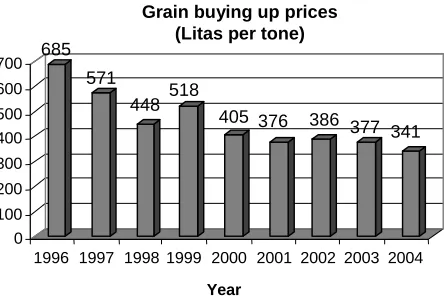
Despite the cost price of grain cultivation increased the buying up prices not even grew but dropped (see figure 3).
Other chain participants of the industry such as fertil-izers manufacturers and grain buyers have increased their profits. According to the data of ELTA (2005) the nitro-gen fertilisezs and chemicals producer AB “Achema” has the biggest fertilizers market in Lithuania. During the 9 months in 2005 the company’s income amounted to 685 million litas, that is 51 percent more than in the same period in 2004 (454 million litas). The profit of chain
participants may have grown due to the innovations and favorable fertilizers prices worldwide. But, however, once the farmers cultivating grain had not gained directs payoffs it would have been unprofitable for them to culti-vate grain due to the increased costs and decreased grain prices. Though the direct crops support has been executed just for the second year the bigger profit can exhilarate not grain cultivators but other chain participants. Stated facts above show that the direct support allotted to the grain cultivators actually comes to other chain par-ticipants such as tenants, fertilizers and chemicals producers and grain remakers.
685 571
448 518
405 376 386 377 341
0 100 200 300 400 500 600 700
1996 1997 1998 1999 2000 2001 2002 2003 2004
Year
Grain buying up prices (Litas per tone)
Source: Department of Statistics Lithuania (2006)
Figure 3. The dynamics of grain buying prices
It is necessary to note that market participants are in-terdependent. This connection was described before as
the integrated partners company of the branch. Although the government allotted support to the Bottleneck indus-try the profit and support among the participants of the integrated company can spread differently. The problem lies in that the strongest chain participants will strive to pocket the bigger portion of profit and support despite the Bottleneck needs support the most. This situation is de-picted in figure 2. The government here provides with support the Bottleneck but the benefit is gained by other chain participants.
Due to the governmental direct support to the Bottle-neck other subjects can make a fortune. To our mind profit repartition results in that the Bottleneck depends on the other chain participant, which often turns to be the only Bottleneck supplier or wholesaler. Other branch par-ticipants being able to replace one partner running the Bottleneck business with another have no need to in-crease the Bottleneck permeability. That is why they grab the additional income dedicated to the Bottleneck.
Applying the TOC chain allegory we defined ineffi-ciency of the direct support. It does not increase the Bot-tleneck permeability of the industry as it comes to the stronger chain participants of the industry. Even though the support was not repartitioned among chain partici-pants the Bottleneck with additional income gained not necessarily would increase permeability investing to the new technologies.
be kept by the Bottleneck. The specimen of such support could be the scientific researches financed by the gov-ernment. Widely spread information about the new branch technologies will result in that only the Bottle-necks of the industry would stay in the market that would be able to practise the information obtained from the re-searches. There would be no market distortion despite the information had been opened to all enterprises that run the Bottleneck business. Free knowledge as a form of support could not be available to other chain participants that run other than Bottleneck business. Suppliers, pro-duction remakers and sellers could access that kind of support only under condition that they start vertical inte-gration and launch the Bottleneck business.
Conclusions
Management theory was related with economics us-ing the integrated chain allegory. Accordus-ing to the alle-gory industry subjects operating in the separate industries are reckoned the partners. The partners in the branch are considered the individual subdivisions of the integrated company. Suppliers were classed to the first company’s subdivision, factories to the second one, sellers to a third one, etc. Despite the competition between the same busi-ness running companies the seller of the goods of the factory usually is the partner of the manufacturer. The supplier (the partner) will not sell his raw material until the factory (the partner) calls for them. And the demand will come after the sellers (the partners) sell goods to the final customers.
The support pursuant to the TOC theory may be sub-stantiated provided that it increases the permeability of the Bottleneck of the industry. But it is necessary to note the causes under which the Bottleneck permeability in-crease will be zero. They are as follows:
• The support will not be substantiated if it is allot-ted not to the Bottleneck of the industry. The rea-son is that in accordance with the Theory of Con-straints the branch permeability will grow once the permeability in the Bottleneck is increased.
• The governmental trade support can bring con-straint itself once the government gives the sup-port to the individual enterprises that run the Bot-tleneck business of the industry. In this case the permeability of one company will be increased on the account of another one, and total Bottleneck permeability will not rise.
• The support allotted to all enterprises of the Bot-tleneck business of the industry will be inefficient once it is repartitioned among stronger branch par-ticipants.
• The support allotted to tall enterprises of the Bot-tleneck business of the industry will be inefficient once the permeability of the Bottleneck of the in-dustry is not increased.
To fulfill the governmental support requirements stated above the most suitable support is the scientific researches sponsored by the government that are dedi-cated to increase the permeability of the industry and the Bottleneck.
References
1. Cox, J. F. The constraints management handbook / J. F. Cox, M.S. Spencer. St Lucie Press, 1997. 352p.
2. Caspari, J. A. Management Dynamics: merging constraints account-ing to drive improvement/ J.A. Caspari, P.Caspari. John Wiley & Sons Inc., 2004. 327p.
3. Broga, Š. Viešojo sektoriaus neefektyvumo priežasčių beieškant, naudojant Apribojimų teoriją. [interaktyvus] [žiūrėta 2006 m. vasario 17 d.] Prieiga per internetą:
<http://www.toc.lt/lit/Viesojo_sektoriaus_neefektyvumo_priezasciu_ beieskant_naudojant_Apribojimu_teorija./271>
4. Corbett, T. Throughput Accounting: TOC’s management accounting system. North River Press, 1998. 174p.
5. Dettmer, H. W. Goldratt’s Theory of Constraints: a systems approach to continuous improvement. ASQC Quality Press, 1997. 387p. 6. Dettmer, H. W. Breaking the constraints to world class performance.
ASQ Quality Press, 1998. 288p.
7. ELTA. ,,Achema” šiemet padidino pajamas 51 proc.[interaktyvus] [žiūrėta 2006 m. vasario 17 d.] Prieiga per internetą: <
http://www.std.lt/lt/pages/view/?id=1238>
8. Goldratt, E. M. The goal: a process of continuous improvement, 2nd Revised/ E. M.Goldratt, J. Cox. The North River Press, 1994. 337p. 9. Goldratt, E.M. Tikslas II: sėkmė priklauso ne nuo laimės. Vilnius:
Goldratt Baltic Network, 2002. 261p.
10. Goldratt, E.M. Tikslas III : būtina, bet nepakankama/ E.M. Goldratt, E. Schragenheim. Vilnius: Goldratt Baltic Network, 2003. 281p. 11. Goldratt, E. M. Critical chain. The North River Press, 1997. 246p. 12. Imai, M. Gemba kaizen: a commonsense, low cost approach to
man-agement. McGraw-Hill 1997, 354p.
13. Kendall, G. I. Securing the future: strategies for exponential growth using the theory of constraints. St. Lucie Press, 1998. 335p. 14. Leach, L.P. Critical chain project management. Artech House Inc.,
2000. 330p.
15. Matiušaitytė, R. Konkurencijos ir paramos problema ekonomikoje,
jos praktiniai aspektai / R.Matiušaitytė, E.Jasinskas // Ekonomika :
mokslo darbai. Vilnius: VU leidykla, 2004, Nr. 67(2), p. 53-60. 16. McMullen, T.B.C. Introduction to the theory of constraints (TOC)
management system. St. Lucie Press, 1998. 320p.
17. Nacionalinė mokėjimo agentūra prie ŽŪM. Klausimai: tiesioginės išmokos. [interaktyvus] [žiūrėta 2006 m. vasario 17 d.] Prieiga per in-ternetą: <http://www.nma.lt/index.php?-2001447318>
18. Newbold, R.C. Project management in the fast lane: applying the theory of constraints. St. Lucie Press, 1998. 284p.
19. Noreen, E. The theory of constraints and its implications for man-agement accounting / E. Noreen, D.Smith, J. T. Mackey. The North River Press, 1995. 187p.
20. Ptak, C. A. ERP: tools, techniques, and applications for integrating the supply chain / C. A.Ptak, E.Schragenheim. St. Lucie Press, 2000. 424p.
21. Rackham, N. SPIN selling. McGraw-Hill Inc. 1998, 197p.
22. Scheinkopf, L. Thinking for a change: putting the TOC thinking processes to use. St Lucie Press/APICS series on constraint manage-ment, 1999. 255p.
23. Schragenheim, E. Management dilemmas: the Theory of Constraints approach to problem identification and solutions. St. Lucie Press 1999. 209p.
24. Schragenheim, E. Manufacturing at warp speed: optimizing supply chain financial performance / E. Schragenheim, H. W. Dettmer. The St. Lucie Press, 2000. 342p.
25. Smith, D. The measurement nightmare: how the theory of constraints can resolve conflicting strategies, policies, and measures. St Lucie Press/APICS series on constraint management, 2000. 184p.
26. Statistikos departamentas prie Lietuvos Respublikos Vyriausybės. Žemės ūkis: žemės ūkio produkcijos supirkimo kainos. [interaktyvus] [žiūrėta 2005 m. vasario 17 d.] Prieiga per internetą: <http://www.std.lt/lt/pages/view/?id=1238>
28. Stein, R. E. Re-engineering the manufacturing system: applying the theory of constraints (TOC). Marcel Dekker, 1996. 306p.
29. Umble M. M. Synchronous manufacturing: principles for world class excellence / M.M. Umble, M. L. Srikanth. Spectrum Publishing Company, 1995. 273p.
30. Woehr, W. A. Unblock the power of your salesforce! / W. A.Woehr, D.Legat. Neuer Wissenschaftlicher Verlag GmbH, 2002. 130p. 31. Woeppel M. J. Manufacturer’s Guide to Implementing the Theory of
Constraints. St. Luice Press, 2000. 192p.
Remigijus Čiegis, Edmundas Jasinskas
Apribojimų teorija (TOC) ir jos panaudojimas vertinant valstybės paramą verslui
Santrauka
TOC teorija siūlo vadybininkams kitaip pažvelgti į kylančias problemas įmonėje. Nesistengti spręsti visų problemų iš eilės, o nu-statyti esminį apribojimą ir sutelkti dėmesį į jį. TOC teorijos teiginiai plačiai naudojami vertinant įvairius valdymo aspektus. TOC teorija pritaikyta sprendžiant strategijos kūrimo, projektų valdymo, marke-tingo, finansų, kokybės valdymo, gamybos sinchronizavimo ir kitus įmonės valdymo aspektus.
Svarbiausia įmonių problema TOC teorijos atstovai laiko ta, kad vadovai remiasi neteisinga prielaida ir stengiasi padidinti visus vieti-nius rodiklius, neatsižvelgdami į tai, kur yra laidumo apribojimas. Susikaupusios atsargos negali būti greičiau apdorotos už ,,butelio kakliuko“ laidumo greitį. Nepaisant ,,butelio kakliuko“ laidumo grei-čio, įmonėje daugėja atsargų prie ,,butelio kakliuko“, tai didina išlai-das skirtas naujoms žaliavoms įsigyti ir nebaigtiems gaminiams (at-sargoms) sandėliuoti. Pagerinus įmonės skyriaus darbą, kuris nebuvo ribojamas, įmonės pralaidumo rodiklio nepadidintume. Dėl šių prie-žasčių įmonei būtina nustatyti ,,butelio kakliuką“ ir suderinti visą sistemą su „butelio kakliuko“ greičiu.
TOC teorijos atstovai: H.W. Dettmer (1997), H.W. Dettmer (1998), L. Scheinkopf (1999), E. Schragenheim (1999), N.Rackham (1998), G.I. Kendall (1998), W.A. Woehr (2002), R.E. Stein (1996), J.F. Cox ir M.S. Spencer (1997), M.J. Woeppel (2000), C.A. Ptak ir E. Schragenheim (2000), E.Schragenheim ir H.W. Dettmer (2000), E.M. Goldratt (1997), R.C. Newbold (1998), L.P. Leach (2000). E.Norreen, D. Smith ir J.T. Mackey (1995), D.Smith (2000), J.A. Caspari ir P Caspari (2004) R.E. Stein (1994), M.Imai (1997), T.Corbett (1998) TOC teorijos teiginių nevartojo vertinant šalyje vykstančius ekonominius procesus. Šio straipsnio mokslinis ir prakti-nis naujumas tas, kad taikant šią teoriją įvertinta valstybės parama verslui.
Ryškiausiai atskleisti TOC teorijos atstovų teiginiai, kurie straipsnyje išplėsti ir susieti su valstybės teikiamos paramos verslui įvertinimo aspektais. TOC teorijos atstovai įmonę lygina su grandine, kiekvieną atskirą padalinį apibrėždami kaip atskirą grandinės grandį. Šakoje veikiančius partnerius traktavome kaip sujungtos įmonės atskirus skyrius, žaliavų tiekėjus priskirdami vienam įmonės skyriui, gamyklas - antram skyriui, pardavėjus - trečiam ir t.t. Nors tarp ta pačia veikla užsiimančių įmonių vyksta konkurencija, bet gamyklos prekės pardavėjas yra tos gamyklos partneris. Žaliavų tiekėjas (part-neris) galės vėl žaliavas parduoti tada, kai gamyklai (partneriui) jų vėl prireiks, o prireiks tik tada, kai pardavėjai (partneriai) parduos prekes galutiniams vartotojams. Tokia sujungta ūkio šakos partnerių įmonė, tiesiogiai bus apribota to ,,butelio kakliuko“ (įmonių partnerių grupės dalyvio), kurio laidumas yra mažiausias.
Įmonė savo pajėgumus turi priderinti prie ,,butelio kakliuko“ partnerių grupės pajėgumo, kad pas juos nesikauptų atsargų ir nedidė-tų išlaidų. Ekonomikos šakos konkurencingumas didės didėjant eko-nomikos šakos laidumui.
Paprastai vyriausybė, teikdama paramą verslui, siekia didinti ša-lies konkurencingumą pagal TOC teoriją; tai būtų šakos laidumo
didinimas. Tačiau ar išties parama, skirta silpniausiai šakos grandžiai, šiai grandžiai ir atitenka.
Analizei pasirinkome grūdų ūkį. Ūkininkas, turintis grūdų ūkį, gauna tiesiogines išmokas už pasėlius. Valstybė remia javus auginan-čius ūkininkus, kadangi siekiama didinti Lietuvos grūdų ūkio konku-rencingumą. Kitos sujungtos įmonės grandys: žaliavų tiekėjai – trąšų, chemikalų gamintojai, žemės nuomotojai, gamintojų grupė 2 – grūdų perdirbėjai malūnai, gamintojų grupė 3 - kepyklos, pardavėjų grupė– maisto produktų parduotuvės nėra ūkio šakos ,,butelio kakliukai“.
Nors teikiama parama grūdų augintojams tačiau kartu auga ir ūkininko grūdų auginimo savikaina, grūdų supirkimo kainos mažėja. Jei grūdus auginantys ūkininkai nebūtų gavę tiesioginių išmokų, tai jiems dėl padidėjusių kaštų ir sumažėjusių grūdų kainų būtų nuosto-linga auginti grūdus. Nors tiesioginė parama už pasėlius teikiama tik antrus metus, didesniais pelnais gali pasidžiaugti ne grūdų augintojai, bet kiti grandinės dalyviai. Paminėti faktai rodo, kad parama, išmo-kama tiesiogiai grūdų augintojui, atitenka kitiems grandinės daly-viams: nuomininkams, trąšų ir chemikalų gamintojams, grūdų
perdirbėjams.
Paramą pagal TOC teoriją galima pateisinti, jei ja padidinsime ūkio šakos ,,butelio kakliuko“ laidumą, o kartu ir ūkios šakos konku-rencingumą. Parama, teikiama visoms įmonėms, užsiimančioms ūkio šakos ,,butelio kakliuko“ verslu, bus neefektyvi, jei, teikdami tokią paramą, nepadidinsime ūkio šakos ,,butelio kakliuko“ laidumo.
Atlikta valstybės paramos grūdųūkiui analizė parodė, kad ši parama nedidina grūdųūkio laidumo.Būtina atkreipti dėmesį, kad rinkos dalyviai yra susiję tarpusavyje. Šią sąsają jau anksčiau apibrė-žėme kaip sujungtą ūkio šakos partnerių įmonę. Tarp sujungtos įmo-nės dalyvių pelnas ir parama gali pasiskirstyti įvairiai, nors valstybė ir teiktų paramą ūkio šakos ,,butelio kakliukui“. Problema yra ta, kad, žiūrint iš siauros pozicijos pelno ir paramos, „liūto dalį“ stengsis pasisavinti stipriausi grandinės dalyviai, nors parama labiausiai reika-linga „butelio kakliukui“. Tai atsitinka tada kai valstybė teikia tiesio-ginę paramą ,,butelio kakliukui“, bet naudą iš paramos gauna ne ,,butelio kakliukas“, o kiti grandinės dalyviai.
Valstybei tiesioginę paramą teikiant, „butelio kakliukui“, dėl pa-ramos gali pradėti lobti kiti subjektai. Mūsų nuomone, pelnų persiskirs-tymą lemia tai, kad ,,butelio kakliukas“ priklauso nuo kito grandinės dalyvio, kuris dažniausiai yra vienintelis butelio kakliuko žaliavų tiekėjas ar produkcijos supirkėjas. Kiti šakos dalyviai, galėdami vieną ,,butelio kakliuko“ veikla užsiimantį partnerį nesunkiai pakeisti kitu, nejaučia poreikio didinti ,,butelio kakliuko“ laidumo, todėl papildomai gaunamas ,,butelio kakliuko“ pajamas pasisavina sau.
Naudodami TOC teorijos grandinės alegoriją, nustatėme tiesio-ginės paramos neefektyvumą, nes tiesioginė parama nepadidina ūkio šakos ,,butelio kakliuko“ laidumo, kadangi ji atitenka stipresniems ūkio šakos grandinės dalyviams. Net jei parama nepersiskirstytų tarp grandinės dalyvių, „butelio kakliukas“, gaudamas papildomų pajamų nebūtinai didins laidumą investuodamas į naujas technologijas.
Šiems iškeltiems valstybės paramos reikalavimams labiausiai tinkama parama – valstybės finansuojami moksliniai tyrimai, skirti ūkio šakos „butelio kakliuko“ laidumui didinti.
Vertinant paramą naudojant apribojimo teorijos teiginius, nega-lime pagrįsti tiesioginės paramos nauda ekonomikos šakai. Todėl paramai turi būti taikomas dar vienas kriterijus – parama turi likti ūkio šakos ,,butelio kakliukui“. Tokia parama galėtų būti valstybės finansuojami moksliniai tyrimai. Plačiai skleidžiant žinias apie naujas šakos technologijas, rinkoje liks tik tie ūkio šakos ,,butelio kakliukai“ kurie sugebės pasinaudoti šių tyrimų gautomis žiniomis. Rinka nebū-tų iškreipiama, nes žinios būnebū-tų prieinamos visoms įmonėms, kurios užsiima „butelio kakliuko“ veikla. Teikiamomis nemokamomis ži-niomis kaip parama negalėtų pasinaudoti kiti grandies dalyviai, kurie neužsiima „butelio kakliukų“ veikla. Žaliavų tiekėjai, gaminių pe-rdirbėjai bei pardavėjai šiuo paramos tipu galėtų pasinaudoti tik tada, jei vertikaliai integruotųsi ir užsiimtu ,,butelio kakliuko“ veikla.
Raktažodžiai: apribojimų teorija, valstybės parama verslui.
The article has been reviewed.