Problematic Internet Usage: Why and How Often do
Adolescents Use Internet?
Derya Atalan Ergin
11
(Ministary of Education, Turkey)
ABSTRACT: Internet causes some challeges as well as it gives adolescents some opportunities. One of the most important negative effect of Internet usage is Problematic Internet Using (PIU). PIU can be defined as “use of the Internet that creates psychological, social, school, and/or work difficulties in a person's life”. The main aim of the present study is to investigate the differentiation situation of PIU levels with respect to gender, age, Internet usage time, having a tablet, computer, smartphone, Internet access at home and purpose of Internet usage. Analyses are created with t-test and one-way variance analysis (ANOVA). The Results has shown that PIU level is higher for boys, older age, have higher Internet usage time, Internet access at home, a computer, a smartphone and use the Internet for entertainment. In addition, groups using the Internet for entertainment have higher PIU level than those who do not use Internet for these purposes. Backwords, the groups using the Internet for doing homework/school project, searching a subject for his/her own personal interest and for reading have lower PIU level than those who do not use the Internet for these purposes. Theoretical and practical implications of these findings are discussed.
KEYWORDS –Adolescence, Age, Gender, Problematic Internet Usage, Purpose of Internet Usage, Time.
I. INTRODUCTION
PIU can be defined as “use of the Internet that creates psychological, social, school, and/or work difficulties in a person's life” (Beard & Wolf, 2001). In the first studies in which Internet is investigated by addiction perspective, it has been focused on behavioral outputs (Young, 1996) and negative effects in daily life (Davis, Smith, Rodrigue&Pulvers, 1999).However, the latter studies cognitive symptoms have been focused (Davis, 2001). The basis of cognitive –behavioral approach assumes that emotional and behavioral symptoms come before cognitive symptoms. According to the model psychopathology or Internet usage time comes before dysfunctional cognitions. Researches have shown relationships between PIU and gender (Ballarotto, Volpi, Marzilli&Tambelli, 2018; Beşaltı, 2016; Dinç, 2017; Gomez et al., 2017; Karakuş, 2016), age (Ballarotto et al., 2018; Soh, Chew, Koay & Ang, 2018; Wang et al., 2017), and Internet usage time (Atwood, 2016;Çevik, 2016; Morahan-Martin & Schumacher, 2000; Tsun, 2016). Even if Internet usage time has been realized as a cause for PIU and this situation has been supported with researches results, the results regarding the differentiation of PIU to personal variables like gender, age are inconsistent. Although researches that show being a girl or being younger seems to be protective factors for PIU, there are some researches that do not support this results. It is thought that the knowledge about PIU should be increased, especially in Turkey. In addition, contrary to the research investigating both having Internet access at home and PIU together that are not found in foreign literature, there are a few pieces of research made in Turkey. However, their results are inconsistent, in Turkey. For instance, although there are some researches (Ak, Koruklu & Yılmaz, 2013; Bozkur, 2013; Karakuş, 2016) that show the adolescents having Internet access at home have higher PIU level than those that don’t have, there are other researches that show there are no differences regarding PIU level between the two (Doğan, 2013; Gencer, 2017).
The research regarding the purpose of Internet usage by TUIK (2018) shows that people ages between 16-74 use the Internet with the purpose of creating a profile on the social network sending a message or sharing content, like photos (84.1%) in the first place. It is followed by video watching on sharing sites like YouTube (78.1%), phone/video calling on the Internet (69.5%) seeking information about health (68.8%) seeking information about goods and services (67.8%), respectively. There are researches that support the results of this research and showing social media usage is the first purpose in Internet usage (Ayazseven, Cenkseven Önder, 2018; Semerci, 2017; Yalçın, 2017). In the research by Yalçın (2017), it is considered important to emphasize the habits of Internet usage as a leisure time activity is in third place with a rate of 71.6% . Distraction purpose of the Internet or digital media tools usage beginning since childhood even infancy is increasing more and more nowadays. It is a controversial issue that how the choice of taking advantages of the technological opportunities such as computer games and Internet as a leisure activity affects children’s development (Türk, Erten, Atalan Ergin, Artar, 2017). While control of leisure activities can be provided by the parent for children, this control decreases in adolescence. It is considered that this could be a risk factor for PIU.
According to the results of Turkish literature, it can be pointed out that social media usage is the most expressed purpose of Internet usage, especially for adolescents. As determined before, social network usage can be seemed like a specific Internet usage and so can be interpreted as a specific PIU. But the research by Montag (2015) has been found that there is a relation between the general Internet usage and online social networking problematic usage. It is thought that the result is determined as they have been because social networking sites can be used for different reasons such as gaming, chatting, sharing news or information. The relationship between PIU and social media usage has been shown in both sectional (Kuss, Rooij, Shorter, Griffiths & Mheen, 2013) and longitudinal (Leung, 2014) researches. Another specific usage of the Internet can be pointed out as the academic purpose of Internet usage. But the literature has only a few pieces of researches about the relationships between PIU and academic purpose of Internet usage. Researches show the negative correlation between the two (Eldeleklioğlu&Vural-Baltık, 2013; Kim, Kim, Park, Kim&Choi, 2017; Xu, Shen, Yan, Hu&Yang, 2012; Young, 1998). However, Cristelis et al (2014) finds that there is no meaningful relationship between the two. A research with Korean adolescents, Internet usage was investigated in two categories as study and general. The results have shown that there is a positive correlation between higher school performance and study the purpose of Internet usage up to one hour and a negative correlation between school performance and over three hours of general usage. It also showed that there is a positive relationship between school performance and one or two-hour general usage. Also, there are some results showing the relationships between PIU and online gaming (Kuss et al., 2013; Teng, Li&Liu, 2014), watching online video/film(Potes, Szabo&Griffiths, 2015).
It is known that adolescents use more hours than the other ages (Treuer et al., 2001; Widyanto&McMurran, 2004). They use the Internet for social networks, communications and games / entertainment purposes more. In addition, it is founded that the purpose of Internet usage is the most important variable in predicted PIU (Ceyhan, 2010). But it is considered that it needs more researches investigating PIU and purpose of Internet usage together. In addition, as determined before, even if there are some researches investigating together PIU and demographic variables such as gender, age, their results are inconsistent. While there are the limited number of researches about having Internet access at home, there are no researches found about having a tablet, computer and smartphone. Therefore, the main aim of the present study is to investigate the differentiation situation of PIU levels with respect to gender, age, Internet usage time, having a tablet, computer, smartphone and Internet access at home.
II. METHOD
2.1.Research Design
The present study is a survey design aimed to determine the differentiation of PIU levels in respect to categories of variables. In this study, the differentiation situation of PIU levels with respect to gender, age, Internet usage time, having a tablet, computer, smartphone and Internet access at home are investigated. The assumptions required for parametric tests are satisfied so analyses are created with t-test for two categories variables and with one-way variance analysis (ANOVA) for three and more categories variables.
2.2.Participants
from different socio-economical status and easy to access for the investigator were selected from three districts. Total of the 114 (%20.5) students are below to 11, 210 (39.9%)students are 12 ages, 202 (28.7%) students are 13 ages and 147 (20.9%) students are 14 and above ages. The mean age of the participants is15.50 (SD=1.48). A total of 369 (% 52.2) female and 338 (%47.8) male students participated in the study.
2.3.Data Collection Tools
Personal Information Form: The form included information regards to age, gender, the purpose of Internet usage, Internet usage time, having Internet access at home and tablet, computer and smartphone.
Nonfunctional Internet Usage Scale: The scale is developed by Atalan Ergin (2018) aims to measure the level of nonfunctional Internet usage based on adolescents self-report. 5 Likert type scale includes 15 items and three subscales. Adolescents PIU level is measured with the subscales named “excessive occupation”, “mood alteration” and “social and academic negative outcome”. The increase in the total score taken from the scale indicates an increase in PIU level. The highest possible score is 75. The scale’s Cronbach Alfa internal consistency coefficient is .88 in this study.
2.4.Procedure
In the process of collecting data, firstly determined schools’ directorates were informed about the study and the time and day to collect data was decided. The data was collected in the classroom by the researcher himself on the determined day and time. Before the data collection, the principle of volunteering was reminded to students and the ones who are not volunteer to take part in the research were left out of the research.
III. FINDINGS
Before the analysis the assumptions -regards to missing values, univariate and multivariate outliers analysis, multicollinearity, univariate and multivariate normality tests- were tested needed for parametric tests. Data has missing rate below 5% complete with the median. It seems that there is no outliers in univariate and multivariate outliers analysis. The examine regard to multicollinearity has shown VIF, CI and tolerance value are within the acceptance limits. Graphic of histogram and skewness and kurtosis coefficients were examined for normality and normality assumption was satisfied. The findings that the differentiation situation of PIU levels with respect to variables is presented in the following section. NIUS total score is shown with (1) excessive occupation is shown with (2), mood alteration is shown with (3) and academic and social negative output is shown with (4) on the tables.
3.1.PIU Scores Regards to Gender
The differentiation of NIUS total score and its subscales scores were examined through the t-test. Means and standart deviations for gender groups are demonstrated Table 1.
Table 1. The Means and Standart Deviations of NIUS and Its Subscales for Gender Groups Variable Categorize of
variable
(1)** (2)** (3)** (4)** N x̅
(Sd)
x̅ (Sd)
x̅ (Sd)
x̅ (Sd)
G
e
nde
r Girl 369 29.79* (11.14)
16.43* (6.66)
6.34* (3.28)
7.02 (3.16) Boy
338 33.09* (11.91)
18.58* (7.20)
7.05* (3.44)
7.46 (3.22)
*p<.01
** NIUS total score(1), excessive occupation(2), emotion reulation(3) and academic and social negative output(4)
According to Table 1, boys had higher PIU total score (t(705)= 3.814, p<.01), excessive occupation
subscale score (t(705)= 4.134, p<.01), mood alteration subscale score (t(705)= 2.815, p<.01) than girls. There is no
difference academic and social negative output subscale score according to gender (t(705)= 1.831, p>.01). 3.2.PIU Scores Regards to Age
Age is investigated in four categories; 11 or below, 12, 13 and 14 or above. The differentiation of NIUS total score and its subscales scores were examined through ANOVA, and the Scheffe test is used to identify which groups differed. Means and standart deviations for age groups are demonstrated Table 2.
Table 2. The Means and Standart Deviations of NIUS and Its Subscales for Age Groups Variable Categorize of
variable
(1)** (2)** (3)** (4)** N x̅
(Sd)
x̅ (Sd)
x̅ (Sd)
x̅ (Sd)
12 210 29.84* (11.77) 16.52 * (7.05) 6.41 (3.34) 6.90* (3.18) 13 202 32.05
(10.14) 17.86 (6.08) 6.98* (3.24) 7.21 (2.78) 14 or above 147 35.19*
(12.71) 19.74* (7.69) 7.45* (3.54) 7.99* (3.58) *p<.01
**NIUS total score(1), excessive occupation(2), emotion reulation(3) and academic and social negative output(4)
According to Table 2, adolescents who are 14 or above ages had significantly higher PIU total score (F(3,699)=9.461, p<.01) and excessive occupation subscale scores (F(3,699)= 9.366, p<.01) than aged 11 and 12.
adolescents who are 13 and 14 ages had significantly higher mood alteration subscale score (F(3,699)= 6.505,
p<.01) than 11 aged. Lastly, adolescents who are aged 14 had significantly higher academic and social negative output subscale score (F(3,699)= 3.816, p<.01) than aged 12.
3.3.PIU Scores Regards to Internet Usage Time
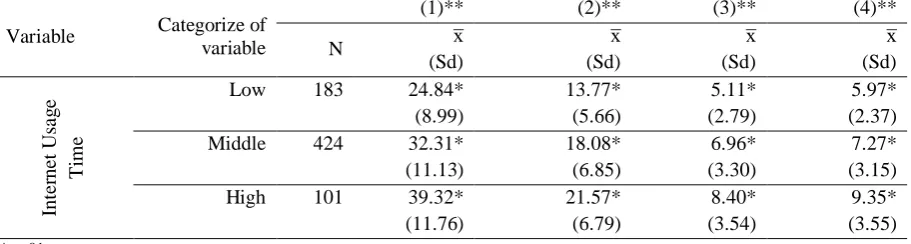
Internet usage time was investigated as a categoric variable. So, the cut-off point was decided as half standart deviation below (low Internet usage time) and above the mean (high Internet usage time). Those who were between were accepted as “medium Internet usage”. The differentiation of NIUS total score and its subscales scores were examined through ANOVA, and the Scheffe test is used to identify which groups differed. Means and standart deviations for Internet usage time groups are demonstrated Table 3.
Table 3. The Means and Standart Deviations of NIUS and Its Subscales for Internet Usage Time Groups Variable Categorize of
variable
(1)** (2)** (3)** (4)** N x̅
(Sd) x̅ (Sd) x̅ (Sd) x̅ (Sd) Int e rne t U sa g e T im e
Low 183 24.84* (8.99) 13.77* (5.66) 5.11* (2.79) 5.97* (2.37) Middle 424 32.31*
(11.13) 18.08* (6.85) 6.96* (3.30) 7.27* (3.15) High 101 39.32*
(11.76) 21.57* (6.79) 8.40* (3.54) 9.35* (3.55) *p<.01
** NIUS total score(1), excessive occupation(2), emotion reulation(3) and academic and social negative output(4)
According to Table 3, adolescents who have high Internet usage time had significantly higher PIU total score (F(2, 705)= 63.420, p<.01), excessive occupation (F(2,705)= 50.935, p<.01), mood alteration (F(2,705)= 37.879,
p<.01), and academic and social negative output (F(2,705)= 40.625, p<.01) than adolescents who have low and
medium; also adolescents who have medium Internet usage have higher the all scores than adolescent have low Internet usage time.
3.4.PIU Scores Regards to Internet Access at Home
The differentiation of NIUS total score and its subscales scores were examined through the t-test. Means and standart deviations for having Internet access at home groups are demonstrated Table 4.
Table 4. The Means and Standart Deviations of NIUS and Its Subscales for Having Internet Accesss at Home Groups
Variable Categorize of variable
(1)** (2)** (3)** (4)** N x̅
(Sd) x̅ (Sd) x̅ (Sd) x̅ (Sd) Int e rne t A c c e ss a t H om e Present
584 32.23* (11.67) 17.99* (7.03) 6.96* (3.42) 5.41 (2.80) Absent
123 27.41* (10.56) 15.04* (6.33) 7.28* (3.19) 6.97 (3.20) *p<.01
** NIUS total score(1), excessive occupation(2), emotion reulation(3) and academic and social negative output(4)
than adolescents who not have Internet access at home. There is no difference academic and social negative output subscale score (t(705)= .994, p>.01).
3.5.PIU Scores Regards to Having a Tablet, a Smartphone and a Computer
The differentiation of NIUS total score and its subscales scores were examined through the t-test. Means and standart deviations for having a tablet, a smartpone and a computer are demonstrated Table 5. Table 5. The Means and Standart Deviations of NIUS and Its Subscales for Having a Tablet, a Computer and a Smartphone Groups
Variable Categorize of variable
(1)** (2)** (3)** (4)** N x̅
(Sd) x̅ (Sd) x̅ (Sd) x̅ (Sd) T a b le
t Having a
Tablet 436
31.91 (11.65) 17.78 (7.09) 6.93* (3.43) 7.19 (3.18) Not Having a
Tablet 272
30.53 (11.55) 16.96 (6.83) 6.28* (3.24) 7.29 (3.21) Com u te
r Having a
Computer 542
32.35* (11.60) 18.10* (6.99) 6.98* (3.40) 7.28 (3.14) Not Having a
Computer 163
28.34* (11.17) 15.47* (6.66) 5.74* (3.11) 7.13 (3.37) S m a rt ph one Having a
Smartphone 513
32.42* (11.67) 18.08* (7.06) 6.98* (3.43) 7.36 (3.19) Not Having a
Smartphone 195
28.64* (11.06) 15.86* (6.58) 5.90* (3.09) 6.89 (3.17) *p<.01
** NIUS total score(1), excessive occupation(2), emotion reulation(3) and academic and social negative output(4)
According to Table 5, there is no difference PIU total score (t(706)= 1.536, p>.01), excessive occupation
(t(706)= 1.511, p>.01), and academic and social negative output (t(706)= -.363, p>.01) according to if having a
tablet or not. But adolescent who have a tablet had higher mood alteration score (t(706)= 2.504, p<.01) than do
not have. Adolescent who have a computer have higher PIU total score (t(703)= 3.909, p<.01), excessive
occupation (t(703)= 4.261, p<.01), and mood alteration score (t(703)= 4.145, p<.01) than do not have. There is no
difference academic and social negative output (t(703)= .518, p>.01). Also adolescents who have a computer have
higher PIU total score (t(706)= 3.908, p<.01), excessive occupation (t(706)= 3.808, p<.01) and mood alteration
(t(706)= 3.860, p<.01) than do not have. There is no difference academic and social negative output (t(706)= 1.772,
p>.01).
3.6.PIU Scores Regards to Purpose of Internet Usage
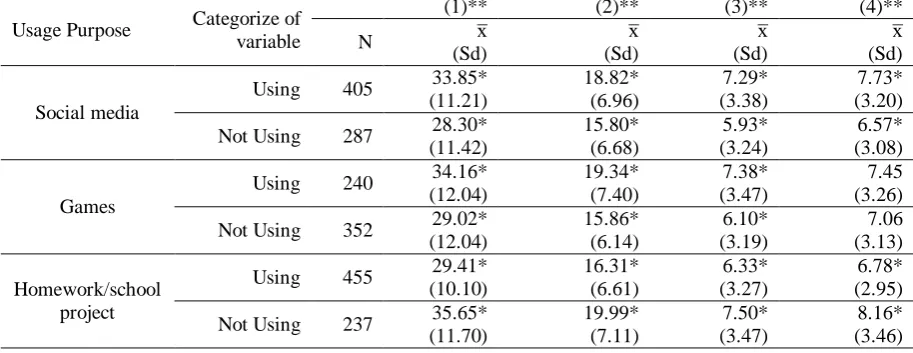
Purpose of Internet usage is investigated in eight categories who are determined as social media usage, games or watching computer games, doing homework/school project, searching a subject for his/her own personal interest, sharing video/photos, reading, sending a message via Whatsapp, Facebook, Messenger, following YouTuber. The differentiation of NIUS total score and its subscales scores were examined through the t-test. Means and standart deviations for having Internet access at home groups are demonstrated Table 6. Table 6. The Means and Standart Deviations of NIUS And Its Subscales for Purpose of Internet Usage Groups
Usage Purpose Categorize of variable
(1)** (2)** (3)** (4)** N x̅
(Sd) x̅ (Sd) x̅ (Sd) x̅ (Sd) Social media
Using 405 33.85* (11.21) 18.82* (6.96) 7.29* (3.38) 7.73* (3.20) Not Using 287 28.30*
(11.42) 15.80* (6.68) 5.93* (3.24) 6.57* (3.08) Games
Using 240 34.16* (12.04) 19.34* (7.40) 7.38* (3.47) 7.45 (3.26) Not Using 352 29.02*
(12.04) 15.86* (6.14) 6.10* (3.19) 7.06 (3.13) Homework/school project
Using 455 29.41* (10.10) 16.31* (6.61) 6.33* (3.27) 6.78* (2.95) Not Using 237 35.65*
Own personal interest
Using 349 29.60* (10.96) 16.40* (6.68) 6.39* (3.18) 6.81* (2.99) Not Using 343 33.53*
(11.95) 18.76* (7.13) 7.08* (3.55) 7.69* (3.35) Sharing video/photos
Using 233 34.14* (11.99) 19.05* (7.34) 7.35* (3.47) 7.75* (3.20) Not Using 459 30.23*
(11.20) 16.82* (6.71) 6.42* (3.31) 7.00* (3.18) Reading
Using 181 28.82* (10.71) 15.92* (6.29) 6.02* (3.19) 6.88 (3.10) Not Using 511 32.51*
(11.78) 18.15* (7.15) 6.98* (3.42) 7.38 (3.23) Sending a message
Using 364 33.96* (11.66) 19.02* (7.06) 7.24* (3.33) 7.70* (3.24) Not Using 328 28.87*
(10.98) 15.96* (6.59) 6.16* (3.37) 6.75* (3.08) Following YouTuber
Using 380 34.58* (11.22) 19.32* (6.87) 7.57* (3.43) 7.69* (3.25) Not Using 312 27.86*
(11.02) 15.43* (6.57) 5.71* (3.04) 6.71* (3.06) * p<.01
** NIUS total score (1), excessive occupation (2), emotion reulation (3) and academic and social negative output (4)
According to Table 6, adolescents using the Internet for social media had higher PIU total score (t(690)=
-6.360, p<.01), excessive occupation (t(690)=-5.730, p<.01), mood alteration (t(690)= -5.306, p<.01) and academic
and social negative output (t(690)= -4.758, p<.01) than those who do not use internet for these purposes.
adolescents using the Internet for games or watching computer games had higher PIU total score (t(690)= -5.969,
p<.01), excessive occupation (t(690)=-6.737, p<.01), mood alteration (t(690)= -5.046, p<.01) than those who do
not use internet for these purposes. There is no difference academic and social negative output (t(690)= -1.605,
p>.01). Adolescents not using the Internet for homework/school project had higher PIU total score (t(690)= 6.922,
p<.01), excessive occupation (t(690)=6.777, p<.01), mood alteration (t(690)= 4.362, p<.01) and academic and
social negative output (t(690)= 5.497, p<.01) than those who use Internet for these purposes. Adolescents not
using the Internet for searching a subject for his/her own personal interest had higher PIU total score (t(690)=
4.514, p<.01), excessive occupation (t(690)= 4.488, p<.01), mood alteration (t(690)= 2.699, p<.01) and academic
and social negative output (t(690)= 3.661, p<.01) than those who use Internet for these purposes. Adolescents
using the Internet for sharing video/photos had higher PIU total score (t(690)= -4.237, p<.01), excessive
occupation (t(690)=-3.998, p<.01), mood alteration (t(690)= -3.446, p<.01) and academic and social negative
output (t(690)= -2.934, p<.01) than those who do not use internet for these purposes. Adolescents not using the
Internet for reading had higher PIU total score (t(690)= 3.706, p<.01), excessive occupation (t(690)= 3.716, p<.01),
mood alteration (t(690)= 3.321, p<.01) than those who use Internet for these purposes. There is no difference
academic and social negative output (t(690)= 1.786, p>.01). Adolescents using the Internet for sending a message
via Whatsapp, Facebook, Messenger had higher PIU total score (t(690)= -5.891, p<.01), excessive occupation
(t(690)=-5.875, p<.01), mood alteration (t(690)= -4.264, p<.01) and academic and social negative output (t(690)=
-3.906, p<.01) than those who do not use Internet for these purposes. Adolescents using the Internet for following YouTuber had higher PIU total score (t(690)= -7.906, p<.01), excessive occupation (t(690)=-7.563,
p<.01), mood alteration (t(690)= -7.468, p<.01), and academic and social negative output (t(690)= -4.019, p<.01)
than those who do not use Internet for these purposes.
IV. DISCUSSION
Facebook, Messenger, following YouTuber have higher PIU level than those who don’t use Internet for these purposes. In addition, the groups using the Internet for doing homework/school project, searching a subject for his/her own personal interest and for reading have lower PIU level than those who do not use the Internet for these purposes.
It is seen that the results of the researches investigating both gender and PIU together are inconsistent. When causes of the inconsistency were interpreted, the cause seems to be because of the differentiation of the age of groups on the researches. It is seen that the age range of research findings that have higher PIU scores on girls (Ballarotto et al.., 2018; Beşaltı, 2016; Gomez et al.., 2017; Liu et al.., 2011) than the researches findings that have higher PIU scores on boys (Bozkur, 2013; Çelen et al.., 2014; Çetinkaya, 2013; Dinç, 2017; Doğan, 2013; Gencer, 2017; İnan, 2010; Toraman, 2013) or findings that has no differentiation (Karakuş, 2016; Köksal, 2015; Saatçıoğlu, 2016; Tuna, 2015). Participants of the present study are selected from adolescents of their early and middle adolescence similar to the research findings that have higher PIU scores on boys. Another cause for inconsistent results can be originated from the features of technology usage. While girls have more anxiety than the boys in tasks related to technology (Chua, Chen&Wong, 1999) and technology usage (Durndell&Haag, 2002; Jackson, Ervin, Gardner, Schmitt, 2001; Schottenbauer, Glass, Arnkoff&Rodriguez, 2004); boys have more positive attitude and perception of self-efficacy than girls (Cai, Fan&Du, 2017; Li&Kirkup, 2007). Boys having a more positive attitude about technology can spend more time with the computer and face problems such as PIU. However, longitudinal researches are needed in order to interpret the results of research findings that have inconsistent results in different ages and the researches that shows the advantages regarding the technology of boys.
Results of researches regards to age are inconsistent as it is with gender. In this study, the PIU level is found to increase along with the age. This situation can be related to the decrease of parents control on Internet usage as their child gets older (Bozkur, 2013; Wang et al.., 2017). In addition, adolescence is characterized by qualitative and quantitative changes on the psycho-social structure such as independence from parents, autonomy, identity, developing abstract thought and increase in the importance of peer relationship. It can be considered that these changes can affect adolescent’s purpose and time of Internet usage until from early adolescence to late adolescence. Social media usage or online gaming can increase to join the peer group, therewithal, search answer area to the basic question of identity development. On the contrary, the researches that show the decrease in PIU level regarding older age are claimedthat their findings are associated with immaturity, self-regulation skills and this could lead to vulnerability to addiction (Ballarotto et al., 2018). Therefore, it is thought the change of PIU level regarding age should be investigated both longitudinal researches and variables like parental mediation strategies together.
The present research shows that the more time the Internet is used, the more PIU level increases. This result is consistent with both findings from literature (Atwood, 2016; Çevik, 2016; Morahan-Martin&Schumacher, 2000) and theorical basis. The definition of PIU based on the model of Davis (2001) Internet usage time that negative affect daily life is directly related to PIU. Tolerance, one of the basic criterion on the perspective of addiction, is defined as increasing usage of substance (Internet).
Another variable of this study shows that the adolescents’ PIU levels differ regarding the purpose of Internet usage. Accordingly, adolescents who use the Internet for entertainment purposes more like social networks, games, sharing a video, sending a message via Whatsapp, Facebook, Messenger have higher PIU level than those who do not. Conversely, adolescents who use the Internet for doing homework/school project, for searching a subject for his/her own personal interest and for reading have lower PIU level than those who do not use the Internet for these purposes. Ceyhan (2010), finds that the purpose of Internet usage is one of the variables predicting PIU. In addition, it is shown that the points of Internet addiction differ in groups of adolescents who use the Internet for social media, game/music/ film or for homework/research; students who use the Internet for social media purposes have the highest level of addiction while the students who use the Internet for homework/research have the lowest level of addiction (Ayazseven&Cenkseven Önder, 2018). It can be specified that the basic distinction for purpose of Internet usage is academic and entertainment usage according to the results of studies. But the literature has only a few pieces of researches investigating PIU and purpose of Internet usage together. Therefore, more researches are needed for the purpose of the Internet usage regarding the variables that affect it in different ways.
Finally, the analysis demonstrated that PIU level is higher in these groups: boys, older people, having higher internet usage time, having Internet Access at home, a computer, a smartphone and use the Internet for entertainment.
REFERENCES
[1] K.W. Beard, & E.M., Wolf, Modification in the proposed diagnostic criteria for Internet addiction. Cyberpsychology and Behavior, 4, 3, 2001,377-383.
[2] K. S. Young. Psychology of computer use: xl. addictive use of the Internet: a case that breaks the stereotype. Psychological Reports,
79, 3, 1996899-902.
[3] S. F. Davis, B. Smith, K.Rodrigue, & Pulvers, K. An examination of Internet usage in two college campuses. College Student Journal, 33, 2, 1999, 257–260.
[4] R. A. Davis. A cognitive-behavioral model of pathological Internet use. Computers in Human Behavior, 17, 2001,187-195.
[5] G.Ballarotto, B.Volpi, E. Marzilli, & R.Tambelli. Adolescent Internet abuse: A Study on the role of attachment to parents a nd peers in a large community sample. BioMed Research International, 1-11,2018.
[6] M. Beşaltı. Analyzing the internet addiction and personality traits adolescents according to certain socio-demographic characteristics,Master’s Thesis. Gaziantep University, Gaziantep, Turkey 2016.
[7] P.Gómez, S. K.Harris, C.Barreiro, M. Isorna, & A.Rial. Profiles of Internet use and parental involvement, and rates of online risks and problematic Internet use among Spanish adolescents. Computers in Human Behavior, 75, 2017, 826-833.
[8] M. Dinç. Investigation of specific internet addiction in high school students in terms of temperament and attachment styles, Master’s Thesis. Marmara University, İstanbul, Turkey, 2017.
[9] Z. Karakuş. Research of i̇nternet addiction level in terms of the some factors and TEOG exam scores , Master’s Thesis, Çağ University, Mersin, Turkey, 2016.
[10] P. C. H.Soh, K. W.Chew, K. Y. Koay, & P. H. Ang. Parents vs peers’ influence on teenagers’ Internet addiction and risky online activities. Telematics and Informatics, 35, 1, 2018, 225-236.
[11] L.Wang, T.Tao, C. Fan, W. Gao, & C.Wei. The association between Internet addiction and both impulsivity and effortful control and its variation with age. Addiction Research & Theory, 25, 1, 2017, 83-90.
[12] R. Atwood. The relationship between adolescents' use of Internet-enabled mobile devices and engaging in problematic digital behaviors. Doctoral dessertation, Utah State University, 2016.
[13] Ç. Çevik,. Psychological effects of the duration of internet usage on adolescents. Master’s Thesis. Beykent University, İstanbul, 2016.
[14] J.Morahan-Martin, & P. Schumacher. Incidence and correlates of pathological Internet use among college students. Computers in Human Behavior, 16, 2000, 13-29.
[15] Tsun, T. Socioeconomic Influence on Adolescent Problematic Internet Use through School-related Psychosocial Factors and Pattern of Internet Use, Master’s thesis. Available from ProQuestDissertations and Theses database (UMI. No. 10169002), 2016.
[16] Ş. Ak, N. Koruklu & Y. Yılmaz. A study on Turkish adolescent's Internet use: possibl e predictors of Internet addiction.
Cyberpsychology, Behavior, and Social Networking, 16,3, 2013, 205-209.
[18] A. Doğan. The prevalence of internet addiction, Master’s Thesis. Dokuz Eylül University, İzmir, 2013.
[19] H. Gencer. Investigation of internet dependency and variables related to cyber bullying behaviours in middle school students,
Master’s Thesis. Cumhuriyet University, Sivas, Turkey, 2017.
[20] TÜİK (Türkiye İstatistik Kurumu) (2018). Hane Halki Bilişim Teknolojileri Kullanim Araştirmasi. Retrieved from http://www.tuik.gov.tr/PreHaberBultenleri.do;jsessionid=WnQ7bzZNlJ2F0xCq7Lv22QQQSYn0NSGcWppSd4TnjVkX1txD0nPL!7 16416837?id=27819
[21] Ö. Ayazseven, & F. Cenkseven Önder. Internet Addiction in Adolescents: The Role of Depression and Loneliness In 3rd Eurasian Conference on Language and Social Sciences (p. 31), 2018.
[22] A.Semerci. Examination of High School Students’ Cyberbullying and Victimization Cases in Terms of Different Variables. Kastamonu Education Journal, 25(4), 2017,1285-1300.
[23] H. Yalçın. Digital natives and information sources. Journal of Kirsehir Education Faculty, 18(2), 2017.
[24] E.C.G. Türk, D. Atalan Ergin, C. Erten, M. Artar, Ama Çok Sıkıldım! Erken Çocuklukta Teknoloji ve Oyalanma. Eylem Gökçe Türk (Ed.), Çocuk ve Çevre(si), Ankara Üniversitesi Çocuk Kültürü Araştırma ve Uygulama Merkezi Yayınları, Ankara, Turkey, 2017.
[25] C.Montag, K.Bey, P.Sha, M. Li, Y. F. Chen, W. Y. Liu, ... & M. Reuter. Is it meaningful to distinguish between generalized and specific Internet addiction? Evidence from a cross‐cultural study from G ermany, S weden, Taiwan and China. Asia‐ Pacific Psychiatry, 7(1), 2015, 20-26.
[26] D. J.Kuss, A. J. van Rooij, G. W.Shorter, M. D. Griffiths, & D. van de Mheen. Internet addiction in adolescents: prevalence a nd risk factors. Computers in Human Behavior, 29, 5, 2013,1987-1996.
[27] L. Leung. Predicting Internet risks: a longitudinal panel study of gratifications-sought, Internet addiction symptoms, and social media use among children and adolescents. Health Psychology and Behavioral Medicine: an Open Access Journal, 2(1), 2014, 424-439.
[28] J.Eldeleklioğlu & M. Vural. Predictive effects of academic achievement, internet use duration, loneliness and shyness on internet addiction. Hacettepe University Journal of Education, 28, 1, 2013,141-152.
[29] S. Y. Kim, M. S. Kim, B. Park, J. H. Kim, & H. G. Choi. Lack of sleep is associated with internet use for leisure. PloS one, 13(1), 2018, e0191713.
[30] J.Xu, L. X.Shen, C. H.Yan, H.Hu, F.Yang, L. Wang, S.r. Kotha,... & X. Shen. Personal characteristics related to the risk of adolescent internet addiction: a survey in Shanghai, China. BMC public health, 12, 1, 2012, 1106.
[31] K. S. Young. Internet addiction: The emergence of a new clinical disorder. Cyber Psychology and Behavior, 1(3), 1998, 237–244.
[32] E.Critselis, M.Janikian, N. Paleomilitou, D. Oikonomou, M. Kassinopoulos, G. Kormas, & A. Tsitsika. Predictive factors a nd psychosocial effects of Internet addictive behaviors in Cypriot adolescents. International journal of adolescent medicine and health,
26(3), 2014, 369-375.
[33] Z. Teng, Y. Li, & Y. Liu. Online gaming, internet addiction, and aggression in Chinese male students: The mediating role of l ow self-control. International Journal of Psychological Studies, 6(2), 2014, 89.
[34] H. M. Pontes, A. Szabo, & M. D. Griffiths. The impact of Internet-based specific activities on the perceptions of Internet addiction, quality of life, and excessive usage: A cross-sectional study. Addictive Behaviors Reports, 1, 2015, 19-25.
[35] T. Treuer, Z.Fabian, & J. Füredi. Internet addiction associated with features of impulse control disorder: is it a real psychiatric disorder? Journal of Affective Disorders, 66, 2-3, 2001, 83.
[36] L. Widyanto, & M.Griffiths. “Internet addiction”: A critical review. International Journal of Mental Health Addiction, 4, 2006, 31-51.
[37] Ceyhan, E. (). Predictiveness of Identity Status, Main Internet Use Purposes and Gender on University Students' the Problematic Internet Use. Educational sciences: theory & practice, 10(3), 2010
[38] D. Atalan Ergin, Effect of attachment, parental mediation, impulsivity on problematic Internet usage and academic achievement. doctoral dissertation, Institute of Educational Science, Ankara University, Turkey, 2018.
[39] T. C. Liu, R. A Desai, S. Krishnan-Sarin, D. A. Cavallo, & M. N. Potenza. Problematic Internet use and health in adolescents: data from a high school survey in Connecticut. The Journal of clinical psychiatry, 72, 6, 2011, 836.
[40] F. K., Çelen, A. Çelik, S. S. Seferoğlu. Children’s Internet Usage and Online Risks They Face. Akademik Bilişim 11 - XIII. Akademik Bilişim Konferansı Bildirileri 2 - 4 Şubat 2011 İnönü University, Malatya, 2011.
[41] M. Çetinkaya. An investigation of internet addiction of the elementary school students Master’s Thesis, Dokuz Eylül University, İzmir, Turkey 2013.
[43] Toraman, M. Investigation of the relationship of secondary school students' academic achievement with Internet addiction and social networking use levels. Master’s Thesis. Fırat University, Elazığ, Turkey, 2013.
[44] B.Köksal. Examination of the relationship between digital game addiction levels i students studying in secondary education, attachment styles with internetaddiction levelsMaster’s Thesis. Üsküdar University, İstanbul, 2015.
[45] H. Saatçıoğlu. İnternet bağimliliği tanisi alan ergenlerin sosyal bilişsel becerilerinin değerlendirilmesi, Master’s Thesis. Ege University, İzmir, Turkey, 2016.
[46] C. Tuna. The effect of attachment relationship of middle school students to their parents to the internet addiction, Master’s Thesis. Nişantaşı University, İstanbul, Turkey, 2015
[47] S.L. Chua, D.T. Chen, A.F.L. Wong. Computer anxiety and its correlates: A meta -analysis. Computers in Human Behavior, 15,5,
1999, 609-623.
[48] A. Durndell, Z. Haag. Computer self-efficacy, computer anxiety, attitudes towards the Internet and reported experience with the Internet, by gender, in an East European sample. Computers in Human Behavior, 18, 5, 2002, 521-535.
[49] L.A. Jackson, K.S. Ervin, P.D. Gardner, N. Schmitt. Gender and the Internet: Women communicating and men searching.Sex Roles,
44, 5–6, 2001363-379.
[50] M.A.Schottenbauer, C.R. Glass, D.B. Arnkoff, B.F. Rodriguez. Computers, anxiety, and gender: An analysis of reactions to the Y2K computer problem. Computers in Human Behavior, 20,1, 2004, 67-83.
[51] Z. Cai, X. Fan, & J. Du. Gender and attitudes toward technology use: A meta-analysis. Computers & Education, 105, 2017, 1-13.
[52] Li, N., Kirkup, G. Gender and cultural differences in internet use: A study of China and the UK. Computers & Education, 48, 2,