59
ISSN 1392-2785 ENGINEERING ECONOMICS. 2007. No 2 (52) WORK HUMANISM
Knowledge Management: the Development of Testing Portal for Selection of
Profession
Asta Valackienė
1, Alina Dėmenienė
21 KTU Panevėžio institutas
Vadybos ir administravimo fakultetas Nemuno g. 33, LT-37164, Panevėžys
2
KTU Panevėžio institutas Informacinių technologijų centras Klaipėdos g. 3, LT-35209, Panevėžys
Nowadays, knowledge management is one of the most important components of success in life and quali-tative performance of all persons and organizations. According to Andrew Carnegie, “The only unparalleled asset of the organization is the knowledge and capaci-ties of its people. Efficiency of this capital depends on how effectively the people share their competence with those who can use it.” Seeing as Barclay (2000) told when quoting Francis Bacon (1597), that "knowledge is power” and Peter Drucker (1993) - that knowledge is "the sole meaningful resource today" - this implies that for quite some time businesses were encouraged to manage the knowledge effectively.
Field of knowledge management helps to orient in the flow of information when choosing a profession. A person can find inner fulfillment, like his work, improve and ameliorate it only if he chose a job that matches his psychic, physical capabilities and aptitudes. It is rather difficult to make a suitable choice of profession. Often this necessitates an advice, encouragement to pursue the set objective. That is why consultants who are able to manage knowledge have to help the pupils to assess their vocational suitability, determination, interests, capabilities, will, etc. more adequately, to advice how to practically verify the legitimacy of their choices and \to consult on all the aspects pertaining to finding of their vocations.
Analysis of factors that affect choice of profession of students was carried out in comprehensive schools in the cities and districts of the region of Panevėžys and the developed student testing portal is presented.
Selection of profession is one of the most actual problems, the resolution of which determines the growth of people„s personal as well as public welfare. Only selection of such a vocation that complies with the ind i-vidual„s spiritual and physical capabilities and propen-sities will enable the person to find inner fulfillment in the job, care for it, improve and perfect it. It is rather difficult to select a suitable vocation. Often, advice or encouragement to seek for the set objective is necessary. Therefore, consultants have to help the pupils to assess their vocational aptitude, determination, interests,
abili-ties, desires and other factors more adequately, advise how to verify the motivation for such a decision in pra c-tice and consult on all aspects of finding one„s true vo-cation. Analysis of factors affecting the choice of pro-fession of Panevėžys urban and regional comprehensive school pupils has been carried out and the developed testing portal for pupils is presented.
Keywords: knowledge management, information tech-nologies, testing portal, choosing of profes-sions.
Introduction
One of the originators of knowledge management, Yogesh Malhotra (2000) defines this area as a critical factor, guaranteeing adaptation and survival of persons and organizations in the ever unevenly changing world. The author notes that knowledge management connects possibilities of information technologies to process the data, information, innovativeness and creativity of people.
According to Atkočiūnienė (2002), terms “informa-tion and knowledge society” “knowledge and informa“informa-tion management”, “knowledge economy”, “information technologies”, “information systems”, “data banks”, “in-tellectual capital”, etc. nowadays are being used particu-larly often. Knowledge and information are directly iden-tified with our lives.
When the term “knowledge management” emerged, many researchers did not feel significant difference be-tween the knowledge and information management. The basis of information management is formed by working with data or information that is managed with the help of information systems (Denning, 1998). The purpose of this management is to ensure access to information, to pro-tect, disseminate and store it.
60 But nowadays KM already creates a strong influence on corporate activities and economy in highly developed countries.
Reacting to the later situation in the transforming en-gines of economic development, European Council in 2000 March in Lisbon adopted a challenged plan for the future of European Union1. Strategic goal was defined start bearing in mind both external challenges – global-ization – and internal constrains – Europe‟s response (Kriščiūnas, Daugėlienė, 2006).
Under the conditions of rapid economic development and rising competition in the labor market, it becomes increasingly more difficult to adapt to the market changes and to choose the most perspective profession that matches the individual needs as well as those of the soci-ety. Suitable profession, well-liked job, career – these are important things in every person„s life. According to T.Tamošiūnas (2000), the choice of certain work is pro-pelled by: 1) nature – abilities, activeness, 2) social envi-ronment – willingness to occupy a certain status within it, 3) subjective goals in life – ideals, conception of purpose of life and one‟s mission. These three factors describe one of the key features of a personality – a calling to pur-sue an activity as a livelihood.
Preparation for a professional career occurs while studying in comprehensive schools, therefore school plays a special role – to help to combine the aspirations and possibilities as well as to adapt them to the social and economic needs of the dynamic society.
According to Petkevičiūtė (2003), to make personal career desinions. Personal career decisions are important in the past solutions and future visions. When people face the surrounding world, they learn to know themselves, i.e. what they like doing, what they are able to do best and what is important in their career and their life.
According to Pukelis (2003), in many cases career solutions are grounded in the belief that in the future, having a certain specialty and working in a certain posi-tion in a certain organizaposi-tion it is possible to have signifi-cant and satisfying opportunities and acquire signifisignifi-cant experience. Career studies have become very popular recently. Their popularity is determined by the fact that personal career perception can help explain the most im-portant person‟s relations with himself, his activity and other people.
Rapid economic, political, technological and cultural changes in the world have exerted a strong impact upon the world of work. These abrupt changes have aroused turmoil in people‟s careers and their life. Personal career success depends on personal self-knowledge and knowl-edge about the environment and ability to realistically evaluate oneself and environment, the world of work and one‟s own place in it.
Scientific problem. To analyze the raised issues, a
survey of target pupil groups has been carried out in the region of Panevėţys. The region of Panevėţys is a part of central Lithuania. Specific characteristics of labor market are not inherent there; therefore it is likely that vocational guidance in the region of Panevėţys is analogical to that in many other regions of Lithuania.
Objective of the article. To reveal the factors
affect-ing the choice of vocation of pupils of Panevėţys, urban and regional comprehensive schools, basing on the analy-sis of scientific literature and the results of the empiric study, and to present the testing portal.
Object of the article. Presentation of the testing
por-tal while assisting pupils in choosing professions. Key methods of research:
1. Analysis of secondary statistical data. 2. Questionnaire survey.
3. Compilation of algorithm.
Collection and Analysis of Statistical Data
In order to determine the set of the study, a list of comprehensive schools of Panevėţys County has been drawn up. The list has been prepared on the basis of offi-cial information, presented at http://www.aikos.smm.lt and electronic links to the necessary institutions (basic schools, secondary schools and gymnasiums), presented on this webpage, to which requests for information about the number of 10-11th grade pupils studying in these schools as well as the number of classes have been sent. By applying statistical calculation methods, schools and number of pupils, necessary for the study, have been se-lected from this data.
Determination of the Surveyed Set
After taking into account that in schools of all types of Panevėţys region in classes singled out for the cross-section (10–11) there study 8863 pupils, it can be stated that the general set N = 8863. Thus, the sampling size is verified by applying the following formula:
N
n
1
1
2
. (1)Where:
N – number of cases in the cross-section, N – general set
∆ – error value.
n calculated according to this formula shows the numbers of respondents who have to be surveyed. In case n calculated in this way is lower than or equal to 625, it can be stated that the sampling size has been selected correctly.
After completing the calculations, the following is derived:
.
584
8863
1
04
,
0
1
1
1
2 2
N
n
61
Table 1
Distribution of pupils by types of schools and place of residence
After expressing the number of the population mem-bers in per cent, it can be seen that pupils residing in the city comprise 75 per cent in schools of various types, whereas pupils living in the districts, comprise 25 per cent. By applying the corresponding proportions, it has been determined that it is necessary to survey:
- 146 pupils from the districts; - 438 pupils from the cities.
Table 2
Distribution of pupils by types of schools and place of residence
Among those, basic schools in districts 37
secondary schools 77
gymnasiums 32
In total: 146
Among those, basic schools in cities 22
secondary schools 197
gymnasiums 219
In total: 438
Substantiation of Research Method
It was planned to carry out the survey via the Inter-net. Algorithm (Aho, Hopcroft, Jeffrey, Uleman, 1976) for the development of website has been compiled ac-cording to the questionnaire. After the development to the algorithm, testing portal for pupils has been created (Bruce, 1996)
The sequence of questions to the pupils was laid down as follows:
- identification data; - personal information;
- information about the selected profession; - test.
The test has been compiled according to J.Holland. Here, the pupils were able to assess their social, realistic, artistic, enterprising, conventional and investigative co m-petences (skills).
Moreover, they could assess themselves in certain groups of skills: mechanical, hand work, scientific, mathematical, artistic, musical, perception, selling, lead-ing, handing the documents and clerical work.
As an outcome of the electronic survey:
Vocational guidance study database has been pre-pared.
The pupils were provided with the opportunity to gain insight of the assessment of their skills in the mentioned groups as well as of the range of pro-fessions, matching their character features.
All the information has been entered in the database, compiled in SQL (Kenneth, Berk, Carey, 2004).
The survey is anonymous; the data is not distributed. The collected information has been processed by MS Excel (Wiliams, Orvis, 1996).
Development of the Testing Portal
When performing the pupils‟ survey, research in-strumentation has been developed. According to Kiddeer, Judd (1986), five criteria of the study have been high-lighted: identification of pupil‟s personal wishes (in order to find out about the vocational aptitudes and interests); substantiation of wishes‟ identification (in order to de-termine how this is affected by social environment, fam-ily, vocational guidance at school); identification of skills (in order to determine the personality‟s compatibility with the professional environment); realization of wishes and skills (while seeking to find out about the ways to obtain a profession in different educational institutions) and professional career modeling (in order to identify the possibilities to obtain the profession).
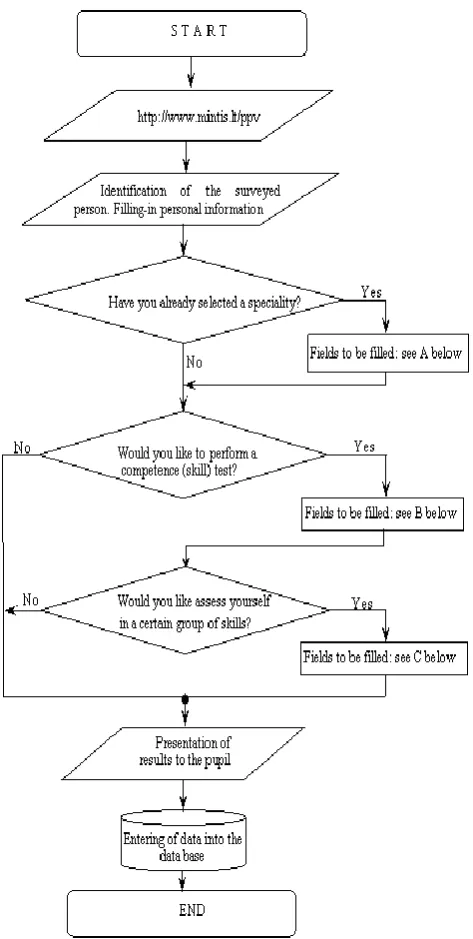
Seeing as the survey has been carried out via the Internet, algorithm for the development of the website was compiled (see Figure 3).
Statistical Analysis of Survey Data
Here, we are going to present replies to the sole ques-tion “Where did you obtain informaques-tion about the stud-ies?“. Resources from which the pupils gained informa-tion about the professions that they would like to study differ.
Figure 1. The sources from which the pupils obtained informa-tion about the chosen specialty
im-62 portant. Open door days and vocational guidance events are less effective (1.4 per- cent.).
When analyzing the sources of information on the se-lected professions by regional and urban pupils (see Fig-ure 2), we can see that urban pupils mostly use the Inter-net (35 per cent), whereas the pupils living in districts comprise a lower percentage (23 per cent). Regional pupils obtain the major share of information at school (38.5 per cent), which is not typical of urban pupils (24 per cent).
Figure 2. Sources of information by pupils‟ place of residence
The algorithm for a development of profession selec-tion web site can be represented via following flowchart (Ragonis, Ben-Ari, 2005) (Figure3).
A:
! Where did you obtain information on the speciality you would like to study?
! Why do you dream of this speciality? (What is influenc-ing this choice?)
! Have you already decided where you would like to ob-tain this speciality?
! What was the role of school in helping you to make a choice of profession?
! What profile did you choose at school?
! Do the selected profiles correspond to the chosen speci-ality?
! What were the subjects that helped you to make the choice?
! What types of schools you would like to get more in-formation about?
B:
! Assessment of social competence (skills); ! Assessment of enterprising competence (skills); ! Assessment of artistic competence (skills) ! Assessment of conventional competence (skills); ! Assessment of realistic competence (skills); ! Assessment of investigative competence (skills).
C:
! Assessment of mechanical skills; ! Assessment of hand work skills;
! Assessment of scientific skills; ! Assessment of mathematical skills; ! Assessment of artistical skills; ! Assessment of musical skills; ! Assessment of teaching skills; ! Assessment of perception skills; ! Assessment of selling skills; ! Assessment of leading skills;
! Assessment of skills related to handling of documents and clerical work;
! Assessment of office work skills.
Figure 3. Algorithm for the development of website
Conclusions
pro-63 fessional expectations, the pupils mostly pursue higher university education. However, the urban pupils have more choices available, whereas the pupils in district localities pay much attention to vocation training institutions – colleges and pro-fessional schools. This illustrates that the pupils do not have sufficient information about new forms to obtain a profession – post-secondary technical and vocational education (colleges), distance-learning, however, traditionally and sometimes precariously choose the universities.
2. The pupils select the profession basing on their wishes and taking into account their skills and pe-culiarities. Family, its size, education of parents or siblings affects their choice of profession very in-significantly. Career possibilities or material incentives are the factors that are more important. Possibility to foresee career possibilities is an important factor in making one‟s choice of a profession.
3. The study verified the outcome of electronic sur-vey of the pupils regarding their selection of pro-fessions: vocational guidance study database has been prepared; the pupils were provided with the opportunity to gain insight of the assessment of their skills in the mentioned groups as well as of the range of professions, matching their character features.
Recommendations
1. In view of the fact that a substantial number of pu-pils search for information about their future pro-fession in the Internet, it would be advisable to create a specialized Internet portal for vocational guidance, where the pupils could find all the nec-essary information about specialties and profes-sions, obtain the answers to the questions that worry them (e.g., in forum) and get some informa-tion about the proposed study and educainforma-tion pro-grams. In the portal, more attention should be paid to new forms to acquire a profession – non-university higher education (studies in colleges), various distance-studies, courses, etc.
2. In rural areas, Internet should be made available more expeditiously as a very important source of information. It is necessary to establish broadband Internet reading rooms, to computerize libraries and clubs. It is imperative to enable the citizens of districts to use the Internet for the fulfillment of daily living needs, self-education, learning, com-munication and leisure.
References
1. Adamonienė, R. Psychology and pedagogic of vocational training / R. Adamonienė, S. Daukilas, B.Krikščiūnas, I.Maknienė, A. Palujanskienė. Utena, 2003. 348 p.
2. Atkočiūnienė Z. Informacijos išteklių valdymas: duomenų, infor-macijos ir ţinių valdytojai // Inforinfor-macijos mokslai, 2002, Nr. 22, p. 60-67.
3. Bailey, K. Methods of social research. New York: Free Press, 1994, p. 428 - 429.
4. Beresnevičienė, D. Vocational guidance in Lithuania // Pedagogika,
Vilnius, 2002, Vol. 9, p. 342–349.
5. Bieliūnas M. Practical approaches to knowledge management: changes, determined by economic tendencies. Vilnius, 2000. 6. Bruce Morris. HTML In Action: hot tools for cool Web sites.
Pub-lished by Microsoft Press, Redmond, Washihgton, 1996.
7. Denning, S. (ed.) What is knowledge management? Background paper for the World development Report. World Bank Knowledge management Board, 1998. 98 p.
8. Ядов В. А. Социологическое исследование: методология, про-грамма, методы. Москва, 1998.
9. Jovaiša, L. Psychology of career counselling. Vilnius, 1998. 151 p. 10. Jeffrey, D. The design and analysis of computer algorithms.
Addi-son – Wesley Publishing Company, 1976, p. 128-195.
11. Kenneth, N. Data Analysis with Microsoft Excel. Updated for Office XP. Thomson Brooks/Cole, 2004, p. 295 - 461.
12. Kiddeer, L. H. Research methods in social relations / L. H. Kid-deer, Ch. M. Judd. Cambridge USA: Blackwell. 1986. 263 p. 13. Kriščiūnas, K. The Assessment Models of Knowledge-Based
Economy Penetration / K. Kriščiūnas, R. Daugėlienė. Kaunas, 2006, No 5 (50), p. 36-46.
14. Lauţackas, R. Methodology of vocational training. Kaunas, 2005, p. 331 - 332.
15. Malhotra, Yogesh. Knowledge Management, Knowledge Organiza-tions & Knowledge Workers: A View from the Front Lines. Pub-lished in Maeil Business Newspaper of Korea, February 19, 1998. 16. Pukelis K. Karjeros projektavimo gebėjimai ţinių visuomenėje:
nauji iššūkiai profesiniam konsultavimui ir karjeros planavimui // Profesinis rengimas, 2003, Nr. 6, p. 70.
17. Petkevičiūtė N. Asmeninės karjeros projektavimas ir vystymas globalizacijos kontekste. Kaunas, 2003, p.82-98.
18. Ragonis N. On Understanding the Statics and Dynamics of Object-Oriented Programs / N. Ragonis, M. Ben-Ari // ACM SIGCSE Bul-letin, 37 (1), 2005, p. 226-230.
19. Stanišauskienė, V. Socio–educational basics of preparing for a career. Kaunas, 2004. 174 p.
20. Tamošiūnas T. School activity directions in multinational regions:
Lithuania's case. The Humanities on the II millennium threshold: International conference: Daugavpils Pedagogical University: Dau-gavpils, 2000, p. 58-63.
21. Wiliams, J. Orvis. EXCEL for scientists and engineers. San Fran-cisco: Sybex Inc, 1996, p. 455-462.
Asta Valackienė, Alina Dėmenienė
Žinių valdymas: profesijos pasirinkimo testavimo portalo parengimas
Santrauka
Straipsnyje atliekama ţinių vadybos sampratos bendriausia kon-ceptuali analizė. Išryškinama ţinių vadybos vieta modeliuojant savo asmeninės karjeros situaciją.
Šiandien ţinių vadyba kiekvienam asmeniui, kiekvienai organizaci-jai yra vienas svarbiausių gyvenimo sėkmės ir kokybiško darbo kompo-nentų. Anot Andrew Carnegie, „Vienintelis nepakartojamas organizacijos turtas – jos ţmonių ţinios ir sugebėjimai. Šio kapitalo produktyvumas priklauso nuo to, kaip efektyviai ţmonės dalijasi savo kompetencija su tais, kurie gali ja pasinaudoti“. Barclay (2000), cituodamas Francis Bacon (1597), teigė, kad „ţinios yra galia“, o Peter Drucker (1993) - kad ţinios yra „vienintelis prasmingas išteklius šiandien“, – vadinasi, verslas jau gana seniai yra skatinamas valdyti ţinias efektyviai.
Vienas iš ţinių vadybos pradininkų Yogesh Malhotra (2000) šią sritį apibrėţia kaip kritinį veiksnį, garantuojantį tiek asmens, tiek orga-nizacijos prisitaikymą ir išgyvenimą vis netolygiau kintančiame pasau-lyje. Autorius paţymi, kad ţinių vadyba sujungia informacinių techno-logijų galimybes apdoroti duomenis ir informaciją bei ţmonių kūrybiš-kumą ir inovatyvumą.
Kai atsirado terminas „ţinių vadyba“, daugelis tyrinėtojų nejautė didelio skirtumo tarp ţinių ir informacijos vadybos terminų. Informaci-jos vadybos pagrindą sudaro darbas su duomenimis ar informacija, kuri valdoma informacinėmis sistemomis. Šios vadybos tikslas – uţtikrinti priėjimą prie informacijos, ją apsaugoti, paskleisti ir išsaugoti.
64
rinkoje sąlygomis vis sudėtingiau prisitaikyti prie rinkos pokyčių, pasi-rinkti perspektyviausią individualius ir visuomenės poreikius atitinkan-čią profesiją. Tinkamai pasirinkta profesija, mėgstamas darbas, karjera – svarbūs dalykai kiekvieno ţmogaus gyvenime. Rinktis tam tikrą veik-lą, anot T. Tamošiūno (2000), skatina: 1) prigimtis – gabumai, aktyvu-mas, 2) socialinė aplinka – noras uţimti joje tam tikrą padėtį, 3) subjek-tyvūs gyvenimo tikslai – idealai, gyvenimo prasmės, savo misijos sam-prata. Šie 3 veiksniai apibūdina vieną pagrindinių asmenybės bruoţų – pašaukimą tam tikrai veiklai.
Ţinių vadybos sritis padeda susivokti informacijos sraute renkantis profesiją. Tik pasirinkęs darbą, atitinkantį asmens dvasinius ir fizinius gabumus ir polinkius, ţmogus jaus dirbdamas vidinį pasitenkinimą, mėgs savo darbą, gerins ir tobulins jį. Tinkamai pasirinkti profesiją gana sunku. Daţnai čia reikia patarimo, paskatinimo siekti uţsibrėţto tikslo. Todėl ţinias gebantys valdyti konsultantai turi padėti mokiniui adekvačiau įvertinti savo profesinį tinkamumą, pasiryţimą, interesus, gebėjimus, valią ir kt., patarti, kaip praktiškai patikrinti savo apsispren-dimo pagrįstumą, konsultuoti visais profesinio pašaukimo atraapsispren-dimo aspektais.
Profesijos pasirinkimas yra viena aktualiausių problemų, nuo ku-rios tinkamo sprendimo priklauso tiek ţmonių asmeninės, tiek visuo-meninės gerovės augimas. Pasirengimas profesinei karjerai vyksta mokantis bendrojo lavinimo mokykloje, todėl jai tenka ypatingas vaid-muo – ne tik padėti suderinti siekius ir galimybes, bet ir pritaikyti juos prie dinamiškos visuomenės socialinių ir ekonominių poreikių.
Įvardinti klausimai tampa moksline problema, reikalaujančia atlik-ti išsamią analizę. Iškeltus klausimus analizuojant buvo atliktas atlik- tiksli-nių moksleivių grupių tyrimas Panevėţio regione. Panevėţio regionas yra centrinės Lietuvos regionas, neturintis specifinių darbo rinkos savy-bių, todėl tikėtina, jog šio regiono profesinio orientavimo veikla yra analogiška daugeliui Lietuvos regionų.
Pagrindiniai tyrimo metodai: antrinių statistinių duomenų analizė, anketinė apklausa, algoritmo sudarymas.
Statistinių duomenų rinkimas, jų analizė.Siekiant nustatyti tyrimo aibę, parengtas Panevėţio apskrities bendrojo lavinimo mokyklų sąra-šas (109 mokyklos). Jis sudarytas remiantis oficialia http://www.aikos.smm.lt teikiama informacija bei šiame tinklalapyje pateiktų reikiamų institucijų (pagrindinių mokyklų, vidurinių mokyklų bei gimnazijų) elektroninėmis nuorodomis, kuriomis buvo išsiuntinėti prašymai suteikti informaciją apie mokykloje besimokančių 10-11 klasių moksleivių skaičių bei klasių skaičių. Iš šių duomenų statistinius skaičiavimo metodais buvo atrinktos tyrimui atlikti reikiamos mokyklos bei moksleivių skaičius.
Tiriamosios aibės nustatymas. Įvertinus tai, kad Panevėţio regiono visų tipų mokyklose pagal atrankai išskirtų klasių (10-11) skaičių mo-kosi 8863 moksleivių, galima teigti, kad generalinė aibė yra N = 8863.
Išreiškus populiacijos sąrašo narių skaičių procentiniu pavidalu, ţinoma, kad miesto mokiniai įvairių tipų mokyklose sudaro 75 proc., o rajono 25 proc. Taikant atitinkamas proporcijas nustatoma, kad ap-klausti reikia: 146 rajono moksleivius; 438 miesto moksleivius.
Moksleivių pasiskirstymas pagal mokyklų tipus ir gyvenamąją vietą: vidurinių mokyklų – 77; gimnazijų – 32. Iš viso: 146 moksleiviai. Iš jų miesto pagrindinių mokyklų atitinkamai 22: vidurinių mo-kyklų – 197; gimnazijų – 219. Iš viso: 438 moksleiviai.
Apklausą numatyta vykdyti pasitelkus internetą, pagal anketą buvo sudarytas algoritmas ţiniatinklio sukūrimui. Parengus algoritmą, sukur-tas moksleivių testavimo portalas.
Moksleiviui klausimai išdėstyti tokia tvarka: identifikavimo duo-menys, asmeninė informacija, informacija apie pasirinktą specialybę.
Testas sudarytas pagalDţ. Holandą. Čia moksleiviai galėjo įver-tinti savo bendravimo, iniciatyvias, menines, normatyvines, realistines, tiriamąsias kompetencijas (mokėjimus).
Taip pat galėjo įvertinti save tam tikroje sugebėjimų grupėje: me-chaninių, rankų darbo, mokslinių, matematinių, meninių, muzikinių, kitų supratimo, pardavimo, vadovavimo, dokumentų tvarkymo, raštinės, kontoros darbų.
Elektroninio anketavimo rezultatas: parengta proforientavimo ty-rimo duomenų bazė, pagal Dţ. Holando pasiūlytą algoritmą moksleiviai galėjo susipaţinti su savo gebėjimų minėtose grupėse įvertinimu bei jiems pateikiama profesijų, tinkančių jų charakterio savybėms, pasiūla.
Visa informacija įtraukta į duomenų bazę, parengtą SQL terpėje. Apklausa anoniminė, duomenys neplatinami.
Surinkta informacija buvo apdorota statistine duomenų apdoroji-mo SPSS programa.
Remiantis mokslinės literatūros analize bei empirinio tyrimo re-zultatais, atskleista Panevėţio regiono miestų bei rajonų bendrojo lavi-nimo mokyklų moksleivių profesijos pasirinkimui įtaką darančių veiks-nių analizė ir pateikiamas sukurtas moksleivių testavimo portalas.
Išanalizavus empirinio tyrimo rezultatus, išryškėjo, kad a
ukštes-niųjų klasių (10 ir 11 klasių) mokiniai jau bent preliminariai turi pasi-rinkę profesiją. Tai lemia jų profilinio mokymosi dalykų pasirinkimą. Moksleiviai savo profesiniams lūkesčiams įgyvendinti daugiausia ren-kasi aukštąjį universitetinį išsilavinimą. Tačiau miesto vietovių moks-leivių šis pasirinkimas didesnis, o rajono vietovių mokiniai daug dėme-sio skiria profesinio rengimo mokymo įstaigoms – kolegijoms bei pro-fesinėms mokykloms. Tai rodo, jog mokiniai neturi pakankamai infor-macijos apie naujas profesijos įsigijimo formas – neuniversitetinį aukš-tąjį mokymą (kolegijas), nuotolinį mokymą, tačiau tradiciškai, o kartais ir nepagrįstai, renkasi universitetus.
Profesiją mokiniai renkasi remdamiesi savo norais, įvertindami gebėjimus, asmenines savybes. Mokinių profesinį pasirinkimą labai maţai veikia šeima, jos dydis, tėvų ar brolių bei seserų išsilavinimas. Svarbesni veiksniai yra karjeros galimybės ar materialinis suinteresuo-tumas. Svarbus veiksnys renkantis profesiją yra karjeros galimybių numatymas.
Tyrimu patvirtintas elektroninio moksleivių profesijos pasirinkimo anketavimo rezultatas: parengta proforientavimo tyrimo duomenų bazė; pagal Dţ. Holando pasiūlytą algoritmą moksleiviai galėjo susipaţinti su savo gebėjimų minėtose grupėse įvertinimu bei jiems pateikiama profe-sijų, tinkamų jų charakterio savybėms, pasiūla.
Pasiūlymai:
Atsiţvelgiant į tai, jog didelė dalis moksleivių apie savo būsimą profesiją informacijos ieško internete, tikslinga būtų šalyje sukurti specializuotą proforientavimui skirtą interneto portalą, kuriame moks-leiviai rastų visą reikiamą informaciją apie specialybes ir profesijas, gautus atsakymus į rūpimus klausimus (pvz., naudojant forumą), siūlo-mas studijų bei mokymo prograsiūlo-mas. Portale daugiau dėmesio reikėtų skirti naujoms profesijos įsigijimo formoms – neuniversitetiniam aukš-tajam mokymui (studijos kolegijose), įvairioms nuotolinėms studijoms, kursams ir pan.
Rajono vietovėse sparčiau diegti internetą kaip labai svarbų in-formacijos paieškos šaltinį. Kurti plačiajuosčio interneto skaityklas, kompiuterizuoti bibliotekas, klubus. Būtina sudaryti sąlygas rajono gyventojams diegti internetą buitiniams poreikiams tenkinti, savišvietai, mokymuisi, komunikavimui bei laisvalaikio praleidimui.
Raktaţodţiai: žinių vadyba, informacinės technologijos, testavimo porta-las, profesijos pasirinkimas.
The article has been reviewed.