DOI: 10.30954/0974-1712.06.2019.8
©2019New Delhi Publishers. All rights reserved
SOIL SCIENCE
Study of Micronutrient Status in Soil of Solapur District
Mulani, R.D.
1*
, Gaikwad, G.A.
1, Bhosale, B.D.
2and Upadhay, V.B.
1 1Shrimant Babasaheb Deshmukh Mahavidyalaya, Atpadi, Maharashtra, India2Rajaram College, Kolhapur, Maharashtra, India
*Corresponding author: [email protected] (ORCID ID: 0000-0002-0752-7644)
Paper No. 775 Received: 14-03-2019 Revised: 13-05-2019 Accepted: 20-05-2019
ABSTRACT
The aim of this study was to evaluate available micronutrient (Fe, Cu, Zn, Mn and B) status and their relationship with soil properties. In this work the status of micronutrient in soil of Solapur district area, Maharashtra, India is described The present study is mainly focused on testing of soil samples in Solapur
district to determine their level of micronutrients and to provide information to the farmers regarding
micronutrients availability in soil. The increment in nutrient supply beyond a certain limit resulting in the decreased yield of plants is often be associated with the production of specific toxic effects .The incidence of micronutrient deficiencies in soil and plants is increasing due to high and multiple plant. Extensive micronutrient deficiencies lead to decline in factor productivity even with balanced NPK fertilization.
Although the crop response to micronutrients application varies with soil type, crops and genotype,
agro-climatic conditions and severity of deficiency, an enormous response to micronutrient fertilization has been reported in a wide variety of crops including horticultural crops across the country.
Highlights
mThe present investigation was carried out for determine the status of DTPA-Fe, Cu, Zn and B in relation with chemical properties in soils of Solapur district for this purpose representative soil samples were collected from different villages of Solapur District. These soil samples were analyzed
for soil properties and micronutrient fertility status of soil
Keywords: Micronutrient, Total Content of Soil, Analysis of soil, Soil quality, Soil nutrients
Soil is vital resources in which proper use depends on the country and the socio-economic development of its people. Macronutrients (N,P, and K) and micronutrients (Zn, Fe, Cu and Mn) are essential for healthy plant growth. N,P, K are needed in large amounts and Zn, Fe, Cu and Mn are needed in smaller amounts. Both macronutrients and
micronutrients are naturally obtained by the roots
from the soil. Correlation analysis was carried out by using bivariate correlation using Pearson’s method. This was carried out for macronutrients and
micronutrients dataset and it indicates geochemical
complexity in the region with less negative
correlation of all parameter[1]. The micronutrients in soil are very important for plant growth, soil fertility, animal nutrition and productivity[2]. The functions
of the micronutrients are enzyme action, cellular
organization, metabolically active compounds,
structural components etc.[3]. The increase in the
amount of nutrient supply beyond limit resulting
toxic effects which decreases yield of crops[4]. The
micronutrient deficiencies in soil and crop are due
to large crop production[5]. The micronutrients in
soil generally found in different chemical forms
and the main sources of micronutrients in soils
are rock weathering and atmospheric deposition
of dust particles, volatile compounds etc.[6]. An
available micronutrient contents were leached out
from soil by different extraction methods[7]. The
micronutrient status in soils of some part of India was described[8]-[23]. In this paper, the micronutrients
status in soil and micronutrients deficiencies and toxicities are discussed. Even though the role of
vital, information regarding their status in the most
of soils is insufficient.
As result, fertilizer recommendation for crops in the country is mainly for macronutrients yet. But,
continuous application of only macronutrients may cause for rapid depletion of other nutrients such
as micronutrients. In view of this, a study was conducted at Solapur district to assess the status of some micronutrients. These micronutrients were extracted by using Mehlich-III multi-nutrient extraction method and their concentrations
were measured by using AAS[24]-[26]. Content of
micronutrients and their ability to supply to crop vary widely depending upon soil types, nature of
crops grown, ecology and agro climatic variability.
Total levels of micronutrients are rarely indicative of plant availability, hence, rational management
of micronutrient fertility and toxicity requires an understanding of how plant-available soil micronutrients vary across the soils. The effects of mineral and organic fertilization on the contents of Fe, Cu, Zn, Mn, B and Mo in soil and in the
soil solution as well as on availability of these
elements for crops were investigated in the long-term field trial. Generally three different types of the soil found in this reason of Solapur district. The different types of soil from 110 villages of Solapur
district were collected for study as described in the literature[24].
Soil Characteristics
The soils of the district can broadly be classified
into three types:
1. Black 2. Coarse Gray 3. Reddish
According to topography the District is divided in
three natural zones.
1. Eastern Zone: This comprises of Barshi,
North Solapur, South Solapur and Akkalkot Talukas. The soil is medium to deep black and of rich quality. Jawar, Bajra and Pulses are the main crops of this zone.
2. Central or Tansitional Zone: Mohol,
Mangalwedha, eastern part of Pandharpur and Madha Taluka are covered by this zone. Like to moderate soil and uncertain rainfall
marks this zone. Both Kharip and Rabbi crops
are grown in this part.
3. Western Zone: Karmala, Sangola and
Malshiras Talukas and western parts of Pandharpur comes under this zone. Shallow and poor type of soil, not retentive of moisture marks this part. Scanty and uncertain rainfall. Rabbi crops mainly grown in Karmala, Pandharpur and Madha Talukas while Kharip crops like Bajra and Groundnut are grown in Sangola and parts of Malshirastalukas.
MATERIALS AND METHODS
Study AreaThe Solapur district is bounded by 17º05’ North latitudes to 18º 32’ North latitudes and 74º42’ East of76º 15’ East longitudes. The total geographical area of Solapur district is 14895 Sq.K.m. divided into eleven tahsils. The Population is 32.4 lakhs in eleven tahsils of District (Censes 2001). It is bounded from the North by Osmanabad district and Ahmednagar district, on the North-East by Satara district and at the South & East it has common boundary of Karanataka state. Temperature is high in summer season. Rainfall varies from East to West between range of 200 to 600millimeters. The rivers like Bhima, Sina, Man, Nira, Bhogawati and many other smaller tributaries drain in the district. Banana, Cottan, Jawar, Sugarcan, Grain, Grapes, Bajari, Wheat, The soil of the district is mainly of Deccan Trap Volcanic origin.
Sample Collection
The study was designed to determine the status of micronutrients in agriculturally fertile soils
of District Solapur. Represented soil samples
were collected with wooden tools to avoid any
Analysis of Soil Sample
Soil samples (0-15 cm) were collected from different sites covering 110 villages, keeping in view the
physiographic characteristic in different cross sections of the area as well as variation in soil
texture. Soils were completely air dried and passed through 2mm sieve and stored in properly labeled plastic bags for analysis. The processed soil samples were analyzed for basic soil parameters ( pH, EC, OC and OM) and the available Fe, Mn, Cu and Zn in soil samples were extracted with a DTPA solution (0.005M DTPA + 0.01 M CaCl2 + 0.1M triethanolamine, pH 7.3 as outlined by Lindsay and
Norvell[11]. The concentration of micronutrients in
the extract was determined by atomic absorption spectrophotometer (ECIL, AAS-4129).
RESULTS AND DISCUSSION
Concentration variations of micronutrient To study this, there were 2362 surface soil samples collected from growing fields of Solapur tehsil. The soils were analyzed for physico-chemical properties and status of available micronutrients.
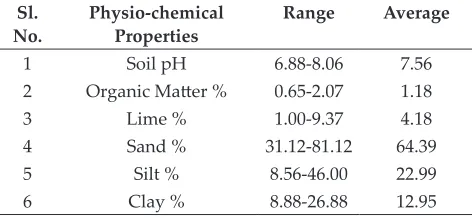
The results shows that majority of the soil sites were alkaline in nature with medium amount of organic matter and lime content. Considering textural classes most of the sites were sandy loam. The
soil pHrange from 6.88 to 8.06 (average 7.56). The
organic matter content ranged from 0.65 to 2.07% (average 1.18%). The lime content ranged from 1.00 to 9.37% (average 4.18%) as reported in Table 1.
Table 1: Range and average values of
Physio-Chemical properties of tested soil samples of district
Solapur
Sl.
No. Physio-chemical Properties Range Average
1 Soil pH 6.88-8.06 7.56
2 Organic Matter % 0.65-2.07 1.18
3 Lime % 1.00-9.37 4.18
4 Sand % 31.12-81.12 64.39
5 Silt % 8.56-46.00 22.99
6 Clay % 8.88-26.88 12.95
By comparing the extractable micronutrients (Iron, Copper, Zinc and Manganese) and hot water
soluble Boron content with the established criteria
of Soltanpour, 1985 and Johnson and Fixen, 1990.
The range and average value of micronutrient in
soil of 110 villages of the studied area are presented in Table 2.
Table 2: Range and average values of Micronutrients of tested soil samples of district Solapur
Sl.
No Micronutrients in ppm Range Average
1 Fe 3.5-5.5 4.5
2 Cu 1-3 2
3 Zn 0.3-0.9 0.6
4 Mn 1-3 2
5 B 0.3-0.7 0.5
All the soil sites were found high in Iron, Copper
and Manganese contents, it was found that 3.34% samples had high, 70 % samples had medium and 26.66% samples had low in Zinc content. Boron was found low in 80% sites and medium in 20% sites as presented in Table 3.
Table 3: Critical soil test values of AB-DTPA extractable Copper, Iron, Manganese, Zinc and HWS
B *Johnson and Fixen, 1990 and ** Soltanpour, 1985.
Sl. No. Micronutrients Nutrient Content (mg kg-1) Low Medium High
1 HWS Boron <0.5 0.5-1 >1
AB-DTPA-DTPA Extraction Method
2 Iron <3.0 3.0-5.0 >5.0
3 Copper <0.3 0.3-0.5 >0.5
4 Zinc <0.9 0.9-1.5 >1.5
5 Manganese <0.6 0.6-1.0 >1.0
CONCLUSION
Most of the soil sample shows the slightly alkaline nature and low value of N and P. The potassium was medium range in almost soil. Excess of phosphorus will not have direct effect on the plant but may show visual deficiencies Zn, Fe and Mn, whereas, due to the excess of potassium plants will exhibit typical Mg and possibly Ca deficiency symptom due to a cation imbalance. The excess amount of micronutrient shows a bronzing of leaves with tiny brawn spots on the leaves. The data reveals that in location point where the soil are deficient in N, P, & K which requires addition of extra fertilizer and manures to make it suitable plantation and for increasing plant growth. In contrast to deficiency of micronutrients
productivity in future. As par the nutrient index value, soil factors such as pH, EC, OC and CaCO3
were contributed lower fertility status in relation to
availability of micronutrients. Strategies involving
the soil application of micronutrients by seed treatment, foliar sprays or use of organic manures
can adopt to sustain an optimum yield ofcrop. The soils of Solapur district are neutral to alkaline in soil
reaction, safe in electrical conductivity, medium in
organic carbon content and calcareous in nature. According to the concept of soil nutrient index soils are deficient in Zinc and Boron while sufficient in Copper, Manganese and Iron content.
REFERENCES
[1] Gupta, U.C., Kening, W. and Siyuan, L.2008 Micronutrients in Soils, Crops and Livestock. Earth Science Frontiers,15:
110-125.
[2] Renwick, A.G. and Walker, R. Risk. 2008. Assessment of Micronutrients. Toxicology Letters, 180: 123-130.
[3] Fageria, N.K., Baligar, V.C. and Clark, R.B. 2002. Micronutrients in Crop Production. Advances in Agronomy, 77: 185-268.
[4] Welch, R.M. and Shuman, L. 1995. Micronutrient Nutrition of Plants Critical Reviews in Plant Sciences, 14: 49-82. [5] Mortvedt, J.J. Cox, F.R., Shuman, L.M. and Welch, R.M.
1991. Micronutrients in Agriculture Second Edition Number 4 in the Soil Science Society of America Book Series, Chapter14. Soil Science Society of America, Inc., Madison.
[6] Chatzistathis, T. 2014. Micronutrient Deficiency in Soils & Plants, Micronutrient Solubility and Availability in Soils. Bentham Science Publishers Ltd. Oak Park.
[7] Gupta, A.P. 2005. Micronutrient Status and Fertilizer Use Scenario in India. Journal of Trace Element in Medicine and Biology,18: 325-331.
[8] Gowda, N.K.S., Ramana, J.V., Prasad, C.S. and Singh, K. 2004. Micronutrient Content of Certain Tropical Conventional and Unconventional Feed Resources of Southern India. Tropica Animal Health and Production,36:
77-94.
[9] Yadav, B.K. 2011. Micronutrient Status of Soils under Legume Crops in Arid Region of Western Rajasthan, India. Academic Journal of Plant Sciences, 4: 94-97.
[10] Sharma, J.C. and Chaudhary, S.K. 2007. Vertical Distribution of Micronutrient Cations in Relation to Soil Characteristics in Lower Shiwalika of Solan District in North-West Himalayas. Journal of the Indian Society of Soil Science, 55: 40-44.
[11] Venkastesh, M.S., Majumdar, B.K. and Patriam, K. 2003. Status of Micronutrient Cations under Various Land Use Systems of Meghalaya. Journal of the Indian Society of Soil Science, 51: 60-64.
[12] Sharma, R.P., Singh, M. and Sharma, J.P. 2003. Correlation Studies on Micronutrients Vis-a-Vis Soil Properties in Some Soils of Nagaur Districts in Semi-Arid Region of Rajasthan. Journal of the Indian Society of Soil Science, 51:
522-527.
[13] Somasundaram, J., Singh, R.K., Parandiyal, A.K. and Prasad, S.N. 2009. Micronutrient Status of Soils under Different Land Use Systems in Chambal Ravines. Journal of the Indian Society of Soil Science,57: 307-312.
[14] Lindsay, W.L. and Norvell, W.A. 1978, Development of DTPA soil test for zinc, iron, manganese and copper, Soil Science. Society of America Journal,42: 421-428.
[15] Muhr, G.R., Datta, N.P., Sankarasubramaney, H., Dever, F., Laley, V.K. and Donahue, R.L. 1963. Criticaltest value for available N, P & K in different soils. Soil Testing in India, 2nd edn. U.S. Agency for International Development,
New Delhi, 120.
[16] Hodgson, J.F. 1963. Chemistry of micronutrient element
in soil Adv. Agrn., 15: 15-9.
[17] Mathur, G.M., Dev, R. and Yadav, B.S. 2006. Status of zinc in irrigated north west plain soils of Rajasthan, Journal of the Indian Society of Soil Science, 54: 359-361.
[18] Yadav, R.L. and Meena, M.C. 2009. Available Micronutrient Status and Their Relationship with Soil Properties of Degana Soil Series of Rajasthan. Journal of the Indian Society of Soil Science, 57: 90-92.
[19] Hundal, H.S., Raj, K., Singh, D. and Machandra, J.S. 2006. Available Nutrient and Heavy Metal Status of Soils of Punjab, North-West India. Journal of the Indian Society of Soil Science,54: 50-56.
[20] Anil, S., Sharma, P.K., Tur, N.S. and Nayyar, V.K2009 Micronutrient Status and Their Spatial Variability in Soils of Muktsar District of Punjab—A GIS Approach. Journal of the Indian Society of Soil Science, 57: 300-306.
[21] Kumar, M. and Babel, A.L. 2011. Available Micronutrient Status and Their Relationship with Soil Properties of Jhunjhunu Tehsil, District Jhunjhunu, Rajasthan, India. Journal of Agricultural Science, 3: 97-106.
[22] Prasad, B. and Sinha, N.P. 1982. Changes in the Status of Micronutrients in Soil with Long Term Applications of Chemical Fertilizers, Lime and Manure. Plant and Soil, 64: 437-441.
[23] Arunachalam, P., Kannan, P., Prabukumar, G. and Govindaraj, M. 2013. Zinc Deficiency in Indian Soils with Special Focus to Enrich Zinc in Peanut. African Journal of Agricultural Research, 4: 6681-6688.
[24] Patra, P., Mondal, S. and Ghosh, G.K. 2012. Status of Available Sulphur in Surface and Sub- Surface Soils of Red and Lateritic Soils of West Bengal. International Journal of Plant Animal and Environmental Sciences, 2: 276-281. [25] Singh, A.H., Kumarjit, S.R.K., Singh L.N., Gopimohan,
S.N., Nandini, C. and Kumar, S.A.K. 2007. Sulphur Status and forms in Acid Soils of Manipur. Indian Journal of Agricultural Research, 41:205-209.
Critical Limit in the Soil for Green Gram (Vigna radiata) Growing in Madurai and Sivagangai Districts of Tamil Nadu, India. Soil Science and Plant Nutrition59: 229-236. [27] Dhamak, A.L., Meshram, N.A. and Waikar, S.L. 2014.
Assessment of Micronutrient Indices in Soils of Ambajogai Tahsil of Beed District under Semiarid Agro Ecological Region (Maharashtra). Journal of Research in Agriculture and Animal Science,2:40-43.
[28] Tan, K.H. 2005. Soil Sampling, Preparation and Analysis. 2nd Edition, CRC Press, Boca Raton. https://www.crcpress.
com/Books-in-Soils-Plants-and-the-Environment/book- series/CRCBKSPE
[29] Sippola, J. 1994. Acid Ammonium Acetate-EDTA Universal Extractant in Soil Testing and Environmental Monitoring. Communications in Soil Science and Plant Analysis,25: 1755-1761.
[30] Zbiral, J. 1992. Determination of Molybdenum in Hot-Water Soil Extracts: Influence of pH and Available Iron on the Molybdenum Content. Communications in Soil Science and Plant Analysis, 23:817-825.