Institutional Complexity
Fahruddin and Zulfakar
Secretary of Graduate Program, Educational Administration, University of Mataram Lombok- West Nusa Tenggara-Indonesia
Education Administration Program, Faculty of Science Education, Institute of Teacher Training and Education Mataram,
Lombok West Nusa Tenggara, Indonesia
Introduction
A central and distinctive feature of the mission of Strategic Organization is to publish ground breaking research at the intersection of the fields of strategic management and organization theory. It is therefore fitting that this, the journal‟s first thematic special issue on the topic “Institutional Complexity” reflects in microcosm the potential for convergence and mutual enrichment such an orientation implies (Durand, 2012; Oliver, 1991, 1997; Suddaby, Seidl, & Lê, 2013).
Specifically, the special issue draws on recent insights in institutional theory that organizations are often confronted with incompatible prescriptions from constituents holding multiple institutional logics. The “institutional complexity” (Greenwood, Raynard, Kodeih, Micelotta, & Lounsbury, 2011) that emerges from a multiplicity of conflicting demands generates ambivalence in interpreting these demands. The idea that organizations face multiple institutional prescriptions is not new (see for example, D'Aunno, Sutton, & Price, 1991), but there has been a recent resurgence of interest in how organizations respond strategically to these demands (e.g., Pache & Santos, 2013; Raaijmakers, Vermeulen, Meeus, & Zietsma, 2015; Tracey, Phillips, & Jarvis, 2011). Our initial hope for this special issue was to advance our understanding of how organizations experience and respond to institutional complexity.
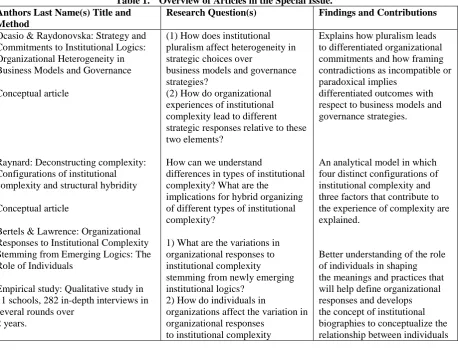
Our call for papers received 51 submissions, out of which five articles and two essays appear in this issue. Table 1 provides a summary of the research questions, methods and contributions represented in this special issue. The empirical papers all differ in their use of research methods, including qualitative research, time series analysis and qualitative comparative analysis (QCA). The articles in this issue address a range of topics drawing on diverse conceptual backgrounds, including literature on hybrid organizations, paradox theory, strategic choice theory and organizational commitment. In this editorial we comment upon four themes that emerge from the papers included in this issue: the nature of institutional complexity, the challenge of responding to it, methodological implications, and avenues for future research.
The nature of institutional complexity
In recent years, there has been an increasing focus on the plurality of institutional influences that organizations face as they contemplate strategic decisions: it is no longer sufficient for firms to assume that only market performance need be considered, or that responsibilities for meeting particular demands can be neatly divided up into entirely separate spheres, sectors or domains. This focus has intensified partly because boundaries between firms, industries, public and private lives are fading (e.g., Ball, 2007; Yescombe, 2011) Scholars have framed this „plurality‟ in terms of influence from divergent “institutional logics” (Kraatz & Block, 2008; Thornton, Ocasio, & Lounsbury, 2012). It is suggested that “institutional complexity” (Greenwood et al., 2011) occurs when organizations experience these multiple pressures as incompatible albeit to a greater or lesser degree.
However, with the increasing number of studies on this phenomenon it is becoming important to provide a more detailed specification of what “institutional complexity” actually involves. Ocasio and Radoynovska‟s article in this issue offers a useful starting point, differentiating between pluralism (Kraatz & Block, 2008), which they argue describes a situation when an organization faces multiple, not necessarily incompatible, prescriptions because it operates in multiple institutional spheres, and complexity, which refers to the experience of “incompatible prescriptions from multiple logics” (Greenwood et al., 2011, p. 318), sometimes even from the same institutional spheres. Raynard‟s conceptual paper (this issue) goes further. She argues that three factors determine the nature of institutional complexity within a given domain: the incompatibility of the logics, the jurisdictional overlap of the logics, and the extent to which the prioritization of logics has not been settled. Raynard then identifies different configurations of these factors, labelling them “segregated”, “restrained”, “aligned” and “volatile” complexity, and postulates different ways of responding to each of them.
Taking a different focus, Meyer and Höllerer (this issue) differentiate what they call intra-institutional complexity, that is, incompatible prescriptions coming from the same logic domain, vs. the more usual inter-institutional complexity, which focuses on incompatible prescriptions arising from different logics. They focus on competing concepts of corporate governance in Indonesia, the corporatist and shared value frameworks respectively, which are each based in the market logic and yet differ in stakeholder expectations and logic prescriptions.
Finally, the essay by Smith and Tracey (this issue) draws attention to a different and potentially complementary perspective for understanding competing demands: paradox theory. Smith and Tracey point out that a paradox perspective does not assume that competing demands come from outside the organization as in an institutional complexity perspective, but rather suggests that tensions are inherent to organizational systems, interdependent and therefore in some sense irreducible. As we see next, different assumptions about the nature of institutional complexity and competing demands may lead to different responses.
Table 1. Overview of Articles in the Special Issue. Anthors Last Name(s) Title and
Method
Research Question(s) Findings and Contributions
Ocasio & Raydonovska: Strategy and Commitments to Institutional Logics: Organizational Heterogeneity in Business Models and Governance
Conceptual article
Raynard: Deconstructing complexity: Configurations of institutional complexity and structural hybridity
Conceptual article
Bertels & Lawrence: Organizational Responses to Institutional Complexity Stemming from Emerging Logics: The Role of Individuals
Empirical study: Qualitative study in 11 schools, 282 in-depth interviews in several rounds over
2 years.
(1) How does institutional pluralism affect heterogeneity in strategic choices over
business models and governance strategies?
(2) How do organizational experiences of institutional complexity lead to different strategic responses relative to these two elements?
How can we understand
differences in types of institutional complexity? What are the
implications for hybrid organizing of different types of institutional complexity?
1) What are the variations in organizational responses to institutional complexity stemming from newly emerging institutional logics?
2) How do individuals in
organizations affect the variation in organizational responses
to institutional complexity
Explains how pluralism leads to differentiated organizational commitments and how framing contradictions as incompatible or paradoxical implies
differentiated outcomes with respect to business models and governance strategies.
An analytical model in which four distinct configurations of institutional complexity and three factors that contribute to the experience of complexity are explained.
Meyer & Höllerer: Laying a smoke screen: Ambiguity and neutralization as strategic responses to institutional complexity
Empirical study: Longitudinal study of Austrian corporations (1990-
2005), drawing on corporate annual reports, regression analysis.
Misangyi: Institutional Complexity and the Meaning of Loose Coupling: Connecting Institutional Sayings and (Not) Doings
Empirical study: Fuzzy-set QCA in 28 business facilities adopting an
environmental management system. Archival data and survey
Smith & Tracey: Institutional Complexity and Paradox Theory Complementarities of Competing Demands
Essay
Reay & Jones: Qualitatively capturing institutional logics
Essay
stemming from newly emerging institutional logics?
How can corporations handle a situation of intra-institutional complexity?
Which, if any, of the multiple prevailing institutional logics in the field are instantiated by instances of (de)couplings? In what way can insights from institutional and paradox theory complement one another, generating richer
and more diverse theorizing about competing demands and
environmental complexity?
How to analyze institutional logics based on qualitative data?
and institutional logics.
In institutionally complex situations, the concepts used by organizations are interlinked and coupled through multiwave diffusion. Organizations regularly respond to institutional complexity by resorting to discursive neutralization techniques and strategically producing ambiguity.
Different systematic connections between the coupling and decoupling of EMS practices are explained. Decoupling of certain practices are pivotal to understanding the meaning of the program adoptions.
Highlights underlying
assumptions of institutional and paradox theory and
suggest avenues for integration by looking at salience of competing demands, static and dynamic responses, real world experiences of tension and approaches to grand challenges.
Identifies three techniques for capturing logics: pattern deducing, pattern matching, and pattern inducing. For each of these approaches, the ontological assumptions, methodological techniques, challenges, and benefits are explained.
Responding to institutional complexity
Navigating institutionally complex waters requires tradeoffs, negotiations (Zietsma & Lawrence, 2010), distinctive capabilities (Jarzabkowski, Smets, Bednarek, Burke, & Spee, 2013; Li, Peng, & Macaulay, 2013) and the careful balancing of resources, stakeholder interests and strategic responses in order to secure legitimacy from different sources while ensuring organizational performance and survival. It is this challenge of gaining acceptance and endorsement from fieldlevel proponents of the various logics in play that has been a particular preoccupation of recent studies.
and otherwise legitimate (Dhalla & Oliver, 2013). When complexity results from interactions among diverse fields, responses may be focused on solving immediate problems in the moment, and actors may have flexibility in the logics they choose to enact (McPherson & Sauder, 2013; Smets, Morris, & Greenwood, 2012). Yet there also may be significant limits to that flexibility as constituents invested in other logics may be angered by changes in logic enactment (Toubiana & Zietsma, 2016). While institutional complexity may sometimes procure strategic advantages, it clearly poses strategic challenges as well. Our knowledge of when complexity enables flexibility and when it engenders conflicts and constraints is limited.
Ocasio and Radoynovska (this issue) emphasize that the experience of institutional complexity is socially constructed, affected by individual, situational, organizational and field factors. Ocasio and Radoynovska (and Smith and Tracey, this issue) also point to differences in the experience of complexity when actors interpret it as paradox vs. contradiction. Paradox involves the persistence over time of interdependent, contradictory elements. While actors may structurally differentiate in order to avoid contradictions, the interpretation of contradictions as paradox may stimulate efforts to find integrative solutions to transcend institutional complexity. These two papers thus imply that organizations with different interpretations of a complex environment they share may respond quite differently, with some segregating institutional logics, and some blending them, leading to heterogeneous business models and strategies (Ocasio and Radoynovska, this issue).
The Bertels and Lawrence study in this issue gives empirical credence to these arguments. Bertels and Lawrence emphasize the individual experiences of, and responses to institutional complexity in their cross-case analysis of 10 schools responding to pressures for aboriginal education in Canada. They identify institutional biographies as a key determinant of an actor‟s identification with a specific logic and their organization‟s response to complexity. While external surveillance triggered sensemaking among the schools, individuals who drew significantly on an emerging aboriginal distinctiveness logic, rather than primarily on a dominant multicultural logic, used influence, authority and coalition building with other school members to move their schools to take practical actions rooted in the aboriginal distinctiveness logic. Contributing to the inhabited institutions and institutional work perspectives, this study shows in detail how individuals matter in how organizations respond to complexity.
The papers by Raynard, Meyer and Höllerer, and Misangyi focus more on the firm level. Raynard focuses specifically on the responses of hybrid organizations, developing propositions to describe how hybrids can respond to ease the experience of each type of institutional complexity. She then further describes the implications that different types of complexity may have on innovation and conflict. The conceptual apparatus that Raynard has developed promises to be quite useful in helping to differentiate among organizational fields and better understand the effects of field conditions on field members, particularly for hybrid organizations.
Meyer and Höllerer focus on firm responses to intra-institutional complexity, finding that Indonesia firms managed competing prescriptions on corporate governance by the adoption of a second wave governance concept corporate social responsibility. Organizations that adopted a shareholder value perspective frequently also adopted ideas and practices of corporate social responsibility, which was sufficiently ambiguous to send multivocal signals, bridging the competing demands, and thus helping to neutralize institutional complexity. Misangyi (this issue) analyzes adoptions by firms of environmental management systems, and highlights the importance of understanding managers‟ intentions in doing so. He opens up our understanding of decoupling, normally considered a strategic behavior, by asserting that in complex environments we need to pay attention to what managers are both coupling with and decoupling from. He suggests that decoupling depends on the stance of the observer, and managers might be intentionally displaying one logic, rather than attempting strategically to decouple from another. Misangyi‟s results point again to the importance of managerial interpretation in complex environments, and provide a provocation to the standard assumptions of decoupling research.
Methodological implications
Prior work has predominantly used qualitative methods to identify and describe institutional complexity, with some exceptions involving experiments (Raaijmakers et al., 2015), and quantitative methods (Chandler, 2014; Greenwood, Díaz, Li, & Lorente, 2010; Meyer & Höllerer, 2010). In this special issue, authors use a variety of methods including QCA (Misangyi), quantitative approaches (Meyer and Höllerer), and qualitative approaches (Bertels and Lawrence).
which to identify and empirically capture „logics‟, this essay should be an important contribution to future work and help avoid any tendency towards unnecessary imprecision and/or undue conformity of approach. The essay reveals the variety of ontological assumptions that underlie efforts to capture what seems on the surface to be the same phenomenon (ranging from realist to interpretivist approaches), suggesting a need for further discussion on the nature of the concept it self, and the reciprocal influences between methods and theoretical understandings. The essay is also particularly engaging in part because many of the authors whose studies are reviewed were personally contacted to provide behind-the-scenes insight into the challenges experienced in developing the method and in convincing journal reviewers of its appropriateness.
Misangyi‟s empirical paper (this issue) provides a very interesting complementary methodological contribution to that of Reay and Jones by showing how fuzzy set QCA methods can be mobilized to capture the multiple logics to which firms are responding through the mix of overlapping rationales that are being used to support their adoptions of environmental management systems.
The Location and Type of Institutional Complexity
One issue with institutional complexity that emerges from reading the papers within the special issue is the „location‟ of institutional complexity. Raynard locates complexity within the organizational fields surrounding hybrid organizations. But if this is the case, do we need to consider other sources of complexity than simply “logics”? For example, actor types and relationships or networks may be more or less complex, and field infrastructures may be more or less complex (Hinings, Logue, & Zietsma, forthcoming). Or is complexity something experienced by actors who span more than one field, rather than something that occurs within a particular field, as studies of hybrid organizations have often considered? Or does institutional complexity refer to societal level domains, such as the market domain to which Meyer and Höllerer refer?
Additional thought needs to be put into location and levels of analysis, as all three of the above possibilities are somewhat different, and there are potential interactions. For example, Lounsbury‟s (2007) analysis of the Boston and New York banking fields locates logics within fields and communities, but points out their differences. Is this an example of intra-institutional complexity, because the market logic of banking is different, or is this the market logic impacted by local community logics, featuring inter-institutional complexity? Or is the separation of these domains evidence that there is no complexity just geographically differentiated logics? This work could also benefit from recent efforts to elaborate differences in the types and conditions of organizational fields and their implications for field dynamics (Zietsma, Groenewegen, Logue, & Hinings, forthcoming).
Efforts to merge these streams of research are needed, as institutional complexity deals with complexity in logics, while a focus on fields also allows for complexity in structures and networks and considers types of fields, which may be more susceptible to specific types of complexity.
Institutional Complexity and Hybrid Organizations
As we have already noted, much research focuses upon „hybrid‟ organizations, which is natural since hybrid organizations by definition have to manage multiple logics (Battilana, Besharov, & Mitzinneck, forthcoming). As Ocasio and Radoynovska (this issue) note, nearly all organizations are hybrids to one extent or another. Is, therefore, institutional complexity ubiquitous? Has it always been so, even while scholarship has focused more on isomorphism, or has the nature of organizational fields and other social spheres changed over time, as Powell, Oberg, Korff, Oelberger and Kloos (forthcoming) contend? If institutional complexity now describes nearly all situations, more nuanced theoretical tools are likely needed to distinguish among types of complexity and their effects, and the papers by Raynard and Meyer and Höllerer in this issue lay the groundwork for further scholarship that should capture how dynamics differ depending on types of complexity.
Institutional Complexity and Organization Design
important area for study. There is a need to better specify the specific structural conditions for organizations to deal with institutional complexity at the level of the organization as a whole and at the individual level. Some work on institutional complexity has distinguished between structurally differentiated or compartmentalized hybrids, wherein different units or subsidiaries of an organization deal with different logics, and blended hybrids, wherein elements of different logics are selectively coupled, integrated or assimilated into one logic (Greenwood et al., 2011; Kraatz & Block, 2008; Pache & Santos, 2013; Skelcher & Smith, 2015; Zilber, 2002). Yet further work is needed in this area too.
Institutional Complexity and Actor Interpretations
Several papers in this special issue identify the importance of actors‟ interpretations in affecting organizational responses to institutional complexity (Bertels & Lawrence, Ocasio & Radoynovska, Misangyi). These interpretations determine how and whether logics are blended, whether actors will transcend contradictions or attempt to avoid them through differentiation. Interpretations, however, are not unconstrained, although the degree of constraint can vary. Some studies suggest that actors can use different logics flexibly (McPherson & Sauder, 2013; Smets et al., 2012; Smets, Jarzabkowski, Burke & Spee, 2015), whereas others suggests that actors are more bound by specific logics that make the use of other logics problematic (Battilana & Dorado, 2010). Friedland (forthcoming) argues that logics are built around a “substance” that is highly valued, and that those embedded in the logic prize that substance. They cannot, therefore, unproblematically shift from logic to logic, and will defend a logic they value (Wright, Zammuto, & Liesch, forthcoming), even within a hybrid organization. Embedded actors, in other words, will defend their values (Toubiana & Zietsma, 2016; Wright et al., forthcoming), and they may be convinced to change their practices if their values are reinterpreted (Vaccaro & Palazzo, 2015). Further investigation into actors‟ perceptions, the depth of their embeddedness in specific institutional logics, and the associated action capabilities, or the microfoundations of action, perception and commitments under institutional complexity, is warranted.
Institutional Complexity and Strategic Management
Although institutional complexity has attracted a good deal of interest from organization theorists, and although strategic management scholars have become increasingly interested in recognizing non-market concerns, Durand‟s (2012) call to better integrate ideas from institutional theory with strategic management scholarship remains weakly addressed in the field‟s main journals. It is clear from the papers in this special issue as well as other recent studies that institutional pressures have important implications for strategic management. The papers in this special issue move towards recognition of this need, in some cases more than others, with Ocasio and Radoynovska coming perhaps closest to adopting the language of strategic management in the development of their ideas about strategic complexity. There is room for much more cross-fertilization across these related domains, and this may require an openness towards hybridizing conceptual frames and theoretical vocabularies on both sides, something which is not always easy to achieve, but which seems important to move forward.
Conclusion
References
[1]. Ball SJ (2007) Education plc: Understanding private sector participation in public sector education. London: Routledge.
[2]. Battilana J, Besharov M and Mitzinneck (forthcoming) Hybrid organizing: A review and roadmap for future research. In Greenwood R, Oliver C, Lawrence T and Meyer R (Eds.), Sage Handbook of Organizational Institutionalism. London: SAGE Publications.
[3]. Battilana J and Dorado S (2010) Building sustainable hybrid organizations: The case of commercial microfinance organizations. Academy of Management Journal 53(6): 1419–1440. [4]. Chandler D (2014) Organizational susceptibility to institutional complexity: Critical events
driving the adoption and implementation of the ethics and compliance officer position.
Organization Science 25(6): 1722–1743.
[5]. D‟Aunno T, Sutton RI and Price RH (1991) Isomorphism and external support in conflicting institutional environments: A study of drug abuse treatment units. Academy of Management Journal 34(3): 636–661.
[6]. Dhalla R and Oliver C (2013) Industry identity in an oligopolistic market and firms‟ responses to institutional pressures. Organization Studies 34(12): 1803–1834.
[7]. Durand R (2012) Advancing strategy and organization research in concert: Towards an integrated model? Strategic Organization 10(3): 297–303.
[8]. Durand R and Jourdan J (2012) Jules or Jim: Alternative conformity to minority logics.
Academy of Management Journal 55(6): 1295–1315.
[9]. Friedland R (forthcoming) Moving institutional logics forward: Emotion and meaningful material practice. Organization Studies.
[10]. Greenwood R, Díaz AM, Li SX and Lorente JC (2010) The multiplicity of institutional logics
and the heterogeneity of organizational responses. Organization Science 21(2): 521–539. [11]. Greenwood R, Hinings C and Whetten D (2014) Rethinking institutions and organizations.
Journal of Management Studies 51: 1206–1220.
[12]. Greenwood R, Raynard M, Kodeih F, Micelotta ER and Lounsbury M (2011) Institutional complexity and organizational responses. The Academy of Management Annals 5(1): 317–371. [13]. Hinings CR, Logue D and Zietsma C (forthcoming) Organizational fields and institutional
infrastruc- ture. In Greenwood R, Oliver C, Lawrence T and Meyer R (Eds.), Sage Handbook of Organizational Institutionalism. London: SAGE Publications.
[14]. Jarzabkowski P, Smets M, Bednarek R, Burke G and Spee P (2013) Institutional ambidexterity:
Leveraging institutional complexity in practice. Research in the Sociology of Organizations 39: 37–61.
[15]. Jay (2013) Navigating paradox as a mechanism of change and innovation in hybrid organizations.
Academy of Management Journal 56(1): 137–159.
[16]. Kraatz MS and Block ES (2008) Organizational implications of institutional pluralism. In Greenwood R, Oliver C, Sahlin K and Suddaby R (Eds.), Sage Handbook of Organizational Institutionalism (pp. 243–275). London: SAGE Publications.
[17]. Li Y, Peng MW and Macaulay CD (2013) Market-political ambidexterity during institutional transitions. Strategic Organization 11(2): 205–213.
[18]. Lounsbury M (2007) A tale of two cities: Competing logics and practice variation in the professionalizing of mutual funds. Academy of Management Journal 50 (2): 289–307.
[19]. McPherson CM and Sauder M (2013) Logics in Action Managing Institutional Complexity in a
Drug Court. Administrative science quarterly 58(2): 165– 196.
[20]. Meyer RE and Höllerer MA (2010) Meaning structures in a contested issue field: A topographic map of share holder value in Austria. Academy of Management Journal 53(6): 1241–1262.
[21]. Miller D, Greenwood R and Prakash R (2009) What happened to organization theory? Journal
of Management Inquiry 18: 273–279.
[22]. Oliver C (1991) Strategic responses to institutional processes. Academy of management Review 16(1): 145–179.
[24]. Pache A-C and Santos F (2013) Inside the hybrid organization: Selective coupling as a response to competing institutional logics. Academy of Management Journal 56(4): 972–1001.
[25]. Powell WW, Oberg A, Korff VP, Oelberger C and Kloos K (forthcoming) Institutional analysis
in a digital era: Mechanisms and methods to understand emerging fields. In Krücken G, Mazza C and Meyer RWP (Eds.), New Themes in Institutional Analysis: Topics and Issues from European Research. Cheltenham, UK: Edward Elgar.
[26]. Quirke L (2013) Rogue resistance: Sidestepping isomorphic pressures in a patchy institutional field.Organization Studies 34(11): 1675–1699.
[27]. Raaijmakers AG, Vermeulen PA, Meeus MT and Zietsma C (2015) I need time! Exploring pathways to compliance under institutional complexity. Academy of Management Journal 58(1): 85–110.
[28]. Skelcher C and Smith SR (2015) Theorizing hybridity: Institutional logics, complex organizations, and
actor identities: The case of nonprofits. Public Administration 93(2): 433–448.
[29]. Smets M, Jarzabkowski P, Burke GT and Spee P (2015) Reinsurance trading in Lloyd‟s of London: Balancing conflicting-yet-complementary logics in practice. Academy of Management Journal 58: 932–970.
[30]. Smets M, Morris T and Greenwood R (2012) From practice to field: A multilevel model of
practice-driven institutional change. Academy of Management Journal 55(4): 877–904.
[31]. Suddaby R, Seidl D and Lê JK (2013) Strategy-as-practice meets neoinstitutional theory. Strategic Organization 11(3): 329–344.
[32]. Thornton P, Ocasio W and Lounsbury M (2012) The Institutional Logics Perspective. Oxford: Oxford
University Press.
[33]. Toubiana M and Zietsma C (2016) The Message is on the Wall? Emotions, Social Media and the
Dynamics of Institutional Complexity. Academy of Management Journal, amj. 2014.0208.
[34]. Tracey P, Phillips N and Jarvis O (2011) Bridging institutional entrepreneurship and the creation of new organizational forms: A multilevel model. Organization Science 22(1): 60–80.
[35]. Vaccaro A and Palazzo G (2015) Values against violence: Institutional change in societies dominated
by organized crime. Academy of Management Journal 58, 1071–1101.
[36]. Wright A, Zammuto R and Liesch P (forthcoming) Maintaining the values of a profession: Institutional
work and moral emotions in the emergency department. Academy of Management Journal.
[37]. Yescombe ER (2011) Public-private partnerships: principles of policy and finance: Butterworth-Heinemann.
[38]. Zietsma C, Groenewegen P, Logue D and Hinings CR (forthcoming) Field or fields? Building the scaffolding for cumulation of research on institutional fields. Academy of Management Annals.
[39]. Zietsma C and Lawrence TB (2010) Institutional work in the transformation of an organizational field:
The interplay of boundary work and practice work. Administrative science quarterly 55(2): 189–221. [40]. Zilber TB (2002) Institutionalization as an interplay between actions, meanings, and actors: The case of