PUBLIC PRIVATE PARTNERSHIP (PPP) IN INDIAN
INFRASTRUCTURE SECTOR
Suman Rani
(karnal, India)INTRODUCTION
Infrastructure is one of the important factors that drive the economic growth of a country. Good infrastructure is the basic requirement for any production process to work efficiently. Infrastructure itself may not be the part of the production process, but is important for the services it provides. It is an important input to the production process and raises the productivity of other sectors. Infrastructure connects goods to the markets, workers to industry, people to services and the poor in rural areas to urban growth centers. Infrastructure lowers costs, enlarges markets and facilitates trade. Thus, infrastructure provides services that support economic growth by increasing the productivity of labor and capital thereby reducing the costs of production and raising profitability, production, income and employment.
A country‟s development is strongly linked to its infrastructure strength and its ability to expand trade, cope with population growth, reduce poverty and produce inclusive growth. The World Bank in its “World Development Report 1994” pointed out that productivity growth is higher in countries with an adequate and efficient supply of infrastructure services. Provision of infrastructure services to meet the demands of business, households and other users is one of the major challenges of economic development. In many surveys conducted by World Bank Group, private investors have cited reliable infrastructure services as an important consideration in their investment decisions. The report also points out that “infrastructure capacity grows step by step with economic output – a one percent increase in the stock of infrastructure is associated with a one percent increase in gross domestic product (GDP) across all countries”. In an increasingly globalizing world, availability of good quality infrastructure is a crucial factor in attracting foreign investments. Availability and accessibility of adequate infrastructure in a country on par with international community is an indicator of the presence of high quality of life.
Physical infrastructure has a direct impact on the growth and overalldevelopment of an economy. The goals of inclusive growth and 9 percent growth in GDP can be achieved only if India's infrastructure deficit is overcome. Infrastructure development will also help create a better investment climate in India. To develop infrastructure in the country, the government is expected to review issues of budgetary allocation, tariff policy, fiscal incentives, private sector participation, and public-private partnerships (PPPs).However, the resources needed are much larger than what the public sector can provide. So private sector is encouraged to participate.
REVIEW OF LITERATURE
Hirschman (1958) in theories of unbalanced growth and other development theories regarding the role of economicand social overhead capital in national and regional development. Renewed interest over the pastfew
Abstract:
Infrastructure is one of the important factors that drive the economic growth of a country.Infrastructure connects goods to the markets, workers to industry, people to services and the poor in rural areas to urban growth centers. Infrastructure lowers costs, enlarges markets and facilitates trade. Thus, infrastructure provides services that support economic growth by increasing the productivity of labor and capital thereby reducing the costs of production and raising profitability, production, income and employment.To develop infrastructure in the country, the government is expected to review issues of budgetary allocation, tariff policy, fiscal incentives, private sector participation, and public-private partnerships (PPPs).
The purpose of this paper is toaboutthe theoretical framework of Indian infrastructure. It include the brief view of infrastructure development during 12th five year plan, its financing sources and role of PPPs in Indian infrastructure and challenges towards it.
years is based on numerous econometric studies where infrastructure enters as an input inaggregate production functions.
Kindleberger and Herric (1973) however, while defining infrastructure introduced two more concepts such as Economic Overhead Capital (EOC) and Strictly Social Overhead Capital (SSOC) which are two different components of Social Overhead Capital. According to them EOC are nothing but public utilities in the form of transport, communication, road, railways, electricity, etc. whereas SSOC includes the plants and equipments required for providing services in the form of education, health and housing.
Aschauer(1989a, 1989b) study focuses on the „core‟infrastructure such as streets, highways, airports, mass transit, sewers, and water systems which are the importantexplanatory factors for the productivity of the economy.
Feltenstein and Ha (1995)studied the relationship between infrastructure and private output in 16 sectors for Mexico and found that the availability of better quality infrastructure in electricity and communication generally reduces the cost of production, but that transportation infrastructure tends to increase the costs of production.
In the Indian context, Jha and Sahni (1992) examined the efficiency of the most important infrastructure facilitieslike gas, electricity and railways sectors by estimating trans-log cost functions.
Shah (1970) attempts to relate the level of per capita income of Indian states with their level of infrastructural development and suggests that a strong correlation exists between them.
Dadibhavi (1991)surveys the levels of social infrastructure in the states of India over the period 1970-71 to 1984-85 using educational and health facilities as indicators.
Escobal (2001) promote that infrastructure development, where importance is given to development ofroads, suggesting that it helps development by increasing efficiency and reducing poverty.
OBJECTIVES AND METHODOLOGY
The objectives of the present study
To examine the theoretical framework of infrastructure.
Part 1 gives a brief description of Infrastructure Development in the Twelfth Five Year Plan.
Part 2 explains in detail a few important sources of infrastructure financing in the country.
Part 3 explain public-private partnerships in India
Part 4 include The major challenges and to infrastructure development in india
Part 5 gives conclusion.
1. Infrastructure Development in the Twelfth Five Year Plan
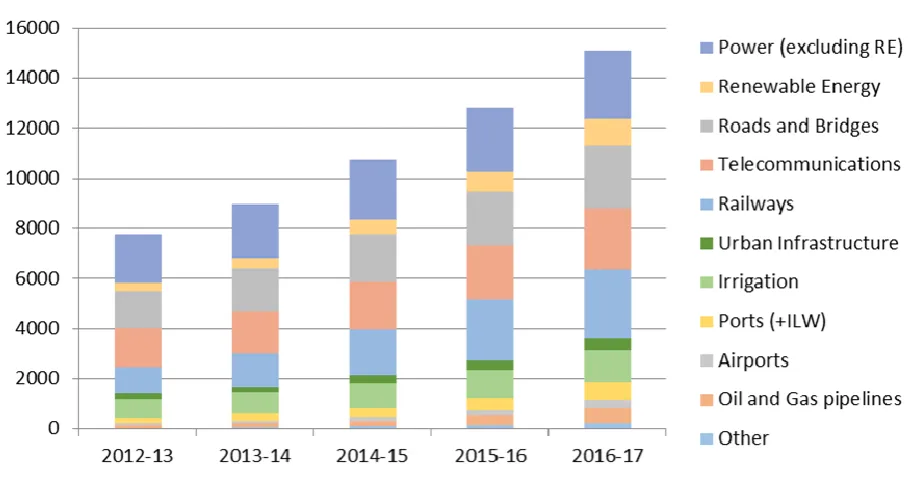
Inadequate infrastructure created the hindrance in growth in the Eleventh Plan. Therefore need for expansion on investment in infrastructure is arise based on a combination of public and private investment in the forms of PPPs. Substantial progress has been made in this respect. The total investment in infrastructure, which includes roads, railways, ports, electricity and telecommunication, oil gas pipelines, and irrigation, is estimated to have increased from 5.7 percent of GDP in the base year of the Eleventh Plan to around 8 percent in the last year of the Plan. Investment showsgrowth in some sectors, like telecommunication and oil and gas pipelines, while falling short of targets in electricity, railways, roads, and ports. Efforts to attract private investment in infrastructure through the PPP route have met with considerable success, not only at the level of the Central government, but also at the level of individual states.
Figure 1:-
2. Infrastructure Financing in India
The total public sector investment in infrastructure envisaged in the Twelfth Plan is `16,01,061crore by the Centre and `12,89,762 crore by the States. Investment by the private sector, which includes PPP projects, makes up the balance of `26,83,840 crore, which is 48.14 per cent of the required investment during the Twelfth Plan, a much higher share than the anticipated 36.61 per cent during the Eleventh Plan. Of the projected investment of `16,01,061crore bythe Central Government, `9,47,083 crore is likely to be funded out of IEBR. In the case of States, `7,30,569crore is expected from budgetary resources, whileabout `5,59,194 crore is expected from their IEBR, as per details in Table 2.1. This would require a much higher scale of effort by the public sector undertakings, especially for raising debt on commercial terms.
TABLE 2.1
Source-Wise Projected Investment
2012–13 2013–14 2014-15 2015-16 2016-17 Total 12th plan
Centre 2,50,758 2,80,662 3,15,217 3,54,296 4,00,129 16,01,061 Central budget 1,07,664 1,17,805 1,29,245 1,42,220 1,57,044 6,53,978 Internal generation 68,200 75,519 83,919 93,145 1,03,931 4,24,713 Borrowings 74,894 87,338 1,02,052 1,18,931 1,39,154 5,22,370
State 2,06,944 2,30,045 2,55,645 2,83,201 3,13,928 12,89,762
State budget
1,27,290
1,36,027
1,45,413 1,55,499 1,66,340 7,30,569
Private
2,93,310
3,76,747
4,90,455 6,48,077 8,75,251 26,83,840
Internal accruals/equity 87,992 1,13,024 1,52,042 2,00,904 2,71,328 8,25,291 Borrowings 2,05,318 2,63,723 3,38,413 4,47,172 6,03,923 18,58,549 Total projected
investment
7,51,012
8,87,454
10,61,316
12,85,573 15,89,308
55,74,663
Non debt 4,14,575 4,70,027 5,43,041 6,29,328 7,42,052 27,99,022
Debt
3,36,437
4,17,426
5,18,275 6,56,246 8,47,256 27,75,641
Source:-planning commission 12th five year plan document
The total requirement of debt by the public and private sectors is likely to be `27,75,641crore.
However, the availability of debt financing for infrastructure during the Twelfth Plan is estimated at `22,65,171crore. There is a likely funding gap of about `5,00,000crore for the debt component. Measures would have to be taken for addressing this gap
The projected investment in infrastructure over the Twelfth Plan would be possible only if there
is a substantial expansion in internal generation and extra-budgetary resources of the public sector, in addition to a significant rise in private investment. The scale of private investment would require a significant reinforcement of the enabling policy and regulatory environment.
3. Public-Private Partnerships in Indian infrastructure
In the last decade, the government has been faced with a huge resourcecrunch. The combined deficit of the Central and state governments is roughly 10 percent of the GDP. Government borrowing has been capped through the Fiscal Responsibility and Budgetary ManagementAct. This necessarily limits state participation in infrastructure financing,thus opening the door to innovative approaches such as PPPs. The Government of India has been encouraging private sector investment and participation in all infrastructure sectors. As the National Development Council has made clear, 'increased private participation has now become a necessity to mobilize the resources needed for infrastructure expansion and upgrading.' The PPP model has been fairly
successful in many advanced countries and it is a robust model. PPPs in India are in a nascent stage but are gaining popularity and support given the dire need to improve infrastructure in the country. A review of international best practice in PPPs suggests a number of core issues that
public authorities must address when considering use of PPPs for procuring public infrastructure projects. In recent years, the PPP model in India has been fairly successful with several projects being implemented across sectors. However, one of the main problems confronting infrastructure and PPPs in India is the delay in implementing and executing large-scale projects resulting in time and cost overruns. Efficiency in implementing infrastructure projects in India is a rarity. The PPP model is complex, leading to problems at various stages of implementation and execution of the project.
Undoubtedly, PPPs in India have gathered significant traction in recent years but it is said that India lacks the overall sophistication of the market in terms of innovative and diverse application of PPPs. According to a2011 survey by the Royal Institution of Chartered Surveyors, over 240 projects with a value of $14.5 billion have been delivered over the last 15 years which show that this model has been operational in India, with the majority $9.4 billion having been delivered during 2005–10 alone.
for efficient delivery of services. Similar efforts will also have to beinitiated in social sectors. The government has been emphasising theneed to explore the scope of PPPs in the development of social sectorslike health and education.
Reason for Failure of PPPs
• Unbalanced decisions that do not reflect the interest of the public sector; • Inappropriate time to take the decisions
• Lack of understanding of duties and responsibilities • Conflicts and disputes
• Inability to manage the work
There are a number of reasons why the public sector may fail to manage a PPP project successfully, including: • Poorly drafted contracts
• Allocation of insufficient resources • Lack of experience
• Conflicts between employees • Lack of understanding • Inadequate supervision
India's overall infrastructure investment is pegged at $1 trillion in theTwelfth Five Year Plan of which approximately 40 per cent is expectedfrom the private sector. While this ensures tremendous potentialopportunities for private sector investment, it is imperative that both the
4. Major hindrance to Infrastructure Development:-
Time and overruns:-Many projects complted with the cost more than estimation. Reason for overrun are
Land acquisition
Financing limits
Faulty planning and execution
Delay in clearance
Lack of experience
Disputes amogpersonnels
Regulatory environment: There is no independent PPP regulator in India currently. In order to attract more domestic and international private funding of infrastructure, a more robust regulatory environment, with an independent regulator, is essential.
Lack of information: The PPP program lacks a comprehensive database regarding the projects/studies to be awarded under PPP. An online data base, consisting of all the project documents including feasibility reports, concession agreements and status of various clearances and land acquisitions will be helpful to all bidders.
Project development: The project development activities such as, detailed feasibility study, land acquisition, environmental/forest clearances etc., are not given adequate importance by the concessioning authorities. The absence of adequate project development by authorities leads to reduced interest by the private sector, mispricing and many times delays at the time of execution.
Lack of institutional capacity: The limited institutional capacity to undertake large and complex projects at various Central ministries and especially at state and local bodies level, hinder the translation of targets into projects.
Financing availability: The private sector is dependent upon commercial banks to raise debt for the PPP projects. With commercial banks reaching the sectoral exposure limits, and large Indian Infrastructure companies being highly leveraged, funding the PPP projects is getting difficult.
Lack of proper dispute resolution mechanism: Disputes often lead to lengthy litigation and substantial project delays. Taking possession of land for large projects is both a contentious and time-consuming issue. There were weaknesses in the laws governing land acquisition and, right now, a process of securing political consensus onthe amendment to existing legislation is in progress. There is a need to reduce the time needed for land acquisition while recognising the competing demands on scare resource. Infrastructure projects require an efficient process of land acquisition to be in place with adequate checks and balances for considerations of equity and justice.
5.
Conclusion
The development of India‟s infrastructure presents a huge task as well as a huge opportunity. The previoussections have raised some of the key issues that will need to be addressed for a major step-up in infrastructure development. But there are other challenges too. It is important to draw attention to two of them in particular. The first concerns the environment. Building good quality infrastructure is integral to the development of a competitive Indian economy that is expected to play a larger role in the world economy. And building it rapidly with the least damage to the environment is important. How the huge growth in power generation, transportation and urbanization can be managed is therefore especially important.1 A second issue is the importance of transparent processes of bidding and procurement if a PPP is to play a major role. Fairness and a level playing field must be firmly established and not perceived to be compromised at any stage. There is no doubt that India‟s infrastructure is a growth sector: it is clearly recognized as a national priority. The infrastructure will be built.
References
[1]. Aschauer, David A., 1990. Highway capacity and economic growth: Concepts and evidence. [2]. Economic Perspectives, Federal Reserve Bank of Chicago, Sep., p.p. 14-24.
[3]. Dadibhavi, R.V. 1991. Disparities in Social Infrastructural Development in India: 1970-71 to1984-85. Asian Economic Review, 33(1).
[4]. Dholakia, R. H. 1985. Regional Disparity in Economic Growth in India. Himalaya Publishing House, Bombay.
[5]. Government of India. Various years, Statistical Abstract of India, Central Statistical Organizationreport . [6]. Hirschman, A.O. 1958. The Strategy of Economic Development. New Haven, CT: Yale University Press. [7]. Mera, K. 1975. Income Distribution and Regional Development, University of Tokyo Press.
[8]. Munnell, Alecia H. 1990. How does public infrastructure affect regional economic performance? [9]. New England Economic Review.
[10]. Munnell, Alecia H. 1992. Infrastructure Investment and Economic Growth. The Journal ofEconomic Perspectives, 6(4), p.p. 189-198.
[11]. Shah, Narottam. 1970. Overall Summary: Infrastructure for the Indian Economy. In Dagli, Vadilal (ed.) Infrastructure for the Indian Economy.
[12]. Sivasubramonian, S. 2004. The Sources of Economic Growth in India 1950-1 to 1999-2000. Oxford. New Delhi.
[13]. Tewari, R.T.1984. Economic Infrastructure and Regional Development in India. Man and Development, 6(4).
[14]. www.infrastructure.gov.in/
[15]. www.planningcommission.nic.in/