DOI: 10.30954/0974-1712.2018.00178.22 ©2018New Delhi Publishers. All rights reserved
MICROBIOLOGY
Isolation, Screening, Identification, and Optimization of
Xylanase Producing Bacteria from Forests of Western Ghats,
India
V. Senthil Kumar, V. Karthi, A. Ramkumar, R. Ramesh, A. Stephen and S. Kumaresan*
PG and Research Department of Botany, Ramakrishna Mission Vivekananda College (Autonomous), Mylapore, Chennai, India *Corresponding author: [email protected] (ORCID ID: 0000-0002-1645-3616)Paper No. 665 Received: 25-09-2017 Accepted: 21-01-2018
ABSTRACT
Xylanase was used in paper industries as an alternate for toxic chemicals in bleaching and pulping processes. This potential has markedly increased the need for research on xylanase production. Hence this study was aimed at isolation of xylanase producing bacteria. The soil samples were collected from different regions in the reserve forests of Western Ghats of Nilgiri district in Tamil Nadu, India. Totally 154 bacterial strains were isolated from the soil samples. All the strains were screened for xylanolytic activity by xylan agar plate assay method. Based on the size of formation of the clear zone, six potential bacterial strains were selected for the further studies and identified by 16S rRNA sequence. Solid state fermentation (SsF) and submerged fermentation(s SmF) were done to identify strains that could produce maximum xylanase. Bacillus was found to be the dominating xylanase producer among the isolated strains. Bacillus subtilis showed maximum xylanase production of 15.55 IU/ml and 2.62 IU/ml in solid state and submerged fermentations, respectively.
Highlights
mEnzyme productivity in solid-state fermentation (SSF) is much higher than that of submerged fermentation.
mWheat bran is the most suitable substrate for xylanase production than rice bran and sugarcane
bagasse.
Keywords: Forest soil, Western Ghats, Bacillus sp., Solid-state fermentation, Submerged fermentation, Xylanase production.
In recent years, the demand for paper products has increased around the world. To meet the ever-increasing demand, many pulp and paper industries have been established. Most of the paper pulp mills in developing countries use elemental chlorine for bleaching process (Thomas
et al. 2007); such bleaching agents are toxic to the environment (Bajpai et al. 2006). In nature, microbes produce enzymes to completely degrade the plant biomass. Such enzymes are non-toxic biopolymers that catalyze the chemical reactions and convert substrates to particular products (Haq et al. 2006). Hence microbial enzymes could be a better alternate for bleaching agents.
bacteria, fungi and actinomycetes produce xylanase. However, compared to fungi, major attention has been given to bacteria especially Bacillus spp. due to their ability to produce cellulase-free thermostable and alkaline xylanase (Dhiman et al. 2008; Beg et al. 2001). Bacterial xylanases show higher efficiency than fungal xylanases upon hydrolysis of xylan (Khasin et al. 1993). Bacillus species have been the major workhorse of industrial microorganisms for more than thousand years. Some species of Bacillus
produce a large number of enzymes, which are industrially very important (Bajpai 1998). They are attractive industrial organisms for several reasons including their high growth rates leading to short fermentation cycle times and their capacity to secrete proteins into the extra cellular medium. It is estimated that enzymes produced by Bacillus spp. constitutes about 50% of the total enzyme market (Schallmey et al. 2004). In recent years, xylanases are in demand due to their use in animal feed, textile and food processing industries and in the production of several valuable products like xylitol and ethanol (Salles et al. 2005). The major industrial applications of enzyme are in textile industry for ‘biopolishing’ of fabrics and producing stonewashed look of denims and in household laundry detergents for improving fabric softness and brightness (Cavaco-Paulo 1998). Solid state fermentation has gained interest for researchers in recent years because of its economic and engineering advantages (Zhang et al. 2015; Rui
et al. 2017; Shi et al. 2017).
The present study deals with the isolation and identification of potential xylanase producing bacteria from forest soil. Efficient strains were cultured in various fermentation conditions to identify the optimal condition for enhanced production of xylanase.
MATERIALS AND METHODS
Collection of soil samples
The soil samples were collected from different sites in the reserve forests of Western Ghats of Nilgiri district (Lat 110 081 to 110 371 N, Long 760 271 to 770 41 E) in Tamil Nadu, India. The soil samples were sieved through a 2mm sieve in order to avoid large soil particles and decomposed plant materials. The samples were dispensed into sterile polythene bags and were brought to the laboratory.
Isolation of soil bacteria
One gram of forest soil was added to 10ml of sterile distilled water and mixed well. After 10 minutes, the mixture was centrifuged at 3000 rpm for 5 minutes to remove the solid particles. 1ml of mixture was pipetted out and added to a fresh tube containing 9ml of sterile distilled water. This process was repeated till the sample was serially diluted up to 10-6 concentration.100µl of diluted
sample wasplated on sterile petriplatecontaining nutrient agar medium and was incubated at 37oC for 2 days. Bacterial colonies were purified by quadrate streaking method. The purified colonies were preserved at 4oC for further identification and screening for xylanase production.
Qualitative assay for xylanase Activity
Plate assay: The isolated bacterial cultures were screened for their ability to produce xylanase on selective media containing MgSo4 0.5 g/l; KCL 0.5 g/l; K2HPO4 1.0 g/l; NaNo3 2.0 g/l; Agar 20.0 g/l; Brich Wood Xylan 10.0 g/l and pH was adjusted to 7.0. The plates were inoculated with bacterial culture and incubated at room temperature for 3 days. After incubation, 1% Congo red solution was added to the plates and incubated for 15min. The Congo red staining solution in the plate was discarded and washed with 1N NaCl. Formation of clear zone of hydrolysis indicated degradation around the bacterial colonies. Xylanolytic activity of each colony was detected by determining the ratio of diameter of clearance zone (CZ) to the diameter of size of colony (CS). The high zone of clearance was considered for a higher xylanolytic activity and this bacterial isolates were used for further studies.
Bacterial genomic DNA extraction
Bacterial isolates were grown in 10 ml of Nutrient broth. Bacterial Genomic DNA was isolated by using the InstaGene TM Matrix (Catalog # 732-6030) Genomic DNA isolation kit, following the instructions of the manufacturer. The genomic DNA was suspended in TE buffer and stored at -20oC for further assay.
Amplification of 16SrRNA
chain reaction using a Peltier thermalcyler (MJ. Research PTC -225). The amplification reaction was performed by adding 1 µl of template DNA in 20 µl of PCR reaction solution (ITS1/ITS4 were used as primers).
Primer sequences: ITS1 forward primer:
5’TCCGTAGGTGAACCTGCGG3’ ITS 4 reverse primer:
5’TCCTCCGCTTATTGATATGC3’
The reaction was carried out at; 94°C for 45 sec (denaturation), 55°C for 60 sec (annealing) and 72°C for 60 sec (extension); 35 cycles. Positive (E.
coli genomic DNA) and negative controls were included in the PCR. PCR product was purified using Montage PCR clean up kit (Millipore).
Sequence Analysis
Single-pass sequencing was performed on each template using different combinations of ITS1/ ITS4 primers. The fluorescent-labelled fragments were purified from the unincorporated terminators with an ethanol precipitation protocol. The samples were re-suspended in distilled water and subjected to electrophoresis in an ABI 3730xl sequencer (Applied Biosystems). Sequence data was aligned and analyzed for identifying the sample.
Submerged fermentation (SmF)
The bacteria were cultured in Erlenmeyer flasks (250 ml) containing 50 ml of medium. The medium composition in (g/L) was NH4Cl 0.5 g/l; KH2PO4 0.5 g/l; KCl 0.75 g/l; K2HPO4 2.5 g/l; MgSO4.7H2O 7.0 g/l; Brich wood xylan 10 g/l; NaCl 30 g/l; DH2O-1.0 g/l and pH was adjusted to 5.5. Flasks were inoculated with 1ml of one day-old pure bacterial broth culture. Flasks were incubated at 30ºC under static conditions for 3 days. After incubation, the culture filtrate was harvested by filtration using Whatman No.1 filter paper and centrifuged at 10,000rpm for 15 min at 4°C. The clear supernatant was used for enzyme assays, and stored at 4ºC for further uses.
Solid state Fermentation (SsF)
The bacteria were cultured in Erlenmeyer flasks (250 ml) containing 5g of wheat bran, rice bran and sugarcane bagasse in separate flask and moistened
with 15ml of mineral salts solution, respectively. The mineral salt solution comprised of (g/L) FeSO4.7H2O, 0.01; KH2PO4, 0.5; NH4Cl, 0.5; KCl, 0.75; K2HPO4, 2.5; MgSO4, 7.0; NaCl, 30; DH2O, 1.0; Trace metal solution, 1ml and pH was adjusted to 5.5. Trace metal solution containing (g/l) ZnCl2 0.02 g/l; Na2MO4 0.02 g/l; CuCl2 0.03 g/l; CoCl2 0.04 g/l; C4H4KNaO6.4H2O 1.77 g/l; MnCl2.7H2O 1.80 g/l; FeSO4 2.49 g/l; H3BO3 2.8 g/l and DH2O-1.0 g/l. The flasks were inoculated with 1ml of bacterial broth culture. After mixing, flasks were incubated at 30ºC under static conditions for 3 days. After incubation, 30 ml of citrate buffer (50mM, pH 7.0) was added to the culture and kept in an orbital shaker for 15 minutes. The culture was separated by filtering through Whatman No. 1 filter paper and centrifuged at 10,000 rpm for 10 min at 4°C. The clear supernatant was used for enzyme assays and stored in the refrigerator at 4ºC.
Determination of protein (Bradford, 1976) The concentration of soluble protein was estimated by Bradford’s method using bovine serum albumin as the standard.
Enzyme Assay (Miller, 1959)
0.5ml of 1% xylan solution was added to 0.5ml of suitably diluted culture supernatant of each bacterial strain. Reaction mixture was incubated for 30 minutes at 50˚C. After incubation, the reaction was terminated by adding 3 ml of DNS reagent to the reaction mixture and was placed in a boiling water bath for 5 minutes. After cooling, the absorbance was read at 540 nm against the blank. The amount of reducing sugar liberated was quantified using xylose as the standard one. One unit of xylanase is defined as the amount of enzyme that liberates 1µmole of glucose equivalents per minute under the assay condition.
RESULTS AND DISCUSSION
Isolation and screening of xylanase producing bacteria
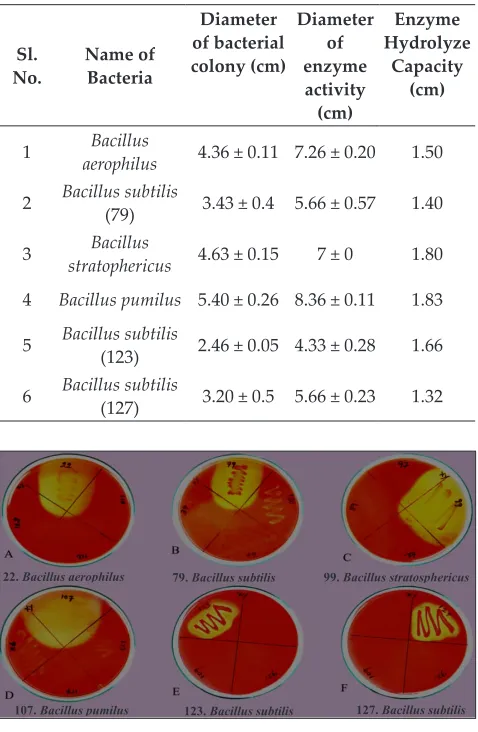
the morphological characteristics such as colony pattern, growth, colour and gram staining. Based on their difference in morphological characteristics, 28 isolates were selected and the repeated strains were avoided. These 28 strains were screened for xylanolytic activity by plate assay. Only 6 isolates of bacteria showed hydrolyzing zones on xylan agar plates after 3 days of incubation (Fig. 1). The size of clearing zone was measured and tabulated (Table 1). Xylanase-producing bacteria were isolated based on the clear hollow zones on xylan agar plate, which is similar to the earlier studies (Roy and Abedin 2002; Kamble and Jadhav 2012).
Table 1: Bacterial xylanase enzyme activity on xylan substrate agar medium
Sl.
No. Name of Bacteria
Diameter of bacterial colony (cm)
Diameter of enzyme
activity (cm)
Enzyme Hydrolyze
Capacity (cm)
1 aerophilusBacillus 4.36 ± 0.11 7.26 ± 0.20 1.50 2 Bacillus subtilis (79) 3.43 ± 0.4 5.66 ± 0.57 1.40
3 stratophericusBacillus 4.63 ± 0.15 7 ± 0 1.80 4 Bacillus pumilus 5.40 ± 0.26 8.36 ± 0.11 1.83 5 Bacillus subtilis (123) 2.46 ± 0.05 4.33 ± 0.28 1.66 6 Bacillus subtilis (127) 3.20 ± 0.5 5.66 ± 0.23 1.32
22.Bacillus aerophilus 79.Bacillus subtilis
123.Bacillus subtilis 127.Bacillus subtilis 99.Bacillus stratosphericus
107.Bacillus pumilus
Fig. 1: Preliminary screening for xylanase producing bacteria by plate assay
Molecular identification of xylanolytic bacteria The DNA sequence data of an organism could be used to study phylogeny at the species level. It
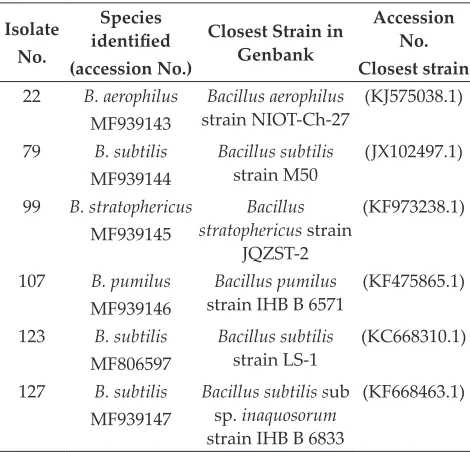
facilitate species discovery and can eventually be used for the development of molecular diagnostics. The 6 strains that were active in xylanase production were identified by sequence analysis of ITS region of 16srRNA. The ITS of the strain was amplified by PCR using universal primer ITS1 for forward and ITS4 for reverse. The amplified ITS was sequenced using ABI prism 3730xl sequencer. Using BLAST tool, the 16srRNA sequences obtained from this study were compared with the sequences in the GenBank database of the NCBI and the closely related ITS sequence was considered for the identification (Table 2). The program PHYLIP 3.57C was used for phylogeny analysis and the program TreeDyn 198.3 was used for tree rendering. Phylogenetic analysis revealed that the selected bacterial isolates belonged to the genera Bacillus.
The unknown strains were identified by sequencing the 16SrRNA gene with the data available in Genbank. As a result, the 16SrRNA gene of the strains revealed close relationship to various species of Bacillus. The Bacillus species complex is a tight assemblage of closely related species. For many years, it has been recognized that these species cannot be differentiated on the basis of phenotypic characteristics (Fig. 2).
*
*
*
*
*
*
Fig. 2: Phylogenetic tree constructed for six bacterial isolates by comparing with related species
Hence, phylogenetic analysis of the 16S rRNA gene gives some clue about their identity (Woese 1987), but phylogenetic analysis of multiple protein-coding loci could still be a better identification aid (Rooney
calculating a pair-wise Jukes-Cantor (Jukes and Cantor 1969). From these distances, phylogenetic trees were inferred using Neighbour-Joining method (Saitou and Nei 1987). Analysis of the 16S rRNA gene of isolate revealed that these organisms were closely related phylogenetically to the members of the genus Bacillus rRNA group 5 (Rainly et al. 1994).
Table 2: Xylanolytic bacterial strains identification based on BLAST result
Isolate No.
Species identified (accession No.)
Closest Strain in Genbank
Accession No. Closest strain 22 B. aerophilus
MF939143
Bacillus aerophilus
strain NIOT-Ch-27 (KJ575038.1) 79 B. subtilis
MF939144
Bacillus subtilis
strain M50 (JX102497.1) 99 B. stratophericus
MF939145
Bacillus stratophericus strain
JQZST-2
(KF973238.1)
107 B. pumilus MF939146
Bacillus pumilus
strain IHB B 6571 (KF475865.1) 123 B. subtilis
MF806597
Bacillus subtilis
strain LS-1 (KC668310.1) 127 B. subtilis
MF939147
Bacillus subtilis sub sp. inaquosorum strain IHB B 6833
(KF668463.1)
Enzyme production under cultivation methods
Based on the plate assay, totally 6 bacterial strains were selected for submerged fermentation (SmF) and Solid State fermentation (SsF) studies (Agnihotri et al. 2010). In the present study, enzyme production by the test isolates with different mode of cultivation was compared and it was found that there is an increase in xylanase production under SSF when compared to SmF after three days of incubation period. Irfan et al. (2012) reported that selection of suitable medium plays a vital role in xylanase production. In general, it was observed that the enzyme productivity via solid-state fermentation (SSF) is normally much higher than that of submerged fermentation (Agnihotri et al.,
2010). Malarvizhi et al. (2003) reported that xylanase production in SSF was observed much higher than that in SmF, which is similar to the SSF is defined as the growth of microorganisms on a layer of moist solid substrate with air as the continuous phase (Gessesse and Mamo, 1999; Battan et al. 2006; El-Shishtawy et al. 2014).
Xylanase production using agro industrial residues
(wheat bran, rice bran and sugarcane bagasse)
as carbon sources was also tested. High levels
of xylanolytic activity (about 159.96 U/ml), but less than 0.0017 U/ml of cellulolytic activity was exhibited by crude filtrates of cultures from B. pumilus grown on wheat bran (Poorna and Prema, 2007). The suitability of wheat bran as substrate could be due to the presence of 45% hemicellulose, which may fulfill the role of inducer and 23% organic nitrogen, which is essential for protein synthesis (Babu and Satyanarayana 1996). Sanghi et al. (2009) stated B. subtilis produced a very high level of xylanase in SSF using inexpensive agro-residues of wheat bran and it was much higher than that reported by other bacterial isolates. Ninawe and Kuhad (2005) reported that wheat bran was used as an enhancer for xylanase production by Streptomyces cyaneus SN32. In the present study, an increase in enzyme production in wheat bran when compared to rice bran and sugarcane bagasse as the substrate for SSF was observed with 6 test isolates after three days of incubation (Fig. 3).
Fig. 3: Quantity of xylanase produced in Submerged
Fermentation and Solid State fermentation
Enzyme productivity in solid state fermentation (SSF) is usually much higher than that of submerged fermentation (Haltrich et al. 1996). It was reported that xylanase production was found to be higher in the wheat bran medium for a period of 72h of fermentation (Archana and Satyanarayan 1997). Several workers reported the suitability of wheat bran for xylanase production in SSF (Heck et al.,
2006; Malarvizhi et al. 2003) which is similar to the present study. To the best of our knowledge, this is the first evidence of large number of xylanases induction in bacteria by wheat bran.
CONCLUSION
bacterial strains were successfully isolated from soil samples collected from Western Ghats of Nilgiri district, Tamilnadu, India. 16S rRNA sequencing was carried out for identification of selected bacterial strains. Bacillus subtilis exhibited maximum xylanase production of 15.55 IU/ml and 2.62 U/ml in solid state and submerged fermentations, respectively. In our study, it was observed that only wheat bran doesn’t aggregate even after the addition of mineral salt solution whereas other substrates become slurry. Hence the bacterial colonies were established well in wheat bran than rice bran and sugarcane bagasse. This condition leads to higher production of xylanase in wheat bran. The Bacillus strains in this study were found to be the potential sources for xylanase production, however, the process of xylanase production from these Bacillus isolates may be commercialized after further optimization for enhanced enzyme production.
ACKNOWLEDGMENTS
Authors thank the Management of RKM Vivekananda College (Autonomous) for providing all the necessary facilities and encouragement. The Authors wish to thank Dr. Malali Gowda, Center for Genomics Discovery, School of Liberal Arts and Science, TransDisciplinary University, Bengaluru for insightful comments on the manuscript.
REFERENCES
Agnihotri, S., Dutt, D., Tyagi, C.H., Kumar, A. and Upadhyaya, J.S. 2010 Production and biochemical characterization of a novel cellulase-poor alkali-thermo-tolerant xylanase from Coprinellus disseminatus SW-1 NTCC 1165. W. J. Micro. Biotech.,26: 1349-1359.
Archana, A. and Satyanarayana, T. 1997. Xylanase production by thermophilic Bacillus licheniformisA99 in solid-state fermentation. Enzyme Micro. Tech.,21: 12-17.
Babu, K.R. and Satyanarayana, T. 1995. Production of bacterial enzymes by solid state fermentation. J. Sci. Ind. Res.,55: 464-467.
Bajpai, P. 1998. Microbial xylanolytic enzyme system properties and applications. Adv. Appl. Micro.,43: 141-194. Bajpai, P., Anand, A., Sharma, N., Mishra, S.P., Bajpai, P.K.
and Lachenal, D. 2006. Enzymes improve ECF bleaching of pulp. BioResources, 1: 34-44.
Battan, B., Sharma, J. and Kuhad, R.C. 2006. High-level xylanase production by alkaliphilic Bacillus pumilus ASH under solid-state fermentation. World J. Microbiol. Biotechnol.,22: 1281-1287.
Beg, Q.K., Kapoor, M., Mahajan, L. and Hoondal, G.S. 2001. Microbial xylanase and their industrial applications. Appl. Micro. Biotech.,56: 326-338.
Blanco, A., Vidal, T., Colom, J.F. and Pastor, F.I.J. 1995. Purification and properties of xylanase A from alkali-tolerant Bacillus sp. strain BP-23. Appl. Enviro. Micro.,61: 4468-4470.
Bradford, M.M. 1976. A rapid and sensitive method for the quantitation of microgram quantities of protein utilizing the principle of protein-dye binding. Anal. Biochem.,72: 248-254.
Cavaco-Paulo, A. 1998. Mechanism of cellulase action in textile processes. Carbohydr. Polym.,37: 273-277.
Dhiman, S.S., Sharma, J. and Battan, B. 2008. Industrial applications and future prospects of microbial xylanases. BioResources,3: 1377-1402.
El-Shishtawy, R.M., Mohamed, S.A., Asiri, A.M., Gomaa, A.M., Ibrahim, I.H. and Al-Talhi, H.A. 2014. Solid fermentation of wheat bran for hydrolytic enzymes production and saccharification content by a local isolate Bacillus megatherium. BMC Biotechnology, 14: 29.
Gessesse, A. and Mamo, G. 1999. High-level xylanase production by an alkaliphilic Bacillus sp. by using solid-state fermentation. Enzyme Micro. Tech.,25: 68-72. Haltrich, D., Nidetzky, B., Kulbe, K.D., Steiner, W. and
Zupanic, S. 1996. Production of fungal xylanases. Bioresour. Tech.,58: 137-161.
Haq, I.U., Javed, M.H. and Khan, T.M. 2006. An innovative approach for hyper production of cellulolytic and hemicellulolytic enzymes by consortium of Aspergillus niger MSK-7 and Trichoderma viride MSK-10. Afri. J. Biotech., 5: 609-614.
Heck, J.X., Soares, L.H.D.B., Hertz, P.F. and Ayub, M.A.Z. 2006. Purification and properties of a xylanase produced by Bacillus circulans BL53 on solid-state cultivation. Biochem. Eng. J.,32: 179-184.
Irfan, M., Nadeem, M., Syed, Q. and Baig, S. 2012. Effect of Medium Composition on Xylanase Production by Bacillus subtilis using Various Agricultural Wastes. Am. Eur. J. Agric. Environ. Sci.,12: 561-565.
Jukes, T.H. and Cantor, R.R. 1969. Evolution of protein molecules in Mammalian protein metabolism. Academic Press, New York.
Kamble, R.D. and Jadhav, A.R. 2012. Isolation, Purification, and Characterization of Xylanase Produced by a New Species of Bacillus in Solid State Fermentation. Int J Microbiol., doi: 10.1155/2012/683193.
Khasin, A., Alchanati, I. and Shoham, Y. 1993. Purification and characterization of a thermostable xylanase from Bacillus stearothermophilus T-6. Appl. Environ. Micro.,59: 1725-1730. Malarvizhi, K., Murugesan, K. and Kalaichelvan, P.T. 2003.
Nath, D. and Rao, M. 2001. pH dependent conformational and structural changes of xylanase from an alkalophilic thermophilic Bacillus sp. (NCIM 59). Enzyme Micro. Tech., 28: 397-403.
Ninawe, S. and Kuhad, R.C. 2005. Use of xylan rich cost effective agro residues in the production of xylanase by Streptomyces Cyaneus SN32. J. Appl. Micro.,99: 1141-1148. Poorna, C.A. and Prema, P. 2007. Production of cellulase-free
endo-xylanase from novel Alkalophilic thermotolerent Bacillus pumilus by solid-state fermentation and its application in waste paper recycling. Bioresour. Tech.,98: 485-490.
Rainly, F.A., Fritze, D. and Stackebrandt, E. 1994. The phylogenetic diversity of thermophilic member of the genus Bacillus as revealed by 16S rDNA analysis. FEMS Micro. Lett.,115: 205-212.
Rooney, A.P., Price, N.P.J., Ehrhardt, C., Swezey, J.L. and Bannan, J.D. 2009. Phylogeny and molecular taxonomy of the Bacillus subtilis species complex and description of Bacillus subtilis subsp. inaquosorum subsp. nov. Int. J. Syst. Evol. Micro.,59: 2429-2436.
Roy, N. and Abedin, Z. 2002. Isolation and molecular characterization of xylanase producing bacteria from drain water. J. Biol. Sci.,2: 399-402.
Rui, X., Wang, M., Zhang, Y., Chen, X., Li, L., Liu, Y. and Dong, M. 2017. Optimization of soy solid-state fermentation with selected lactic acid bacteria and the effect on the anti-nutritional components. J. Food Process. Preserv., doi: 10.1111/jfpp.13290.
Saitou, N. and Nei, M. 1987. The neighbour-joining method- a new method for reconstructing phylogenetic trees. Mol. Biol. Evol.,4: 406-425.
Salles, B.C., Medeiros, R.G., Bao, S.N., Silva, F.G. and Filho, E.X.F. 2005. Effect of cellulase free xylanase from Acrophialo phoranainiana and Humicola grisea var. thermoidea on eucalyptus kraft pulp. Process Biochem., 40: 343-349. Sanghi, A., Garg, N., Kuhar, K., Kuhad, R.C. and Gupta, V.K.
2009. Enhanced production of cellulase-free xylanase by alkallophilic Bacillus subtilis ash and its application in biobleaching of kraft pulp. BioResources,4: 1109-1129. Schallmey, M., Singh, A. and Ward, O.P. 2004. Development
in the use of Bacillus species for industrial production. Can. J. Micro.,50: 1-17.
Shallom, D. and Shallom, Y. 2003. Microbial hemicellulases. Curr. Opin. Microb., 6: 219-228.
Shi, C., Zhang, Y., Lu, Z. and Wang, Y. 2017. Solid-state fermentation of corn-soybean meal mixed feed with Bacillus subtilis and Enterococcus faecium for degrading antinutritional factors and enhancing nutritional value. J. Ani. Sci. Biotechnol.,8: 50.
Thomas, R., Singh, S.P. and Subrahmanyam, S.V. 2007. A study on oxygen delignification of Melocanna baccifera (Muli bamboo) kraft pulp. BioResources,2: 430-441.
Woese, C. 1987. Bacterial evolution. Micro. Rev., 51: 221-271. Zhang, B.B., Lu, L.P. and Xu, G.R. 2015. Why solid-state