Replacing meat with alternative
plant-based products (RE-MAPs): protocol for
a randomised controlled trial of a
behavioural intervention to reduce
meat consumption
Filippo Bianchi,1 Paul Aveyard,2 Nerys M Astbury, 1 Brian Cook,2 Emma Cartwright,3 Susan A Jebb2
To cite: Bianchi F, Aveyard P, Astbury NM, et al. Replacing meat with alternative plant-based products (RE-MAPs): protocol for a randomised controlled trial of a behavioural intervention to reduce meat consumption. BMJ Open 2019;9:e027016. doi:10.1136/ bmjopen-2018-027016
►Prepublication history and additional material for this paper are available online. To view these files, please visit the journal online (http:// dx. doi. org/ 10. 1136/ bmjopen- 2018- 027016).
Received 1 October 2018 Revised 20 March 2019 Accepted 27 March 2019
1Nuffield Department of Primary
Care Health Science, University of Oxford, Oxford, UK
2Primary Care Health Sciences,
University of Oxford, Oxford, UK
3Lee Kong Chain medical
school, Nanyang Technological University, Singapore, Singapore
Correspondence to Filippo Bianchi;
filippo. bianchi@ phc. ox. ac. uk © Author(s) (or their employer(s)) 2019. Re-use permitted under CC BY. Published by BMJ.
AbstrACt
Introduction Reducing meat consumption could
contribute towards preventing some chronic conditions and protecting the natural environment. This study will examine the effectiveness of a behavioural intervention to reduce meat consumption.
Methods and analyses Replacing meat with alternative
plant-based product is a randomised controlled trial comparing a behavioural intervention to reduce meat consumption with a no intervention control condition. Eligible volunteers will be recruited from the general public through advertisement and randomised in a 1:1 ratio to receive no intervention or a 4-week intervention comprising the provision of free plant-based meat alternatives, written information on the health and environmental benefits of eating less meat, success stories of people who reduced their meat consumption and recipes. The primary outcome is the change in meat consumption at 4 weeks (T1) from baseline. Secondary and exploratory outcomes include changes in meat consumption at 8 weeks (T2) from baseline and changes from the baseline to both follow-up in other aspects of participants diet, putative psychosocial determinants of eating a low meat diet and of using meat substitutes and biomarkers of health risk, including blood lipid profiles, blood pressure, weight and body composition. Linear models will be employed to explore whether the changes in each of the aforementioned outcomes differ significantly between the control and intervention group. Qualitative interviews on a subsample of participants receiving the intervention will evaluate their experiences of the intervention and help to identify the mechanisms through which the intervention reduced meat consumption or the barriers preventing the intervention to aid this dietary transition.
Ethics and dissemination The trial has been granted
ethical approval by the Medical Sciences Interdivisional Research Ethics Committee (IDREC) of the University of Oxford (Ref: R54329/RE001). All results originating from this study will be submitted for publication in scientific journals and presented at meetings and through the media.
trial registration number
ISRCTN13180635;Pre-recruitment.
IntroduCtIon
While meat is a source of important nutri-ents and can be part of a healthy diet,1 red and processed meat consumption is also associated with an increased risk of devel-oping some forms of cancer,2–4 cardiovascular disease5–8 and type 2 diabetes.7 9–11 Further-more, producing meat can negatively affect the natural environment and contribute to anthropogenic global warming,12–14 which may also detrimentally affect human health.15–18 Reducing meat consumption couldhelp to promote public health and protect the natural environment, but a recent report identified ‘a remarkable lack of policies, initiatives or campaigns’ designed to tackle the demand for meat.19 This state of inaction is partly due to the scarcity of
strengths and limitations of this study
► The first randomised controlled trial assessing the behavioural, nutritional, psychosocial and health impact of a 4-week intervention to reduce meat consumption through replacement with meat alternatives.
► Assessment of putative psychosocial determinants of meat and meat alternatives consumption will help to identify the active components of the intervention and will help inform future intervention development. ► Health risk outcomes will provide preliminary evi-dence on potential health implications of replacing meat with meat alternatives in the diet.
► Recruitment will occur among adult-only house-holds within Oxford (UK), limiting the generalisability of the results.
► The study will only provide proof of principle for the short-term effectiveness of a behavioural interven-tion to reduce meat consumpinterven-tion and future work will be needed to translate these insights into longer term interventions in routine settings.
on September 22, 2020 by guest. Protected by copyright.
evidence on the effectiveness of interventions to reduce meat consumption19–23 warranting more experimental research to develop and evaluate such interventions. The rising availability of alternatives, such as textured vegetable proteins and mycoprotein-based alterna-tives,24 could help to reduce meat consumption, as these products resemble meat in their gastronomic function, appearance and preparation. Nevertheless, uptake of meat alternatives remains low in many developed coun-tries,24–27 which might partly be due to a lack of familiarity with these foods.25 28 29 Interventions increasing people’s familiarity with meat alternatives could, therefore, help to overcome this barrier and, in turn, reduce meat consumption. A recent systematic review of experimental studies concluded that interventions that supplied plant-based alternatives were associated with reductions in meat consumption during, and several weeks after, the inter-ventions.23 Nevertheless, this evidence is based on small uncontrolled pre–post intervention studies30 31 and more systematic evaluations of the behavioural impact of such interventions is warranted. Additionally, there is currently no evidence from randomised trials on the psychosocial and health consequences of interventions aiming at reducing meat consumption through the replacement with meat alternatives.
objectives
The primary aim of the replacing meat with alternative plant-based products (RE-MAP) trial is to examine the effectiveness of a behavioural intervention to reduce meat consumption compared with a no intervention control condition. Additionally, this study will evaluate the impact of the intervention on the consumption of other food groups, the nutritional composition of participants’ diets, the putative psychosocial determinants of eating a low meat diet and of using plant-based meat alternatives and on biological markers of health risk, including blood lipid profiles, blood pressure, weight and body composition. This study also aims to qualitatively investigate partici-pants’ experiences of the intervention, the mechanisms through which the intervention reduced meat consump-tion, and/or the barriers preventing the intervention to aid this dietary transition.
MEthods
study design and setting
The Re-MAP study will employ a two-arm parallel group individually randomised controlled trial (RCT) to eval-uate a 4-week behavioural intervention to reduce meat consumption. The primary endpoint is defined as the change in average daily meat consumption at 4 weeks form baseline, assessed through self-reported 7 days food diaries. The study will be conducted in Oxford, UK.
recruitment
Participants will be recruited from the general population through advertisements in public buildings, newspapers,
mailing lists and social media. Individuals contacting the study team will receive a written information sheet summarising the study protocol. Individuals confirming their interest will be called by the recruiting member of the research team, who will summarise the study protocol and answer any outstanding question. The recruiting member of the research team will also screen individuals against the eligibility criteria and invite eligible individ-uals to attend an enrolment appointment.
Eligibility criteria Inclusion criteria: A. Are ≥18 years old.
B. Self-report to eat meat regularly. C. Belong to an adult-only household. D. Are willing to try meat alternatives. E. Own adequate food storing facilities.
F. Possess a device compatible with the requirements of the online food diary.
G. Provide informed consent. Exclusion criteria:
A. Report they have relevant food allergies. B. Report suffering from an eating disorder.
C. Report to be pregnant or plan pregnancy in the study period.
D. Belong to the same household as a previously enrolled participant.
E. Report consuming meat alternatives more than once a week on average.
F. Return baseline dietary records of insufficient quality for analysis.
G. The recruiting researcher deems the interested in-dividual unable to adhere appropriately to the study protocol (eg, insufficient knowledge of the English language, planned absences from main residence during the course of the study, enrolled in other lon-gitudinal dietary intervention study).
Participant flow
Enrolment appointment
The enrolment appointment will take place on the univer-sity premises. During this appointment, an appropri-ately trained member of the research team will seek written informed consent (see online supplementary file 1), witnessing this by means of dated signature. After gaining informed consent, the enrolling member of the research team will set up participants’ online food diaries to include six possible meal entries per day (breakfast, mid-morning, lunch, mid-afternoon, dinner and post-dinner) and to allow the research team to remotely access participants’ food diaries by means of a password. The recruiting member of the research team will also train participants in how to appropriately use the online food diaries and estimate portion sizes.
Baseline
Following the enrolment appointment, participants will complete a 7-day food diary over the week leading up to
on September 22, 2020 by guest. Protected by copyright.
the following appointment, the baseline (T0). Partici-pants not keeping sufficiently detailed diaries and those eating meat on less than five eating occasions over the week will be discontinued. At the baseline appointment, an appropriately trained member of the research team will collect participants’ food diaries, ask participants to answer the baseline online questionnaire and measure participants blood lipids profile, blood pressure, weight and body composition. At the end of the baseline appointment, participants will be randomised to one of the two study conditions and will then follow the respec-tive protocol for the next 4 weeks.
Follow-up
Participants will be invited to attend a 4-week (T1) and an 8-week (T2) follow-up and to keep a 7-day food diary over the week leading up to each follow-up. During the follow-up appointments, a member of the research team will collect the respective food diary, ask participants to answer an online questionnaire and measure participants blood lipids profile, blood pressure, weight and body composition.
sample size
Due to lack of research studies directly comparable to ours, pragmatic considerations have guided the decision to terminate recruitment once a sample of at least 100 volunteers has completed the 4 weeks follow-up. A power analysis based on this pragmatically selected sample size suggests that 100 participants completing the primary outcome will allow detection of a medium effect size of d=0.6 with a power of 1-beta=0.84 and a two-tailed alpha criterion of 0.05.
randomisation and blinding
Participants’ group allocation will be based on a comput-er-generated randomisation sequence, produced by an independent statistician. The randomisation sequence was designed to individually allocate participants to the intervention or control condition in a 1:1 ratio and to achieve a proportional gender balance in the two condi-tions through blocking and stratification by sex. The research team is blinded to the randomisation sequence and to its block sizes and sequence. Allocation will be revealed to the researcher performing the randomis-ation only after the first food diary has been returned. Due to the nature of the intervention, participants and some members of the research team cannot be blind to participants’ group allocation. The members of the research team analysing the food diaries will be blind to the group allocation. Due to the nature of the outcomes, the risk of investigator bias will be low. To address the risk of social desirability bias in participants’ reporting of foods intake and questionnaire responses, participants will be reminded during the enrolment visit and before each questionnaire that there are no right or wrong answers.
Intervention and comparator
Intervention
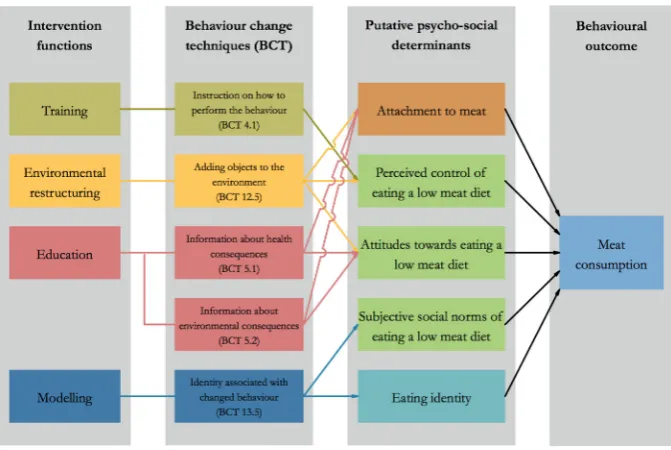
Re-MAP is a 4-week behavioural intervention, which aims to reduce meat consumption, defined as non-seafood meat products, among regular meat eaters. Following an analysis of the target behaviour, that is, a reduction in meat consumption, we included five psychosocial vari-ables as the intervention’s targets: attitudes, perceived behavioural control and subjective social norms of eating a low meat diet, as well as attachment to meat, and eating identities (eg, ‘meat eater’ or ‘vegetarian’). We then selected four intervention functions from the Behaviour Change Wheel32 33 with the aim of influencing these psychosocial variables1: environmental restruc-turing enacted through providing meat alternatives for 4 weeks,2 training enacted through recipes,3 education enacted through infographics on the health and environ-mental benefits of eating less meat, and4 social model-ling enacted through written vignettes outlining the story of people who reduced their meat consumption. These success stories were developed following an online patient and public involvement (PPI) activity. This PPI activity involved asking people who consciously reduced their consumption of meat to share their motives to do so, their strategies to enact this dietary transition, and the way they overcame the challenges associated with this transition. A logic model of the intervention is displayed in figure 1.
Comparator
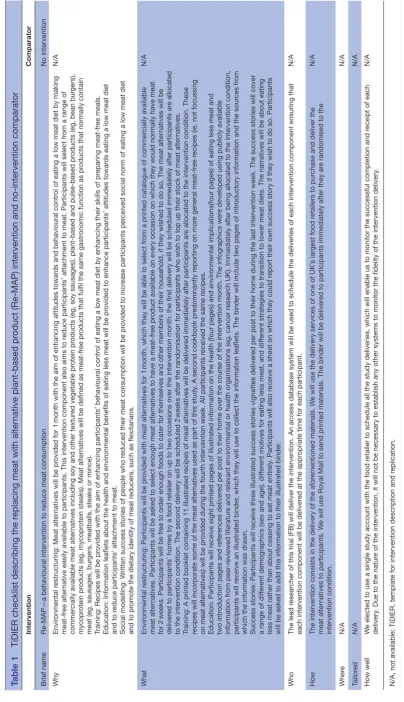
Participants in the control condition will receive no inter-vention. The template for intervention description and replication (TiDIER) checklist34 for the Re-MAP interven-tion and the comparator is reported in table 1.
Patients and public involvement
Following the development of the basic intervention structure, we held a discussion group with 10 members of the general public aiming to improve the acceptability and effectiveness of the RE-MAP intervention. We invited five meat eaters and five meat reducers to attend the discussion group, aiming to include people representing the target population of the intervention as well as people that successfully reduced their meat consumption. Public contributors were recruited using an established mailing list. The discussion group informed the development of each intervention component and of other aspects of the trial including:
► What type of meat alternatives to offer as part of the intervention.
► How to design the educational intervention compo-nents to be engaging and easily accessible to different publics.
► What language to use as part of the success stories vignettes and how to increase their relatability.
► What cookbooks and recipes to use as part of the intervention.
on September 22, 2020 by guest. Protected by copyright.
► The likely burden of trial participation and how to best compensate trial participants.
Contributors to the aforementioned public involve-ment activities will not be involved in other aspects of the trial implementation (such as recruitment) and will be asked not to enrol as trial participants, as they will have already reviewed much of the intervention material.
outcomes
Primary outcome
► Change in mean daily grams of meat consumed between the baseline (T0) and the 4-week follow-up (T1).
Secondary outcomes
► Change in mean daily grams of meat consumed between the baseline (T0) and the 8-week follow-up (T2).
► Change in the intention to eat a low meat diet between the baseline (T0) and both follow-up (T1, T2). ► Change in attachment to meat, eating identities and in
attitudes, perceived behavioural control, and subjec-tive social norm of eating a low meat diet between the baseline (T0) and both follow-up (T1, T2).
Exploratory outcomes
► Change in participants’ blood lipid profiles (total cholesterol, High-density lipoprotein (HDL) choles-terol, triglycerides, Low-density lipoprotein (LDL) cholesterol, non-HDL cholesterol, LDL:HDL choles-terol ratio) between the baseline (T0) and both follow-up (T1, T2).
► Change in systolic and diastolic blood pressure between the baseline (T0) and both follow-up (T1, T2).
► Change in participants’ body mass index between the baseline (T0) and both follow-up (T1, T2).
► Change in participants’ body fat percentage between the baseline (T0) and both follow-up (T1, T2).
► Change in the number of meals containing foods from other food groups between the baseline (T0) and both follow-up (T1, T2).
► Change in participants’ mean daily energy, macronu-trients and micronumacronu-trients intake between the base-line (T0) and both follow-up (T1, T2).
► Change in participants’ intentions, attitudes, perceived behavioural control and subjective social norms of using meat alternatives between the baseline (T0) and both follow-up (T1, T2).
► Change in participants’ desire for meat substitutes to be similar to meat between the baseline (T0) and both follow-up (T1, T2).
Measurements
Table 2 provides a summary of the trial activities and of the measurement that will be collected at each stage of the trial.
sociodemographic characteristics
► At the baseline, participants will be asked to self-re-port on their age, sex, highest degree, household income, household composition, ethnicity and nationality.
Psychological trait characteristics
► At the baseline, participants’ trait food neophobia will be measured using a questionnaire scale adapted from Pliner and Hobden35 including six items with a 7-point scale (disagree strongly—agree strongly). ► At the baseline, participants’ self-control will also be
assessed using a questionnaire scale adapted from Tangney36 including eight items with a 7-point scale (disagree strongly—agree strongly).
Figure 1 Intervention logic model.
on September 22, 2020 by guest. Protected by copyright.
Table 1
TiDIER checklist describing the r
eplacing meat with alter
native plant-based pr
oduct (Re-MAP) intervention and no-intervention comparator
Intervention
Comparator
Brief name
Re-MAP—a behavioural intervention to r
educe meat consumption
No intervention
Why
Envir
onmental r
estructuring: Meat alter
natives will be pr
ovided for 1
month with the aim of enhancing attitudes towar
ds and behavioural contr
ol of eating a low meat diet by making
meat-fr
ee alter
native easily available to participants. This intervention component a
lso aims to r
educe participants’ attachment to meat. Participants will select fr
om a range of
commer
cially available meat alter
natives including soy and other textur
ed vegetable pr
otein pr
oducts (eg, soy sausages), plant-based and pulse-based pr
oducts (eg, bean bur
gers),
mycopr
otein pr
oducts (eg, mycopr
otein steaks). Meat alter
natives will be defined as meat-fr
ee pr
oducts that fulfil the same gastr
onomic function as pr
oducts that normally contain
meat (eg, sausages, bur
gers, meatballs, steaks or mince).
Training: Recipes will be pr
ovided with the aim of enhancing participants’ behaviour
al contr
ol of eating a low meat diet by enhancing their skills of pr
eparing meat-fr
ee meals.
Education: Information leaflets about the health and envir
onmental benefits of eating less meat will be pr
ovided to enhance participants’ attitudes towar
ds eating a low meat diet
and to r
educe participants’ attachment to meat.
Social modelling: W
ritten success stories of people who r
educed their meat consumption will be pr
ovided to incr
ease participants per
ceived social norm of eating a low meat diet
and to pr
omote the dietary identity of meat r
educers, such as flexitarians.
N/A
What
Envir
onmental r
estructuring: Participants will be pr
ovided with meat alter
natives for 1
month, which they will be able to select fr
om a printed catalogue of commer
cially available
meat alter
natives. Participants will be asked to select enough meat alter
natives to have a meat-fr
ee pr
oduct available on every occasion on which they would normally have meat
for 2
weeks. Participants will be fr
ee to or
der enough foods to cater for themselves and other members of their household, if they wished to do so. The meat alter
natives will be
deliver
ed to participants’ homes by a food r
etailer on up to two occasions over the intervention month: the first delivery will be scheduled immediately after participants
ar
e allocated
to the intervention condition. The second delivery will be scheduled 2
weeks after the randomisation for participants who wish to top up their stock of meat alter
natives.
Training: A printed booklet containing 11 illustrated r
ecipes of meat alter
natives will be deliver
ed immediately after participants ar
e allocated to the intervention condition. These
recipes will incorporate some of the meat alter
natives used as part of this study
. A second cookbook pr
edominantly r
eporting on mor
e general meat-fr
ee r
ecipes (ie, not focussing
on meat alter
natives) will be pr
ovided during the fourth intervention week. All participants r
eceived the same r
ecipes.
Education: Participants will r
eceive eight printed pages of illustrated information on the health (four pages) and envir
onmental implications(four pages) of eating less meat and
two intr
oduction pages and r
efer
ences deliver
ed per post to their home over the course of the intervention month. The infographics wer
e developed using publicly available
information fr
om peer
-r
eviewed literatur
e and r
elevant envir
onmental or health or
ganisations (eg, cancer r
esear
ch UK). Immediately after being allocated to the intervention condition,
participants will r
eceive an illustrated binder
, which they will use to collect the information leaflets. The binder will include two pages of intr
oductory information and the sour
ces fr
om
which the information was drawn. Success stories: Participants will r
eceive thr
ee illustrated success stories vignettes deliver
ed per post to their home during the last intervention week. The success stories will cover
a range of dif
fer
ent demographics (sex and age), dif
fer
ent motives for eating less meat, and dif
fer
ent strategies to transition to lower meat diets. The narratives will be about eating
less meat rather than about ceasing to eat meat entir
ely
. Participants will also r
eceive a sheet on which they could r
eport their own success story if they wish to do so. Participants
will be asked to add this information to their illustrated binder
.
N/A
Who
The lead r
esear
cher of this trial (FB) will deliver the intervention. An access databas
e system will be used to schedule the deliveries of each intervention component ensuring that
each intervention component will be deliver
ed at the appr
opriate time for each participant.
N/A
How
The intervention consists in the delivery of the afor
ementioned materials. W
e will use the delivery services of one of UK’
s lar
gest food r
etailers to pur
chase and deliver the
meat alter
natives to participants. W
e will use Royal Mail to send printed materials. The binder will be deliver
ed to participants immediately after they ar
e randomised to the
intervention condition. N/A Wher e N/A N/A Tailor ed N/A N/A How well W
e elected to use a single study account with the food r
etailer to schedule all the study deliveries, which will enable us to monitor the successful completion and r
eceipt of each
delivery
. Due to the natur
e of the intervention, it will not be necessary to establish any other systems to monitor the fidelity of the intervention
delivery
.
N/A
N/A, not available; TiDIER, template for intervention description and r
eplication. on September 22, 2020 by guest. Protected by copyright.
dietary measurements
► Meat consumption will be measured in grams/day by disaggregating meat products recorded by partici-pants on their 7 days food diaries. The daily average will exclude days in which energy intake was <1000 kcal, which are considered unlikely to represent habitual consumption.
► Average daily number of meals containing foods from other food groups will be measured counting the meals in participants’ food diaries containing the food groups of interest, including:
– Unprocessed pork meat.
– Unprocessed red meat from ruminants. – Unprocessed poultry or game meat. – Processed meat.
– Mycoprotein meat alternatives.
– Soy-based meat alternatives or meat alternatives
made of other textured vegetable protein.
– Other meat alternatives (eg, bean burgers). – Milk and yoghurt.
– Cheese.
– Dairy-free milk and yoghurt alternatives. – Dairy-free cheese alternatives.
– Fish and seafood. Table 2 Schedule of measurements and trial activities
Visits Telephone
screening Enrolmentvisit Baselinevisit 4-week follow-up 8-week follow-up
Enrolment
Eligibility screening X
Informed consent X
Randomisation X
Intervention
Replacing meat with alternative plant-based product Control
Demographic and psychosocial traits
Demographics X
Food neophobia X
Self-control scale X
Dietary measurements
Food diary X X X
Retrospective eating questionnaire X X X
Psychosocial variables
Attitude towards eating a low meat diet and using meat alternatives
X X X
Perceived behavioural control of eating a low meat diet and
using meat alternatives X X X
Subjective social norm of eating a low meat diet and using
meat alternatives X X X
Intention to eat a low meat diet and to use meat alternatives X X X
Attachment to meat X X X
Eating identity X X X
Desire for similarity between meat and meat alternatives X X X
Biophysical outcomes
Height X
Weight X X X
Body composition X X X
Blood pressure X X X
Blood lipids profile X X X
Qualitative workstream
Semistructured interviews X
on September 22, 2020 by guest. Protected by copyright.
– Eggs.
– Pulses other than those in meat alternatives.
– Vegetables other than those in meat alternatives. – Starchy foods other than those in meat alternatives. – Nuts and seeds other than those in meat alternatives. – Fruit.
– Savoury and sweet snacks. – Soft drinks.
– Alcoholic drinks.
A retrospective eating questionnaire will also ask participants to recall the number of eating occasions on which they had the foods listed above over the week of their food diary. This questionnaire will only be used in sensitivity analyses.
► The daily average energy intake and nutritional composition of participants’ diets will be measured using data from the online food diary.
Psychosocial variables
► Attachment to meat will be measured using the meat attachment questionnaire.37
► Eating identities will be self-reported by participants among meat eater, omnivore, flexitarian, pescatarian, vegetarian, vegan or ‘other’.
► Attitudes, subjective social norms and perceived behavioural control to eat a low meat diet and to use meat alternatives will be, respectively, assessed with three questionnaire items constructed following Francis et al38 on a 7-point scale (disagree strongly— agree strongly).
► Intentions to eat a low meat diet and to use meat alter-natives will be assessed using a single questionnaire item on a 7-point scale (disagree strongly—agree strongly).
► Desire for similarity between meat and meat alterna-tives will be assessed using 11 questionnaire items with a 7-point scale (disagree strongly—agree strongly) adapted from Hoek et al.25
Physical measures
► Blood lipids profiles (total cholesterol, HDL terol, triglycerides, LDL cholesterol, non-HDL choles-terol, LDL:HDL cholesterol ratio) will be measured using Alere Cholestech LDX.
► Height will be measured to the nearest 0.1 cm using a stadiometer.
► Weight and body composition will be measured using an electronic scale (SC-240 MA, Tanita, Japan), which records the proportion of body fat using bioelectrical impedance. Weight was recorded to the nearest 0.1 kg. ► Seated blood pressure will be measured as the average
of the second and third reading of three seated readings
retention
We will use reminder text messages to increase atten-dance to each of the four study appointments. Addition-ally, participants will receive financial compensation for
partaking in each of the three assessment visits. Partici-pants will have the right to withdraw from the study at any time. The principal investigator will have the right to discontinue participants’ involvement in the study when they become ineligible and/or when significant protocol deviations occur. The data of participants who withdraw will be kept and might be used in exploratory and sensi-tivity analyses, unless the participant requests for the data to be deleted.
Adverse events
Any study-related adverse event will be reported to the research ethics committee in accordance to Good Clin-ical Practice (GCP). All study-related adverse events will be included in the final trial report.
data management
Data will be entered by a trained member of the research team and stored in an OpenClinica database that was specifically developed for this trial. The database will feature ranges and validation checks to promote reliability in the data entry process. Data recording and storage will run in accordance with GCP.
statistical analyses
We will employ linear models to investigate whether changes in meat consumption between the baseline and both follow-up differ significantly between the interven-tion and the control group. Our main analysis will employ unadjusted models and only include data from partici-pants completing the relevant follow-up. Sensitivity anal-ysis will be performed with a baseline observation carried forward assumption for missing data and adjusting for baseline variables. The intervention effect will be reported with 95% CI and p values. A two-tailed criterion p value of alpha=0.05 will be used to assess the statistical significance of the results. The same procedure will be employed to assess whether changes in the other prespec-ified dietary, nutritional, psychosocial and biophysical outcomes between the baseline and both follow-up differ significantly between the control and the intervention group. Detailed main, subgroup and sensitivity analyses plans will be finalised before conducting any specific outcome analysis. No interim analysis is planned.
Qualitative study
After the 8-week follow-up, a subsample of participants receiving the intervention will be invited to take part in a semistructured interview. This qualitative study aims to understand participants’ experiences of the intervention, the mechanisms through which the intervention helped reducing meat consumption or the barriers preventing the intervention to aid this transition. The semistruc-tured interviews will follow a discussion guide while also remaining sensitive to unsolicited themes. The interview will set the context by asking participants to elaborate on their motivation to volunteer for the trial and on their thoughts and feelings towards reducing meat consump-tion prior to enrolling into the study. Participants will then
on September 22, 2020 by guest. Protected by copyright.
be encouraged to elaborate on the mechanisms through which they felt that the intervention helped them eat less meat or the barriers preventing the intervention to do so. In doing so, participants will be prompted to think about the intervention in its entirety as well as about each individual intervention component. Participants will be encouraged to elaborate on their perceived ability and motivation to maintain a lower consumption of meat after the intervention period and beyond the context of the study. Whenever possible we will use open questions to encourage participants to elaborate on their thoughts and feelings freely and in depth. We aim to avoid ques-tions of evaluative nature to minimise the risk of social desirability bias. We anticipate interviewing 20 partic-ipants, however, sampling will be extended should new themes emerge during the interviewing process. We will employ a purposeful sampling technique aiming to achieve a sex balance. Participants will be free to decide whether or not to be interviewed. No additional compen-sation will be offered to participants agreeing to be inter-viewed. Qualitative interviews will be conducted in person and transcribed verbatim. Transcriptions will be anal-ysed using NVivo and employing a data-driven thematic analysis to identify codes and to group these codes into broader themes.
trial steering committee
The principal investigator will be responsible for the project coordination and the senior investigators will oversee the operational aspects of the trial. The authors of this protocol will form the trial management group (TMG), which will regularly monitor the study imple-mentation, as well as the data generation, documentation and reporting. All members of the TMG are trained in GCP and will take appropriate actions to safeguard partic-ipants and the quality of the trial. Access to data will be granted to appropriate members of the research team and to authorised representatives from the host institution to monitor and/or audit the study and ensure compliance with regulations.
Ethics and dissemination
The investigators will ensure that this study is conducted in accordance with the principles of the Declaration of Helsinki, with relevant institutional regulations, with GCP and General Data Protection Regulations (GDPR). This study was reviewed and received ethical approval by the Medical Sciences Interdivisional Research Ethics Committee of the University of Oxford (R54329/RE001). Substantial planned changes to the protocol, an end of study notification, and a final report will be submitted to the aforementioned research ethics committee. The results of this RCT will be reported following the Consol-idated Standards of Reporting Trials guidelines39 and submitted for publication to scientific journals, regard-less of the outcome. Authorship will be determined in accordance with the International Committee of Medical Journal Editors (ICMJE) guidelines. Contributors of other
parties and funding will be acknowledged. Results will also be presented at national and international confer-ences and disseminated through established networks. A lay summary will be distributed through an established newsletter to which participants can subscribe on their last study appointment.
Acknowledgements We thank all the PPI contributors for having helped us develop the RE-MAP intervention. We thank Lynne Maddocks for her assistance in forming the PPI panel for this study. We thank Lucy Eldridge for her support in developing the study database. We thank Jason Oke for his assistance in developing the randomisation sequence. We thank Alexa Hayley and Bernhard Haring for their comments on previous versions of this manuscript.
Contributors All authors have been involved in shaping each stage of this research protocol. FB has written this protocol and developed the intervention and led on the study design. FB, SAJ and PA have designed the study. FB and NMA have developed the trial management system. NMA, BC and EC have contributed in designing this research and the intervention.
Funding This research is funded by the Wellcome Trust, Our Planet Our Health programme (Livestock, Environment and People—LEAP), award number 205212/Z/16/Z. FB’s time on this project is funded by the Medical Research Council (MRC), Green Templeton College Oxford and the National Institute for Health Research (NIHR) School for Primary Care Research (SPCR). EC’s and BC’s time on this project is funded by the Wellcome Trust, Our Planet Our Health programme (Livestock, Environment and People - LEAP), award number 205212/Z/16/Z. NMA, PA and SAJ are supported by the NIHR Oxford Biomedical Research Centre and Collaboration for Leadership in Applied Health Research and Care Oxford at Oxford Health NHS Foundation Trust. PA and SAJ are NIHR Senior Investigators. Competing interests None declared.
Patient consent for publication Not required.
Ethics approval This study was reviewed and received ethical approval by the Medical Sciences Interdivisional Research Ethics Committee of the University of Oxford (R54329/RE001).
Provenance and peer review Not commissioned; externally peer reviewed. open access This is an open access article distributed in accordance with the Creative Commons Attribution 4.0 Unported (CC BY 4.0) license, which permits others to copy, redistribute, remix, transform and build upon this work for any purpose, provided the original work is properly cited, a link to the licence is given, and indication of whether changes were made. See: https:// creativecommons. org/ licenses/ by/ 4. 0/.
rEFErEnCEs
1. Scarborough P, Kaur A, Cobiac L, et al. Eatwell Guide: modelling the dietary and cost implications of incorporating new sugar and fibre guidelines. BMJ Open 2016;6:e013182.
2. Bouvard V, Loomis D, Guyton KZ, et al. Carcinogenicity of consumption of red and processed meat. Lancet Oncol 2015;16:1599–600.
3. Chan DS, Lau R, Aune D, et al. Red and processed meat and colorectal cancer incidence: meta-analysis of prospective studies. PLoS One 2011;6:e20456.
4. Parkin DM, Boyd L, Walker LC. 16. The fraction of cancer attributable to lifestyle and environmental factors in the UK in 2010. Br J Cancer 2011;105(Suppl 2):S77–S81.
5. Schwingshackl L, Hoffmann G, Lampousi A-M, et al. Food groups and risk of type 2 diabetes mellitus: a systematic review and meta-analysis of prospective studies. Eur J Epidemiol 2017:1–13. 6. Micha R, Wallace SK, Mozaffarian D. Red and processed meat
consumption and risk of incident coronary heart disease, stroke, and diabetes mellitus: a systematic review and meta-analysis. Circulation 2010;121:2271–83.
7. Micha R, Michas G, Mozaffarian D. Unprocessed red and processed meats and risk of coronary artery disease and type 2 diabetes–an updated review of the evidence. Curr Atheroscler Rep 2012;14:515–24.
8. Song M, Fung TT, Hu FB, et al. Association of Animal and Plant Protein Intake With All-Cause and Cause-Specific Mortality. JAMA Intern Med 2016;176:1453.
on September 22, 2020 by guest. Protected by copyright.
9. Feskens EJM, Sluik D, van Woudenbergh GJ, et al. Diabetes, and Its Complications. Curr Diab Rep 2013;13:298–306.
10. Barnard N, Levin S, Trapp C. Meat consumption as a risk factor for type 2 diabetes. Nutrients 2014;6:897–910.
11. Pan A, Sun Q, Bernstein AM, et al. Changes in Red Meat Consumption and Subsequent Risk of Type 2 Diabetes Mellitus. JAMA Intern Med 2013;173:1328.
12. Steinfeld H, Gerber P, Wassenaar T. Livestock’s long shadow. 2006. https://www. rfp- europe. org/ fileadmin/ SITE_ ERFP/ ERFP_ meetings/ 2007_ Dublin/ Dublin2007_ LivestocksLongShadow_ HOFFMANN. pdf (cited 23 May 2017).
13. Pimentel D, Pimentel M. Sustainability of meat-based and plant-based diets and the environment. Am J Clin Nutr 2003;78(3 Suppl):660S–3.
14. Tilman D, Clark M. Global diets link environmental sustainability and human health. Nature 2014;515:518–22.
15. Watts N, Amann M, Ayeb-Karlsson S, et al. The Lancet Countdown on health and climate change: from 25 years of inaction to a global transformation for public health. Lancet 2018;391.
16. Mcmichael AJ, Campbell-Lendrum DH, Corvalán CF, et al. Climate change and human health. Risks and responses 2003. http://www. who. int/ globalchange/ publications/ climchange. pdf (cited 25 Jan 2018).
17. Economou V, Gousia P. Agriculture and food animals as a source of antimicrobial-resistant bacteria. Infect Drug Resist 2015;8:49–61. 18. Tang KL, Caffrey NP, Nóbrega DB, et al. Restricting the use of
antibiotics in food-producing animals and its associations with antibiotic resistance in food-producing animals and human beings: a systematic review and meta-analysis. Lancet Planet Health 2017;1:e316–e327.
19. Bailey R, Froggatt AWL. Livestock–climate change’s forgotten sector. 2014. https:// gastronomiaycia. republica. com/ wp- content/ uploads/ 2014/ 12/ estudio_ consumo_ carne. pdf (cited 10 Nov 2017). 20. Garnett T, Mathewson S, Angelides P, et al. Policies and actions to
shift eating patterns: What works? 2015. http://www. fcrn. org. uk/ sites/ default/ files/ fcrn_ chatham_ house_ 0. pdf (cited 24 May 2017). 21. Wellesley L, Happer C, Froggatt A. Chatham House Report Changing
Climate, Changing Diets Pathways to Lower Meat Consumption. 2015 https://www. chathamhouse. org/ sites/ files/ chathamhouse/ publications/ research/ CHHJ3820 (cited 10 Nov 2017). 22. Bianchi F, Dorsel C, Garnett E, et al. Interventions targeting
conscious determinants of human behaviour to reduce the demand for meat: a systematic review with qualitative comparative analysis. Int J Behav Nutr Phys Act 2018;15:102.
23. Bianchi F, Garnett E, Dorsel C, et al. Restructuring physical micro-environments to reduce the demand for meat: a systematic review and qualitative comparative analysis. Lancet Planet Heal [Internet].
Elsevier 2018;2:e384–97.
24. Mintel Group Ltd. Meat-free Foods - UK. 2017. http:// academic. mintel. com/ sinatra/ oxygen_ academic/ list/ id= 796253& type= RCItem# 0_ 1___ page_ RCItem=0 (cited 12 Nov 2017).
25. Hoek AC, Luning PA, Weijzen P, et al. Replacement of meat by meat substitutes. A survey on person- and product-related factors in consumer acceptance. Appetite 2011;56:662–73.
26. Hartmann C, Siegrist M. Consumer perception and behaviour regarding sustainable protein consumption: A systematic review. Trends Food Sci Technol 2017;61:11–25.
27. Kumar P, Chatli MK, Mehta N, et al. Critical Reviews in Food Science and Nutrition Meat analogues: Health promising sustainable meat substitutes Meat analogues: Health promising sustainable meat substitutes. 2017. http://www. tandfonline. com/ action/ journalInformation? journalCode= bfsn20 (cited 16 May 2018). 28. Clery E, Bailey R. Food technologies Findings from the 2008 British
Social Attitudes survey. 2010. Available: http://www. fcrn. org. uk/ sites/ default/ files/ BSA_ Food_ technologies_ findings. pdf (cited 24 May 2017).
29. Hoek AC, Elzerman JE, Hageman R, et al. Are meat substitutes liked better over time? A repeated in-home use test with meat substitutes or meat in meals. Food Qual Prefer 2013;28:253–63.
30. Clark M. Chronic Effects Of Replacing Red And Processed Meat With Non/Reduced Meat Alternatives. Cambridge University Press, 2017. https://www. cambridge. org/ core/ product/ identifier/ S0029665117001434/ type/ journal_ article (cited 12 Nov 2017). 31. Holloway T, Salter AM, McCullough FS. Dietary intervention to
reduce meat intake by 50% in University students – a pilot study. Proc Nutr Soc 2012;71(OCE2):E164.
32. Michie S, Atkins L, West R. The behaviour change wheel: a guide to designing interventions. Needed: physician leaders. 2014. http:// www. physicianleaders. ca/ assets/ cspl jour nals umme r2015. pdf# page= 26 (cited 24 May 2017).
33. Michie S, van Stralen MM, West R. The behaviour change wheel: a new method for characterising and designing behaviour change interventions. Implement Sci 2011;6:42.
34. Hoffmann TC, Glasziou PP, Boutron I, et al. Better reporting of interventions: template for intervention description and replication (TIDieR) checklist and guide. BMJ 2014;348:g1687.
35. Pliner P, Hobden K. Development of a scale to measure the trait of food neophobia in humans. Appetite 1992;19:105–20.
36. Tangney J. High self-control predicts good adjustment, less pathology, better grades, and interpersonal success. taylorfrancis. com. Available: https://www. taylorfrancis. com/ books/ e/
9781351707756/ chapters/ 10. 4324% 2F9781315175775- 12 (cited 13 May 2018).
37. Graça J, Calheiros MM, Oliveira A. Attached to meat? (Un) Willingness and intentions to adopt a more plant-based diet. Appetite 2015;95:113–25.
38. Francis J, Eccles M, Johnston M, et al. Constructing questionnaires based on the theory of planned behaviour: A manual for health services researchers. 2004.
39. Schulz KF, Altman DG, Moher D. CONSORT Group. CONSORT 2010 Statement: updated guidelines for reporting parallel group randomised trials. BMC Med 2010;8:18.
on September 22, 2020 by guest. Protected by copyright.