Volume 2007, Article ID 64012,16pages doi:10.1155/2007/64012
Research Article
The Shooting Method and Nonhomogeneous Multipoint BVPs of
Second-Order ODE
Man Kam Kwong and James S. W. Wong
Received 25 May 2007; Revised 20 August 2007; Accepted 23 August 2007
Recommended by Kanishka Perera
In a recent paper, Sun et al. (2007) studied the existence of positive solutions of nonhomo-geneous multipoint boundary value problems for a second-order differential equation. It is the purpose of this paper to show that the shooting method approach proposed in the recent paper by the first author can be extended to treat this more general problem.
Copyright © 2007 M. K. Kwong and J. S. W. Wong. This is an open access article distrib-uted under the Creative Commons Attribution License, which permits unrestricted use, distribution, and reproduction in any medium, provided the original work is properly cited.
1. Introduction
In a previous paper [1], the first author demonstrated that the classical shooting method could be effectively used to establish existence and multiplicity results for boundary value problems of second-order ordinary differential equations. This approach has an advan-tage over the traditional method of using fixed point theorems on cones by Krasnosel’ski˘i [2]. It has come to our attention after the publication of [1] that Baxley and Haywood [3] had also used similar ideas to study Dirichlet boundary value problems.
In this article, we continue our exposition by further extending this shooting method approach to treat multipoint boundary value problems with a nonhomogeneous bound-ary condition at the right endpoint, and homogeneous boundbound-ary condition at the left endpoint of the most general type, that is, the Robin boundary condition which includes both Dirichlet and Neumann boundary conditions as special cases.
Symmetric positive solutions for Dirichlet boundary value problems, which are related to second-order elliptic partial differential equations, were studied by Constantian [9], Avery [10], and Henderson and Thompson [11]. We defer a discussion of these results in relation to ours to the last section of this paper.
We will first establish two existence results (Theorems3.1and3.2) on multipoint prob-lems for the second-order differential equation
u(t) +a(t)fu(t)=0, t∈(0, 1), (1.1)
where the nonlinear term is in a separable format, andaand f are continuous functions satisfying
a: [0, 1]−→[0,∞), a(t)≡0,
f : [0,∞)−→[0,∞), f(u)>0 foru >0. (1.2)
Note that the assumption that f(u) does not vanish foru >0 is a technical assumption imposed for convenience. Without this assumption, the second inequality sign in (1.8) and (1.9) below may not be strict.
Analogous results (Theorems3.3and3.4) are then formulated and extended to non-linear equations of the more general form
y(t) +Ft,y(t)=0, t∈(0, 1), (1.3)
where the nonlinear term may not be in a separable format. In both [12,13], the Neumann boundary condition
u(0)=0 (1.4)
is imposed on the left endpoint. Some other authors use the Dirichlet condition
u(0)=0. (1.5)
The results in this paper are applicable to the most general Robin boundary condition of the form
(sinθ)u(0)−(cosθ)u(0)=0, (1.6)
whereθ is a given number in [0, 3π/4). The choicesθ=0 andπ/2 correspond, respec-tively, to the Neumann and Dirichlet conditions (1.4) and (1.5). We leave out thoseθ
in [3π/4,π] as solutions satisfying the corresponding Robin’s condition cannot furnish a positive solution for our boundary value problem. To see this, note that ifθ∈[3π/4,π], thenu(0)=u(0) tanθ≤ −u(0). Sinceu(t) is concave,u(t) must lie below the line joining the points (0,u(0)) and (1, 0), sou(t) cannot be positive in [0, 1].
The second boundary condition we impose involves m−2 given pointsξi∈(0, 1),
positive numbers, andb≥0. We require the solution to satisfy
u(1)−
m−2
i=1
kiu
ξi
=b≥0. (1.7)
The boundary value problem for the differential equation (1.1) with boundary conditions (1.6) and (1.7) is often referred to as them-point problem. Whenb=0, the multipoint boundary condition is said to be homogeneous. Otherwise, it is called nonhomogeneous. In the special case whenm=3, only one interior pointξ=ξ1is used and the boundary value problem is called a three-point problem.
In the case of left Neumann problem, it is known that a necessary condition for the existence of a positive solution is
0<ki<1. (1.8)
To see this, we putb=0 in (1.7) and use the fact thatu(1)< u(ξi) for alli, becauseu(t) is
a concave function in [0, 1].
In the case of the left Dirichlet problem, the corresponding necessary condition is
0<kiξi<1. (1.9)
To see this, we use the fact thatu(t) is a concave function, and sou(t) lies strictly above the straight line joining the origin (0, 0) with the point (1,u(1)). Therefore,u(ξi)> ξiu(1)
for alli. Plugging these inequalities andb=0 into (1.7) gives (1.9).
We will state and prove the corresponding necessary condition for the general Robin condition in the next Section, seeLemma 2.2.
In [12], Ma proved the following existence result for the homogeneous three-point problem. Define
f0= lim
u→0+
f(u)
u , f∞=ulim→∞ f(u)
u . (1.10)
Theorem1.1. The three-point problem (1.1), (1.5), and (1.7) (withm=3andb=0) has at lease a positive solution if either
(a) f0=0and f∞= ∞(the superlinear case) or
(b) f0= ∞andf∞=0(the sublinear case).
For the nonhomogeneous problem, Ma [14] has the following result for the superlin-ear case.
Theorem1.2. Suppose that f(u)is superlinear as in case (a) ofTheorem 1.1. There exists a positive numberb∗such that for allb∈(0,b∗), the nonhomogeneous three-point problem (1.1), (1.5), and (1.7) has at least one positive solution. Furthermore, forb > b∗, there is no positive solution.
(i.e., when f0= ∞and f∞=0 as in case (b) ofTheorem 1.1) without providing a proof.
However, the simple counterexample
u(t) + 1=0, u(0)=0, u(1)−u(1/2)
2 =b (1.11)
has the solutionu(t)= −t2/2 + 2b+ 7/8 for allb >0, showing that the result as stated in [13, Theorem 1.2] is false.
Since our technique of proof uses the shooting method, the issues of continuability and uniqueness of initial value problems for the differential equations (1.1) or (1.3) arise naturally. In fact, these issues have already been discussed in [1]. The readers can be re-ferred to that paper for more details. We only give a brief summary below. It is well known that continuability and uniqueness may not always hold for initial value problems of gen-eral nonlinear equations. In particular, it is known, see, for example, Coffman and Wong [15], that solutions of superlinear equation may not be continuable to a solution defined on the entire interval [0, 1]. This is not a problem for our study because in our technique, we only need to be able to extend the solution up to its first zero. Since the solution is concave, this poses no problem at all. We also know that solutions of initial value prob-lems may not be unique if f(u) is not Lipschitz continuous. In such a situation, we can approximate f(u) by Lipschitz continuous functions, obtain existence for the smoothed equation, and then use a compactness (passing to limit) argument to derive solutions for the original equation.
2. Auxiliary lemmas
Our first Lemma has already been presented in [1]. It is repeated here for the sake of easy reference. It is a simple consequence of a well-known fact in the Sturm Comparison theory of linear differential equations.
Lemma2.1. LetY(t)andZ(t)be, respectively, positive solutions of the two linear differential equations
Y(t) +b(t)Y(t)=0,
Z(t) +B(t)Z(t)=0, (2.1)
in the interval[0, 1]such thatY(0)/Y(0)≥Z(0)/Z(0), and we assume thatb(t)≤B(t) for allt∈[0, 1]. Letξi∈(0, 1)andki>0,i=1,. . .,m−2be2m−4given constants, and let
τ∈[0, 1]be any constant greater than all theξi, then
m−2
i=1
kiY
ξi
Y(τ) ≤
m−2
i=1
kiZ
ξi
Z(τ) . (2.2)
Proof. The classical Sturm comparison theorem has a strong form that yields the inequal-ity
Y(t)
Y(t) ≥
Z(t)
Z(t), t∈[0, 1], (2.3)
where strict inequality will hold if we know, in addition, thatb≡Bin [0,t]. One way to prove this is to note that the functionr(t)=Y(t)/Y(t) satisfies a Riccati equation of the form
r(t) +b(t) +r2(t)=0. (2.4)
The function s(t)=Z(t)/Z(t) satisfies an analogous Riccati equation. The inequality
r(t)≥s(t) follows by applying results in differential inequalities to compare the two Ric-cati equations.
Letξbe any point in (0,τ). By integrating over [ξ,τ], we see that
log Y
(ξ)
Y(τ)
= −
τ
ξ
Y(t)
Y(t)dt≤ − τ
ξ
Z(t)
Z(t)dt=log Z
(ξ)
Z(τ)
. (2.5)
Hence,Y(ξ)/Y(τ)≤Z(ξ)/Z(τ). In particular, the inequality is true forξ=ξi, and the
conclusion of the lemma follows by taking the appropriate linear combination of the
various fractions.
Lemma2.2. A necessary condition for the homogeneous Robin multipoint boundary value problem, withθ=π/2, to have a positive solution is
m−2
i=1
ki
1 +ξitanθ
1 + tanθ <1. (2.6)
Proof. LetSbe the tangent line to the solution curveu(t) at the initial point (0,u(0)). LetY(t) be the function that is represented byS. ThenY satisfies the simple differential equationY(t)=0. We can useLemma 2.1to compareu(t) withY(t) to get
uξi
u(1) >
Yξi
Y(1) =
1 +ξitanθ
1 + tanθ . (2.7)
Substituting these inequalities into the homogeneous Robin boundary condition gives
(2.6).
The next lemma is reminiscent of the eigenvalue problem of a linear equation.
Lemma2.3. Consider the homogeneous linear multipoint boundary value problem
y(t) +λa(t)y(t)=0, t∈(0, 1), (2.8)
(see (1.6)), y(1)−
m−2
i=1
kiy
ξi
whereλis a positive parameter, anda(t)≥0,a(t)≡0. Furthermore, assume that (2.6) holds. Then there exists a unique constantLθ>0for which the problem, withλ=Lθ, has a positive nontrivial solution.
Proof. Let y(t;λ) be the “shooting” solution of the initial value problem for (2.8) with
y(0,λ)=1 andy(0,λ)=tanθ, whenθ=π/2. In the Dirichlet caseθ=π/2, we lety(0,λ)
=0 and y(0,λ)=1. Let us increaseλcontinuously from 0 to the first valueλ=Λθ for
whichy(1;Λθ)=0. The assumption thata(t)≡0 is needed here to ensure thatΛθexists.
Forλ∈[0,Λθ),y(1,λ)>0, and we can define
φ(λ)=
m−2
i=1
kiy
ξi;λ
y(1,λ) , (2.10)
which is a continuous function ofλ. Condition (2.6) implies thatφ(0)<1. On the other hand, limλ→Λθφ(λ)= ∞. Hence, by the intermediate value theorem, there exists a value
λ=Lθsuch thatφ(λ)=1, and this yields a solution of the boundary value problems (2.8)
and (2.9).
The uniqueness ofLθfollows from the fact thatφ(λ) is a strictly increasing function of
λ, which is a simple corollary ofLemma 2.1.
In the proof ofLemma 2.3, we see that ify(1,λ)>0, thenφ(λ) is defined and finite. Later inSection 3, we have occasions to make use of the inverse of this simple fact, namely, that ifφ(λ) (or a similar function) is defined and finite, theny(1;λ) (or the value att=1 of a similar function) is positive.
3. Main results
To study the multipoint problem, we use the shooting solutionu(t;h), which satisfies the initial condition
u(0;h)=h, u(0;h)=htanθ, (3.1)
forθ=π/2, and
u(0;h)=0, u(0;h)=h, (3.2)
for the Dirichlet case.
The functionu(t;h) concaves downwards. It can happen thatu(t;h) intersects thet -axis at some pointt=τ≤1. Such a function cannot be a positive solution to our bound-ary value problem. In the contrbound-ary case, suppose thatu(t;h) remains positive in [0, 1].
We define two functions
φ(h)=
m−2
i=1
kiu
ξi;h
u(1,h) (3.3)
ψ(h)=max
u(1;h)−
m−2
i=1
kiu
ξi;h
which are continuous inh(when restricted to where the functions are defined). The first function is similar toφ(λ) defined in (2.10), except that we useu(t;h) instead ofy(t;λ). Note thatψ(h)=0 if and only ifφ(h)≥1.
The second functionψcan be extended to include allh≥0 by simply definingψ(h)=
0 ifu(t;h) vanishes at some t≤1. The extended functionψ(h) becomes a continuous function ofh∈[0,∞).
It is obvious from the definition that forb >0,u(t;κ) furnishes a solution to our mul-tipoint problem if and only ifψ(κ)=b. Forb=0,u(t;κ) is a nontrivial solution if and only ifκ=0 and is a boundary point of the set of points{h >0|ψ(h)=0}(in other words,ψ(κ)=0, and every neighborhood ofκcontains points for whichψ(h)>0).
We can now state our first result.
Theorem3.1. Suppose that (1.2) hold, and
lim sup
u→0+
f(u)
u < Lθ, lim infu→∞ f(u)
u > Lθ, (3.5)
whereLθ is the positive constant guaranteed by Lemma 2.3. Then there exists a constant
b∗>0such that the BVP (1.1), (1.6), and (1.7) has (1)at least two positive solutions forb∈(0,b∗), (2)at least one positive solution forb=0orb∗, (3)and no positive solution forb > b∗.
Proof. The first condition means that whenu is sufficiently small, the nonlinear term
a(t)f(u(t)) is dominated by the linear functionLa(t)u(t). More precisely, letL1 be any number such that
lim sup
u→0+
f(u)
u < L1< Lθ. (3.6)
Then there exists au1>0 such that for allu∈[0,u1],
f(u)< L1u < Lθu. (3.7)
Let us shoot a solutionu(t;h) with a sufficiently smallh. Sinceu(t;h) concaves down-wards, its curve lies below the straight line that is tangent to the curve at the point (0,h). By choosinghsufficiently small, say forh < h1 for someh1>0, we can guarantee that
u(t;h)≤u1for allt∈[0, 1]. The inequality (3.7), therefore, holds for alltclose tot=0, up to the first zero ofu(t,h) if there is one beforet=1. This allows us to compareu(t;h) with solutions of
z(t) +L1a(t)z(t)=0, z(0)=h≤h1, z(0)=htanθ, (3.8)
at least in the neighborhood of 0 before the first zero ofu(t;h). It is easy to see that, in fact,
z(t)=hy(t;L1), wherey(t;λ) is the solution of (2.8) defined in the proof ofLemma 2.3. By the Sturm comparison theorem,u(t;h)≥z(t)≥hy(t;Lθ) for allt. Since y(t;Lθ)
sat-isfies the boundary condition (2.9), we see thaty(t;Lθ) does not vanish in [0, 1]. Hence,
on the entire interval [0, 1]. Another implication is thatψ(h) will now be determined by (3.4) instead of being set simply to 0 in the case when the solution vanishes somewhere in [0, 1].
UsingLemma 2.1, we have
φ(h)≥φL1> φLθ=1. (3.9)
It follows thatu(1,h)−kiu(ξi;h)>1 and consequentlyψ(h)>0. Recall that this fact is
proved for allh∈(0,h1).
Next, let us study the functionψ(h) whenhis large. The second condition of (3.5) is similar to the first one, and suggests an analogous situation. LetL2 be any number betweenLθ and lim infu→∞f(u)/u. By hypothesis, we can find au2 large enough such that
f(u)≥L2u > Lθu (3.10)
for allu≥u2. This allows us to compare solutions of (1.1) with solutions of
w(t) +L2a(t)w(t)=0, w(0)=h≥u2, w(0)=htanθ (3.11)
(note thatw(t) is simplyhy(t;L2)) as long asu(t;h) remains aboveu2. This last require-ment complicates our argurequire-ments because we have no guarantee thatu(t;h)≥u2whent is near 1. The Dirichlet case has an additional complication becauseu(t; 0)=0, and we have to deal with those points that are neart=0.
In the following, we present the detailed proof for the Neumann case. The proof for the general case is similar, with an appropriate modification of the value ofτ. We leave the Dirichlet case to the readers.
We now assume only the Neumann case withu(0;h)=hand u(0,h)=0. Suppose thatu(τ;h)=u2for somet=τ. We claim that ifτ≤1−u2/h, thenu(t;h) must vanish somewhere in [τ, 1]. In such cases, by definition,ψ(h)=0. To prove the claim, in thetu -plane, we draw a straight lineSjoining the points (0,h) and (1, 0). The point (1−u2/h,u2) lies onS. The solution curveu(t;h) intersects the straight lineSat the initial point (0,h) but stays aboveSat least for a neighborhood neart=0. Ifτ≤1−u2/h, then the point on the curve att=τis belowS. Therefore, the solution curve intersects Sat a second point somewhere beforeτ. Sinceu(t;h) is concave, it cannot intersectSat a third point, sou(t;h) must lie strictly belowSin [t, 1], forcing it to vanish somewhere before reaching
t=1.
It, therefore, remains to find whatψ(h) is whenτ >1−u2/h. By choosinghsufficiently large, we can makeτas close to 1 as we please. Let us determine how close it should be in order to work for us. We know thatφ(L2)> φ(Lθ)=1. By continuity, we can pick a point
τ1close to, but distinct from, 1 such that
m−2
i=1
kiw
ξi
wτ1
=
m−2
i=1
kiy
ξi;L2
yτ1;L2
≥1. (3.12)
b
b
κ1 κ
κ2 κ h2
Figure3.1. Graph ofψ(h) (Theorem 3.1).
We claim thatψ(h)=0 for allh > h2. Let us consider all shooting solutionsu(t;h) with initial heighth≥h2. Ifu(τ1;h)≤u2, thenu(t;h) must have reachedu2beforeτ1< 1−u2/h. By the above claim, we know thatψ(h)=0. So we assume thatu(τ1;h)> u2. In the interval [0,τ1], comparing (1.1) withwis valid andLemma 2.1gives
m−2
i=1
kiu
ξi;h
uτ1;h ≥
m−2
i=1
kiw
ξi
wτ1
≥1. (3.13)
Even though we do not have precise information on howu(t;h) behaves in the interval [τ1, 1], we can still determineψ(h). It can happen thatu(t;h) has a zero in this interval. Thenψ(h)=0, by definition. Ifu(t;h) has no zero in [τ, 1], we know that it is a decreasing function, and sou(τ1;h)> u(1;h). Hence,
φ(h)=
m−2
i=1
kiu
ξi;h
u(1;h) >
m−2
i=1
kiu
ξi;h
uτ1;h ≥1. (3.14)
It then follows thatψ(h)=0.
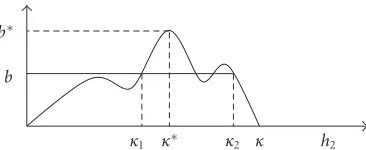
To summarize, the continuous functionψ(h) is positive in a right neighborhood of
h=0, and 0 for allh > h2. It, therefore, is bounded above. Let the least upper bound beb∗, which is obviously positive, and suppose that it is attained at a pointκ∗>0,ψ(κ∗)=b∗.
Figure 3.1illustrates a concrete example.
Letb∈(0,b∗). Then, by continuity,ψ(h) must assume the valuebat least twice: once at a pointκ1in (0,κ∗) and once at a pointκ2in (κ∗,∞). Each of these furnishes a solution to the multipoint problem. It is, of course, possible that there may be other solutions, in particular when the functionψ(h) has multiple local maxima and local minima. Ifb=b∗, thenh=κ∗gives a solution to the multipoint problem. Ifb=0, then the first valueκin (κ∗,∞), for whichψ(κ)=0, gives a solution to the multipoint problem. There may or may not be a solution forhin (0,κ∗) because it can happen that the only valuehthat solvesψ(h)=0 ish=0, which corresponds to the trivial solution. Forb > b∗,ψ(h)=b
has no solution and neither does the multipoint boundary value problem.
Theorem3.2. Suppose that (1.2) hold, and
lim sup
u→∞ f(u)
b
κ1 κ2 κ3 κ
Figure3.2. Graph ofψ(h) (Theorem 3.2).
Then for allb >0, the boundary value problem (1.1), (1.6), and (1.7) has at least one positive solution. If, in addition,
lim inf
u→0+
f(u)
u > Lθ, (3.16)
then the same multipoint problem withb=0has at least one positive solution.
Proof. The arguments are the same as those used to proveTheorem 3.1, except that we interchange the parts regarding large and smallh, respectively, and the conclusions are different.
Assume first that only (3.15) holds. LetL1be a number between lim supu→∞f(u)/u andLθ, and letu1be so large that f(u)/u≤L1< Lθ, foru≥u1.
We can compare the shooting solutionu(t;h) withz(t)=hy(t;L1) as we do in the proof ofTheorem 3.1. Sincez(1)>0, we can takeh > u1/z(1). This ensures thatu(t;h) remains greater than u1 for all t∈[0, 1] so that the comparison is valid in the entire interval [0, 1]. In particular, we have
u(1;h)≥z(1)=hy1;Lθ
. (3.17)
We see that
lim
h→∞u(1;h)= ∞. (3.18)
Now,Lemma 2.1givesφ(h)≤φ(L1)< φ(Lθ)=1. This implies that
ψ(h)=u(1;h)−
m−2
i=1
kiu
ξi;h
≥1−φ(h)u(1;h)−→ ∞ (3.19)
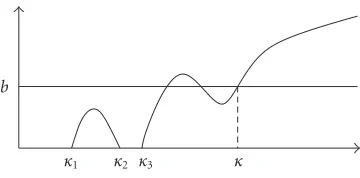
ash→ ∞. We thus see thatψ(h) is a continuous function on [0,∞), with the proper-ties thatψ(0)=0 andψ(h)→ ∞. This is depicted inFigure 3.2. Note also that the func-tionψ(h) may vanish on a subinterval of [0,∞), and this situation is also illustrated in
Figure 3.2.
On account of this, anyb >0 is in the range ofψ(h) and the corresponding boundary value problem has at least one positive solution.
withw(t)=hy(t;L2) as in the proof ofTheorem 3.1. In fact, the argument is easier this time since the comparison condition is now satisfied for all t∈[0, 1], and we do not need to find special treatments for a set of tsuch as those near t=1 in the proof of
Theorem 3.1.
We remark thatTheorem 3.2does not assert the uniqueness of the positive solution whenb=0. In fact, in the example shown inFigure 3.2, there are three positive solutions, corresponding to the pointsκ1,κ2, andκ3.
It is interesting to note the asymmetry between Theorems3.1and3.2. InTheorem 3.1, we need both asymptotic conditions to prove the existence of positive solutions to the boundary value problem, while inTheorem 3.2, we need only one asymptotic condition to get the existence of the solutions. In addition,Theorem 3.1gives at least two positive solutions to the boundary value problem forb < b∗, whileTheorem 3.2can only guaran-tee at least one positive solution for allb >0.
By examining the proof ofTheorem 3.1more closely, it is not difficult to see that the only places where the separable format of the nonlinear term is needed are to enable us to compare the nonlinear term of (1.1) with the linear terms of the comparing equations (3.8) and (3.11). If we include that as part of the hypotheses, we can obtain the following analogous results concerning the more general nonlinear equivalent (1.3).
Theorem3.3. Suppose that (1.2) hold, and there exist four constantsL1,L2,u1, andu2such that
0< L1< Lθ< L2, 0< u1< u2,
F(t,u)≤L1a(t)u, ∀u < u1,
F(t,u)≥L2a(t)u, ∀u > u2.
(3.20)
Then the conclusions ofTheorem 3.1hold for the BVP (1.3), (1.6), and (1.7).
Likewise, we have the following.
Theorem3.4. If we replace condition (3.15) by the existence of two constantsL1andu1 such that
F(t,u)≤L1a(t)u, ∀u > u1, (3.21)
and condition (3.16) by the existence of two constantsL2andu2such that
F(t,u)≥L2a(t)u, ∀u < u2, (3.22)
then the conclusions ofTheorem 3.2hold for the BVP (1.3), (1.6), and (1.7).
Let us assume, in addition, thata(t)>0 for allt∈[0, 1], andb(t)≥0 is a given func-tion on [0, 1].Theorem 3.4obviously implies the following extension ofTheorem 3.2to the “forced” equation
Theorem3.5. Suppose that (1.2) hold, anda(t)>0andb(t)≥0are in[0, 1]. Then Theo-rem 3.2continues to hold for (3.23).
Proof. LetF(t,u)=a(t)f(u) +b(t). Then the hypotheses ofTheorem 3.5imply the hy-potheses ofTheorem 3.4, and the same conclusions ofTheorem 3.2hold.
Note again the asymmetry,Theorem 3.1does not appear to have a similar extension to the forced equation.
4. Discussion and examples
(1)Theorem 1.1has been extended by Raffoul [16] by showing that it still holds if f0and
f∞are positive finite constants satisfying certain bounds. The constants given by Raffoul
are not the best possible. Our Theorems3.1and3.2include Raffoul’s results and give the best possible constantLθ. A discussion of Raffoul’s results can be found in [1]. In [17],
Liu and Yu proved results similar to that ofTheorem 1.1 for the homogeneous three-point problem. Liu [18] further improvedTheorem 1.1by considering cases when both of f0and f∞are finite or zero. He also proved existence theorems when both f0and f∞
are finite. In all these cases, he also assumed that f(u) is either bounded above or below by a constant multiple of|u|in certain specified intervals. The techniques used in this paper can easily be extended to generalize these results.
(2) With the exception of a few, for example, [1,3], most of the results on the ex-istence of solutions to multipoint boundary value problems are based upon fixed-point theorems of Krasnoselskii’s type; see Krasnoselskii [2], Guo and Lakshmikantham [19], and recent articles of Ma [12,14,20], Liu [18], and Sun et al. [13]. Other methods in nonlinear functional analysis such as Leray-Schauder continuation theorem, nonlinear alternative of Leray-Schauder fixed point theorem, and coincidence degree theory have also been used, see Mawhin [21,22]. In most cases, the conditions imposed are stronger than those required by using the shooting method and Sturm comparison theorem as dis-cussed in the previous work [1] and in this paper. Nevertheless, the abstract methods in Banach spaces have the important advantage over the shooting method; in that, it can be applied to higher-order equations, in higher dimensions, and to equations with deviating arguments.
(4) In Feng and Webb [29,30] and Feng [31], more general nonlinear functions subject to certain sign conditions and quadratic growth are studied. It is interesting to see if the shooting method and Sturm comparison theorem can be extended to such cases.
(5) Multipoint problems have been studied forp-Laplacian equations; see, for exam-ple, [32]. The shooting method can be easily adapted to get similar results for such equa-tions because the Sturm comparison theorem remains valid forp-Laplacian equations.
(6) Another generalization of the multipoint problem can be obtained by replacing (1.7) by an integral condition (sometimes called a nonlocal condition) such as
u(1)=
1
0k(t)u(t)dt (4.1) and the corresponding nonhomogeneous form. This can be considered as the continu-ous analogue of the discrete m-point condition. The shooting method can also be easily adapted to treat such generalizations.
(7) Numerous authors have derived results guaranteeing multiple solutions to various boundary value problems. Typically, assumptions are imposed on the nonlinear function so that it is alternatively large and then small in successive subintervals of [0,∞). See [1] for a discussion of such results.
We close our discussion with three examples.
Example 4.1. The forced equation (3.23) inTheorem 3.5is an example that is covered by the general case (1.3) and cannot be put into the separable format (1.1). A similar example that is covered byTheorem 3.3but notTheorem 3.1is
u(t) +a(t)fu(t)+b(t)gu(t)=0, (4.2)
wherea(t)>0,b(t)≥0 in [0, 1], andg(u) is a continuous nonnegative function such that
g(0)=0.
Example 4.2. Consider the second-order nonlinear differential equation
u(t) + u 2(t)
1 +u(t)=0, t∈(0, 1), (4.3)
subject to the Robin boundary condition at the left end-point
u(0)=u(0), u(1)−1
3u
1 2
=b. (4.4)
Here, f0=0 andf∞=1 as defined by (1.10).
Theorem 3.1 shows that there exists a positive number b∗ such that the boundary value problem (4.3) and (4.4) has at least two positive solutions for allb, 0≤b < b∗, at least one positive solution forb=b∗, and has no solution forb∗>0. Here,Theorem 1.2
Example 4.3. Consider the second-order nonlinear equation
u(t) +u(t)
γ
1 +u(t)=0, t∈(0, 1), 0< γ <1, (4.5)
subject to the Dirichlet boundary condition at the left end-point
u(0)=0, u(1)−1
2u 1
3
−1
3u 1
2
=b≥0. (4.6)
Here, f0= ∞and f∞=0, which is typical in the sublinear case.Theorem 3.2is applicable
(by choosing anyLθ>0) and we conclude that the boundary value problem (4.5) and
(4.6) always has a positive solution for allb≥0. This example is not covered by either
Theorem 1.1or any other previously known results applicable to the sublinear case.
Acknowledgments
The authors would like to thank two anonymous referees for their careful reading of this manuscript and for suggesting useful rhetorical changes. They are thankful to one of the referees who pointed out that the shooting method has also been used by Naito and Tanaka [33] and by Kong [34] for the study of two-point boundary value problems.
References
[1] M. K. Kwong, “The shooting method and multiple solutions of two/multi-point BVPs of second-order ODE,”Electronic Journal of Qualitative Theory of Differential Equations, vol. 2006, no. 6, pp. 1–14, 2006.
[2] M. A. Krasnosel’ski˘ı,Positive Solutions of Operator Equations, P. Noordhoff, Groningen, The Netherlands, 1964.
[3] J. V. Baxley and L. J. Haywood, “Nonlinear boundary value problems with multiple solutions,”
Nonlinear Analysis: Theory, Methods & Applications, vol. 47, no. 2, pp. 1187–1198, 2001. [4] V. A. Il’in and E. L. Moiseev, “Nonlocal boundary-value problem of the first kind for a
Sturm-Liouville operator in its differential and finite difference aspects,”Journal of Differential Equa-tions, vol. 23, no. 7, pp. 803–810, 1987.
[5] V. A. Il’in and E. L. Moiseev, “Nonlocal boundary value problem of the second kind for a Sturm-Liouville operator,”Journal of Differential Equations, vol. 23, pp. 979–987, 1987.
[6] C. P. Gupta, “Solvability of a three-point nonlinear boundary value problem for a second order ordinary differential equation,”Journal of Mathematical Analysis and Applications, vol. 168, no. 2, pp. 540–551, 1992.
[7] C. P. Gupta, “A note on a second order three-point boundary value problem,”Journal of Mathe-matical Analysis and Applications, vol. 186, no. 1, pp. 277–281, 1994.
[8] S. A. Marano, “A remark on a second-order three-point boundary value problem,”Journal of Mathematical Analysis and Applications, vol. 183, no. 3, pp. 518–522, 1994.
[9] A. Constantin, “On a two-point boundary value problem,”Journal of Mathematical Analysis and Applications, vol. 193, no. 1, pp. 318–328, 1995.
[10] R. Avery, “Existence of multiple positive solutions to a conjugate boundary value problem,”
Mathematical Sciences Research Hot-Line, vol. 2, no. 1, pp. 1–6, 1998.
[12] R. Ma, “Positive solutions for a nonlinear three-point boundary-value problem,”Electronic Jour-nal of Differential Equations, vol. 1999, no. 34, pp. 1–8, 1999.
[13] W. Sun, S. Chen, Q. Zhang, and C. Wang, “Existence of positive solutions ton-point nonhomo-geneous boundary value problem,”Journal of Mathematical Analysis and Applications, vol. 330, no. 1, pp. 612–621, 2007.
[14] R. Ma, “Existence theorems for a second order three-point boundary value problem,”Journal of Mathematical Analysis and Applications, vol. 212, no. 2, pp. 430–442, 1997.
[15] C. V. Coffman and J. S. W. Wong, “Oscillation and nonoscillation of solutions of generalized Emden-Fowler equations,”Transactions of the American Mathematical Society, vol. 167, pp. 399– 434, 1972.
[16] Y. N. Raffoul, “Positive solutions of three-point nonlinear second order boundary value prob-lem,”Electronic Journal of Qualitative Theory of Differential Equations, vol. 2002, no. 5, pp. 1–11, 2002.
[17] B. Liu, “Positive solutions of a nonlinear three-point boundary value problem,”Computers & Mathematics with Applications, vol. 44, no. 1-2, pp. 201–211, 2002.
[18] B. Liu, “Positive solutions of a nonlinear three-point boundary value problem,”Applied Mathe-matics and Computation, vol. 132, no. 1, pp. 11–28, 2002.
[19] D. Guo and V. Lakshmikantham,Nonlinear Problems in Abstract Cones, vol. 5 ofNotes and Re-ports in Mathematics in Science and Engineering, Academic Press, Boston, Mass, USA, 1988. [20] R. Ma, “Existence theorems for a second orderm-point boundary value problem,”Journal of
Mathematical Analysis and Applications, vol. 211, no. 2, pp. 545–555, 1997.
[21] J. Mawhin,Topological Degree Methods in Nonlinear Boundary Value Problems, vol. 40 ofCBMS Regional Conference Series in Mathematics, American Mathematical Society, Providence, RI, USA, 1979.
[22] J. Mawhin, “Topological degree and boundary value problems for nonlinear differential equa-tions,” inTopological Methods for Ordinary Differential Equations, M. Furi and P. Zecca, Eds., vol. 1537 ofLecture Notes in Mathematics, pp. 74–142, Springer, Berlin, Germany, 1993. [23] C. P. Gupta, S. K. Ntouyas, and P. Ch. Tsamatos, “Existence results form-point boundary value
problems,”Differential Equations and Dynamical Systems, vol. 2, no. 4, pp. 289–298, 1994. [24] C. P. Gupta, S. K. Ntouyas, and P. Ch. Tsamatos, “On anm-point boundary-value problem for
second-order ordinary differential equations,”Nonlinear Analysis: Theory, Methods & Applica-tions, vol. 23, no. 11, pp. 1427–1436, 1994.
[25] C. P. Gupta and S. I. Trofimchuk, “Existence of a solution of a three-point boundary value prob-lem and the spectral radius of a related linear operator,”Nonlinear Analysis: Theory, Methods & Applications, vol. 34, no. 4, pp. 489–507, 1998.
[26] Y. P. Guo, W. R. Shan, and W. G. Ge, “Positive solutions for second-orderm-point boundary value problems,”Journal of Computational and Applied Mathematics, vol. 151, no. 2, pp. 415– 424, 2003.
[27] C. P. Gupta and S. I. Trofimchuk, “A sharper condition for the solvability of a three-point second order boundary value problem,”Journal of Mathematical Analysis and Applications, vol. 205, no. 2, pp. 586–597, 1997.
[28] C. P. Gupta, “A generalized multi-point boundary value problem for second order ordinary differential equations,”Applied Mathematics and Computation, vol. 89, no. 1–3, pp. 133–146, 1998.
[29] W. Feng and J. R. L. Webb, “Solvability of three point boundary value problems at resonance,”
Nonlinear Analysis: Theory, Methods & Applications, vol. 30, no. 6, pp. 3227–3238, 1997. [30] W. Feng and J. R. L. Webb, “Solvability ofm-point boundary value problems with nonlinear
growth,”Journal of Mathematical Analysis and Applications, vol. 212, no. 2, pp. 467–480, 1997. [31] W. Feng, “On anm-point boundary value problem,”Nonlinear Analysis: Theory, Methods &
[32] W.-S. Cheung and J. Ren, “Twin positive solutions for quasi-linear multi-point boundary value problems,”Nonlinear Analysis: Theory, Methods & Applications, vol. 62, no. 1, pp. 167–177, 2005.
[33] Y. Naito and S. Tanaka, “On the existence of multiple solutions of the boundary value prob-lem for nonlinear second-order differential equations,”Nonlinear Analysis: Theory, Methods & Applications, vol. 56, no. 6, pp. 919–935, 2004.
[34] Q. Kong, “Existence and nonexistence of solutions of second-order nonlinear boundary value problems,”Nonlinear Analysis: Theory, Methods & Applications, vol. 66, no. 11, pp. 2635–2651, 2007.
Man Kam Kwong: Lucent Technologies Inc., Lisle, IL 60532, USA; Department of Mathematics, Statistics, Computer Science, University of Illinois at Chicago, Chicago, IL 60607-7045, USA
Email address:[email protected]
James S. W. Wong: Department of Mathematics, The University of Hong Kong, Pokfulam, Hong Kong; Department of Mathematics, City University of Hong Kong, Kowloon, Hong Kong; Chinney Investments Ltd., Hong Kong