Abstract—The effects of changes in engine operating parameters, i.e., engine speed, throttle and water temperature, for four types of diesel fuel (A, B, C and D) of different specific gravities, as supplied from local market and refineries, were studied and simultaneously optimized. The experiment design was based on Taguchi’s “L' 16” orthogonal table, and the engine was put to test at different engine speeds, throttling opening percentages and water temperatures, using different fuels. The data were analyzed using S/N (signal to noise ratio) for each factor. The obtained results show that the optimum operating conditions for minimum BSFC (brake specific fuel consumption) are achieved when the engine speed is 2500 rpm, the throttle is placed at 75% of full throttling, the water temperature is 80 oC and the engine is using fuel type D. Also, results of S/N ratio reveal that the throttle has significant influence on brake thermal and exergic efficiencies. Water temperature is the second most effective factor and then comes the influence of engine speed. The least effective factor among the studied parameters for the types of fuel considered in this experiment is the fuel type.
Index Terms—Compression ignition engines, exergy, Taguchi, performance.
I. INTRODUCTION
A charge of compressed air and a diffused spray of liquid fuel operate the compression ignition engine. The combustion pressure in the cylinder of a diesel engine is the result of a larger compression ratio which, combined with better combustion efficiency, gives it a higher indicated thermal
______________________________________________________________ ARO-The Scientific Journal of Koya University
Volume IV, No 1(2016), Article ID: ARO.10101, 08 pages DOI: 10.14500/aro.10101
Received 28 July 2015; Accepted 30 March 2016 Regular research paper: Published 17 May 2016
Corresponding author’s e-mail: [email protected] Copyright © 2016 Dara K. Khidir and Soorkeu A. Atrooshi. This is an open access article distributed under the Creative Commons Attribution License.
efficiency when compared to spark ignition engine. The diesel engine is still recognized as a promising power train for the foreseeable future due to superior thermal efficiency and reliability (Xin, 2011).
This work is based on experimental observations to improve our understanding of the parameters affecting the performance of a diesel engine. To select the range of parameters to work with, it was necessary to run a review over the working parameters and check their effect on the performance of the compression ignition test rig.
Engine characteristics such as; engine speed, reduction in intake throttle pumping loss, equivalence ratio balance and its effect on leaner mixture of air and fuel, and higher compression ratio, prove that the diesel engine can run at a higher brake thermal efficiency than its gasoline engine counterpart (Xin, 2011; Mollenhauer and Tschoeke, 2010; Doe, 1993).
It is estimated that for diesel engine, the specific fuel consumption is about 80% of that of petrol engine. The lowest specific fuel consumption of compression ignition engine is attained as the fuel-air ratio approaches the stoichiometric ratio and a speed at which volumetric efficiency is at the optimum. It is also estimated that the highest thermal efficiency and lowest fuel consumption of diesel engines occur at approximately 50-85% of maximum brake mean effective pressure (Garrett, 2001; Rajput, 2008).
To improve our understanding of the significance of diesel fuels and their influence on the engine itself, it is important to have a basic understanding of fuel characteristics, properties and contaminants that impact the operation of such an engine. The quality of fuel plays an important role in diesel engine performance. It also affects the durability of operation and maintenance intervals. A fuel property is considered to be a characteristic occurring in the fuel carried over from its crude source or the result of the refining processes by which it was produced. Fuel characteristics are affected by fuel delivery temperatures and excessive evaporation of fuel during its transport to the combustion chamber can disturb the performance of the fuel injectors.
Taguchi Method for Investigating the
Performance Parameters and Exergy of a Diesel
Engine Using Four Types of Diesel Fuels
Dara K. Khidir
1and Soorkeu A. Atrooshi
21
Koya University
Daniel Mitterrand Boulevard, Koya KOY45, Kurdistan Region – F.R. Iraq
2Department of Mechanical Engineering, Salahaddin University
Cooling systems are designed to maintain engines at optimum temperatures, allowing the design of components that expand on heating to form very tight fits and running tolerances. The calibration of ignition and fuel settings is balanced against the operating temperature imposed for the clean and efficient combustion of fuel. Temperatures inside the combustion chamber of an engine, during combustion, reach the order of 2427 oC and up (Pulkrabek, 2004). Engine components may not be able to tolerate this kind of temperature and can fail if proper heat transfer does not occur. Cooling the combustion chamber is highly critical in keeping an engine and engine lubricant from thermal failure. This is balanced against the principle that it is desirable to operate an engine as hot as possible to maximize thermal efficiency (Pulkrabek, 2004; Denton, 2011).
Many researchers studied the performance of CI engines, using Taguchi method. An experimental study has been carried out by Nataraj, Arunachalam and Dhandapani (2005), to simultaneously optimize several diesel engine designs and operating parameters for low exhaust emissions using, Taguchi method. Kanogˇlu, Isık, and Abuşogˇlu (2005) studied the characteristics and performance parameters of the internal combustion engines of the power plant. The mass, energy and exergy balances are verified for each flow stream in the power plant. The work and heat interactions, the exergy losses and the efficiencies of various components based on both energy and exergy concepts are evaluated and the thermal and the exergy efficiencies of the plant are determined. Tamilvendhan, et al. (2011) based their experiment on diesel fuel blends and studied fuel replacing ability, performance and emission behavior with respect to blend proportions, injection timing and pressure, using Taguchi’s nine trials for optimization. The trials were based on studying the main effect of each of the above three parameters. The measured performance figures from these trials were used to analyze the effect of the studied factors. The results indicated improved brake thermal efficiency without excessive deterioration of the exhaust emission.
Wu and Wu (2013) used Taguchi method to determine the optimal concentration of diesel/biodiesel blend using cooled exhaust gas recirculation (EGR) at the inlet port. They researched the optimal operating factors for achieving good combustion performance and low emissions at various engine loads and 1500 rpm.
Sekmen and Yılbaşı (2010) conducted experimental investigation of diesel engine performance including, specific fuel consumption and brake horse power, based on energy and a number of exergy balances such as; exergy destruction and exergetic efficiency, with different fuel. They arrived at the conclusion that a combined energy and exergy analysis provides a much better and more realistic answer.
ANOVA (analysis of variance) is an approach based on analysis related to sums of squares for each effective factor to express dispersion of characteristics, (Lee, et al., 2013). It finds the factors with significantly effective impact, when compared to the others. This helps in reducing the number of considered parameters.
Xiao, et al. (2014) conducted a simulation investigation using, CFD (computation fluid dynamics) with Taguchi method and ANOVA to understand the combined effect of a number of combustion parameters such as EGR (exhaust gas recirculation), fuel quality and injection timing on NOx (oxides of nitrogen). They concluded that EGR is the most effective factor in estimation of the amount of produced NOx. There are a large number of parameters to be considered for every experimental investigation. An approach based on Taguchi method is adopted in this work with the aim of optimizing the experimental parameters with a reduced number of attempts. Larger number of parameters leads to larger number of trials and consumes more time to complete the experiment.
Taguchi method depends on orthogonal arrays, which are statistically analyzed, leading to a thorough investigation of the results. Based on this approach the considered data is assessed and optimized taking into account a more universal view when considering the mean and the variation through signal to noise ratio. The strength of the influence of parameters is based on the outcome of signal to noise ratio evaluation.
The concept of signal (product quality) to noise (uncontrollable factors) ratio are log functions based on Larger the better, Smaller the better and Nominal the better.
In this work the effective parameters to be investigated are pre-defined as engine speed, throttle position, cooling water temperature and the fuel type. ANOVA was not applied to optimize the selection process due to limited number of considered parameters. At one stage, Taguchi method is applied to indicate the order of significance of these parameters.
II. THEORETICAL APPROACH
A. Fuel Consumption
Specific fuel consumption is defined as the amount of fuel consumed for each unit of brake power developed per hour. It is a clear indication of the efficiency with which the engine develops power from fuel, (Rajput, 2008).
𝐵𝑆𝐹𝐶 = 3600 𝑚𝑓 . 𝐵𝑃 (1)
B. Volumetric Efficiency
This is equal to the ratio of mass of air, which enters or is forced into the cylinder in intake stroke, to the mass of air equivalent to the piston displacement at intake temperature and pressure conditions, (Rajput, 2008).
𝜂𝑣= 𝑚𝑎./ 𝑚𝑓. (2) Air volumetric flow-rate is measured with air box manometer head by the relation, (Cussons Technology Ltd, 1989):
C. Energy Analysis of Diesel Engine
Most transient-flow processes can be modeled as uniform flow. The following assumptions were made to simplify the first law calculation; the engine operates at steady state and the whole engine, including the dynamometer, is selected as a control volume. This excludes the work transfer between the engine and the dynamometer. Also the combustion air and the exhaust gas each form ideal gas mixtures and potential and kinetic energy effects of the incoming and outgoing fluid streams are ignored.
Fuel energy rate to the control volume is given by Equation:
𝑄𝑓 = 𝑚𝑓. 𝐿𝐻𝑉 (4)
Brake power of the engine is determined by: 𝑃𝑏 = Tr. 𝜔 = 2𝜋𝑁𝑇𝑟/60 (5)
Brake thermal efficiency of the control volume (b) is usually determined as the ratio of the power output (net work) to the fuel energy input and is represented by: 𝐵𝑇𝐸 = 𝑃𝑏/𝑄𝑓= 𝑃𝑏/ (𝑚͘𝑓 𝐿𝐻𝑉 ) (6)
D. Exergy Analysis Exergy is the maximum theoretical work obtainable from an overall system consisting of a system and the environment as the system comes into equilibrium with the environment. The order of exergy destruction and losses in the processes and components of a thermal system can be revealed by the exergy analysis of the system. The results of exergy analysis can be used for identifying certain processes in a thermal system, on which further studies must be conducted to achieve better energy source utilization. The specific chemical exergies of liquid fuels can be evaluated from the following expression on a unit mass basis (Sayin, 2006; Rakopoulos, 2004). 𝑎𝑓𝑐ℎ= 𝐿𝐻𝑉 (1.04224 + 0.011925 𝑚1/𝑚2− 0.042 𝑚2) (7)
On the other hand, assuming the ideal solution assumption is valid; the specific chemical exergy for a multi component stream can be calculated as: 𝑒𝑐ℎ= 𝑅 𝑇𝑜 ∑𝑛𝑖=1𝑎𝑖 𝑙𝑛(𝑦𝑖/𝑦𝑖𝑜) (8)
When R is gas constant (kJ/(kmol.K)) and To is the ambient temperature as indicated in the nomenclature. Diesel fuel can be modeled as C14.4H24.9 (Rakopoulos, 2004). When computing the rate of exergy transfer accompanying heat transfer, it was assumed that Q͘cv is rejected into the ambient air from the boundary having the same temperature as the engine coolant circulating in the engine block. Inserting values for the exergy transfer accompanying heat, mass flow, and power transfers, used in calculation of fuel and work exergies, the rate of exergy destruction in the engine can be determined by (12), indicated below. Exergetic efficiencies also can be used to evaluate the effectiveness of engineering measures taken to improve the performance of a thermal system. Finally, the exergetic efficiency of the engine (13) can be evaluated from the ratio of the power output to the fuel exergy input. Exergy destruction can be calculated from the difference between the exergy input and the net work produced. If the proportion of exergy destruction to the entered fuel exergy decreased, then the exergic efficiency is increased. The relevant exergy relations are defined below (Sorathia and Yadav, 2012): 𝐹𝑢𝑒𝑙 𝐸𝑥𝑒𝑟𝑔𝑦: 𝐸𝑓 = 𝑚𝑓 𝑒𝑐ℎ (9)
𝐻𝑒𝑎𝑡 𝐸𝑥𝑒𝑟𝑔𝑦: 𝐸𝑄= ∑ (1 − 𝑇𝑠 𝑜/𝑇) (10)
𝑊𝑜𝑟𝑘 𝐸𝑥𝑒𝑟𝑔𝑦: 𝐸𝑤= 𝑊 = 𝑃𝑏 (11)
𝐷𝑒𝑠𝑡𝑟𝑜𝑦𝑒𝑑 𝐸𝑥𝑒𝑟𝑔𝑦: 𝐸𝑑= 𝐸𝑓− 𝐸𝑤 (12)
𝐸𝑥𝑒𝑟𝑔𝑒𝑡𝑖𝑐 𝐸𝑓𝑓𝑖𝑐𝑖𝑒𝑛𝑐𝑦: 𝜂𝐼𝐼= 𝐸𝑤/𝐸𝑓= 1 − 𝐸𝑑/𝐸𝑓 (13)
III. EXPERIMENTAL WORK
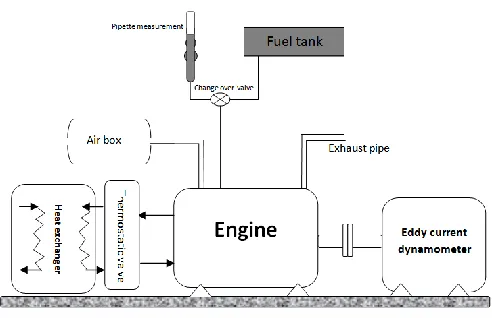
In this study the experimental set up consists of a compression ignition engine test bed connected directly to an eddy current dynamometer as indicated in Fig. 1.
Fig. 1. Test rig schematic
For this layout the specifications are shown below:
TABLEI
PROPERTIES OF FOUR TYPES OF DIESEL FUELS
Type SG AT 15.5°C LHV (MJ/Kg)
A 0.8118 43.188
B 0.8318 43.154
C 0.8284 43.265
D 0.8322 43.364
The succession of tests is listed in Table II. This table shows throttle openings of (55%, 65%, 75% and 85%), engine speed variations of (2000 rpm, 2250 rpm, 2500 rpm and 2750 rpm) and water temperatures of (65 oC, 70 oC, 75 oC and 80
oC) for four fuel types.
IV. RESULTS AND DISCUSSION
The present work uses four factors at four levels. Hence, an L'16 orthogonal array, Table II, with four columns and sixteen rows were used to design Taguchi's experiment with Minitab 16 software. The factors considered for experiment and levels are shown in Table II. Sixteen independent experiments were conducted in an attempt to obtain high accuracy and research quality results. All the parametric variations were done on the same fuel to avoid mixing between the fuels during experimentations. To ensure the correct throttle position, the gap between the throttle lever and its stop was measured with a set of spacers for each similar throttle positions.
TABLEII TEST ARRANGEMENTS
L’16ORTHOGONAL ARRAY Obtained Data
Experiment
no. Fuel Type
Engine Speed (rpm)
Throttle (%)
Water Temperatur
e (oC)
Torque
Head of Air Box Manometer (mm)
[converted to air flow rate (l/min)]
Time for Fuel Consumption (sec) [converted to fuel flow rate (g/sec)]
1 A 2000 55 65 40.1 7.75 [1183.15] 29.1 [0.821]
2 A 2250 65 70 53 9.75 [1327.062] 22.05 [1.083]
3 A 2500 75 75 65.3 12.25 [1487.5] 19.55 [1.221]
4 A 2750 85 80 72.4 14 [1590.204] 15.25 [1.566]
5 B 2000 55 65 37.9 7.5 [1163.91] 32.1 [0.752]
6 B 2250 65 70 59.9 9.5 [1309.938] 22.6 [1.069]
7 B 2500 75 75 63.9 12.75 [1517.554] 18.08 [1.336]
8 B 2750 85 80 72.1 14.25 [1604.34] 15.1 [1.599]
9 C 2000 55 65 31.2 7.5 [1163.91] 33.03 [0.738]
10 C 2250 65 70 44.6 9.75 [1327.062] 24.23 [1.005]
11 C 2500 75 75 73 12.25 [1487.5] 20.33 [1.198]
12 C 2750 85 80 73 14.25 [1604.34] 18.332 [1.33]
13 D 2000 55 65 22.6 7.5 [1163.91] 37.98 [0.644]
14 D 2250 65 70 51.7 10 [1343.968] 24.3 [1.006]
15 D 2500 75 75 72.2 12 [1472.243] 20.29 [1.205]
16 D 2750 85 80 74 14 [1590.204] 19.11 [1.279]
All data are taken after the engine coolant temperature, coming out of the engine, reached the desired temperature. The results of the experimental layout of L'16 orthogonal array were calculated. The data is analyzed with Minitab 16 software, which simplifies the Taguchi procedure and results and S/N ratios are calculated. The software was checked for accuracy using stepwise hand calculations. S/N ratio represents the transformation of repetition data to measure of present variation. There are several S/N ratios available depending on the type of characteristic, the equations for calculating S/N ratios give negative values as is indicated from the format of these equations (Ross, 1996):
- Lower is better:
𝑠/𝑁𝐿𝐵= −10 𝐿𝑂𝐺(1/𝑛 ∑𝑛𝑖=1𝑌𝑖2) (14) - Higher is better:
𝑠/𝑁𝐻𝐵= −10 𝐿𝑂𝐺(1/𝑛 ∑𝑛𝑖=11/𝑌𝑖2) (15)
- Nominal is better:
𝑠/𝑁𝑛𝑜𝑚𝑖𝑛𝑎𝑙 = −10 𝐿𝑂𝐺(1/ 𝑛 ∑𝑛𝑖=1𝑌𝑖− 𝑌𝑚) (16)
Once the experimental design was determined and the trials were carried out, the measured performance characteristic from each trial was used to analyze the relative effect of the different parameters.
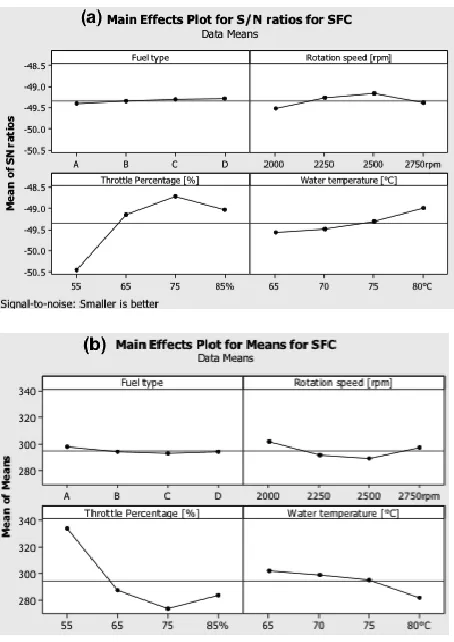
Fig. 2. Main effects plot of the S/N ratios and means for BSFC.
Fig. 3. Main effects plot of the S/N ratios and means for volumetric efficiency.
The peak value of each graph is considered as the optimum point, as these points are offering highest S/N ratios. The horizontal line in the middle of each figure indicates the mean of the projected values. The mean of means indicates the average of the highest and lowest averages for each factor and the graphs are limited in presentation by the software mini tab (5) grapher and this has partially affected the presentation of the throttle contribution as the highest value of the graph falls outside the y-axis limit.
The confirmation tests were later conducted with the optimum combination of results showing that the obtained parameters have prime values compared to the other tested experiments. The obtained results are discussed below:
A. Brake Specific Fuel Consumption (BSFC)
Results reveal that the specific fuel consumption is strongly affected by the throttle position because of the highest range between maximum to minimum S/N ratio. Fig. 2 shows that the minimum point of consumption occurs at %75 of the full throttle. The second most effective factor is the water temperature of the engine. The plot profile reveals that BSFC decreases as the water temperate is increased, reaching the minimum at a water temperature of 80°C. The third effective factor over the output of BSFC characteristic is rotation speed of the engine. The minimum fuel consumption is achieved at an engine speed of 2500 rpm. And it is at this speed that the engine attains maximum volumetric efficiency. The contours of the diesel fuel type curves are almost unremitting. The results reveal approximated output. As specific gravity (SG) is increased, BSFC is slightly decreased and it indicates the minimum value with diesel fuel type (D), which has the highest specific gravity (SG15.5= 0.833). If BSFC is expressed
in [liter/kW.hr], the consumption differences become more observable.
B. Volumetric Efficiency
The engine speed (N) has a major effect on volumetric efficiency. Fig. 3 shows that (ηv) has maximum value at an
engine speed of 2500 rpm. The temperature of water is the second most effective factor on the volumetric efficiency. As the temperature is increased, the volumetric efficiency is decreased as a result of the decreasing density of the air entering the combustion chamber. It is concluded that the volumetric efficiency reaches the maximum value at a temperature of (65°C).
C. Brake Thermal Efficiency (BTE)
The energy converted into power output was measured by the dynamometer. The dynamometer was also used to keep the engine speed at a constant value.
The torque was measured from the force imposed by the dynamometer. The recorded engine speed and the measured torque lead to the calculation of the output power, (5). To measure the energy transferred from the fuel to the engine, the mass flow rate of fuel was calculated, the net heating value (LHV) was obtained from an empirical relation (Mollenhauer and Tschoeke, 2010):
𝐿𝐻𝑉 = 46.22 − 9.13 × (𝑆𝐺)2+ 3.68 × (𝑆𝐺), and then
(BTE) was found. In order to efficiently study the factors and find their optimum impact point, Taguchi techniques are employed. Results reveal that the throttle has a significant effect on the brake thermal efficiency (BTE) and Fig. 4 shows that (BTE) reaches its optimum point at 75% of the maximum throttle. The second significant factor affecting (BTE) is the water temperature. Within the operating range, (BTE) is directly increased as the water temperature is increased. From the test it is established that b has the optimum point at 80°C. The engine speed is the third effective factor on (BTE). (BTE) reaches the optimum point at an engine speed of 2500 rpm. Diesel fuel type has a minor effect on (BTE). However, increasing the specific gravity (SG) of the diesel fuel slightly increases (BTE). From the experiments, it is concluded that (BTE) is optimum for the diesel fuel type D which has
𝑆𝐺15.5 °𝐶 = 0.833.
The optimal values are obtained from using Taguchi method on the samples of test results for the variables indicated above as shown in Fig. 4. After conducting the confirmation test with the optimum combination (water temperature = 80 oC, throttle = 75%, N = 2500 rpm, fuel type (D)), the results show a value of 0.331 for (BTE). This value, which is obtained with the optimal data, as explained above, represents the maximum value which is confirmed though using only the optimized values of above mentioned parameters and it is the maximum value when compared to the other experiments. Therefore, the validity of this value is confirmed using Taguchi method, which is the case for this work.
D. Exergetic Efficiency
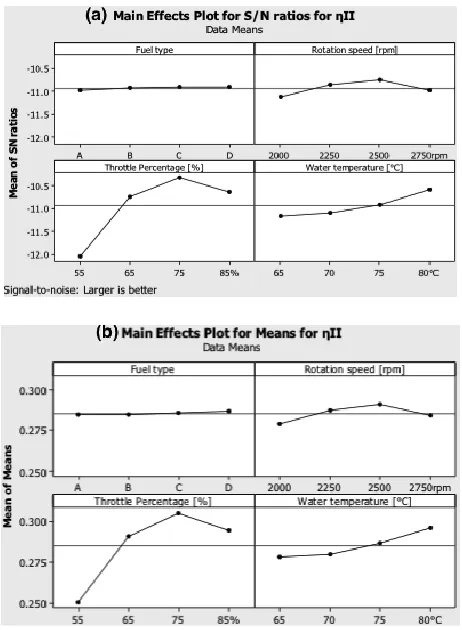
Since the exergetic efficiency takes into account not only the first but also the second law of thermodynamics, it provides a better measure of the performance for a thermal system. The fuel exergy (based on chemical exergy), expressed in (7), (8) and (9) for the four fuel types is calculated with procedures involving lower heating value (LHV). Exergetic efficiency (ηII) and S/N ratios for all
experiments are calculated and the effects of factors are investigated as shown in Fig. 5. The throttle has a significant effect on the exergic efficiency (ηII) and it has the optimum
value at %75 of full throttle. Temperature of water is the second significant factor for (ηII). The pattern of the curve of
(ηII) is increased as the temperature is increased and it has a
maximum value at 80 °C.
Fig. 4. Main effects plot of the S/N ratios and means for (b).
Engine speed is the third effective factor for (ηII) and it has
the peak value at 2500 rpm. Diesel fuel type has a minor effect on (ηII). However fuel type D achieves the optimum value of
(ηII). Due to the fact that both exergic efficiency and BTE are
inherently expressing deviation from the ideal performance, their trends are also similar. However, the exergic efficiencies are lower than the corresponding (BTE) because a higher amount of deviations are expressed in fuel exergy, compared to the fuel energy.
V. CONCLUSION
a) The effectiveness of Taguchi methodology is underlined by replacing the required (44 = 256) tests, needed to decide the effect of parameters: engine speed, throttle and water temperature for four types of fuel by only 16 deciding experiments as indicated in Table II.
b) The throttle has a proportional relation to break mean effective pressure as a result of the increase in the quantity of injected fuel. The best operating point was accomplished at 75% of full throttle.
c) Throttle position has no effect on volumetric efficiency of test engine.
d) Water temperature is second most effective parameter on engine operation for minimum BSFC. The optimum temperature for improved brake thermal and exergic efficiencies is found to be 80oC.
e) As the water temperature was increased the volumetric efficiency dropped. During the experiments, the maximum volumetric efficiency was recorded at a water temperature of 65oC.
f) The optimum engine speed for the test engine, based on maximum volumetric efficiency, minimum BSFC and improved values of thermal and exergic efficiencies was 2500 rpm.
g) Fuel specific gravity has a limited effect on BSFC. It is shown from the results that the reduction in power caused by the reduction in volumetric flow rate is compensated by increasing the fuel density.
Future work can focus on applying a similar procedure to a direct injection diesel test rig, which is more susceptible to variation in diesel engine fuel type.
NOMENCLATURE
Symbol Definition Unit
Ai Coefficient of the component i in the reaction
equation -
afch Specific chemical exergy kJ/kg
BSFC BP
Brake specific fuel consumption Brake power
g/kW.hr kW
D Orifice diameter mm
Ed Destroyed exergy kJ
Ef Fuel exergy kJ
EQ Heat exergy kJ
Ew Work exergy kJ
Ech Specific chemical exergy for a
multicomponent stream kJ/kg
he Exit enthalpy kJ/kg
hi Inlet enthalpy kJ/kg
Hh Manometer reading mm
LHV Lower heating value kJ/kg
m.e Exit mass flow rate kg/sec
m.
i Inlet mass flow rate kg/sec
N Number of tests in a trial -
N Engine speed Rpm
Q Heat rate Watt
Qcv Heat rejection Watt
Qo
f Fuel energy rate Watt
Pb Brake power Watt
R Gas constant kJ/kmole.K
SG Specific gravity -
S/N Signal to noise ratio -
T Temperature oC
To Ambient temperature oC
Tr Torque N.m
Vo Volumetric flow rate m3/sec
Wo Rate of work Watt
yi Molar ratio of ith component in exhaust -
yio
Molar ratio of ith component in the
environment -
Yi Value of the performance characteristic for a
given experiment -
Ym Nominal value of results -
Greek letters
b Brake thermal efficiency - II Exergetic efficiency - v Volumetric efficiency -
Density kg/m3
Angular velocity rad/sec
3.14 -
REFERENCES
Cussons, Diesel Multi-cylinder Engine Test Bed Instructions Manual, 1989 Cussons Technology Ltd.
Denton, T., 2011. Automobile mechanical and electrical systems, Butterworth-Heinemann, Elsevier.
Doe, 1993. Fundamentals handbook of mechanical science, 1, U.S. Department of Energy.
Garrett, T.K., 2001. The motor vehicle thirteenth edition, Butterworth Heinemann.
Lee, D.H., 2013. Development of a highly efficient low-emission diesel engine-power co-generation system and its optimization using Taguchi method. Applied Thermal Engineering, 50(2013), pp.491-495.
Kanogˇlu, M., Isık, S.K. and Abuşogˇlu, A., 2005. Performance characteristics of a diesel engine power plant. Energy Conversion and Management, 46(11-12), pp.1692–1702.
Mollenhauer, K., and H. Tschoeke, 2010. Handbook of diesel engines, Springer.
Pulkrabek, W.W., 2004. Engineering fundamentals of the internal combustion engine, 2nd ed. Pearson Educational International.
Rajput, R.K., 2008. A text book of internal combustion engine, 2nd Edition,
Laxmi Publications.
Rakopoulos, C.D., 2004. Availability analysis of a turbocharged diesel engine operating under transient load conditions, Energy, 29(8), pp.1085-1104.
Ross, P., 1996. Taguchi techniques for quality engineering, 2nd ed.
McGraw-Hill Book Company.
Sayin, C., 2006. Energy and exergy analyses of a gasoline engine, Wiley Inter-Science, John Wiley & Sons, Ltd.
Sekmen, P. and Yılbaşı, Z., 2010, Application of energy and exergy analyses to a CI engine using biodiesel fuel, Mathematical and Computational Applications, 16(4), pp.797-808.
Sorathia, H.S. and Yadav, H.J, 2012. Energy analyses to a CI engine using diesel and bio-gas dual fuel; A review study. International Journal of Advanced Engineering Research and Studies (IJAERS), 1(2), pp.212-217.
Tamilvendhan, D., Ilangovan, V. and Karthikeyan, R., 2011. Optimization of engine operating parameters for eucalyptus oil mixed diesel fueled DI diesel engine using Taguchi method. Journal of Engineering and Applied Sciences (ARPN), 6(6), pp.14-22.
Wu, H-W., and Wu, Z-Y, 2013. Using Taguchi method on combustion performance of a diesel engine with diesel/biodiesel blend and port-inducting H2. Applied Energy, 104, pp.326-370.
Xiao, S., Sun, W., Du, J. and Li, G., 2014. Application of CFD, Taguchi method and ANOVA technique to optimize combustion and emissions in light duty diesel engine. Mathematical Problems in Engineering, Article ID 502902, 9 pages, doi:10.1155/2014/502902.