ORIGINAL ARTICLE
A virtual reality simulator for hysteroscopic placement of tubal
sterilization micro-inserts: the face and construct validity
Juliënne A. Janse&Sebastiaan Veersema& Frank J. Broekmans&Henk W. R. Schreuder
Received: 29 January 2013 / Accepted: 28 March 2013 / Published online: 18 April 2013
#Springer-Verlag Berlin Heidelberg 2013
Abstract This study investigated the validity of a virtual reality simulator for hysteroscopic tubal sterilization. Initially performed laparoscopically, the hysteroscopic ster-ilization method is becoming increasingly popular. An ade-quate training model could enhance one’s skills prior to the start of performing the procedure on the real patient. This prospective study (Canadian Task force II-2) enrolled 69 res-idents and gynecologists who were divided into three groups, based on vaginoscopic hysteroscopy and Essure® experi-ence level: novices (N= 17), intermediates (N= 35), and experts (N= 17). Participants completed two cases on a virtual reality simulator (EssureSim™) in which four Essure® place-ments were performed. A questionnaire was completed to assess face validity, and reality scores were given on a 5-point Likert scale. Construct validity was represented by the ability of six simulator-derived parameters to significantly differentiate between different hysteroscopic experience levels. Reality of the sterilization procedure was scored with a median of 5.00 points on a 5-point Likert scale by all participants with prior sterilization experience. Of these participants, 95.5 % indicated the simulator as a useful preparation for real-time Essure® placement. The expert and intermediate group performed both cases significantly faster than novices (p=.001). The novices had a significantly longer path length in comparison to the other
groups (p=.006). Analysis of the remaining parameters did not show a persistent ability to differentiate between experience levels. Satisfactory validity was demonstrated for the EssureSim™ by high reality scores and moderate ability to distinguish between different performance levels.
Keywords Hysteroscopy . Training . Sterilization . Essure® . Virtual reality
Background
Female sterilization is the most common method of contra-ception worldwide [1]. More than 600,000 tubal steriliza-tions are performed annually in the USA [2]. Initially performed laparoscopically, the hysteroscopic sterilization method is becoming increasingly popular [3,4].
Hysteroscopy is generally considered as a safe procedure with a low complication rate [5,6]. Its practice ranges from diagnostics in an outpatient setting to a surgical alternative for many gynecological problems. Teaching hysteroscopy skills traditionally has been based on a mentored model, where trainees are exposed to procedures with the guidance of an experienced teacher. However, in recent years, the surgical volume has been limited by restrictions on resident working hours and less highly skilled teachers are available [7,8]. This results in difficulties in acquiring sufficient skills in advanced endoscopic surgery [9,10]. Effective usage of simulation and training models is a possible solution to this problem [9–11].
Development and validation research on training models and simulators has been mainly focused on laparoscopy. Training models allow a surgeon to safely overcome the learning curve of a new technique before practicing on a patient [9,12,13]. Virtual reality (VR) simulators especial-ly, allow more independent instruction and objective imme-diate feedback for more reliable, unbiased assessment of
All authors contributed extensively to the work presented in this paper.
Electronic supplementary material The online version of this article (doi:10.1007/s10397-013-0790-8) contains supplementary material, which is available to authorized users.
J. A. Janse (*)
:
S. VeersemaDepartment of Gynecology and Obstetrics, Sint Antonius Hospital Nieuwegein, Koekoekslaan 1,
3435 CM Nieuwegein, Netherlands e-mail: [email protected] F. J. Broekmans
:
H. W. R. Schreuderpsychomotor skills [9, 12, 14]. In addition, it allows for repeated practice without any risk to patients. Training on a VR system bypasses the ethical concerns associated with practice on animals or cadavers. Besides, many VR systems allow for practice at varying levels of difficulty and across a wide range of scenarios, thus accommodating trainees at many levels [14,15].
Prior to implementation of a new training tool in a curric-ulum, evaluation and validation of the simulator and its pa-rameters are mandatory [16–19]. Validity measures whether a simulator is actually teaching or measuring what it is intended to teach or measure [17]. Different aspects of validity exist. Face validity refers to whether the model resembles the task or procedure it is aiming to train for, by determining the opinion of users on realism of the simulation. Objective approaches consist of construct and predictive validity. Construct validity refers to whether the model measures the quality or ability it is supposed to measure [17]. In this regard, the simulator must be able to differentiate between the experienced and the inex-perienced surgeon, or in addition, measure improvement in novices’ performance by training. Predictive validity is the extent to which the simulator predicts future performance by assessing whether the skills acquired on a simulator actually result in improved skills in patients in the real-time clinical setting [17,20].
Excellent data are available to support the validity and effectiveness of VR training of surgical skills in general surgery [21–23], urology [20] as well as in gynecology [24, 25]. VR training leads to more efficient movements and less errors, which translates into less operating time and improved patient safety.
In comparison to laparoscopy, little work has been done regarding hysteroscopy training despite its upcoming use and applicability during the last decades. Several training methods have been designed, focusing mainly on the development of physical models and box trainers [26–28]. A collaboration between gynecologists and technicians in Switzerland led to the development of the Hysteroscopic Surgery Simulator System (HystSim™)—a VR simulator for hysteroscopic in-terventions. Face and construct validity have been established for a diagnostic training module [29,30]. Recently, a new procedural training module became available by which the Essure® sterilization method can be practiced (EssureSim™). The hysteroscopic sterilization method by Essure® Permanent Birth Control system (Conceptus; Mountain View, CA, USA) was approved in 2001 by the European Health Office and in 2002 by the U.S. Food and Drug Administration. Micro-inserts placed in both the tubal ostia cause a sterile inflammatory response of the intramural and isthmic parts of the Fallopian tube, thereby occluding the tubes within 3 months. Since the introduction of this method, it is performed by gynecologists around the world and has become an accepted alternative to laparoscopic sterilization.
Initially taught with significant hands-on supervision, the EssureSim™is developed to train gynecologists who want to start performing this procedure in a more efficient manner and without risks for the patient.
The aim of this study is to determine the face and con-struct validity of this VR training module for the hystero-scopic placement of tubal sterilization micro-inserts.
Methods
Participants
Between June 2010 and April 2011, 25 ob-gyn residents and 44 consultant gynecologists (N=69) were randomly recruited at the Annual Meeting of the Dutch Society of Obstetrics and Gynecology and from a university hospital and a major teach-ing hospital in the Netherlands.
Given that hysteroscopic sterilization is performed as a type of therapeutic vaginoscopic hysteroscopy, without use of a speculum and tenaculum, three groups were made. This divi-sion was based on a combination of Essure® experience level and experience level in therapeutic vaginoscopic hysteroscopy. “Novices”(N=17): never performed an Essure® placement nor a therapeutic vaginascopic hysteroscopy, “experts” (N=17): performed >25 Essure® placements and >25 therapeutic vaginascopic hysteroscopies,“intermediates”(N=35): any ex-perience varying between a novice and expert. The assessment of the participants’ experience was made by self-estimated numbers of both procedures.
Equipment
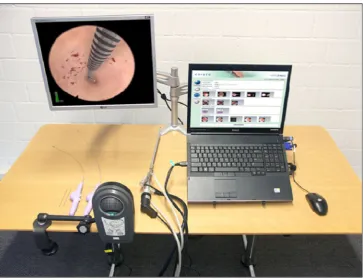
The EssureSim™consists of an adapted hysteroscope (10-mm resectoscope), an Essure® simulation device, simulation hard-ware and softhard-ware (Fig.1). The simulation software runs on standard laptop hardware (2.40 GHz Intel® Core™ 2 DUO CPU P8600, 2 GB RAM, NVIDIA Quadro FX 2700 M graph-ic card). The system does not possess haptgraph-ic feedback. The software contains eight different cases with varying degrees of difficulty.
Face validity
proposed for further opinion inquiry. These were answered with“agree,” “disagree,”or“no opinion.”Face validity was determined by analyzing the opinion of the participants with prior Essure® experience. In this manner, realism and training capacity of the simulator was evaluated only by the partici-pants who had knowledge of the real-time procedure and who could make a comparison between both environments.
Construct validity
To investigate construct validity, the participants performed tasks on the simulator. To all participants, a standard introduc-tion of the simulator and sterilizaintroduc-tion procedure was given. A familiarization with the VR simulator was executed, consisting of one tubal micro-insert placement in a uterus with normal tubes. In the first case (case 1), the participant performed a bilateral sterilization in a uterus with normal tubes, as shown in the animation (Online Resource1). The second case (case 2) comprised a bilateral placement in a uterus of a more difficult level, because of the thickened endometrium of this uterus, decreased visibility, and slightly more lateral insertion of the tubes (Online Resource2). All participants were supervised by one supervisor (J.A.J.), who gave answers to questions and gave instructions if one was not able to proceed.
Case 1 and 2 were used for analysis. Parameters being measured by the simulator and used for data analysis were task time, path length, trauma, patient comfort, amount of distension fluid used, and successful placement. A description
of all parameters used is given in Table1. These parameters were compared between the different groups for both cases separately, since they were of a different level.
Use of statistics
Data were analyzed using the statistical software package SPSS 17.0 (SPSS, Inc., Chicago, IL). Differences between the general demographics and performances between the three groups were analyzed using the Kruskal–Wallis test for nonparametric data. If the Kruskal–Wallis test resulted in Fig. 1 Set up EssureSim™
(with permission of VirtaMed AG)
Table 1 Description of all parameters used
Parameter Description
Task time Time of the total procedure, from insertion of scope into cervix to removal of scope, in seconds Path length Path length of the tip of the hysteroscope in
millimeters
Trauma Cumulative number of contacts of the scope with the cervix and uterine wall
Patient comfort Combination of number of trauma and the distension pressure of the fluids exerted on the uterine wall, given on a 10-point scale, 1= extremely uncomfortable, 10=no discomfort at all Correct
placement
1 to 8 coils of the micro-insert need to be visible after placement
Distension fluid used
a significant difference, then a comparison between two sep-arate groups was done using the Mann–Whitney Utest with post hoc Dunn’s (Bonferroni) correction. To verify the mini-mum sample size, a power analysis was performed. A total sample of 69 subjects achieves a power of >.80 with the Kruskal–Wallis test with a target significance of .05. The average within-group standard deviation assuming the alterna-tive distribution is 1.0 (PASS 2008 NCSS; LCC, Kayville, UT). Apvalue of <.05 was considered to be statistically significant. Values are presented as medians with interquartile ranges un-less stated otherwise.
Findings
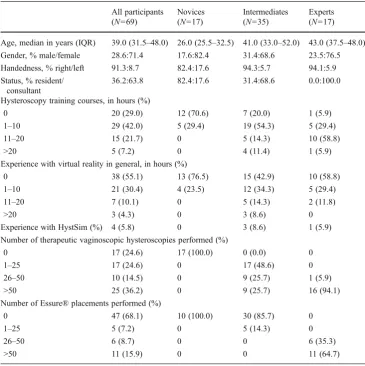
Table 2 shows the general demographics of the partici-pants. A significant difference for age was seen between groups (p<.05), while gender and handedness did not differ significantly. Of all participants, one expert and three partici-pants of the intermediate group had been introduced to the HystSim™at other conference venues.
Face validity
Of the 69 participants, all completed the entire questionnaire. Table3summarizes the median values of the scores consid-ering the realism and training capacity of the simulator, awarded by the participants with prior Essure® experience (N=22). In the questionnaire, realism of the sterilization pro-cedure was scored with a median of 4.00 points on a 5-point Likert scale. Training capacity of the sterilization procedure was awarded a median of 5.00 points. Of all participants with prior Essure® experience, 100.0 % agreed with the statement that the hysteroscopy simulator offers procedural training of hysteroscopic skills. Furthermore, 95.5 % indicated the train-ing module for the Essure® sterilization method as a useful preparation for real-time placement.
Construct validity
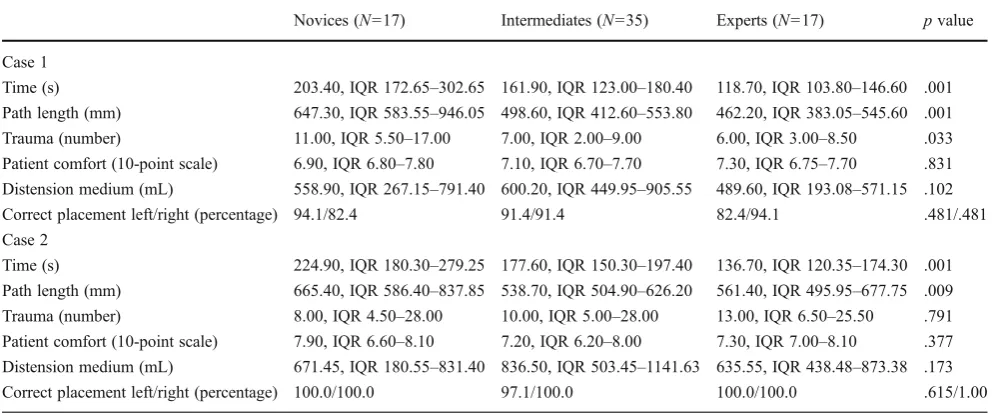
All of the 69 participants completed all cases. Median values of the assessed parameters for case 1 and 2 are shown in Table4. The simulator was able to differentiate between
Table 2 Baseline characteristics of all participants
IQRinterquartile ranges
All participants (N=69)
Novices (N=17)
Intermediates (N=35)
Experts (N=17)
Age, median in years (IQR) 39.0 (31.5–48.0) 26.0 (25.5–32.5) 41.0 (33.0–52.0) 43.0 (37.5–48.0) Gender, % male/female 28.6:71.4 17.6:82.4 31.4:68.6 23.5:76.5 Handedness, % right/left 91.3:8.7 82.4:17.6 94.3:5.7 94.1:5.9 Status, % resident/
consultant
36.2:63.8 82.4:17.6 31.4:68.6 0.0:100.0
Hysteroscopy training courses, in hours (%)
0 20 (29.0) 12 (70.6) 7 (20.0) 1 (5.9)
1–10 29 (42.0) 5 (29.4) 19 (54.3) 5 (29.4)
11–20 15 (21.7) 0 5 (14.3) 10 (58.8)
>20 5 (7.2) 0 4 (11.4) 1 (5.9)
Experience with virtual reality in general, in hours (%)
0 38 (55.1) 13 (76.5) 15 (42.9) 10 (58.8)
1–10 21 (30.4) 4 (23.5) 12 (34.3) 5 (29.4)
11–20 7 (10.1) 0 5 (14.3) 2 (11.8)
>20 3 (4.3) 0 3 (8.6) 0
Experience with HystSim (%) 4 (5.8) 0 3 (8.6) 1 (5.9) Number of therapeutic vaginoscopic hysteroscopies performed (%)
0 17 (24.6) 17 (100.0) 0 (0.0) 0
1–25 17 (24.6) 0 17 (48.6) 0
26–50 10 (14.5) 0 9 (25.7) 1 (5.9)
>50 25 (36.2) 0 9 (25.7) 16 (94.1)
Number of Essure® placements performed (%)
0 47 (68.1) 10 (100.0) 30 (85.7) 0
1–25 5 (7.2) 0 5 (14.3) 0
26–50 6 (8.7) 0 0 6 (35.3)
subjects with varying hysteroscopy experience for two out of six parameters.
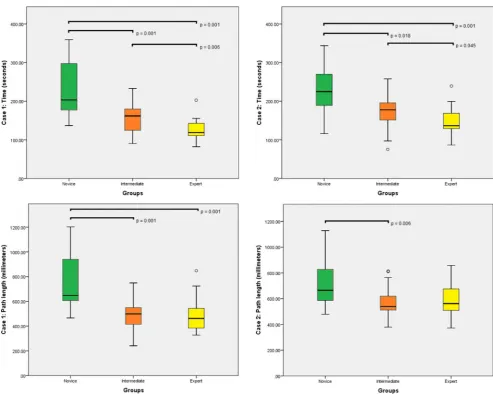
The parameter task time was able to differentiate signif-icantly between all groups in both cases. The novice group performed both cases significantly slower in comparison to the other groups (p=.001 for both cases). In addition, all groups required more time to finish the second case, a uterus of a more difficult level, in comparison to the first case.
Similarly, the parameter path length showed significant differences between groups in both cases. The novices had a significantly longer path length in comparison to the inter-mediate and expert group (case 1, p=.001 in both groups; case 2,p=.006 in comparison with the intermediate group). The results for parameter task time and path length are visualized in Fig.2. Both parameters reflect a more efficient performance of hysteroscopy by experienced gynecologists; however, the clinical relevance of a shorter duration of 1 to 1.5 min per patient is uncertain.
In the first case, the parameter trauma displayed a significant difference between the novices and the intermediate group and a similar trend in comparison to the expert group. However, in the second case, a reversed (nonsignificant) effect is observed. The novice group achieved a median score of 8 contacts in comparison to 13 in the expert group. A similar contradictory trend in both cases is seen for the parameter patient comfort.
The analysis of the parameter distension medium did not show significant results, while the intermediate group used the largest amount of fluid in both cases. The last parameter, the number of correctly placed devices, did not differ sig-nificantly between the three groups and no specific trend could be observed. Both inexperienced and experienced Table 3 Results face validity
Participants with prior Essure® experience (N=22)
What is your opinion about the realism of the following items? (1=not realistic…5=very realistic)
Instrumentation 4.00 (3.75–5.00) Setting 4.00 (3.00–5.00) Navigation 4.00 (4.00–5.00) In- and outflow valves 4.00 (4.00–5.00) Quality of images 5.00 (4.00–5.00) Depth perception 4.00 (3.00–4.25) Essure®procedure 4.00 (4.00–5.00) General impression 5.00 (4.00–5.00)
What is your opinion about the training capacity of the following items? (1=very bad…5=very good)
Camera navigation 4.50 (4.00–5.00) Hand–eye coordination 5.00 (4.00–5.00) Depth perception 4.00 (3.00–4.25) Operative hysteroscopy 4.00 (4.00–5.00) Essure®procedure 5.00 (4.00–5.00) Training capacity in general 4.00 (4.00–5.00)
Statement 1: the HystSim™offers procedural training of hysteroscopic skills
Agree: 100.0 % Disagree: 0.0 % No opinion: 0.0 % Statement 2: the EssureSim™offers a useful preparation for the
real-time Essure®sterilization procedure
Agree: 95.5 % Disagree: 4.5 % No opinion: 0.0 %
Median scores (with interquartile ranges) are given for the realism and training capacity of the simulator on a 5-point Likert scale. Results are presented for those participants who have prior Essure® experience
Table 4 Results of construct validity for each group
Novices (N=17) Intermediates (N=35) Experts (N=17) pvalue
Case 1
Time (s) 203.40, IQR 172.65–302.65 161.90, IQR 123.00–180.40 118.70, IQR 103.80–146.60 .001 Path length (mm) 647.30, IQR 583.55–946.05 498.60, IQR 412.60–553.80 462.20, IQR 383.05–545.60 .001 Trauma (number) 11.00, IQR 5.50–17.00 7.00, IQR 2.00–9.00 6.00, IQR 3.00–8.50 .033 Patient comfort (10-point scale) 6.90, IQR 6.80–7.80 7.10, IQR 6.70–7.70 7.30, IQR 6.75–7.70 .831 Distension medium (mL) 558.90, IQR 267.15–791.40 600.20, IQR 449.95–905.55 489.60, IQR 193.08–571.15 .102 Correct placement left/right (percentage) 94.1/82.4 91.4/91.4 82.4/94.1 .481/.481 Case 2
Time (s) 224.90, IQR 180.30–279.25 177.60, IQR 150.30–197.40 136.70, IQR 120.35–174.30 .001 Path length (mm) 665.40, IQR 586.40–837.85 538.70, IQR 504.90–626.20 561.40, IQR 495.95–677.75 .009 Trauma (number) 8.00, IQR 4.50–28.00 10.00, IQR 5.00–28.00 13.00, IQR 6.50–25.50 .791 Patient comfort (10-point scale) 7.90, IQR 6.60–8.10 7.20, IQR 6.20–8.00 7.30, IQR 7.00–8.10 .377 Distension medium (mL) 671.45, IQR 180.55–831.40 836.50, IQR 503.45–1141.63 635.55, IQR 438.48–873.38 .173 Correct placement left/right (percentage) 100.0/100.0 97.1/100.0 100.0/100.0 .615/1.00
Median values (interquartile ranges) for all analyzed parameters are given. For every parameter, apvalue is stated per exercise to indicate whether a significant effect between any of the groups is observed (nonparametric, Kruskal–Wallis test)
participants were able to position the sterilization micro-inserts in a correct manner.
Discussion
The aim of this study was to determine the validity of a new training module by which the Essure® sterilization method can be practiced on a commercially available VR simulator. We assessed the realism of the simulator by questionnaires (face validity) and determined the capacity of the simulator to distin-guish between experienced and inexperienced hysteroscopists (construct validity). Face validity was established with high scores, while construct validity showed moderate results.
The study was preceded by a power analysis and contained a sufficient number of participants. One supervi-sor coached all participants to limit inter-supervisupervi-sor bias.
According to the fact that hysteroscopic sterilization is usually performed as a type of therapeutic vaginoscopic hysteroscopy [32, 33], participants were grouped by their experience in both procedures.
In general, gynecologists with ample experience in performing hysteroscopies are considered experts. In the absence of generally accepted criteria for the classification of experience levels, we applied the arbitrary number of 0 and 25 therapeutic procedures to form three levels. Both the novice and expert group were of similar size (N= 17), whereas the intermediate group consisted of clearly more participants (N= 35), indicating that the majority of our study population had some or more therapeutic vaginoscopic hysteroscopy experience. Face validity was assessed by taking into account only the opinion of those participants who had tubal sterilization experience (performed≥1 Essure®). In this manner, realism was evaluated Fig. 2 Results of construct validity inbox plots.Box plotsfor
param-eters task time and path length, for all groups performing case 1 and 2.
Bars are medians,boxes show interquartile range,whiskers show
only by those participants who had knowledge of the real-time procedure.
Not all performance parameters measured by the simula-tor were able to differentiate between participants with vary-ing hysteroscopy experience. We hereby confirm findvary-ings of previous studies by Bajka et al. [30] and Panel et al. [34], who investigated the face and construct validity of the diagnostic and sterilization module on this hysteroscopy simulator, respectively. Both studies found that less than half of all used parameters significantly correlated with hysteroscopy experience.
Possible reasons for the current study could be the fact that an active coaching strategy was adopted, by which the supervisor was easily accessible for questions and practical advice. It should be emphasized that this might have reduced possible differences between experi-enced and inexperiexperi-enced participants. Another reason may possibly be the lack of haptic feedback, which might impair especially the experienced hysteroscopist. Not only the visual aspect but also haptic feedback gives guidance to the operator for efficient and safe hysteros-copies. Both parameters trauma and patient comfort, which is a combination of number of trauma and the distension pressure of the fluids exerted on the uterine wall, might not be able to differentiate in a consequent manner between novices and experts as a result.
Also, the parameter distension medium should be interpreted with caution due to a number of missing data, as the simulator tended not to register fluid use during all place-ments. Further refinement of the software and scoring sys-tems is therefore necessary. Incorrectly placed devices were mainly caused by placing them too deeply into the tubes, whereby the coils were not visible in the uterine cavity after deployment. The fact that novices scored high percentages for correctly placed devices might be explained by the observation that those participants without any hysterosco-py experience tended to adhere more closely to any practi-cal advice given during device placement, in contrast to the more experienced groups. In addition, one needs to realize that the assessment of the participants’experience was self-reported and therefore is subject to recall bias. Also, the division into three levels of experience could be seen as a potential source of bias since the norm of both sufficient hysteroscopy and sterilization experience must be met to be classified as an expert.
One could ask oneself in general if a slower performance with more use of distension medium is not preferred when a higher correct placement rate is achieved with better patient comfort. The parameters used by this simulator might not be the only measures of hysteroscopy performance. For proce-dural exercises, one could design a global rating scale (GRS), which is a scoring system that is built on certain clinically relevant performance parameters [35,36].
Conclusion
In conclusion, this simulator received the highest scores regarding both procedure realism and training capacity. It was able to differentiate between subjects with varying hysteroscopy experience for two out of six parameters. We consider this study as an essential basic step in the validation cascade of a VR simulator for training operative hysteros-copies and for hysteroscopic sterilization in particular. Also, we believe this simulator could be suitable for future train-ing of hysteroscopic sterilization skills, after further refine-ment of the software. The next important step would be the investigation of the learning curve, with concurrent use of a clinically relevant GRS. The learning curve is a vital part of construct validity and in addition addresses implementation of the simulator in hysteroscopy training curricula. The learning curve could possibly indicate the necessary number of training sessions contributing to efficient and safe daily practice. Assessing predictive validity would be a last and ideal step in the validation cascade, providing data to which extent the simulation can predict real-life hysteroscopic performance.
Acknowledgments We would like to thank the residents and consul-tants who voluntarily participated in this study. We would like to thank Ass. Prof. M.J.C. (René) Eijkemans from the Julius Centre for Health Sciences and Primary care, University of Utrecht, the Netherlands for his help with the statistical analysis. No funding resources or compen-sation disclosure is applicable.
Potential conflict of interest J.A.J. has nothing to disclose. S.V. has received honorariums for training sessions on the Essure® device for Conceptus and was involved in the development of the EssureSim™. F.J.B. has nothing to disclose. H.W.R.S. has nothing to disclose. No funding was received for this study.
References
1. Peterson HB (2008) Sterilization. Obstet Gynecol 111:189–203 2. Chan LM, Westhoff CL (2010) Tubal sterilization trends in the
United States. Fertil Steril 94:1–6
3. Levie M, Chudnoff MS (2011) A comparison of novice and experienced physicians performing hysteroscopic sterilization: an analysis of an FDA-mandated trial. Fertil Steril 96:643–648 4. Shavell VI, Abdallah ME, Shade GH Jr, Diamond MP, Berman JM
(2009) Trends in sterilization since the introduction of Essure hysteroscopic sterilization. J Minim Invasive Gynecol 16:22–27 5. Jansen FW, Vredevoogd CB, van Ulzen K, Hermans J, Trimbos
JB, Trimbos-Kemper TC (2000) Complications of hysteroscopy: a prospective, multicenter study. Obstet Gynecol 96:266–270 6. Aydeniz B, Gruber IV, Schauf B, Kurek R, Meyer A, Wallwiener D
(2002) A multicenter survey of complications associated with 21,676 operative hysteroscopies. Eur J Obstet Gynecol Reprod Biol 104:160–164
8. Van Dongen H, Kolkman W, Jansen FW (2006) Hysteroscopic surgery: perspectives on skills training. J Minim Invasive Gynecol 13:121–125
9. Gallagher AG, Cates CU (2004) Virtual reality training for the operating room and cardiac catheterization laboratory. Lancet 364:1538–1540
10. Shoukrey MN, Fathulla BI, Al Samarrai T (2008) Hysteroscopy training in the UK: the trainees’perspective. Gynecol Surg 5:213–219 11. Chudnoff SG, Liu CS, Levie MD, Bernstein P, Banks EH (2010) Efficacy of a novel educational curriculum using a simulation laboratory on resident performance of hysteroscopic sterilization. Fertil Steril 94:1521–1524
12. Chou B, Handa VL (2006) Simulators and virtual reality in surgi-cal education. Obstet Gynecol Clin North Am 33:283–296 13. Ahlberg G, Enochsson L, Gallagher AG et al (2007)
Proficiency-based virtual reality significantly reduces the error rate for resi-dents during their first 10 laparoscopic cholecystectomies. Am J Surg 193:797–804
14. Palter VN, Grantcharov T (2010) Virtual reality in surgical skills training. Surg Clin North Am 90:605–617
15. Neary PC, Boyle E, Delaney CP, Senagore AJ, Keane FB, Gallagher AG (2008) Construct validation of a novel hybrid vir-tual–reality simulator for training and assessing laparoscopic colectomy; results from the first course for experienced senior laparoscopic surgeons. Surg Endosc 22:2301–2309
16. Verdaasdonk EG, Stassen LP, Monteny LJ, Dankelman J (2006) Validation of a new basic virtual reality simulator for training of basic endoscopic skills: the SIMENDO. Surg Endosc 20:511–518 17. McDougall EM (2007) Validation of surgical simulators. J Endourol
21:244–247
18. Schout BM, Hendrikx AJ, Scheele F, Bemelmans BL, Scherpbier AJ (2010) Validation and implementation of surgical simulators: a critical review of present, past, and future. Surg Endosc 24:536–546
19. Gallagher AG, Ritter EM, Satava RM (2003) Fundamental prin-ciples of validation, and reliability: rigorous science for the assessment of surgical education and training. Surg Endosc 17:1525–1529
20. Schout BM, Ananias HJ, Bemelmans BL et al (2009) Transfer of cysto-urethroscopy skills from a virtual–reality simulator to the operating room: a randomized controlled trial. BJUI Int 106:226– 231
21. Seymour NE, Gallagher AG, Roman SA et al (2002) Virtual reality training improves operating room performance: results of a ran-domized, double-blinded study. Ann Surg 236:458–463
22. Grantcharov TP, Kristiansen VB, Bendix J, Bardram L, Rosenberg J, Funch-Jensen P (2004) Randomized clinical trial of virtual reality simulation for laparoscopic skills training. Br J Surg 91:146–150 23. Van Sickle KR, Ritter EM, Baghai M et al (2008) Prospective,
randomized, double-blind trial of curriculum-based training for intracorporeal suturing and knot tying. J Am Coll Surg 207:560–568 24. Larsen CR, Soerensen JL, Grantcharov TP et al (2009) Effect of virtual reality training on laparoscopic surgery: randomized con-trolled trial. BMJ 338:b1802. doi:10.1136/bmj.b1802
25. Schreuder HW, van Dongen KW, Roeleveld SJ, Schijven MP, Broeders IA (2009) Face and construct validity of virtual reality simulation of laparoscopic gynecologic surgery. Am J Obstet Gynecol 200:540.e1-8
26. Burchard ER, Lockrow EG, Zahn CM, Dunlow SG, Satin AJ. Simulation training improves resident performance in operative hys-teroscopic resection techniques. Am J Obstet Gynecol 197:542.e1-4. 27. Kingston A, Abbott J, Lenart M, Vancaillie T (2004) Hysteroscopic training: the butternut pumpkin model. J Am Assoc Gynecol Laparosc 11:256–261
28. Wallwiener D, Rimbach S, Bastert G (1994) The HysteroTrainer, a simulator for diagnostic and operative hysteroscopy. J Am Assoc Gynecol Laparosc 2:61–63
29. Bajka M, Tuchschmid S, Streich M, Fink D, Székely G, Harders M (2009) Evaluation of a new virtual–reality training simulator for hysteroscopy. Surg Endosc 23:2026–2033
30. Bajka M, Tuchschmid S, Fink D, Székely G, Harders M (2010) Establishing construct validity of a virtual–reality training simulator for hysteroscopy via a multimetric scoring system. Surg Endosc 24:79–88 31. Mattel MS, Jacoby J (1972) Is there an optimal number of
alter-natives for Likert-scale items? J App Psychol 56:506–509 32. Miño M, Arjona JE, Cordón J, Pelegrin B, Povedano B, Chacon E
(2007) Success rate and patient satisfaction with the Essure sterilisation in an outpatient setting: a prospective study of 857 women. BJOG 114:763–766
33. Ubeda A, Labastida R, Dexeus S (2004) Essure: a new device for hysteroscopic tubal sterilization in an outpatient setting. Fertil Steril 82:196–199
34. Panel P, Bajka M, Le Tohic A, Ghoneimi AE, Chis C, Cotin S (2012) Hysteroscopic placement of tubal sterilization implants: virtual real-ity simulator training. Surg Endosc. doi:10.1007/s00464-011-2139-6
35. Reznick RK (1993) Teaching and testing technical skills. Am J Surg 165:358–361