II
Br NH2
Br
3 C9
2
O O
H
OH
ABSTRACT
The thesis entitled "STUDIES DIRECTED TOWARD THE SYNTHESIS OF CYCLAMENOL A AND DEVELOPMENT OF SOME NOVEL METHODOLOGIES" is divided into three chapters.
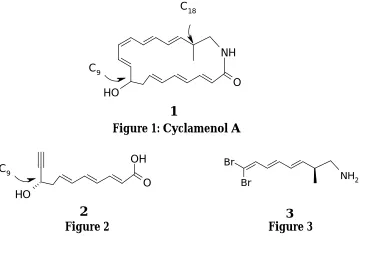
Chapter 1 deals with the introduction to Cyclamenol A (Figure 1) and earlier synthetic approaches. Chapter 2 is divided into three sections. Section A deals with our strategy for the synthesis of the C1-C11 fragment of the Cyclamenol A (Figure 2) and section B pertains to the synthesis of C12-C19 fragment (Figure 3) and finally Section C deals with our efforts toward the synthesis of the Cyclamenol A. Chapter 3 is divided into three sections. Section A deals with the synthesis of chiral furan diols (Figure 4), using monmorillonite KSF, Section B deals with a facile and non-metallic protocol for the synthesis of iodo quinolines (Figure 5) from tosyloxyquinolines, and Section C deals with ytterbium triflate catalyzed facile conversion of ketoximes to amides and lactams (Figure 6).
Figure 1: Cyclamenol A
Figure 2 Figure 3
O O
H
NH C9
C18
III O
OH
R O H
Montmorillonite KSF
CH3CN, r.t O
OH OH
R= OH, R1= H, glucal R= H, R1= OH, galactal
R1
Figure 4: Montmorillonite KSF catalyzed synthesis of chiral furan diols.
N CF3 OTs
R
N CF3 I
R I2, CH3COOH
Red P
Figure 5: Preparation of Iodo quinoline
NOH
NH O Yb(OTf)3
Toulene, reflux
NOH
Yb(OTf)3
Acetonitrile, reflux
N H
CH3 O
R R
Figure 6: Beckmann rearrangement of ketoximes
IV
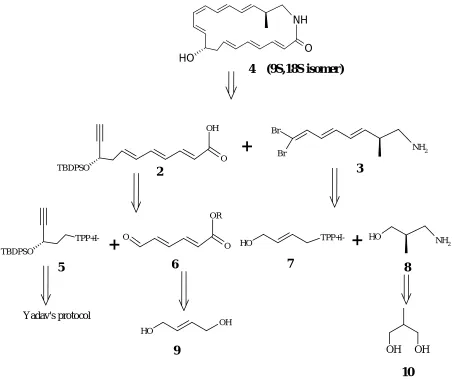
the two stereogenic centres, (C9 & C18) are unknown (Figure 1). In the light of these important and unsolved medicinal and biological questions, and in order to develop tools for unraveling the biological activity of Cyclamenol A, a synthesis of the (9S,18S) diastereoisomer of Cyclamenol A and its analogues was embarked on.
O TBDPSO
OH
NH2 Br
Br
TBDPSO
TPP+I-O O
OR
O
H TPP+I- NH2
O H
O H
OH Yadav's protocol
O O
H
NH
OH OH
+
+
+
5 6 7 8
9
3
4 (9S,18S isomer)
10 2
Figure 7: Retro synthetic approach of Cyclamenol A
V
Scheme 1
O THPO
O THPO
H
O
THPO
OH
THPO
OH
13
14 O
H
OH
11 12
c
a b
(15, 16 E/Z= 9:1)
d
Reagents and conditions : a. DHP, DCM, cat. CSA b. Benzene, PhSH (10 %), AIBN(10%), reflux. 70% c. Swern oxidation. d. PPh3+ CH2COOEt)Br- benzene, r.t..
THP protected cis butenediol was isomerized to the corresponding trans isomer using thiophenol and AIBN reflux. The geometry of the double bond was confirmed by 1H NMR and TLC. Swern oxidation of the alcohol provided the aldehyde 14. Wittig olefination with triphenylphosphoranilydene acetate yielded a separable (E/Z = 9:1) mixture of dienes 15&16.The pure E isomer(16) was obtained by column purification of the mixture.
Scheme 2
O O
H
O
O THPO
O O
O
THPO
O O
O
b a
c
(16, 15 E/Z= 1:1) 16
17 18
Reagents and conditions : a. Benzene, PhSH (10 %), AIBN(10%), reflux. b. cat. CSA, Methanol 0 °C-R.T. c. Py.SO3, DCM, DMSO, TEA, 0 °C-R.T.
VI
However the Z-isomer was not obtained in the pure form. The E, Z mixture was converted to the E isomer 16 by our own isomerization protocol. Acid catalyzed deprotection of the THP group in methanol afforded the alcohol 17, which was oxidized to the aldehyde by using pyridine: sulfur trioxide in dichlorormethane.
Synthesis of C7-C11 fragment using Yadav’s Protocol:
Homo propargyl alcohol 19 was protected as its THP ether 20 by treatment with DHP and cat CSA.Treatment of 20 with ethylmagnesiumbromide generated from ethylbromide and magnesium turnings, afforded the acetylide which on treatment with excess paraformaldehyde yielded alcohol 21 in 70 % yield. Selective reduction of the triple bond using lithium aluminum hydride (LAH) provided the trans allyl alcohol 22 in 80 % yield. The geometry of the double bond was confimed by 1H NMR. Sharpless asymmetric epoxidation using Ti(i-OPr)4/ TBHP and L-di-isopropyl tartarate afforded epoxide 23 in 80% yield with 88%ee.
Scheme 3
OTHP
OH OTHP
OH
OH
OTHP
OH
THPO
O
Cl
THPO
O THPO
OH
24 25
23 21 20
22 19
a b
c d
e f
Reagents and conditions : a. DHP, DCM, cat. CSA, 0 0C-R.T. b.Ethyl magnesium bromide, alkyne (20)
addition and then addition of the Para formaldehyde. c. LAH, THF, 0 °C –reflux, 20 hrs. d. Ti(i-OPr)4,
Di-isopropyl tartarate, TBHP 4 °A Mol. Sieves, DCM -20 °C, 6Hrs-10 hrs. 78%. e. TPP/CCl4, NaHCO3 reflux.
VII
The alcohol 23 was chlorinated using TPP/CCl4 with NaHCO3 as acid scavenger in refluxing CCl4 to afford the chloro epoxide 24, the structure of which was confirmed by the spectral data. Yadav’s propargylation using 6eq. of LiNH2 in liquid ammonia provided the chiral propargyl alcohol 25 in very good yield. The 1H and 13C NMR helped to confirm the product 25.
Scheme 4
THPO
OH
26
THPO
OTBDPS
27
O H
OTBDPS
28
a b
Reagents and conditions : a. DCM, imidazole, TBDPSCl, 0 °C-R.T. b. Cat. PTSA, methanol, 0 °C-R.T. Scheme 5
OH OTBDPS
28
OTBDPS
OTs
29
OTBDPS
TPP+I-31
OTBDPS
I
30 a
c
b
Reagents and conditions : a. TsCl, TEA, DCM, cat. DMAP, 0 °C-R.T. b. NaI, CH3CN,reflux (89%, 2
steps) c. TPP, toluene, reflux.)
VIII
refluxing benzene . The yield of the reaction was enhanced upto 90% by the repeated isolation of the ylide from the reaction mixture in regular intervals of time.
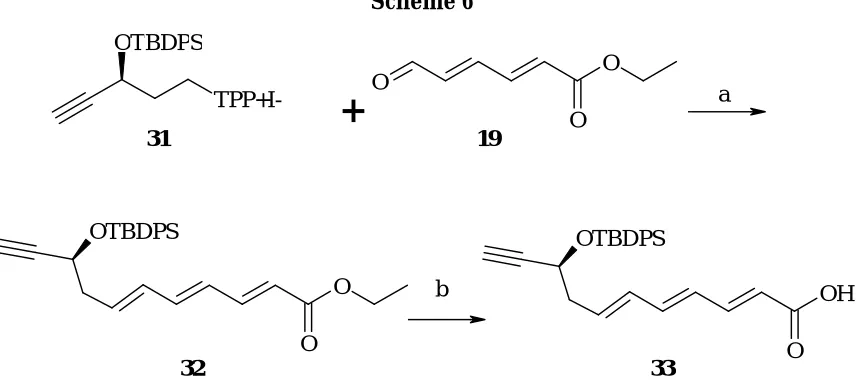
Wittig olefination of the aldehyde 18 using the ylide generated from 31, afforded the cis and trans isomers in the ratio of 70:30 . 32 was obtained by column purification . The selectivity may be due to the steric and thermodynamic reasons.The structure of the ester 32 was confirmed by IR, 1H , 13C NMR and mass. Ester 32 was saponified to yield the unstable acid 33 . The bulk of the ester was therefore stored in dry benzene under nitrogen atmosphere at -20 °C. After successful completion of the C1-C11 fragment of the Cyclamenol A attempts were made to prepare the C12-C19 fragment.
Scheme 6
33 OTBDPS
TPP+I-31
O O
O 19
32 OTBDPS
O
O
OTBDPS
OH
O a
b
+
Reagents and conditions : a. Compound 47, BuLi(2 eq), then addition of aldehyde 33 b. 0.1M LiOH, THF:MeOH, 0 °C-R.T.
Figure 8
O
N
H
P
N
H
P
O
OH
O
H
37
NH
2Br
Br
O
H
TPP+I-35
36 38
34
IX
Synthesis of C12-C19 fragment using enzymatic resolution:
The Corey-Fuchs adduct 34 that represent the C12-C19 fragment of Cyclamenol A (Figure 8), was envisaged from the synthon aldehyde 35, which in turn may be obtained from the Wittig olefination of the aldehyde 36 and ylide generated from 37.
Chiral alcohol 41 was prepared by the enzymatic resolution of the racemic mono protected alcohol 40. Commercially available diol 39 was monoprotected as its TBDPS ether 40, and then it was resolved to the S-alcohol 41, and R-acetate 42 using Candida Rugosa Lipase (CRL) in dry diisopropyl ether at R.T for 6 hrs with an enantiomeric excess of greacter than 95%.
Scheme 7
OTBDPS
OH OH OAc OTBDPS
OH OH
40 41 42
39
OTBDPS + b
a
Reagents and conditions : a. NaH, THF,24 hrs then TBDPSCl. b. i. CRL lipases, vinyl acetate,di-isopopyl ether solvent. ii. column purification.
X
Scheme 8
OTs OTBDPS N3 OTBDPS
NH2 OTBDPS NH-BocOTBDPS
OH OTBDPS
42 43
44 45
41
NH-BocOH
46
b c
d a
e
Reagents and conditions : a. TsCl, DCM, TEA, 0°C-R.T. 100%. b. NaN3, DMF, 50 °C, 12 hrs. 90%
c.TPP:H2O, 24hrs. d. (Boc)2O,TEA , DCM, 0°-R.T. 14 hrs. 80 % over 2steps e. TBAF, THF, 0 °C-R.T. 2 hrs.
Figure 9
O H
NH-Boc 47
XI
Scheme 9
THPO OH
THPO I HO
I
O
H PPh3
+I-49
THPO I HO
I
50 48
49 48
14
a
b
+
or
Reagents and conditions : a.NaI, BF3.OEt2. CH3CN. 0 °C. b. TPP, benzene , reflux, 4hrs.
Aldehyde 51 was prepared by oxidation of carbamate 46 using Py/SO3, (Scheme 10) wittig olefination of 51 with the dianion prepared from 50 (in THF:HMPA 8:1) afforded the isomeric diens 46 and 52 in ratio (60:40). The isomerization of the 52 to 47 (Z to E) was effecting using I2/DCM,and also by PhSH and AIBN condition.
Oxidation of the alcohol 47 using the swern conditions afforded conjugated aldehyde 53 and Corey-Fuchs reaction afforded the dibromo adduct 54 in good yield,the structure of which was confirmed by 1H NMR and mass data.
Scheme 10
NH-Boc OH
46
NH-Boc O
H
51
a
XII
Scheme 11
O H
PPh3
+Br-50
NH-Boc O
H
51
O H
NH-Boc
47
O H
NH-Boc
52
+
+
a
Reagents and conditions : a.compound 50, 2 equi. of BuLi -78 °C 2hrs, then addition of compound 51 in THF.
Scheme 12
47 53
54 NH-Boc
O H
NH-Boc O
NH-Boc Br
Br
a
b
Reagents and conditions : a. Swern oxidation b. 2equi. CBr4, 4equi. TPP, 3 equi. TEA, DCM, 0 °C 2hrs.
XIII
Scheme 13
55
54 BocNH
Br
Br
N H2 Br
Br a
Reagents and conditions : a.TFA, DCM, 0 °C-R.T. 4 hrs.
Scheme 14
33
OTBDPS
OH
O
55
O TBDPSO
NH Br
Br
NH2 Br
Br
56
+
a,b
Reagents and conditions : a. compound 33, DCC, DMAP, DCM, 2hrs, then addition of compound 55 in DCM b. passed through silica column deactivated with triethyl amine.
XIV
Figure 10: plausible mechanism for the macro-cyclization. For clarity of the mechanism the molecule was written linearly.
O O
H
N H
Br
Br SnBu3
99
O O
H
N H
Br SnBu3
58
O O
H
NH Br
Br
57
O O
H
NH 59
Pd
Cyclamenol A Pd
Pd
1
1.equi. Bu3SnH
2nd.equi. Bu3SnH
XV
was envisaged that by using appropriate amount of the Bu3SnH (2 equi, 1+1) in presence of the Pd complex, trans stanylation of the alkyne, cis vinyl bromide formation and final cyclization can be achieved in one pot. (Figure 10)
Scheme 15
O TBDPSO
NH Br
Br
57
a
polymerized
Reagents and conditions : a. 2 equi. Bu3SnH, PdCl2(PPh3)2 ,Pd(PPh3)4, AIBN, toluene (degassed),
0°C-R.T.-reflux.
Preliminary attempts for the preparation of macrolactum by using Stile’s protocol were not successful as mixtures of polymeric products were obtained. 1H NMR of the crude mixture indicates the bis-debromination of the terminal vinyl dibromide. Attempts are under way for the cyclization of the vinyl bromide under different available Stile’s conditions.
Synthetic Methadologies Section A
Montmorillonite KSF Clay as novel and recyclable heterogeneous solid acid for the conversion of D-glycals into chiral furan diols.
XVI
Recently the use of solid acid catalysts like clays, zeolites and ion-exchange resins has received much attention in different areas of organic synthesis because of their environmental compatibility, reusability, greater selectivity, non-corrosiveness, low cost and ease of handling. Particularly, the clay catalysts make the reaction process more convenient, economic and environmentally benign and act as both Bronsted and Lewis acids in their natural and ion-exchanged forms enabling them to function as efficient catalysts for various transformations.
We have developed a simple and efficient protocol for the synthesis of optically active furan diol from D-glucal using montmorillonite KSF clay as promoter (Scheme 16).
Scheme 16: Montmorillonite KSF catalyzed synthesis of chiral furan diols.
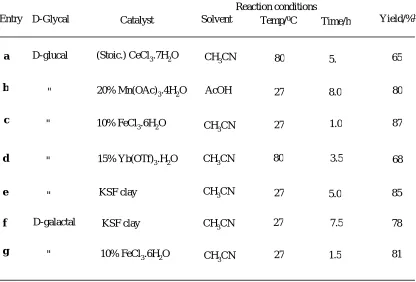
D-glucal 60 on treatment with Montmorillonite KSF clay in acetonitrile afforded 2-(D-glycero–1,2–dihydroxy ethyl) furan 62 in 85% yield. The reaction proceeded smoothly at ambient temperature with high selectivity. Similarly, D-galactal 61 also reacted well to give the same furan diol 62 in 78% yield in a short reaction time. As a solvent, acetonitrile gave the best results. It is worth to mention that the non-metallic nature of the reagent with minimum waste effluent shows the environmental consciousness and may contribute to the dream of ‘Green Process’: A simple, efficient and environmentally benign protocol has been developed for the conversion of glycals into 2-(D-glycero-1,2-dihydroxy ethyl) furan derivatives using montmorillonite KSF as
CH3CN, r.t.
O OH
OH O
O
R O
R'
60
61
62
Montmorillonite KSF
R = OH, R' = H, glucal
XVII
inexpensive and environmentally benign solid acid to afford excellent yields with high selectivity.
Section B
A Mild and Facile Synthesis for the Preparation of Substituted 4-iodoquinolines
Haloquinolines are versatile reactive intermediates undergoing both electrophilic and nucleophilic substitutions. Among these Iodoquinolines are key pharmacophores and important intermediates for the synthesis of biologically active compounds particulary in the construction of antimalarial drugs. Our interest in recent years has been towards the synthesis of various halogen derivatives of quinolines for our ongoing project with a view to synthesize novel biologically active molecules incorporating quinoline moiety.
Table 1: Conversion of D-glucal and D-galactal into chiral furan diola
Entry Solvent Yield/%b
a 65
b 80
87
d
5.
8.0
1.0
3.5
5.0 c
e
Catalyst
Reaction conditions Temp/0C
Time/h D-Glycal
D-glucal (Stoic.) CeCl3.7H2O CH
3CN
" 20% Mn(OAc)3.4H2O AcOH
80
27
27
80
27 " 10% FeCl3.6H2O CH
3CN
15% Yb(OTf)3.H2O CH3CN
"
"
68
KSF clay CH3CN 85
f 7.5
1.5 g
27
27 CH3CN
"
78 KSF clay
CH3CN 81
D-galactal
10% FeCl3.6H2O
XVIII
We have designed a simple and facile method for the preparation of substituted 4-iodoquinolines in good yield by the reaction of 4-tosyloxy derivatives with iodine, red phosphorus and glacial acetic acid at room temperature.
Scheme 17
Accordingly, treatment of 4-tosyloxy derivative with iodine, red phosphorous in glacial acetic acid affords 4-iodoquinoline in 89% yield. The reaction proceeds smoothly at room temperature and after workup, 4-iodoquinolines are isolated in pure form.. In a similar fashion, various substituted 4-iodo quinolines have been prepared in good yields from their corresponding tosyloxy derivatives. The results are summarized as shown in Table 2.
We have also observed that this method did not yield positive result when it was adopted for 4-hydroxy quinolines instead of 2-trifluoro 4-tosyloxy quinolines. Moreover the iodination of the 2-methyl-4-tosyloxy quinolines under the same reaction condition leads to iodo compound in less than 5%. Thus, it can be assumed that the highly electron withdrawing functional groups such as CF3 at the 2nd position facilitates the nucleophilic attack of the iodide on the quinoline. We presume that the generated acid halide is responsible for this transformation, which was confirmed by the preparation of 2-trifluoro-4-chloroquinoline from tosylderivatives with acetyl chlorde in the same reaction condition in 60% yield. Thus this method offers a very simple and versatile method for the synthesis of substituted iodo quinolines in high yields. The mild and convenient as well as good yields make the present iodination method highly practical for the synthesis of substituted 4-iodo quinolines. Moreover the procedure avoids the use of expensive hazardous phosphyl halides.
N CF3
OTs
N CF3
I
R R
I2, Red P
XIX N
OTs
CF3
CF3 N CF3
I
CF3 N
OTs
CF3 N
I
CF3
N OTs
CF3
CH3 N
I CF3 CH3 N OTs CF3 C H3 Br N OTs CF3 MeO N OTs CF3 F N OTs CF3 Cl N I CF3 C H3 Br N I CF3 MeO N I CF3 F N I CF3 Cl N OTs CF3 Cl N OTs CF3 Cl N I CF3 Cl N I CF3 Cl a b c d e f h i Entry 75 80 73 79 90 75 Producta
1 2 Yield
Substrate
78 g
65
75
a All the products were characterized by 1H-NMR, IR and mass Spectroscopy b Yield refers to the isolated pure products after column chromatography
Table 2: Synthesis of substituted 4-iodo quinolines:
XX
Section C
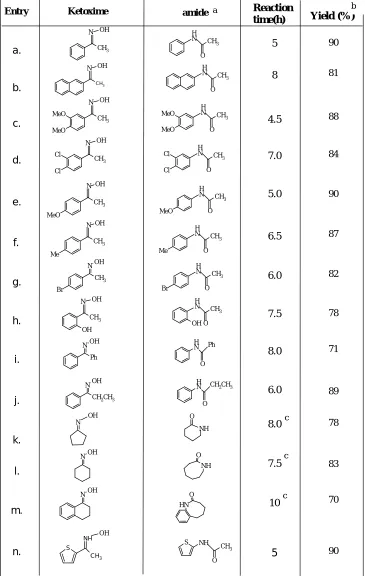
Ytterbium triflate catalyzed facile conversion of ketoximes to amides and
lactams.
Beckmann rearrangement of ketoximes for the preparation of the amides and lactams had gained importance because of its versatility and wide-spread applications in the synthesis of many biologically active natural products. Recently more attention has been paid towards lanthanide triflates as Lewis acids as they were quite stable to water, reusable and highly efficient. Particularly, ytterbium salts ,due to their high catalytic activity, easy availability, greater selectivity and reusability, without any considerable loss in catalytic activity had gained much importance.
NOH
NH O Yb(OTf)3
Toulene, reflux
NOH
Yb(OTf)3
Acetonitrile, reflux
N H
O
R R
Figure 6: Beckmann rearrangement of ketoximes to amides and Lactums
XXI
Table 3: Yb(OTf)3 mediated synthesis of amides and lactums from Oximes.
Entry Ketoxime CH3 N OH N CH 3 O H N CH 3 O H N OH CH3 MeO MeO N CH 3 O H CH3 MeO MeO N OH Cl Cl N CH 3 O H CH3 Cl Cl N OH MeO N CH 3 O H CH3 MeO N OH Me N CH 3 O H N H Br N CH 3 O H N CH3 Br OH CH3 OH N OH OH N CH 3 O H CH3 Me N OH N Ph OH Ph O N H N
CH2CH3
OH CH
2CH3
O N OH O NH NOH NH O NOH S NH CH3 OH S NH O CH3 N H O a. b. c. d. e. f. g. h. i. j. k. l. m. n. Reaction time(h) 5 8 4.5 7.0 5.0 6.5 7.5 8.0 6.0 8.0 7.5 10 5 6.0 Yield (%) 90 81 88 84 90 87 82 78 71 89 78 83 70 90
amide a b
c
c c
XXII
Experimental procedure is simple more convenient and also the method has ability to tolerate variety of substrates. Acetonitrile is the solvent of choice as best results were obtained.Yttrium, ytterbium and Zinc triflates were used for this transformation among which ytterbium triflate was found to be more useful and effective in terms of yields and reaction times. The catalyst was recovered from the aqueous layer during workup and reused twice without any significant loss of the activity.