Original Article
Journal of Advances in Medical Education & Professionalism
Online formative assessments: exploring their educational value
KAVITHA NAGANDLA1*, SHARIFAH SULAIHA1, SIVALINGAM NALLIAH1
1Department of obstetrics and Gyanecology, International Medical University, Jalan Rasah, Seremban, 70200, Malaysia
Introduction: Online formative assessments (OFA’s) have been increasingly recognised in medical education as resources that promote self-directed learning. Formative assessments are used to support the self-directed learning of students. Online formative
assessments have been identified to be less time consuming with automated feedback. This pilot study aimed to determine whether
participation and performance in online formative assessments (OFA’s) had measurable effects on learning and evaluate the students’ experience of using the OFA’s in the department of Obstetrics and Gynaecology.
Methods: This is a cross-sectional study conducted among
fourth year medical students (n=92) during their seven week
postings in Obstetrics and Gynaecology. Five sets of online
formative assessments in the format of one best answers (OBA),
Objective structured practical examination (OSPE) and Short
answer question (SAQ) with feedback were delivered over five weeks through the online portal. The mean scores of the end of posting summative exam (EOP) of those who participated in the assessments (OFA users) and of those who did not (non-OFA users) were compared, using Students t-test. The frequency of tool usage was analysed and satisfaction surveys were utilized at the end of the course by survey questionnaire using the five point
Likert scale.
Results: The mean scores of the students in end of posting
summative examination marks for students who had participated in the online formative assessment (OFA users) and for those who had not (non OFA users) showed no significant difference in all the three components OBA, SAQ and OSPE (p=0.902, 0.633, 0.248). Majority of the students perceived that OFAs fulfilled the stated aims and objectives and so they would persuade their peers
to participate in the OFAs.
Conclusions: Online formative assessments are perceived as
tools that promote self-directed learning, improved knowledge
and tailor learning for individual learning needs and style.
*Corresponding author:
Kavitha Nagandla,
Department of Obstetrics and Gyanecology,
International Medical University,
Jalan Rasah, Seremban, 70200, Malaysia
Tel: +60-175821704
Email: kavitha.nagandla@ gmail.com
Please cite this paper as:
Nagandla K, Sulaiha S, Nalliah S. Online formative assessments: exploring their educational value. J Adv Med Educ Prof. 2018;6(2):51-57
Received: 9 November 2017 Accepted: 10 February 2018
Keywords: Assessments, Self-directed learning, Education
A
bs
tr
ac
t
Introduction
O
nline formative assessments (OFAs) have been increasingly recognised in medical education as resources that promote self-directed learning. With the shift from lecture-based tostudent-based instruction, there is a need to stimulate the inquiry phenomenon and actively
engage the student in the learning process.
Self-directed learning is identified to be a promising
continuing professional education (1). The
self-directed learners are able to self-appraise their
work, identify their strengths and weaknesses and seek, accept and use feedback from others in
order to improve their performance (2). Formative
assessment can be defined as one form of self-assessment by the student, which intends to
provide feedback to both the teacher and the
student (3). The faculty takes cognisance of the
feedback to modify teaching and learning to meet the students’ needs and for the students to identify their learning needs. As designers of medical curriculum are looking for strategies to invigorate
the teaching and learning delivery methods,
formative assessments are considered as means of ensuring deeper learning and understanding
(4). Bandura proposed that repeated exposure to successful testing experiences in students with increased anxiety will promote self-efficacy for subsequent tests (5). The use of formative assessments, with no evaluation stress on the students, is the ideal exposure which has been
proved to increase the positive experience in future testing event by reducing the cognitive
stress anxiety (6).
Formative assessment can be delivered as informal comments made at the end of a case
presentation on a ward round to highly complex
and formally structured computer-based learning tools (7). Within the clinical context these formative assessment are used to encourage
appropriate professional behaviour, to develop clinical competence and to stimulate acquisition of knowledge and clinical reasoning. From the clinician perspective, the time constraint is likely
to impact the ability to provide a comprehensive formative assessment task to complement the
learning (8). Considering the clinician’s time,
production of formative assessment materials for the online medium is an expensive exercise.
However, if time, effort and money are to be spent in this direction, there must be an evidence of its benefits and cost-effectiveness (9).
There are studies demonstrating the benefits of web based formative assessment that students voluntarily take part in while preparing for a summative exam (10-12). The potential limitations with paper based formative assessments include
time constraint for individualised feedback and
the need for the students to be gathered at specific time and place to receive the feedback, which
becomes a tedious task in the presence of large
class size (13). There is, therefore, an argument to move towards online formative assessments
(OFAs).
The postulated advantages of online formative assessments (OFAs) include easy access and
availability, utilising interactive features such as images, provision of immediate and individualized feedback, along with the scores allowing timely interventions (12, 14). The
formative assessments are perceived to assist the students in terms of their extent of understanding the course material and therefore planning their
subsequent learning activities (15).
Many studies have investigated the effects
of OFAs and the improvement of scores on
the subsequent summative assessment. The
mechanisms proposed are related to increasing
student engagement, increasing time on task,
preventing procrastination and identifying
learning deficiencies through the formative feedback (12, 14, 15). Although the literature shows that the students participating in the OFAs achieved more, often in the form of a grade,
all students do not tend to participate in such
assessments (16, 17). This highlights the need to identify the reasons why some students do or do
not use OFAs despite the demonstrated positive effects.
Our study is aimed to explore the educational value of OFAs in the department of Obstetrics and Gynaecology. Our hypothesis is that OFAs
will have positive impact on the summative examination scores of the students. Based on this research question, online formative assessments are created using articulate quiz software and students are provided with unrestricted access
and they elect to participate in these assessments
voluntarily. It is anticipated that our study will identify the reasons why students do or do not
participate in OFAs (OFA users and non OFA users). Our particular interest is to identify if there is any difference in the summative performance of the students among the OFA users and non OFA users. Insights into these aspects
will provide information on the mechanisms that explain the relation between the OFAs and the final summative examinations and the
personal learning styles and learning preferences
of students. This would assist in formulating
guidelines on designing and implementation
of OFAs aligning with the curricular learning
outcomes and students’ learning needs.
Methods
The context
Obstetrics and Gynaecology is one of the
30 one best answers (OBA), 3 short answer questions (SAQ) and 3 objective structured practical examination (OSPE) questions. This evaluation is conducted at the end of the 7 weeks
of the posting.
The participants in this study were semester 8 students (n=90) in their 7 weeks of obstetrics and
Gynaecology posting. This is a cross-sectional study conducted among fourth year students
during their seven week postings in Obstetrics
and Gynaecology. A convenient sample is taken and the students’ participation is voluntary. Five sets of online formative assessments (OFAs) in
the format of one best answers (OBA), Objective
structured practical examination (OSPE) and
Short answer question (SAQ) with feedback were delivered over five weeks through the online
portal. The online formative assessments (OFAs)
were prepared, using software -Articulate Quiz maker by the faculty teaching the course, thereby
establishing content validity. This also ensured
that style and difficulty of the questions were
similar in both the formative and summative
assessments. The questions present in the
formative assessments covered the core content
of the course syllabus, which is assessed during summative examinations. The assessments were delivered by university Moodle to which every
student has access by their individual username
and password. The question format is similar to
summative examination that includes one best
answer (OBA), OSPE identifying a detail (hot spot) on an image or drag and drop sequence and SAQ (OBA, n=40, OSPE, n=7 and SAQ n=3). Students will be made aware of the OFA’s in
the course syllabus by class announcements.
The students’ participation was voluntary and taking the OFA’s was based on their own
initiative either in the computer lab or in their
own personal computer.
The assessments were organized into five assessments each (1/5) being available online starting from the second week of the posting and was open with unrestricted access for 24 hours and 7 days a week. By the end of the 6th week all the five assessments (5/5) were available for the students. Automated feedback was given
by the computer program after every attempt of
answering the set of questions. The students’ performance on first attempt of each assessment was reported and the mean marks of the 5 tests with the SD were computed.
This study was exempted from ethical
clearance as the online formative assessments are ongoing curriculum activity and this pilot
project was designed as quality assurance of the curriculum, the results of which will be analysed
for feasibility of implementation across the clinical specialities.
Data analysis
The data collected was tabulated and analysed
by using the Statistical Package for Social
Sciences (SPSS) version 17.0. In this study, a p<0.05 was considered statistically significant.
The effectiveness of the OFA’s is assessed by comparing the summative examination scores
for students who used OFA’s and did not use
(‘non-OFA’s’) by student t test. The relationship
between the scores of students using the OFA’s and the summative assessment was determined by the Pearson’s Correlation Coefficient.
The pattern and frequency of access of modules was analysed by week and time of day usage. The satisfaction surveys were utilized at the end of the posting by qualitative analysis using a survey questionnaire. The survey questionnaire has eleven items of closed ended questions and the response is obtained by five point Likert scale.
The reliability and the internal consistency of the
test items were measured by Cronbachs alpha. The factor analysis was performed to check the quality and integrity of the questionnaire and to see whether the factors are conceptually fitting together or not. It was based on Keyser-Meyer-Olkins (KMO) measure and Bartlett’s Test. Results
Comparing the summative scores of the OFAs and Non OFAs users
Of the total of 92 students, 48.9% (n=45)
participated in the assessments (OFA users)
and 51.08% (n=47) did not participate in the
assessments (Non OFA users). The End of posting summative examination marks for OFA users and
Non OFA users showed no significant difference with the mean scores of 64% & 66% in the OBA (p=0.902) 54% & 50% in the OPSE (p=0.633) and 58% & 57% in the SAQ (p=0.248). The Non
OFA users demonstrated similar performance as the OFA users in all the components of the
summative examinations, Table 1.
However, there is a moderate positive correlation r=0.46 between the mean scores of
the OFA users and the end of posting summative
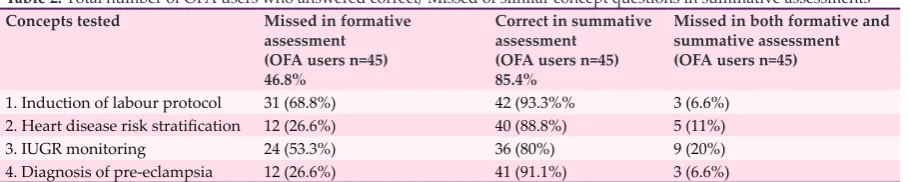
examination in the one best answer (OBA) component (p<0.001). On testing the summative performance on six similar concept questions of formative assessments with different content, the OFA users performed better with 85.4% scored correct responses compared to 46.8% in
the formative assessments. Among the Non OFA
Pattern and frequency of usage of OFA’s
The five assessments were viewed a total of 247 times by 45 students (48.9%) in 5 weeks’ time. The maximum views were in the fourth week of the posting. Mean time taken for completion was 11:13 minutes. The weekends, Friday (37.3%) and Saturday (48.4%) were the
days of maximum completion of the assessments.
There was a significant after hour use of the assessments (8:00pm-11:00pm) and an increased
access close to summative examination.
Perception of the intervention by survey questionnaire
Quantitative analysis of the survey
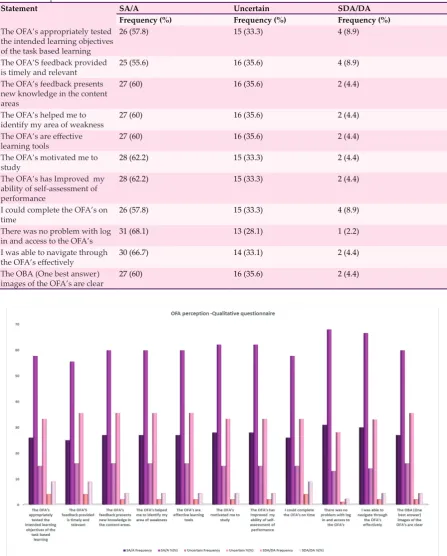
The Cronbach’s alpha (an estimated of internal consistency) was 0.96 for the present study. The factor analysis of 11 items was examined. The Kaiser-Meyer-Olkin measure of sampling adequacy was 0.83, above the recommended value of 0.6, and Bartlett’s test of sphericity was significant (X 2=615.64, p<0.000). This
suggested that each item shared some common
variance with other items and therefore reliability was achieved (Table 3).
Overall, 44.4% of students rated the online formative assessments as good, 31.1% as very good and 24.4% as satisfactory. About 64.2% felt that the OFA’s fulfilled its stated aims and objectives and 77.1% felt that they would
persuade their peers to participate in the OFA’s.
About 62.2% perceived that participation in the
assessments had improved their ability of
self-assessment of performance. About 60% strongly agreed that OFA’s had presented new knowledge to the content (Figure 1).
Discussion
In the pursuit of inventing new strategies to deliver the curriculum, our shift is towards
meaningful teaching and learning tools that can challenge students to ‘stretch further than
they think they can’ (18). Assessments are one way of challenging the students that enhance
the engagement as long as the challenges
are associated with swift focused feedback. Formative assessments well fit the model that
have the ability to foster student engagement
and deliver purposeful learning (19). However,
the emphasis must also be on assessing and providing evidence on the educational gains of such creative strategies. The primary purpose of
our study was to determine if the OFAs would
improve the summative exam scores. There
are studies reporting that formative quizzes
enhance the summative exam performances in the undergraduate medical and dental students
(20-23). However, there are few research findings
suggesting that formative assessments do not
enhance summative exam scores (24-26). The results of our study showed that mean
summative exam scores for OFA users and
OFA users were almost equal. The
non-OFA users demonstrated similar performance as the OFA users in all the components of the
summative examinations. There was a moderate correlation of mean scores of the one best answers component (OBA) of the formative assessments with the summative assessments. Our study did not demonstrate statistically significant
improved performance of the summative
assessments between OFA users and non-OFA users. These findings contradict the concept that
Table 1: Summative examination scores for students who used OFA’s and did not use (‘Non-OFA’s’) compared by independent
student t-test
OFA /Non OFA users EOP/Summative
OBA Mean±SD
EOP/Summative OSPE
Mean±SD
EOP/Summative SAQ
Mean±SD
OFA users
(n=45, 48.9%) 64.66±9.5 54.81±12 58.25±9.3
Non OFA users (n=47, 51.08 %) 66.38±8.9 50.24±13 57.05±7.6
p 0.902 0.633 0.248
Table 2: Total number of OFA users who answered correct/ Missed of similar concept questions in summative assessments
Concepts tested Missed in formative
assessment (OFA users n=45) 46.8%
Correct in summative assessment
(OFA users n=45) 85.4%
Missed in both formative and summative assessment (OFA users n=45)
1. Induction of labour protocol 31 (68.8%) 42 (93.3%% 3 (6.6%)
2. Heart disease risk stratification 12 (26.6%) 40 (88.8%) 5 (11%)
3. IUGR monitoring 24 (53.3%) 36 (80%) 9 (20%)
retrieval practice, quizzing in particular, directly boosts exam outcomes, and overall academic performance (27). However, the OFA users performed better on similar concepts questions
compared to the non-OFA users in the summative assessments. The format and content of the OFA’s material is similar although they did not mirror
the summative assessments, so rote learning is
not a reasonable conclusion to draw.
In our study only half of the students (48.5%) participated in the OFA’s. The low participation
is perhaps related to the students’ motivation. The key motivating factors for assessments are the perceived relevance of these assessments to
preparing them for high stake exams, the peer influences and teachers enthusiasm (28). While
Table 3: Perception of the OFA assessment structure and content
Statement SA/A Uncertain SDA/DA Frequency(%) Frequency (%) Frequency (%)
The OFA’s appropriately tested the intended learning objectives of the task based learning
26 (57.8) 15 (33.3) 4 (8.9)
The OFA’S feedback provided
is timely and relevant 25 (55.6) 16 (35.6) 4 (8.9)
The OFA’s feedback presents new knowledge in the content areas
27 (60) 16 (35.6) 2 (4.4)
The OFA’s helped me to
identify my area of weakness 27 (60) 16 (35.6) 2 (4.4)
The OFA’s are effective
learning tools 27 (60) 16 (35.6) 2 (4.4)
The OFA’s motivated me to
study 28 (62.2) 15 (33.3) 2 (4.4)
The OFA’s has Improved my ability of self-assessment of performance
28 (62.2) 15 (33.3) 2 (4.4)
I could complete the OFA’s on
time 26 (57.8) 15 (33.3) 4 (8.9)
There was no problem with log
in and access to the OFA’s 31 (68.1) 13 (28.1) 1 (2.2)
I was able to navigate through
the OFA’s effectively 30 (66.7) 14 (33.1) 2 (4.4)
The OBA (One best answer)
images of the OFA’s are clear 27 (60) 16 (35.6) 2 (4.4)
the first two items are within the realm of student strategic considerations of what to learn that would benefit them, the third item is an external influence related to teacher’s factors who, due to busy clinical duty, may not find the necessary to
time to build the enthusiasm and support system.
The students who participated were more curious
and motivated and had better study habits. These
traits would have contributed to satisfactory
performance outcomes rather than the effect of the resources itself.
Nonetheless, one study reported there was
no effect of online formative assessments on the
students’ final assessments as measured by their entry grade point average (GPA) (29). However,
the design of our study could not account for
such a causal relationship that would mandate
randomisation of group to OFA and non OFA users
that would deprive one group of the opportunity
to take formative assessments during the trial period. While it could be argued that the aim of formative assessment is not so much to raise the standards of attainment as to foster the spirit of
learning, it appears that OFA’s are perceived as
a useful resource that enables students to self-regulate their learning process (9). According to
Sadler and Hattie and Timperley, the three factors
that are motives for students for using formative
assessments are (a) feed up, (b) feedback and (c) feed forward (30, 31). Our study confirms the findings that students consider feedback function
being an important factor to use the OFA’s as it helps them to check their understanding and guide
their future learning directions which are again the feed forward function of the OFA’s. Furthermore,
the students perceived that OFA’s have given them
an idea about what is expected of them in the
summative assessment in terms of both content and form. Regarding the pattern of usage of
OFA’s, there is a non-uniform temporal fluctuation of usage of the OFA’s, which is more pronounced towards close to summative examinations dates, supporting the notion that students have viewed OFA’s as learning tools that would prepare them
for the high-stake exams. This supports the feed
up function of OFA’s (31, 32). However, with our study findings suggesting multiple attempts on
OFAs have not resulted in increased performance
in the summative exams, it can be proposed that
the summative examination performance is
primarily influenced by the inherent properties of the students, rather than the salient effects of formative assessment with feedback itself.
Implications for future research and practice The evidence from the feedback of the students is encouraging enough to place value
on OFA’s as valuable learning tools. While there
was considerable time, effort was directed in the generating these OFA’s, the limited uptake by the students’ needs reflection on the teacher’s role on how to stimulate motivation and direction for student centred learning. The findings of the
study have implications for postgraduates and
specialist trainees who have formidable time constraints and having well-designed OFA’s will be of considerable benefit for non-threatening feedback on their knowledge and clinical decision-making. For future research perspective, it is worth determining whether the learning benefits of OFA’s for junior medical students (semester 8), which we have demonstrated, persist
into senior clerkship of medical programs. Limitations
One of the limitations of the study is that
we did not explore information on the reasons why students elected not to participate in the assessments. The small sample size precludes the generalisation of our results. Ours was
a convenient sample of all students in the
Obstetrics & Gynaecology rotation in year 4. It is also possible that the observed effects would be substantially influenced by the speciality and
there is a need to examine the effects in larger samples and across other specialities before
we conclude if the OFA’s are robust enough as
educational interventions.
Conclusion
Our experience with online formative
assessments is a demonstration of utilising technology to supplement traditional assessments to provide additional learning platform for the
students. Although we cannot conclusively provide evidence that the OFA’s improve the final summative scores, there is moderate correlation of mean scores of the one best answers component
of the formative assessments to the summative assessments. The OFA users performed better on
similar concepts with different content questions
compared to the non-OFA users. This reinforces
that repeated assessments of questions related to
those of exams but focussing on various aspects of content can produce consistent improvement in the exam performance. The students perceived
that the assessments improved their knowledge
and their self- assessment ability to tailor learning for their individual learning needs and style. The usage pattern demonstrates that the
flexibility of an e-learning technology that allows
the students to access the resource materials at
the posting implies that the students were using
the formative assessment as preparation for the exams rather than to facilitate the learning
processes. Our future efforts will be directed towards improving the assessment contents to
improve the students’ learning experience overall and to include them in the development of online
resources to optimize their future usage.
Acknowledgement
The authors would like to thank the International Medical University for their support in conducting this study and Ms Aida, Senior executive, E learning for her assistance in the
construct and designing the online formative assessments.
Conflict of Interest: None declared.
References
1. Murad MH, Coto-Yglesias F, Varkey P, Prokop L, Murad AL. The effectiveness of self-directed learning in health professions education: A systematic review. Med Educ. 2010;44:1057–68.
2. Sargeant J, Mann K, Sinclair D, Van Der Vleuten C, Metsemakers J. Understanding the influence of emotions and reflection upon multi-source feedback acceptance and use. Adv Health Sci Educ. 2008;13:275–88
3. Rolfe I, McPherson J. Formative assessment: how am I doing?. Lancet. 1995;345:837-9.
4. Prober CG, Khan S. Medical education reimagined: a call to action. Acad Med. 2013;88:1407–10.
5. Bandura A. Social foundations of thought and action: A social cognitive theory. Englewood Cliffs, NJ: Prentice Hall; 1986.
6. Schutz PA, Davis HA. Emotions and self-regulation during test taking. Educational Psychologist. 2000; 35:243-56.
7. Greenhalgh T. Computer assisted learning in undergraduate medical education. BMJ. 2001;322:40-4. 8. Alexandraki I, Mooradian A. Academic advancement of clinician educators: why is it so difficult?. Int J ClinPract. 2011;65(11):1118-25.
9. Palmer E. The assessment of a structured online formative assessment program: a randomised controlled trial. BMC Medical Education. 2014;14:8 10. Velan GM, Kumar RK, Dziegielewski M, Wakefield
D. Web-based assessments in pathology with QuestionMark Perception. Pathology. 2002;34: 282-4. 11. Wang TH. Developing web-based assessment strategies for facilitating junior high school students to perform self-regulated learning in an e-Learning environment. Comput Educ. 2011;57:1801–12.
12. Gikandi JW, Morrow D, Davis NE. Online formative assessment in higher education: A review of the literature. Comput Educ. 2011;57:2333–51.
13. Johnson GM. Optional online quizzes: College student use and relationship to achievement. Can J Learn Tech; 2006 [serial online].
14. Cook DA, Levinson AJ, Garside S. Time and learning efficiency in Internet-based learning: A systematic review and meta-analysis. Adv Health Sci Educ. 2010;15:755–70
15. Carrillo-de-la-Pena MT, Bailles E, Cseras X, Martinez I, Ortet G, Perez J. Formative assessment and academic achievement in pre-graduate students of health sciences. Adv Health Sci Educ. 2009;14:61–7. 16. Kibble J. Use of unsupervised online quizzes as
formative assessment in a medical physiology course: Effects of incentives on student participation and performance. Adv Physiol Educ. 2007;31:253–60. 17. Sly L. Practice tests as formative assessment
improve student performance on computer-managed learning assessments. Assess Eval Higher Educ. 1999;24:339–43.
18. Kuhn D, Dean D. Is developing scientific thinking all about learning to control variables? Psychological Science. 2005;16(11):866–70.
19. Rushton A. Formative assessment: A key to deep learning? Med Teach. 2005;27:509–13.
20. Kibble JD, Johnson TR, Khalil MK, Nelson LD, Riggs GH, Borrero JL, et al. Insights gained from the analysis of performance and participation in Online Formative Assessment. Teach Learn Med. 2011;23:125–9. 21. Angus SD, Watson J. Does regular online testing
enhance student learning in the numerical sciences? Robust evidence from a large data set. Br J Educ Technol. 2009;40:255–72.
22. Bouwmeester RAM, De Kleijn RAM, Freriksen AWM, Van Emst MG, Veeneklaas RJ, Van Hoeij MJW, et al. Online formative tests linked to microlectures improve academic achievement. Med Teach. 2013;35(12):1044-6. 23. Buchanan T. The efficacy of a World-Wide Web
mediated formative assessment. J Comp Assist Learn. 2000;16:193–200.
24. Peat M, Franklin S. Has student learning been improved by the use of online and offline formative assessment opportunities? Aust J Ed Technol. 2003;19(1):87–99. 25. Brothen T, Wambach C. Effective student use of
computerized quizzes. Teach Psychol. 2001;28:292–4. 26. Haberyan KA. Do weekly quizzes improve student
performance on general biology exams? Am Biol Teach. 2003;65:110–4.
27. McDermott KB, Agarwal PK, D’Antonio L, Roediger HL, McDaniel MA. Both multiple-choice and short-answer quizzes enhance later exam performance in middle and high school classes. J ExpPsychol Appl. 2014;20:3–21.
28. Seale J, Chapman J, Davey C. The influence of assessments on students’ motivation to learn in a therapy degree course. Med Educ. 2000;34:614-21. 29. Sadler DR. Formative assessment and the design of
instructional systems. Instruct Sci. 1989;18:119–44. 30. Hattie J, Timperley H. The power of feedback. Rev
Educ Res. 2007;77:81–112.
31. Walker DJ, Topping K, Rodrigues S. Student reflections on formative e-assessment: Expectations and perceptions. Learn, Media Technol. 2008;33:221–34. 32. Henley DC. Use of Web-based formative assessment