
[Iliev* 4(10): October, 2017] ISSN 2349-4506
Impact Factor: 2.785
G
lobal
J
ournal of
E
ngineering
S
cience and
R
esearch
M
anagement
SOME NOTES ON THE FAST ADAPTIVE NEURAL NETWORK SOLVERS
Anna Malinova, Angel Golev, Anton Iliev*, Nikolay Kyurkchiev
*Faculty of Mathematics and Informatics, University of Plovdiv Paisii Hilendarski, 24, Tzar Asen Str., 4000 Plovdiv, Bulgaria
Faculty of Mathematics and Informatics, University of Plovdiv Paisii Hilendarski, 24, Tzar Asen Str., 4000 Plovdiv, Bulgaria
Faculty of Mathematics and Informatics, University of Plovdiv Paisii Hilendarski, 24, Tzar Asen Str., 4000 Plovdiv, Bulgaria
Faculty of Mathematics and Informatics, University of Plovdiv Paisii Hilendarski, 24, Tzar Asen Str., 4000 Plovdiv, Bulgaria
DOI: 10.5281/zenodo.1034497
KEYWORDS
:
solving polynomial systems of equations, Weierstrass method, non-attractive set of initial approximations.ABSTRACT
With this paper, we discuss some important aspects related to the iterative solution of two classes of polynomials, nonlinear systems of equations, and the adapted to them – "FAST adaptive neural solver" (FANS). The crucial issue of choosing initial approximations (separation of unattractive networks of initial data) and the possibility of minimizing CPU–time with the use of existing FANS is discussed.
INTRODUCTION
Polynomial systems of equations are of major interest and they are heavily used in any discipline of sciences such as mathematics, physics, chemistry and engineering.
According to [1], [2], the approaches for solving polynomial systems of equations can be classified in two categories as follows:
”1. Symbolic methods that stem from algebraic geometry;
2. Numerical methods, based on iterative procedures. These methods are suitable for local analysis only and perform well only if the initial guess is good enough, a condition that generally is rather difficult to satisfy.” In [1] the authors considered the neural network architecture for the system of polynomials
𝑓𝑖(𝑥) = ∑𝑘𝑗=1𝑖 (𝑎𝑖𝑗∏𝑛𝑙=1𝑥𝑙 𝑒𝑙𝑗𝑖
) − 𝛽𝑖= 0; 𝑖 = 1,2, … , 𝑛, (1)
where in every exponent 𝑒𝑖 the superscript 𝑖 denotes the equation, the first subscript 𝑗 denotes the factor of the summation in equation 𝑖 and the second subscript 𝑙 denotes the corresponding unknown 𝑥.
Introduced in [1] neural solvers gave good results for polynomial systems associated with chemical engineering applications.
For other results, see [4]–[9].
The point 𝑥̃ ∈ 𝑅𝑛 is an equilibrium point for the differential equation 𝑑𝑥
𝑑𝑡 = 𝑔(𝑡, 𝑥) if 𝑔(𝑡, 𝑥̃) = 0 for all 𝑡.
Of course, as we have already mentioned, it remains of crucial importance to choose initial approximations for which researched numerical method or iterative procedure is convergent.
The article is structured as follows. Firstly in “MAIN RESULTS” we explore one special class of polynomial systems and give an analytical description of the non-attractive sets to be considered by the specialists working in the direction - generating of FANS.
[Iliev* 4(10): October, 2017] ISSN 2349-4506
Impact Factor: 2.785
G
lobal
J
ournal of
E
ngineering
S
cience and
R
esearch
M
anagement
http: // www.gjesrm.com © Global Journal of Engineering Science and Research Management
(appearing as modification of classical Newton-Broyden method).
MAIN RESULTS
We will illustrate the said for a special class of polynomial systems.
Many problems in mathematics and other natural sciences and techniques reduce themselves to determining all roots of a system of equations:
| |
𝑓1(𝑥) = 𝑥𝑑1+ 𝑎
1,1𝑥𝑑1−1+ ⋯ + 𝑎1,𝑑1= 0, 𝑓2(𝑥) = 𝑥𝑑2+ 𝑎2,1𝑥𝑑2−1+ ⋯ + 𝑎2,𝑑2 = 0, ⋯
𝑓𝑛(𝑥) = 𝑥𝑑𝑛+ 𝑎
𝑛,1𝑥𝑑𝑛−1+ ⋯ + 𝑎𝑛,𝑑𝑛 = 0,
(2)
where 𝑓𝑗(𝑥) are polynomials of degree 𝑑𝑗, 1 ≤ 𝑗 ≤ 𝑛 with simple zeros. Let 𝑥𝑖,𝑗𝑘, 𝑖 = 1,2, … , 𝑛; 𝑗 = 1,2, … , 𝑑 𝑖, be distinct reasonably close approximations of these zeros. Usually, the Weierstrass procedure is used to solve the problem [45]:
𝑥𝑖,𝑗𝑘+1= 𝑥𝑖,𝑗𝑘 − 𝑓𝑖(𝑥𝑖,𝑗 𝑘)
∏𝑑𝑖𝑙≠𝑠(𝑥𝑖,𝑙𝑘−𝑥𝑖,𝑠𝑘)
; 𝑗 = 1,2, … , 𝑑𝑖; 𝑖 = 1,2, … , 𝑛.
Finding the zeros of the polynomial system (2) is related closely to research in the area of ”chemical equilibrium applications”, ”kinematic applications” and others. Following the ideas given in [34], [30] we obtain
∑𝑑𝑟
𝑝=1 𝑥𝑟,𝑝𝑘+1= −𝑎𝑟,1, ∑𝑑𝑟
𝑝=1 𝑥𝑟,𝑝𝑘+1∑𝑑𝑞≠𝑝𝑟 𝑥𝑟,𝑞𝑘 = ∑𝑙<𝑠𝑑𝑟 𝑥𝑟,𝑙𝑘 𝑥𝑟,𝑠𝑘 + 𝑎𝑟,2, ∑𝑑𝑟
𝑝=1 𝑥𝑟,𝑝𝑘+1∑𝑙<𝑠;𝑙,𝑠≠𝑝𝑥𝑟,𝑙𝑘𝑥𝑟,𝑠𝑘 = 2 ∑𝑙<𝑠<𝑡𝑑𝑟 𝑥𝑟,𝑙𝑘 𝑥𝑟,𝑠𝑘 𝑥𝑟,𝑡𝑘 − 𝑎𝑟,3, …
∑𝑑𝑟
𝑝=1 𝑥𝑟,𝑝𝑘+1∏𝑑𝑞≠𝑝𝑟 𝑥𝑟,𝑞𝑘 = (𝑑𝑟− 1) ∏𝑑𝑞=1𝑟 𝑥𝑟,𝑞𝑘 + (−1)𝑑𝑟𝑎𝑟,𝑑𝑟, ; 𝑟 = 1,2, … , 𝑛.
(3)
The resulting systems of equations (3) can be written in vector form as: 𝐴𝑟𝑑𝑟𝑥
𝑟𝑑𝑟 𝑘+1= 𝑏
𝑑𝑟
𝑟 ; 𝑟 = 1,2, … , 𝑛,
where
𝐴𝑑𝑟𝑟: =
(
1 1 … 1
∑𝑞≠1𝑥𝑟,𝑞𝑘 ∑
𝑞≠2 𝑥𝑟,𝑞𝑘 … ∑𝑞≠𝑑𝑟 𝑥𝑟,𝑞 𝑘
⋮ ⋮ ⋮
∏𝑞≠1𝑥𝑟,𝑞𝑘 ∏
𝑞≠2𝑥𝑟,𝑞𝑘 … ∏𝑞≠𝑑𝑟 𝑥𝑟,𝑞𝑘 ) ,
𝑑𝑒𝑡𝐴𝑑𝑟𝑟= ∏𝑑𝑟
𝑖<𝑗(𝑥𝑟,𝑖𝑘 − 𝑥𝑟,𝑗𝑘 ) ≠ 0,
𝑥𝑟𝑑𝑘+1𝑟: =
( 𝑥𝑟,1𝑘+1 𝑥𝑟,2𝑘+1 ⋮ 𝑥𝑟,𝑑𝑘+1𝑟
) ,
𝑏𝑑𝑟𝑟: =
( 𝑏𝑟,1𝑑𝑟
𝑏𝑟,2𝑑𝑟 ⋮ 𝑏𝑟,𝑑𝑑𝑟𝑟 ) = ( −𝑎𝑟,1 ∑𝑑𝑟
𝑙<𝑠 𝑥𝑟,𝑙𝑘𝑥𝑟,𝑠𝑘 + 𝑎𝑟,2 ⋮
(𝑑𝑟− 1) ∏𝑑𝑟
𝑞=1𝑥𝑟,𝑞𝑘 + (−1)𝑑𝑟𝑎𝑟,𝑑𝑟)
, 𝑟 = 1,2, … , 𝑛.
We shall use also the notations 𝑆𝑚𝑟,𝑑𝑟: = ∑
1≤𝑖1<𝑖2<⋯<𝑖𝑚≤𝑑𝑟 𝑥𝑟,𝑖1 𝑘 … 𝑥
𝑟,𝑖𝑚
[Iliev* 4(10): October, 2017] ISSN 2349-4506
Impact Factor: 2.785
G
lobal
J
ournal of
E
ngineering
S
cience and
R
esearch
M
anagement
Then
𝑏𝑟,𝑚𝑑𝑟 = (𝑚 − 1)𝑆
𝑚𝑟,𝑑𝑟+ (−1)𝑚𝑎𝑟,𝑚, 𝑟 = 1,2, … , 𝑛; 𝑚 = 1,2, … , 𝑑𝑟. For any given 1 ≤ 𝑖 < 𝑗 ≤ 𝑑𝑟, 𝑟 = 1,2, … , 𝑛, we define the polynomials:
𝜔𝑖𝑗𝑟,𝑑𝑟(𝑥) = (𝑥 − 𝑥
𝑟,1𝑘 ) … (𝑥 − 𝑥𝑟,𝑖−1𝑘 )(𝑥 − 𝑥𝑟,𝑖+1𝑘 ) … (𝑥 − 𝑥𝑟,𝑗−1𝑘 )(𝑥 − 𝑥𝑟,𝑗+1𝑘 ) … (𝑥 − 𝑥𝑟,𝑑𝑟 𝑘 ).
We have the following theorem.
Theorem A. [37] Suppose that for some 1 ≤ 𝑖 < 𝑗 ≤ 𝑑𝑟, 𝑟 = 1,2, … 𝑛, the sequence of approximations 𝑥𝑟,1𝑘 , … , 𝑥
𝑟,𝑑𝑟
𝑘 , 𝑟 = 1,2, … , 𝑛, satisfies the conditions
∑𝑑𝑟
𝑚=1(−1)𝑚𝑏𝑟,𝑚𝑑𝑟 [𝜔𝑖𝑗 𝑟,𝑑𝑟(𝑥
𝑟,𝑗𝑘 )(𝑥𝑟,𝑖𝑘 ) 𝑑𝑟−𝑚
+ 𝜔𝑖𝑗𝑟,𝑑𝑟(𝑥 𝑟,𝑖 𝑘 )(𝑥
𝑟,𝑗𝑘 ) 𝑑𝑟−𝑚
] = 0, (4)
𝑟 = 1,2, … , 𝑛. Then 𝑥𝑟,𝑖𝑘+1= 𝑥
𝑟,𝑗𝑘+1, 𝑟 = 1,2, … , 𝑛, and thus, the (k+2)-th step of the Weierstrass method cannot be performed.
The set 𝐷𝑓[𝑓1,…,𝑓𝑛] of the non-attractive starting points is the set of points satisfying equations (4).
Example 1. We consider the system (Mamat et al. [3], Goulianis et al. [1]): 𝑓𝑖(𝑥) = 𝑥𝑖2+ 𝑥
𝑖− 2 = 0, 𝑖 = 1,2, … , 𝑛. (5)
Let 𝑛 = 2. The non-attractive set 𝐷𝑓[𝑓1,𝑓2] is given by (see, (4)) 𝐷𝑓[𝑓1,𝑓2]= ⋃2
𝑖=1 𝐷𝑓𝑖, where
𝐷𝑓1: 2𝑥1,1 𝑘 𝑥
1,2𝑘 + 𝑥1,1𝑘 + 𝑥1,2𝑘 − 4 = 0, 𝐷𝑓2: 2𝑥2,1𝑘 𝑥2,2𝑘 + 𝑥2,1𝑘 + 𝑥2,2𝑘 − 4 = 0.
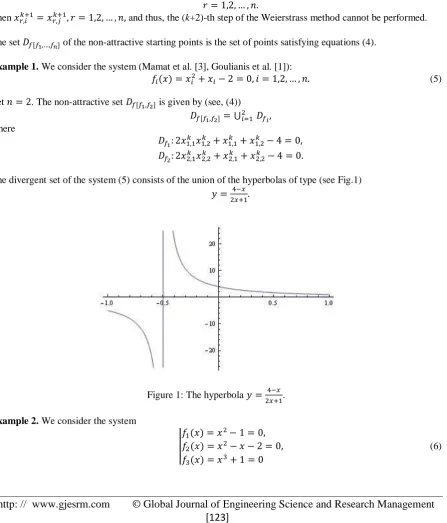
The divergent set of the system (5) consists of the union of the hyperbolas of type (see Fig.1) 𝑦 = 4−𝑥
2𝑥+1.
Figure 1: The hyperbola 𝑦 = 4−𝑥 2𝑥+1.
Example 2. We consider the system
|
𝑓1(𝑥) = 𝑥2− 1 = 0, 𝑓2(𝑥) = 𝑥2− 𝑥 − 2 = 0, 𝑓3(𝑥) = 𝑥3+ 1 = 0
[Iliev* 4(10): October, 2017] ISSN 2349-4506
Impact Factor: 2.785
G
lobal
J
ournal of
E
ngineering
S
cience and
R
esearch
M
anagement
http: // www.gjesrm.com © Global Journal of Engineering Science and Research Management
which has root −1. The non-attractive set 𝐷𝑓[𝑓1,𝑓2,𝑓3] is given by (see, (4)) 𝐷𝑓[𝑓1,𝑓2,𝑓3]= ⋃
3 𝑖=1𝐷𝑓𝑖, where
𝐷𝑓1: 𝑥1,1 𝑘 𝑥
1,2𝑘 − 1 = 0, 𝐷𝑓2: 𝑥2,2𝑘 (2𝑥
2,1𝑘 − 1) = 4 + 𝑥2,1𝑘 , 𝐷𝑓3: (𝑥3,1𝑘 − 𝑥
3,2𝑘 )2(𝑥3,3𝑘 )2+ (2 + 𝑥3,1𝑘 (𝑥3,2𝑘 )2+ (𝑥3,1𝑘 )2𝑥3,2𝑘 )𝑥3,3𝑘 −(2(𝑥3,1𝑘 )2(𝑥
3,2𝑘 )2+ 𝑥3,1𝑘 + 𝑥3,2𝑘 ) = 0.
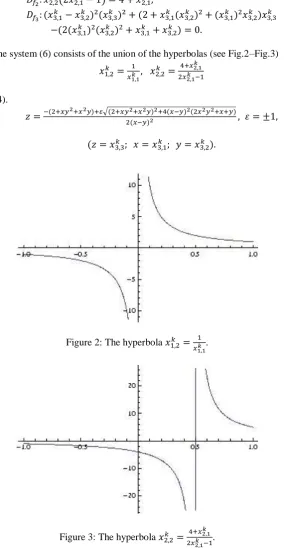
The divergent set of the system (6) consists of the union of the hyperbolas (see Fig.2–Fig.3)
𝑥1,2𝑘 = 1 𝑥1,1𝑘 , 𝑥2,2
𝑘 = 4+𝑥2,1𝑘 2𝑥2,1𝑘 −1
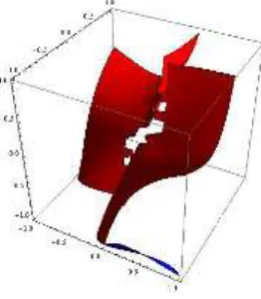
and surface (see Fig. 4).
𝑧 =−(2+𝑥𝑦2+𝑥2𝑦)+𝜀√(2+𝑥𝑦2+𝑥2𝑦)2+4(𝑥−𝑦)2(2𝑥2𝑦2+𝑥+𝑦)
2(𝑥−𝑦)2 , 𝜀 = ±1,
(𝑧 = 𝑥3,3𝑘 ; 𝑥 = 𝑥
3,1𝑘 ; 𝑦 = 𝑥3,2𝑘 ).
Figure 2: The hyperbola 𝑥1,2𝑘 = 1 𝑥1,1𝑘 .
[Iliev* 4(10): October, 2017] ISSN 2349-4506
Impact Factor: 2.785
G
lobal
J
ournal of
E
ngineering
S
cience and
R
esearch
M
anagement
Figure 4: The surface 𝑧.
Remarks
In the Example 1, the Newton’s procedure does not converge for 𝑛 > 2 and Weierstrass procedure fails for the non-attractive set 𝐷𝑓[𝑓1,𝑓2] of initial approximations.
The Example 2 is very instructive and divergent set of initial approximations 𝐷𝑓[𝑓1,𝑓2,𝑓3] is very complicated. In studying the equilibrium state of some classes of differential systems that require the study of polynomial systems of the type (2) it is extremely important to "separate" the non-attractive initial approximations to the roots. For an arbitrary 𝑛 the description of conditions (4) it is not difficult due to the existing symmetry.
You will explicitly note that for all known classic and newer algorithms like Chebishev, Halley, Ehrlich, Abert, Nourein, Dvorchuk, Petkovic, Kyurkchiev, Iliev, Proinov and others(see, [29], [31]–[33], [35]–[36], [38]–[43]) to solve the assigned task are derived and described in details respective non-attractive sets of initial data that are permanently present in the implemented scientific platform (intellectual property, see, for instance [44]). This is a very important element in dealing with issues of the mentioned issues.
First of all, the user of such algorithms usually is naturalist and a priori is not supposed to be a specialist in "Applied Mathematics".
In this sense, the requirements to user of choosing initial approximations by using different subroutines and products included in program environments and platforms are highly restrictive.
Program modules in contemporary environments must be so set to automatically report ”non-attractive sets” (as we have noted - it is not difficult their description) and to provide the user reliable solution to the problem. Goulianis et al. [1] showed that the proposed adaptive neural network algorithm is characterized by fast convergence for high–dimensional systems.
Of course analogous questions regarding the appropriate choice of initial approximations can be found in the existing and described in the literature adaptive neural network solvers.
Inevitably that will mean – ”better CPU–time”.
Solving the more general polynomial systems class of the type (1)
General iteration process, which possesses order of convergence 𝑡 is constructed in [32], [33]. From this process, Newton’s iteration formula (𝑡 = 2) and Halley’s iteration formula (𝑡 = 3) are received as particular cases. The used technique is based on generalized Taylor’s formula.
Let the system of equations
𝑓𝑖(𝑥⃗𝑘) = 0, 𝑖 = 1,2, . . . , 𝑛 (7) be given.
Supposed that 𝑓𝑖 and the partial derivatives of these functions of sufficiently high order are continuous in the neighborhood of solution 𝜉⃗(𝜉1, 𝜉2, . . . , 𝜉𝑛).
[Iliev* 4(10): October, 2017] ISSN 2349-4506
Impact Factor: 2.785
G
lobal
J
ournal of
E
ngineering
S
cience and
R
esearch
M
anagement
http: // www.gjesrm.com © Global Journal of Engineering Science and Research Management
degree 𝑡 − 1 with respect of ℎ𝑠 will be included. Taylor’s formula is of the form 0 = 𝑓𝑖+ 𝑓𝑖𝑖1
(1) ℎ𝑖1+1
2!𝑓𝑖𝑖1𝑖2 (1)
ℎ𝑖1ℎ𝑖2+1 3!𝑓𝑖𝑖1𝑖2𝑖3
(1)
ℎ𝑖1ℎ𝑖2ℎ𝑖3
+. . . + 1
(𝑡−1)!𝑓𝑖𝑖1𝑖2...𝑖𝑡−1 (1)
ℎ𝑖1ℎ𝑖2. . . ℎ𝑖𝑡−1+ 𝑂̅(𝜀𝑡). (8)
Following the scheme by which Newton’s and Halley’s iteration formulae were developed we suppose that in the above consideration we have determined
ℎ𝑗= 𝐻 𝑡−2
𝑗 + 𝑂𝑗(𝜀𝑡−1) (9)
and
‖𝑂𝑖(𝜀𝑡−1)‖ ≤ 𝑀
𝑡−1∗ 𝜀𝑡−1. (10)
Then, after replacing ℎ𝑗 from (10) in (9) we receive 0 = 𝑓𝑖+ (𝑓𝑖𝑖(1)
1 +1 2!𝑓𝑖𝑖1𝑖2
(1)
𝐻𝑡−1𝑖2 +1 3!𝑓𝑖𝑖1𝑖2𝑖3
(1)
𝐻𝑡−1𝑖2 𝐻 𝑡−1 𝑖3
+. . . +(𝑡−1)!1 𝑓𝑖𝑖(1)1𝑖2...𝑖𝑡−1𝐻𝑡−1𝑖2 𝐻 𝑡−1 𝑖3 . . . 𝐻
𝑡−1
𝑖𝑡−1) ℎ𝑖1+1 2!𝑓𝑖𝑖1𝑖2
(1)
𝑂𝑖2(𝜀𝑡−1)ℎ𝑖1
+1 3!𝑓𝑖𝑖1𝑖2𝑖3
(1) (𝑂𝑖2(𝜀𝑡−1)𝐻 𝑡−1
𝑖3 + 𝑂𝑖3(𝜀𝑡−1)𝐻 𝑡−1
𝑖2 + 𝑂𝑖2(𝜀𝑡−1)𝑂𝑖3(𝜀𝑡−1)) ℎ𝑖1
+. . . +(𝑡−1)!1 𝑓𝑖𝑖(1)1𝑖2...𝑖𝑡−1(𝑂𝑖2(𝜀𝑡−1)𝐻 𝑡−1
𝑖3 𝐻 𝑡−1
𝑖4 . . . 𝐻 𝑡−1
𝑖𝑡−1
+. . . +𝐻𝑡−1𝑖2 (𝜀𝑡−1)𝐻 𝑡−1
𝑖3 (𝜀𝑡−1). . . 𝑂𝑖𝑡−1(𝜀𝑡−1)
+𝑂𝑖2(𝜀𝑡−1)𝑂𝑖3(𝜀𝑡−1). . . )ℎ𝑖1+ 𝑂̅ 𝑖(𝜀𝑡).
(11)
The system (11) we write in the form
0 = 𝑓𝑖+ 𝑓𝑖𝑖 1
(𝑡)ℎ𝑖1+ 𝑂
𝑖(𝜀𝑡), (12)
where we substitute
𝑓𝑖𝑖(𝑡)1 = 𝑓𝑖𝑖11+1 2!𝑓𝑖𝑖1𝑖2
(1)
𝐻𝑡−1𝑖2 +. . . + 1
(𝑡−1)!𝑓𝑖𝑖1𝑖2...𝑖𝑡−1
1 𝐻
𝑡−1 𝑖2 𝐻
𝑡−1 𝑖3 . . . 𝐻
𝑡−1 𝑖𝑡−1
and
𝑂𝑖(𝜀𝑡) = 1 2!𝑓𝑖𝑖1𝑖2
(1)
𝑂𝑖2(𝜀𝑡−1)ℎ𝑖1+1 3!𝑓𝑖𝑖1𝑖2𝑖3
(1) (𝑂𝑖2
(𝜀𝑡−1)𝐻 𝑡−1
𝑖3 + 𝑂𝑖3(𝜀𝑡−1)𝐻 𝑡−1 𝑖2
+𝑂𝑖2(𝜀𝑡−1)𝑂𝑖3(𝜀𝑡−1)) ℎ𝑖1+. . . + 1 (𝑡−1)!(𝑂
𝑖2(𝜀𝑡−1)𝐻 𝑡−1 𝑖3 𝐻
𝑡−1 𝑖4 . . . 𝐻
𝑡−1 𝑖𝑡−1
+. . . +𝐻𝑡−1𝑖2 (𝜀𝑡−1)𝐻 𝑡−1
𝑖3 (𝜀𝑡−1). . . 𝑂𝑖𝑡−1(𝜀𝑡−1)+. . . )ℎ𝑖1+ 𝑂̅ 𝑖(𝜀𝑡).
The elements of reciprocal matrix of {𝑓𝑖𝑖 1 (𝑡)
} we denote with 𝑓(𝑡)𝑖𝑖1. From the system (12) we determine ℎ𝑖1
ℎ𝑖1= −𝑓 (𝑡)
𝑖1𝑠𝑓 𝑠+ 𝑓(𝑡)
𝑖1𝑠𝑂
𝑠(𝜀𝑡). (13)
We substitute 𝐻𝑡−1𝑖1 = −𝑓 (𝑡)
𝑖1𝑠𝑓 𝑠.
The following iteration formula can be formed:
𝑥𝑘+1𝑠 = 𝑥
𝑘𝑠+ 𝐻𝑡−1𝑠 , (14)
where 𝑡 denotes order of convergence. Let us form the expression
𝜉𝑠− 𝑥
(𝑘)𝑠 − 𝐻𝑡𝑠= 𝜉𝑠− 𝑥(𝑘+1)𝑠 = ℎ𝑠− 𝐻𝑡𝑠= 𝑂𝑠(𝜀𝑡). We have
‖𝑂𝑖(𝜀𝑡)‖ ≤ 1 2!‖𝑓𝑖𝑖1𝑖2
(1)‖‖𝑂𝑖2
(𝜀𝑡−1)‖‖ℎ𝑖1‖
+1
3!(‖𝑓𝑖𝑖1𝑖2𝑖3 (1) ‖ ‖𝑂𝑖2
(𝜀𝑡−1)‖‖ℎ𝑖1‖ + ‖𝑓 𝑖𝑖1𝑖2𝑖3
(1) ‖ ‖𝑂𝑖3
[Iliev* 4(10): October, 2017] ISSN 2349-4506
Impact Factor: 2.785
G
lobal
J
ournal of
E
ngineering
S
cience and
R
esearch
M
anagement
+. . . + 1
(𝑡−1)!(‖𝑓𝑖𝑖1𝑖2...𝑖𝑡−1
(1) ‖ ‖𝑂𝑖2(𝜀𝑡−1)‖‖𝐻 𝑡−1 𝑖3 ‖. . . ‖𝐻
𝑡−1 𝑖𝑡−1‖
+. . . + ‖𝑓𝑖𝑖 1𝑖2...𝑖𝑡−1 (1) ‖ ‖𝐻
𝑡−1 𝑖2 ‖‖𝐻
𝑡−1
𝑖3 ‖. . . ‖𝑂𝑖𝑡−1(𝜀𝑡−1)‖+. . . ) + ‖𝑂̅(𝜀𝑡)‖
and
‖𝑂̅𝑖(𝜀𝑡)‖ = ‖𝑓𝑖𝑖1𝑖2...𝑖𝑡 (1)
ℎ𝑖1ℎ𝑖2. . . ℎ𝑖𝑡‖ ≤ ‖𝑓 𝑖𝑖1𝑖2...𝑖𝑡
(1)
‖ ‖ℎ𝑖1‖‖ℎ𝑖2‖. . . ‖ℎ𝑖𝑡‖ ≤ ‖𝑓 𝑖𝑖1𝑖2...𝑖𝑡
(1) ‖ 𝜀𝑡,
where all summands which contained multipliers 𝜀𝑠 are dropped, when 𝑠 > 𝑡.
Taking into account the fact that functions 𝑓𝑖 are sufficiently smooth and that in above estimates all summands are of order 𝑂𝑖(𝜀𝑡).
We conclude that the following upper bound is valid
‖𝑂𝑖(𝜀𝑡)‖ ≤ 𝑀
𝑡∗𝜀𝑡, (15)
where 𝑀𝑡∗ is a positive constant.
Using (15) we receive the inequalities ‖𝜉𝑠− 𝑥
(𝑘+1)𝑠 ‖ ≤ ‖𝑂𝑠(𝜀𝑡)‖ ≤ 𝑀𝑡∗𝜀𝑡‖𝑓𝑡 𝑖1𝑙‖.
Example 3. We consider the system
|
𝑓1(𝑥) = 0.25𝑥12+ 𝑥
22− 1 = 0,
𝑓2(𝑥) = 𝑥12− 2𝑥1+ 𝑥22= 0, (16)
Figure 5: The structure of neural solver for Example 3. [1].
When we apply formula (14) to solve system from Example 3 for 𝑡 = 3 with initial approximations (1; −1), (1; 1) and (3; 1) with accuracy 15 decimal digits the respectively results are
(0.666666666666667; −0.942809041582063),
(0.666666666666667; 0.942809041582063) and
[Iliev* 4(10): October, 2017] ISSN 2349-4506
Impact Factor: 2.785
G
lobal
J
ournal of
E
ngineering
S
cience and
R
esearch
M
anagement
http: // www.gjesrm.com © Global Journal of Engineering Science and Research Management
For specifying the double root (2,0), appropriate modification of the method outlined above is used.
Example 4. We consider the system
|
𝑓1(𝑥) = 𝑥1𝑥22− 3𝑥13𝑥22− 5 = 0, 𝑓2(𝑥) = 2𝑥13𝑥
22+ 2𝑥14𝑥24− 4𝑥12𝑥24+ 3 = 0, (17)
Figure 6: The structure of neural solver for Example 4. [1].
We have used the formula (14) for finding solutions of system from Example 4 for 𝑡 = 3 with initial approximations (−1.9; 0.7), (−1.9; −0.7), (−3.6; 0.2) and (−3.6; −0.2) with accuracy 15 decimal digits and the respectively results are
(−1.70807408954102; 0.614482226647498),
(−1.70807408954102; −0.614482226647499),
(−3.32903633273033; 0.215813224817305) and
(−3.32903633273034; −0.215813224817305) for 4 iterations only.
Figure 7: Higher order recurrent neural networks.
[Iliev* 4(10): October, 2017] ISSN 2349-4506
Impact Factor: 2.785
G
lobal
J
ournal of
E
ngineering
S
cience and
R
esearch
M
anagement
CONCLUDING REMARKS
Part of the notes in “Remarks” remain valid for solving arbitrary systems of nonlinear equations.
Here is also interesting the question of isolating the non-attractive initial approximations using different modifications of the classic Newton–Broyden type methods with high order of convergence 𝑡.
The much broader issue of selecting initial data for solving polynomial systems of type (1) can be considered as open.
Sigmoidal functions (also known as ”activation functions”) find multiple applications to neural networks [10]– [15].
In conclusion, we will note that the newly constructed recurrently generable families of sigmoidal and activation functions (see, for instance [16]–[28]) can be used with success in creating a new higher order recurrent neural networks (Fig. 7).
Of course the specialists working in this important area also have the task of exploring eventual possibility for minimizing CPU–time using the existing and new ones FANS.
ACKNOWLEDGMENTS
This work has been supported by the project FP17–FMI–008 of Department for Scientific Research, Paisii Hilendarski University of Plovdiv.
REFERENCES
1. K. Goulianis, A. Margaris, I. Refandis, K. Diamantaras, Solving polynomial systems using a fast adaptive back propagation–type neural network algorithm, Euro. Jnl of Applied Mathematics, 2017, 1–37. 2. D. Manocha, Solving systems of polynomial equations, IEEE Comput. Graph. Appl., 14 (2), 1994, 46–
55
3. M. Mamat, K. Muhamad, M.Y. Waziri, Trapezoidal Broyden’s method for solving systems of nonlinear equations, Appl. Math. Sci. 8 (6), 2014, 251–260
4. T. Nguyen, Neural network architecture of solving nonlinear equation systems, Electron. Lett., 29 (16), 1993, 1403–1405
5. K. Mathia, R. Saeks, Solving nonlinear equations using recurrent neural networks, In: World Congress on Neural Networks (WCNN’ 95), Washington DC, pp. 76–80
6. X. Guo, Z. Zeng, The neural–network approaches to solve nonlinear equation, J. Comput., 5 (3), 2010, 410–416
7. A. Margaris, M. Adamopoulos, Solving nonlinear algebraic systems using artificial neural networks, In: Proceedings of the 10th international conference of engineering applications of artificial neural networks, Thessaloniki, Greece, 2007
8. N. Hahm, B.I. Hong, A note on neural network approximation with a sigmoidal function, Appl. Math. Sci., 10 (42), 2016, 2075–2085
9. K. Goulianis, A. Margaris, I. Refandis, K. Diamantaras, T. Papadimitriou, A back propagation–type neural network architecture for solving the complete 𝑛 × 𝑛 nonlinear algebraic system of equations, Adv. in Pure Math., 6, 2016, 455–480.
10. D. Costarelli, R. Spigler, Approximation results for neural network operators activated by sigmoidal functions, Neural Networks 44, 101–106 (2013).
11. D. Costarelli, G. Vinti, Pointwise and uniform approximation by multivariate neural network operators of the max-product type, Neural Networks, 2016; doi:10.1016/j.neunet.2016.06.002; http://www.sciencedirect.com/science/article/pii/S0893608016300685.
12. D. Costarelli, R. Spigler, Solving numerically nonlinear systems of balance laws by multivariate sigmoidal functions approximation, Computational and Applied Mathematics 2016; DOI:10.1007/s40314-016-0334-8 http://link.springer.com/article/10.1007/s40314-016-0334-8
13. D. Costarelli, G. Vinti, Convergence for a family of neural network operators in Orlicz spaces, Mathematische Nachrichten 2016; doi:10.1002/mana.20160006
14. N. Gyliyev, V. Ismailov, On the approximation by single hidden layer feed forward neural networks with fixed weights, arXiv:1708.06219v1 [cs. NE] 21 August (2017)
[Iliev* 4(10): October, 2017] ISSN 2349-4506
Impact Factor: 2.785
G
lobal
J
ournal of
E
ngineering
S
cience and
R
esearch
M
anagement
http: // www.gjesrm.com © Global Journal of Engineering Science and Research Management
16. N. Kyurkchiev, A. Iliev, S. Markov, Some techniques for recurrence generating of activation functions, LAP LAMBERT Academic Publishing, 2017; ISBN 978-3-330-33143-3.
17. Malinova, A., A. Golev, A. Iliev, N. Kyurkchiev, A Family of Recurrence Generating Activation Functions Based on Gudermann Function, International Journal of Engineering Researches and Management Studies, 4(8), 2017, 38-48, ISSN: 2394-7659
18. N. Kyurkchiev, A. Iliev, A note on the new Fibonacci hyperbolic tangent activation function, Int. J. of Innovative Science, Engineering and technology, 4 (5), 2017.
19. Golev, A., A. Iliev, N. Kyurkchiev, A Note on the Soboleva’ Modified Hyperbolic Tangent Activation Function, International Journal of Innovative Science Engineering and Technology, 4 (6), 2017. 20. N. Kyurkchiev, S. Markov, Sigmoid functions: Some Approximation and Modelling Aspects. (LAP
LAMBERT Academic Publishing, Saarbrucken, 2015); ISBN 978-3-659-76045-7.
21. V. Kyurkchiev, A. Iliev, N. Kyurkchiev, On some families of recurrence generated activation functions, Int. J. of Sci. Eng. And Appl. Sci., 3 (3), 2017; ISSN:2395-370
22. N. Kyurkchiev, A family of recurrence generated sigmoidal functions based on the Verhulst logistic function. Some approximation and modeling aspects, Biomath Communications, 3 (2), (2016); 18 pp., http://www.biomathforum.org/biomath/index.php/conference/article/view/789/873
23. N. Kyurkchiev, A note on the Volmer’s activation function, Compt. rend. Acad. bulg. Sci., 70 (6), 2017, 769-776
24. A. Iliev, N. Kyurkchiev, S. Markov, A family of recurrence generated parametric activation functions with applications to neural networks, International Journal on Research Innovations in Engineering Science and Technology, 2 (1), 60–68, 2017.
25. N. Kyurkchiev, S. Markov, Hausdorff Approximation of the Sign Function by a Class of Parametric Activation Functions, Biomath Communications, 3 (2), (2016); 14 pp., http://dx.doi.org/10.11145/bmc.2016.12.217
26. N. Kyurkchiev, A. Iliev, S. Markov, Families of recurrence generated three and four parametric activation functions, Int. J. Sci. Res. and Development, 4 (12), 746-750, 2017.
27. V. Kyurkchiev, N. Kyurkchiev, A family of recurrence generated functions based oh Half-hyperbolic tangent activation functions, Biomedical Statistics and Informatics, 2 (3). 87-94, 2017,
28. Iliev, A., N. Kyurkchiev, S. Markov, A Note on the New Activation Function of Gompertz Type, Biomath Communications, 4(2), 2017 (accepted).
29. Petkovic, M., D. Herceg, S. Ilic, Point Estimation Theory and its Applications, Institute of Mathematics, Novi Sad, 1997
30. Hristov V., N. Kyurkchiev, A note on the globally convergent properties of the Weierstrass-Dochev method, Approximation Theory, A volume dedicated to Bl. Sendov (B. Boyanov Ed.), DARBA, Sofia, 2002, 231-240.
31. Kyurkchiev N., Initial approximations and root finding methods, Mathematical Research Vol. 104, Wiley-VCH Verlag Berlin GmbH, Berlin, 1998.
32. Iliev, A., I. Iliev. Numerical method with order t for solving system nonlinear equations, Collection of scientific works, 30 years FMI, Plovdiv, 2000, 105-112.
33. A. Iliev, N. Kyurkchiev, Nontrivial methods in numerical analysis, Selected topics in numerical analysis, LAP LAMBERT Academic Publishing, GmbH Co. KG, Saarbrucken, 2010.
34. Kyurkchiev N., Some remarks on Weierstrass root-finding method, Compt. rend. Acad. bulg. Sci., 46, No 8, 1993, 17–20.
35. Petkovic, M., N. Kyurkchiev, A note on the convergence of the Weierstrass SOR method for polynomial roots, J. Comput. Appl. Math., 80 (1), 1997, 163–168
36. Valchanov, N., A. Golev, A. Iliev, On the critical points of Kyurkchiev’s method for solving algebraic equations, Serdica J. Computing, 9 (1), 2015, 27–34
37. Hristov, V., N. Kyurkchiev, A. Iliev, On the solutions of polynomial systems obtained by Weierstrass method, C. R. Acad. Bulg. Sci., 62, No 11, 2009, 1371–1376
38. P. Proinov, New general convergence theory for iterative processes and its applications to Newton– Kantorovich type theorems, Journal of Complexity 26, 2010, 3–42.
[Iliev* 4(10): October, 2017] ISSN 2349-4506
Impact Factor: 2.785
G
lobal
J
ournal of
E
ngineering
S
cience and
R
esearch
M
anagement
40. P. Proinov, M. Vasileva, On the convergence of high-order Ehrlich-type iterative methods for approximating all zeros of a polynomial simultaneously, Journal of Inequalities and Applications, 336, 2015, doi:10.1186/s13660-015-0855-5
41. P. Proinov, S. Cholakov, Semilocal convergence of Chebyshev-like root-finding method for simultaneous approximation of polynomial zeros, Applied Mathematics and Computation, 236, 2014, 669-682.
42. P. Proinov, S. Ivanov, On the Convergence of Halley’s Method for Multiple Polynomial Zeros, Mediterranean Journal of Mathematics, 2015, 12(2), 555–572.
43. P. Proinov, M. Petkova, Convergence of the Weierstrass method for simultaneous approximation of polynomial zeros, C. R. Acad. Bulg. Sci., 66(6), 2013, 809-818.
44. Valchanov, N., Modeling and Implementation of Extensible Modular Information Systems, PhD Thesis, University of Plovdiv, Plovdiv, 2012
![Figure 5: The structure of neural solver for Example 3. [1].](https://thumb-us.123doks.com/thumbv2/123dok_us/8888416.1823760/7.595.130.473.331.641/figure-structure-neural-solver-example.webp)
![Figure 6: The structure of neural solver for Example 4. [1].](https://thumb-us.123doks.com/thumbv2/123dok_us/8888416.1823760/8.595.104.492.193.413/figure-structure-neural-solver-example.webp)
