Strategic management of solid waste in Tehran: a case
study in District no. 1
Monireh Majlessi1, Aida Vaezi2*, Mohsen Mehdipour Rabori3
1Associate Professor, Department of Environmental Health Engineering, School of Public Health, Shahid Beheshti University of Medical Science, Tehran, Iran
2MA of Environmental Science, Islamic Azad University, Science and Research Branch, Tehran, Iran
3PhD Student of Environmental Health in SBMU, Member of Environmental Health Engineering Research Center, Kerman University of Medical Sciences, Kerman, Iran
Abstract
Background: Successful waste management programs are linked to internal factors, SW (strength and weakness points), and external factors, OT (opportunities and threats), and at the macro level are grounds for sustainable development. Studies may be related to David’s study which presented a method to quantify strength, weakness, opportunity, threats (SWOT) analysis.
Methods: In this study, designed to investigate recycling and managing dry residues in District 1, threat factors were studied and internal factors evaluation (IFE) and external factors evaluation (EFE) matrixes were scored. Tehran Municipality District 1 has 10 subdistricts and 26 neighborhoods. The dry residues from Municipality District 1 that currently weigh approximately 2678 tons per day.
Results: Results showed that WO strategies for improving weaknesses and employing opportunities available in District 1 are ideal. After constructing the Quantitative Strategic Planning Matrix (QSPM), WO strategies were prioritized.
Conclusion: The evaluation matrix of internal and external factors in the city of Tehran indicated that waste management has weak internal factors. Meanwhile, evaluation points of external factors showed that, in the current situation, SWOT could achieve good results. Waste management systems are involved with different multi-disciplinary factors; therefore, trends in the development of waste treatment technologies have been led by various social, economic, and environmental drivers in Tehran.
Keywords: Solid waste management, SWOT, Strategic management
Citation:Majlessi M, Vaezi A, Mehdipour Rabori M. Strategic management of solid waste in Tehran: A case study in District no. 1. Environmental Health Engineering and Management Journal2015; 2(2): 59–66.
*Correspondence to: Aida Vaezi
Email: [email protected] Article History: Received: 9 February 2015 Accepted: 10 May 2015 ePublished: 25 May 2015
Environmental Health Engineering and Management Journal
HE M J
© 2015 The Author(s). Published by Kerman University of Medical Sciences. This is an open-access article distributed under the terms of the Creative Commons Attribution License (http://creativecommons.org/licenses/by/4.0), which permits unrestricted use,
Original Article
Introduction
Management, planning, and efforts to find optimal solu-tions for improving urban residue problems are inevitable, and city authorities seek optimal procedures to remedy urban problems and issues (1). Successful waste manage-ment programs are linked to internal factors (strength and weakness points) and external factors (opportunities and threats), and at the macro level are grounds for sustain-able development (2). Studies on such subjects may be related to David’s study in which the author presented a method to quantify SWOT. David (3) formed the matrix of internal & external factors and matrix-profile competi-tion, but allocating a score to main factors having to be done mentally was a shortcoming of this method. Halla (4) studied the city of Dar al-Salam in Tanzania to analyze internal and external factors for urban management plan-ning. Observations were made along with the participa-tion and documented investigaparticipa-tions in accordance with the available data.
Among the most important issues considered in this de-sign are the collection, transfer, and disposal of environ-mentally friendly urban residues. Among other studies in this regard, the work of Abedin-Zadeh et al (2) can be noted. In this study, internal and external factors affecting waste management in the city of Tehran were identified, and analysis and strategy formulation using Quantitative Strategic Planning Matrix (QSPM) was performed. From other research papers, that of Zarei et al (5) can be noted, which attempted to study solid waste management in the city of Minab. Based on their results, WT strategies based on weaknesses and threats were chosen. Tehran Munici-pality District 1 has 10 regions and 26 neighborhoods. Currently, dry residues weighing approximately 2678 tons per day are collected from door fronts by a contractor company and 24 pick-up trucks. Seventeen recycling units have been established at the regional level so that resi-dents can deliver their dry residues, which weigh about 103 tons per day, in person. The current study examined
the strengths, weaknesses, opportunities, and threats of recycling and waste management of Tehran’s dry residues in 2011 and prioritized relevant strategies.
Methods
Library information on recycling and urban waste man-agement was collected by studying conducted internal and external research:
1. Data about regional waste from the waste manage-ment organization was collected, and
2. The internal and external factors evaluation (EFE) matrix and Quantitative Strategic Planning Matrix (QSPM) were created as described below.
After reviewing the internal and external factors, the most important items were listed. A number was then allocated to each coefficient: 0 (unimportant) to 1(very important). The number allocated to each coefficient is expressive of its significance. The sum of these coefficients had to equal one. Scores from 1 to 4 were allocated to each fac-tor. A score of 1 showed fundamental weakness, 2 showed little weakness, 3 indicated strength, and 4 indicated high strength for the factor in question. The coefficient of each factor was then multiplied by the score, and so the overall scores for each factor and the final score was determined (4). To create the QSPM matrix, the first and second stages of the analysis framework (the evaluation matrix of inter-nal and exterinter-nal factors) were used to objectively deter-mine implementable strategies. In the QSPM matrix, im-portant internal and external factors that influence design were considered. In this matrix, each factor was allocated an attractiveness score, which showed the attractions and
the ability to deal effectively with the strategy of internal and external factors (5).
Results
Internal and External Factors Evaluation Matrix
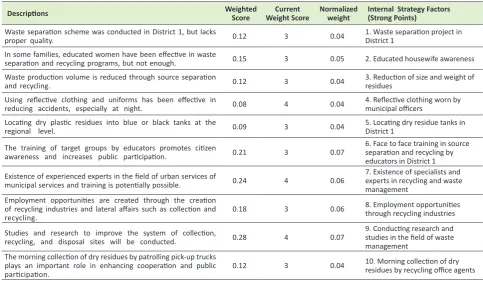
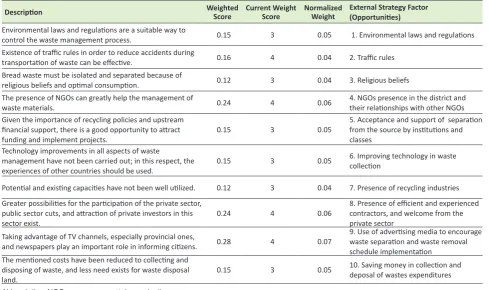
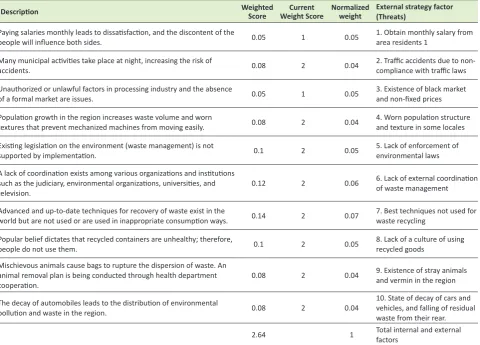
After determining the strengths, weaknesses, opportuni-ties, and threats of an organization in the area of Tehran, the internal and external factors matrix of the waste man-agement system were set up in Tables 1, 2, 3, and 4 as fol-lows:
Weights of dry residues from Tehran in the years 2007, 2009, and 2011 (kg) are shown in Table 5.
The final score for the internal factors evaluation (IFE) matrix is less than 2.5; therefore,the organization is weak at internal factors.
The final score for the EFE matrix final is 2.5; therefore, there are more organizational opportunities than threats, and the organization can take advantage of these opportu-nities to improve the trend of its activities.
Internal and External Matrix
To form this matrix, the scores created by the evaluation matrixes of internal and external factors already obtained are inserted in the horizontal and vertical dimensions of the matrix. Since the internal and external factor scores rate the situation of the organization as conservative (Figure 1), a conservative strategy (WO) is recommended. Since the organization is in a conservative position, strate-gies used are:
• WO1: Development and promotion of recycling in-dustries through financial support and marketing for
Table 1. Matrix of internal factors, recycling and management of dry residues from District 1
Descriptions Weighted Score Weight ScoreCurrent Normalized weight Internal Strategy Factors(Strong Points)
Waste separation scheme was conducted in District 1, but lacks
proper quality. 0.12 3 0.04 1. Waste separation project in District 1
In some families, educated women have been effective in waste
separation and recycling programs, but not enough. 0.15 3 0.05 2. Educated housewife awareness
Waste production volume is reduced through source separation
and recycling. 0.12 3 0.04 3. Reduction of size and weight of residues
Using reflective clothing and uniforms has been effective in
reducing accidents, especially at night. 0.08 4 0.04 4. Reflective clothing worn by municipal officers Locating dry plastic residues into blue or black tanks at the
regional level. 0.09 3 0.04 5. Locating dry residue tanks in District 1
The training of target groups by educators promotes citizen
awareness and increases public participation. 0.21 3 0.07
6. Face to face training in source separation and recycling by educators in District 1 Existence of experienced experts in the field of urban services of
municipal services and training is potentially possible. 0.24 4 0.06
7. Existence of specialists and experts in recycling and waste management
Employment opportunities are created through the creation of recycling industries and lateral affairs such as collection and
recycling. 0.18 3 0.06
8. Employment opportunities through recycling industries
Studies and research to improve the system of collection,
recycling, and disposal sites will be conducted. 0.28 4 0.07
9. Conducting research and studies in the field of waste management
The morning collection of dry residues by patrolling pick-up trucks plays an important role in enhancing cooperation and public
participation. 0.12 3 0.04
Table 2. IFE matrix of recycling and waste management of District 1
Description Weighted Score Weight ScoreCurrent Normalized Weight Internal Strategy Factor(Weaknesses)
Municipal officers stand at the rear of the waste-carrying car and lack personal protective equipment such as gloves and mask which causes
high risk, and conducted trainings are insufficient. 0.05 1 0.05
1. Failure of municipal officers to observe safety rules
Shortages in collection machinery exist, but essential measurements
are being made in this respect. 0.1 2 0.05 2. Lack of adequate machinery for waste collection in District 1 Consumption patterns change and the willingness of citizens toward
consumerism has increased waste volume; effective measures have
not been made in this regard. 0.08 2 0.04
3. Changing consumption patterns and increasing volume of waste (consumerism)
The separation of waste from its origin is not performed principally;
the necessary actions have not yet been taken. 0.06 1 0.06 4. Lack of segregation of waste at origin
Even if waste is to be separated at its point of origin, it will not be
done during collection. 0.04 1 0.06 5. Porting mixed wastes by municipal officers
Citizens do not separate waste and the washing by agents is
unprincipled, causing the vessel to be smelly. 0.04 1 0.04 6. Odors eliminated from waste tanks
Recycling industries require financing and face a lack of credit and
investment risks. 0.12 2 0.06
7. Lack of financial resources; lack of independent funding defined in the recycling and waste management industries.
Creation of traffic and noise during waste loading and collection
results in residents’ unhappiness. 0.08 2 0.04 8. Road blocking and creation of traffic in District 1
Comprehensive information on all areas of the district has been
targeted. 0.07 1 0.07 9. Lack of sufficient information to distinguish the origin of the waste
Non-compliance with waste collection schedule by officers has
resulted in complaints from residents. 0.08 2 0.04
10. Noncompliance with the schedule of waste collection by officers
2.42 1 Total internal factors
Abbreviation: IFE, internal factors evaluation.
Table 3. Recycling and waste management system of external evaluation matrix in District 1
Description Weighted Score Current Weight Score Normalized Weight External Strategy Factor(Opportunities)
Environmental laws and regulations are a suitable way to
control the waste management process. 0.15 3 0.05 1. Environmental laws and regulations
Existence of traffic rules in order to reduce accidents during
transportation of waste can be effective. 0.16 4 0.04 2. Traffic rules
Bread waste must be isolated and separated because of
religious beliefs and optimal consumption. 0.12 3 0.04 3. Religious beliefs
The presence of NGOs can greatly help the management of
waste materials. 0.24 4 0.06 4. NGOs presence in the district and their relationships with other NGOs
Given the importance of recycling policies and upstream financial support, there is a good opportunity to attract
funding and implement projects. 0.15 3 0.05
5. Acceptance and support of separation from the source by institutions and classes
Technology improvements in all aspects of waste
management have not been carried out; in this respect, the
experiences of other countries should be used. 0.15 3 0.05
6. Improving technology in waste collection
Potential and existing capacities have not been well utilized. 0.12 3 0.04 7. Presence of recycling industries Greater possibilities for the participation of the private sector,
public sector cuts, and attraction of private investors in this
sector exist. 0.24 4 0.06
8. Presence of efficient and experienced contractors, and welcome from the private sector
Taking advantage of TV channels, especially provincial ones,
and newspapers play an important role in informing citizens. 0.28 4 0.07
9. Use of advertising media to encourage waste separation and waste removal schedule implementation
The mentioned costs have been reduced to collecting and disposing of waste, and less need exists for waste disposal
land. 0.15 3 0.05
10. Saving money in collection and deposal of wastes expenditures
industrial products
• WO2: Simultaneous training for workers (active forc-es) and citizens for development of mechanization and improved equipment.
• WO3: Formation of regulations and guidelines for encouragement in the waste management sector, and employing private sector capital in this regard.
Quantitative Strategic Planning Matrix
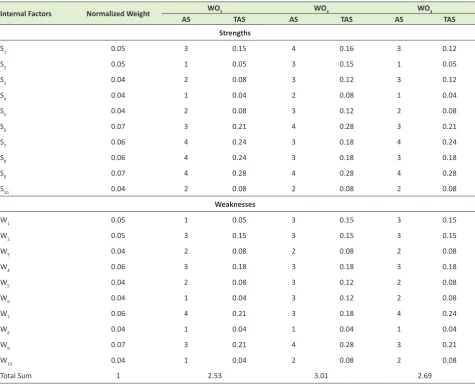
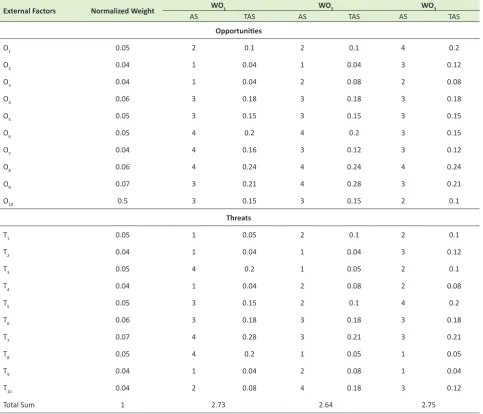
Tables 6 and 7 show the WO strategies attractiveness score for each internal and external factor on the QSPM.
Discussion
Pollution resulting from the poor management of urban
waste in the area of health and aesthetics imposes irrepa-rable consequences upon society. Among them, the lack of waste management can lead to various diseases. The most important step in raising the level of understanding about the foundations of solid waste management is to have pre-cise SWOT metrics.
In a study conducted in Tanzania, results suggested that the management plan in the city of Dar al-Salam acts stronger than a normal and ordinary plan; the compre-hensive urban management plan for the city of Dar al-Salam is more general, and the city management plan is more specialized. Important factors in the stability and plan performance of this city were citizen participation in planning, coordinating groups working together, and
Table 4. Matrix of external evaluation in waste management for the dry residues recycling and management systems of District 1
Description Weighted Score Weight ScoreCurrent Normalized weight External strategy factor (Threats)
Paying salaries monthly leads to dissatisfaction, and the discontent of the
people will influence both sides. 0.05 1 0.05 1. Obtain monthly salary from area residents 1
Many municipal activities take place at night, increasing the risk of
accidents. 0.08 2 0.04 2. Traffic accidents due to non-compliance with traffic laws
Unauthorized or unlawful factors in processing industry and the absence
of a formal market are issues. 0.05 1 0.05 3. Existence of black market and non-fixed prices
Population growth in the region increases waste volume and worn
textures that prevent mechanized machines from moving easily. 0.08 2 0.04 4. Worn population structure and texture in some locales
Existing legislation on the environment (waste management) is not
supported by implementation. 0.1 2 0.05 5. Lack of enforcement of environmental laws
A lack of coordination exists among various organizations and institutions such as the judiciary, environmental organizations, universities, and
television. 0.12 2 0.06
6. Lack of external coordination of waste management
Advanced and up-to-date techniques for recovery of waste exist in the
world but are not used or are used in inappropriate consumption ways. 0.14 2 0.07 7. Best techniques not used for waste recycling
Popular belief dictates that recycled containers are unhealthy; therefore,
people do not use them. 0.1 2 0.05 8. Lack of a culture of using recycled goods
Mischievous animals cause bags to rupture the dispersion of waste. An animal removal plan is being conducted through health department
cooperation. 0.08 2 0.04
9. Existence of stray animals and vermin in the region
The decay of automobiles leads to the distribution of environmental
pollution and waste in the region. 0.08 2 0.04
10. State of decay of cars and vehicles, and falling of residual waste from their rear.
2.64 1 Total internal and external factors
Table 5. Weight of dry residues in the years 2007, 2009, and 2011 (kg)
Year District No. BreadDry Plastic Types CardboardPaper and (Light and Heavy)Ferrous Metals Colored metals(Copper, Zinc, Aluminum, Brass) Metals Types PET Textiles Glass Burial waste Collected Dry Weights of Waste
2007 1 785730 948263 926113 - - 562860 332735 3560 7728 40825.3 3660494
2009 1 3555465 5930495 6104452 4703955 1552880 6256835 2238488 1433488 1544970 253220 28047774
The final score of the internal factors
4 3
2 1
3 Invasive
Growth and Development
(SO) Conservative
Continuous Improvement
(WO)
2 Competitive
Gradual change (ST) Reduction, Relaxation,
Dissolution
(WT) The final score of
external factors evaluation
Figure 1. External and internal factors matrix.
providing equipment and resources for groups (4). Results of the evaluation matrix of internal and external factors in the city of Rasht indicate that waste management has weak internal factors. External factor evaluation points, however, show that in the current situation, strengthening opportunities and overcoming threats could achieve good results (2). Results obtained using quantitative strategic
planning showed that implementing waste management law created the highest attractiveness, and education and proper method for pollutant reduction in burial sites cre-ated the least attractiveness (2).
Studies also indicate that Minab city’s waste management strategy where WT strategies are based on weaknesses and threats is appropriate. Media and advertising strategies have the highest priority, and increasing the assignment of waste collection and recycling strategies to the private sector has the lowest priority (5). In this study, strategies were prioritized (Table 8) to determine the attractiveness of strategies using the QSPM.
In 2007, a study in Tehran ascertained that municipal sol-id waste comprised more than 97% of Tehran’s solsol-id waste, while 3 other types comprised less than 3%, namely hos-pital waste (1.0%), industrial waste (0.6%), and construc-tion and demoliconstruc-tion waste (0.5%). The contribuconstruc-tion of household solid waste to total municipal solid waste was about 62.5% (6). The study also identified important chal-lenges in solid waste management in Tehran including proper collection and management of hospital waste; pub-lic education aimed at reducing and separating household
Table 6. Quantitative strategic planning matrix (internal factors)
Internal Factors Normalized Weight WO1 WO2 WO3
AS TAS AS TAS AS TAS
Strengths
S1 0.05 3 0.15 4 0.16 3 0.12
S2 0.05 1 0.05 3 0.15 1 0.05
S3 0.04 2 0.08 3 0.12 3 0.12
S4 0.04 1 0.04 2 0.08 1 0.04
S5 0.04 2 0.08 3 0.12 2 0.08
S6 0.07 3 0.21 4 0.28 3 0.21
S7 0.06 4 0.24 3 0.18 4 0.24
S8 0.06 4 0.24 3 0.18 3 0.18
S9 0.07 4 0.28 4 0.28 4 0.28
S10 0.04 2 0.08 2 0.08 2 0.08
Weaknesses
W1 0.05 1 0.05 3 0.15 3 0.15
W2 0.05 3 0.15 3 0.15 3 0.15
W3 0.04 2 0.08 2 0.08 2 0.08
W4 0.06 3 0.18 3 0.18 3 0.18
W5 0.04 2 0.08 3 0.12 2 0.08
W6 0.04 1 0.04 3 0.12 2 0.08
W7 0.06 4 0.21 3 0.18 4 0.24
W8 0.04 1 0.04 1 0.04 1 0.04
W9 0.07 3 0.21 4 0.28 3 0.21
W10 0.04 1 0.04 2 0.08 2 0.08
Total Sum 1 2.53 3.01 2.69
Table 7. Quantitative Strategic planning matrix (external factors)
External Factors Normalized Weight WO1 WO2 WO3
AS TAS AS TAS AS TAS
Opportunities
O1 0.05 2 0.1 2 0.1 4 0.2
O2 0.04 1 0.04 1 0.04 3 0.12
O3 0.04 1 0.04 2 0.08 2 0.08
O4 0.06 3 0.18 3 0.18 3 0.18
O5 0.05 3 0.15 3 0.15 3 0.15
O6 0.05 4 0.2 4 0.2 3 0.15
O7 0.04 4 0.16 3 0.12 3 0.12
O8 0.06 4 0.24 4 0.24 4 0.24
O9 0.07 3 0.21 4 0.28 3 0.21
O10 0.5 3 0.15 3 0.15 2 0.1
Threats
T1 0.05 1 0.05 2 0.1 2 0.1
T2 0.04 1 0.04 1 0.04 3 0.12
T3 0.05 4 0.2 1 0.05 2 0.1
T4 0.04 1 0.04 2 0.08 2 0.08
T5 0.05 3 0.15 2 0.1 4 0.2
T6 0.06 3 0.18 3 0.18 3 0.18
T7 0.07 4 0.28 3 0.21 3 0.21
T8 0.05 4 0.2 1 0.05 1 0.05
T9 0.04 1 0.04 2 0.08 1 0.04
T10 0.04 2 0.08 4 0.18 3 0.12
Total Sum 1 2.73 2.64 2.75
Abbreviations: WO, weakness, opportunity; AS, available score; TAS, total available score.
Table 8. Prioritized WO strategies Scores
Sum External Factors Internal Factors Strategy
5.65 2.64 3.01 WO2: Simultaneous training of workers and citizens for the development of mechanization and improvement
of municipal services equipment
5.44 2.75 2.69 WO3: Formulation of regulations and guidelines in order to encourage participation in waste management and attract private sector investment
5.26 2.53 2.73 WO1: Upgrading recycling industries through financial support for the development and promotion of industry
and marketing of recycled products
waste; educating municipal workers in order to optimize the waste collection system; and the participation of other related organizations and the private sector in solid waste management (7). The results of that study correspond with those of the current study.
Various studies have revealed that about 90% of municipal solid waste (MSW) is disposed of unscientifically in open dumps and landfills, creating problems to public health and the environment (8).
In another study conducted in Sweden, selected potential emerging waste treatment technologies were analyzed based on SWOT analysis, and the technologies were eval-uated with a qualitative evaluation method based on waste handling capacity, development stage, and waste manage-ment problem solving capacity (9).
• Lack of coordination between the municipalities of different regions;
• Frequent changes in management and decision-making units;
• Lack of purpose and sustainable long-term plans to achieve goals;
• Lack of support for providing the necessary facilities, equipment, and resources to do the job right;
• Lack of incentives for private sector investment that will lead to 1-year contracts;
• Lack of motivation and confidence among citizens due to poor performance, lack of continuing education programs, and lack of collection of dry waste plans;
• Emergent and short-term projects not conducted fundamentally due to lack of time and money;
• Low quality of recycled products because of poor technology and lack of proper segregation of waste materials at the source, and
• Fragmentation and high number of recycling units of multiplicity, lack of oversight on their activities, and unauthorized agent activities.
Generally, recommendations that can be made to im-prove waste management include (a) defining “Recycling Day” as a symbolic movement in the country, (b) creat-ing recyclcreat-ing exchange and offercreat-ing recyclcreat-ing products, (c) gradual reduction in frequency of manually collecting waste in neighborhoods, (d) preventing unauthorized ac-tivities and badgers, (e) providing facts and figures about the problem of recycling waste and creating incentives to encourage more people to participate in this plan, and (f) avoiding parallel activities between parties related to the issue of waste management and recycling in order to re-duce costs.
Conclusion
Waste management systems are dependent upon socio-economic issues such as population growth and gross do-mestic product (GDP) (10,11). Six waste management de-velopment drivers are categorized by Wilson in his study: (a) public health, (b) environmental protection, (c) re-source value of waste closing the loop, (d) institutional de-velopment, (e) responsible issues, and (f) public awareness overtime (12). Waste management systems are involved with different multidisciplinary factors; therefore, trends in the development of waste treatment technologies have been led by various social, economic and environmental drivers in Tehran.
Encouraging nongovernmental organizations (NGOs), associations, urban and rural councils, and schools, uni-versities and establishing programs for women, youth, and people interested in this issue with the collaboration of lo-cal authorities, municipalities, environmental agencies in order to gain public support for recycling waste through group focused activities should be considered.An impor-tant consideration is that, in the field of waste manage-ment, only by using the synchronized and simultaneous “education and culture making,” “applying law” and “em-ploying superior technologies and promoting them” can we be hopeful that waste management laws will take the
right step toward optimal management of waste materials (13). The development of waste technologies also involves other externalities, like shifting personal and social view-points on waste such as ‘waste’ to ‘resource’. A number of studies have been conducted by different researchers on the ‘zero waste’ concept (14).
Ethical issues
We certify that all data collected during the current study is presented in this manuscript; no data from the study has been or will be published separately.
Competing interests
The authors declare that they have no competing interests.
Authors’ contributions
Monireh Majlessi, Aida Vaezi, and Mohsen Mehdipour conceived and designed the study. Mohsen Mehdipour performed the literature search and wrote the manuscript. All authors participated in data acquisition, analysis and interpretation. All authors critically reviewed, refined, and approved the manuscript.
Acknowledgments
It is necessary to thank all those who participated in this research, especially the authorities of District 1 of Tehran Municipality.
References
1. Abbasvand M. Examining urban waste management process of Golestan province. In: 4th National Conference on Waste Management; 2008; Mashad, Iran.
2. Abedinzadeh N, Abedinzadeh F, Abedi T. Examining strategic factors in waste management of Rasht city using SWOT analysis and QSPM matrix. Journal of Ecology 2011; 37(57): 93-104.
3. David FR. Strategic Management. Parsaeiyan A, Arabi M, trans. 21st ed. Tehran: Culture and Management Publications; 2011. p. 687.
4. Halla F. A SWOT analysis of strategic urban development planning: the case of Dar al Salaam city in Tanzania. Habitat International 2007; 31(1): 130-42.
5. Zarei M, Raeisi A. Documenting a strategic management plan for Minab city’s waste. In: 6th National Conference on Waste Management; 2012; Mashad, Iran.
6. Damghani AM, Savarypour G, Zand E, Deihimfard R. Municipal solid waste management in Tehran: Current practices, opportunities and challenges. Waste Manag 2008; 28(5): 929-34.
7. Karbasi A, Monavari M, Mogouyi R. Strategic Management in the Environment. Kavosh Ghalam Publications; 2007.
9. Zaman AU. Identification of waste management development drivers and potential emerging waste treatment technologies. Int J Environ Sci Technol (Tehran) 2013; 10(3): 455-64.
10. Mazzanti M, Zoboli R. Waste generation, waste disposal and policy effectiveness: Evidence on decoupling from the European Union. Resources, Conservation and Recycling 2008; 52(10): 1221-34. 11. EEA indicator fact sheet. http://www.eea.europa.eu/ data-and-maps/indicators. Accessed April 22, 2009. Published 2008.
12. Wilson DC. Development drivers for waste management. Waste Manag Res 2007; 25(3): 198-07. 13. Fallahi Gilani R, Darvish A. Awareness and
importance of waste separation and environmental protection: case study from Tehran’s 22 municipality regions. In: 5th National Conference of Environmental Engineering; 2011; Terhan, Iran.