Comparison of the effects of role play and video feedback on the knowledge and
attitude of midwives towards communication skills training
Abstract
Background and Purpose: To create a positive attitude towards communication skills training, experimental methods are preferred over theoretical approaches since they encourage the practical use of these skills among different health staff. This study aimed to compare the effects of role play and video feedback on the attitude and knowledge of midwives towards communication training skills.
Methods: In this study, 47 midwives were randomly selected from educational hospitals of Mashhad, Iran and divided into two groups of role play (N=24) and video feedback (N=23). Intervention consisted of a two-day training workshop for each group. Role play and video feedback training were performed at four stages of acceptance, labor, delivery, and postpartum. Level of knowledge and attitude was evaluated in the subjects before and after the intervention using questionnaires. Data analysis was performed using independent and paired t-test, Mann-Whitney and Wilcoxon test.
Results: In this study, mean score of knowledge and attitude had a significant increase after the intervention in both groups (P=0.001) (P=0.03). Additionally, mean of difference in the scores of knowledge and attitude was not considered significant before and after the intervention (P≥0.05).
Conclusion: According to the results of this study, video feedback and role play could be equally effective in raising the awareness and improving the attitude of midwives towards communication training skills.
Keywords: Attitude, Awareness, Communication Skills, Midwife, Role Play, Video Feedback
Maryam Sadat Katebi1, Tal’at Khadivzadeh2*, Zohre Sepehri Shamloo3, Habibollah Esmaeili4
(Received: 14 Apr 2015; Accepted: 15 Aug 2015)
1 Qaen School of Nursing and Midwifery, Birjand University of Medical Sciences, Birjand, Iran
2* Corresponding author: Assistant Professor, School of Nursing and Midwifery, Mashhad University of Medical Sciences, Mashhad, Iran
Email: [email protected]
3 Department of Clinical Psychology, Ferdowsi University of Mashhad, Mashhad, Iran
4 Department of Biostatistics and Epidemiology, School of Health, Mashhad University of Medical Sciences, Mashhad, Iran
Original article
Introduction
Given the importance of interactions between midwives and patients, communication is considered as an essential element in the provision of obstetric
care (1, 2). Despite the urgent need for helpful
interactions between patients and midwives during the postpartum period, these health professionals lack the appropriate knowledge, attitude and skills in this regard (3).
Attitude influences the behaviors and actions of
individuals, and effects of awareness on the attitude
could bring about changes in the behavioral patterns
(4, 5). Different training methods are used for the adjustment of attitude and awareness. Successful communication skills training could result in the enhancement of knowledge and attitude and largely depends on the aims and design of training
courses (6, 7). Although theoretical courses are more common in this field, they are likely to impair
the process of learning (8). Evidence suggests that training courses that are based on experience could
be more effective in acquiring communication skills and attitude adjustment compared to theoretical
approaches (9). This is mainly because experimental
methods ameliorate the practical involvement of learners in the training process (10).
If changes in the attitude occur through the active engagement of the individual, they are less likely to be affected by subsequent circumstances (11). Various training methods are practiced with the
purpose of improving knowledge and attitude; they
may involve training sessions with real patients, use of patient education, and presenting teaching methods via methods such as role play and video feedback (12).
Role play is a popular method widely used to teach communication skills. In this method, learning occurs more effectively due to the emphasis on the individual’s senses and emotional involvement. Consequently, learners could predict their attitudes and values and adjust their problem-solving skills in accordance with the circumstances (13). On the other hand, practice and feedback are the key elements in the process of learning, and videotapes could yield the most practical feedback for learners
(14). Video feedback is a beneficial method used for
the promotion of communication skills in medical sciences. In this method, learners are able to assess
themselves by reviewing the recorded films and
reinforce their performance correspondingly (14).
Several studies have evaluated the influential
factors in the practice of knowledge among
different individuals, offering conflicting results. In one study, MacLaren increased awareness in nursing students using role play to facilitate pain
management in children; however, the level of attitude remained unchanged (15). In another study,
Margalit used role play instead of lecturing and
theoretical pamphlets, and observed a significant
increase in the level of knowledge, self-esteem and attitude of the patients (16). In another research,
performance and knowledge of 9 physicians were
evaluated after receiving communication skills training through video feedback. According to the results, trained physicians were more interested in evaluation and had more positive attitudes with regard to the adoption of the targeted skills (17).
For specific courses about health education,
behavioral changes in the emotional aspect are necessary. Therefore, factors such as interest, personal feelings and values should be taken into account in educational curriculum (18).
According to previous studies and lack of planning for communication skills training for midwives and nursing students, implementation of experimental courses in this regard is of paramount importance.
Given the importance of communication skills
in the field of midwifery, and since no studies have
been conducted on the effects of different learning programs on the level of knowledge and attitude in midwives, this study aimed to compare the efficacy
of role play and video feedback in the enhancement of knowledge and attitude towards communications skills among midwives.
Materials and Methods
This study was conducted on 47 midwives engaged in different hospitals of Mashhad, Iran, using the pretest-posttest method in 2014. Inclusion criteria were as follows: 1) possession of a degree in the
field of midwifery (A.D, B.A, M.A); 2) employment
in the maternity wards of Qaem, Imam Reza, Omolbanin and Shahid Hasheminejad hospitals; 3)
working in different shifts; 4) at least one year of clinical experience in maternity wards and 5) lack
of participation in communication skills workshops within the past 6 months. Exclusion criteria were lack of interest to continue participation and absence in workshop sessions.
Sample size was determined based on the comparison of study groups, and performance of
the subjects was evaluated based on the findings of
previous studies and presented in the form of mean
and standard deviation (31). With 95% confidence interval and 80% test power, the sample size was
calculated as 23 subjects in each group. Due to the exclusion of 13 research units for their absence in the sessions, 47 midwives were ultimately selected and assigned to the role play group (N=24) and video feedback group (N=23). Research units were randomly divided into two groups of role play and
video feedback. Names of qualified midwives were
recorded from 1 to 47; even numbers were in the
role play group, and odd numbers were assigned to video feedback group.
Data collection was performed using demographic and independent questionnaires in order to evaluate the level of knowledge and attitude among the subjects.
Demographic questionnaires contained 11 items, including questions about personal features, career and family history of the subjects. Due to the lack of a standardized questionnaire on the knowledge and attitude of midwives, a questionnaire was prepared by the researchers after reviewing available resources.
Validity of the questionnaires was confirmed
by content validity, and all the questionnaires were investigated and approved by ten faculty members of the School of Nursing and Midwifery at Mashhad University of Medical Sciences. Moreover, reliability of the questionnaires was
determined using factor analysis (α=91% for
awareness evaluation questionnaire, α=86% for
attitude questionnaire). Questionnaires about the awareness and attitude consisted of 7 and 14 items, respectively, which were organized on a four-point Likert scale (strongly agree, agree, disagree,
strongly disagree). Score range was between 14-56,
and higher scores were indicative of higher levels of awareness and attitude.
In this study, intervention included a two-day workshop on communication skills training.Teachings of the workshop revolved around the following subjects: overview of the process of communicating educational content
and communication skills, significance of communication in the field of midwifery and
role of active listening and verbal and non-verbal communication with patients. In this workshop, guidance was provided by expert counselors, and reliable sources, such as nursing and midwifery
reference books, were exploited as well (21-25).
After the pre-test of knowledge and attitude, communication skills workshop was initiated for the two study groups. On the first day, the workshop was held jointly, and an overview of the significance
of communication skills was presented by the
researchers and a clinical psychologist through lectures, PowerPoint presentations and group discussions.
In the role play group, the subjects were divided into three subgroups on the second day of the workshop and given four different scenarios involving common clinical issues in the maternity wards in four stages of acceptance, labor, delivery and postpartum. Afterwards, subjects were asked to voluntarily take up the roles of midwives and mothers, while others remained as observers. Each
of the scenarios lasted for about 45 minutes.
In this study, role playing was performed in seven steps, including topic introduction, selection of participants, processing the scene, preparing the observers, performance, discussion and evaluation, and sharing the views with other group members. This was performed at the Clinical Skills Center of the School of Nursing and Midwifery. Finally, in the role play group, each scenario was performed in front of other participants for ten minutes.
In the video feedback group, four midwives were asked to volunteer before the educational workshop to play the role of midwife in a simulated maternity ward setting and exhibit their actual behavior. Each of the midwives played the role in the four stages of acceptance, labor, delivery and postpartum.
Duration of each scenario was about ten minutes;
role play of the subjects in the simulation of
maternity interactions was filmed, and the videos of
all their performance in the four maternity stages were assembled for each subject.
On the second day, the video montage of the performance was displayed, and participants were asked to focus on different aspects of communication skills, behavior and judgment while discussing their views with other colleagues. Immediately after the completion of the role play workshop, knowledge and attitude of both groups were examined using the post-test approach.
In this study, data analysis was performed using SPSS V.20., and the mean scores of knowledge and attitude between the two groups were compared using independent t-test and Mann-Whitney test. Moreover, mean scores of knowledge and attitude before and immediately after the workshop were
calculated in both groups using the Wilkoxon test. To perform variance analysis, normality of dependent variables and post-test scores of knowledge and attitude were examined using Loon’s test. According to the calculations of Loon, the
significance level in the measurement of awareness is >0.05, and obtained data do not question the assumption of equality of variance errors (F=0.39,
df=4 and 42, P=0.81). However, this assumption was not established in the evaluation of attitude (P=0/03, df =42 and 4, and F= 3.01), and analysis of variance was not performed as such.
Results
In this study, mean age of the subjects in the role
play and video feedback groups was 7.14±42.67
and 9.6±37.69 years, respectively. Mean scores of knowledge in the role play and video feedback
groups before the intervention was 4.17±1.09 and
3.78±1.16, respectively, which was not statistically
significant (P=0.22). After the intervention, these
scores were calculated to be 5.75±0.67 in the role play group, which has a significant difference with
the scores before the intervention (P=0.0001) (Table 1, Figure 1).
As for the video feedback group, the mean score of knowledge after the workshop was estimated
at 5.47±0.73, which had a significant increase
compared to the scores achieved before the intervention (P=0.0001). Comparison of the mean scores of knowledge in both groups was indicative
Table 3. Results of Pearson’s Correlation Coefficient between Primary Attitude (before Intervention), Demographic Features and Employment Status of Subjects
Primary Attitude (before Intervention)
Age 0.15 0.32
Clinical Experience 0.16 0.30 Professional Interest 0.09 0.56
Job Satisfaction -0.15 0.31 Childbirth Experience 0.004 0.98
Table 2. Mean ± Standard Deviation of the Characteristics of Subjects
Mann-Whitney Test Results Group
Video Feedback N=23 Role Play
N=24 Variable
Mean±SD Mean±SD
Z=-2.00
P=0.05 37.70±9.6
Age 42.67±7.14
Age
Z=-1.50
P=0.13
13.13±9.34
Clinical Experience
17.37±7.19
Clinical Experience
Z=-0.18 P=0.86
0.85±4.91
Professional Interest 4.87±0.61
Professional Interest
Z=-0.85
P=0.40
0.90±3.09
Job Satisfaction
0.92±2.83
Job Satisfaction
Z=-1.88 P=0.06
0.49±1.36
Childbirth Experience 0.34±1.13
Childbirth Experience
Table 1. Comparison of Mean Knowledge Score of Subjects about Communication Skills before and after Intervention in Both Groups
Mann-Whitney Test Results Group
Video Feedback N=23 Role Play
N=24 Knowledge Scores
Mean±SD Mean±SD
Z=-1.24 P=0.22 3.78±1.16
4.17±1.09
Before Intervention
Z=-1.17 P=0.24
5.47±0.73 5.75±0.67
After Intervention
Z=-0.31 P=0.76 -1.70± 1.40
-1.58±1.21 Changes
P=0.0001 P=0.0001
Wilcoxon Test Results
of no significant difference after the training
program in this group (P=0.24).
According to the information in Table 2, the studied subjects were matched in terms of age, while they there was no homogeneity in other variables.
According to the information in Table 3there was no
significant correlation between the primary attitude,
demographic characteristics and employment status of the subjects (Table 4, Figure 2).
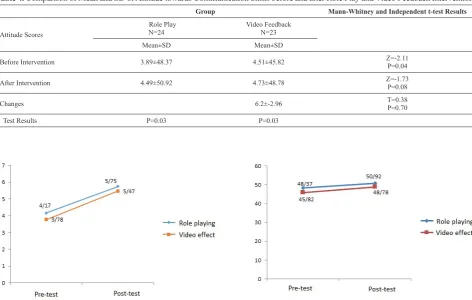
According to the results of this study, there was a
significant difference in the attitude scores between
the role play and video feedback subjects before the intervention (P=0.04). In addition, a significant
difference was observed in the attitude of the subjects in the role play group after the intervention (P=0.03). Also, there was a significant difference
in the mean scores of attitude in the subjects of the video feedback group after the workshop (P=0.03). However, comparison of the scores of attitude between the two groups after the intervention was
indicative of no significant differences (P=0.80).
To perform variance analysis, normality of dependent variables and the same variances were examined using the Loon’s test. According to the
calculations of Loon, the significance level in the measurement of awareness is >0.05, and obtained
data do not question the assumption of equality of
variance errors (F=0.39, df=4 and 42, P=0.81).
Discussion
The present study aimed to compare the effects of communication skills training on the knowledge and attitude of midwives, using two methods of role play and video feedback. According to the obtained results, mean score of knowledge after
the intervention had a significant increase in both
groups compared to before intervention (P=0.001),
which confirms the effectiveness of both applied
methods in improving the awareness of midwives.
However, there was no significant difference in the
changes of knowledge level (P=0.24).
Table 4. Comparison of Mean and SD of Attitude towards Communication Skills before and after Role Play and Video Feedback Interventions
Mann-Whitney and Independent t-test Results Group
Video Feedback N=23 Role Play
N=24 Attitude Scores
Mean±SD Mean±SD
Z=-2.11 P=0.04
4.51±45.82 3.89±48.37
Before Intervention
Z=-1.73 P=0.08 4.73±48.78
4.49±50.92
After Intervention
T=0.38 P=0.70 6.2±-2.96
Changes
P=0.03 P=0.03
Test Results
Figure 2. Comparison of Attitude Scores in Role Play and Video Feedback Groups using Pretest-Posttest
Figure 1. Comparison of Knowledge between Role Play and Video Feedback Groups using Pretest-Posttest
In the present study, mean score of attitude after
the intervention had a significant increase compared to before intervention (P=0.03), which also confirms the efficacy of both applied methods in changing
the attitude of midwives. However, the percentage of changes of attitude score in both group was no
significant difference (P=0.08). According to the
results of this study, role play and video feedback have similar effects on the level of awareness in midwives.
In previous studies examining the attitude of health professionals, there are reports on the inadequate training of midwifery students in the
field of communication and counseling skills, which
is a major cause of lack of proper communication skills among these individuals. As such, the most effective teaching methods in the improvement of
communication skills still remain unknown (19, 20).
In a study conducted by Robin, physicians who were trained on communication skills through role play were observed to acquire a more positive attitude and show better performance after the intervention compared to the subjects using other communicative skills (21).
On the other hand, the results obtained by Zraick
indicated that use of role play had no significant
effects on the improvement of communication skills among midwifery students. According to his claim, this was due to the lack of detailed assessments and use of appropriate research tools. Use of accurate methods to evaluate medical performance could
result in the more efficient assessment of educational
objectives (22).
The findings of the current study are consistent
with the results obtained by Perlini, Manaqeb, Hazavehei and Abedian. In the study conducted by Perlini (2000), mean of attitude scores towards
patients with acquired immune deficiency syndrome (AIDS) had a significant difference
between the subjects after different interventions involving role play, video feedback and lectures (P=0.017). Furthermore, role play was observed
to have a more significant effect on the changes of
attitude compared to other methods. In this regard, the researchers explained that this method could increase the motivation of subjects, depending on
the message and application of the issue addressed in the scenario. Correspondingly, focus of this method was reported to be on changing the behavior of the subjects, which could eventually bring about
changes in their general attitude (5).
In the study conducted by Manaqeb et al. (2009),
role play and group discussion were the methods used in the communication skills training of the subjects, and the former was reported to be more effective in changing the attitude of the participants (14). The results obtained by Hazavehei et al. (2006)
indicated that role play could significantly increase
the awareness and performance of female students
of middle school in the field of nutrition during
puberty periods. Moreover, durable learning had
more significant effects on this parameter compared
to lecturing (12).
In their research, Abedian et al. (2011) compared the effectiveness of role play and lecturing in the improvement of knowledge, attitude and performance of pregnant women about delivery, and
concluded that lecture could have a more significant
effect on the level of awareness about the type of delivery among these women (20).
On the other hand, in a study conducted by Roberts (2001), it was reported that in communication skills training, nurses were not willing to participate in role plays mainly because they found it uncomfortable (18).
In a research conducted by Knowles et al. (2001), communication skills training was performed using video feedback method only, and the intervention was reported to be effective in improving communication skills among the subjects (13). Furthermore, the researchers claimed that use of other communicative methods, such as role play and
group discussions, could increase the efficacy of video
feedback in communication skills training (13).
Another study performed by Margalit et al.
(2005) in Palestine compared the effectiveness of
two educational methods on the enhancement of awareness and attitude of general practitioners towards biomedical, psychological and social issues, showed that role play improved awareness, self-esteem and attitude of patient-centered health care in physicians (16).
In a study conducted by Cushing (1997), level
of awareness was reported to increase among medical students after communication skills training
workshops. According to the findings, subjects
showed great interest in role play as a communicative method, and this method was observed to be remarkably effective in improving the knowledge of the subjects. These results are consistent with the
findings of the current study (23).
Role play has been reported to be more effective in the improvement of communication skills compared to other methods. Several studies performed in different medical universities across the world have
confirmed the remarkable efficacy of role play
in enhancing the attitude among different study populations (17).
Despite the presence of accumulative scientific
and professional activities in our country, there are
insufficient courses on communication skills training;
this is mainly due to the lack of awareness and wrong
attitude of the society towards the significance of communicative skills (24, 25). Therefore, it is
necessary to improve the knowledge and attitude of the medical community, especially midwives, in order to offer academic courses on communication
skills for the students of different medical fields.
One of the limitations of the present study was that at the beginning of workshops, some midwives found
it difficult to demonstrate labor in the role play group.
As for the video feedback group, some of the subjects
were reluctant about being recorded on film while
implementing the assigned scenario at the beginning of the workshop. Due to the limited number of participants and duration of the intervention, only four midwives were randomly selected to play the scenarios in a simulated parturient setting.
The video recordings obtained from the
interventions in the present study could be beneficial
in the implementation of educational courses about communication skills for medical students and health professionals. It is believed that these results could contribute to the improvement of knowledge and attitude of midwives engaged in maternity wards.
Conclusion
In conclusion, it should be noted that the
level of communication skills is relatively low among midwives. Implementation of educational programs, increasing public expectations from midwives, and raising the awareness of pregnant women about their rights could contribute to the enhancement of communication skills among midwives and nurses. Furthermore, these health professionals should endeavor to improve their knowledge and attitude using different educational methods. For instance, midwives should be able to
promote the confidence of pregnant women during
childbirth and delivery.
To date, several studies have been conducted on
the efficacy of different communicative methods,
such as role play and group discussion, in the improvement of knowledge and attitude. However, there are limited studies on the effects of video feedback training in medical professionals, and the
findings of the current study could be helpful for
future researches in this regard.
Conflicts of interest
This study was conducted under financial support
of Mashhad University of Medical Science.
Author’s contributions
M.S. Katebi wrote the manuscript draft, studied connections, designed and performed data collection. T. Khadivzadeh studied conception and design. Z. Sepehri Shamloo studied conception, and H. Esmaily performed data analysis.
Acknowledgements
This article was extracted from the thesis published
by the first author (code: 922887) in 2015, approved
by the Research Deputy of Mashhad University of Medical Sciences, Iran. Hereby, the researchers extend their gratitude to the head of the Nursing and Midwifery School of Mashhad University of Medical Sciences for the implementation of the workshops. We would also like to thank the educational supervisors of Qaem Hospital, Imam Reza Hospital, Omolbanin Hospital, and
Shahid Hasheminejad Hospital of Mashhad, Ms. Hosseinzade and Ms. Kamalzadeh for assisting us in this research project.
References
1. Sehati F, Najar Zadeh M. Impact of continuing midwifery care during labor on length of delivery. Tabriz Nurs & Mid J.2009; 15:13-8 (Persian).
2. Kordi M, Samee Zadeh T, Salehi Fadardi J, Esmaily H. Investigation for effect of participant by primigravid mothers in long duration of delivery in Malayer city [Master Thesis]. Mashhad: Mashhad Medical University Sciences; 1998.
3. Taghizadeh Z, Rezaiepour A, Mehran A, Alimoradi Z. Usage of communication skills by midwives and its relation to clients’ satisfaction. Hayat J 2006; 12(4):47-55 (Persian).
4. Sharifirad GR, Rezaeian N, Jazini A, Sadat Etemadi Z. The
knowledge, attitude and practice of the academic members towards effective communication skills in education. J Health Sys 2010; 6(2):220-5 (Persian).
5. Perlini AH, Ward Ch. HIV prevention intervention: The effect of role-play and behavioural commitment on knowledge and attitudes. Canadian J Behav Sci 2000; 32(3):133-43.
6. Nestel D, Tierney T. Role-play for medical students learning about communication: guidelines for maximising benefits. BMC Med Educ 2007; 7:3.
7. Amidy M, Akbarzadeh K. Effect of health education on knowledge and attitudes of pregnant women in cesarean section. J Illam Univ Med Sci 2005; 13(4):17-26 (Persian). 8. Juice B, Will M, Challon E. Teaching Models [M. Behrangi,
trans]. 5th ed. Tehran: Kamale Tarbiat; 2004.
9. Heidarzadeh A, Dadkhah Tirani H, Asadi A, Nemati M. Intens, residents and faculty members’ knowledge and attitudes toward communication skills. Iran Res Med Edu 2007; 9:150-6.
10. Yarandi F, Rezaee Z, Eftekhar Z, Saadat H, Ansari Jafari M. The knowledge and attitude of pregnant women about delivery methods in health centers in Tehran. J Guilan Univ Med Sci 2002; 11(42):15-20.
11. Malakouti J, Alidoost N, Mohaddesi H, Sattarzadeh Jahdi N, Asghari Jafarabadi M, Salehi Pourmehr H. The evaluation effective of education on knowledge and attitude of nulliparous woman toward the delivery method. J Uremia Nurs Mid Facul 2014; 12(7):568-75 (Persian).
12. Hazavehie MM, Taghdisi MM, Mohaddes HR, Hasanzadeh A. The effects of three teaching methods of lecture, training game and role playing on knowledge and practice of middle school girls in regard to puberty nutrition. Develop Med Edu J 2006; 3(2):125-33.
13. Knowles C, Kinchington F, Erwin J, Peters B. A randomize controlled trial of the effectiveness of combining video role play with traditional methods of delivering undergraduate medical education. Sex Transm Infect 2001; 77(5):376-80. 14. Managheb E, Zamani AR, Shams B, Farajzadegan Z. The
effect of communication skills training through video feedback method on Intern s clinical competency. Iran J Med Edu 2010; 10(2):164-70 (Persian).
15. MacLaren JE, Cohen LL, Larkin KT, Shelton EN. Training nursing students in evidence-based techniques for cognitive-behavioral pediatric pain management. J Nurs Educ 2008; 47(8):351-8.
16. Margalit AP, Glick SM, Benbassat J, Cohen A, Katz M. Promoting a biopsychosocial orientation in family practice: effect of two teaching programs on the knowledge and attitudes of practising primary care physicians. Med Teach 2005; 27(7):613-8.
17. Kurts SM, Silverman DJ, Draper J. Teaching and Learning Communication Skills in Medicine. 1st ed. Oxford: Radcliffe Publishing; 1998. P.12-83.
18. Rees C, Sheard C, McPherson A. Medical students' views and experiences of methods of teaching and learning communication skills. Patient Educ Couns 2004; 54(1):119- 21.
19. Erfanian F, Khadivzadeh T, Khadem N, Khajedelooie M. The effect of teaching by role playing on students’ counceling and screening skills toward IUD clients. Iran J Med Edu 2009; 8(2):275-83.
20. Abedian Z, Navaee M, Jafarisani H, Ebrahimzadeh S. Comparing of two methods of teaching, roll play and lecture on knowledge, attitudes and practices of primigravid women about method of delivery. Mashhad University of Medical Sciences. 2011. (Dissertation).
21. Jackson A, Back L. Teaching communication skills using role play: an experience-based guide for educators. J Palliative Med 2011; 14(6):775-80.
22. Zraick RI, Kempster GB, Connor NP, Thibeault S, Klaben BK, Bursac Z, et al. Establishing validity of the Consensus Auditory Perceptual Evaluation of Voice. Am J Speech Lang Pathol 2011; 20(1):14-22.
23. Malekzadeh J, Amouzeshi Z, Mazlom R. The effect of teaching Orem self-care model on nursing students
communication performance in clinical setting. School of Nursing and Midwifery. Birjand Fact Nurs & Mid J 2011; 8(3):107-15.
24. Sadeghi Shermeh M, Amiri H, Karimi Zarchi A, Bahari F, Binesh A. Effectiveness of solution-focused communication
training (SFCT) in nurses’ communication skills. Iran J Military Med 2013; 14(4):279-86.
25. Dacre J, Richardson J. Noble A. Communication skills training in postgraduate medicine: the development of a new course. Postgrad Med J 2004; 80(950):711-5.