Medical Journal of the Islamic Republic of Iran (MJIRI)
Med J Islam Repub Iran. 2017(25 Dec);31.130. https://doi.org/10.14196/mjiri.31.130
Depression among Iranian nurses: A systematic review and
meta-analysis
Sahar Sadat Saeedi Shahri
1, Ahmad Ghashghaee
1, Masoud Behzadifar*
2, Nicola Luigi Bragazzi
3,
Meysam Behzadifar
4,5, Nasrin Mousavinejad
5, Mozhgan Sadat Ghaemmohamadi
1, Faezeh Ebadi
1, Hesam Seyedin
6Received:
24 Aug 2017
Published:
25 Dec 2017
Abstract
Background:
Depression is one of the most commonly diagnosed mental disorders. Nurses and other hospital service providers are a
group at high risk for developing depression. Thus, knowing the prevalence of depression among nurses can help the health care decision-
makers to plan ad hoc prevention programs to control depression in this group. This study was conducted to quantitatively assess the
prevalence of depression in nurses by performing a systematic review and meta-analysis.
Methods:
ISI/Web of Science (WoS), PubMed/MEDLINE via Ovid, PsychInfo, and Embase, as well as Iranian databases such as
Irandoc, SID, and Magiran were searched from January 2000 to March 2017. To calculate the pooled prevalence rate, the random effects
model based on the DerSimonian-Laird approach was used. I2 and the Q tests were used to examine heterogeneity among studies. To
investigate the causes and sources of heterogeneity, the impact of such variables as quality, sample size, geographic region, and criteria
used to diagnose depression was analyzed performing subgroup analyses. The quality of reviewed studies was assessed according to the
22-item STROBE checklist. Sensitivity analysis was performed to investigate the stability and robustness of the obtained results. All
data were analyzed using the “meta” package included in the R Software Version 3.4.0.
Results:
A total of 30 studies were retained in the current investigation. The overall prevalence of depression was 22% [95%CI
19-27] among nurses, with a high statistically significant heterogeneity (I2= 94% and Q-test= 479.87).
Conclusion:
This rate was higher than the prevalence of depression among the general population in Iran. Presence of happy nurses
with good mental state at hospitals is essential for promoting the care provided to patients.
Keywords:
Depression, Nurses, Iran, Systematic Review, Meta-analysis
Copyright© Iran University of Medical SciencesCite this article as
:Saeedi Shahri SS, Ghashghaee A, Behzadifar M, Luigi Bragazzi N, Behzadifar M, Mousavinejad N, Sadat Ghaemmohamadi M, Ebadi F, Seyedin H. Depression among Iranian nurses: A systematic review and meta-analysis. Med J Islam Repub Iran. 2017 (25 Dec);31:130. https://doi.org/10.14196/mjiri.31.130Introduction
Depression is one of the most commonly diagnosed
men-tal disorders. According to the World Health Organization
(WHO), about 300 million people suffer from depression
worldwide, which represents one of the leading causes of
disability and global burden of diseases (1). Every year,
large amounts of money are spent to treat depressed
pa-tients (2). This disorder imposes a considerable economic
burden on the society; therefore, prevention plays an
im-portant role in saving resources and improving quality of
life (3).
By 2030, depression is expected to become the second
cause of disability and comorbidities in developing
coun-tries (4), profoundly impacting people’s performance and
quality of life. Furthermore, an anticipation of age-of-onset
______________________________
Corresponding author: Masoud Behzadifar, [email protected]
1.Student Research Committee, School of Health Management and Information
Sci-ences Branch, Iran University of Medical SciSci-ences, Tehran, Iran.
2. Health Management and Economics Research Center, Iran University of Medical
Sci-ences, Tehran, Iran.
3.School of Public Health, Department of Health Sciences (DISSAL), University of
Genoa, Genoa, Italy.
4. Social Determinants of Health Research Center, Lorestan University of Medical
Sci-ences, Khorramabad, Iran.
5.Department of Epidemiology, Faculty of Health & Nutrition, Lorestan University of
Medical Sciences, Khorramabad, Iran.
6.Department of Health Services Management, School of Health Management and
In-formation Sciences, Iran University of Medical Sciences, Tehran, Iran.
↑
What is “already known” in this topic:
Depression is one of the most commonly diagnosed mental
dis-orders. Physicians, nurses, and other hospital service providers
represent a group of workers at high risk for developing
depres-sion.
→
What this article adds:
The overall prevalence of depression among nurses is 22%, and
this rate is higher than the prevalence of depression among the
general population in Iran. Thus, knowing the prevalence of
de-pression among nurses can help the health care decision-makers
to plan ad hoc prevention programs to control depression in this
working group.
Meta-analysis of depression in Iranian nurses
is expected (5). From an etiopathogenetic standpoint,
he-reditary genetic and biochemical causes can cause
depres-sion, disturbing communication between nerve cells (6).
Social and family problems and employment conditions
can be among the causes of depression (7). This disease
se-verely impairs familiar and social sphere, as well as
profes-sional working, leading, in some cases, to suicide (8).
Doctors, nurses, and other hospital service providers are
among a group at high risk for developing depression (9).
It is estimated that depression has a greater impact on job
performance than chronic diseases, such as arthritis, blood
pressure, backache, and diabetes (10). Nursing is among
occupational groups at high risk for depression due to harsh
working conditions (11).
Several studies have examined the prevalence of
depres-sion among nurses. In 2 studies conducted in the USA, the
prevalence of depression was reported to range from 18%
to 41% (12, 13). In a study conducted in China, this rate
was about 38% (14). In Iran, various studies have
investi-gated the prevalence of depression among nurses. Thus,
knowing the prevalence of depression among nurses can
help the health care decision- makers to plan ad hoc
pre-vention programs to control depression in this working
group.
When nurses have good physical and mental status, they
are likely to make less job mistakes and their working
mo-tivation increases. The use of psychiatric services for
nurses, who are prone to depression, should be considered.
Therefore, this study was conducted to quantitatively
as-sess the prevalence of depression in nurses by systematic
review and meta-analysis method in Iran.
Methods
Literature search
The results of the current investigation were reported
ac-cording to the “Preferred Reporting Items for Systematic
Reviews and Meta-Analyses” (PRISMA) guidelines.
Sev-eral databases including ISI/Web of Science (WoS),
Pub-Med/MEDLINE via Ovid, PsychInfo, and Embase, as well
as Iranian databases such as Irandoc, SID, and Magiran
were searched from January 2000 until March 2017. The
search strategy was as follows: “Prevalence” AND
(“pression” OR “Mental Health Disorder” OR “Major
De-pression Disorder”) AND “Nurses” AND “Iran”. Search
strategy is reported in
Appendix 1
. The reference lists of
potentially eligible articles were scanned to find further
rel-evant studies. Two authors independently eliminated
dupli-cate studies, screened them based on title and abstract, and
finally, identified studies to be retained based on
inclu-sion/exclusion criteria.
Inclusion and exclusion criteria
We included studies if they were:
1.
Observational studies (cross-sectional, case-control,
cohort investigations) examining the prevalence of
depres-sion among Iranian nurses with clear and unambiguous
re-sults;
2.
Studies published in both English and Persian;
3.
Studies published between January 2000 and March
2017;
4.
Studies using validated/standardized tools for
examin-ing depression.
We excluded studies if they were:
1.
Studies designed as randomized clinical trials (RCTs),
case-report investigations, case series, reviews, and
edito-rials;
2.
Studies reporting overlapping results;
3.
Studies whose results were not clear, and in which the
possibility of calculating the prevalence was not provided.
Data extraction and quality assessment of articles
Two of the authors extracted the required data after
agreeing on selected studies. Disagreements were resolved
by discussion. Finally, the name of the first author, year of
publication, number of participants, age, city of the study,
province of the study, type of test used to assess depression,
and the prevalence of reported depression were extracted
and collected in ad hoc designed form.
The quality of reviewed studies was assessed according
to the 22-item “Strengthening the Reporting of
Observa-tional Studies in Epidemiology” (STROBE) checklist (15).
This assessment was performed independently by 2
au-thors, and their eventual disagreements were resolved by
discussion.
Statistical analysis
To calculate the pooled prevalence rate, the
random-ef-fects model based on the DerSimonian-Laird approach was
used. Results were computed with their 95% confidence
in-terval (CI). P-value <0.05 was considered as statistically
significant. The I
2and the Q tests were used to examine
heterogeneity among studies (16). To investigate the causes
and sources of heterogeneity, the impact of such variables
as quality, sample size, geographic region, and criteria used
to diagnose depression was analyzed performing subgroup
analyses. Sensitivity analysis was performed to investigate
the stability and robustness of the obtained results. In
addi-tion, cumulative meta-analysis was done based on year of
publication. To explore more sources of heterogeneity,
meta-regression was used based on the publishing year and
sample, according to the previously defined variables.
Eg-ger’s test was used to analyze publication bias (17). All data
were analyzed using the “meta” package included in the R
Software Version 3.4.0 (freely available and downloadable
at https://www.r-project.org/).
Results
After the initial search and selecting pertinent studies
based on inclusion/exclusion criteria, 30 studies were
fi-nally included (18-47).
Figure 1
displays the process of
finding and selecting relevant studies. The overall number
of included participants was 5613. The design of all
in-cluded studies was cross-sectional.
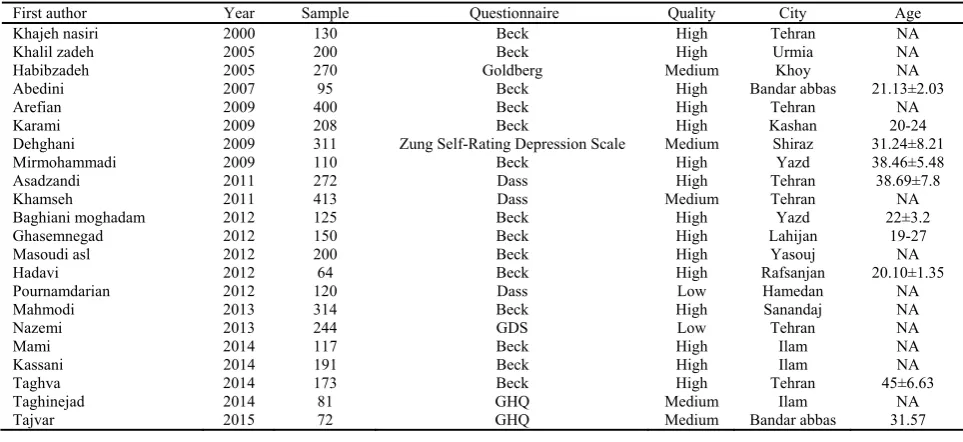
Sample sizes ranged from 60 to 413. The main
character-istics of the included studies are presented in
Table 1
. The
overall prevalence of depression among nurses was 22%
[95%CI 19-27], with I
2= 94% and Q-test = 479.87 (
Fig. 2
).
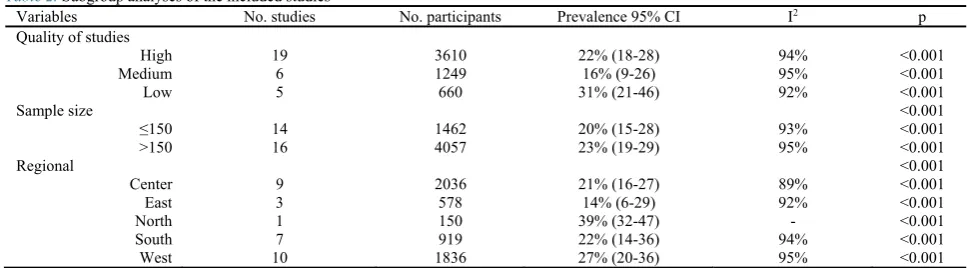
The results of the subgroup analyses based on quality,
sample size, geographic region, and diagnostic test used are
demonstrated in
Table 2
.
Sensitivity Analysis
Sensitivity analysis revealed no change in the results, and
thus, ensured
the
stability of the findings (
Appendix 2
).
Cumulative analysis
Studies were sorted based on year of publication, and no
statistically significant change could be noticed in the
re-sults (
Appendix 3
).
Fig. 1.Flowchart of the current systematic review and meta-analysis
Table 1. Main characteristics of the included studies
First author Year Sample Questionnaire Quality City Age
Khajeh nasiri 2000 130 Beck High Tehran NA
Khalil zadeh 2005 200 Beck High Urmia NA
Habibzadeh 2005 270 Goldberg Medium Khoy NA
Abedini 2007 95 Beck High Bandar abbas 21.13±2.03
Arefian 2009 400 Beck High Tehran NA
Karami 2009 208 Beck High Kashan 20-24
Dehghani 2009 311 Zung Self-Rating Depression Scale Medium Shiraz 31.24±8.21
Mirmohammadi 2009 110 Beck High Yazd 38.46±5.48
Asadzandi 2011 272 Dass High Tehran 38.69±7.8
Khamseh 2011 413 Dass Medium Tehran NA
Baghiani moghadam 2012 125 Beck High Yazd 22±3.2
Ghasemnegad 2012 150 Beck High Lahijan 19-27
Masoudi asl 2012 200 Beck High Yasouj NA
Hadavi 2012 64 Beck High Rafsanjan 20.10±1.35
Pournamdarian 2012 120 Dass Low Hamedan NA
Mahmodi 2013 314 Beck High Sanandaj NA
Nazemi 2013 244 GDS Low Tehran NA
Mami 2014 117 Beck High Ilam NA
Kassani 2014 191 Beck High Ilam NA
Taghva 2014 173 Beck High Tehran 45±6.63
Taghinejad 2014 81 GHQ Medium Ilam NA
Tajvar 2015 72 GHQ Medium Bandar abbas 31.57
Meta-analysis of depression in Iranian nurses
The results of sensitivity analysis and cumulative
analy-sis showed that the overall prevalence did not change in a
statistically significant way.
Meta- regression
Meta-regression was conducted based on year of
publi-cation and sample size. Results showed that the prevalence
of depression in Iranian nurses tended to decrease based on
the publishing year, and this decrease was statistically
sig-nificant.
Table 1.Cntd
Alipoor 2015 142 Dass Low Fasa 35±8.6
Yasemi 2015 60 Dass Low Ilam 31.86±8.35
Bahnam 2016 182 Beck High Semnan 29.74±7.919
Khani 2016 196 Beck High Neishabour 32.1±8
Yazdanshenas 2016 94 Dass Low Tehran NA
Khodadadi 2016 242 Dass High Tabriz NA
Kashani 2017 102 MMPI Medium Tehran 30.2 ± 5.6
Sagharjoghi Farahani 2017 241 Beck High Khoram abad NA
Fig. 2.Forest plot of the included studies
Table 2.Subgroup analyses of the included studies
Variables No. studies No. participants Prevalence 95% CI I2 p
Quality of studies
High 19 3610 22% (18-28) 94% <0.001
Medium 6 1249 16% (9-26) 95% <0.001
Low 5 660 31% (21-46) 92% <0.001
Sample size <0.001
≤150 14 1462 20% (15-28) 93% <0.001
>150 16 4057 23% (19-29) 95% <0.001
Regional <0.001
Center 9 2036 21% (16-27) 89% <0.001
East 3 578 14% (6-29) 92% <0.001
North 1 150 39% (32-47) - <0.001
South 7 919 22% (14-36) 94% <0.001
West 10 1836 27% (20-36) 95% <0.001
Meta-regression based on the sample size of the included
studies showed that depression prevalence tended to
in-crease, but this increase was not statistically significant
(
Table 3
and
Fig. 3
).
Publication bias
Publication bias was assessed with Egger’s test. P-value
was 0.412, showing no significant evidence of publication
bias.
Discussion
Studies examining the prevalence of diseases and health
problems can provide useful and valuable information for
health decision-makers, helping them to properly
imple-ment interventional programs and secondary and tertiary
level prevention activities (48). In this study, the prevalence
of depression was studied among the Iranian nurses. Based
on these results, prevalence of depression was 22%. The
prevalence among Iranian general population was reported
to be 4%. The results of this study showed that depression
among nurses is significantly higher than the overall pooled
prevalence rate in Iran (49).
In a study conducted in China, the prevalence of
depres-sion among nurses was 38% (14). Also in 2 studies
con-ducted in Taiwan, the prevalence was 52.5% and 27.7%,
respectively (50, 51). Canada, France, and the USA
re-ported a prevalence rate of 10% to 40% (12, 13, 52, 53).
Various factors, such as differences in personality,
cul-tural, social, and working conditions may explain
differ-ences in the prevalence of depression among nurses in
dif-ferent countries around the world. Moreover, difdif-ferent
methodological designs and different tools used for
as-sessing depression could play a role in explaining these
dis-crepancies.
The rate of depression among nurses is considerably
high. Nursing is considered as one of the most stressful
jobs, and this can increase depression and reduce nurses’
job performance and working motivation over time (54).
In Iran, the Ministry of Health is responsible for
recruit-ing and trainrecruit-ing nurses. Given the limited financial
re-sources in the health sector, the country is faced with
short-age of nurses like other many developing countries. A total
of 90 026 nurses in Iran were employed in 2008, while the
country needed at least approximately 220 000 nurses (55).
The shortage of work force has led the nurses to provide
services for longer hours. Lack of manpower in hospitals
increases job burnout in nurses, reduces job satisfaction,
and raises the rate of depression (56). Based on studies in
different geographical areas of Iran and considering the
re-sults of this study, the highest rate of depression was in the
Western part of Iran, with a prevalence of 27%. Iran has a
large population in its West part, and unfortunately,
short-age of nurses is particularly high in this area. On the other
hand, the significant role of the private sector in the health
sector and the lack of private hospitals have increased the
workload of nurses, resulting in an increase in the rate of
depression among them.
Several studies have shown that nurses who work for
longer periods are more prone to depression. Fatigue
Table 2.Cntd
Tools <0.001
Beck Depression Inventory 17 3096 21% (17-27) 93% <0.001
DASS questionnaire 7 1343 30% (21-42) 94% <0.001
GHQ-28 questionnaire 2 153 9% (5-16) 14% 0.285
Geriatric Depression Scale (GDS) 1 244 40% (34-47) Not applicable -
Goldberg test 1 270 46%(40-52) Not applicable -
MMPI 1 102 5% (2-12) Not applicable -
Zung Self-Rating Depression Scale 1 311 16% (13-21) Not applicable -
Table 3.Results of meta-regression
Variable Estimate Size Effect Z-val p 95% CI
Lower Upper
Year of publication -0.041 0.0241 -1.708 0.087 -0.088 0.006
Sample size of studies 0.000 0.001 0.668 0.503 -0.001 0.002
Fig. 3.Results of the meta-regression analyses
Meta-analysis of depression in Iranian nurses
caused by an increase in working hours can have a
devas-tating impact on intellectual and spiritual life (52). Also, the
rate of depression among nurses could depend on working
in specific wards, where stress is higher. Unfortunately, in
this study, no proper information was available to compare
the level of depression in different parts of hospitals.
It seems that health care workers working in intensive
care units (ICUs), coronary care units (CCUs), emergency,
surgery, pediatrics, ear, nose and throat (ENT), and internal
departments are at higher risk of developing depression.
Also, nurses working in psychiatric hospitals and clinics are
more prone to depression. Due to hard working conditions
in these sectors, the nurses are at greater risk for developing
depression (52, 57). On the other hand, in sectors such as
infectious diseases, fear of infections may cause too much
stress in nurses. Nurses' work stress is generally high, and
as the most important reason for depression is stress, stress
management plays an important role in reducing depression
in nurses (57). On the other hand, violence in the workplace
is another factor profoundly influencing nurses’ mental
health. The violent and intimidating behavior of some
pa-tients and their relatives is another reason for the increase
in depression rate (58). Studies revealed a relationship
be-tween workplace violence and depression among nurses.
Indeed, nurses who have experienced violence are more
likely to develop depression than the ones who have been
less exposed to violence. Research shows that the
preva-lence of viopreva-lence caused by employment condition has a
huge impact on psychological conditions of nurses (59).
Nurses, due to long working hours in the hospital, do not
have a chance to attend social activities. Sustained
engage-ment in social activities, communication with friends, and
emotional interactions with family members make people
less susceptible to stress, isolation, and depression (60).
Research has shown that people who work in rotating
shifts (round the clock) have lower level of serotonin
hor-mone than others. Serotonin is a neurotransmitter of the
central nervous system that helps the body to regulate sleep.
Insomnia has a negative impact on the body and mind of
individuals over time and can cause depression and anxiety.
Working shifts can cause insomnia and disruption of the
body's circadian rhythm. Nurses and doctors are among
people whose circadian rhythm is disrupted and get
insuf-ficient sleep. This impairs family, work, and social spheres
(61, 62).
In this study, the prevalence of depression ranged from
5% to 46% (
Table 2
). One of the reasons for this variation
comes from differences in diagnostic tests used (63).
The strengths of this study were performing a
compre-hensive and systematic research on diverse and important
medical sites, using sensitivity analysis to check the
stabil-ity of the results, and studying the potential sources of
het-erogeneity by meta-regression and subgroups-analyses.
However, this study had some limitations. There was a
high level of observed heterogeneity, which was mainly
due to the examination of studies characterized by different
geographic locations, and there were different
methodolog-ical features. Furthermore, the collected data were
insuffi-cient to stratify the prevalence of depression by gender and
different hospital wards.
As such, we recommend that future high-quality studies
be conducted fully taking into account the results of the
cur-rent investigation.
Conclusion
According to the results of this study, the prevalence of
depression among Iranian nurses is 22%, which is relatively
high. Presence of happy nurses with good mental state is
essential for the promotion of patients’ health care. Thus,
health policy- makers in Iran should have a comprehensive
plan to increase the manpower in nursing, try to manage
nurses' working hours, and provide wage increase and
wel-fare services to raise job satisfaction and motivation in
nurses.
Funding/Support
Iran University of Medical Sciences, Tehran, Iran, (Grant
No: 96-01-193-30016).
Conflict of Interests
The authors declare that they have no competing interests.
References
1.World health organization. Depression. 2017; Available from: http://www.who.int/mediacentre/factsheets/fs369/en/.
2.Okumura Y, Higuchi T. Cost of depression among adults in Japan. Prim Care Companion CNS Disord. 2011;3:pii: PCC.10m01082. 3.Luppa M, Heinrich S, Angermeyer MC, König HH, Riedel-Heller SG.
Cost-of-illness studies of depression: a systematic review. J Affect Disord. 2007;98:29-43.
4.Mathers CD, Loncar D. Projections of global mortality and burden of disease from 2002 to 2030. PLoS Med. 2006;3:e442.
5.Ustün TB, Ayuso-Mateos JL, Chatterji S, Mathers C, Murray CJ. Global burden of depressive disorders in the year 2000. Br J Psychiatry. 2004;184:386-92.
6.Goodwin GM. Depression and associated physical diseases and symptoms. Dialogues Clin Neurosci. 2006;8:259-65.
7.Kessler RC, Greenberg PE, Mickelson KD, Meneades LM, Wang PS. The effects of chronic medical conditions on work loss and work cutback. J Occup Environ Med. 2001;43:218-25.
8.Mata DA, Ramos MA, Bansal N, Khan R, Guille C, Di Angelantonio E, et al. Prevalence of Depression and Depressive Symptoms Among Resident Physicians: A Systematic Review and Meta-analysis. JAMA. 2015;314:2373-83.
9.Callaghan P, Tak-Ying SA, Wyatt PA. Factors related to stress and coping among Chinese nurses in Hong Kong. J Adv Nurs. 2000;31: 1518-27.
10.Kessler RC, EJ B. The epidemiology of depression across cultures. Annu Rev Public Health. 2013;34:119-38.
11.Oates J, Drey N, Jones J. Associations between Age, Years in Post, Years in the Profession and Personal Experience of Mental Health Problems in UK Mental Health Nurses. Issues Ment Health Nurs. 2017:1-9.
12.Letvak S, Ruhm CJ, McCoy T. Depression in hospital-employed nurses. Clin Nurse Spec. 2012;26:177-82.
13.Ruggiero JS. Health, work variables, and job satisfaction among nurses. J Nurs Adm. 2005;35:254-63.
14.Gong Y, Han T, Yin X, Yang G, Zhuang R, Chen Y, et al. Prevalence of depressive symptoms and work-related risk factors among nurses in public hospitals in southern China: A cross-sectional study. Sci Rep. 2014;4:7109.
15.Vandenbroucke JP, von Elm E, Altman DG, Gøtzsche PC, Mulrow CD, Pocock SJ, et al. Strengthening the Reporting of Observational Studies in Epidemiology (STROBE): explanation and elaboration. Int J Surg. 2014;12:1500-24.
16.Higgins JP, Thompson SG, Deeks JJ, Altman DG. Measuring inconsistency in meta-analyses. BMJ. 2003;327:557-60.
17.Egger M, Davey Smith G, Schneider M, Minder C. Bias in
analysis detected by a simple, graphical test. BMJ. 1997;315:629-34. 18.Abedini S, Davachi A, Sohbaee F, Mahmoodi M, Safa O. Prevalence of depression in nursing students in Hormozgan University of Medical Sciences. HMJ. 2007;11:2.
19.Alipoor R, Ebrahimi A, Omidi R, Hedayati A, Ranjbar H, Hosseinpour S. Depression, anxiety, stress and related demographic variables in nurses of Valiasr hospital in Fasa University of Medical Sciences in 2014. Pajouhan Sci J. 2015;13:51-9.
20.Arefian NM, Seddighi A, Seddighi AS, Nobahar MR. Depression in the nurses of the special wards versus nurses of the general wards, a comparative study. Iran J Cancer Prev. 2009;2:151-4.
21.Asad Zandi M, Sayari R, Ebadi A, Sanainasab H. Abundance of depression, anxiety and stress in militant Nurses. J Mil Med. 2011; 13:103-8.
22.Baghiani Moghaddam MH, Ehrampoush MH, Rahimi B, Aminian AH, Aram M. Prevalence of depression among successful and unsuccessful students of Public Health and Nursing-Midwifery schools of Shahid Sadoughi University of Medical Sciences in 2008. JMED. 2012;6:17-24.
23.Bahnam B, Semnani V, Hadadnia F, Mirmohammadkhani M. Vitamin D serum levels in nurses in Semnan educational hospitals and its association with depression. Koomesh J. 2016;17:313-22. 24.Dehghani M, Zoladl M, Boland-Parvaz SH, Keshtkaran Z,
Mahmoudi R, Jabbarnejad A. A survey on depression and its related factors in Nurses who work in Namazi Hospital of Shiraz University of Medical Sciences-2008. Iran Occup Health. 2009;6:29-34. 25.Ghasemnegad SM, Barchordary M. Frequency of anxiety and its
relation with depression and other individual characteristics in nursing students. J Holist Nurs Midwifery. 2012;22.
26.Habibzadeh H, Motearefi H, Hassanpoor dehkordi A. Risk factors of depression among nursing students in West Azarbaijan province. Mod Care J. 2005;2:23-7.
27.Hadavi M, Rostami N. Depression and its effective factors among the students of Rafsanjan Nursing, Midwifery and Paramedical faculty- 2012. Community Health J. 2012;6:58-65.
28.Karami M. The study of the rate of depression in allied health faculty students of kashan university of medical sciences in 2008. J Urmia Nurs Midwifery Fac. 2009;7.
29.Kashani P, Mirbaha S, Forouzanfar MM, Meschi F, Baratloo A. The Prevalence of Personality Disorders among Emergency Nurses Based on MMPI-2 Questionnaire; a Cross-sectional Study. Emergency. 2017;5.
30.Kassani A, Niazi M, Menati R, Alimohamadi Y, Menati W. Relationship between nurses’ depression and quality of life: applying path analysis model. Q J Nurs Manag. 2014;3:61-9.
31.Khajeh Nasiri F. A study of depression prevalence of nurses and its effective factors in Tehran Emam Khomeini Hospital. Tehran Univ Med J. 2000;58:10-4.
32.Khalilzadeh R, Yavarian R, Khalkhali R. The relationship of job stress, depression and anxiety of nursing staff of Urmia University of Medical Sciences. J Urmia Nurs Midwifery Fac. 2005;3.
33.Khamseh F, Roohi H, Ebaady A, Hajiamini Z, Salimi H, Radfar S. Survey Relationship between demographic factors and stress, anxiety and depression in nurses working in selected hospitals in Tehran city . J Holist Nurs Midwifery. 2011;21:13-21.
34.Khani H, Ghodsi H, Nezhadnik H, Teymori S, Ghodsi A. Depression and its relationship with hypochondriasis in nurses in Neyshabur, Iran. Mil Caring Sci. 2016;3:34-40.
35.Khodadadi E, Hosseinzadeh M, Azimzadeh R, Fooladi M. The relation of depression, anxiety and stress with personal characteristics of nurses in hospitals of Tabriz, Iran. Int J Med Res Health Sci. 2016;5:140-8.
36.Mahmodi SH, Zehni K. The comparison of depression prevalence between shift work nurses in education hospitals of kurdistan medical sciences university. Iran J Nurs Res. 2013;8:29-38.
37.Mami S, Mehdian K, Davoodian Z. Investigation of depression rate in nurses working at state hospitals of the city of and its associated factors. SJIMU. 2014;22:51-6.
38.Masoudi Asl I. Evaluation of Depression in Nursing Students of Azad University. Middle East J Disabil Stud. 2012;1:42-6.
39.Mirmohammadi S, Mehrparvar A, FallahMehrjerdi A. The effect of shift work on depression in nurses. TKJ. 2009;1:24-7.
40.Nazemi L, SKOOG I, Karlsson I, Hosseini S, Hosseini M, Hosseinzadeh MJ, et al. Depression, prevalence and some risk factors in elderly nursing homes in Tehran, Iran. Iran J Public Health.
2013;42:559.
41.Purnamdarian S, Birashk B, Asghar nejad f. The Clarification of Contribution of Meta-Cognitive BelieFs in Explaining the Symptoms of Depression, Anxiety and Stress in Nurses. Knowl Res Appl Psychol. 2012;13:86-94.
42.Sagharjoghi Farahani M, Khodadadi B, Dalvand S. The Study of the Prevalence of Depression and Associated Factors among Nurses in Khoram Abad Hospitals during 2016. J Nurs Midwifery Khorramabad. 2017;10.
43.Taghinejad H, Suhrabi Z, Kikhavani S, Jaafarpour M, Azadi A. Occupational mental health: A study of work-related mental health among clinical nurses. J clinic diagn Res, 2014;8.
44.Taghva A, Yazdani A, Ebrahimi MR, Alizadeh K, Sakhabakhsh M. Prevalence of depression in psychiatric nurses and comparison with other parts of the AJA hospitals. NPWJM. 2014;1:11-6.
45.Tajvar A, Saraji GN, Ghanbarnejad A, Omidi L, Hosseini SSS, Abadi ASS. Occupational stress and mental health among nurses in a medical intensive care unit of a general hospital in Bandar Abbas in 2013. Electron Physician. 2015;7:1108.
46.Yasemi M, Peyman H, Khajavikhan J, Nasiri AA, Najafi F, Hemati K, Bimanand Lida. Prevalence of Depression among Nurses Working in the Operating Rooms and Intensive Care Units. J zabol Uni Med Sci Health Serv. 2015;6:70-7.
47.Yazdanshenas Ghazwin M, Kavian M, Ahmadloo M, Jarchi A, Javadi SG, Latifi S, Tavakoli SAH, Ghajarzadeh M. The Association between Life Satisfaction and the Extent of Depression, Anxiety and Stress among Iranian Nurses: A Multicenter Survey. Iran J Psychiatr. 2016;11:120.
48.Abubakar I, Aliyu SH, Arumugam C, Usman NK, Hunter PR. Treatment of cryptosporidiosis in immunocompromised individuals: systematic review and meta-analysis. Br J Clin Pharmacol. 2007;63: 387-93.
49.Sadeghirad B, Haghdoost AA, Amin-Esmaeili M, Shahsavand Ananloo E, Ghaeli P, Rahimi-Movaghar A, et al. Epidemiology of Major Depressive Disorder in Iran: a Systematic Review and Meta-Analysis. Int J Prev Med. 2010;1:81-91.
50.Chang Y, Wang PC, Li HH, Liu YC. Relations among depression, self-efficacy and optimism in a sample of nurses in Taiwan. J Nurs Manag. 2011;19:769-76.
51.Lin HS, Probst JC, Hsu YC. Depression among female psychiatric nurses in southern Taiwan: main and moderating effects of job stress, coping behaviour and social support. J Clin Nurs. 2010;19: 2342-54. 52.Nourry N, Luc A, Lefebvre F, Sultan-Taïeb H, Béjean S. Psychosocial and organizational work environment of nurse managers and self-reported depressive symptoms: cross-sectional analysis from a cohort of nurse managers. Int J Occup Med Environ Health. 2014;27:252-69.
53.Ohler MC, Kerr MS, Forbes DA. Depression in nurses. Can J Nurs Res. 2010;42:66-82.
54.Tsai YC, Liu CH. Factors and symptoms associated with work stress and health-promoting lifestyles among hospital staff: a pilot study in Taiwan. BMC Health Serv Res. 2012;16:199.
55.Zarea K, Negarandeh R, Dehghan-Nayeri N, Rezaei-Adaryani M. Nursing staff shortages and job satisfaction in Iran: issues and challenges. Nurs Health Sci. 2009;11:326-31.
56.Zhang LF, You LM, Liu K, Zheng J, Fang JB, Lu MM, et al. The association of Chinese hospital work environment with nurse burnout, job satisfaction, and intention to leave. Nurs Outlook. 2014; 62:128-37.
57.Arimura M, Imai M, Okawa M, Fujimura T, Yamada N. Sleep, mental health status, and medical errors among hospital nurses in Japan. Ind Health. 2010;48:811-7.
58.Rafati Rahimzadeh M, Zabihi A, Hosseini S. Verbal and Physical Violence on Nurses in hospitals of Babol University of Medical Sciences. Hayat. 2011;17:5-11.
59.Merecz D, Drabek M, Mościcka A. Aggression at the workplace--psychological consequences of abusive encounter with coworkers and clients. Int J Occup Med Environ Health. 2009;22:243-60.
60.Diener E, Oishi S, Lucas RE. Personality, culture, and subjective well-being: emotional and cognitive evaluations of life. Annu Rev Psychol. 2003;54:403-25.
61.Bannai A, Tamakoshi A. The association between long working hours and health: a systematic review of epidemiological evidence. Scand J Work Environ Health. 2014;40:5-18.
62.Chiou ST, Chiang JH, Huang N, Wu CH, Chien LY. Health issues
Meta-analysis of depression in Iranian nurses
among nurses in Taiwanese hospitals: National survey. Int J Nurs Stud. 2013;50:1377-84.
63.Ravaghi H, Behzadifar M, Behzadifar M, Taheri Mirghaed M, Aryankhesal A, Salemi M, et al. Prevalence of Depression in
Heaaadxxc ,modialysis Patients in Iran: a Systematic Review and Meta-analysis. Iran J Kidney Dis. 2017;11:90-8.
Appendix 1.Search strategy in PubMed/MEDLINE and ISI/Web of Sciences
Search strategy for PubMed/MEDLINE #1 Prevalence[Tiab]
#2 Frequency[Tiab] #3 Epidemiology[Tiab] #4 #1 OR #2 OR #3 #5 Depression[Tiab]
#6 Mental Health Disorder[Tiab] #7 Major Depression Disorder[Tiab] #8 #5 OR #6 OR #7
#9 Nurses[Tiab] #10 Iran[Tiab]
#11 #4 AND #8 AND #9 AND #10 Search strategy for ISI/Web of Sciences
#1 TS=(Prevalence* OR Frequency* OR Epidemiology)
#2 TS=(Depression* OR Mental Health Disorder* OR Major Depression) #3 TS=(Nurses)
#4 TS=(Iran)
#5 #1 AND #2 AND #3 AND #4
Appendix 2.Sensitivity analysis of included studies
Appendix 3.Cumulative meta-analysis of included studies