Vol. 6, No. 2, 2014 Article ID IJIM-00342, 8 pages Research Article
Estimating most productive scale size in DEA with real and integer
value data
Z. Moghaddas ∗ †, M. Vaez-Ghasemi ‡
————————————————————————————————–
Abstract
For better guiding a system, senior managers should have accurate information. Using Data Envelop-ment analysis (DEA) help managers in this objective. Thus, many investigations have been made in order to find the most productive scale size (MPSS) for the evaluating decision making units (DMUs). In this paper we consider this case where there exist subsets of input and output variables to be integer valued. We use data envelopment analysis (DEA) technique, which is a mathematical programming for efficiency evaluation and target setting for a set of DMUs, and develop a model with which the desired MPSS point can be found. The applicability of developed model is illustrated in the context of the analysis to show the validity of the proposed model.
Keywords: Data envelopment analysis; Most productive scale size; Integer values.
—————————————————————————————————–
1
Introduction
D
aematical programming technique for ef-ta envelopment analysis (DEA) is a math-ficiency assessment of decision making units (DMUs). The CCR model, Charnes et al. [5], evaluates the relative efficiency of DMUs under constat returns to scale form of technology and Banker et al. [3] provided the BCC model under that of variable returns to scale. In DEA litera-ture there are some methods for determining the returns to scale (RTS) situation such as Banker et al. [2], F¨are et al. ([8]) and Zarepisheh et al. [?]. The type of RTS for each efficient DMU in a variable returns to scale production technol-ogy, indicates the direction of rescaling needed for improving the productivity. Banker et al.∗Corresponding author. [email protected] †Department of Electrical, Computer and
Biomedi-cal Engineering, Qazvin Branch, Islamic Azad University, Qazvin , Iran.
‡Department of Management, Science and Research
Branch, Islamic Azad University, Tehran, Iran.
[3] reported that a new free BCC dual variable,
uo, estimates RTS. If the case of increasing
re-turns to scale (IRS) the expansion of the DMU under evaluation is suggested, and by decreasing returns to scale (DRS), contraction is suggested. In the case of constant returns to scale (CRS) it is said that DMU under evaluation operates as a most productive scale size (MPSS). Banker [1] shows that the CCR model can be employed to test for DMU’s RTS using the concept of MPSS. The concept of most productive scale size (MPSS) has been defined by Banker [1] is invariant with respect to the orientation of the model. In the production technology of the BCC model Banker [1] gave conditions for identifying increasing, con-stant and decreasing returns to scale. He showed that the type of RTS also serves as an indicator of the direction towards the MPSS. As Podinovski [11] states, if a DMU exhibits CRS, it operates at MPSS and if it exhibits IRS and DRS, it does not operate at MPSS but would achieve it by scaling its operations up and down, respectively.
Also, Cooper et al. [6] proposed a model with a fractional objective function for determining most productive scale size. Jahanshahloo and Khod-abakhshi [9], also, provided an input−output ori-entation model to estimate most productive scale size units with linear objective function. Khod-abakhshi [10] stated that one of the important methods to deal with imprecise data is consider-ing stochastic data in DEA. Thus he has studied most productive scale size considering stochas-tic data in DEA. Therefore, input output ori-entation model introduced in Jahanshahloo and Khodabakhshi [9] has been extended in stochas-tic data envelopment analysis.
Although real valued inputs and outputs are usu-ally utilized in data envelopment analysis tech-nique, in many occasions some inputs and/ or outputs can only take integer values. In this oc-casion rounding the acquired solution can lead to misleading efficiency assessments and perfor-mance targets. Therefore, some changes in con-ventional DEA models should be made in order to consider the real life settings. The aim of this paper is to propose a procedure for detect-ing the most productive scale size and guide units through the region of the most productive scale size when some inputs and/ or outputs can only take integer values.
The paper unfolds as follows: in Section2, data envelopment analysis will be briefly reviewed. In Section3, the proposed model will be presented. Section 4 contains an illustrative example and Section5 concludes the paper.
2
Data envelopment analysis
Assume there are n homogeneous decision mak-ing units each of them usesm inputsxij (i=1,...,
m) to produce s outputsyrj (r=1,..., s). Also let Xj ∈ Rm and Yj ∈ Rs be non-negative vectors.
We define the set of production possibility as
T ={(X, Y)|X can produceY}.
When T =TBCC we have;
TBCC =
{(x, y)| x≥λX, y≤λY,1λ= 1, λ≥0}
and when T =TCCR we have;
TCCR={(x, y)| x≥λX, y≤λY, λ≥0}
The constant returns to scale form of the en-veloping problem, which was first introduced by Charnes et al. (1978), is as follows:
min θ−ε(
m
∑
i=1
s−i +
s
∑
r=1
s+r)
s.t. n
∑
j=1
λjxij +s−i =θxio, i= 1, ..., m,
n
∑
j=1
λjyrj−s+r =yro, r = 1, ..., s,
λj ≥0, j= 1, ..., n.
(2.1)
The variable returns to scale form of the en-veloping problem, which was first introduced by Banker et al. (1984), is as follows:
min θ−ε(
m
∑
i=1
s−i +
s
∑
r=1
s+r)
s.t. n
∑
j=1
λjxij +s−i =θxio, i= 1, ..., m,
n
∑
j=1
λjyrj−s+r =yro, r = 1, ..., s,
n
∑
j=1
λj = 1,
λj ≥0, j= 1, ..., n.
(2.2)
If a DM Uo is not CCR (BCC) efficient, via
the following formulas which use the optimal values of the above models, we can project this DMU onto the CCR (BCC) efficiency frontier:
ˆ
xio =θ∗xio−s−
∗
i = n
∑
j=1
λ∗jxij, i= 1, ..., m,
ˆ
yro =yro+s+r∗ = n
∑
j=1
λ∗jyrj, r= 1, ..., s.
(2.3)
(θ ∗x
io−s−
∗
i
∑n
j=1λˆ∗j
,yro+s
+∗
r
∑n
j=1λˆ∗j
) (2.4)
in which θ∗,s−∗ and s+∗ are optimal solution of CCR model and ∑nj=1λˆ∗j is the optimal solution
of the following model while decreasing returns to scale prevail atDM Uo.
max
n
∑
j=1
ˆ
λj+ε( m
∑
i=1 ˆ
s−i +
s
∑
r=1 ˆ
s+r)
s.t. n
∑
j=1
ˆ
λjxij+ ˆs−i =θ∗xio, i= 1, ..., m,
n
∑
j=1
ˆ
λjyrj −sˆ+r =yro, r= 1, ..., s,
n
∑
j=1
ˆ
λj ≤1, (a)
ˆ
s−≥0, ˆs+≥0, λj ≥0, j= 1, ..., n.
(2.5)
It is noteworthy of attention that while in-creasing returns to scale prevail at DMU under evaluation the objective function of this model should be changed into minimization and also
∑n
j=1λˆj ≤1,should be replaced by
∑n
j=1λˆj ≥1.
As mentioned in Banker and Morey [4], con-vexification of (2.3) provides a point in MPSS projection. That means, using the additional step provided by the benchmark projection formula one can achieve MPSS points.
3
MPSS with integer valued
data
In this section, a model for finding a suitable MPSS will be introduced while there exist some inputs and/ or outputs that can only take integer values. Usually real valued data utilized in data envelopment analysis but in many occasions some inputs and/ or outputs can only take integer values. In this case rounding the real number will yield inaccurate results.
Without of loss of generality assume thatDM Uo
is BCC efficient. We emphasis that in order to find the maximum and minimum value of
∑n
j=1λˆj there is no need to consider constraint
(a) in model (2.5) and introduce different models for DMUs which have various RTS status. But it is sufficient to solve the following model for under assessment DMUs without consideration of its RTS type. Thus, consider the following problems which have constant returns to scale technology.
λ−= min
n
∑
j=1
ˆ
λj−ε( m
∑
i=1 ˆ
s−i +
s
∑
r=1 ˆ
s+r)
s.t. n
∑
j=1
ˆ
λjxij + ˆs−i =θ∗xio, i= 1, ..., m,
n
∑
j=1
ˆ
λjyrj−sˆ+r =yro, r= 1, ..., s,
ˆ
s−≥0, sˆ+≥0, λj ≥0, j = 1, ..., n.
(3.6)
λ+= max
n
∑
j=1
ˆ
λj +ε( m
∑
i=1 ˆ
s−i +
s
∑
r=1 ˆ
s+r)
s.t. n
∑
j=1
ˆ
λjxij + ˆs−i =θ∗xio, i= 1, ..., m,
n
∑
j=1
ˆ
λjyrj−ˆs+r =yro, r= 1, ..., s,
ˆ
s−≥0, sˆ+≥0, λj ≥0, j= 1, ..., n.
(3.7)
As stated in Jahanshahloo and Khodabakhshi [9], the largest and the smallest MPSS can be achieved. In regard of the obtained optimal solution of CCR model and the obtained λ− and
λ+ through solving the aforesaid models, we can define the largest MPSS correspond with DM Uo
as following:
(θ ∗X
o−S−
∗
λ− ,
Yo+S+
∗
λ− ) = ( ¯Xo,Y¯o) (3.8)
Equivalently, the smallest MPSS correspond withDM Uo can be defined as following:
(θ ∗X
o−S−
∗
λ+ ,
Yo+S+
∗
Considering CCR model, it is noteworthy of attention that since (θ∗Xo − s−∗, Yo + s+∗)
belongs to the CCR frontier and due to the constant returns to scale axiom in CCR pro-duction possibility set, (3.8) also belongs to CCR frontier. As provided in Banker and Morey [4] it can be easily verified that when the projection point on CCR frontier is scaled by
λ− the obtained point is located onto the BCC frontier. Thus this convexification provides a MPSS point. The same procedure is true for the smallest MPSS. Considering the largest and the smallest MPSS points corresponding to DM Uo,
for all γ ∈ [0,1], γ( ¯Xo,Y¯o) + (1−γ)( ˜Xo,Y˜o) is
MPSS as well. According to constant returns to scale axiom in CCR model, by rescaling a point located onto the frontier the projected point is located onto this frontier. Thus it is possible to find a point with integer value. But, the important issue is that we are looking for a point with integer value in the intersection of CCR and BCC frontiers. Note that the largest and smallest MPSS points correspond with DM Uo
have integer coordinate in the required element then, but the aim is find a point suitable for the unit under evaluation in regards of its ability and the corresponding inputs and outputs. Since the convex combination of MPSS points is not necessarily an MPSS point, thus for finding an desired point we confine the analysis to seek in the intersection of CCR frontier and convex combination of MPSS points.
For finding an MPSS point with integer
values forDM Uo we propose the following model
in which E, indicates the set of MPSS points. These points can be recognized through solving the mentioned models in previous section. For
DM Uo under assessment, after finding the
largest and the smallest corresponding MPSS points we are seeking for the nearest point to the line segmented the largest and the smallest points. Moreover, since the aim is find a point which is MPSS thus we restrict the analysis to the intersection of CCR frontier and convex hull of MPSS points because under this condition the obtained point will be MPSS. The objective of the proposed model, (3.10), is to minimize the distance in order to find the smallest region in the intersection of CCR frontier and convex hull of MPSS points which contains a unit with integer value. In model (3.10) constraints (a) and (b) confine the analysis into the CCR frontier. Constraint (c) is also imposed to ensure that the obtained point has integer values. Moreover, Constraints (d), (e) and (f) indicate the convex combination of MPSS points. I1 shows the set
of inputs which can only take integer values. ˜
s− and ˜s+ are considered unrestricted in sign in order to increase the flexibility of this model to find a suitable MPSS point. It should be reminded that ˜X and ¯X are those introduced in (3.9) and (3.8). For purpose of the remainder of this paper, we assume that in input side, a subset of variables can only take integer values.
min m
∑
i=1 |s˜−i |+
s
∑
r=1 |s˜+r|
subject to
n
∑
j=1
˜
λjxij = (αx¯io+ (1−α)˜xio) + ˜s−i , i= 1, ..., m,(a) n
∑
j=1
˜
λjyrj= (αy¯ro+ (1−α)˜yro) + ˜s+r, r= 1, ..., s,(b)
(αx¯io+ (1−α)˜xio) + ˜s−i =wi, i∈I1,(c) ∑
j∈E ˜
µjxij = (αx¯io+ (1−α)˜xio) + ˜s−i , i= 1, ..., m,(d)
∑
j∈E ˜
µjyrj= (αy¯ro+ (1−α)˜yro) + ˜s+r, r= 1, ..., s,(e)
∑
j∈E ˆ
µj = 1,(f) ˜
s−, s˜+unrestricted, w
i∈Z+, i∈I1,
˜
λj ≥0, j= 1, ..., n,0≤α≤1.
(3.10)
This model can be easily converted into its linear counterpart. To this end let ˜
s+
r = ur − vr, ur ≥ 0, vr ≥ 0 for all r and
˜
s−i =ui−vi, ui ≥0, vi≥0 for all i, where
ur=
{
0, s˜+r ≤0,
˜
s+
r, s˜+r ≥0.
vr =
{
0, s˜+r ≥0,
−˜s+
r, s˜+r ≤0,
and
ui=
{
0, s˜−i ≤0,
˜
s−i , s˜−i ≥0. vi = {
0, ˜s−i ≥0,
−˜s−i , ˜s−i ≤0,
which results in ui.vi = 0 and ur.vr = 0
for every r and i. Now, accordingly|s˜+r|=ur+vr
for all r and |s˜−i |= ui +vi for all i. It should
be noted that by using this variable transfor-mation the nonlinear constraint, ur.vr = 0 and ui.vi = 0 for every r and i, are also added to the
model. But nonlinear constraints, ur.vr = 0 and ui.vi = 0, are redundant due to the dependency
Thus, model (3.10) can be easily written in linear form. The linear counterpart of model (3.10) is as follows:
min
m
∑
i=1
(ui+vi) + s
∑
r=1
(ur+vr)
subjec to
n
∑
j=1 ˜
λjxij =
(αx¯io+ (1−α)˜xio) +ui−vi, i= 1, ..., m,(a) n
∑
j=1 ˜
λjyrj =
(αy¯ro+ (1−α)˜yro) +ur−vr, r= 1, ..., s,(b)
(αx¯io+ (1−α)˜xio) +ui−vi=wi, i∈I1,(c)
∑
j∈E
˜
µjxij =
(∑αx¯io+ (1−α)˜xio) +ui−vi, i= 1, ..., m,(d)
j∈E
˜
µjyrj =
(∑αy¯ro+ (1−α)˜yro) +ur−vr, r= 1, ..., s,(e)
j∈E
ˆ
µj = 1,(f)
ui≥0, vi ≥0, i= 1, ..., m, wi ∈Z+, i∈I1, ˜
λj ≥0, j= 1, ..., n,0≤α≤1.
(3.11)
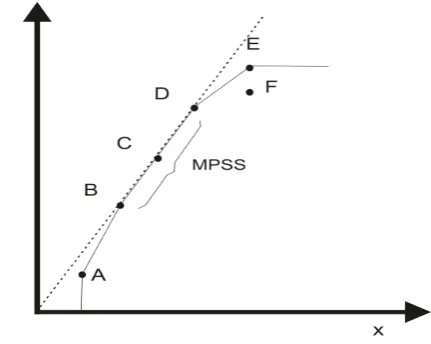
To clarify we proceed to develop the follow-ing examples by usfollow-ing the coordinate values as follows:
A = (1,1) B = (2,3) C = (4,6) D = (6,9) E= (7,9.5) F = (7,10)
The coordinates are in the order (X, Y). In this example only input is confined to take integer value.
In this figure the BCC efficiency frontier repre-sented by the solid lines and the CCR efficiency frontier represented by the dotted line from the origin which evaluates the technical and returns to scale performances of DMUs, simultaneously. We illustrate with A=(1, 1) in Fig. 1 for which we utilize expression (3.9) to obtain the smallest MPSS. By assessing unit A with CCR model we have θ∗ = 23 and s−∗=s+∗ = 0. Thus;
1θ∗−s−∗
1 3
= 2, 1 +s
+∗
1 3
= 3
Figure 1: Most productive scale size..
which is unit B. Also, by Considering (3.8) the smallest and the largest MPSS points corre-sponding to unit A, will be unit B and D. Taking into account units B and D, as corresponding MPSS points for unit A, and solving the pro-posed model we will have α∗ = 0.5, s− = 0 and s+ = 0 which results in a point with the coordinate of (3,4).
According to Fig. 1, this is the point in line segment of units B and C. This example is in R2, one-input and one-output, thus at the first step the required MPSS is obtained but we use it just to show that how this model works. As noted, input is integer and it is needed to find a MPSS point with integer value in input. It should be mentioned that the largest and the smallest MPSS points in this example, as they are observed DMUs, have integer value in input. The proposed model has the ability to find other points in MPSS region with input being integer in accordance to the input and outputs of the unit under evaluation which is more suitable and achievable. As mentioned, considering other methods (3,4) can not be achieved.
4
Application
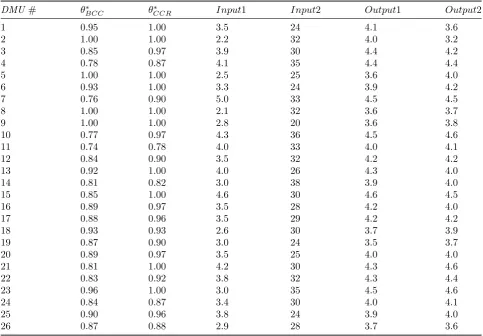
In this section we consider the data that were used in benchmarking marketing productivity written by Donthu et al.[7]. Input/Output data are gathered in Table 1.
Table 1: Data set of chain stores.
DMU# θ∗BCC θ∗CCR Input1 Input2 Output1 Output2
1 0.95 1.00 3.5 24 4.1 3.6
2 1.00 1.00 2.2 32 4.0 3.2
3 0.85 0.97 3.9 30 4.4 4.2
4 0.78 0.87 4.1 35 4.4 4.4
5 1.00 1.00 2.5 25 3.6 4.0
6 0.93 1.00 3.3 24 3.9 4.2
7 0.76 0.90 5.0 33 4.5 4.5
8 1.00 1.00 2.1 32 3.6 3.7
9 1.00 1.00 2.8 20 3.6 3.8
10 0.77 0.97 4.3 36 4.5 4.6
11 0.74 0.78 4.0 33 4.0 4.1
12 0.84 0.90 3.5 32 4.2 4.2
13 0.92 1.00 4.0 26 4.3 4.0
14 0.81 0.82 3.0 38 3.9 4.0
15 0.85 1.00 4.6 30 4.6 4.5
16 0.89 0.97 3.5 28 4.2 4.0
17 0.88 0.96 3.5 29 4.2 4.2
18 0.93 0.93 2.6 30 3.7 3.9
19 0.87 0.90 3.0 24 3.5 3.7
20 0.89 0.97 3.5 25 4.0 4.0
21 0.81 1.00 4.2 30 4.3 4.6
22 0.83 0.92 3.8 32 4.3 4.4
23 0.96 1.00 3.0 35 4.5 4.6
24 0.84 0.87 3.4 30 4.0 4.1
25 0.90 0.96 3.8 24 3.9 4.0
26 0.87 0.88 2.9 28 3.7 3.6
Table 2: The obtained MPSS point after scaling.
DMU# Input1 Input2 Output1 Output2
1 2.80 20.00 3.60 3.80
6 2.78 20.25 3.60 3.81
13 2.80 20.00 3.60 3.80
15 2.80 20.00 3.60 3.80
21 2.80 20.00 3.60 3.80
23 2.37 27.66 3.69 3.77
Table 3: MPSS points through solving the proposed model.
DMU# Input1 Input2 Output1 Output2
1 2.80 20 3.60 3.80
6 2.80 20 3.60 3.80
13 2.80 20 3.60 3.80
15 2.80 20 3.60 3.80
21 2.80 20 3.60 3.80
23 2.35 28 3.68 3.77
(I1) and number of employees (I2). Output variables include customer satisfaction (O1) and sales (O2). As mentioned above, the number of employee (I2) was included as an explicit
By solving BCC models efficient units un-der variable returns to scale can be identified. By solving CCR and BCC models the MPSS DMUs have been found which are DMUs 2, 5, 8 and 9. As noted in Table 1, DMUs 1, 6, 13, 15, 21 and 23 are BCC efficient but they are not MPSS. After examining the status of RTS it has been found that decreasing returns to scale prevail on all these units. Which means they do not operate at MPSS unless by scaling their operations down. As already mentioned, by projecting these units onto the CCR fron-tier and finding maximum and minimum of
∑n
j=1λˆ∗j, for any DM Uj can be scaled thus
the largest and the smallest MPSS points will be acquired. Finally, after this scaling if an MPSS point, with integer value in the second input, can not be found by solving the pro-posed model a suitable MPSS will be obtained. Consider DM U23 for which λ+ = λ− = 1.22 thus after scaling (I1, I2) = (2.37,27.66) and (O1, O2) = (3.69,3.77) will be obtained which is not a suitable MPSS. The result of using expressions (3.8) and (3.9) are gathered in Table
2. Noted that using these expressions the largest and the smallest MPSS points coincide into each other. Considering the units that were gathered in Table 2 and solving the proposed model we will have the following results listed in Table 3. According to the presented method MPSS points with integer value found, as indicated in Table3. Now, in regards of the obtained MPPS points, it is possible for managers to guide units to reach the most productive scale size region in order to perform efficiently.
5
Conclusion
Real valued inputs and outputs are usually uti-lized in DEA technique. In many occasions some inputs and/ or outputs can only take integer val-ues. The aim of this paper is to propose a pro-cedure for detecting the MPSS and guide units through the region of the most productive scale size when some inputs and/ or outputs can only take integer values. In this paper we consider this case where there exist subsets of inputs variables to be integer valued. This procedure can be easily be generalized for different subsets of inputs and / or outputs. Illustrative example is also docu-mented which confirms validity of this model as
a means for determining MPSS points.
References
[1] R. D. Banker, Estimating most productive scale size using Data Envelopment Analysis, European Journal of Operational Research 17 (1984) 35-44.
[2] R. D. Banker, W. W. Cooper, LM. Seiford, R. M. Thrall, J. Zhu, Returns to scale in different DEA models, European Journal of Operational Research 154 (2004) 345-362.
[3] R. D. Banker, A. Charnes and W. W. Cooper, Some models for the estimation of technical and scale inefficiencies in data en-velopment analysis, Management Science 30 (1984) 1078-92.
[4] R. D. Banker and R. Morey, Efficiency anal-ysis for exogenously fixed inputs and outputs, Operations Research 34 (1986) 513-521.
[5] A. Charnes, W. W. Cooper and E. Rhodes, Measuring the efficiency of decision making units, European Journal of Operational Re-search 2 (1978) 429-41.
[6] W. W. Cooper, R. G. Thompson and R. M. Thrall,Extensions and new developments in DEA, The Annals of Operations Research 66 (1996) 3-45.
[7] N. Donthua, E. K. Hershberger, T. Osmon-bekov,Benchmarking marketing productivity using data envelopment analysis, Journal of Business Research 58 (2005) 1474-1482.
[8] R. F¨are, S. Grosskopf and C. A. K. Lovell, Production Frontiers, Cambridge University Press 1994.
[9] G. R. Jahanshahloo and M. Khodabakhshi, Using input-output orientation model for de-terminingmost productive scale size in DEA, Applied Mathematics and Computation 146 (2003) 849-855.
[11] V. V. Podinovski, Efficiency and Global Scale Characteristics on the No Free Lunch Assumption Only, Journal of Productivity Analysis 22 (2004) 227-257.
Zohreh Moghaddas is a candi-date for PhD at the Department of Mathematics, Science and Re-search Branch, Islamic Azad Uni-versity, Tehran, Iran. Her re-search interests include operation research and data envelopment analysis.