B. Radha Madhavi et al, JGTPS, 2014, Vol. 5(2): 1738 - 1746
B. Radha Madhavi*A. N.U. College of Pharmaceutical Sciences,
Acharya Nagarjuna University,
Nagarjuna Nagar – 522 510, Guntur
Address for correspondence
B. Radha Madhavi et al. / JGTPS/ 5(2)-(2014) 1738 –1746
FORMULATION AND EVALUATION OF TASTE MASKED ORAL
DISINTEGRATING TABLET OF CEFIXIME BASED ON CYCLODEXTRIN BINARY
SYSTEMS
INTRODUCTION:
Formulation of orally disintegrating tablets (ODTs) has enormously increased as it is in continuous demand and it has significant impact on the patient compliance. Orally disintegrating tablets offer an advantage for populations who have difficulty in swallowing. ODT s is not only specific with pediatric and geriatric population but also with institutionalized patients and patients with nausea, vomiting and motion sickness complications. ODTs with good taste and flavor increase the acceptability of bitter drugs by various groups of population1.
Due to several reasons and undesirable taste, most of the pharmaceuticals are administered orally but bitter taste is one of the formulation problem encountered with such oral products 2, 3. Taste of pharmaceutical product is important parameter in governing the patient compliance. Thus taste masking of oral pharmaceutical formulations has become important tool to improve patient compliance and especially the quality of treatment 4, 5.
β-cyclodextrin is most widely used complexing agent for inclusion type complexes. Cyclodextrins (CD) are cyclic oligosaccharides with a hydrophilic outer surface and a lipophilic central cavity. On account of their relatively hydrophobic interiors, CDs have the ability to form inclusion complexes with a wide range of substrates 6. This complex-forming ability of CD has been widely exploited in the pharmaceutical field for various applications, including taste-masking of bitter drug 7.
The use of CD as a taste-masking agent has been widely reported 8, 9. It is sweet, nontoxic, cyclic oligosaccharide obtained from starch. The suppression of bitter taste by cyclodextrin was in increasing order of alpha, gamma and beta cyclodextrin stable complex. The complexing agent is capable of masking the bitter taste of the drug by either decreasing its oral solubility on ingestion or decreasing the amount of drug particles exposed to taste buds thereby reducing the perception of bitter taste 10,11.
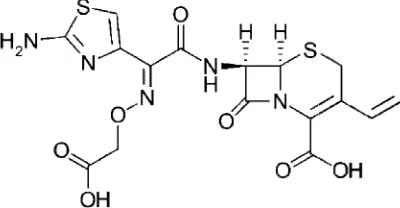
Cefixime Figure 1 is used to treat infections caused by bacteria such as pneumonia, bronchitis, gonorrhoea, and ear, lung, throat, and urinary tract infections. Cefixime has bitter taste so; an attempt has been made to mask the bitter taste of the drug by complexation with β-cyclodextrin 12.
The purpose of the present study was to formulate and evaluate taste masked oral disintegrating tablets of Cefixime to increase the palatability and bioavailability of the drug. In the present work, an attempt was made to mask the taste by complexation
technique, Taste improvement of drug by β-Cyclodextrin was done by simple complexation approach using physical and kneading methods with various ratios. Taste perception study was carried and the optimized taste masking ratio 1:3of kneading mixture was selected based on bitterness score and characterized by Fourier transform infrared spectroscopy (FTIR) to identify the physicochemical interaction between drug and carrier and its effect on dissolution. In-vitro drug release studies for the prepared solid dispersions were performed in phosphate buffer pH 7.2 buffer. 1:3 kneading system showed better results when compared to the dispersions prepared by other methods. Tablets were prepared by direct compression technique using super disintegrants like sodium starch glycolate, crospovidone and croscarmellose sodium. Prepared tablets were evaluated for different properties like drug content, hardness, friability, disintegration time and in vitro dissolution study. The different formulations showed disintegration time between 30 to 56s. Among all the formulations, C6 showed 99 % drug release within 20 min. Thus, C6 was considered best among the other formulations.
Keywords: Cefixime, taste masking, cyclodextrin, binary systems
ABSTRACT
B. Radha Madhavi*
1Varanasi S N Murthy
1A. Prameela Rani
1and
Y. Mohan Kumar
21
A. N.U. College of
Pharmaceutical Sciences,
Acharya Nagarjuna University,
Nagarjuna Nagar – 522510,
Guntur
2
Scientist, FRD, IPDO, Dr.
Reddys Laboratories,
Hyderabad.
Journal of Global Trends in Pharmaceutical Sciences
Journal home page: www.jgtps.com
ISSN: 2230-7346
Figure 1: Chemical Structure of Cefixime
MATERIALS AND METHODS MATERIALS:
Cefixime was kindly gifted by Dr. Reddy’s laboratory, Hyd., All the other chemicals and solvents used were of Pharmaceutical and analytical grade obtained from commercial sources.
METHODS:
A) Preparation of solid dispersion of Cefixime
Cefixime solid dispersions were prepared by physical mixing and kneading methods using drug: beta cyclodextrin in ratios, viz. 1:1, 1:2, 1:3 (Drug:Carrier). Methanol is selected as common solvent for
of solid dispersions. Physical mixture:
Accurately weighed amount of drug and beta cyclodextrin were taken into glass mortar and then mixed for 10 minutes to get good mixture of drug and polymer. Then the product was stored in the desiccator for further study.
Kneading method:
Accurately weighedamount of Cefixime and β cyclodextrin were taken into glass mortar and then methanol was added in small quantity and the mixture was kneaded for 45min and then dried in oven at 40 The product obtained was pulverized and passed through mesh (#) 80 and stored in desiccator for further study.
Evaluation of β-CD inclusion complexes: FTIR studies:
IR spectrophotometer was used for infrared spectroscopy analysis of drug and complexes. The samples were prepared in KBr disk by means of a hydrostatic press. The scanning range was 400
1.
Drug content:
An accurately weighed amount of complex (equivalent to 50 mg of cefixime) was dissolved in small volume of methanol in 50 ml volumetric flask and made upto the volume .From this solution 1 ml was
methanol in 10 ml volumetric flask, again 1 ml of this solution was taken and diluted to 10 ml. The absorbance of this solution was measured at 282 nm using appropriate blank.
Evaluation of taste masking character of
drug/ β-CD complex
Taste masking ability of prepared formulations was evaluated using taste panel of six healthy human
Chemical Structure of Cefixime
MATERIALS AND METHODS
Cefixime was kindly gifted by Dr. Reddy’s other chemicals and solvents used were of Pharmaceutical and analytical grade
A) Preparation of solid dispersion of Cefixime
dispersions were prepared by physical mixing and kneading methods using drug: beta cyclodextrin in ratios, viz. 1:1, 1:2, 1:3 (Drug:Carrier). for preparation
Accurately weighed amount of drug and beta cyclodextrin were taken into glass mortar and then mixed for 10 minutes to get good mixture of drug and polymer. product was stored in the desiccator for further
amount of Cefixime and β-cyclodextrin were taken into glass mortar and then methanol was added in small quantity and the mixture was kneaded for 45min and then dried in oven at 40 0C. The product obtained was pulverized and passed through
stored in desiccator for further study.
IR spectrophotometer was used for infrared spectroscopy analysis of drug and complexes. The samples were prepared in KBr disk by means of a press. The scanning range was 400- 4000 cm
-An accurately weighed amount of complex (equivalent to 50 mg of cefixime) was dissolved in small volume of methanol in 50 ml volumetric flask and made upto the volume .From this solution 1 ml was diluted with methanol in 10 ml volumetric flask, again 1 ml of this solution was taken and diluted to 10 ml. The absorbance of this solution was measured at 282 nm using
Evaluation of taste masking character of
Taste masking ability of prepared formulations was evaluated using taste panel of six healthy human
volunteers. In this test, volunteers were given a litt sample of pure drug (2 mg) and equivalent sample from β-CD complex formulations to taste and eval
bitterness and give their response after ten seconds. The response was evaluated on a scale from 0
good, 1= tasteless, 2= slightly bitter, 3= bitter and 4 = very bitter. Each volunteer was asked to detect the taste of both drug and the complex to act as his or her own control. The results of this test indicated a score 1which indicated that the complex
drug and β-CD are tasteless.
In-vitrodissolution studies of pure drug and complex:
Dissolution study of samples
mg cefixime) was performed using USP XXIV apparatus with 900 ml of phosphate buffer pH 7.2. The stirring speed employed was 50 rpm, and the temperature was maintained at 37 ± 0.5 0C. Five millilitre aliquots of dissolution medium was withdrawn at predetermined time intervals and replaced by 5 ml of fresh dissolution medium. The filtrates of the samples were analyzed for the content of drug by UV spectrophotometer at 282 nm.
B) Formulation of Oral Disintegrating Tablets by Direct Compression Method
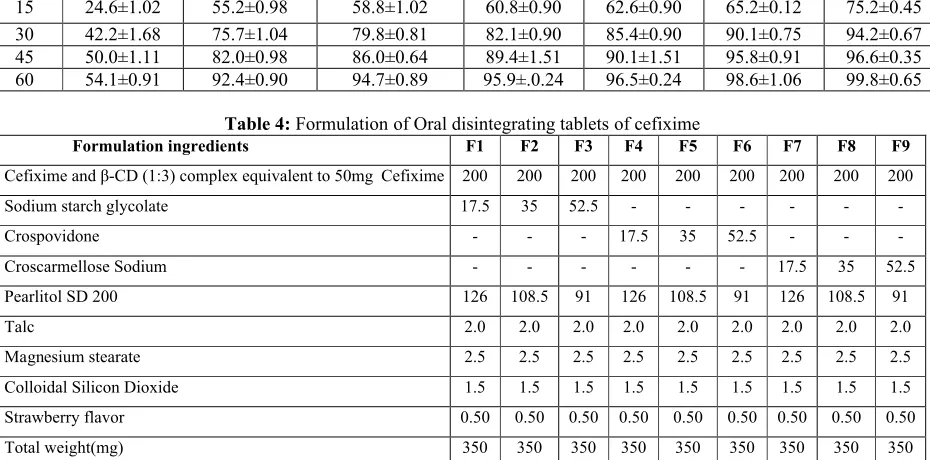
Fast dissolving tablets of cefixime were prepared by direct compression method according to the formulae given in Table 4. All the ingredients were passed through sieve # 60 mesh separately. Then the ingredients were weighed and mixed in geometrical order and compressed into tablets of 350 mg using 12mm, flat punches on 10 station rotary tablet machine (Riddhi, Ambalacant
FTIR studies
IR spectra of cefixime and the finalised formulation were obtained by potassium bromide pellet method using Bruker – Alpha FTIR
order to rule out drug-carrier interactions.
Evaluation of blends:
The powder blend was evaluated for its flow properties such as angle of repose, bulk density, tapped density, compressibility index, and Hausn
Angle of Repose:
Angle of repose was determined using funnel method. The blend was poured through a funnel that can be raised vertically until a maximum cone height (h) was obtained. Radius of the heap (r) was measured and the angle of repose (ө) was calculated using the formula:
ө = Tan-1[h/r] Bulk density:
Apparent bulk density was determined by pouring the blend into a graduated cylinder. The bulk volume (Vb) and weight of the powder (M) was determined. The bulk density was calculated usi formula:
Apparent bulk density = M/ V Tapped density:
The measuring cylinder containing a known mass of blend was tapped for a fixed time. The minimum volume (Vt) occupied in the cylinder and the weight (M) volunteers. In this test, volunteers were given a little equivalent sample from CD complex formulations to taste and evaluate the bitterness and give their response after ten seconds. The response was evaluated on a scale from 0-4, where 0 = good, 1= tasteless, 2= slightly bitter, 3= bitter and 4 = very bitter. Each volunteer was asked to detect the taste e complex to act as his or her own control. The results of this test indicated a score of 1which indicated that the complexes formed between
dissolution studies of pure drug and
Dissolution study of samples (equivalent to 50 mg cefixime) was performed using USP XXIV type II apparatus with 900 ml of phosphate buffer pH 7.2. The stirring speed employed was 50 rpm, and the temperature C. Five millilitre aliquots of was withdrawn at predetermined time intervals and replaced by 5 ml of fresh dissolution medium. The filtrates of the samples were analyzed for the content of drug by UV spectrophotometer at 282 nm.
Formulation of Oral Disintegrating Tablets by Compression Method
Fast dissolving tablets of cefixime were prepared by direct compression method according to the formulae All the ingredients were passed through sieve # 60 mesh separately. Then the ingredients were geometrical order and compressed into tablets of 350 mg using 12mm, flat punches on
10-Riddhi, Ambalacant).
IR spectra of cefixime and the finalised formulation were obtained by potassium bromide pellet spectrophotometer in carrier interactions.
The powder blend was evaluated for its flow properties such as angle of repose, bulk density, tapped density, compressibility index, and Hausner’s ratio.
Angle of repose was determined using funnel method. The blend was poured through a funnel that can be raised vertically until a maximum cone height (h) was obtained. Radius of the heap (r) was measured and the
ө) was calculated using the formula:
Apparent bulk density was determined by pouring the blend into a graduated cylinder. The bulk ) and weight of the powder (M) was determined. The bulk density was calculated using the
Apparent bulk density = M/ Vb
B. Radha Madhavi et al, JGTPS, 2014, Vol. 5(2): 1738 - 1746
1740 of the blend was measured. The tapped density was
calculated using the formula: Tapped density = M/ Vt Compressibility index:
Compressibility index I is calculated as follows: I = Vb - Vt / Vb× 100
Where - Vbis the bulk volume; Vtis the tapped volume. The value below 15% indicates a powder with usually give rise to good flow characteristics where as above 25% indicate poor flowability.
Hausner’s ratio:
Hausner’s ratio10 is an indirect index of ease of powder flow. It is calculated by the following formula Hausner’s ratio =T apped density/Bulk density Lower Hausner’s ratio (<1.25) indicates better flow properties than higher ones (>1.25)
Evaluation of tablets
Weight variation
Twenty tablets were selected at random and weighed individually. The individual weights were compared with the average weight for determination of weight variation.
Drug content
The cefixime content in the filtrate was determined by measuring the absorbance at 282 nm after appropriate dilution with distilled water. The drug content was determined using the standard calibration curve. The mean percent drug content was calculated as an average of three determinations.
Disintegration test
Tablets were taken and introduced one tablet in each tube of disintegration apparatus and the tablet rack of the disintegration apparatus was positioned into a 1 – litre beaker and the time of disintegration was recorded.
Wetting time
A piece of tissue paper folded twice was placed in a small petridish (Internal diameter = 6.5 m) containing 5 ml of distilled water. A tablet was placed on the paper, and the time of complete wetting of the tablet was measured in seconds.
Dissolution study
In vitro dissolution of cefixime fast disintegrating tablets was studied in USP XXIII type-II dissolution apparatus (Lab India – Disso 8000) employing a paddle stirrer at 50 rpm using 900 ml of pH 7.2 phosphate buffer at 37 ± 0.5 0C as a dissolution medium.
RESULTS AND DISCUSSION Drug content of solid dispersions
The Cefixime solid dispersions were tested for drug content and it was found that the drug was within the compendial limits 95-101% w/w. All the solid dispersions were uniform in drug content. The results were shown in Table 1.
FTIR studies:
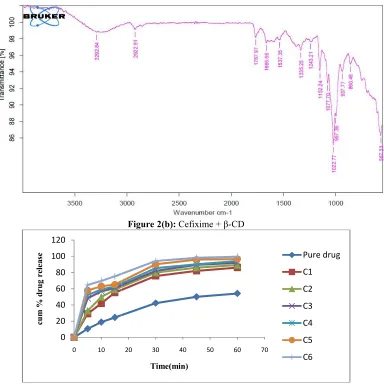
The IR spectrum of Cefixime, Cefixime: β-CD complex were shown in the Figure 2(a) and 2(b) respectively. The IR spectrum of Cefixime exhibited peak at 3370 cm-1due to N-H stretching, while peak at 1338 cm-1indicate SO2 stretching. The IR spectrum of β-cd showed peak at 3394 cm-1. The IR spectrum of Cefixime: β-CD (1:3) inclusion complex prepared by kneading method has shown peaks at 3374 cm-1and 1340 cm-1. Taste evaluation of Cefixime -β-CD sloid dispersions
The efficiency of taste masking was evaluated by six human volunteers. It was observed that there was no bitter taste percepted for both binary systems viz. physical mixture and kneading mixture when compared with the pure drug. The results have been shown in Table 2. It is confirmed that the bitter taste of Cefixime was masked by complexing with β –cyclodextrin.
In-vitrodissolution studies
Cefixime release from the solid dispersion and the drug alone was studied up to 60 minutes. The average percentage release of the pure drug was found to be 36.8% in 60 minutes. In the solid dispersions formulation, β-cyclodextrin was used as carrier and the dissolution rate increased with increased amount of cd. The best results among solid dispersions with β-cd were obtained for the complex C-6 Figure 3. Dissolution data of Cefixime and its cyclodextrin complexes prepared by three methods in different ratios were given in Table 3. The increased dissolution rate may be due to the higher solubility of β-cd in dissolution medium and better wettability of Cefixime in the complex.
EVALUATION OF TABLETS:
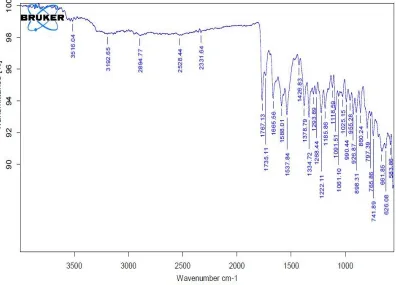
The FTIR spectra of cefixime with the excipients and the final formulation were shown in the Figure 4. The spectrum obtained has shown that there is no interaction of excipients with the drug. The final blend of tablets was evaluated for flow properties and was found that the flow property of prepared blends was good and the values of different physical tests are given in the Table 5. The tablets obtained had drug contents in the range of 98 to 100%.
In case of formulation prepared with Croscarmellose sodium (F7 to F9) the DT was found to be 50-58 seconds. Among all the formulations F6 was showing promising results as the DT was 26 seconds. Wetting time prepared for all the formulations was found to be in the range of 22-44. Among all the formulations F6 showed less wetting time of 22 seconds. The results are shown in the Table 8 and Figures 6 and 7.
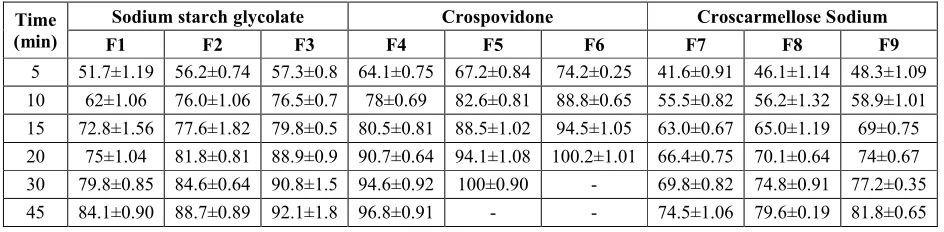
Various dissolution parameters values viz., Dissolution efficiency at 30 min (DE30%), Percent drug dissolved in 10 min(D10 ),Percent drug dissolved in 30 min (D30),Time taken to dissolve the 50%.70% and 90%drug(t50, t70, t90 respectively) were given in the Table 9. Based on the data obtained on the dissolution rate, the disintegrants can be ranked as crospovidone > Sodium starch glycolate > croscarmellose sodium. The results were shown in Fig 6.
15% crospovidone showed better dissolution efficiency among the disintegrants studied at three levels (5%, 10% and 15%). Hence crospovidone was recommended as suitable disintegrant and the study shows that the dissolution rate of Cefixime can be enhanced to a great extent by Direct- compression technique with the addition of super disintegrants, which gives quick relief.
Table 3:Cumulative Percent Drug Released data of Cefixime from Inclusion complexes in
pH 7.2 phosphate buffer
Table 1:Drug content of prepared solid dispersions
Cefixime: β-CD Ratio Product name
Percent drug content present
Physical Mixture 1:1 1:2 1:3
C1 C2 C3
98.3±1.02 99.6±0.08 98.9±0.06
Kneading method 1:1 1:2 1:3
C4 C5 C6
97.4±0.01 98.4±0.04 99.1±0.02
Table 2:Bitterness evaluation by taste panel
Solid dispersions 1 2 3 4 5 6
C1 4 4 4 4 4 4
C2 1 2 2 2 2 1
C3 1 1 2 1 2 1
C4 1 1 1 1 2 2
C5 0 0 1 1 1 1
C6 0 0 0 0 0 0
Table 4:Formulation of Oral disintegrating tablets of cefixime
Formulation ingredients F1 F2 F3 F4 F5 F6 F7 F8 F9
Cefixime and β-CD (1:3) complex equivalent to 50mg Cefixime 200 200 200 200 200 200 200 200 200
Sodium starch glycolate 17.5 35 52.5 - - -
-Crospovidone - - - 17.5 35 52.5 - -
-Croscarmellose Sodium - - - 17.5 35 52.5
Pearlitol SD 200 126 108.5 91 126 108.5 91 126 108.5 91
Talc 2.0 2.0 2.0 2.0 2.0 2.0 2.0 2.0 2.0
Magnesium stearate 2.5 2.5 2.5 2.5 2.5 2.5 2.5 2.5 2.5 Colloidal Silicon Dioxide 1.5 1.5 1.5 1.5 1.5 1.5 1.5 1.5 1.5 Strawberry flavor 0.50 0.50 0.50 0.50 0.50 0.50 0.50 0.50 0.50 Total weight(mg) 350 350 350 350 350 350 350 350 350 Time
(min) Pure drug Physical mixtures Kneading method
C1 C2 C3 C4 C5 C6
5 10.6±1.40 29.1±1.56 32.6±0.74 48.1±0.50 52.4±0.50 57.8±0.91 64.6±1.05
10 18.8±1.04 41.8±1.19 49.7±1.04 56.8±0.70 59.1±0.70 63.0±0.82 69.7±1.01
15 24.6±1.02 55.2±0.98 58.8±1.02 60.8±0.90 62.6±0.90 65.2±0.12 75.2±0.45
30 42.2±1.68 75.7±1.04 79.8±0.81 82.1±0.90 85.4±0.90 90.1±0.75 94.2±0.67
45 50.0±1.11 82.0±0.98 86.0±0.64 89.4±1.51 90.1±1.51 95.8±0.91 96.6±0.35
B. Radha Madhavi et al, JGTPS, 2014, Vol. 5(2): 1738 - 1746
1742 Table 5:Evaluation of flow properties of powder blend
Formulation
parameters F1 F2 F3 F4 F5 F6 F7 F8 F9
Bulk density (gm/cm3) (mean±SD) 0.404±0.0 2 0.421±0.0 4 0.418±0.0 6 0.429±0.0 4 0.401±0.0 2 0.417±1.0 5 0.424±0.0 6 0.412±1.0 1 0.431±0.0 6 Tapped density (gm/cm3) (mean±SD) 0.442±0.0 1 0.463±0.0 3 0.470±0.0 2 0.474±0.0 3 0.440±0.0 2 0.469±0.0 2 0.463±0.0 1 0.468±0.4 4 0.472±0.0 4 Hausner’s ratio (mean±SD) 1.094±0.0 2 1.099±0.0 2 1.124±0.0 4 1.104±0.0 1 1.097±0.0 3 1.124±0.0 1 1.091±0.0 2 1.135±0.0 2 1.095±0.0 4 Compressibilit
y index (%) (mean±SD)
8.59±0.94 9.97±1.13 11.06±.0.92 8.64±0.83 8.86±1.14 11.08±0.87 8.42±0.92 11.96±0.99 8.68±0.87
Angle of repose (0) (mean±SD) 25.44±1.2 0 26.21±1.5 2 25.43±1.3 1 26.18±1.2 2 24.22±1.1 2 26.32±0.9 8 24.90±1.4 5 26.19±1.2 4 23.48±1.4 6
Table 6:Evaluation of prepared tablets
Formulati on parameter
s
F1 F2 F3 F4 F5 F6 F7 F8 F9
Weight (mg) (±SD) n=6 349.2±1. 81 350.8±1. 23 350.2±1. 22 351.4±1. 91 349.6±1. 07 350.0±1. 72 351.1±1. 22 350.8±1. 41 351.9±1. 22 Thickness (mm) (±SD) n=6 3.81±0.0
14 3.87±0.016 3.89±0.012 3.87±0.013 3.89±0.015 3.90±0.012 3.89±0.008 3.88±0.009 3.91±0.012 Hardness
(Kg/cm2) (±SD) n=6 4.09±0.2 9 4.14±0.3 2 4.67±0.3 4 4.78±0.1 2 5.14±0.2 3 4.56±0.1 1 4.08±0.2 8 4.16±0.4 1 4.14±0.3 6 Friability
(%) 0.45 0.32 0.37 0.40 0.38 0.43 0.36 0.42 0.39
Table 7: Cumulative Percent Drug Release data of Cefixime from Prepared Formulations in pH 7.2 phosphate buffer
Time (min)
Sodium starch glycolate Crospovidone Croscarmellose Sodium
F1 F2 F3 F4 F5 F6 F7 F8 F9
5 51.7±1.19 56.2±0.74 57.3±0.8 64.1±0.75 67.2±0.84 74.2±0.25 41.6±0.91 46.1±1.14 48.3±1.09 10 62±1.06 76.0±1.06 76.5±0.7 78±0.69 82.6±0.81 88.8±0.65 55.5±0.82 56.2±1.32 58.9±1.01 15 72.8±1.56 77.6±1.82 79.8±0.5 80.5±0.81 88.5±1.02 94.5±1.05 63.0±0.67 65.0±1.19 69±0.75 20 75±1.04 81.8±0.81 88.9±0.9 90.7±0.64 94.1±1.08 100.2±1.01 66.4±0.75 70.1±0.64 74±0.67 30 79.8±0.85 84.6±0.64 90.8±1.5 94.6±0.92 100±0.90 - 69.8±0.82 74.8±0.91 77.2±0.35 45 84.1±0.90 88.7±0.89 92.1±1.8 96.8±0.91 - - 74.5±1.06 79.6±0.19 81.8±0.65
Table 8: Disintegration time and wetting time of the prepared formulations
Formulation parameters
F1
F2
F3
F4
F5
F6
F7
F8
F9
Disintegration time (sec) (±SD) n=6 48±1 46±2 40±1 42±2 39±1 28±1 58±2 53±2 50±1
Table 9: In vitro-Dissolution parameters of different formulations
Formulation DE5 (%) DE20 (%) D10 (%) D20 (%) t50 (min) t70 (min) t90 (min) Kmin-1 r2
F1 25.8 37.3 62 75 4 15 >45 0.024 0.904
F2 28.1 41.7 76 81.8 4 14 >45 0.042 0.859
F3 28.6 43 76.5 88.9 3 18 14 0.061 0.818
F4 32 44.6 78 90.7 3 9 20 0.090 0.935
F5 33.6 47.5 82.6 94.1 3 5 17 0.103 0.992
F6 37.1 51.25 88.8 100 1 3 10 0.154 0.996
F7 20.8 32.2 55.5 66.4 8 30 >45 0.025 0.863
F8 23 24.6 56.2 70.1 6 20 >45 0.030 0.931
F9 24.1 35.5 58.9 74 5 16 >45 0.033 0.893
DE5=Dissolution efficiency in 5 min DE20= Dissolution efficiency in 20 min D10= Percent drug dissolved in 10 min D20= Percent drug dissolved in 20 min t50=Time taken to dissolve 50% of the drug t70=Time taken to dissolve 70% of the drug t90=Time taken to dissolve 90% of the drug Kmin-1=first order rate constant
r2 = correlation coefficient values of first order plots
B. Radha Madhavi
Figure 3:Figure 4:Comparative FTIR Spectra of pure drug cefixime and with excipients 0
20 40 60 80 100 120
0 10
cu
m
%
d
ru
g
re
le
as
e
B. Radha Madhavi et al, JGTPS, 2014, Vol. 5(2): 1738 - 1746
Figure 2(b):Cefixime + β-CDIn-vitro drug dissolution of solid dispersions
Comparative FTIR Spectra of pure drug cefixime and with excipients
20 30 40 50 60 70
Time(min)
Pure drug C1 C2 C3 C4 C5 C6
Figure 5:
In-Figure 6:Disintegration time for different formulations
Figure 7: 0
10 20 30 40 50 60 70
F1 F2
D
is
in
te
gr
at
io
n
ti
m
e(
se
c)
0 10 20 30 40 50 60
F1 F2
W
et
tin
g
tim
e(
se
c)
-vitro drug dissolution of prepared formulations
Disintegration time for different formulations
Figure 7: Wetting time for different formulations
F3 F4 F5 F6 F7 F8 F9
Formulations
F3 F4 F5 F6 F7 F8 F9
B. Radha Madhavi et al, JGTPS, 2014, Vol. 5(2): 1738 - 1746
1746
CONCLUSION:
Cefixime, a bitter drug, could be successfully taste-masked using β-CD by complexation method. The taste-masked complex was incorporated to prepare fast disintegrating tablets. Tablets were formulated using three super disintegrants in three ratios (5%, 10% and 15%). Among all F6 showed faster disintegration and drug release. The prepared formulation offered significant results in terms of improving taste and bioavailability. The results conclusively demonstrated effective taste masking by β-Cyclodextrin in both binary systems, which can be utilized as a novel alternative approach for effective taste masking.
ACKNOWLEDGEMENT:
The authors are thankful to Dr. Reddys laboratories for providing gift sample of Cefixime tri hydrate and also grateful to the principal of Acharya nagarjuna university for providing lab facilities and also for her constant support and encouragement.
REFERENCES:
1. Jain C.P, Naruka P.S: Formulation and evaluation of fast dissolving tablets of valsartan. Int J Pharm Sci 2009; 1: 219-226. 2000; 17(1): 61‐72.
2. Venkatesh D.P, Rao C.G. Formulation of taste masked oro-dispersible tablets of Ambroxol hydrochloride. Asian J Pharm, 2(4): 261-264,(2008).
3. Raghavendra Rao N.G, Patel T, Gandhi S. Development and evaluation of carbamazepine fast dissolving tablets prepared with a complex by direct compression technique. Asian J Pharm, 3(2): 97 - 103, (2009).
4. Mallikarjuna Setty C, Prasad D.V.K, Gupta V.R.M. Development of fast dispersible
Aceclofenac Tablets: Effect of functionality of super disintegrants. Indian J Pharm Sci, 70(2): 180- 185, (2008).
5. Rajeshwari R A, Chhalla V J. Pharmaceutical Applications of Cyclodextrins II: in-vivo Drug Delivery. J Pharm Sci. 1996; 85:1142–1169. 6. Freudenberg K, Cramer F, Plieninger H, Inclusion
Compounds of Physiologically Active Organic Compounds. Germen Patent 895769: 1953. 7. Szejtli J, Szente L. Elimination of Bitter,
Disgusting Tastes of Drugs and Foods by Cyclodextrins. Eur J Pharm Biopharm. 2005; 61:115–125.
8. Patel AR, Vavia PR. Preparation and Evaluation of Taste Masked Famotidine Formulation Using Drug/β-cyclodextrin/Polymer Ternary Complexation Approach. AAPS PharmSciTech. 2008; 9(2):544-550.
9. Patel AR, Vavia PR. Preparation and Evaluation of Taste Masked Famotidine Formulation Using Drug/β-cyclodextrin/Polymer Ternary Complexation Approach. AAPS PharmSciTech. 2008; 9(2):544-550.
10. Szejtli J, Szente L. Elimination of Bitter, Disgusting Tastes of Drugs and Foods by Cyclodextrins. Eur J Pharm Biopharm. 2005; 61:115–125.
11. Jadhav GS, Patel AR, Vavia PR, Malde AK, Coutinho EC. Interaction of Valdecoxib with β-Cyclodextrin: Experimental and Molecular Modeling Studies. J Incl Phenom Macrocycl Chem. 2006; 56:247–251.
12. Vinoth Kumar G, Anand Babu K, Ramasamy C. Formulation and Evaluation of Bilayered Tablets of Cefixime trihydrate and Dicloxacillin sodium. Int. J. Pharm Tech Res2011; 3(2):613-618.
How to cite this article:
B. Radha Madhavi*, Varanasi S N Murthy, A. Prameela Rani and Y. Mohan Kumar: Formulation and Evaluation of taste masked oral Disintegrating tablet of cefixime based on cyclodextrin binary systems: A Review, 5(2): 1738-46. (2014)