A PROSPECTIVE OBSERVATIONAL STUDY ON RISK FACTORS,
COMPLICATIONS AND MANAGEMENT OF PATIENTS WITH
CHRONIC KIDNEY DISEASE
1 Gaddam Raghu, 2 Bollamalla Spruha Teja, 3Kota Vinitha, 4Santi Deepthi Meghana, 5 Ayesha Rafiya, 6 Dr. Kadarla Rohith Kumar*
B Pharm 1-5, Assistant Professor*6
Sree Chaitanya Institute of Pharmaceutical Sciences, Karimnagar, Telangana, India
Email – 6 [email protected]
1. INTRODUCTION:
The CKD well known as either kidney damage or decreased glomerular filtration rate [GFR] of less than
60ml/min/1.73m2 for at least three months. Once functional renal mass and nephrons are loss reaches to certain point,
the remaining nephrons starts the process of irreversible sclerosis and results in progressive decrease in the GFR [1]
CKD is most common in old age people, while younger people also develop gradual loss of renal function, but CKD is
a stable disease in 30% of people above the age of 65 years [2]
CKD is associated with risk of cardiovascular disorders and chronic renal failure. CKD is ninth leading cause of death in the United States. The nephron is the functional unit of the kidney. Approximately 1 million nephrons are present in each healthy kidney, each of which participates in GFR. In kidney injury, kidney unable to maintain GFR due to gradual decrease of nephrons, the remaining nephrons present in kidney undergoes hyperfiltration and raised intra-glomerular pressure. This causes ‘bystander’ damage with secondary nephron loss. The patient remains well until so many nephrons are lost that the GFR can no longer be maintained despite activation of compensatory mechanisms. As a consequence there is a progressive decline in kidney function. Plasma levels of urea and creatinine elevated only after
total GFR has decreased to 50% [3].
The plasma creatinine values will double with 50% reduction in GFR. For example, a rise in plasma creatinine
from a baseline value of 0.6 mg/dL to 1.2 mg/dL in a patient [3].
By the data obtained from the National Health and Nutrition Examination Survey (NHANES), Stauffer and Fan found that anemia was twice as prevalent in people with CKD (15.4%) as in the general population (7.6%). The
prevalence of anemia increased with stage of CKD, from 8.4% at stage 1 to 53.4% at stage 5. [4]
The parathyroid glands are four pea-sized glands located on the thyroid gland in the neck. The parathyroid glands secrete parathyroid hormone (PTH), that helps to maintain the correct balance of calcium and phosphorous in the body. PTH is involved in the homeostasis of bone metabolism by regulating the level of calcium in the blood, release of calcium from bone, absorption of calcium from the intestine, and excretion of calcium in the urine. Consequently, the levels of calcium and other minerals involved in bone metabolism, such as phosphorus and vitamin D, affect the secretion of PTH by the parathyroid gland. Although smaller fragments of this molecule may have unique actions in the
ABSTRACT: The Chronic Kidney Disease (CKD) is either kidney damage or decreased glomerular filtration rate [GFR] of less than 60ml/min/1.73m2 for at least three months. Once functional renal mass and nephrons are loss reaches to certain point, the remaining nephrons starts the process of irreversible sclerosis and results in progressive decrease in the GFR. The findings from this study suggest that the risk factors for renal progression in males (77%) more than female (23%). Testosterone hormone present in males induces apoptosis of renal cells, estrogen in females reverse this process. In this study revealed that the primary cause of CKD in karimnagar population is analgesics (38%). Most patients have age ranges from 55-65 years (42%). Among all 43% of patients are at stage III due late identification and diagnosis of disease. in the study population 62% of patients on medication and 38% of patients on dialysis. Anaemia (85%) is most common complication in CKD. Based on the recent US Renal Data System (USRDS) annual data report, the prevalence of CKD between the years 2007 and 2012 was higher in women (15.1%) than in men (12.1%). It is important to mention that several studies have opposing this data. i.e. a French epidemiologic study showed a higher incidence rate of CKD in men. Chinese cross-sectional study demonstrated CKD prevalence among men and women similar. Based on the recent US Renal Data System data, 57.8% of the patients with a new onset ESRD were men. The prevalence of CKD is increasing, particularly in those of age 70 and above. American kidney foundation said that the diabetes is the major cause of CKD but, it is only (22%) in this study.
body, generally, the PTH is measured and used to assess bone metabolism and bone disease. HPT in CKD is an overproduction of PTH caused by several changes that occur in bone and mineral metabolism as a result of decreased kidney function. The first changes that usually occur with declining kidney function involve the deficiency of activated vitamin D and an increase in phosphorus excretion by the remaining functional nephrons. Both of these changes
stimulate an increase in PTH synthesis and secretion. [5]
1.1 RISK FACTORS: Hypertension, Diabetes mellitus, Age > 55 years , Family history of kidney disease, Obesity or metabolic syndrome, Renal calculi, Alcoholism, Chronic usage of chemotherapeutic agents and NSAID’s
1.2 COMPLICATIONS: Metabolic acidosis, Salt- and water-handling abnormalities (edema), Anemia,
Hyperparathyroidism, Bone disease, Hyperkalemia, Hyperphosphatemia and hypocalcaemia, Hyponatremia and
hyperchloremia
2. MANAGEMENT OF CKD COMPLICATIONS: 2.1 Gastro-intestinal symptoms
Nausea and vomiting may persist after starting a low protein diet. Metoclopramide is useful to treat this, but sometimes accumulation of the drug and its metabolites may occur, leading to extrapyramidal side effects. Patients should be started on a low dose, which should then be increased slowly. Prochlorperazine or cyclizine may also be useful. The 5-HT3 antagonists such as ondansetron have also been shown to be effective.
Pruritus
Itching associated with renal failure can be extremely severe, distressing and difficult to treat. xerosis (dry skin), skin micro-precipitation of divalent ions, elevated PTH levels and increased dermal mast cell activity. Sometimes correction of serum phosphate or calcium levels improves the condition, conventionally, oral antihistamines are used to treat pruritus; however, topical versions should not be used owing to the risk of allergy. Non-sedating antihistamines such as loratidine are generally less effective than sedating antihistamines such as chlorphenamine or alimemazine which may be useful, particularly at night. Topical crotamiton lotion and creams may also be useful in some patients. Other non-drug therapies include either warming or cooling the skin using baths, three times weekly, UVB phototherapy and modified electrical acupuncture.
2.2 Uremia
Although urea is only one of the toxins encountered in uremia, many patients experience a symptomatic improvement when dietary protein intake is reduced, presumably through a reduction in the output of nitrogenous waste. There is some evidence that, as well as reducing the symptoms of uremia, protein restriction slows the progression of CKD, but this remains controversial. Protein-restricted diets have been used extensively in the past but they are unpalatable and the benefits marginal, so they are used infrequently in modern medical practice.
2.3 Anaemia
The normochromic, normocytic anaemia of CKD does not respond to iron or folic acid unless there is a coexisting deficiency. Traditionally, the only treatment available was to give red blood cell transfusions, but this is time-consuming, expensive, an infection risk, may lead to fluid and iron overload and promotes antibody formation, which may give problems if transplantation is subsequently attempted. The introduction of ESAs, initially as recombinant human erythropoietin’s (epoetin alfa and beta) have transformed the management of renal anaemia.
2.4 Hyperphosphatemia
The management of hyperphosphatemia depends initially upon restricting dietary phosphate. Phosphate-binding agents can be used to reduce the absorption of orally ingested phosphate in the gut, by forming insoluble, non-absorbable complexes when taken a few minutes before or with meals. Traditionally, phosphate-binders were usually salts of a di- or trivalent metallic ion, such as aluminium, calcium or occasionally magnesium (Calcium acetate, calcium carbonate, aluminium hydroxide, magnesium salt).
2.5 Vitamin D deficiency and hyperparathyroidism
Vitamin D deficiency may be treated with the synthetic vitamin D analogues 1α-hydroxycholecalciferol (alfacalcidol) at 0.25–1 μcg/day or 1,25-dihydroxycholecalciferol (calcitriol) at 1–2 μcg/day.
Dietary modifications:
Fluid and sodium restriction to reduce the risk of fluid overload ( oedema)
Reduce intake of potassium rich foods to prevent hyperkalaemia ( cardiac risk)
Take low protein diet
Take calcium rich foods
DIALYSIS:
3. METHODOLOGY:
This study was a prospective observational study conducted in District Headquarters Hospital. Karimnagar,
Telangana, India between January - April, 2019. The study was approved by the Institutional Ethical Committee and all
the participants provided a written informed consent. 124 patients of all age groups diagnosed with chronic kidney
disease and admitted in the hospital and patients with serum creatinine levels above 1.9mg/dl were included in this study. Patients with serum creatinine levels below 1.9mg/dl and with other types of kidney disorders (renal calculi, acute kidney injury) were excluded from the study. Appropriate data collection form was designed, data collected and subjected to analysis.
4. RESULTS:
The study “ A prospective observational study on risk factors, complications and management of patients with chronic kidney disease” was conducted in District Head Quarters Hospital. A total number of 100 patients were admitted in the hospital with Chronic Kidney Disease participated in the study.
Table 1: Gender wise distribution of patients out of the 100 patients, 77 patients were male and remaining 23 were female patients. Male patients [77%] suffering from chronic kidney disease were almost thrice in number as that of female patients [23%]. This states that prevalence of CKD is more in males patients than the female patients in our study population, this is due to the greater prevalence of alcoholism in males than females in this region.
Gender No. of patients Percentage(%)
Male 77 77%
Female 23 23%
Total 100 100%
Distribution Of Patients According To Age Criteria:
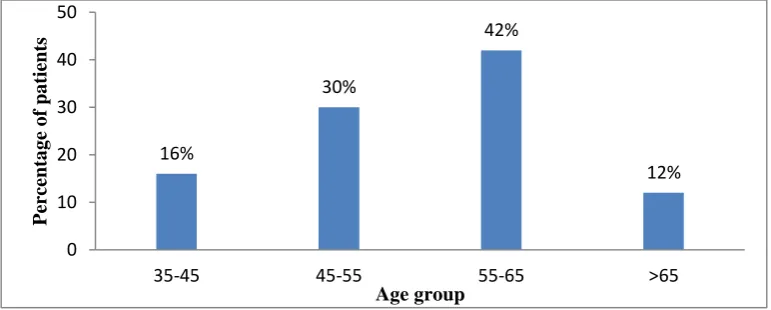
In the study population it was observed that both male and female patients were maximum in the age group of 55-65 years (42%) followed by in the age group 45-55 years (i.e. 30%) and than in 35-45 age group is 16%, in above 65 years of age 12%. Maximum number of patients in the age group 55-65 years shows the same pattern which is seen most chronic diseases.
Figure 01: Distribution of CKD patients according to Age
Table 2: Distribution of patients according to cause and gender
Cause males % males Females % females Total % total
Hypertension 16 20.7% 5 21.7% 21 21%
HTN and DM 22 28 % 9 39.1% 31 31%
Analgesics 32 41.5% 9 39.1% 41 41%
Hereditary 7 9% 0 00% 7 7%
In the study population it was observed that the maximum cause of CKD is analgesics (41%). The percent cause of CKD in both males and females nearly equal. And other cause includes hypertension (21%), combination of hypertension and diabetes (31), and hereditary (7%). This data when plotted in a bar graph showing that the more prevalence is seen by analgesics.
16%
30%
42%
12%
0 10 20 30 40 50
35-45 45-55 55-65 >65
P
er
ce
nta
g
e
o
f
pa
tient
s
Table 3: Distribution of patients according to stages. Stage No. of patients Percentage (%)
Stage I 17 17%
Stage II 27 27%
Stage III 43 43%
End stage 13 13%
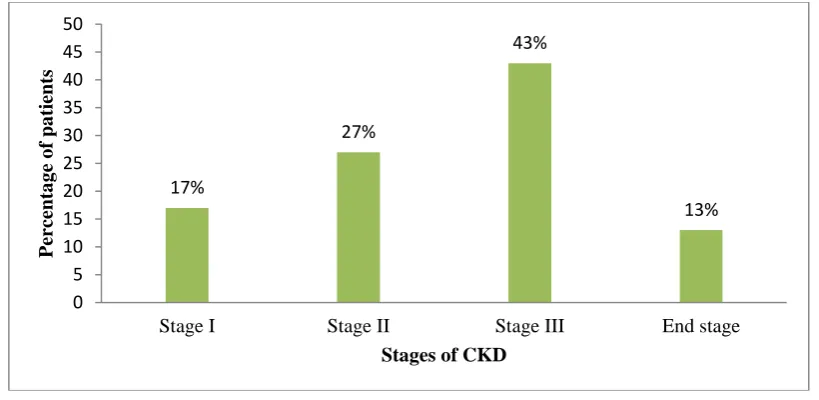
In the study population it was observed that the numbers of patients are varying in various stages. The majority of patients were present in stage III i.e. 43% followed by 27%, 17%, and 13% in the stages I, II, and end stage respectively.
Figure 02: Distribution of CKD patients according to stages
Table 04: Distribution of patients according to complications.
Complication No. of patients Percentage (%)
Anaemia 85 85%
Hyperkalaemia 72 72%
Bone disorder 67 67%
Hyperparathyroidism 4 4%
CKD is associated with various complications like anaemia, hyperkalaemia, bone disorder, hyperparathyroidism, and etc. In the study population majority of CKD patients are suffering with anaemia (85%). The least complication is hyperparathyroidism (4%), remaining are hyperkalaemia (72%), bone disorders (67%).
Figure 03: Distribution of CKD patients according to their complications 17%
27%
43%
13%
0 5 10 15 20 25 30 35 40 45 50
Stage I Stage II Stage III End stage
P
er
ce
nta
g
e
o
f
pa
tient
s
Stages of CKD
85% 72%
67% 4%
0 10 20 30 40 50 60 70 80 90
Anaemia Hyperkalaemia Bone disorders Hyperparathyroidism
Percentage of patients
Co
m
pli
ca
tio
Table 5: Distribution of patients according to type of treatment Type of treatment No. of patients Percentage On medication 62 62%
On dialysis 38 38%
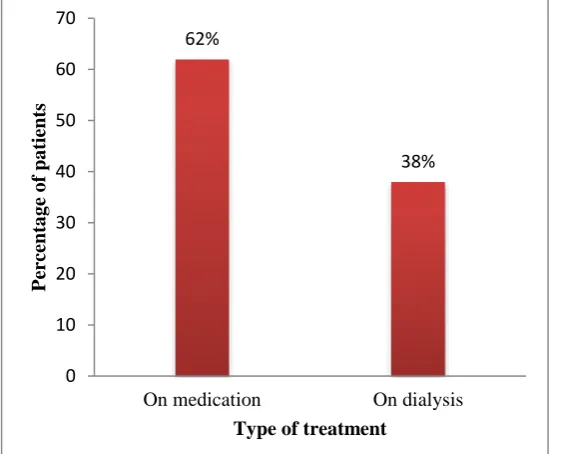
Majority of patients are treated by using medications i.e., 62% and only 38% of patients are on dialysis that indicates they are in the stage of End Stage Renal Disease (ESRD).
Figure 04: Distribution of CKD patients according to type of treatment
Table 6: Distribution of patients according to duration of disease Duration No. of patients Percentage
< 6 months 16 16%
Since 1 year 14 14%
Since 2 years 26 26%
Since 3 years 20 20%
> 3years 24 24%
In the study population it was observed that majority of the patients suffering with CKD since 2 years (26%) followed by least percentage of patients since 1 year (14%). The newly diagnosed CKD i.e. since less than 6 months is 16%. The remaining are 20% and 24% since 3 years and above 3 years respectively.
Figure 05: Distribution of CKD patients according to duration of disease 62%
38%
0 10 20 30 40 50 60 70
On medication On dialysis
P
er
ce
nta
g
e
o
f
pa
tient
s
Type of treatment
16% 14%
26% 20%
24%
0 5 10 15 20 25 30
< 6 Months Since 1 yrs Since 2 yrs Since 3 yrs Above 3 yrs
percentage of patients
Dura
tio
n o
f
dis
ea
Table 07: Distribution of patients according to duration of dialysis Duration No. of patients Percentage
<6 months 16 42%
Since 1 year 14 36%
Since 2 years 8 21%
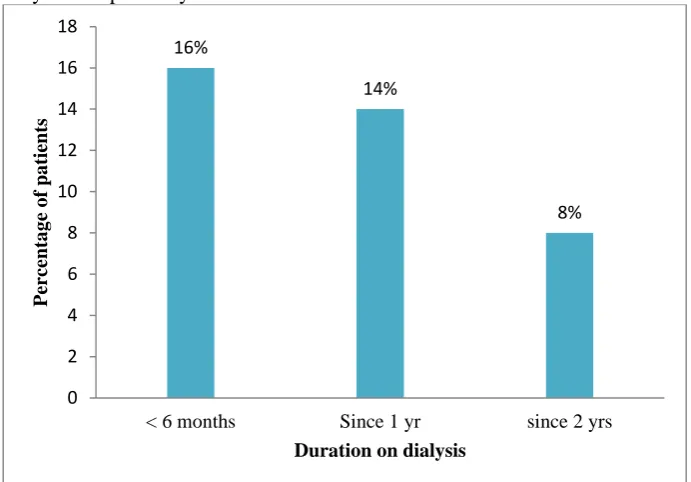
Majority of patients were come to hospital for dialysis since less than 6 months (42%) followed by 36% and 21% since 1 year and 2 years respectively.
Figure 06: Distribution o CKD patients based on duration of Dialysis
5. DISCUSSION:
The chronic kidney disease (CKD) is results from the poor control of hyperglycemia, hypertension, and chronic usage of analgesics. In hypertension, angiotensin II receptors present on glomerular arterioles causes the
vasoconstriction followed by increased renal pressure. [6] In diabetes, hyper filtration of glucose in glomerulus increases
the work load on the nephron. [7] In the condition of hyperglycemia increases the levels of TGF-β in glomeruli may
contribute to cellular hypertrophy and more collagen synthesis induces vascular changes in nephron [8]. PGE
2 and PGI2
are regulating the different functions of kidney, by chronic usages of NSAID’s are inhibit the production of these PG
may alter the renal functions. [9] CKD is associated with different complications like metabolic acidosis, anaemia, bone
disorders and hyperparathyroidism etc. when comparing the both genders males are high progression to this disease due to anatomically, the kidney is usually larger in men, due to a larger body surface area. Men may develop higher filtration rate in response to angiotensin II infusion. A lifestyle difference between men and women has been suggested as another possible explanation for the influence of gender on CKD. A high protein and high caloric dietary intake, which characterizes men more than women, is associated with the development and the progression of kidney disease. The role of sex hormones in the pathogenesis of renal injury has gained a lot of attention. Several animal studies demonstrate a harmful influence of testosterone and protective influence of oestrogen on processes involved in kidney injury. Testosterone induces podocytes apoptosis (glomerulosclerosis), and TGF-β1 expression (tissue fibrosis), while oestradiol inhibits these processes. It was demonstrated that testosterone induces proximal tubular cell apoptosis in human cells in vitro. In addition, oestradiol has a direct influence on mesangial cells, decreasing extracellular matrix
production and glomerulosclerosis. [10] Among all the causes analgesics induced CKD is 41%.
Based on the recent US Renal Data System (USRDS) annual data report, the prevalence of CKD between the years 2007 and 2012 was higher in women (15.1%) than in men (12.1%). It is important to mention that several studies have opposing this data. i.e. a French epidemiologic study showed a higher incidence rate of CKD in men, whereas a Chinese cross-sectional study demonstrated CKD prevalence among men and women similar. Nonetheless, the incidence of ESRD appears to be higher in men than women. Based on the recent US Renal Data System data, 57.8%
of the patients with a new onset ESRD were men. Furthermore, 56.3% of the prevalent dialysis patients were males. [10]
In my study revealed that the prevalence of CKD more in males (77%) than females (23%) in hospitalized patients. 16%
14%
8%
0 2 4 6 8 10 12 14 16 18
< 6 months Since 1 yr since 2 yrs
P
er
ce
nta
g
e
o
f
pa
tient
s
People with no CKD are more likely than people with stage 3 to 5 CKD to be alive 1 year after a heart attack. The 1-year mortality for heart attack patients without identified CKD is 36 percent, compared with 51 percent for patients
with stage 3 to 5 CKD. [11] The prevalence of CKD is increasing, particularly in those of age 70 and above [12]. But in
this study we observed that, more prevalence in people of age 55-65 (67%). In out of 100 patients 62% are on medication and 38% are on dialysis. The most commonly seen CKD complication in this study anaemia (85%) and the least complication is hyperparathyroidism (4%), the remaining are hyperkalaemia (72%), bone disorders (67%).
American kidney foundation said that the diabetes is the major cause of CKD. Diabetes causes 44% of all new cases of kidney failure. In 2012 it was the primary cause for 239,837 kidney failure patients. An estimated 29.1 million people have diabetes; 8.1 million of them don’t know they have it. About 40% of people with diabetes will get CKD.
[13] But in this study we revealed that, 41% of cases are reported by cause of analgesics induced CKD. And remaining
are 21% by hypertension, 31% by both DM and hypertension, and 7% by hereditary. 38% of patients are at End Stage Renal Disease; this is only due to fail in early diagnosis of disease.
6. CONCLUSION:
The prevalence of CKD is more in males (77%) than females (23%) and available data in that shows analgesics (41%) are the most intensified cause of CKD in karimnagar population. According to data collected from the patients, Diabetes and hypertension are the second commonest causes of CKD. Among all, 67% of patients have above the age of 55 years. The common complications of CKD include anaemia, hyperkalaemia, bone disorders, and hyperparathyroidism. All patients have diagnosed with elevated levels of serum creatinine and blood urea. And 38% of patients are at the stage of ESRD; this is only due to late identification and diagnosis of disease. From the data we concluded that the all hospitalized CKD patients are adhere to the treatment (diuretics, erythropoietin, vit-D, calcium and etc).
Identification of CKD in early stages and aware the people about harmful effects of nephrotoxic drugs (analgesics) are important to delay the progression of the disease, and also control the blood glucose levels and hypertension which intern decreases the economic burden on individual, family and community. More such studies are required to sensitize the people about the functioning of kidney
REFERENCES:
1. Schnaper HW et al. Remnant physiology and a progression of chronic kidney disease. Pediatr nephrol. 2014
Feb. 29 (2): 193-202.
2. O'Hare AM; Choi AI; Bertenthal D; Bacchetti P; Garg AX; Kaufman JS; Walter LC; Mehta KM; Steinman MA;
Allon M; McClellan WM; Landefeld CS. Age effects outcomes in chronic kidney disease. Journal of the
American Society of Nephrology. 2007 Oct. 18 (10):2758-65.
3. Pradeep Arora, MD, Vicihi batuman, MD.Chronic kidney disease. Nephrology. Medscape.
4. Stauffer ME, Fan T. “Prevalence of anaemia in Chronic Kidney Disease in the United States”. PLoS One. 2014. 9(1): e84943.
5. Sarah Tomasello, PharmD, BCPS.” Secondary hyperparathyroidism and chronic kidney disease”. Diabetes
spectrum 2008 Jan: 21(1): 19-25.
6. Roger Walker and Cate Whittlesea, Fifth edition, A text book of “Clinical Pharmacy and Therapeutics”.
7. Odegaard JI; Chawla A. “Connecting type 1 and type 2 diabetes through innate immunity”. Cold Spring Harb
Perspect Med.2012 March. 2 (3): a007724.2157-1422.
8. Rask-Madsen C; King GL. “Kidney complications: factors that protect the diabetic vasculatute”. Nat Med. 2010
Jan. 16(1): 40-1.
9. Noroian G., Clive D. Cyclo-oxygenase-2 inhibitors and the kidney: a case for caution. Drug Saf. 2002; 25:165–
172.
10. Idan Goldberg, Ilan Krause, “the role of gender in chronic kidney disease”. Emj European medical journal. 2016; 1[2]:58-64.
11. Bethesda, MD, “The growing burden of kidney disease”. Kidney Disease Statistics for the United States. 20892– 3580
12. Kunitoshi Iseki, “Gender differences in chronic kidney disease”. Kidney International (2008) 74, 415–417.