Financial Inclusion and Economic Growth: Evidence from the Nigerian
Economy
1Nwankwo, Caroline N., 2Onyeka, Virginia Nnenna, 3Iroegbu, Ferdinand N. 1, 2, 3 Department of Accountancy
Faculty of Management Sciences
Enugu State University of Science and Technology
1. INTRODUCTION:
The emerging trends in financial inclusion have gained growing attention among developing countries Policymakers and central bankers from around the world. The Emerging economies enhanced interest towards economic growth with specific interest on the factors that lead to higher savings and investments, which have been viewed as important determinants of economic growth (Gardeva & Rhyne, 2011). Previous researches on financial exclusion define it among others as those processes that serve to prevent certain social groups and individuals from gaining access to the formal financial system (Leyshon& Thrift, 1995), Hannig& Jensen (2010) or as the inability of some societal groups within an economy to access the financial system. Similarly, Conroy (2005) identified the process that prevents the poor and the disadvantaged social groups from gaining access to formal financial systems of their countries as a form of financial exclusion, while Mohan (2006) opined that lack of access by certain segments of the society to appropriate, low-cost, fair and safe financial products and services from mainstream providers are measures of financial exclusion.
Developing countries all over the world has been constantly emphasizing reduction of poverty, one of the basic agenda of Millennium Development Goals (MDGs). The State, formal financial system and community based organizations are incidental in annihilating poverty while posing as the three pillars in achieving societal transformation Thorat, (2006). Financial system can play a role in reinforcing many of the objectives of the MDGs involving savings, livelihood and economic infrastructure apart from providing an efficient payments system. Financial exclusion epithets limited accessibility of individuals to formal financial services.
Mobilization and circulation of finance is the primary requirement of development of an economy. Achieving inclusive growth makes financial inclusion a key policy concern for a developing nation like Nigeria. Inclusive financial arrangement is becoming a policy issue in both developed and developing nations of the world as it has been perceived as a veritable tool for poverty alleviation, economic growth and development (Onaolapo, 2015). Financial inclusion refers to a process that ensures the ease of access, availability and usage of the formal financial system by all members of an economy. Martinez (2011) identified financial access as an important policy tool employed by government in fighting and stimulating growth given its ability to facilitate efficient allocation of productive resources, thus reducing the cost of capital. This process otherwise referred to as an inclusive financing system can significantly improve the day-to-day management of finances, as well as reduce the growth of informal sources of credit (such as money lenders), which are often found to be exploitative. An inclusive financial system is now widely recognized as a policy priority in many countries with initiatives coming from the financial regulators, the government and the banking industry. Legislative measures have also been initiated in some countries leading to such regulatory frameworks as the United States Community Reinvestment Act (1997), which requires banks to offer credit throughout their entire area of operation and prohibits them from targeting only the rich neighborhoods.
In France, the Law on Exclusion (1998) emphasizes an individual’s right to have a bank account, while government of the United Kingdom constituted, a ‘Financial Inclusion Task Force’ in 2005 in order to monitor the development of financial inclusion. Regulations have also been enacted in developing nations such as the Reserve Bank of India Financial Inclusion initiative and the Central Bank of Nigeria (CBN) Micro-finance banking policy
Abstract: Our study set out to determine the impact of financial inclusion on economic growth in Nigeria. Findings revealed that, financial inclusion had a positive impact on poverty reduction in Nigeria, there is causal relationship between financial inclusion and economic growth in Nigeria and that commercial banks intermediation activities have positive effect on financial inclusion in Nigeria. Hence, financial inclusion enhances economic growth in Nigeria. The study therefore recommended that regulators and supervisory bodies, need a consistent and coordinated effort at not only ensuring that the financial institutions offer basic banking products at minimal cost through all their channels to most of the population but also promote consumer enlightenment and protection policy. Efforts should also be made to close the gap/spread between deposit and lending rate in the rural areas to encourage savings.
(2005). In South Africa, a low cost bank account called Mzansiwas launched for financially excluded people in 2004 by the South African Banking institutions and Self-help Groups in order to extend financial services to the excluded. Many of these regulatory frameworks were designed as mediums for improving economic welfare of low income groups such as, rural women being able to buy serving machine and establish small businesses artesian, having access to wider financial services with capacity to increase or stabilize income and thus build resilience against economic shocks. Besides income benefits of a safe place to make deposits and access to affordable credit assistance, access to financial services through micro-savings and micro-credit has resulted in positive outcomes such as a reduction in child-labour and increases in agricultural productivity (Robinson, 2001).
In essence financial inclusion is complementary to economic growth as the two contribute toward poverty alleviation. For instance, Demirgue-Kunt, Beck &Honohan, (2008), Johnson & Murdoch (2008), Hannig& Jansen (2010) noted that financial sector development is a driver of economic growth which indirectly reduces poverty and inequality while appropriate financial services for the poor can improve their welfare. Such inclusive financial system is therefore a veritable avenue for economic development and growth given its capacity to ensure improvement in the delivery of efficient services, creation of saving opportunities and facilitation of capital formation among the poor (Ahmed, 2006). This study seeks to investigate the impact of financial inclusion on the Nigerian economy.
A major cornerstone of inclusive growth is to ensure that the benefits and fruits of growth reach the bottom of the pyramid population especially, vulnerable social and sectoral groups. Inclusive growth in Nigeria hence remains a mirage, save a radical transformation of the entire tools of how the Nigerian economy functions in the grassroots. Well-functioning financial systems serve a vital purpose by offering savings, payment, credit, and risk management services to individuals and firms. Inclusive financial systems are those with a high share of individuals and firms that use financial services. Without inclusiveness in financial systems, people rely on their own limited savings to invest in education or become entrepreneurs. Newly founded enterprises must likewise depend on their constrained earnings to take advantage of promising growth opportunities. This can contribute to persistent income inequality and slow economic growth. Development theory provides important clues about the impact of financial inclusion on economic development (World Bank, 2014). Available models illustrate how financial exclusion and, in particular, lack of access to finance can lead to poverty traps and inequality (Aghion& Bolton 1997; Banerjee & Newman 1993; Galor&Zeira 1993). For example, in the model of Galor&Zeira (1993), it is because of financial market frictions that poor people cannot invest in their education, despite their high marginal productivity of investment. In Banerjee and Newman’s model (1993), the occupational choices of individuals (between becoming entrepreneurs or remaining wage earners) are limited by the initial endowments. These occupational choices determine how much the individuals can save and what risks they can bear, with long-run implications for growth and income distribution. These models show that lack of access to finance can be critical for generating persistent income inequality or poverty traps, as well as lower growth.
Financial inclusion and access to finance are different issues. Financial inclusion refers to the proportion of individuals and firms that use financial services. The lack of use does not necessarily mean a lack of access. Some people may have access to financial services at affordable prices, but choose not to use certain financial services, while many others may lack access in the sense that the costs of these services are prohibitively high or that the services are simply unavailable because of regulatory barriers, legal hurdles, or an assortment of market and cultural phenomena. The key issue is the degree to which the lack of inclusion derives from a lack of demand for financial services or from barriers that impede individuals and firms from accessing the services (World Bank, 2014).
Financial inclusion has become a subject of considerable interest among policy makers, researchers, and other stakeholders. In international forums, such as the Group of Twenty (G-20), financial inclusion has moved up the reform agenda. At the country level, about two-thirds of regulatory and supervisory agencies are now charged with enhancing financial inclusion Abreu and Mendes (2010). The heightened interest reflects a better understanding of the importance of financial inclusion for economic and social development. It indicates a growing recognition that access to financial services has a critical role in reducing extreme poverty, boosting shared prosperity, and supporting inclusive and sustainable development (World Bank, 2014). The interest also derives from a growing recognition of the large gaps in financial inclusion.
Furthermore, academic literatures abound on the nexus between financial development and economic growth (Odedokun, 1989; Ayadiet al, 2008; Ighodaro&Oriaki, 2011). Emphasis of these studies focus on the relationship between financial aggregates, financial sector development and economic growth. Studies on the likely impacts of financial inclusion as means for including the ‘excluded’ poor in the scheme for economic development and growth are relatively scarce and the extent to which an enhanced bank intermediation activity can support economic development in the Nigerian case has not been exhaustively addressed. This study is an attempt to bridge the gap in this essential area and thus complement existing researches designed to achieve adequate financial inclusion by the CBN. The aim of this our study is therefore to undertake an in-depth study on the impact of financial inclusion on the Nigerian economy. The next section of this our paper
2. THEORETICAL FRAMEWORK/METHODOLOGY:
FitzGerald (2006) emphasized that the “long-term sustainable economic growth depends on the ability to raise the rates of accumulation of physical and human capital, to use the resulting productive assets more efficiently, and to ensure the access of the whole population to these assets”. Therefore, the researcher might be asked what kind of financial & development theory might maximize economic growth? Financial development and economic growth are interdependent correlation factors with strong relationship has occupied the minds of economists from Smith to Schumpeter. However, financial development and economic growth have recently become a central axiom of economic theory, strengthened by apparent support from empirical cross-country studies. The financial relationship between indicators of development and observed rates of growth, the channels and even the direction of causality have remained unresolved in both theory and empirical reviews.
According to McKinnon (1991) liberalization of financial markets allows financial deepening which reflects an increasing use of financial intermediation by savers and investors and the monetization of the economy, and allows efficient flow of resources among people and institutions over time. A large financial system should also be more effective at allocating capital and monitoring the use of funds as there are significant economies of scale in this function. Greater availability of financing can also increase the resilience of the economy to external shocks, helping to smooth consumption and investment patterns. More generally, a financial system plays an important function in transforming and reallocating risk in an economy (Valpy, 2008). A stronger and better financial system can also lift growth by boosting the aggregate savings rate and investment rate, speeding up the accumulation of physical capital. Financial development also promotes growth by strengthening competition and stimulating innovative activities that foster dynamic efficiency.
According to Demirgüç-Kunt& Levine (2008), the overall function of a financial system is to reduce information and transaction costs impeding economic activity, and its five core functions are to produce extant information about possible investments and allocate capital; monitor investments and provide corporate governance after providing finance; facilitate the trading, diversification and management of risk; mobilize and pool savings; and ease the exchange of goods and services.
Demirgüç-Kunt& Levine (2008) opined that, the efficiency of a financial system, refers to how well a financial system performs the five core functions and financial development refers to an improvement in Growth and Development. Finally, the majority of the economists believe that a fundamental first step toward development and growth is to address property rights issues, otherwise only a small part of the economic sector will be able to participate in growth. That is, without inclusive property rights in the equation, the informal sector will remain outside the mainstream economy, excluded and without the same opportunities.
The unconventional economic theory is employed by Koehler (2009) towards financial inclusion strategies. The unconventional economic theory explaining in terms of financial exclusion in India is an important concern for excluded disadvantaged communities in which discrimination has been observed especially in access to finance, capital, resources, technology, and markets. The basic purpose is to use as far as possible neoclassical tools in the analysis of discrimination. However, Prahalad (2011), predicted that the success of economic development of any country would be able to offer those "at the Bottom of the Pyramid" facilities such as access to quality of the products, finance, capital, resources, technology and services they needed to overcome poverty, according to an appropriate economic model, while creating new markets for companies. In the other words, said that giving them more breathing space in terms of economic opportunity, in terms of access to fiancé, capital, resources, technology, and market to overcome exclusion to inclusion which further reduces their vulnerability, increasing their autonomy and their ability to use services that provide opportunities to overcome poverty.
Based on the theories our study adopts three different regression models. Firstly, we hypothesis that financial inclusion does not have positive and significant impact on poverty reduction in Nigeria, this we represent as:
where; PCI = Per Capita Income
BLR = Bank loan to rural areas
DDR = Demand deposits from rural areas
ACS = Agricultural credit guarantee scheme fund
β0 = constant term
β1 – β3 = Coefficients
ε = error term
Secondly we hypothesis that there is no causality effect between financial inclusion and economic growth in Nigeria,
this again we represent as:
GDPt = β0 + β1RBMt + β2RCPt + β3LDRMt + β4LQRMt + εt………. (ii)
Where; GDP = Gross Domestic Product
RBM = the ratio of Broad Money to GDP (M2/GDP)
RCP = ratio of Credit to Private Sector to GDP (CPS/GDP)
LDRB = loan-to-deposit ratio of Commercial banks
LQRB = Liquidity ratio of Commercial banks
β0 = constant term
β1 - β4 = coefficients
ε = error term
Lastly we hypothesis that commercial banks intermediation activities do not have positive and significant effect on
financial inclusion in Nigeria, again we represents this as:
RADt = β0 + β1BLRt + β2LDRBt + β3LSSEt + εt………(iii)
Where; DRA = Deposit from rural areas
BLR = Loan to rural area
LDRB = Loan-to-deposit ratio of Commercial bank
LSSE = Loan to small scale enterprises
β0 = constant term
β1 - β3 = coefficients
ε = error term
3. ANALYSIS/RESULT:
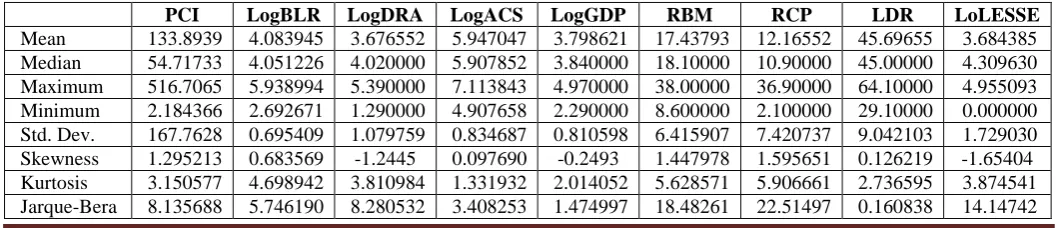
Table 1 below shows the summary descriptive statistics analysis results in terms of the mean scores, median, maximum and minimum values, standard deviation, skewness, Kurtosis and Jarque-Bera statistics. These were computed from the descriptive statistics tab in the main econometric software (EViews version 9.0) used in the analysis. The reported statistics are for the proxies used to measure PCI (Per capita income, BLR (Bank loan to rural areas), DRA (Deposits from rural areas) ACS (Agricultural credit guarantee scheme fund), GDP (Gross Domestic Product), RBM (Ratio of Broad Money to GDP (M2/GDP - a Financial deepening indicator), RCP (ratio of Credit to Private Sector to GDP (CPS/GDP - Financial deepening indicator), LDR (loan-to-deposit ratio), LQR (Liquidity ratio), LSSE (Loan to small scale enterprises). The transformation of these variables were deemed appropriate following the outcome of diagnostic tests conducted and reported in chapter three. Summarily, the transformed variables yielded optimum results in terms of the adjusted coefficient of multiple determination, F- ratio, and t-tests).
Table 1: Summary of Descriptive Statistics
PCI LogBLR LogDRA LogACS LogGDP RBM RCP LDR LoLESSE
Mean 133.8939 4.083945 3.676552 5.947047 3.798621 17.43793 12.16552 45.69655 3.684385
Median 54.71733 4.051226 4.020000 5.907852 3.840000 18.10000 10.90000 45.00000 4.309630
Maximum 516.7065 5.938994 5.390000 7.113843 4.970000 38.00000 36.90000 64.10000 4.955093
Minimum 2.184366 2.692671 1.290000 4.907658 2.290000 8.600000 2.100000 29.10000 0.000000
Std. Dev. 167.7628 0.695409 1.079759 0.834687 0.810598 6.415907 7.420737 9.042103 1.729030
Skewness 1.295213 0.683569 -1.2445 0.097690 -0.2493 1.447978 1.595651 0.126219 -1.65404
Kurtosis 3.150577 4.698942 3.810984 1.331932 2.014052 5.628571 5.906661 2.736595 3.874541
Probability 0.017114 0.056524 0.015919 0.181931 0.478309 0.000097 0.000013 0.922730 0.000847
Sum 3882.924 118.4344 106.6200 172.4644 110.1600 505.7000 352.8000 1325.200 106.8472
Sum Sq.
Dev. 788041.8 13.54062 32.64466 19.50765 18.39794 1152.588 1541.886 2289.270 83.70729
Observations 29 29 29 29 29 29 29 29 29
Source: Authors’ computations (2019)
Note: *** indicates 5 per cent significance levels
The results in Table 1 show that the mean which represent the average values of the variables. This implies that all the variables have disparate mean values especially for the measures of real gross domestic product. This supports the argument that informed the logarithmic transformation of the variables. The same pattern is shown by the standard deviation which measures the how concentrated the data are around the mean. The results reveal that the variations in the variables were not significant. This view is supported by the equally significant values of the measures of skewness and kurtosis which reported high values beyond the normal range.
Unit Root Test
Table 2 presents the results of the augmented Dickey-Fuller (ADF) unit root test, proposed in Dickey and Fuller (1979), for the individual variables as diagnostic tests to evaluate the stationarity properties of the variables. Unit root test is particularly important to ensure that the series are stationary, as estimate obtained from nonstationary series are not reliable. It is clear from Table 4.4 that the base level of some of the series contain unit root at conventional confidence level (i.e., LRt ~ I(1)). At first differences, however, all series do not contain unit root (i.e., Rt
~ I(0)).
Table 2: Augmented Dickey-Fuller Unit Root Test Results
O-level Critical Values at 5% P-value
Variables
PCI -2.971853 0.9996
LogBLR -2.998064 0.8580
LogDRA -2.971853 0.1499
LogACS -2.971853 0.9504
LogGDP -2.971853 0.4326
RBM -2.971853 0.3369
RCP -2.971853 0.2996
LQR -2.971853 0.0444
LDR -2.976263 0.0104
LogLESSE -2.971853 0.1776
Source: Researchers’ 2019
Table 3: Financial Inclusion on Poverty Reduction in Nigeria.
Dependent Variable: PCI Method: Least Squares Date: 04/21/18 Time: 08:39 Sample: 1987 2015
Included observations: 29
Variable Coefficient Std. Error t-Statistic Prob.
C -668.6543 148.7106 -4.496347 0.0001
LOGBLR 90.71735 37.39067 2.426203 0.0228
LOGDRA -37.51348 16.38082 -2.290086 0.0307
LOGACS 95.84649 32.42903 2.955577 0.0067
R-squared 0.766792 Mean dependent var 133.8939
Adjusted R-squared 0.738807 S.D. dependent var 167.7628
S.E. of regression 85.73865 Akaike info criterion 11.86793
Sum squared resid 183777.9 Schwarz criterion 12.05652
Log likelihood -168.0849 Hannan-Quinn criter. 11.92699
Prob(F-statistic) 0.000000
Source: Authors’ Computation (2019)
The E-view result reveals that, bank loan to rural areas had positive but significant impact on Per Capital Income (Log BLR = 90.72, t-value = 2.43, p-value = 0.023<0.05); demand deposit from rural areas had negative and significant impact on Per Capital Income (DRA = -37.51, t-value = -2.29, p-value = 0.03<0.05) and Agricultural Credit Guarantee Scheme Fund had positive and significant impact on Per Capital Income (Log ACS = 95.85, t-value = 2.96, p-value = 0.0067<0.05). On the whole, the coefficient of determination which measures goodness of fit as revealed by R-square (R2) indicates that 74% of the variations observed in the dependent variable (Per Capital Income) were explained by variations in the independent variables (bank loan to rural areas, demand deposit from rural areas and Agricultural Credit Guarantee Scheme Fund. The test of goodness of fit of the model as indicated by
R2 was properly adjusted by the Adjusted R-Square of 77%. With a DW value of 1.78 shows there is no trace of serial
correlation and no autocorrelation.
Table 4: Causal Relationship between Financial Inclusion and Economic Growth in Nigeria
Date: 04/21/18 Time: 16:19 Sample: 1987 2015
Lags: 2
Null Hypothesis: Obs F-Statistic Prob.
RBM does not Granger Cause LOGGDP 27 5.95165 0.0086
LOGGDP does not Granger Cause RBM 3.81131 0.0379
RCP does not Granger Cause LOGGDP 27 5.65908 0.0104
LOGGDP does not Granger Cause RCP 2.50411 0.1048
LDR does not Granger Cause LOGGDP 27 0.15270 0.8593
LOGGDP does not Granger Cause LDR 0.54390 0.5881
LQR does not Granger Cause LOGGDP 27 0.62589 0.5440
LOGGDP does not Granger Cause LQR 0.26369 0.7706
Source: Authors’ Computation (2019)
The result of the Granger causality test above shows that, there is a causal relationship between financial inclusion and economic activities. A bi-directional causality exists between GDP and the ratio of broad money to GDP. Thus causality runs from GDP to broad money (p-value = 0.0086<0.05), and a reverse causality from broad money to GDP (p-value = 0.0379<0.05). Moreover, there is an evidence of a unidirectional causality running from GDP to ratio of private sector credit (p-value = 0.0104<0.05). However, there is no causal relationship between loan-to-deposit ratio and GDP (p-value = 0.8593>0.05, and p-value = 0.5881>0.05), and between liquidity ratio of commercial banks and GDP (p-value = 0.5440>0.05, and p-value = 0.7706>0.05).
Table 5: Commercial banks intermediation activities and financial inclusion in Nigeria
Dependent Variable: LogDRA Method: Least Squares
Date: 04/21/18 Time: 09:44 Sample (adjusted): 1987 2015
Included observations: 24 after adjustments
Variable Coefficient Std. Error t-Statistic Prob.
C -7.266254 4.514907 -1.609392 0.1232
LogBLR 0.155763 0.365479 0.426188 0.6745
LDR 0.033526 0.017054 1.965883 0.0633
R-squared 0.741166 Mean dependent var 3.695914
Adjusted R-squared 0.732341 S.D. dependent var 1.176546
S.E. of regression 1.024109 Akaike info criterion 3.036534
Sum squared resid 20.97598 Schwarz criterion 3.232877
Log likelihood -32.43841 Hannan-Quinn criter. 3.088624
F-statistic 3.452217 Durbin-Watson stat 1.986194
Prob(F-statistic) 0.036029
Source: Authors’ Computation (2019)
From the above E-view results it can be seen that, loan to rural areas had positive but non-significant effect on rural area deposit (Log BLR = 0.155763, t-value = 0.426188, p-value = 0.6745>0.05); loan-to deposit ratio had positive and non-significant effect on rural area deposit (LDR = 0.033526, t-value = 1.965883, p-value = 0.0633>0.05) and loan to small scale enterprises had positive and significant effect on rural area deposit (Log LSSE = 1.835100, t-value = 2.183598, p-value = 2.183598<0.05). On the whole, the coefficient of determination which
measures goodness of fit as revealed by R-square (R2) indicates that 74% of the variations observed in the dependent
variable (rural area deposit) were explained by variations in the independent variables (loan to rural areas, loan-to deposit ratio and loan to small scale enterprises. The test of goodness of fit of the model as indicated by R2 was properly adjusted by the Adjusted R-Square of 73%. With a DW value of 1.986194 shows a trace of serial correlation and no autocorrelation.
4. CONCLUSION - RECOMMENDATION:
This study critically reviewed the impact of financial inclusion on the Nigerian economy. Findings from the empirical results reveals that relationship exists between financial inclusion, poverty reduction, economic growth and financial intermediation in Nigeria within the period studied. The study suggests therefore that financial inclusion had a positive impact on poverty reduction in Nigeria. The positive and significant impact of Agricultural Credit Guarantee Scheme Fund on Per Capital Income shows that financial inclusion increases Per Capital Income and therefore standard of living. Also, the study revealed a causal relationship between financial inclusion and economic growth in Nigeria. Therefore, financial inclusion has a causal effect on economic growth. Similarly, commercial banks intermediation activities have positive effect on financial inclusion in Nigeria. The positive and significant effect of loan-to deposit ratio on rural area deposit indicates that commercial banks intermediation activities promote financial inclusion which in turn reduces poverty and enhances economic growth. From the study, we recommend that recommended that there is a need for financial regulators to enforce proper guidelines or regulations on financial institution to encourage financial intermediation among rural poor who are mostly unbanked, and with limited access to the financial system.
REFERENCES:
1. Abreu F and Mendes, H. (2010). Financial Development and Economic Growth Cross country: Evidence from
Selected Sub-Saharan Countries. International Journal of Economic Research, 1(1),59-72.
2. Aghion S. and Bolton, A. (1997). ). Financial Inclusion and Financial Sector Stability with reference to Kenya: A review of literature. Journal of Applied Finance and Banking. 2(6), 95 -120.
3. Ahmed, A. D. (2006). The Impact of Financial Liberalization Policies: The case of Botswana. Journal of African Development, 1 (7), 13-38.
4. Ayadi, O. Adegbite, E. and Ayadi, F (2008). Structural Adjustment financial sector Development and
Economic Prosperity in Nigeria. International Research Journal of Finance and Economics No. 15
(www.euroiournals.com/finance).
5. Banerjee B. and Newman, F (1993). Credit Where Credit’s Due: A Report for the National Housing Federation. London, National Housing Federation.
6. Central Bank of Nigeria (2005). Microfinance Policy, Regulatory and Supervisory Framework for Nigeria,
Federal Government press, Abuja.
7. CBN (2013). Federal Government to Float N220bn Fund for Financial Inclusion in Nigeria. Central Bank of
Nigeria Publication, 34-39
8. Demirguc-Kunt A. and Levine R. E. (2008) Finance Financial sector policies, and Long Run Growth" M. sperce Growth Commission Background paper, No 11 Washington, D. C. world Bank
9. Fitzgerald, V. (2006), Financial Development and Economic Growth: A Critical View (Background and
10. Galor F and Zeira, A (1993). Financial inclusion and economic growth in Nigeria. International journal of economics and financial issues,5(3), 629-637
11. Gardeva A. and Rhyne, C (2011). Profitable Models for Financial Inclusion", Compendum II; Layout 1,BANCON Review papers.
12. Hannig B and Jansen, A (2010). Finance, inequality and poverty: cross-country evidence. World Bank
Policy Research Working Paper 3338. Retrieved on15th march, 2016 from
www.aeaweb.org/assa/2005/0108_0800_0302.pdf
13. Ighodara C. &Oriakhi.D. (2011). Trivanite Causality Relationship Between Financial Development and Economics Growth in Nigeria. Journal of the Chartered Institute of Bankers of Nigeria, 5(1).
14. Johnson J and Murdoch, F (2008). Reaching out Access to and use of banking services across countries.
Journal of financial economics, 85(1), 234-66.
15. Koehler, G. (2009). Finance, Inequality and Poverty: Cross country Evidence. Journal of economic
Growth 12(1), 211-252.
16. Leyshon H and Thrift, F (1995). The Social Exclusion Discourse: Ideas and Policy Change. Policy & Politics,35(1), 123-139.
17. Martinez M.V (2011). The Political Economy of Increased Financial Access. A Thesis Submitted in Partial
Fulfilment of The Requirement for The Degree of Master of Public Policy to the Faculty of the Graduate
School of Arts and Sciences of Georgetown University McKinnon (1991Valpy, 2008
18. Mohan, M (2006). The economic impact of Banking the unbanked: Evidence from Mexico World Bank: Policy Research working paper 4981. Washington D. C World Bank.
19. Odedokun, O. (1989). ). Bank credits and rural development in Nigeria (1982-2009). International Journal of Finance and Accounting, 1(3),45-52.
20. Onaolapo A. (2015). Effects of Financial Inclusion on the Economic Growth of Nigeria (1982-2012), International Journal of Business and Management Review3(8), 11-28.
21. Prahalad, F. (2011). Conclusion. In B. Rogaly, T. Fisher and E.Mayo, Eds. (1999). Poverty, Social
Exclusion and Microfinance in Britain. Oxford and London, Oxfam Publishing and New Economics
Foundation: 131-144.
22. Robinson, D. (2001). Financial development, growth and poverty: How close are the links, in financial development and economic growth: Explaining the links, Ed. Charles Goodhart. London: Palgrave
23. Tambunan, (2015). The need for Financial Inclusion in India. A publication of India Reserve Bank,
22-32.
24. Thorat, (2006). Financial development and poverty reduction in developing