Available Online at www.ijpret.com 674
INTERNATIONAL JOURNAL OF PURE AND
APPLIED RESEARCH IN ENGINEERING AND
TECHNOLOGY
A PATH FOR HORIZING YOUR INNOVATIVE WORK
A SLIDING MODE CONTROL ALGORITHM FOR ARTIFICIAL PANCREAS
NIRLIPTA RANJAN MOHANTY1, PAUROOSH KAUSHAL2, SURAJ GAUTAM3
1. Instrumentation & Control, D. Y. Patil College of Engineering Pune, India. 2. Instrumentation & Control, College of Engineering Pune, India. 3. Instrumentation & Control, Kurukshetra University, Kurukshetra, India.
Accepted Date: 05/03/2015; Published Date: 01/05/2015
\
Abstract: Artificial pancreas is simulated to handle type I diabetic patients under intensive
care by automatically controlling the insulin infusion rate. In this paper, a sliding mode control via moving sliding surfaces is used to control blood glucose level in type I diabetic patient. The method is applied on the minimal model of Bergman subjected to an oral glucose tolerance test by applying a meal in form of a disturbance. The computer simulations are done using the mathematical model of the dynamics of blood glucose regulation in the blood system to manifest the theoretical analysis. In this control strategy, the sliding surface is moved, in contrast to the fixed surface of the conventional case. This is done so that the states of the model lie on the sliding surface at all times, and the dynamics is under control. The controller maintained the blood sugar level of the patient with the value of 4.5 mmol/l, when subjected to a meal disturbance. The control strategy has significantly lowered the risk of hypoglycemia/hyperglycemia of the patient.
Keywords: Type I diabetes;Sliding Mode Control;Bergman’s minimal model
Corresponding Author: MS. NIRLIPTA RANJAN MOHANTY
Access Online On:
www.ijpret.com
How to Cite This Article:
Nirlipta Ranjan Mohanty, IJPRET, 2015; Volume 3 (9): 674-681
Available Online at www.ijpret.com 675 INTRODUCTION
Type I diabetes mellitus or insulin- dependent diabetes mellitus is a chronic metabolic illness characterized by the absence or complete destruction of the pancreatic β-cells, which results in the rising of the blood glucose concentration above its normal level. The consequences of this disease are mostly long-term, such as kidney failure, blindness, nerve damage, heart attack, and ineffectiveness of the immune system [1]. Therefore type 1 patient need external insulin injection to assist glucose uptake and utilization.
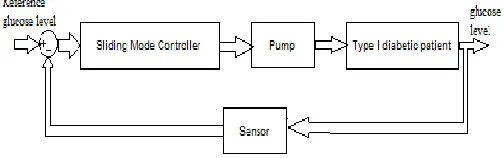
The goal of our research is to investigate a control strategy to regulate blood glucose level in a type I diabetes mellitus. The controller or the “artificial pancreas” manipulates the insulin infusion rate in the blood such that the blood glucose level is maintained at normal level of 4.5 mmol/l which is reference glucose level [2]. The closed loop regulation strategy involves a glucose sensor in feedback loop that measures blood glucose level in blood of subject. This information is compared with reference glucose level, the result of which is passed to a controller. The controller implements sliding mode control strategy to controls the glucose level by manipulating the insulin dosage to be infused to patient to keep the blood glucose level in a stable range. A mechanical pump based on controller output, delivers the desired quantity of insulin. This closed-loop method of controlling the level of blood glucose in blood mimics the action of normal pancreas. [3][4] Figure 1 shows the block diagram of working of closed-loop control strategy for type 1 diabetic patient.
Fig 1. Closed loop control for blood glucose
Available Online at www.ijpret.com 676 blood glucose level for type 1 diabetic patient. Results with respect to controller performance and possible improvements are discussed.
MATHEMATICAL MODEL
The Bergman model provides a minimal model composed of 3 equations to describe the dynamics of the pancreas action [5]. These modeling equations are described below.
dG/dt= -P1*G – X(G+Gb)+ D(t) (1)
dX/dt= -P2*X + P3*I (2)
dI/dt=-n(I+Ib)+U(t)/VI (3)
where, G is the plasma glucose concentration over basal (mmol/l), Gb is the basal plasma glucose (mmol/l), X is the generalized insulin variable for the remote compartment (1/min), I is the insulin concentration above basal (mU/l), Ib is the basal insulin level (mU/l), D(t) is the external glucose input (mmol/min), U(t) is the external insulin input (mU/min) and VI is the insulin distribution volume (l). P1, P2, P3 and n are the patient parameters. The parameters, P1, P2 and P3, may be changed to represent different conditions. Type 1 diabetic patient individuals have the following parameters as P1=0, P2=0.025, P3=0.000013 and for normal person, the values are P1=0.028,P2=0.025,P3=0.000013[6]. This model is linearized about the steady-state values of G = I = X = D= 0, U=16.667mmU/min. A meal disturbance which is exogenous glucose infusion rate (mmol/ min) given by the form D(t). We use the oral glucose tolerance test as the exogenous glucose input of 50 grams glucose meal disturbance. The meal input is modelled by the following equation
D(t)= 1.157*exp(-0.05*t) (4)
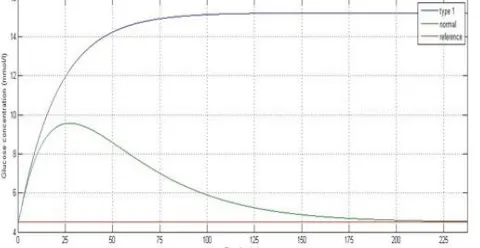
Available Online at www.ijpret.com 677 Fig. 2. Profile of glusoce concentration during meal disturbance
CONTROLLER DESIGN
The steady state blood glucose level in the body is determined by how much insulin is present.
In order to lower blood glucose level in the blood, insulin needs to be injected. Hence , the
controller defines the insulin infusion rate, U(t),based on the measured glucose concentration. Therefore blood glucose levels must be maintained in a tight range around the basal level, which matches the ideal blood glucose levels. To achieve this, Sliding Mode Control is introduced to control the insulin infusion rate.
Sliding Mode Control
The study of sliding mode control has gained popularity in recent years as a methodology for controlling nonlinear and linear systems with modeling uncertainties and external disturbances. The most important step of the control design is the construction of the sliding surface S which is expected to response desired control specifications and performance. The trajectories are enforced to lie on the sliding surfaces [7]. This section discusses the design of sliding surface for bergman minimal model with meal as a perturbation. The model is represented in discrete state space matrices as
x = Ax(t)+Bu(t)+ ∆A x(t)+ ∆B u(t)+D(x,t)
(5)
Y = Cx(t) (6)
where A,B and C are known matrices or the patient parameters. ∆A, ∆B are uncertainties in parameter values, D(x,t) is an disturbance or input meal signal to the system, x(t)is the state vector and u(t)is control input.
Available Online at www.ijpret.com 678 The uncertainties ∆A, ∆B and the disturbance D(x, t) satisfy the matching conditions given by:
ΔA= B*D (7)
ΔB =B*E (8)
D(x, t) = B*v(x,t) (9)
where D and E are unknown matrices of appropriate dimensions and v(x,t) is an external disturbance .The system can now be written as described by,
x= Ax(t)+Bu(t)+Be(x,t) (10)
where e(x,t) = Dx +Eu + v(x,t) are referred as lumped uncertainty in the system. Let the sliding surface for the system be defined as follows
σ = S*x (11)
The attractivity of the surface is assured by enforcing the sliding surface attractivity condition, as given by
σ*σ̇<=0 (12)
The control signal is proposed as:
u = ueq+un (13)
where ueq takes care of known parameters and un takes care of uncertain and disturbance term.
Choosing ueq and un such that the sliding surface condition is met and are given as:
ueq=(SB)-1*(SAx+α*σ(0)*exp(-αt)) (14)
un = ρ*sign(σSB)/(1- β) (15)
where α indicates the rate of reaching sliding surface from any initial condition, σ(0) is the sliding surface at initial point of the system, ρ is the maximum possible value of lumped uncertainity, and β is a positive number less than 1.
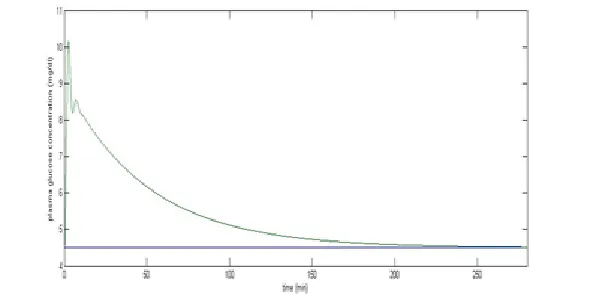
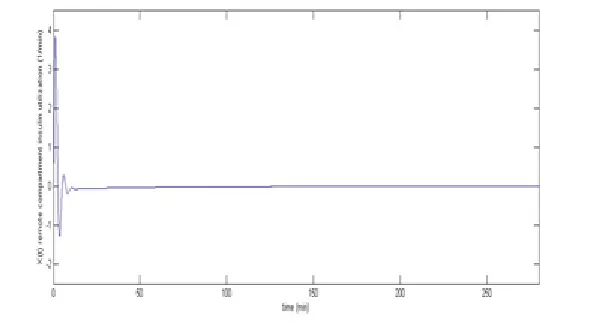
Available Online at www.ijpret.com 679 Bergman's model comes with an artificial pancreas has two inputs, the ingested glucose in plasma after a meal reflected by the disturbance function D(t) and insulin from an external injection u(t) that plays the controllers role. The performance of the control algorithm investigated above was tested for a standard meal disturbance with about four hour duration for type 1 diabetic patient. The actual input signal the insulin infusion rate U(t) is controlled by sliding mode controller. Figure 3 shows control of blood glucose concentration to the normal level. The controller action is seen when meal disturbance is given, the glucose concentration can reach about 10 mmol/l and then it is stabilized at the basal level finally in about 4 hours. Figure 4 and Figure 5 illustrates the remote compartment insulin utilization and plasma insulin concentration respectively. The response time is suitable and matches with physiological regulation system. Figure 6 gives glucose concentration profiles of normal and sliding mode controlled type I diabetic patient during meal disturbance. The profile of type I approaches the normal person response very closely. The simulation can be implemented on hardware and accepted by the clinical research.
Fig. 3. plasma glucose profile of type I patient with control action
Available Online at www.ijpret.com 680 Fig. 5. Comparison of plasma glucose profiles of healthy and type I diabetic
CONCLUSION
The case study presented a robust control strategy to regulate glucose-insulin system for type I diabetic patient. The controller is very effective in the blood glucose regulation. It can control the glucose concentration and the regulation of profile approaches the normal person. There is no instance of hyperglycemia or hypoglycemia during regulation of plasma glucose level. Future work would be implementing the controller on hardware and designing of insulin pump. It can believe that the work is suitable for applications related to human body where precision is of great concern.
REFERENCES
1. C. V. Doran, J.G. Chase, G.M. Shaw, K.T. Moorhead, and N.H. Hudson," Derivative weighted
active insulin control modeling and clinical trials for ICU patients", Medical Engineering & Physics, vol. 26, issue 10 pp. 855-866, 2004.
2. Weijiu Liua, Fusheng Tang, “Modeling a simplified regulatory system of blood glucose at
molecular levels”, Journal of Theoretical Biology, vol. 252, pp 608–620, 2008.
3. Z-H Lam, K-S Hwang,J-Y Lee,J-G Chase,G-C Wake, “Active insulin infusion using optimal and
derivative weighted control”, Medical Engineering & Physics, vol. 24, pp. 663–672, 2002.
4. Chengwei Li, Ruiqiang Hu, “Fuzzy-PID Control for the regulation of blood glucose in diabetes”
Available Online at www.ijpret.com 681
5. R. N. Bergman, L.S. Philips, C. Cobelli, “Physiological evaluation of factors controlling glucose
tolerance in man,” J.Clin.Znvest., vol 68, pp. 1456-1467,1981
6. Sandra M. Lynch, B. Wayne Bequette, “Estimation-based model predictive control of blood
glucose in type I diabetics: a simulation study” IEEE 27th Annual Northeast Bioengineering Conference, pp 79-80, 2001.
7. S. Tokat, I. Eksin, M. Guzelkaya, “Sliding mode control using a nonlinear time-varying sliding