T
T
h
h
e
e
r
r
a
a
n
n
o
o
s
s
t
t
i
i
c
c
s
s
2013; 3(7):527-531. doi: 10.7150/thno.7021 Commentary
Bibliometric Analysis of
Theranostics
: Two Years in the
Making
Don N. Ho1, Ki Young Choi1, Sung-Jong Lee1,2
1. Laboratory of Molecular Imaging and Nanomedicine, National Institute of Biomedical Imaging and Bioengineering, National Institutes of Health, Bethesda, Maryland, USA
2. National Research Foundation of Korea, Daejeon, South Korea
Corresponding author: [email protected]
© Ivyspring International Publisher. This is an open-access article distributed under the terms of the Creative Commons License (http://creativecommons.org/ licenses/by-nc-nd/3.0/). Reproduction is permitted for personal, noncommercial use, provided that the article is in whole, unmodified, and properly cited.
Received: 2013.06.26; Accepted: 2013.07.02; Published: 2013.07.03
Abstract
With the newly released impact factor from Thomson Reuters, we look at the first two years of the journal Theranostics under the scope of a new bibliometric designed for the analysis of emerging specialties and also for journals with a multidisciplinary approach. With this method, we are able to look at characteristics of an interdisciplinary field or a single journal subject area, and also, the bibliographic trends of their authors. We use this tool to examine authors from the journal Theranostics and compare them to similar au-thors in the field of theranostics, or theranosticians. Our document and co-citation analysis examines the growth and overlap of established knowledge networks with the incorporation of fields, topics, and disciplines; the quantification can also reflect the in-tellectual activity in combining leading edge developments in solidly grounded specialties. The quantification of junior authorship aims to gauge the promotion of fresh ideas and scientific development in the community, while productivity of overall authors is meas-ured by citation analysis.
Key words: Theranostics, Bibliometric Analysis
Introduction
Emerging fields must combine established spe-cialties to define the focus of their research goal and similarly, they must also be organized in an interdis-ciplinary repository format such as the scientific spe-cialty journal Theranostics. The discoveries, findings and challenges of the published documents with an interdisciplinary goal have furthered our knowledge [1] and have been a great pleasure to read and inter-pret. The overall effectiveness of a journal covering an interdisciplinary field and analyzing the trends of established journals, must overcome the concerting effort and comprehensive examination of growing fields [2]. With this aim, we look at the first two years
of the journal Theranostics under the scope of a new bibliometric for the analysis of emerging specialties and journals with a multidisciplinary approach. With this method, we are able to look at characteristics of a single journal subject area, and also, the bibliographic trends of authors from the journal Theranostics and compare them to similar authors in the field of theranostics, or theranosticians.
Assessment of the field of theranostics and the journal Theranostics was based on direct publication and bibliometric data. All data were collected from PubMed which include publications from NIH-funded research. Data from the journal
Ivyspring
Theranostics was collected from the date of its incep-tion in January 2011 to February 6, 2013. All mul-ti-authored papers were included as contributions from each respective department, institution, and region to incorporate the multidisciplinary facets. With this information we use the multidisciplinary bibliometric approach to derive keyword footprints, an analysis of multidisciplinary and specialty balance, junior researcher productivity, and individual re-searcher productivity [3, 4].
Keyword Footprint
Before discussing the quantification of a multi-disciplinary approach, we first consider the diverse topics covered within a field. The applications of theranostics create a footprint of the foci and the range of contributions in research areas. Subjects covered in the journal Theranostics were analyzed by frequency of keywords and compared to the frequency of those keywords found in PubMed. This results in the area of coverage representing regions that are commonly covered versus specialty topics that occur less fre-quently. The journal Theranostics covered unique areas with high frequency compared to those in literature, e.g. multimodal imaging, breast cancer early detec-tion, image guided therapy, plasmonics, phage dis-play, stem cells, nanocarriers, biomaterial compatibil-ity, theranostics, and radiochemistry. The journal
Theranostics also covers less frequent topics such as a spectrum of specific and unique nanotechnologies, specific gene and protein targets as well as carriers, and unique therapy techniques. The low frequency in both literature and the journal Theranostics also cor-responds with specialty areas and more unique ap-plications. We also find overlap in high frequency topics in literature and the journal Theranostics, e.g. nanoparticles, molecular imaging, targeted delivery, translation, and positron emission tomography. The keyword frequency for the journal Theranostics was also used for the derivation of the word cloud shown in the banner of this article.
Keywords most frequently used in the journal
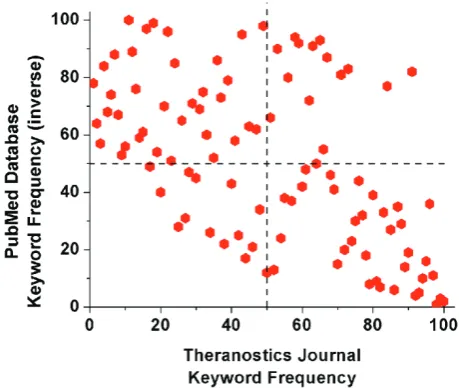
Theranostics were quantified according to frequency, weighted by occurrences and normalized to a scale of 100; the set of authors used is limited to theranosti-cians funded by NIH. PubMed keyword frequency was analyzed in the same process with results from the NIH Query/View/Report (QVR) system [5]. This subset of keywords was then inversely normalized to a scale of 100. The results were then visualized by frequency of occurrence in Theranostics and the in-verse occurrence in PubMed on x- and y-axis, respec-tively (Figure 1).
Figure 1. The journal Theranostics covers specialty areas by
comparative frequency to that found in literature (top half of graph) as well as many common trending topics (bottom right quadrant). Displayed are the 100-most frequent keywords in the journal Theranostics plotted in proportion to occurrences in PubMed.
The first quadrant represents topics that occur less in literature but have higher coverage by authors in the journal Theranostics, theranospecific words. The second quadrant contains less popular, less used keywords showing dispersed coverage by both areas. The third quadrant represents the frequency of pop-ular PubMed references to keywords but less theranospecificity. The fourth quadrant highlights high frequency of keyword usage in both Pubmed publications and the journal Theranostics.
Multidisciplinary and Specialty Balance
From the 597 authors in the last 2 years,Table 1. Specialty research areas represented in the journal Theranostics come from diverse individual specialties and from both combined research disciplines and collaborative works.
Junior Research Involvement and
Productivity
Each author of the manuscripts published in
Theranostics was analyzed. Total number of publica-tions was collected from PubMed and categorized with the earliest publication by the author. Authors were defined as all individuals listed on the manu-script authorship list. Corresponding authors were defined as primary and co-corresponding authors. The analysis for unique identities is accomplished by identifying authors with their specific institution to reduce search results of authors with similar names, and produces a limitation to the publications from previous institute affiliations. A reverse percentile (RP) calculation scores publications based on the normalized ranking of journals where higher impact factors are in the higher percentiles. This method is a useful indicator of reflecting involvement and productivity but reduces impact factor weighting.
Out of the 597 authors in Theranostics, 294 had their first publication since the inception of
Theranostics including their authorship in the journal with 65 having their first first-position authorship and 148 publishing for their first time in any authorship position. These counts show that as junior researchers, authors received their first manuscript presentation during the time of Theranostics inception including their accepted manuscripts, while the other investi-gators had previously published articles before the inception of Theranostics or in other journals.
To investigate productivity of junior researchers among the author group from the journal Theranostics, we took samples from whole data set. 239 of the es-tablished researchers were randomly chosen and were analyzed and found to have published on average 15 papers with an average impact factor (IF) of 5.7 and reverse percentile of 62.8. Likewise 111 selected junior researchers had averaged 3 papers with an average IF of 6.7 and RP of 77. IF scoring is influenced by high IF journals that cover general areas, and this type of scoring is not always reflective of research productiv-ity, especially in a specialty field. RP scoring reflects specialties as a counterpart to IF scoring. With the inclusion of RP scoring, it can be seen that the junior researchers group published in more qualified jour-nals for their specialty. The rate of change for the summation of impact factors (IFS) in 2012 compared to the average of the last 5 years (2007-2011) is 1.71, from 158 established researchers, and 1.59, from 43 junior researchers. In the case of the summation of reverse percentiles (RPS), the rate of change (CR) was 1.62 and 1.59, respectively. The latter case shows the reduced scoring for the established research group that narrows the gap between the two author groups.
Individual Productivity
theragnosis) as a keyword in their publication, termed authors in the theranostics field (TAF). TAF group published 5111 papers in 745 journals (or neighboring journals to the journal Theranostics). Of those, 4022 papers are published in 609 Science Citation Infor-mation (SCI) journals. Authors were analyzed by examining all publications and weighted by journal SCI impact factor [7].
The number of authors in the second subset that used the keyword theranostics (TAF) was similar to the number of Theranostics journal authors (TAJ). Overall, TAJ, as compared to TAF, published more in SCI-rated journals, had a higher number of SCI papers per person, and had a slightly higher aggregate im-pact factor on publications (Table 2). TAF had a higher average impact factor and published more after 2010, after the inception of the journal
Theranostics. An interesting side note is that TAJ had an overall trend of publishing in the journal Bioconju-gate Chemistry while TAF preferred the journal Bio-materials; the most commonly published journals by the authors or close neighboring journals for TAJ are the Journal of Bioconjugate Chemistry and the Journal of Nuclear Medicine.
Table 2. Publication analysis for authors in the specified journal compared to authors in the field of theranostics.
Authors in the journal Theranostics (TAJ)
Authors in the field of Theranostics (TAF)
Number of authors 597 596
Total publications 5111 4618
Publications after 2010 2734 3686
SCI publications 4022 3332
Average impact factor 5.7 6.8 SCI papers per person 6.7 5.6 Average IFS per person 38.3 38.2 Most popular journal Bioconjugate
Chemistry Biomaterials
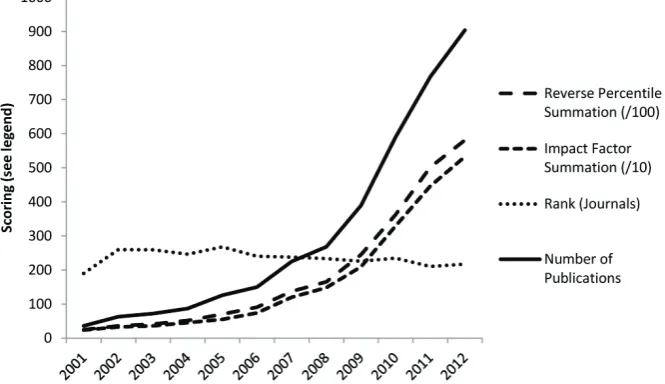
The average IF of TAJ papers was 5.7 and the average SCI papers published per author were 6.7. Taken altogether, the average IFS per person was 38.3 and the average RPS per person was 425.4. For TAJ, the average IF rank of the publication was 224.4 out of 609 neighboring journals and average rate of change for RPS by year was 32.9% during the most recent 12 years. During the recent 12 years, publication in-creased by 25 times, the IFS inin-creased by 22 times, and the RPS increased by 23.5 times (Figure 2). The emerging field categorized by Theranostics authors has a sharp increase in the number of publications, a growing influence in scientific disciplines, and also a developed independent field.
Figure 2. The multidisciplinary analysis examines research productivity during the most recent 12 years scored with Reverse Percentile
Conclusion
Our bibliographic and multidisciplinary analysis aligns squarely with many of the stated goals of
Theranostics in their inaugural commentary [3]. Our document and co-citation analysis examines the growth and overlap of established knowledge net-works with the incorporation of fields, topics, and disciplines; the quantification can also reflect the in-tellectual activity in combining leading edge devel-opments in solidly grounded specialties. The fre-quency and variance of region, discipline back-ground, keywords and topics represent the interests of the field and current publications. The quantifica-tion of junior authorship aims to gauge the promoquantifica-tion of fresh ideas and scientific development in the community, while productivity of overall authors is measured by citation analysis.
With the recent issuance of the journal
Theranostics’ impact factor of 7.8 [8], we look at the determination and value of the impact factor score. The analytical derivation of the impact factor pro-duces a score from the number of citations in a given year for publications in the previous two years and compares them to the total citable items the journal published in those past year two years. Within this impact factor score, journals that are evaluated con-tain a mix of publications from highly established disciplines and more recent, exciting or breaking areas of research. For the specific field, the journal
Theranostics represented specialties such as molecular imaging, nuclear medicine, and nanotechnology and proceeds to frame them for theranostic applications. Although the impact factor is a useful tool for gauging individual journal productivity, the use of impact factor is also not a gauge for individual or research productivity [9] and we move away from these num-bers in the reverse percentile rankings for this analy-sis. In this way, impact factor inflation is mitigated, and key areas can be examined in their relation to the area theranostics. This method could be applied to extrapolate the previously mentioned research fields individually or examine another multidisciplinary field with a similar approach.
In addition, the relevancy of articles in a single journal should also be considered. For our metrics of examining the multidisciplinary field of theranostics, we were able to derive theranosticians in neighboring journals and examine them in both the multidiscipli-nary field and individual contributions. The emphasis on looking solely at impact factor scoring can cause perceptions that lead to impact factor inflation and bias; these are mitigated by incorporating a ranking
system that removes the impact factor score and by examining keywords across multiple journals.
Competing Interests
The authors have declared that no competing interest exists.
References
1. Bartneck C, Hu J. The fruits of collaboration in a multidisciplinary field. Scientometrics. 2010; 85: 41-52. doi:DOI 10.1007/s11192-010-0242-4. 2. Ioannidis JP. Concentration of the most-cited papers in the scientific
literature: analysis of journal ecosystems. PloS one. 2006; 1: e5. doi:10.1371/journal.pone.0000005.
3. Chen XY. Introducing Theranostics Journal - From the Editor-in-Chief. Theranostics. 2011; 1: 1-2. doi:DOI 10.7150/thno/v01p0001.
4. Chen XY. One Year after a Successful Start of Theranostics. Theranostics. 2012; 2: 1-2. doi:Doi 10.7150/Thno.2.1.
5. Gonzalez-Alcaide G, Castello-Cogollos L, Castellano-Gomez M, Agullo-Calatayud V, Aleixandre-Benavent R, Alvarez FJ, et al. Scientific publications and research groups on alcohol consumption and related problems worldwide: authorship analysis of papers indexed in PubMed and Scopus databases (2005 to 2009). Alcoholism, clinical and experi-mental research. 2013; 37 Suppl 1: E381-93. doi:10.1111/j.1530-0277.2012.01934.x.
6. Postma E. Inflated impact factors? The true impact of evolutionary papers in non-evolutionary journals. PloS one. 2007; 2: e999. doi:10.1371/journal.pone.0000999.
7. Rosas SR, Kagan JM, Schouten JT, Slack PA, Trochim WM. Evaluating research and impact: a bibliometric analysis of research by the NIH/NIAID HIV/AIDS clinical trials networks. PloS one. 2011; 6: e17428. doi:10.1371/journal.pone.0017428.
8. Thomson Reuters. Journal Citation Reports. ISI Web of Knowledge. 2013.