Available Online at www.ijpret.com 258
INTERNATIONAL JOURNAL OF PURE AND
APPLIED RESEARCH IN ENGINEERING AND
TECHNOLOGY
A PATH FOR HORIZING YOUR INNOVATIVE WORK
PERFORMANCE AND EMISSION ANALYSIS OF CI ENGINE BY
USING EXHAUST GAS RECIRCULATION THROUGH VENTURI
AVINASH M. WANKHADE1, DR. SHASHANK B. THAKARE2
1. Professor & Head, Mechanical Engg. BNCOE, Pusad. 2. Professor Mechanical Engg., PRMIT & R, Badnera.
Accepted Date: 15/03/2016; Published Date: 01/05/2016
\
Abstract: The work aims in delimit the application range of EGR technique for NOx reduction through venturi. The experiments were conducted and analysis of EGR effect on emission and performance of four stroke single cylinder CI engine is introduced by comparing with the effects on the parameters of engine no EGR. It was found that adding exhaust gas to air flow rate appeared to be more beneficial way of utilizing EGR with substantial decrement in NOx and improvement in various performance parameters as an EGR percentage advances. Significant fall out in the NOx we recorded as a result of reduced availability of O2 in combustion chamber. HC particulates were also
reduced with EGR advancement, result in burning of trapped gases in crevices of combustion chamber. Also performance in terms of mechanical efficiency, overall thermal efficiency and brake specific fuel consumption were recorded. The fuel consumption with increase in EGR was milestone, but results shows satisfactory improvement in BSFC. This also confirms, dilution of charge due to EGR lowers the heat losses and which results in more effective conversion of thermal energy to work, so as to enhance the overall thermal efficiency.
Keywords:EGR, Nox, HC, Mechanical Efficiency, Overall Thermal Efficiency, BSFC.
Corresponding Author: MR. AVINASH M. WANKHADE
Access Online On:
www.ijpret.com
How to Cite This Article:
Avinash M. Wankhade, IJPRET, 2016; Volume 4 (9): 258-265
Available Online at www.ijpret.com 259
INTRODUCTION
The development of power unit with low environmental impact has become one of the most interesting challenges in automobile technology. CI Engines have typically high thermal efficiency resulting from higher compression ratio and Fuel lean operation. Diesel Engine combustion generate large amount of NOx because of high flame temperature in the presence of abundant O2 and H2 as NOx is collaboration of Nitric Oxide (NO) and Nitrogen Oxide and both
are considered to be harmful to human as well as environmental health. Chemically NO2 is
more harmful and toxic than NO. It affects human health directly and to overcome this crucial issue and looking toward economical factor. EGR (Exhaust Gas Recirculation) is one of the most effective methods to reduce NOx by implementing EGR. There are some positive variations in emission and performance parameters of engine. The role of exhaust gases in combustion chamber of IC Engine if well understood. Tests were conducted on 4-stroke single cylinder CI Engine at different loads with different percentage of EGR at constant speed i.e.1500 rpm. First experiment was conducted on engine without implementing EGR and different emission and performance parameters at different loads were recorded. Same experiment was conducted by recirculating exhaust gas through venturi at same percentage of EGR and same loads and same parameters of emission and performance were recorded again. After comparing the results we found 74% decrement in NOx in comparison with without EGR as well as there is drastic decrement in combustion temperature. In spite of several advantages by recirculating more percentage of EGR there is also fall in the thermal efficiency. Results can also obtained by recirculating exhaust gas through simple pipe and Orifice meter.
II. Experimentation
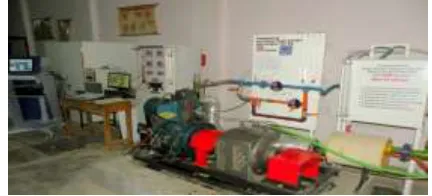
A single cylinder, naturally aspirated four strokes, vertical air cooled engine is taken. Various parameters are measured by electric alternator type dynamometer used to measure brake power, tachometer to find rpm of engine, thermocouple to measure temperature and AVL five gas analyser to measure various emissions like NOx, CO, HC, etc.
Available Online at www.ijpret.com 260
Computerized CI Engine Specification
Four stroke single Cylinder air cooled self-start CI engine.
Make : Kirloskar
Rated Power : 7.5kW (10 HP)
Bore Dia. : 80 mm
Stoke Length : 110 mm
Connecting Rod Length : 234 mm
Swept Volume : 562cc
Compression Ratio : 17.5:1
Rated Speed : 1500 rpm
Rated Torque : 4.6 kg-m
Arm Length : 150 mm
EGR technique for NOx reduction
EGR is a useful technique for reducing NOx, CO2, and HC formation in the combustion chamber.
Exhaust consists of CO2; N2 and water vapours mainly. When a part of this exhaust gas is
re-circulated to the cylinder, it acts as dilutant to the combusting mixture. This also reduces the O2
concentration in the combustion chamber. The specific heat of the EGR is much higher than fresh air, hence EGR increases the heat capacity (specific heat) of the intake charge, thus decreasing the temperature rise for the same heat release in the combustion chamber.
%𝐸𝐺𝑅 = 𝑣𝑜𝑙𝑢𝑚𝑒 𝑜𝑓 𝐸𝐺𝑅
𝑡𝑜𝑡𝑎𝑙 𝑖𝑛𝑡𝑎𝑘𝑒 𝑐ℎ𝑎𝑟𝑔𝑒 𝑖𝑛𝑡𝑜 𝑡ℎ𝑒 𝑐𝑦𝑙𝑖𝑛𝑑𝑒𝑟 𝑥 100
Available Online at www.ijpret.com 261
Fig. 3.1 : NOx (ppm) Vs Torque (N-m)
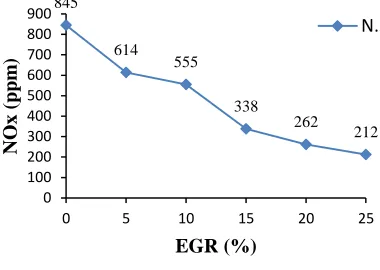
Fig. 3.2 : NOx (ppm) Vs EGR (%)
DISCUSSION
Above graphs shows values of NOx (ppm) at 5%, 10%, 15%, 20%, & 25% of EGR and get Compared with without EGR case is concern and we achieve about 633 (ppm) amount of NOx reduction in quantity as we recirculate the exhaust gases through venturi and used partially cooled type of heat exchanger. The increase of EGR % decreases amount of fresh air induced per cycle at constant pressure. The amount of fuel injected per cycle should remain constant practically, but it contradicts the decrease in AFR. The increase in percentage of EGR increases the EGR temperature, which have adverse effect on AFR (Air Fuel Ratio), which is more pronounced at low engine speed. Thus at full load the effect of thermal throttling (reduced amount of charge to the cylinder) is significant and increases as EGR temp is increased. The increase of gas temperature results to a reduction of combustion pressure which is more at higher EGR rate i.e. there is reduction in availability of oxygen. This lack of oxygen in the
0 100 200 300 400 500 600 700 800 900
0 5 10 15 20 25 30 35 40 45 50
NO x (p p m ) Torque (N-m) WITHOUT EGR 5% EGR 10% EGR 15% EGR 20% EGR 845 614 555 338 262 212 0 100 200 300 400 500 600 700 800 900
0 5 10 15 20 25
Available Online at www.ijpret.com 262
cylinder reduces combustion, thus lowers the cylinder peak pressure. It has also effect on ignition delay which is almost negligible.
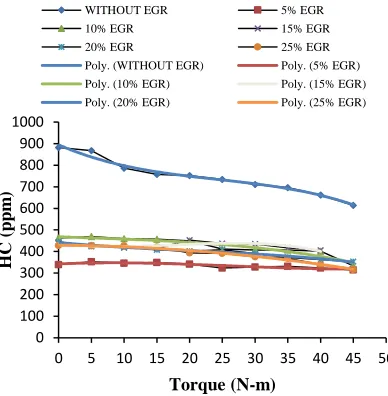
Fig 3.3: HC (ppm) Vs Torque (N-m)
DISCUSSION
The variation of HC w.r.t Torque is as shown in above result graph. In case of without EGR, It is observed that increase in torque decreases the amount of HC emissions & vice versa and same nature is found for different % of EGR. As concern to case of different % of EGR, HC emission is found to be decreasing with increase rate of EGR. It is because as the unburned hydrocarbon emissions have several different sources. Unburnt hydrocarbon is the direct result of incomplete combustion. During compression and combustion, the increase in cylinder pressure forces some of the gas in the cylinder into the crevices or narrow volumes, connected to combustion chamber i.e., the volumes between the piston, rings and cylinder walls are the largest of these. Most of these gases are unburned fuel-air mixture and much of it escapes the primary combustion process and these gases which in expansion and combustion processes is one source of unburnt hydrocarbon emissions. A final source of HC in Engine is incomplete combustion which is especially due to bulk quenching of flame in which fraction is slow.
0 100 200 300 400 500 600 700 800 900 1000
0 5 10 15 20 25 30 35 40 45 50
H
C (p
p
m
)
Torque (N-m)
WITHOUT EGR 5% EGR
10% EGR 15% EGR
20% EGR 25% EGR
Poly. (WITHOUT EGR) Poly. (5% EGR)
Poly. (10% EGR) Poly. (15% EGR)
Available Online at www.ijpret.com 263
Fig 3.4: BSFC (kg/kW-hr) Vs Torque(N-m)
DISCUSSION
Above graph is plotted between BSFC Vs Torque for different % of EGR through simple pipe. It indicates the variations of brake specific fuel consumption with increasing torque rate. There is remarkable decrement in fuel consumption with increasing Torque rate. One of the main reason for this effect is, as Torque is increased Brake Power as well as amount of fuel consumption also increases but increment in the amount of fuel consumption is very low as compare to Brake Power. Also with increase in load cylinder pressure and temperature increases, this improves the combustion process resulting in decrease in BSFC. But as the case of NOx is concerned, there is marginal variation in value of BSFC with different % of EGR.
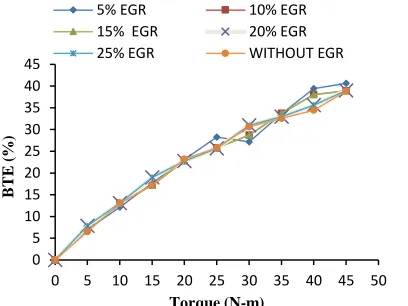
Fig 3.5 BTE (%) Vs Torque (N-m)
0 0.2 0.4 0.6 0.8 1 1.2 1.4
0 5 10 15 20 25 30 35 40 45 50
B
S
FC
(k
g
/k
W
-h
r)
Torque (N-m)
5% EGR 10% EGR
15% EGR 20% EGR
25% EGR WITHOUT EGR
0 5 10 15 20 25 30 35 40 45
0 5 10 15 20 25 30 35 40 45 50
B
T
E
(
%
)
Torque (N-m)
5% EGR 10% EGR
15% EGR 20% EGR
Available Online at www.ijpret.com 264
DISCUSSION
In above graph variation shows brake thermal efficiency when different percentage of EGR is supplied at different torque. The respective values of brake thermal efficiency are taken from performance table. All above line condition showing increment in the Brake Thermal Efficiency with increase rate of torque. We know from earlier study that brake power increases when engine torque is varied from 5 N-m to 45 N-m so brake thermal efficiency also increases positively when engine torque varies positively as shown in above graph. As the case of different % of EGR is concerned, Brake Thermal Efficiency is found to have marginal decrement with increasing rates of EGR but with increasing inlet air pressure the Brake Thermal Efficiency is increased. The possible reason may be with increasing in EGR rates, exhaust gas has higher amount of CO2, which reduces maximum temperature in combustion chamber along with
oxygen availability therefore burning of fuel is not significant but with increasing inlet air pressure along with EGR it increases oxygen availability and significant burning of fuel is occurred. The BTE improvement may be due to the presence of oxygen in its combined form in EGR. This oxygen can be used in combustion, especially in the fuel rich zone. Hence, help for complete the combustion process, and consequently improve the BTE. With high percentages of EGR a marginal improvement in BTE is observed. This is because a larger amount of active radicals and unburned hydrocarbons is admitted into the cylinder when high percentages of EGR are used. Also, the partly cooled EGR acts like a pre-heater for the intake charge improving the combustion conditions. These effects are more prudent at high percentages of EGR.
IV CONCLUSION
As experimental investigation was done on a single cylinder four stroke, water cooled diesel engine. The effect on performance & exhaust emissions were studied and their variations were observed and are concluded as follows:
When engine was operated with EGR case the brake thermal efficiency decreases due to the lower calorific value. The brake thermal efficiency increases at lower EGR rate increasing EGR flow rates to high level resulted into lower brake thermal efficiency. The NOx emission was decreased with increasing EGR flow rate.
Available Online at www.ijpret.com 265
tolerate in between effects when engine operated under different loading & unloading conditions. Results for different operating modes are analyzed and presented graphically for brake thermal efficiency, BSFC, and NOx, HC. The utilization of EGR further reduces the peak pressure & hence extends the engine life. The effect increases with the increment in EGR percentage.
ACKNOWLEDGEMENT
We wish to express our appreciation to the B. N. College of Engineering, Pusad for making the AVL 5 gas analyser for the experimentation under which current investigation of study has been conducted.
REFERENCES
1. D.T. Hountalas, G.C. Mavropoulas and K.B. Binder (2008), Effect of exhaust gas recirculation (EGR) temperature for various EGR rates on heavy duty DI diesel engine performance and emissions, Science Direct Energy 33, 272-283.
2. JeraldA. Caton (2012), Thermodynamic characteristics of high efficiency, internal- combustion engines, Energy Conversion and Management, 58, 84-93.
3. G.H. Abd-Alla (2002) Using exhaust gas recirculation in internal combustion engines: a review, Energy Conversion and Management, 43, 1027-1042.
4. John B. Heywood, (1998), Internal Combustion Engine Fundamentals, New York: Mc-Graw Hill, 572 - 590.