Available Online at www.ijpret.com 26
INTERNATIONAL JOURNAL OF PURE AND
APPLIED RESEARCH IN ENGINEERING AND
TECHNOLOGY
A PATH FOR HORIZING YOUR INNOVATIVE WORK
PERFORMANCE OF MANET ROUTING PROTOCOL IN AD-HOC NETWORK
KAUR M1, KAUR S2
1. Department of CSE, Guru Nanak Dev Engineering College, Ludhiana 2. Department of CSE, Guru Nanak Dev Engineering College, Ludhiana
Accepted Date: 25/06/2014; Published Date: 01/08/2014
\
Abstract: A Mobile Ad-hoc Network (MANET) is a collection of wireless mobile nodes that are capable of communicating with each other without the use of fixed network infrastructure or any centralized administration.Due to the unavailability of controlling entity, routing and network management are done cooperatively by respective nodes. In MANET intermediate nodes are used to route the packets from the source node to the destination node. In MANET, various kind of routing protocols are taken into consideration, i.e. AODV, OLSR, GRP etc. In this paper, different network scenarios with increasing density of nodes in ad-hoc network have been. In proposed work, new node model is designed by adapting standard node model to enhance the overall performance of network and also able to overcome the interaction of fundamental difficulties such as contention, node connectivity and congestion to meet the defined Quality of Services standards. The performance of three MANET routing protocols AODV, OLSR, GRP have been calculated by using new node model and standard node model. Network throughput, retransmission attempts and network load metrics are considered as the performance evaluation
parameters.
Keywords: MANET, AODV, OLSR, GRP
Corresponding Author: MS. MANANPREET KAUR
Access Online On:
www.ijpret.com
How to Cite This Article:
Available Online at www.ijpret.com 27
INTRODUCTION
MANET (Mobile Ad-hoc Network) is an autonomous system, where nodes are connected with each other through wireless links. There is no restriction on the nodes therefore the nodes join or leave the network freely. Mobile Ad-hoc Network topology is dynamic that can change rapidly because the nodes can organize themselves randomly and can move freely. This property of the nodes makes the Mobile Ad-hoc Network unpredictable from the point of view
of scalability and topology.Mobile Ad-hoc Network is a collection of wireless mobile nodes that
Available Online at www.ijpret.com 28
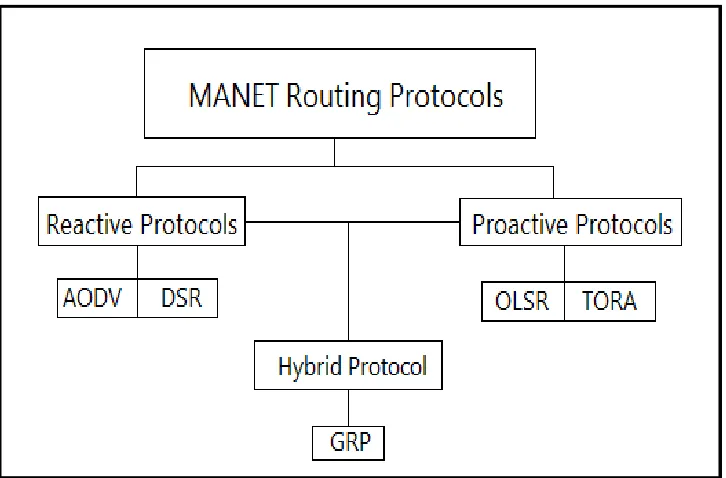
1. Routing protocols of MANET
Figure 1: Hierarchy of MANET Routing Protocols
A) Reactive Protocols
Reactive protocols do not initiate route discovery by themselves until they are requested, by a source node to find a route. These protocols setup routes when demanded i.e. when a node wants to communicate with another node in the network, and the source node do not have a route to the node and source node wants to communicate with reactive routing protocols will establish a route from the source to destination node.
B) Proactive Protocols
Proactive Protocols maintain constantly updated topology of the network. All the nodes in the network know about the every other node of that network in advance. All the routing information is usually kept in number of different tables. Whenever, there is a change in the network topology the routing tables are updated according to the changes.
C) Hybrid Protocols
Available Online at www.ijpret.com 29
3. Performance Evaluation and Design
Performance metrics are used in the evaluation of routing protocols. These metrices represent different characteristics of the overall network performance.
Throughput
It represents the total number of bits (in bits/sec) forwarded from wireless LAN layers to higher layers in all WLAN nodes of the network. Throughput can be defined as the ratio of the total amount of data that reaches a receiver from the sender. Throughput can be defined as the time it takes for the receiver to get the last packet. It is expressed in bits per second.
Network Load (bits/sec)
Network load represents the total load in bit/sec submitted to wireless LAN layers by all higher
layers in all WLAN nodes of the network. When there is more traffic on the network, and it become difficult for the network to handle all this traffic so it is called the network load.
Media Access Delay (sec)
It represents the statistic for the total of queuing and contention delays of the data, management, delayed Block-ACK and Block-ACK Request frames transmitted by all WLAN MACs in the network.
RESULTS AND DISCUSSIONS
To design new node model the performance of three MANET routing protocols AODV, OLSR, GRP have been calculated by using new node model and standard node model. Network throughput and network load metrics are considered as the performance evaluation parameters.
Available Online at www.ijpret.com 30
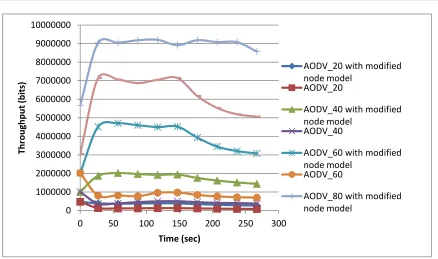
Figure 2: Throughput of AODV
In modified node model, the re-routing of the data packets from the overflowed server to the under flowed server makes the data packets not be dropped and make their delivery more reliable. The AODV protocol throughput begins with the small value, after that it keeps on increasing and decreasing within some specific range. At the same time, the throughput of AODV protocol with large network size begins with greater value. The network that is designed by 60 and 80 nodes, throughput has increased by 17.16% and 18.67%.
Throughput for OLSR: Figure 3 shows throughput of OLSR protocol with varying node densities from 20 to 80 nodes under network scenarios using with modified node model and standard node model. The throughput of network of 20 and 40 nodes has been increased by 10.40% and 13.56% respectively.
0 1000000 2000000 3000000 4000000 5000000 6000000 7000000 8000000 9000000 10000000
0 50 100 150 200 250 300
Th
ro
u
gh
p
u
t
(b
its)
Time (sec)
AODV_20 with modified node model
AODV_20
AODV_40 with modified node model
AODV_40
AODV_60 with modified node model
AODV_60
Available Online at www.ijpret.com 31
Figure 3: Throughput of OLSR
By analyzing the graph, it is observed that throughput of OLSR protocol with modified node model is increased, when the number of nodes is increased at transmission speed of 10 Mbps than standard node model. OLSR protocol is independent of the traffic and network density. OLSR reduce the control overhead forcing the MPR to propagate the updates of the link state and it is suitable for dense networks. The increment is 15.72% and 17.42% in network of 60 and 80 nodes.
Throughput for GRP: It shows throughput of GRP protocol with varying node densities from 20 to 80 nodes. Throughput of the networks based on new node model and standard node model with different network sizes configured by using a hybrid protocol.
0 1000000 2000000 3000000 4000000 5000000 6000000 7000000 8000000 9000000
0 100 200 300 400
Th
ro
u
gh
p
u
t
(b
its)
Time (sec)
OLSR_20 with modified node model OLSR_20
OLSR_40 with modified node model OLSR_40
OLSR_60 with modified node model OLSR_60
Available Online at www.ijpret.com 32
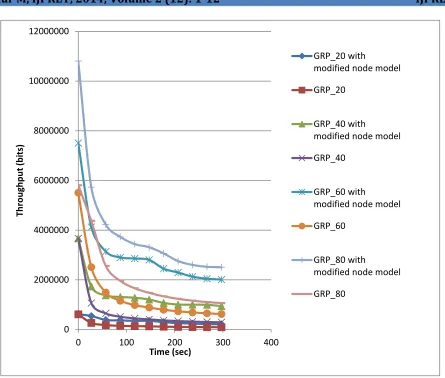
Figure 4: Throughput of GRP
The rendered graph depicts that the throughput for the network designed by using new node model using high traffic load applications to generate data in the network has increased by 13.20% and 15.63% for network of 20 and 40 nodes. The throughput of network that is designed by 60 and 80 nodes has been increased by 18.44% and 20.64% respectively.
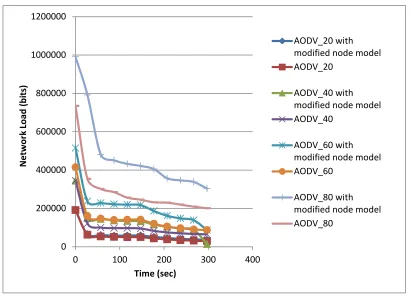
Network Load for AODV: The rendered graph 4.4 depicts the network load of AODV possessed by the network using standard node model and modified node model under different types of network sizes that varies from 20 to 80 nodes. In the graphs, it has shown that for AODV protocol, the network load for the network new node model has increased by 1.66% and 3.05% for node density 20 and 40. In the network load, all the successfully received data packets, control messages and dropped data packets are considered. If the network load of modified node model is increasing than standard node model that means the drop of data has decreased
0 2000000 4000000 6000000 8000000 10000000 12000000
0 100 200 300 400
Th
ro
u
gh
p
u
t
(b
its)
Time (sec)
GRP_20 with
modified node model
GRP_20
GRP_40 with
modified node model
GRP_40
GRP_60 with
modified node model
GRP_60
GRP_80 with
modified node model
Available Online at www.ijpret.com 33 and flow of control messages has also decreased due to the stability of the routes between the nodes. The increment in network load is 4.34% and 5.62% for the network of 60 and 80 nodes.
Figure 5: Network Load of AODV
Network Load for OLSR: As shown in figure 6, the network load for OLSR protocol has increased for all the networks using standard node model under different types of network sizes that varies from 20 to 80 nodes.
0 200000 400000 600000 800000 1000000 1200000
0 100 200 300 400
N
e
tw
o
rk
Load
(
b
its)
Time (sec)
AODV_20 with modified node model AODV_20
AODV_40 with modified node model AODV_40
AODV_60 with modified node model AODV_60
Available Online at www.ijpret.com 34
Figure 6: Network Load of OLSR
In the case of the new node model based networks, the network load has increased by 2.06% and 3.35% for 20 and 40 node networks. Due to less data drop and less network overhead, the network load has been increased for all networks. The network that is designed by 60 and 80 nodes, network load has increased by 4.72% and 6.99% respectively.
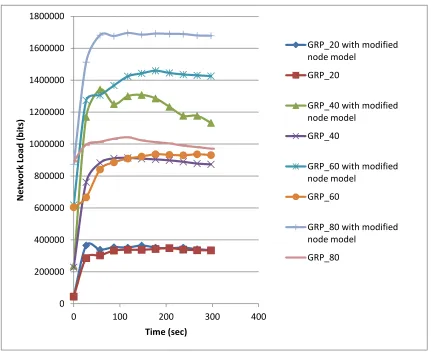
Network Load for GRP: Figure 7 shows the network load of GRP possessed by the network that varies from 20 to 80 nodes. In the graph, the network load for the network new node model has increased by 2.76% and 5.27% for 20 and 40 nodes network.
0 2000000 4000000 6000000 8000000 10000000 12000000 14000000 16000000 18000000
0 100 200 300 400
N
e
tw
o
rk
Load
(
b
its)
Time (sec)
OLSR_20 with modified node model
OLSR_20
OLSR_40 with modified node model
OLSR_40
OLSR_60 with modified node model
OLSR_60
OLSR_80 with modified node model
Available Online at www.ijpret.com 35
Figure 7: Network Load of GRP
In the load of a network, all the successfully received data packets, control messages and dropped data packets are considered. In this, the value of network load start with peak value and start to decrease for some duration of simulation period and after that start to increase along the simulation period. The increment in network load is 6.09% and 7.57% for 60 and 80 node density networks.
C
ONCLUSION
In this work, Simulation of three MANET routing protocols AODV, OLSR and GRP under different client-server architecture and peer-to-peer architecture based applications such as Heavy HTTP
Browsing, High Load Remote Login, respectively using OPNET modeler are performed. The
performance of three MANET Routing Protocols with increasing density of nodes in ad hoc network effects on QoS (Quality of Services) of MANET has been analyzed. From the simulation results it has been concluded that on increasing the number of nodes, the performance of all
0 200000 400000 600000 800000 1000000 1200000 1400000 1600000 1800000
0 100 200 300 400
N
e
tw
o
rk
Load
(
b
its)
Time (sec)
GRP_20 with modified node model
GRP_20
GRP_40 with modified node model
GRP_40
GRP_60 with modified node model
GRP_60
GRP_80 with modified node model
Available Online at www.ijpret.com 36 protocols has improved by using new modified node model that causes less routing overhead and less packet dropped but it varies from protocol to protocol. As the number of nodes increased, the network load also increased for all three routing protocols. Finally, simulation results confirm that AODV protocol giving better performance under the given circumstances, providing better QoS by providing good throughput, less delay and less data dropped. In case of network load too it is observed that on varying the node density, performance of GRP protocol is very high. OLSR performance is average during the simulation. High network load affects the MANET routing packets. By comparing gathered results of AODV, OLSR and GRP routing protocols, it has seen that AODV perform well than OLSR and GRP in delay, network load and throughput and retransmission attempts.
REFERENCES
1. Arefin, Md. T., Khan, Md. T. I. and Toyoda, I. (2012), “Performance Analysis of Mobile Ad-hoc Network Routing Protocols”, International Conference on Informatics, Electronics & Vision, IEEE, pp. 935-939.
2. Aujla, G.S. and Kang, S.S. (2013), “Comprehensive evaluation of AODV, DSR, GRP, OLSR and TORA routing protocols with varying number of nodes and traffic applications over MANETs”, IOSR Journal of Computer Engineering, vol. 9, issue no. 3, pp. 54 -61.
3. Barkhodia, E., Singh, P. and Walia, G.K. (2012), “Simulation based Performance and Comparative Study of Different Reactive and Proactive Routing Protocols in MANET”, International Journal of Electronics & Communication Technology (IJECT), vol. 3, issue no. 1, pp. 158-161.
4. Deepa S. and Nawaz, Dr. D.M.K. (2010), “A Study on the Behavior of MANET Routing Protocols with Varying Densities and Dynamic Mobility Patterns”, IJCA Special Issue on “Mobile Ad-hoc Networks” MANETs, pp. 124-128.
5. Feng, Q., Cai, Z., Yang, J. and Hu, X. (2009), “A Performance Comparison of the Ad Hoc Network Protocols”, Second International Workshop on Computer Science and Engineering, Xi’an Jiaotong University P.R. China, IEEE, pp. 293-297.
6. Gill, A. and Diwaker, C. (2012), “Comparative Analysis of Routing in MANET”, International Journal of Advanced Research in Computer Science and Software Engineering, vol. 2, issue no. 7, pp. 309-314.
Available Online at www.ijpret.com 37 8. Jasani, H. (2011), “Quality of Service Evaluations of On Demand Mobile Ad-Hoc Routing Protocols”, Fifth International Conference on Next Generation Mobile Applications and Services, IEEE 2011, pp. 123-128.
9. Keshtgary, M. and Babaiyan, V. (2012), “Performance Evaluation of Reactive, Proactive and Hybrid Routing Protocols in MANET”, vol. 4, issue no. 2, pp. 248-254.
10. Makkar, A., Bhushan, B., Shelja and Taneja, S. (2011), “Behavioral study of MANET Routing Protocols”, International Journal of Innovation, Management and Technology, Singapore, vol. 2, issue no. 3, pp. 210-216.
11. Royer, E.M. and Chai-Keong Toh, S.B. (1999), “A review of current routing protocols for ad-hoc mobile wireless networks”, IEEE personal Communications, vol. 6, issue no. 2, pp. 46-55.
12. Singh, G. and Singh, A.P.J. (2012), “MANET: issues and behavior analysis of routing protocols”, International Journal of Advanced Research in Computer Science and Software Engineering, vol. 2, issue no. 4, pp. 219-227.
13. Tonk, G and Tyagi S.S. (2012), “Performance of Ad-Hoc Network Routing Protocols in Different Network Sizes”, International Journal of Innovative Technology and Exploring Engineering (IJITEE), vol. 1, issue no. 2, pp. 227-230.
14. Vats, K., Sachdeva, M., and Saluja, Dr. K. (2012), “Simulation and performance Analysis of OLSR, GRP, DSR Routing Protocol using OPNET”, International Journal of Emerging trends in Engineering and Development, Ferozepur, Punjab, vol. 2, issue no. 2, pp. 390-404.