Available Online At www.ijpret.com
INTERNATIONAL JOURNAL OF PURE AND
APPLIED RESEARCH IN ENGINEERING AND
TECHNOLOGY
A PATH FOR HORIZING YOUR INNOVATIVE WORK
ADAPTIVE STREET LAMPS
SHWETA S. DAWLEY, VARSHA K. JEJURKAR, PURVA P. BARGE
B.Tech, Electronics and Telecommunication Department, Dr. Babasaheb Ambedkar
Technological University Lonere, District-Raigad, India
Accepted Date:
27/02/2013
Publish Date:
01/04/2013
Keywords
Street Lamps,
Switche,
Power Consumption
Corresponding Author
Ms. Shweta S. Dawley
Abstract
Available Online At www.ijpret.com INTRODUCTION
In todays fast moving world innovations and
inventions are being made on day to day
means leading to maximize technology use
in every industries and household that
ultimately leads to use of electrical energy
resulting in higher consumption of this
electrical form of energy widely across the
globe. In the same ratio production/
conversion of this form of energy is not
happening leading again to think where
energy can be saved. One situation is
mostly considered where electricity can be
saved , that is in street lighting, because in
cities or villages or towns at night all street
lamps are made on whereas very less are
used for actual usage in traffic.This project
deals with fabrications of model of adaptive
street lamps.
The specific goals and objectives of the
project are:
1. Determine the energy reduction
potential of advanced street light
technologies, LED and induction, as
compared to traditional HPS source.
2. Evaluate the light characteristics of each
technology to determine if energy
efficiency is possible without a
compromise in light performance.
3. Conduct an economic impact analysis
on each technology as compared to the
HPS
4. Identify alternate lighting technologies
that are suitable substitutions for high
pressure sodium technologies.
1.1 Background
Environmental Services Department (ESD)
has been performing energy improvements
in various existing City facilities. During
lighting fixture conversions to new
state-of-the-art florescent type lighting, it was
discovered that the broad-spectrum light,
‘white light’ enhances visual acuity. They
sought to expand the application of broad
spectrum lighting to determine what
advantages it may offer for outdoor
lighting, including street lights in the
right-of-way. To evaluate various types of broad
spectrum street light technology, they
collaborated on a project to identify and
evaluate advanced street light technology
which can benefit the public. Indonesian
engineers are also developing a green street
Available Online At www.ijpret.com
in a pool of light but switches off after
they've gone. Jakarta is one of the biggest
cities in the world. With 10 million
inhabitants, it is the most populous in south
east Asia and the 10th biggest on the
planet. Lighting such a city at night is an
expensive business. Jakarta has over
200,000 street lights, which cost the
equivalent of about $17 million dollars to
run in 2007. The city has plans to double
the number of street lights but would
obviously like to minimise costs. So
Suprijadi, Thomas Muliawan and Sparisoma
Viridi at the Institut Teknologi Bandung in
Indonesia have come up with a novel plan.
1.2 Block Diagram
Figure 1: Block Digram
1.3 Circuit Diagram
Figure2:Circuit diagram
2. CONSTRUCTION AND WORKING
The project work is divided into two parts a
mechanical mode and an electronic control
unit (ECU). The work is fabricated using
parts like MDF sheet, acrylic sheet etc
which forms mechanical part of the project.
For the electronic form various components
like PCB, microcontroller, capacitors,
resistors,power supply units like
transformer, voltage controller IC,
capacitors rectifier bridge etc are used.
The construction goes like by forming a
mechanical base. First of all MDF sheet of
Available Online At www.ijpret.com
width and side supports are kept 4 inches in
height. Thus a box of MDF sheet is made
forming a size 4 foot x 6 inches x 4 inches.
The underneath side is kept open for
connection of wiring. The top of this box is
provided with a cut window for wire
connections to ECU.
For street lamps purpose 4mm thick
acrylic sheet is used. These lamp points are
2cm thick and approx. 20cm in height.
These lamp points are attached to the side
of base box at a distance of approx. 11cm
from each other. At the top end of these
lamps points a 3.7V white focus LED facing
downwards so as to look alike street lamps.
FRC cable is attached to this LED and is
connected to ECU.
At the central point of the base box
various push to on type of switches are
attached.
There are in all 10 number of lamp points
and 6 switches in this project model.
Out of these 10 lamps only 6 are
adaptive in nature. The sequence is kept
like the street lamp number 1,4,7,10 are
kept always on because if they are kept off,
it will make the area dark leading to
unwanted activities like thefts. So it is
necessary to keep some part of that area
lighted. On the other hand street lamps 2,
3, 5, 6, 8, 9 are kept adaptive in nature.
Thus, those 6 push to on type of mechanical
switches are sensors corresponds to above
mentioned street lamp number. The
mechanical switch sensor for each lamp are
placed some distance before the actual
lamp. For example: The first switch that
corresponds the lamp 2 is actually placed in
line with the street lamp 1 and the second
switch that corresponds to the street lamp
3 is placed in line with the lamp 2 and the
number 1 switch is placed in line with the
lamp number 3 because lamp 4 is always in
ON condition. Whereas the mechanical
switch sensor number 3 is placed in line
with street lamp number 4 and it
corresponds to the street lamp number 5
and so on.
The mechanical switch sensors and the
lamp on lamp posts are connected to ECU.
The ECU senses pressure of any pedestrian
passing by with the help of weight/
pressure exerted and makes the
Available Online At www.ijpret.com
sometime sufficient enough to make the
person pass by the relative area of
illuminations. A street lamp is made only
ON when there is somebody passing by on
using the relative area covered under the
corresponding street lamp. This is the
project is constructed and its working.
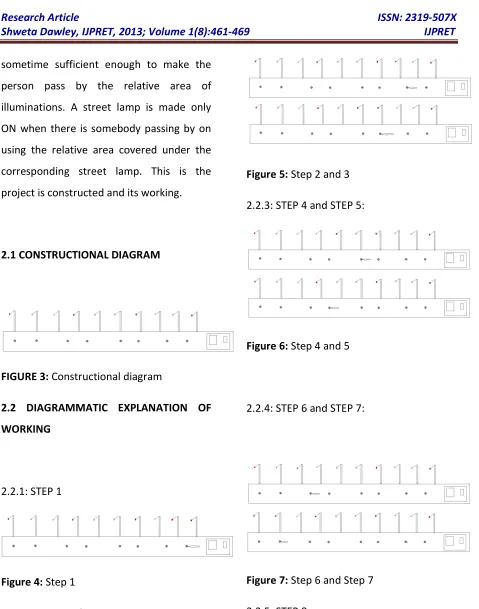
2.1 CONSTRUCTIONAL DIAGRAM
FIGURE 3: Constructional diagram
2.2 DIAGRAMMATIC EXPLANATION OF
WORKING
2.2.1: STEP 1
Figure 4: Step 1
2.2.2: STEP 2 and STEP 3:
Figure 5: Step 2 and 3
2.2.3: STEP 4 and STEP 5:
Figure 6: Step 4 and 5
2.2.4: STEP 6 and STEP 7:
Figure 7: Step 6 and Step 7
Available Online At www.ijpret.com
Figure 8: Step 8
3. TECHNOLOGY USED
3.1 LED Technology
Light-emitting diode (LED) technology is a
fast-evolving technology with significant
energy-saving potential. Operating for an
average of 10 hours per day, LEDs have a
life span of up to 13 years, and provide a
pleasant spectrum of light (Masthead LED
Lighting, 2009). The lifetime and
performance depends on quality of the LED,
system design, operating environment, and
other factors such as the lumen
depreciation factor over a period of time.
Although the upfront cost of the LED is
more than the cost of most HID lamps, the
energy consumed by the LED is half of the
lamp’s energy (or less) and LEDs last longer
than conventional lamps, resulting in
significant savings. The LED fixture does not
require a ballast or a capacitor; instead it
converts the supply voltage to low voltage
direct current, using a small electronic
power supply.
3.2 Light-Emitting Diode (LED) Street Lights
Advantages:
• Very long life
• Reduced maintenance costs due to long lifetimes
• Do not contain toxic chemicals (e.g., mercury)
• No warm up needed (no time delay to reach optimum brightness levels)
• No production of ultraviolet light (which is what attracts insects)
• Useful for directing light on specific areas, since they produce “directional”
light -- light emitted in one direction,
rather than a diffused glow
• Can be dimmed (unlike CFLs), allowing for flexibility in controlling light levels
• High color index, providing bright, true colors during nighttime hours
• No glare effect, reducing visual fatigue for both drivers and pedestrians
Disadvantages:
Available Online At www.ijpret.com • Provision of only directional light
(inability to produce a “glow”
emanating in all directions) limits
usefulness to only streetlights that are
hanging or facing downward
• Adequate heat-sinking is required to ensure long life with high-powered
LEDs.
4. PUSH SWITCH
A push switch is a momentary or
non-latching which causes a temporary change
in the state of an electrical circuit only while
the switch is physically actuated. An
automatic mechanism (ie a spring) returns
the switch to its default position
immediately afterwards, restoring the initial
circuit condition. There are two types:
4.1 PUSH TO MAKE
A push to make switch allows electricity to
flow between its two contacts when held in.
When the button is released, the circuit is
broken.
Figure 9:Push-to-make switch electronic
symbol
4.2: PUSH TO BREAK
A push to break switch does the opposite,
i.e when the button is not pressed,
electricity can flow, but when it is pressed
the circuit is broken.
Figure 10: Push-to-break switch electronic
symbol
5. ADVANTAGES AND DISADVANTAGES
5.1 Advantages:
• Saves energy upto 70% used by lighting during night hours.
• Helps in maintaining atmosphere.
• Cost cutting on electric bills.
• All lamps can be used whenever required being adaptive in nature.
5.2 Disadvantage:
• Increase cost of lighting hardware setup.
Available Online At www.ijpret.com
This project can be further modified in
reference with following points:
1. Sensors can be switched from simple
mechanical two point contact switches
to advanced infrared based beam
cutting sensors.
2. Time duration of lighting can also be
made adaptive in nature.
3. Number of lamp thus controlled can be
further increased by implementing
advanced technologies.
7. CONCLUSION
In huge city, lighting the street is a pricey
precaution. Pedestrians are no doubt safer
when street lamps not just car headlights
illuminate roadways and sidewalks but
street lamps are expensive and inefficient
to run. This is a prototype system turns the
light ON and OFF depending on traffic and
could save money while preserving safety.
The project work thus fabricated
exhibits the expected work results. The
problem statement in the beginning of the
work is successfully executed.
Keeping in mind some modifications
suggested in the future modification and
overcoming the limitations, this project
could be worked in Indian cities.
The overall future of this project seems
promising.
REFERENCES
1. Silverman, Jacob. 2009 ,(NYSERDA,
2002),Version 2.0 — June, 2010 Document
on energy efficient street efficient street
lights guidelines-unsaid india. “How LED
Streetlights Work.” HowStuffWorks.com. 01
June2010.http://science.howstuffworks.co
m/earth/greentechnology/sustainable/com
munity/led-streetlight1.htm. (accessed on
June 1, 2010)
2. Michael Mutmansky, Todd Givler, Jessica
Garcia, and Nancy Clanton. - City of San
Diego Final Report, January 4, 2010
Advanced Street Lighting Technologies
Assessment Project
3. Don McLean—DMD & Associates
Ltd-Document on adaptive roadway lighting-
4. LightSavers Symposium Oct 2008
5. Roy Hughes, P.Eng., LC. British
Available Online At www.ijpret.com
6. Energy savings street lighting-TRIDONIC
enlightening your ideas.
7. Development of street lighting
system-based novel high-brightness LED modules
IEEE Xplore