Organized by G. V. S. E. T., Jaipur. Available Online at www.ijpret.com409
INTERNATIONAL JOURNAL OF PURE AND
APPLIED RESEARCH IN ENGINEERING AND
TECHNOLOGY
A PATH FOR HORIZING YOUR INNOVATIVE WORK
POWER QUALITY ISSUES IN SOLAR PV MODELLING
HARSHITA BADMERA1, K G SHARMA2, N K GUPTA3
1.Research Scholar, Power System, Govt. Women Engineering College Ajmer, India
2.Associate Professor, Department of Electrical Engineering, Govt. Engineering College Ajmer, India 3.Assistant Professor, Department of Electrical Engineering, Govt. Engineering College Ajmer, India
Accepted Date: 19/03/2018; Published Date: 01/04/2018
Abstract:The paper presents an overview on the solar photovoltaic (PV) grid-tied and standalone systems along with the challenges involved in grid tied system and various power quality issues faced by the system have been incorporated. The global perforation of renewable source of energy has increased. The need of renewable sources of energy has increased since last two decades due to depletion of fossil fuels. Renewable source of energy is the non-conventional source of energy which is available in abundance and could be replenished and renewed. It includes solar, wind, biomass, and geo-thermal sources of energy. Solar and wind energy sources are the most prominent source of energy. Integration of solar system with grid give rise to some power quality issues such as fluctuation of frequency, harmonics, voltage variation and transients are introduced due to integration. A brief discussion on these power quality issues has been configured along with application of custom power devices to resolve the power quality issues.
Keywords: Solar Photovoltaic (PV), Grid-tied PV, Hybrid System, Power Quality (PQ),Custom power devices(CPD)
Corresponding Author: HARSHITA BADMERA
Access Online On:
www.ijpret.com
How to Cite This Article:
Harshita Badmera, IJPRET, 2018; Volume 6 (8): 409-420PAPER-QR CODE
SPECIAL ISSUE FOR
NATIONAL LEVEL CONFERENCE
Organized by G. V. S. E. T., Jaipur. Available Online at www.ijpret.com410
INTRODUCTION
In today’s era where the conventional sources of energy are getting exhausted, there is a boost in the utilization of renewable sources of energy. Due to the intermittent availability of renewable sources of energy and high penetration of these resources. In such a situation these non-conventional sources have gained popularity and increased demand of these sources has been observed due to their availability in abundance.
India is a tropical country where 300 out of 365 days are sunny. Therefore, solar energy has a better future scope especially in rural areas where there is no grid system available. In many developing countries, especially in rural areas electricity grids are often fictional or rudimentary and all forms of energy are usually very costly [1]. Here the PV modules can be highly combative with other forms of power supply.
According to the Ministry of New and Renewable energy government of India has a target of 175 GW for installed renewable energy source capacity to be achieved by 2022.A total of 62 GW renewable power is to be installed by
November 2017 [2]. India secured 4th and 6th position in global wind and solar power installed capacity.
The solar photovoltaic system could be grid connected or standalone. The tracker is used to track or collect the maximum solar rays. This will improve the efficiency of PV system. The tracker can be one axis and dual axis tracker. In Wind energy conversion system the electricity is produced by generator which in turn is driven by a turbine.
Basically power quality issues takes place due to the integration of hybrid energy system. The power system should be capable of providing a noise free and pure sinusoidal waveform which should be stable in terms of voltage and frequency this entirely comprises the power quality of system. The faulty connection and wiring also leads to power quality issues along with the type of power supply and the load at the end leads to issues such as harmonic distortion, transients, frequency fluctuation, electromagnetic interference and low power factor.
The paper presents the modeling of solar pv system in matlab Simulink and concern power quality issues with modeling are discussed in next sections.
Organized by G. V. S. E. T., Jaipur. Available Online at www.ijpret.com411
Photovoltaic solar cells are used for the direct erection of electricity from sunlight. Basically in this paper we focus on photovoltaic cells otherwise the solar collectors can also be used in place of PV modules. Solar energy is categorized as:
• Stand alone or off-grid system • Grid connected system
Maximum power point tracker (MPPT) is used in order to erect maximum sun rays which lead to generation of more electricity in an effective manner. Solar trackers are the mounting equipment’s which are responsible for capturing the maximum sun energy according to the changing position of sun during the day. The two different types of trackers are explained below:
A. Single-Axis Tracker
The single-axis tracker has one axis of movement with the North and South alignment. The tracking of sun from east to west is incorporated forming an arc of panel from sunrise to sunset. This type of tracker inhabits more reliability and cost effectiveness as compared to dual-axis system.
Fig.1. Single-Axis tracker
B. Dual-Axis Tracker
Organized by G. V. S. E. T., Jaipur. Available Online at www.ijpret.com412
summers [3]. These type of trackers incorporate high efficiency and more reliability than single axis tracker but the cost and complexity increases.
Fig.2. Dual-Axis tracker
Solar energy system can also be classified as:
Grid Tied System or On Grid or Utility Interactive System.
Off Grid or Stand Alone System
Hybrid Solar System
A. Utility Interactive System
In grid type system the solar system is connected to the grid and due to the direct grid connection no storage device such as battery is required. The energy produced is fed back to the grid.
Hence it could be said that in this type of utility interactive system the grid is acting as storage system. Net metering facility is provided which help in selling the electricity produced by solar back to the grid [4].
Organized by G. V. S. E. T., Jaipur. Available Online at www.ijpret.com413
Fig.3. Block diagram of grid tied system
B. Tand-Alone PV System
In case of stand-alone system the system is not connected with grid. The energy generated is stored with application of batteries. These types of system have found their application in the remote and rural areas where there is no utility grid system.
This is a self-sufficient system and the downtime of grid does not affect the energy production or energy consumption [5]. This system involves the application of battery bank and due to this the cost of the system increases.
Fig.4. Stand-Alone System
C. Hybrid Solar System
The best of utility interactive and the stand-alone system is integrated in hybrid system. It is an off grid system with option of grid utility. Due to the availability of grid the capacity of battery bank could be reduced which will reduce the bulkiness and complexity of the stand-alone system [6]. The system incorporates the switching upon grid tied or stand-stand-alone system completely on consumer.
Organized by G. V. S. E. T., Jaipur. Available Online at www.ijpret.com414
III. Power Quality Issues
Power quality involves voltage, frequency and waveform. Power quality can be considered as the affinity of the system between the output of the electrical outlet and the plugged load. Basically the quality of exchanged power at the point of connection describes the quality of power [7]. The power quality problems cannot be resolved completely from the system but could be controlled unto certain level by using the custom power devices such as DSTATCOM, DVR and UPQC [8].
Power quality issue is a global challenge faced during the integration of solar system with grid. Some of the issues are explicated below:
A. Voltage Sag
Voltage sag leads to dip or scaling down of voltage. It refers to the reduction in voltage magnitude which in turn is followed by voltage recovery after short time span. This in turn is caused due to increment in load abruptly or increase of load impedance [9]. The problem can be resolved if a series compensator which is capable of restoring load side voltage.
B. Voltage Swell
Voltage swell leads to abrupt curtailment or decrement of load on a circuit due to the application of poor voltage regulators. Another reason for such type of voltage disturbance is loose or damaged neutral connection.
C. Harmonic Distortion
Harmonic distortion which are often called as the critical power distortion is defined as the voltage or current having frequencies as integral multiple of fundamental frequency. Harmonic distortion occurs due to the improper application of filters. Total Harmonic Distortion is a common issue that is caused due to the integration of solar PV system with grid and can be defined as number of equally weighted harmonics [10]. Due to low radiation of solar power system there is an increment in total harmonic distortion.
D.Flicker
Flicker is defined as instinctive impression due to visual perception which in turn occurs due to variation of voltage and volatile luminance. Flicker can also be categorized based on the duration of their occurrence as short term and long term flicker.
E. Transients
Organized by G. V. S. E. T., Jaipur. Available Online at www.ijpret.com415
F. Frequency Fluctuation
Frequency fluctuation is another important issue of power quality which arises due to the imbalanced produced power and consumed power [11]. The entire solar system is affected due to this issue of power quality.
G.Low Power Factor
Power factor is defined as the ratio of real power to apparent power. Mainly grid connected system incorporates the issue of low power factor. To resolve the factor inverters are used in PV system to provide unity power factor [12].
The above power quality issues could be mitigated with the help of custom power devices. Custom power device incorporates the use of electronic devices in the distribution system of electric power [13]. Mostly voltage source inverters are used for the custom power controller devices. The various custom power devices are namely:
• Distribution Static Compensator (D-STATCOM) • Static series compensator or Dynamic Voltage
Restorer (DVR)
• Unified power quality compensator (UPQC) • Static transfer switch (STS)
• Static current limiter / Static Circuit Breaker (SCL)
The above described devices provide the flicker regulation, harmonic compensation, voltage stability, load current balancing, fault current limitation and other power quality issues.
IV. Modelling of solar PV System
Organized by G. V. S. E. T., Jaipur. Available Online at www.ijpret.com416
Fig.5. Matlab Model of PV Panel
Fig.6. Modelling of current
Solar irradiation and Temperature are main factors which affects the performance of solar module. If solar Irradiation: If the solar irradiation is higher then solar input to the solar cell will also be higher and hence power magnitude will increase for same value of voltage. Temperature also affects the performance of solar cells. Increment in temperature reduces solar power generation.
Organized by G. V. S. E. T., Jaipur. Available Online at www.ijpret.com417
Results and Discussion
In this section, results of PV panel with and without MPPT have been discussed.
Fig.8. Output of Power
Fig. 8 shows the output power at constant irradiance with and without MPPT modeling. From the figure, it can be observed that the power output in the case of MPPT is maximum.
Similarly, Fig. 9 shows the output power at step irradiation without and with MPPT. Fig. 9 too shows that power using MPPT is more that without using MPPT at (600w/m2, 800w/m2, 1000w/m2, 500w/m2, 300w/m2).
Fig.9. Output of Power in step Irradiace
Organized by G. V. S. E. T., Jaipur. Available Online at www.ijpret.com418
Fig. 11. Voltage Power Current with MPPT at Cons. Irrdiance
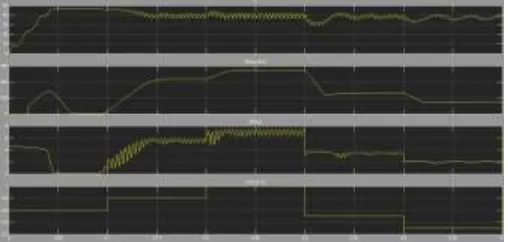
Fig. 19 and Fig. 20 show the graphs of output power, current and voltage without MPPT and with MPPT modeling respectively.
Similarly, Fig. 12 and Fig. 13 show graphs of output power, current and voltage without MPPT and with MPPT modeling respectively.
Fig.12.Voltage Power Current without MPPT Step Irradiance
Organized by G. V. S. E. T., Jaipur. Available Online at www.ijpret.com419
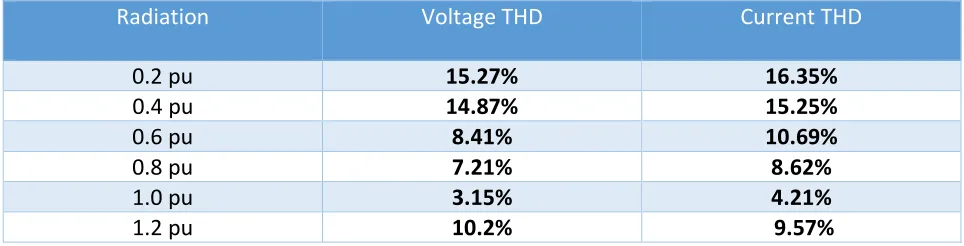
Further power quality is considered in voltage and current waveforms and with help of Fourier transform THD is being calculated. The total THD at different radiations are calculated as follows:
Table 1: THD at different radiation levels
Radiation Voltage THD Current THD
0.2 pu 15.27% 16.35%
0.4 pu 14.87% 15.25%
0.6 pu 8.41% 10.69%
0.8 pu 7.21% 8.62%
1.0 pu 3.15% 4.21%
1.2 pu 10.2% 9.57%
CONCLUSION
This paper provides a brief review on solar power system and the basic challenges or issues faced by the system. Further PV system is modeled in Matlab Simulink and results with power quality issues are discussed. These problems could be resolved by using the custom power devices and the controllers with the optimization techniques could also be used to mitigate the power quality problems. These devices would able to provide a protection to entire system.
REFERENCE:
1. Koen J. P., Macken, Math H. J. Bollen and Ronnie J. M. Belmans, “Mitigation of voltage dips through distributed generation systems” IEEE Transactions on industrial aplications, Vol. 40, NO.6, November/December 2004.
2. Varun Kumar, A. S. Pandey and S. k. Sinha,” Grid Integration and Power Quality Issues of Wind and Solar Energy System: A review” (ICETEESES-16).
3. Kelly Pickerel https://www.solarpowerworldonline.com/2017/09/dual- axis-solar-tracker/
4. Alpesh P. Parekh, Bhavarty N. Vaidya and Chirag T. Patel”Modelling and Simulation Based Approach of Photovoltaic System” in Global Research Analysis Volume 2 Issue 4 April 2013(ISSN No 2277-8160).
Organized by G. V. S. E. T., Jaipur. Available Online at www.ijpret.com420
6. Er. Pankaj Bodhwani, Poonam Rohira “ Hybrid Solar-Wind Power Generation System, Designing and Specifications”, Vol.8 Issue 01, January-June 2016.
7. S. Yasmeena and G. Tulasiram Das “A Review of Technical Issues for Grid Connected Renewable Energy Sources” Vol.4. No.5-1 2015 pp 22-32.
8. Bahadur Singh Pali and Shelly Vadhera “Renewable Energy Systems for Generating Electric Power: A Review” 1st IEEE International Conference On Power Electronics Intelligent Control and Energy Systems (ICPEICES-2016).
9. Tareque Ali Habeebuddin1 and Prof. M.S. Potdar “A review Impact of Solar Panel and Power Quality of Distribution Network And Transformers” Vol 4 Issue: 3 March 2017.