T
HE
R
ADIOACTIVE
W
ASTE
D
ISPOSAL
:
T
HE
C
ONTRIBUTION
OF
E
CONOMIC
A
NALYSIS
J
EAN
-A
LAIN
H
ERAUD
&
O
ANA
I
ONESCU
ABSTRACT
This article addresses the following question: How to deal with uncertainty, emergence of new information and irreversibility in the decision process of the long-term disposal of radioactive waste? Intuitively, one might think that measures taken today are more relevant when they are flexible. We show that the theoretical economic insights supplement this intuition and more precisely we emphasize the real options theory as one means of valuing flexible strategies in the disposal of highly radioactive waste. Moreover, we argue that the optional approach must involve a more complex utilization in the recently developed French project of reversible repository given the presence of multiple disposal stages.
Keywords:
Radioactive waste, Real options, Reversibility
JEL Classification: D81, Q40, Q50
Author Information:
Corresponding Author: Oana IONESCU, BETA/ Nancy University Tel: 0033622879296 Email: , [email protected]
50 Grand Rue, Ap. 32 Strasbourg 67000 FRANCE
INTRODUCTION
One of the most important environmental problems for our Society is the disposal of the radioactive waste. Indeed, taking important decisions in this domain requires the consideration of major uncertainties relative to potential impacts on the environment, long time horizons and fundamental ethical principles reflecting the expectations of Society.
In recent years, in order to protect humans and the environment, governments are increasingly concerned with the challenging tasks of building safe disposals of the radioactive waste. This typically represents a long-term management problem for policy makers.
The research on waste disposal reveals that for some types of radioactive waste like HLW (High Level Waste) or ILW (Intermediate Level Waste), the disposal in geological layers is the best option likely to be accessible in the near future. A significant characteristic of geological disposal, as opposed to interim storage or surface storage, is that it implies a passive system of maintenance and control regarding the future generations.
This option is under examination in most countries having important amounts of radioactive waste. France is one of the countries which have taken formal governmental decisions to go ahead with facilities for the disposal of highly radioactive waste. The Planning Act dated June 28th, 2006 prescribes the deep geological disposal as a reference solution in order to protect humans and the environment. In addition, the repository must be reversible for a minimal period of 100 years. These main features of the radioactive waste repository are being developed in the framework of a national program conducted by ANDRA, the governmental agency in charge with the study of technical solutions for the underground disposal facilities.
The introduction of the reversibility is considered in order to take advantage of progress in science and technology or to adapt to changing political climate or positions in Society. As stated in Aparicio et al. (2010) and Dumont and Hoorelbeke (2011) the reversibility concerns the possibility of a stepwise management of the disposal process and is closely linked to the ability to retrieve the waste packages after they have been placed in the repository. More precisely, as described in Figure 1, the reversibility implies that at each step of decision, different options are available: retrieve the radioactive waste if new information justify it, reevaluate the disposal process, modify the system parameters or continue on the same path.
Th by th packa Th retrie depen lifecy Li Potent he retrievabil he possibility
ages if appro herefore, the eval operatio
nds on the ycle stages, w
ifecycle stag passive s
tial outcome
lity of the rad to recover p priate techni e French p on. Because effort neede with differe
ges of the w safety and a
Figu es of option
Source: N
dioactive wa potentially u iques are avai
roject impli the ability t ed for the r ent degrees Figu waste, illustra active contro Source: N ure 1: ns assessmen NEA (2011)
aste may be m seful radioac ilable in the f ies also som to access th retrieval, the
of retrievab
ure 2: ating chang ols in a deep NEA (2011). nt including motivated by ctive material future. me flexibility e radioactive repository bility, as sta
ging degree p geological
.
g reversal,
y safety reaso ls from the w
y concerning e waste pac
involves mu ated in Figu
These stages are classified from the most reversible (easy to retrieve) to the less reversible one (difficult to retrieve). The first stage is the surface storage, where the degree of retrievability of waste packages is maximal. The other stages concern the deep geological disposal at several hundreds of meters, each of them implying different elements of monitoring or various changes in the structure if the retrieval is intended. The last stage is the one with the minimal degree of retrievability, while the ultimate waste can be recovered only by mining or excavation works. Obviously, the more difficult is the retrieval, the higher is the cost. Also, the active control associated to the interim storage involves higher maintenance and operational costs, while after the disposal in deep geological layers there is mainly a passive control.
Motivated by these special characteristics of the radioactive waste project developed in France, the aim of our paper is to assess the value of the reversible radioactive waste repository with different disposal stages and for doing this we offer some economic theoretical insights to analyze the relationship between reversibility and the significant costs characterizing the project. More exactly our objective is to show how the real options theory may be mobilized for analyzing the issue.
We organize the paper into two sections in addition to this introduction. The second section describes special features of the radioactive waste disposal from an economic point of view and highlights the concept of real options. The third section presents some theoretical ideas concerning possible applications of the real options theory to the radioactive waste project with multiple disposal stages and some extensions for different aspects treated in the paper.
1. WHY IS THE OPTION VALUE IMPORTANT TO THE RADIOACTIVE WASTE
DISPOSAL?
In this section we consider that answering the question whether real options could be useful in the valuation of the project of radioactive waste disposal, should start by a systematization of some important characteristics of the project. Then we are able to explain the link between the option value and the management of radioactive waste.
1.1 In what the radioactive waste disposal is a special issue for the Economist?
Given that the project of radioactive waste disposal involves large-scale needs, different engineering constraints or exogenous events and a long-run decision-making planning, three important features arise in the decision process: the uncertainty, the irreversibility of costs and the flexibility in the implementation.
contents. To these sources of uncertainty we can add the changing political and social context.
Hence, the decision maker facing uncertainty must learn to manage it and to adapt to it. Especially when additional information may arrive in the future, it is better to approach the problem in sequential framework, preserving as long as possible the opportunity to reverse choices if new information warrants. Thus, as a response to uncertainties mentioned above, flexibility needs to be introduced into the project to enable the decision maker to take advantage of opportunities that may develop during the lifetime of the project. For instance, in the French project there is some flexibility associated to the implementation process: on the time-schedule of the project, on the choice of technologies of disposal and on the degree of reversibility of the repository.
Secondly, investing in the radioactive waste repository is very costly. Indeed, it requires heavy financial resources and a specific capital. For example, the construction of the infrastructure takes several years and the whole project costs billions of euros. To this amount, we must add the maintenance costs of waste management, which might spread over several hundreds of years. As a consequence, the radioactive waste disposal implies a strong degree of financial irreversibility.
Above all, the temporal dimension is important and must be taken into account in the decision process. Variations of economic or technical conditions during the lifetime of the project (which is particularly high given the period of reversibility of minimum one hundred years) may mandate a new optimization in the operation of disposal, according to these future developments. Therefore, the question of storing radioactive waste raises a current economic debate on the optimal discount rate in an intergenerational context. The decision may involve significant changes in lives of persons concerned, which indirectly affects the preference of time itself. More precisely, the long-term reversible disposal will provide future generations with the benefit of the option to make additional choices based on improved knowledge and technology, but these benefits may come from higher expenses on design and construction for the current generation, who will build the repository.
observed risk-free market rates and conclude that effective discount rate should decline in the future, in agreement with Weitzman (1999) and Gollier (2007, 2009).
If we adopt the last point of view in the case of reversible disposal of radioactive waste, different scenarios may be applied for the minimal period of reversibility of one hundred years: for a period of time inferior at 30 years the decision-maker may apply a higher discount rate, but for periods exceeding 30 years the discount rate must be very low (1%, 2%), as stated by Gollier (2007).
Following this questioning on the measure of the correct discount rate in a very distant future, many economists tried to tackle the problem of investment under uncertainty by creating different economical models which made history to this day. They tried to investigate how to represent aspects like arrival of new information, irreversibility and flexibility, how to integrate them in a long-term decision dilemma. Somehow they succeeded when they developed the benefit-cost analysis, which became over the time, one of the most applied theories on investment decision. This theory shows that the net present value (NPV) for an allocation is obtained after summing up the difference between benefits and costs, previously accounted for our time preferences:
t t t n
t r
C B
) 1 ( 0
NPV
+ − =
=
∑
(1)
where
B
t etC
t are the benefits and the costs at the datet
andr
is the discount rate.An investment project is undertaken if it has a positive net present value. The rate we consign to the reduction of future costs and benefits represents the discount rate. Nevertheless, this formula could be applied if very important conditions are satisfied: the distribution of cash-flows and costs must be identified at the beginning of the project and the discount rate must be constant during the whole existence of the project. These conditions imply that the use of the cost - benefits method may undervalue investments under uncertainty.
So, in the specific project of disposal of the radioactive waste this technique may fail to correctly analyze some aspects that can affect the decision process: the need to take into account a relative high period of time and an optimal level of the discount rate, the need to be certain that the evaluation includes different types of uncertainties. Consequently, as a response to these difficulties to evaluate a project involving uncertainty, irreversibility and flexibility, the real options theory has been developed and we examine its main contributions in the next subsection.
1.2 What are real options?
decision, not addressed by the traditional method of discounted cash-flows, presented above.
The concept of option value was firstly developed in the work of Arrow and Fisher (1974), Henry (1974) and Myers (1977). The latter formalizes the concept under the name of real option. In their research, these economists show that the information available in the future is not valuable for an irreversible decision, but it is for a reversible decision. In this way the value of additional information is an important argument in favor of a reversible decision. In fact, the value of new information can be zero or positive, depending on the degree of reversibility of the decision. The difference between the value of information for a reversible decision and an irreversible one is an option value. The objective of research in these pioneering works is to show that traditional cost-benefit analysis ignores the fact that information on the consequences of the investment can be revealed in the future, the analysis being then inexact. Actually, the option value underlines this result: if we do not take into account the arrival of information during the life cycle of a project, then the analysis is biased. From an economic point of view, this statement is essential. In reality we must have indicators that can estimate the error induced when ignoring the arrival of additional information. In this sense the option value is a measure of the flexibility cost, since the choice of flexibility is never free for a firm. The price paid to benefit from this option value is the opportunity cost of non-flexibility.
The intuition underlying the real options concept is straightforward: there may be a value associated with the option to postpone a decision until some of the uncertainty about the variables which influence it, is resolved. Depending on whether the circumstances are favorable or not, the decision-maker has the right, but not the obligation to realize an action or to take a decision. These circumstances are determined by the existence of three key conditions which interact and influence the option value: the irreversibility of costs, the uncertainty of the main variables affecting the decision and the flexibility in the implementation of the project. In order to assess the value of a project involving these characteristics, an expanded net present value (
NPV
) can be calculated. It includes the net present value determined from the traditional benefits-costs method(
NPV
)
and an option value:value Option NPV
NPV
Extended = + (2)
In the economic literature several key articles mark the application of this new formula and thus the evolution of this theory, as well as its applications.
McDonald and Siegel (1986) consider that a risky project can incorporate characteristics to enable better determination of its true value. In their work, the authors analyze the asymmetry between the decision to invest and the decision to wait, the first being irreversible, while the second is not. They discover a decision rule that incorporates the cost of opportunity that we may lose because of the possibility to wait when a project is developed.
decision to change the status of the project. Brennan and Schwartz show that precisely this option value of changing between the various states should be included in the analysis. For example, they demonstrate that a project should remain open until the point where the income plus the value of the option to reopen will equal the value of variable costs. On the contrary, a project is expected to remain closed until the point where revenue equals the variable costs plus the option of closing.
The 1990s brought a huge number of applications of the theoretical real options framework. Pindyck (1993) recognizes the importance of the decision to defer investment in time for two reasons. First, the irreversibility of certain investment may encourage waiting in order to see if these investments are actually profitable in the long term. Secondly, the delay of a project gives the company the opportunity to wait for new information on costs, prices and market conditions before committing. Kulatilaka (1993) takes the example of a steam power plant which can use two types of energy: oil and gas. This type of plant can be considered as a series of exchange options since it has the alternative to choose at each period the cheapest source of energy. Obviously, a power plant running only at fuel or only with gas would be cheaper to build. The question is: the flexibility offered by the plant with two types of energy justifies the extra investment compared to a mono-energy plant? To find out, the author compare the additional cost to the value of flexibility, which is calculated as the difference between the value of the bi-energy plant (estimated with real options) and the value of the mono-energy plant (estimated with NPV).
Dixit and Pindyck (1994) lay out a very good foundation for the analysis in the real options field. They provide a substantial level of analysis in the study of irreversibility with dynamic programming and contingent claims techniques developed over the years. Their rigorous study is illustrated with examples of the relations among irreversibility, uncertainty, timing and investment decisions.
Grenadier and Weiss (1997) use the real options approach in a model which considers a company facing a sequence of opportunities for investment in technological innovations. The company anticipates the arrival of a new technology which is more efficient. The existing technology was originally called the current technology. Upon arrival of a new technology called “future technology”, the company decides to switch or not to this new technology. The decision of the company to adopt the new technology depends on its previous decision on the technology. This leads to a path dependency in the process of decision.
Childs, Ott and Triantis (1998) propose a model for the evaluation of real options by taking into account the effect of the interdependence between different projects on investment decisions. Theses relations between the various projects may appear in different forms. Projects may be mutually exclusive in the sense that they can achieve the same aim. In this case, the decision would be to retain a single project. This characterizes companies which are facing to choose between different technologies, more products or manufacturing processes, and so on. A typical case of mutually exclusive projects is the decision to replacement.
2. HOW TO ASSESS THE VALUE OF THE REVERSIBLE RADIOACTIVE WASTE REPOSITORY
Recent literature shows that real option theory can be applied to take into account uncertain time processes, flexibility and irreversibility in the radioactive waste disposal decisions. More particularly, Gollier and Devezeaux de Lavergne (2001) and Loubergé, Chesney and Villeneuve (2001) pick up these ideas in different ways and show that introducing real option theory can generate new insights in the management of the radioactive waste.
The first paper highlights the idea that the value of reversibility in the case of radioactive waste repository is a real option that can be exercised by a future generation, if she wishes to do it. Given a stochastic evolution of the value of raw materials contained in radioactive waste, the authors analyze the costs and the benefits of the reversibility. They show that with representative values of raw materials contained in waste, and given the realistically possible evolution of this value in the future, the value of benefits from the reversibility is small. More specifically, the authors find that it is socially optimal to implement the reversible disposal when the value of radioactive elements contained in the waste reaches a certain threshold.
Loubergé et al. (2001) investigate the optimal timing to switch the radioactive waste from interim storage to deep geological disposal using also the real options theory. Their approach is based on the minimization of different costs of the project. The optimal decision to choose the immediate deep disposal of radioactive waste or not is obtained by maximizing the expected value of the discounted difference between two stochastic variables: the interim storage cost and the cost of deep disposal.
We consider here the necessity to go beyond these papers in order to deal with the actual reversible disposal issue. In the following part, three points will successively be developed: firstly, the recently developed French framework of radioactive waste repository which introduces multiple stages of retrievability, secondly, different types of uncertainties that must be taken into account in the decision process and thirdly, the necessity to introduce a more complex formulation of the real option to switch.
2.1 The French scheme of the reversible repository for radioactive waste
As we just noted in the previous section, the opportunity to reconsider a decision creates an option. For example, if the decision maker closes definitively the repository of radioactive waste, he gives up the opportunity to open it later and recover the radioactive materials contained in the ultimate waste if new techniques of treatment and recycling are available. This means abandoning an option and the opportunity cost must be taken into account in decision making. The flexibility in the implementation project is appealing and it must be measured by some concept of option value linked to the retrievability potential.
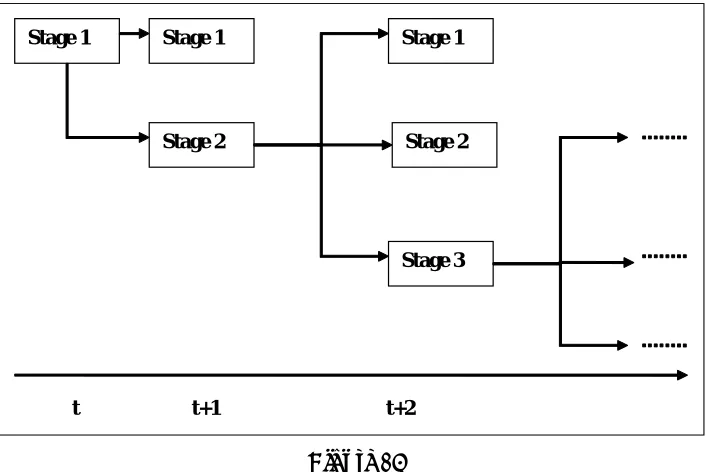
The main originality of the French project is the existence of multiple disposal stages with different degrees of retrievability for the radioactive waste. This means that at each decision point, the governmental agency has to consider three options: to remain on the same stage of retrievability, to switch back to a stage where the waste packages are easier to retrieve or to switch to a stage implying more difficult retrieval operations.
In the following figure we can clearly observe the particular framework of the French radioactive waste repository.
Figure 3:
Stages of retrievability for the radioactive waste repository
The French radioactive waste repository involves the implementation of an underground storage facility, named CIGEO (Industrial Geological Storage Center)1. A scale of retrievability with different lifecycle stages for the waste has been developed. These stages, providing the same degree of safety, are classified according to the degree of flexibility regarding the effort of retrieval, from the most
1Currently, the researchers and the engineers from ANDRA are studying the complex issue of
reversibility of the repository and the conclusions from the scientific reports will be submitted to the government so that deep geological disposal should be authorized by a new Law in 2016. This law will further set out a legal definition of the reversibility and the conditions for its implementation.
Stage 1
Stage 2
Stage 1
Stage 3 Stage 1
Stage 2
reversible to the most difficult to reverse. Stage 1 represents the disposal of waste packages in interim storage. During the second stage, the waste packages are moved from interim storage to the geological repository facility. Additional protective barriers around the waste emplacement cell are put in place in further stages (e.g. Stage 3) until the final disposal state. Returning back means that the waste packages are recovered after various changes of structure.
2.2 Various types of uncertainties
The value of these available options is determined by different uncertainties involved in the implementation process of waste disposal. Since the project is to provide the reversibility of the repository for at least 100 years, uncertainties will be of a very high magnitude. Although the geological conditions may not change during this period, the economic, technical and political or social factors may involve significant changes.
We should consider here an aggregated indicator of the retrieval value of the radioactive waste at each date
t
. This indicator, denoted withW
t is a function of three variables, all affected by significant uncertainty:W
t=
f
(
P
t,
M
t,
Q
t)
. For instance,P
t represents the market value of radioactive materials contained in the radioactive waste, which is determined by changes in general economic parameters or in the nuclear industry.M
t represents the state of the art in relevant technologies (the technological progress may be different when considering a radical or incremental innovation in the nuclear waste field). The last term,Q
t describes the social and political factors that may also influence the value of the project, like public perception of nuclear risk, changing political climate, citizens trust in technological expertise, etc.2.3 Switching among multiple stages of retrievability
This subsection is concerned with an investigation of how the real options approach can be useful for the managerial decision in the French case of radioactive waste repository, which turns out to be quite a special project. We argue here that this work may inspire future investigations in this interesting but highly unexplored area of application for real options. Our particular purpose is not to construct a full calculation model, but to show the usefulness of real options model to waste handling decision process.
In order to simplify the exposition of the problem from the Figure 2, let's define
s
as the retrievability stage amongN
possible technological options, ranked from the more reversibles
=
1
to the less reversible ones
=
N
,
withs
taking entire values. For instance, for the three first periods, with this notation, the possible stages are the following:⎪ ⎩ ⎪ ⎨ ⎧
+ − =
− − −
1 1
1 1 1
t t t t
s s s
s
In Figure revers
Ex
We m stick to p proceed t to make t Returning the barrie The m for a cer and cons
s
s
t=
t−down on
+
=
C
C
the cost a Given as follow value of presented to consid paramete where
e 4 we pres ible radioacti
xample of sw
mean by this preceding tec to a less reve
the waste pa g to the prec ers, etc. maintenance
rtain stage of stant in time
,
1
− there is n
n the retrieva
−
C
or
. Forassociated to n these assum s. At each da the radioac d in equation der in fact rs, as follows
(
= f W
Os
t
t
s
O
is thesent these t ive waste rep
witching opt
formulation chnological o ersible one - ackages more
eding stage i
costs associa f retrievabilit e. Also, if th no switching ability scale (
r instance,
C
the dismantl mptions, the d
ate t, upon ob ctive waste n (3). Then, a
three option s:
, , ,C C+
Wt s
e available op
three possibi pository:
Figure tions among
that the gov option, to re for instance, e compact, m involves de-c
ated with the ty,
C
s,
are here is no ch cost (C
=
0
(
s
t=
s
t−1±
+C
is the cos ling part of e decision pro bservingW
tproject by c applying the n values, ea
)
−
C
ption for the
ilities which
4:
g multiple s
vernmental a eturn to a m , going to a l more isolated compacting a
e monitoring considered hange in the
0
). On the c)
1
±
impliesst of adding existent ones blem of the , the agency choosing be
equation (2) ach of them
stage
s
at th may corres
stages of retr
agency needs more reversib
less reversibl d by concrete and successiv
g of the radi as determin initial adop contrary, swi different sw new barriers .
agency can b y attempts to
etween the t ) to our form m depending
(4)
the date
t
.spond to th
rievability
to choose t ble one, or t e stage mean e barriers, etc vely reopenin
ioactive wast nistically give pted stage, i.e
tching up an witching cost
s and
C
− iThe agency will make the choice between realizing or not the option, bearing in mind not only the consequences of future evolutions of the retrieval value of radioactive waste,
W
t,
but also the value of different costs implied by the project, related to monitoring and switching operations.It is important to mention that when including multiple disposal stages, the switching option might not be seen as independent. Because the repository involves multiple disposal stages which, for technical reasons are sequentially ordered, the project can be thought of as a compound option, in which the realization of the option to store the radioactive waste on a certain disposal stage gives the option to go further to others stages until the final state of the repository or to go back to previous stages in order to retrieve the waste. Consequently, each stage can be viewed as an option on the value of the subsequent stage and will be a function of previous realized and remaining options:
) ,
( −1−1 −1+1
=
t t
t s s
s f O O
O
(5)
More specifically, the value of the option to store the radioactive waste on the first disposal stage will be determined by the outcome from the realization of this option and the potential extension towards subsequent stages. For example, realizing an earlier real option (such as closing the galleries of access) can change the value of future options for the retrieval of waste packages.
These interactions between various options involved in the reversible disposal of radioactive waste may be important in the valuation of the project. This explains why they need to be valued together because their combined value may differ from their separate values.
CONCLUDING REMARKS
Our paper introduced in a simplified way a conceptual real options based framework to support the complex decision problem of reversible disposal of the radioactive waste in France.
In the introduction, we made a review of conceptual tools available to the economist to address this issue. We started from the observation that the real options theory is clearly relevant because the reversible disposal of radioactive waste typically involves several important features: uncertainty, flexibility and irreversibility. In this sense our aim was not to make an additional contribution to the already impressive literature on the real options theory, but rather to show how the concept of option value can be used by the decision maker in the recently developed framework of radioactive waste disposal in France.
This first attempt to stress the sequential nature of decision process and the importance of subsequent options on the initial decision should be of interest to the decision-makers in charge of the nuclear waste management. In this paper we just aimed to explore qualitative results and general principles rather than quantitative outcomes. Of course, we need now to implement a precise model involving technological, economic and social parameters. This paper made the theoretical global setting and stressed the necessity to complexify the traditional option value model.
Our insights can mainly be validated by letting people with relevant competences evaluate our argumentation. In order to completely formalize our considerations, the economic and engineering analysis must work together.
ACKNOWLEDGEMENTS
We are particularly grateful to Sandrine Spaeter for very constructive comments on earlier versions of this work. We also thank Luis Aparicio and engineers from ANDRA (The National Radioactive Waste Management Agency) for helpful discussions. ANDRA is acknowledged for providing financial support.
REFERENCES
Amram, M. and N. Kulatilaka (1999), “Real Options: Managing Strategic Investment in an Uncertain World”, Harvard Business School Press.
Aparicio, L. (ed.) (2010), “Making Nuclear Waste Governable. Deep underground disposal and the challenge of reversibility”, Springer/Andra.
Arrow, K.J. and A.C. Fisher (1974), “Environmental preservation, uncertainty and irreversibility”, Quarterly Journal of Economics, 88:312-319.
Brennan, M.J. and E.S. Schwartz (1985), "Evaluating Natural Resource Investment", Journal of Business, 58:2:135-157.
Broome, J. (1994), “Discounting and Welfare”, Philosophy and Public Affairs, 2:128-156.
Chapman, C.B. and S.C. Ward (2002), “Managing project risk and uncertainty: A constructively simple approach to decision making”, Chichester, UK: John Wiley & Sons.
Childs, P.D., S.H. Ott, and A.J. Triantis (1998), “Capital Budgeting for Interrelated Projects: A Real Options Approach”, Journal of Financial and Quantitative Analysis, 33:305-334.
Cohendet, P. and P. Llerena (1989), “Flexibilité, risque et incertitude dans la théorie de la firme: Un survey”, in Cohendet, Llerena (éds.), Flexibilité, information et décision, Economica, Paris.
Cowen, T. (1990), “Distribution in Fixed and Variable Number Problems”, Social Choice and Welfare,7:47-56.
Cowen, T. and D. Parfit (1992), “Against the Social Discount Rate”, in Laslett and Fishkin (éds.), Philosophy, Politics, and Society, 144-161.
Dixit, A.K. and R.S. Pindyck (1994), “Investment under Uncertainty”, Princeton University Press, Princeton, NJ.
Dumont, J.N. and J. M. Hoorelbeke (2011), Perspectives on reversibility and retrievability of a geological repository in France, Proceedings of the 14th International Conference on Environmental Remediation and Radioactive Waste Management ICEM2011, September 25-29, Reims.
Gollier, C. and J.G. Devezeaux de Lavergne (2001), “Analyse quantitative de la réversibilité du stockage des déchets nucléaires:une valorisation des déchets”, Economie et Prévision, 149 :1-13.
Gollier, C. (2007), “The consumption-based determinants of the term structure of discount rates”, Mathematics and Financial Economics, 1(2):81-102.
Gollier, C. (2009), “Should We Discount the Far-Distant Future at Its Lowest Possible Rate?”, Economics Discussion Papers, 7.
Grenadier, S. and A.M. Weiss (1997), “Investment in Technological Innovations: An Options Pricing Approach”, Journal of Financial Economics, 44:397-416.
Henry, C. (1974), “Investment Decisions under Uncertainty: the Irreversibility Effect”,
American Economic Review, 64:1006-1012.
Kester, W.C. (1984), “Today's options for tomorrow's growth”, Havard Business Review, 62: 153-160.
Mauer, D. and S. Ott (1995), “Investment under uncertainty : the case of replacement Investment decisions”, Journal of Financial and Quantitative Analysis, 30:4.
McDonald, R. and D. Siegel (1986), “The Value of Waiting to Invest”, Quarterly Journal of Economics, 10:707-727.
Myers, S.C. (1977), “Determinants of Corporate Borrowing”, Journal of Financial Economics, 5:147-175.
Pindyck, R.S. (1993), “Investment of Uncertain Cost”, Journal of Financial Economics, 34:53- 76.
NEA (2011), “Reversibility and Retrievability for the Deep Disposal of High-level Radioactive Waste and Spent Fuel”, Radioactive Waste Management Committee, Final Report of the NEA R&R Project (2007-2011).
Newell, R.G. and W.A Pizer (2003), “Disounting the distant future: how much do uncertain rates increase valuations?”, Journal of Environmental Economics, 46:52-71.
Schwartz, E.S. and L. Trigeorgis (2001), “Real Options and Investment under Uncertainty”, MIT Press, Cambridge, MA.