Maria Szpetnar
1, a, c, d, Przemysław Matras
2, a, b, anna boguszewska-czubara
1, c, d,
Małgorzata Kiełczykowska
1, b, d, Sławomir Rudzki
2, e, f, Irena Musik
1 , e, fIs Additional Enrichment of Diet
in Branched-Chain Amino Acids or Glutamine
Beneficial for Patients Receiving Total Parenteral
Nutrition after Gastrointestinal Cancer Surgery?
1 chair and department of Medical chemistry, Medical University of Lublin, Lublin, Poland2 1st chair and department of General and Transplant Surgery and Nutritional Treatment, Medical University of Lublin, Lublin, Poland
A – research concept and design; B – collection and/or assembly of data; C – data analysis and interpretation; D – writing the article; E – critical revision of the article; F – final approval of article; G – other
Abstract
Objectives. Total Parenteral Nutrition (TPN) is necessary in patients unable to receive oral or enteral feeding for a period of at least 7 days. branched-chain amino acids (bcaa): valine (Val), leucine (Leu), and isoleucine (Ile) are essential amino acids, which are important regulators in protein metabolism. They are also the main nitrogen source for glutamine synthesis in muscles. In this process they undergo irreversible degradation and cannot be reutilised for protein synthesis. In catabolic states, like cancers, glutamine demand increases and therefore also its utilisation, which can decrease the level of bcaa required for Gln synthesis. The purpose of this study was to evaluate the necessity of bcaa or glutamine-enriched TPN in patients after gastrointestinal cancers surgery. Material and Methods. Our aim was to investigate changes of plasma bcaa and glutamine concentrations in patients operated for colorectal, small intestine or pancreatic cancer and who are either receiving TPN or not in the postoperative period. free amino acids plasma concentrations were determined by the ion-exchange chroma-tography.
Results. Surgery in the control group caused a decrease in Val, Ile and Leu concentrations in the postoperative period. In TPN patients this depression was inhibited beginning from the third day after surgery, except for Val and Leu in colorectal cancer group. In control and TPN patient groups, Gln concentration decreased after the surgery and subsequently increased beginning from the third day after the operation.
Conclusions. Gastrointestinal cancer patients’ surgery results in decrease in bcaa concentrations. Standard TPN exerts a beneficial effect on the bcaa level in patients with pancreatic and small intestine cancer. In colorectal cancer such TPN should be enriched with Leu and Val (Adv Clin Exp Med 2014, 23, 3, 423–431).
Key words: branched-chain amino acids, glutamine, postoperative TPN, gastrointestinal cancer; surgical stress.
adv clin exp Med 2014, 23, 3, 423–431 ISSN 1899–5276
ORIGINaL PaPeRS
© copyright by Wroclaw Medical University
a decrease in body mass and malnutrition are the most frequently appearing symptoms observed in gastrointestinal (GI) cancer patients with pro-longed catabolic stress, and in over 60% of patients malnutrition increases with the progress of the dis-ease. In the majority of untreated cancer patients, cachexia is observed, but the frequency of cachex-ia occurrence is dependent on the tumour type. as distinct from starvation, age-related loss of mus-cle mass, primary depression, malabsorption, and hyperthyroidism, cancerous cachexia is associated
with increased morbidity [1, 2]. Recent studies have shown positive effects of nutritional support in the postoperative period such as: improved pro-tein balance, improved immune response, reduced morbidity and reduced length of hospitalization after operation [3, 4].
than 7 days [5]. The routine use of postoperative TPN has proved to be useful neither in well-nour-ished patients nor in these with adequate oral in-take within a week after surgery [6]. amino acid requirements in TPN are higher in patients after gastrointestinal cancer surgery than in non-oper-ated cancer subjects.
branched-chain amino acids (bcaa) such as valine (Val), leucine (Leu), and isoleucine (Ile) are essential amino acids. They exert a regulatory ef-fect on synthesis and degradation of protein. fur-thermore, they are the major nitrogen source for synthesis of glutamine (Gln) and alanine (ala) in muscles. Glutamine (Gln) is the most abundant free amino acid in the human body. It plays an portant role in gluconeogenesis and acts as an im-portant energy source for enterocytes and for the cells of the immune system, which are rapidly di-viding cells. Glutamine is produced by the trans-amination of carbon skeletons with amino groups from the bcaa, which are irreversibly degraded and cannot be reutilized for protein synthesis.
The TPN mixture has all the essential amino acids, which cannot be produced by the human body, so they do not contain glutamine. However, glutamine is considered as an amino acid of con-ditional essentiality in malnutrition and cancer-ous cachexia, where the demand for Gln outstrips its synthesis from endogenous precursors [7, 8]. There are studies confirming that enteral bcaa can reduce protein loss and improve the nutrition-al status of patients with liver diseases [9]. It still remains unclear if standard TPN-mixture is suffi-cient and beneficial for patients after GI cancer sur-gery. bcaa-enriched TPN, unbalanced Val, Leu or Ile-enriched diet or glutamine containing TPN may be more effective for certain type of cancer.
Regarding the presented facts, our study aims to evaluate changes of plasma glutamine and bcaa
concentrations in patients operated due to small
intestine cancer, pancreatic cancer or colorectal
cancer and then receiving TPN in vs. a group of patients, who were operated due to gastrointestinal cancers and then received typical nutrition.
Material and Methods
Patients
all patients, after a detailed diagnosis, were clinically categorised according to the classifica-tion of the Internaclassifica-tional Union against cancer (UIcc) as stages II and III. None of the patients were subjected to prior radiation, surgery or che-motherapy. Patients with congestive heart failure, hepatic failure, renal failure, shock as well as pa-tients with metabolic disorders associated with im-paired nitrogen utilisation and those classified as stage IV were excluded from this study.
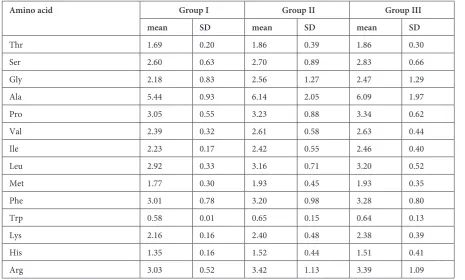
Table 1 presents demographic data of the stud-ied patients and their preoperative characteristics. Supplementation with amino acids was similar among all the groups before the surgery. The post-operative dietary intake was controlled by the clin-ical nutrition team. The composition of the TPN mixtures is presented in Tables 2 and 3.
The overall number of 86 patients, who partic-ipated in the study, was divided into 4 groups: − C – control group, i.e. patients, who were
operated due to gastrointestinal cancer. They received intravenously typical amounts of liq-uids and essential electrolytes for 5 days from the operation.
− I – patients who were operated due to colorectal cancer. They received TPN after the operation.
− II – patients who were operated due to small intestine cancer. They received TPN after the operation.
− III – patients who were operated due to pan-creatic cancer. They received TPN after the operation.
Table 1. characteristics of the studied patients
C
(n = 22) I(n = 22) II(n = 16) III(n = 20)
Sex (male/female) 12/10 10/12 9/7 11/9 age (years ± Sd) 65.3 ± 13.2 69.1 ± 10.4 58.0 ± 12.0 60.2 ± 7.1 body weight (kg ± Sd) 58.6 ± 12.4 53.8 ± 10.6 54.3 ± 11.3 56.2 ± 9.6 associated medical diseases:
diabetes hypertension
coronary artery disease
5 3 2
3 4 2
4 2 1
5 2 3
Table 2. composition of TPN mixture (per 1 litre) (acc. previous study Szpetnar et al. [36])
Parameter Group I Group II Group III
mean SD mean SD mean SD
Nitrogen (g) 5.61 0.12 6.02 0.96 5.98 0.56 amino acids (g) 38.25 3.11 39.80 7.63 39.95 5.15 carbohydrates (g) 98.30 24.04 105.45 26.21 114.00 32.28 Lipids (g) 47.60 3.76 51.05 8.85 48.00 3.55 energy from lipids (kcal) 431.50 68.17 472.50 102.71 446.25 69.72 energy from carbohydrates (kcal) 368.00 75.23 396.00 101.28 444.00 123.73 Non-peptide energy (kcal) 799.50 7.05 834.75 144.11 853.75 172.09 energy from amino acids (kcal) 151.00 14.10 159.75 29.98 166.00 35.45 Total energy 950.50 7.05 993.00 166.10 1 019.75 202.20 Osmolarity (mOsm/kg) 896.00 37.61 884.50 70.45 937.00 148.29 Na (mmol) 46.05 5.92 42.40 17.13 46.00 7.53 K (mmol) 31.35 4.82 29.25 12.38 32.25 7.45 Mg (mmol) 3.05 0.22 3.57 0.74 3.33 0.46 ca (mmol) 2.87 0.17 2.94 0.77 3.07 0.47 cl (mmol) 45.08 4.29 45.66 14.96 45.61 6.95 Zn (mmol) 0.02 0.02 0.01 0.02 0.02 0.02 acetates (mmol) 45.98 11.49 43.58 20.60 47.20 15.09 Phosphates (mmol) 11.09 5.22 11.63 6.18 12.62 5.99
I – colorectal cancer; II – small intestine cancer; III – pancreatic cancer.
Table 3. average levels of amino acids (g/L) given in TPN
Amino acid Group I Group II Group III
mean SD mean SD mean SD
Thr 1.69 0.20 1.86 0.39 1.86 0.30
Ser 2.60 0.63 2.70 0.89 2.83 0.66
Gly 2.18 0.83 2.56 1.27 2.47 1.29
ala 5.44 0.93 6.14 2.05 6.09 1.97
Pro 3.05 0.55 3.23 0.88 3.34 0.62
Val 2.39 0.32 2.61 0.58 2.63 0.44
Ile 2.23 0.17 2.42 0.55 2.46 0.40
Leu 2.92 0.33 3.16 0.71 3.20 0.52
Met 1.77 0.30 1.93 0.45 1.93 0.35
Phe 3.01 0.78 3.20 0.98 3.28 0.80
Trp 0.58 0.01 0.65 0.15 0.64 0.13
Lys 2.16 0.16 2.40 0.48 2.38 0.39
His 1.35 0.16 1.52 0.44 1.51 0.41
arg 3.03 0.52 3.42 1.13 3.39 1.09
In the control group the blood samples were collected as follows: 1st measurement – one day
before the operation, 2nd measurement – three days
after the operation, 3rd measurement – five days
af-ter the operation. In the other groups the samples were collected also at three time points: 1st
mea-surement – one day before the operation, 2nd
mea-surement – three days after applying TPN, 3rd
mea-surement – five days after applying TPN.
The Bioethical Commission of the Medical University in Lublin approved the study (No
KE-0254/31/2006).
The patients were hospitalised in the I chair and department of General and Transplant
Sur-gery and Nutritional Treatment of the Medical
University in Lublin. They accepted the study pro-tocol and agreed to participate in it.
Glutamine and Branched-
-Chain Amino Acids
Examinations
The plasma from each blood sample was collected immediately after centrifugation at 2000 × g for 15 min and then stored at –20oC
un-til analysis. For free amino acids concentration measurements, plasma was deproteinised with 6% sulphosalicylic acid in lithium – citrates buf-fer (pH = 2.8) and centrifuged at 12000 × g for 12 min. amino acids were determined by the au-tomated ion-exchange chromatography with five lithium-citrate buffers by Moore et al. [10] us-ing amino acids analyser (aaa 400) by Ingos, czech Republic.
Statistical Analysis
To perform statistical analysis of the obtained results, SPSS 12.0 PL (Statistical Package for Social Sciences) software was used.
The outcomes were tested by variance analysis or its non-parametric equivalents. compatibility
of studied variables distribution with normal
dis-tribution was tested by Shapiro-Wilk test.
distributions of dependent variable did not differ significantly from normal distribution in most cases; therefore, mixed pattern of variance analysis (aNOVa model) was used for further analysis. When the above assumption was not true, non-parametric equivalents of variance anal-ysis were applied. The influence of the measure-ment date on investigated dependent variable level
was then analysed by the friedman test.
Differenc-es between variablDifferenc-es pairs were examined using
Wilcoxon signed-rank test. The influence of ap-purtenance to patient group on the level of depen-dent variable was analysed by Kruskall-Wallis test.
The Mann Whitney U test was applied to
exam-ine the differences among dependent variable val-ues for single measurements.
Results
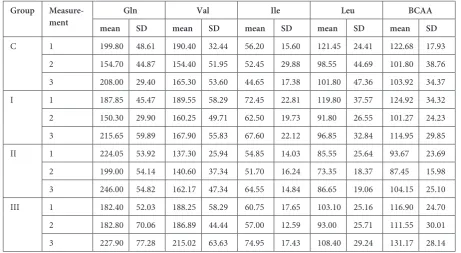
Mean values of bcaa (valine, isoleucine, leu-cine) and glutamine concentrations as well as stan-dard deviations (Sd) are shown in Table 4. Table 5 presents statistics of differences significance tests for studied amino acids’ measurements (1st, 2nd 3rd measurement). Table 6 presents statistics of dif-ferences significance tests for studied amino ac-ids’ measurements in groups of patients (group c, I, II, III). evaluation of the influence of the mea-surement date showed statistically significant dif-ferences for Val concentration between 1st–2nd
and 2nd–3rd measurements (chi-squared = 17.987;
p < 0.05). Statistically significant differences be-tween c-II and II-III groups were found (chi-squared = 12.870, p < 0.05).
In the case of Ile, statistically significant
differ-ences were shown between the 2st and 3rd
measure-ments (f = 4.564; p < 0.05) as well as between c-I and c-III groups (f = 4.641; p < 0.05).
Statistically significant differences in Leu con-centration were found between 1st–2rd and 2st–3rd measurements (f = 12.373; p < 0.05). evaluat-ing groups of patients, significant changes were found between c-II and I-II groups (f = 4.395; p < 0.05).
In the case of all bcaa concentrations, statis-tically significant differences were stated between 1st–2rd and 2st–3rd measurements (f = 11.279; p < 0.05) and between I-II and II-III groups (f = 4.599; p < 0.05).
The evaluation of the influence of the measure-ment date showed statistically significant differ-ences for Gln concentration between 1st–2rd, 1st–3rd
and 2nd–3rd measurements (chi-squared = 57.799;
p < 0.05). The evaluation of the influence of appur-tenance to patient groups showed statistically sig-nificant differences between c-II and I-II groups (chi-squared = 10.848; p < 0.05).
figures 1 and 2 show concentrations of bcaa and glutamine and their standard deviation in all operated patients (groups I–III) receiving postop-erative parenteral nutrition. Mean bcaa
concen-tration in patients receiving TPN in the 5th day of
the therapy was significantly higher than before the operation and significantly higher than in the control group (p < 0.05). Mean Gln concentration
higher than before the operation and in the 3rd day of the therapy, but also significantly higher in comparison to the control group.
Discussion
changes of amino acids concentrations in dif-ferent types of cancer depend on many factors such as: kind of cancer, cancer stage, the age of patients, the way of treatment and nutrition [11]. More-over, depletion of particular amino acids could be a significant marker of specific cancer and there-fore nutritional therapy providing deficient amino Table 4. Gln and bcaa concentration (μmol/L) in blood plasma of patients
Group
Measure-ment meanGln SD meanValSD mean IleSD meanLeuSD meanBCAASD
c 1 199.80 48.61 190.40 32.44 56.20 15.60 121.45 24.41 122.68 17.93 2 154.70 44.87 154.40 51.95 52.45 29.88 98.55 44.69 101.80 38.76 3 208.00 29.40 165.30 53.60 44.65 17.38 101.80 47.36 103.92 34.37 I 1 187.85 45.47 189.55 58.29 72.45 22.81 119.80 37.57 124.92 34.32 2 150.30 29.90 160.25 49.71 62.50 19.73 91.80 26.55 101.27 24.23 3 215.65 59.89 167.90 55.83 67.60 22.12 96.85 32.84 114.95 29.85 II 1 224.05 53.92 137.30 25.94 54.85 14.03 85.55 25.64 93.67 23.69 2 199.00 54.14 140.60 37.34 51.70 16.24 73.35 18.37 87.45 15.98 3 246.00 54.82 162.17 47.34 64.55 14.84 86.65 19.06 104.15 25.10 III 1 182.40 52.03 188.25 58.29 60.75 17.65 103.10 25.16 116.90 24.70 2 182.80 70.06 186.89 44.44 57.00 12.59 93.00 25.71 111.55 30.01 3 227.90 77.28 215.02 63.63 74.95 17.43 108.40 29.24 131.17 28.14
c – control; I – colorectal cancer; II – small intestine cancer; III – pancreatic cancer
1 – first measurement (1 day before operation); 2 – second measurement (3 days after operation or TPN application); 3 – third measurement (5 days after operation or TPN application).
Table 5. Statistically significant differences tests for stud-ied amino acids measurements
aa Test’s
statistics Level of significance Post-hoc Val2 17.987 0.000(*) 1–2; 2–3
Ile1 4.564 0.012(*) 2–3
Leu1 12.373 0.000(*) 1–2; 2–3
bcaa 1 11.279 0.000(*) 1–2; 2–3
Gln2 57.799 0.000(*) 1–2; 1–3;
2–3
1 – first measurement (1 day before operation); 2 – second measurement (3 days after operation or TPN application); 3 – measurement (5 days after operation or TPN applica-tion).
1 Parametric test – aNOVa with mixed pattern: test f
sta-tistic.
2 Nonparametric test – friedman’s test for comparison
between measurements. Wilcoxon signed rank test for comparison of pairs.
* significant distinction on the level p < 0.05.
Table 6. Statistically significant differences for studied amino acids measurements in patient groups
aa Test’s
statistics Level of significance Post-hoc Val2 12.870 0.005(*) c-II; II-III
Ile1 4.641 0.005(*) c-I; c-III
Leu1 4.395 0.007(*) c-II; I-II
bcaa1 4.599 0.005(*) I-II; II-III
Gln2 10.848 0.013(*) c-II; I-II
c – control; I – colorectal cancer; II – small intestine can-cer; III – pancreatic cancer
1 Parametric test – aNOVa with mixed pattern – test
f statistic.
2 Nonparametric test – Kruskall-Wallis test for
compari-son of groups; Mann-Whitney U test for comparison of pairs.
acids might be required [12–14]. Our results con-firm the observation regarding plasma amino acids abnormalities in cancer patients [11, 13].
beginning from the third day after the oper-ations, bcaa concentrations in control group decreased. In groups of patients receiving TPN, bcaa concentrations on the third day after apply-ing TPN were lower in comparison with the val-ues noted before the operation, and from that day they began to increase. In control group, Gln con-centration decreased after the surgery and subse-quently increased beginning from the third day af-ter the operation. a similar tendency was observed in TPN patients, which was probably caused by the use of bcaa for Gln synthesis. bcaa loss was observed in the group of patients with nor-mal feeding after the operation, whereas in TPN ones it was partially compensated. It was found that bcaa use for the synthesis of Gln resulted in their reduction in skeletal muscles and in plasma. Low concentrations of bcaa are characteristic for protein-energy malnutrition and for plasma pro-tein loss [15]. additionally, cancer modifies met-abolic response of muscles to surgical stress that stimulates partial or complete proteolysis and sub-sequently accelerates a release of Gln to the cir-culatory system [16]. In cancer and malnutrition, hyperammonemia is observed. It is caused by the incapability of the liver to detoxify ammonia. The use of bcaa for Gln synthesis causes partial de-toxication of ammonia [17].
The metabolic properties of bcaa and obser-vations regarding their enhanced oxidation in sep-sis, burn and cancer allow applying the treatment with these amino acids in patients with catabolic illnesses. bcaa therapy can actually improve se-rum albumin concentration in patients with liver cirrhosis [18]. However, the incidence of hepato-cellular carcinoma seems to be similar in patients with and without bcaa treatment. Lee et al. [13] noticed that concentrations of bcaa in liver dis-ease were different from those observed in liv-er cancliv-er and in colorectal cancliv-er. They claimed that in the plasma of liver cancer patients,
concen-trations of most exogenous amino acids were
pleted. The progress of the disease caused a de-crease in concentrations of both exogenous and endogenous amino acids, which intensified BCAA depletion. comparing liver cancer patients with cirrhosis ones, charlton [19] found that bcaa concentrations were decreased in both groups, but Gln concentration was significantly depressed only in liver cancer subjects. That suggested accelerated using of Gln in cancer.
Several studies have demonstrated that bcaa-enriched amino acid mixture can reduce protein loss and improve the nutritional status of patients with liver diseases [9, 20]. animal studies per-formed by Holecek et al. [21] displayed that the bcaa infusion did not affect protein synthesis improvement in septic rats, although it increased bcaa concentrations in plasma, muscles, liver and the small intestine. The administration of Gln caused an increase in Gln concentration in plasma, muscles as well as simulated protein synthesis in
Fig. 2. Glutamine concentration in blood serum of patients with gastrointestinal cancer
c – patients operated because of gastrointestinal can-cer who were received no TPN; I-III patients operated because of cancer and given TPN after the opera-tion. 1 – first measurement (1 day before operation); 2 – second measurement (3 days after operation or TPN application); 3 – third measurement (5 days after operation or TPN application).
* statistically significant vs. control group (p < 0.05). a statistically significant vs. 1st measurement (p < 0.05). b statistically significant vs. 2nd measurement (p < 0.05). c statistically significant vs. 3nd measurement (p < 0.05).
0 40 80 120 160 200 240 280 320 360 C I-III Gln (nmol/ml ) 1 2 3
ac b c
*ab
Fig. 1. bcaa concentration in blood serum of patients with gastrointestinal cancer
c – patients operated because of gastrointestinal can-cer who were received no TPN; I-III patients operated because of cancer and given TPN after the opera-tion. 1 – first measurement (1 day before operation); 2 – second measurement (3 days after operation or TPN application); 3 – third measurement (5 days after operation or TPN application).
* statistically significant vs. control group (p < 0.05). a statistically significant vs. 1st measurement (p < 0.05). b statistically significant vs. 2nd measurement (p < 0.05). c statistically significant vs. 3nd measurement (p < 0.05).
liver. In a few studies, tumor growth inhibition or enhanced tumor response to anticancer drugs was seen in animals fed with Gln [22, 23]. conversely, Gln supplementation corrects host Gln depletion and reverses impairment of intestinal functional and structural integrity associated with the tumor-bearing state [22, 24].
The question if baaa-enriched parenteral nu-trition use in patients with gastrointestinal cancer is the most beneficial solution still remains unclear. according to cano et al. [25] baaa-enriched TPN applied in patients operated due to gastrointestinal cancers may improve nitrogen balance, biochem-ical and nutritional parameters as well as may in-fluence the reduction of oxidative stress in these patients. Similarly, Sun et al. [26] showed that the administration of bcaa-enriched TPN in mal-nourished patients after GI cancer (esophageal, gastric and colorectal) surgery can markedly im-prove nitrogen balance and serum albumin and prealbumin levels in comparison with patients re-ceiving standard TPN.
The results of our studies indicate that surgery caused a decrease in concentrations of Val, Ile and Leu, which was maintained during the whole post-operative period. However, in TPN patients this tendency was overcome from the third day after surgery, except for Val and Leu in colorectal can-cer group. The conclusion is that standard TPN is insufficient and it should be modified in patients with colorectal cancers. In the case of those pa-tients, bcaa-enriched TPN or deficit amino ac-ids-enriched diet could be more beneficial.
considerably, some studies suggest that leu-cine-enriched nutrition mixture can stimulate muscle protein synthesis in a greater degree than a balanced mixture, because Leu influences the process of protein synthesis and plays a specific role in the regulation of optimal essential amino acids profile in blood serum [27, 28]. Its catabolism increases 7–8 h after bcaa administration, which proves intensified bcaa transamination, gluta-mate production and increased glutamine synthe-sis de novo [29]. Nitrogen derived from Leu as well as Ile and Val may be directly used for Gln syn-thesis in skeletal muscles [30]. In studies of biolo et al. [31] patients with colorectal cancer after the operation were parenterally administered a stan-dard mixture of amino acids and bcaa-enriched mixture. both mixtures were isonitrogenous and the ratios of leucine to total amino acid (grams) in the two mixtures were 0.09 and 0.22, respective-ly. a standard diet did not influence protein kinet-ics and Gln synthesis. bcaa-enriched TPN accel-erated the turnover of muscles proteins through the stimulation of protein synthesis and Gln syn-thesis. furthermore, it was reported that standard
TPN did not cause an increase in protein synthe-sis, in spite of exogenous amino acids concentra-tions being enhanced in plasma. On the contrary, enriched-bcaa TPN stimulated protein synthe-sis, increased Leu concentration and optimal con-centrations of other exogenous amino acids several hours after applying TPN.
The outcomes of both these and other stud-ies revealed that Leu displayed a specific capabili-ty of initiating protein synthesis in muscles through a modulation of mRNa translation [26, 32]. The underlying mechanism may involve activation of the mammalian target of the rapamycin (mTOR) signalling to enhance translation initiation and in-hibit autophagy in liver and muscle. Other two bcaa – isoleucine and valine, have no effect on mTOR phosphorylation and muscle protein turn-over [33]. However, Murata and Moriyama [34] showed that isoleucine prevented liver metastases in a mouse colon cancer metastatic model, where-as the leucine-treatment mice had multiple metwhere-as- metas-tases in liver. They found that isoleucine prevented tumour growth via a novel mechanism by the in-hibition of vascular endothelial growth factor pro-duction (VeGf), partially through the mTOR path-way, independent of hypoxia-inducible factor 1-α (H1f1-α). In these researches, the serum albumin concentration in the leucine-treated mice was lower than in the isoleucine-treated ones. besides, Lynch et al. [35] showed that prolonged chronic dietary sup-plementation with Leu alone caused disturbances in both body weight and muscle mass gain in rats.
If is probable that unbalanced, BCAA-
leucine-enriched mixture can not only disturb bcaa
me-tabolism, but also induce tumour development and metastasis to the liver, a balanced TPN-enriched diet seems to be more beneficial for patients.
In patients with pancreas and small intestine cancers receiving TPN, the increase in bcaa con-centration is followed with the increase in gluta-mine synthesis. Therefore, glutagluta-mine supplemen-tation seems not to be necessary in such a situation. In the case of colorectal cancer, bcaa-enriched may also cause an increase in glutamine synthe-sis. Such a conclusion can be drawn from the stud-ies of biolo et al. [31], where the rate of muscle
glutamine de novo synthesis did not significantly
change after the infusion of the balanced amino ac-id mixture but increased during the infusion of the bcaa-enriched mixture.
furthermore, glutamine administration in gas-trointestinal cancer might alleviate glucose intoler-ance and protect muscle tissue against tumour-in-duced atrophy. However, the role of glutamine in GI cancers requires further clinical research.
TPN. In our studies patients received standard TPN, nutrition recommended by some scientists, i.e. parenteral immunological nutrition, which caused the fast decrease of proinflammatory cyto-kines and other different necrosis markers was not applied.
concluding, our studies showed that in gas-trointestinal cancer patients, surgery results in
a decrease in bcaa concentrations. application of TPN in the postoperative period was beneficial and caused an increase in Val, Ile and Leu con-centrations in patients with pancreatic cancer and small intestine cancer. However, in colorectal can-cer, such treatment is not sufficient and parenter-ally administered mixture should contain bcaa- -enriched formula.
References
[1] Evans WJ, Morley JE, Argiles J: cachexia: a new definition. clin Nutr 2008, 27, 793–799.
[2] Mantovani G, Madeddu C: cancer cachexia: medical management. Support care cancer 2009, doi: 10.1007/ s00520-009-0722-3.
[3] Argiles JM: cancer-associated malnutrition. eur J Oncol Nurs 2005, 9, Suppl, 39–50.
[4] Noblett SE, Watson DS, Huong H, Davison B, Hainsworth PJ, Horgan AF: Pre-operative oral carbohydrate loading in colorectal surgery: a randomized controlled trial. colorectal dis 2006, 8, 563–569.
[5] Braga M, Ljungqvist O, Soeters P, Weimann A, Bozetti F: eSPeN guidelines on Parenteral Nutrition: surgery. clin Nutr 2009, 28, 378–386.
[6] Weimann A, Braga M, Harsanyi L: eSPeN Guidelines on enteral Nutrition: Surgery including organ transplanta-tion. clin Nutr 2006, 25, 224–244.
[7] Kuhn SK, Muscaritoli M, Wischmeyer P, Stehle P: Glutamine as indispensable nutrient in oncology: experimen-tal and clinical evidence. eur J Nutr 2009, doi: 10.1007/s00394-009-0082-2.
[8] Zaloga GP: Parenteral nutrition in adult patients with functioning gastrointestinal tracts: assessment of outcomes. Lancet 2006, 367, 1101–1111.
[9] Marchesini G, Bianchi G, Merli M, Amodio P, Panellea C, Loguercio C, Rossi Fanelli F, Abbiati R: Nutritional supplementation with branched-chain amino acids in advanced cirrhosis: a double-blind, randomized trial. Gastroenterology 2003, 124, 1792–1801.
[10] Moore S, Spackman DD, Stein WH: chromatography of amino acids on sulfonated polystyrene resins. ann chem 1958, 30, 1185–1189.
[11] Lai HS, Lee JC, Lee PH, Wang ST, Chen WJ: Plasma free amino acid profile in cancer patients. Semin cancer biol 2005, 15, 267–276.
[12] Curi R, Lagranha CJ, Doi SQ, Sellitti DF, Procopio J, Pithon-Curi TC: Glutamine-dependent changes in gene expression and protein activity. cell biochem funct 2005, 23, 77–84.
[13] Lee JC, Chen MJ, Chang CH, Tiai YF, Lin P., Lai HS, Wang ST: Plasma amino acid levels in patients with colorec-tal cancers and liver cirrhosis with hepatocellular carcinoma. Hepatogastroenterology 2003, 50, 1269–1273. [14] Soeters PB, Van De Poll MC, Van De Gemert WG, Dejong CH: amino acid adequacy in pathophysiological
states. J Nutr 2004, 134 (6 Suppl.), 1575–1582.
[15] Wang XY, Li N, Gu J, Li WQ, Li JS: The effects of the formula of amino acids enriched bcaa on nutritional sup-port in traumatic patients. World J Gastroenterol 2003, 9, 599–602.
[16] Biolo G, De Cicco M, Dal Mas V, Lorenzon S, Antonione R, Ciocchi B, Brazzoni R, Zanetti M, Dore F, Guarnieri G: Response of muscle protein and glutamine kinetics to branched-chain-enriched amino acids in intensive care patients after radical cancer. Nutrition 2006, 22, 475–482.
[17] Moriwaki H, Miwa Y, Tajika M, Kato M, Fukushima H, Shiraki M: branched-chain amino acids as a protein- and energy-source in liver cirrhosis. biochem biophys Res commun 2004, 313, 405–409.
[18] Kawaguchi T, Izumi N, Charlton MR, Sata M: branched-chain amino acids as pharmacological nutrients in chronic liver disease. Hepatology 2011, 54, 1063–1070.
[19] Charlton M: branched-chain amino acid enriched supplements as therapy for liver disease. J Nutr 2006, 136(1 Suppl.), 295–298.
[20] Khanna S, Gopalan S: Role of branched-chain amino acids in liver disease: the evidence for and against. curr Opin clin Nutr Metab care 2007, 10, 297–303.
[21] Holecek M, Muthny T, Kovarik M, Sispera L: Simultaneous infusion of glutamine and branched-chain amino acids (bcaa) to septic rats does not have more favourable effect on protein synthesis in muscle, liver and small intestine than separate infusions. JPeN 2006, 30, 467–473.
[22] Xue H, Sawyer MB, Wischmeyer PE, Baracos VE: Nutrition modulation of gastrointestinal toxicity related to cancer chemotherapy: from preclinical findings to clinical strategy. JPeN 2011, 35, 74–90.
[23] Kaufmann Y, Kornbluth J, Feng Z, Fahr M, Schaefer RF, Klimberg VS: effect of glutamine on the initiation and promotion phases of dMba-induced mammary tumor development. JPeN 2003, 27, 411–418.
[24] Barlett DL, Charland S, Torosian MH: effect of glutamine on tumor and host growth. ann Surg Oncol 1995, 2, 71–76.
[26] Sun LC, Shih YL, Lu CY, Hsieh JS, Chuang JF, Chen FM, Ma CJ, Wang JY: Randomised, controlled study of branched chain amino-acid-enriched total parenteral nutrition in malnourished patients with gastrointestinal can-cer undergoing surgery. am Surg 2008, 74, 237–242.
[27] Kimball SR, Jefferson LS: Signaling pathways and molecular mechanisms through which branched – chain amino acids mediate translational control of protein synthesis. J Nutr 2006, 136 (1 Suppl.), 227–231.
[28] Suryawan A, O’Connor PM, Bush JA, Nguyen HV, Davis TA: differential regulation of protein synthesis by amino acids and insulin in peripheral and visceral tissues of neonatal pigs. amino acids 2009, 37, 97–104. [29] Meyer C, Woerle HJ, Gerich J: Paradoxical changes of muscle glutamine release during hyperinsulinemia,
eug-lycemia and hypogeug-lycemia in humans: further evidence for the glucose-glutamine cycle. Metabolism 2004, 53, 1208–1214.
[30] Holecek M: Three targets of branched-chain amino acid supplementation in the treatment of liver disease. Nutrition 2010, 26, 482–490.
[31] Biolo G, De Cicco M, Dal Mas V, Lorenzon S, Antonione R, Ciocchi B, Barazzoni R, Zanetti M, Dore F, Guarnieri G: Response of muscle protein and glutamine kinetics to branched-chain-enriched amino acids in intensive care patients after radical cancer surgery. Nutrition 2006, 11, 475–482.
[32] Yoshizawa F: Regulation of protein synthesis by branched-chain amino acids in vivo. biochem biophys Res commun 2004, 313, 417–422.
[33] Wu G: amino acids: metabolism, functions, and nutrition. amino acids 2009, 37, 1–17.
[34] Murata K, Moriyama M: Isoleucine, an essential amino acid, prevents liver metastases of colon cancer by antian-giogenesis. cancer Res 2007, 67, 3263–3268.
[35] Lynch CJ, Hutson SM, Patson BJ, Vaval A, Vary TC: Tissue-specific effects of chronic dietary leucine and nor-leucine supplementation on protein synthesis in rats. am J Physiol endocrinol Metab 2002, 283, 824–835. [36] Szpetnar M, Matras P, Kiełczykowska M, Horecka A, Bartoszewska L, Pasternak K, Rudzki S: antioxidants in
patients receiving total parenteral nutrition after gastrointestinal cancer surgery. Cell Biochem Funct 2012, 30, 211–216.
Address for correspondence:
Maria Szpetnar
chair and department of Medical chemistry Medical University of Lublin
chodźki 4a 20-093 Lublin
e-mail: [email protected]
conflict of interest: None declared