The Journal of Threatened Taxa (JoTT) is dedicated to building evidence for conservation globally by publishing peer-reviewed articles online every month at a reasonably rapid rate at www.threatenedtaxa.org. All articles published in JoTT are registered under Creative Commons Attribution 4.0 International License unless otherwise mentioned. JoTT allows allows unrestricted use, reproduction, and distribution of articles in any medium by providing adequate credit to the author(s) and the source of publication.
www.threatenedtaxa.org
ISSN 0974-7907 (Online) | ISSN 0974-7893 (Print)
Building evidence for conservation globally
Journal of Threatened Taxa
For Focus, Scope, Aims, Policies, and Guidelines visit https://threatenedtaxa.org/index.php/JoTT/about/editorialPolicies#custom-0
For Article Submission Guidelines, visit https://threatenedtaxa.org/index.php/JoTT/about/submissions#onlineSubmissions
For Policies against Scientific Misconduct, visit https://threatenedtaxa.org/index.php/JoTT/about/editorialPolicies#custom-2
For reprints, contact <[email protected]>
Note
A new distribution record of the Pentagonal Sea Urchin
Crab Echinoecus pentagonus (A. Milne-Edwards, 1879)
(Decapoda: Brachyura: Pilumnidae) from the Andaman
Islands, India
Balakrishna Meher & Ganesh Thiruchitrambalam
26 October 2019 | Vol. 11 | No. 13 | Pages: 14773–14776 DOI: 10.11609/jott.4909.11.13.14773-14776
Partner
Member
Threatened Taxa
Publisher & Host
PLATINUM OPEN ACCESS
14773 to the Hawaiian Islands (Chia et al.
1999). Males and pre-adult females of E. pentagonus mostly live on the surface of sea urchins but sometimes they can be found near the rectum while adult females are restricted to the rectum in a calcified gall-like structure (Castro 1971, 2015). For the first time in India a berried female E. pentagonus was
collected from the rectum of the sea urchin Echinothrix diadema (Linnaeus) from Malacca Beach, Car Nicobar in 1959 by Tiwari (see Sastry 1981). Later Prakash et al. (2012) reported a male E. pentagonus clinging on the ventral side of the sea urchin host Echinothrix calamaris from Agatti Island, Lakshadweep.
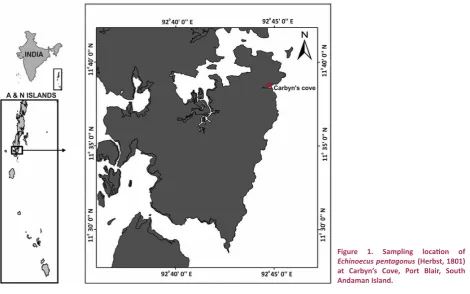
During the survey of brachyuran crabs in the intertidal regions of the South Andaman Islands, from December 2014 to September 2018, a single male specimen of E. pentagonus was collected in December 2015 at Corbyn’s Cove, Port Blair (Figure 1). The specimen was found in rocky substratum in a free-living state. After collection, it was preserved in 10% buffered formaldehyde. Standard literature (Chia et al. 1999; Ng & Jeng 1999) were referred for identification of the species. Photographs and morphological measurements were taken with the help of a stereo zoom microscope (Leica M 205A). The specimen was deposited in the Department Museum, at Pondicherry University, Port Blair.
Material examined: One male collected from Port Blair Coast, Andaman Islands; locality: rocky intertidal region, Carbyn’s Cove (11.6570N, 92.7530E); collected on 14 December 2015 by Balakrishna Meher and T. Ganesh; dt.02.i.2019, deposited at Museum of Department
No
te
DOI:https://doi.org/10.11609/jott.4909.11.13.14773-14776 | ZooBank: urn:lsid:zoobank.org:pub:FD3CE19C-5168-459C-99E7-18AC389D3DFC
Editor: A. Biju Kumar, University of Kerala, Thiruvananthapuram, India. Date of publication: 26 October 2019 (online & print)
Manuscript details: #4909 | Received 21 February 2019 | Final received 24 August 2019 | Finally accepted 10 October 2019
Citation: Meher, B. & G. Thiruchitrambalam (2019). A new distribution record of the Pentagonal Sea Urchin Crab Echinoecus pentagonus (A. Milne-Edwards, 1879) (Decapoda: Brachyura: Pilumnidae) from the Andaman Islands, India. Journal of Threatened Taxa 11(13): 14773–14776. https://doi.org/10.11609/
jott.4909.11.13.14773-14776
Copyright: © Meher & Thiruchitrambalam 2019. Creative Commons Attribution 4.0 International License. JoTT allows unrestricted use, reproduction, and distribu
-tion of this article in any medium by adequate credit to the author(s) and the source of publica-tion.
Funding: Pondicherry University.
Competing interests:The authors declare no competing interests.
Acknowledgements: Theauthors are thankful to the authorities of Pondicherry University for providing the necessary facilities to carry out this work and
University fellowship to Balakrishna Meher. The authors are also thankful to the Zoological Survey of India Andaman & Nicobar Regional Centre, Port Blair for the help in microscope facility.
A new distribution record of the
Pentagonal Sea Urchin Crab Echinoecus
pentagonus (A. Milne-Edwards, 1879)
(Decapoda: Brachyura: Pilumnidae) from
the Andaman Islands, India
Balakrishna Meher1 & Ganesh Thiruchitrambalam2
1,2 Department of Ocean Studies & Marine Biology, Pondicherry
University, Brookshabad Campus, Port Blair, Andaman & Nicobar Islands 744112, India.
1 [email protected], 2 [email protected]
(corresponding author)
ISSN 0974-7907 (Online) ISSN 0974-7893 (Print)
PLATINUM OPEN ACCESS
Journal of Threatened Taxa | www.threatenedtaxa.org | 26 October 2019 | 11(13): 14773–14776
For the first time, the Pentagonal Sea Urchin Crab Echinoecus pentagonus (A. Milne-Edwards, 1879) is recorded from the rocky intertidal region of the Andaman Islands. It is a symbiotic crab that lives with sea urchins of the genus Echinothrix. This species is recorded from the Lakshadweep (Prakash et al. 2012) and Nicobar Islands (Sastry 1981) but there is no record from mainland India. A detailed description of the species, high quality photographs and line diagrams are provided.
Journal of Threatened Taxa | www.threatenedtaxa.org | 26 October 2019 | 11(13): 14773–14776
New distribution record of Pentagonal Sea Urchin Crab Meher & Thiruchitrambalam
14774
of Ocean Studies and Marine Biology, Pondicherry University, Port Blair (PU/MB/501).
Taxonomy
Order Decapoda Latreille, 1802 Infraorder Brachyura Linnaeus, 1758 Family Pilumnidae Samouelle, 1819 Subfamily Eumedoninae Dana, 1852 Genus Echinoecus Rathbun, 1894
Echinoecus pentagonus (A. Milne-Edwards, 1879)
(Image 1, Figure 2)
Description: Carapace almost pentagonal in shape; length of carapace slightly more than width; surface without hairs, granules and very weakly punctuate when observed under microscope; anterior surface of carapace with white margin and two almost vertical white bands on the posterior surface (Image 1a, Figure 2a); different regions of carapace surface weakly marked; antero- and postero-lateral margins well defined. Rostrum elongated, bend downward and with a depression on centre of it (Figure 2c). Pterygostomial and sub orbital regions pitted in large amount (Figure 2b). Antennules obliquely folded (Figure 2b). Basal segment of antenna rectangular. External maxilliped quadrate; rectangular ischium and almost squarish merus; oblique suture
between the ischium and merus; a vertical groove on the ischium and a large pit on the merus (Figure 2b). Surface of chelipeds smooth; upper margin of palm with a blunt spine at its distal end; carpus with one inner and one outer spine, outer spine reduced; merus with a single spine (Figure 2f, g). Walking legs smooth to poorly pitted, unarmed and subcylindrical; dactylus thorny, inner margin with a small bunch of bristles (Figure 2h). Anterior portion of thoracic sternum comparatively narrow; sutures between sternites 1 and 2 indistinct, 2 and 3 well defined, between 3 and 4 interrupted (Figure 2d). Abdomen with seven distinct segments (Figure 2e). First gonopod stout and S-shaped.
Stevcic et al. (1988) established Eumedonidae Dana, 1853 as a distinct family whereas Ng & Clark (2000) recognized Eumedonine as a subfamily of Pilumnidae family.
In the present study, the classification of Eumedonine is based on recent standard literature (Ng & Clark 2000; Ng et. al. 2008) and considered as a subfamily of Pilumnidae. The three species of genus Echinoecus look very similar. Sharp and longer rostrum of E. pentagonus readily differentiates it from E. nipponicus and E. sculptus. E. pentagonus is the only member of its genus represented from the coastal waters of India. Though it is mostly exclusively obligate symbiont with diadematid sea urchins (Castro 2015), in the current
Figure 1. Sampling location of
Echinoecus pentagonus (Herbst, 1801)
at Carbyn’s Cove, Port Blair, South
New distribution record of Pentagonal Sea Urchin Crab Meher & Thiruchitrambalam
Journal of Threatened Taxa | www.threatenedtaxa.org | 26 October 2019 | 11(13): 14773–14776 14775
study it was found in a free-living state, without a host, in the rocky intertidal region. It may be due to death of host or accidental separation from host. Symbiotic brachyurans can be rarely found on non-living substrates (Castro 2015).
There is almost no information on the ecology and behaviour of E. pentagonus from India; E. pentagonus sometimes shows parasitic behaviour and can be lethal to certain species of diadematid sea urchins (Castro
1971). Therefore, it is very important to understand their diversity, distribution, ecology and biology in the coast of Andaman Islands, where the sea urchin is a protected animal.
References
Castro, P. (1971). Nutritional aspects of the symbiosis between
Echinoecus pentagonus and its host in Hawaii, Echinothrix
calamaris, pp. 229–247. In: Cheng T.C. (ed.), Aspects of the Biology
Figure 2. Echinoecus pentagonus: a—dorsal view | b—ventral view | c—lateral view of rostrum | d—anterior portion of thoracic sternum
| e—abdomen | f—cheliped | g—palm of cheliped | h—walking leg.
a
b
c
d
e
f g
Journal of Threatened Taxa | www.threatenedtaxa.org | 26 October 2019 | 11(13): 14773–14776
New distribution record of Pentagonal Sea Urchin Crab Meher & Thiruchitrambalam
14776
of Symbiosis. University Park Press, Baltimore, 327pp.
Castro, P. (2015). Symbiotic Brachyura, pp. 543–581. In: Castro, P.,
P.J.F. Davie, D. Guinot, F. R. Schram & J.C. von Vaupel Klein (eds.). Treatise on Zoology – Anatomy, Taxonomy, Biology: The crustacea. Complementary to the volumes translated from the French of the traité de zoologie, volume 9, Part C-I, Decapoda: Brachyura (Part 1). Brill Leiden, Boston, 1221pp.
Chia, D.G.B., P. Castro & P.K. L. Ng (1999). Revision of the genus
Echinoecus (Decapoda: Brachyura: Eumedonidae), crabs symbiotic
with sea urchins. Journal of Crustacean Biology 9(4): 809–824.
Ng, P.K.L. & M.S Jeng (1999). The brachyuran crabs (Crustacea: Decapoda: Eumedonidae and Portunidae) symbiotic with echinoderms in Taiwan. Zoological Studies 38(3): 268–274.
Ng, P.K.L. & P.F. Clark (2000). The eumedonid file: a case study
of systematic compatibility using larval and adult characters (Crustacea: Decapoda: Brachyura). Invertebrate Reproduction &
Development 38(3): 225–252.
Ng, P.K.L., D. Guinot & P.J.F. Davie (2008). Systema brachyurorum: Part I. An annotated checklist of extant brachyuran crabs of the world. Raffles Bulletin of Zoology, Supplement, 17: 1–286.
Prakash S., T. Thangappan, A. Kumar & T. Balasubramanian (2012).
Occurrence of Urchin Crab Echinoecus pentagonus A. Milne Edwards, 1879 (Decapoda, Brachyura, Eumedonidae) in Lakshadweep, India.
Proceedings of the Zoological Society of India 65(1): 61–63.
Sastry, D.R.K. (1981). On some crustacean associates of echinodermata from the Bay of Bengal, Records of the Zoological Survey of India 79: 19–30.
Stevcic, Z., P. Castro & R.H. Gore (1988). Re-establishment of the family Eumedonidae Dana, 1853 (Crustacea: Brachyura). Journal of
Natural History 22: 1301–1324.
WoRMS (2019). Pilumnidae Samouelle, 1819. https://www.
marinespecies.org/aphia.php?p=taxdetails&id=106766 Accessed on 2019-01-23.
Image 1. Echinoecus pentagonus: a—dorsal view | b—ventral view.
Scale 2mm. © Balakrishna Meher.
ISSN 0974-7907 (Online) | ISSN 0974-7893 (Print)
October 2019 | Vol. 11 | No. 13 | Pages: 14631–14786 Date of Publication: 26 October 2019 (Online & Print)
DOI: 10.11609/jott.2019.11.13.14631-14786
www.threatenedtaxa.org
The Journal of Threatened Taxa (JoTT) is dedicated to building evidence for conservation globally by publishing peer-reviewed articles online every month at a reasonably rapid rate at www.threatenedtaxa.org. All articles published in JoTT are registered under Creative Commons Attribution 4.0 International License
unless otherwise mentioned. JoTT allows allows unrestricted use, reproduction, and distribution of articles in any medium by providing adequate credit to the author(s) and the source of publication.
Communications
Camera trap survey of mammals in Cleopatra’s Needle Critical Habitat in Puerto Princesa City, Palawan, Philippines
– Paris N. Marler, Solomon Calago, Mélanie Ragon & Lyca Sandrea G. Castro, Pp. 14631–14642
Habitat suitability modeling of Asian Elephant Elephas maximus (Mammalia: Proboscidea: Elephantidae) in Parsa National Park, Nepal and its buffer zone
– Puja Sharma, Hari Adhikari, Shankar Tripathi, Ashok Kumar Ram & Rajeev Bhattarai, Pp. 14643–14654
Current population status of the endangered Hog Deer Axis porcinus (Mammalia: Cetartiodactyla: Cervidae) in the Terai grasslands: a study following political unrest in Manas National Park, India
– Alolika Sinha, Bibhuti Prasad Lahkar & Syed Ainul Hussain, Pp. 14655– 14662
A food spectrum analysis of three bufonid species (Anura: Bufonidae) from Uttarakhand region of the western Himalaya, India
– Vivekanand Bahuguna, Ashish Kumar Chowdhary, Shurveer Singh, Gaurav Bhatt, Siddhant Bhardwaj, Nikita Lohani & Satyanand Bahuguna, Pp. 14663–14671
Moulting pattern and mortality during the final emergence of the Coromandel Marsh DartDamselfly Ceriagrion coromandelianum (Zygoptera: Coenagrionidae) in central India
– Nilesh R. Thaokar, Payal R. Verma & Raymond J. Andrew, Pp. 14672– 14680
Diversity of parasitic Hymenoptera in three rice-growing tracts of Tamil Nadu, India
– Johnson Alfred Daniel & Kunchithapatham Ramaraju, Pp. 14681–14690
Mapping octocoral (Anthozoa: Octocorallia) research in Asia, with particular reference to the Indian subcontinent: trends, challenges, and opportunities
– Ghosh Ramvilas, Kannan Shalu, Rajeev Raghavan & Kutty Ranjeet, Pp. 14691–14721
SEM study of planktonic chlorophytes from the aquatic habitat of the Indian Sundarbans and their conservation status
– Gour Gopal Satpati & Ruma Pal, Pp. 14722–14744
Is cultivation of Saussurea costus (Asterales: Asteraceae) sustaining its conservation?
– Chandra Prakash Kuniyal, Joel Thomas Heinen, Bir Singh Negi & Jagdish Chandra Kaim, Pp. 14745–14752
Short Communications
A first photographic record of a Yellow-bellied Weasel Mustela kathiah Hodgson, 1835 (Mammalia: Carnivora: Mustelidae) from western Nepal
– Badri Baral, Anju Pokharel, Dipak Raj Basnet, Ganesh Bahadur Magar & Karan Bahadur Shah, Pp. 14753–14756
Mammal diversity in a montane forest in central Bhutan
– Tashi Dhendup, Kinga Thinley & Ugyen Tenzin, Pp. 14757–14763
Notes
First record of Otter Civet Cynogale bennettii (Mammalia: Carnivora: Viverridae) kept as a pet in Indonesia, representing a possible new threat to the species
– Jamie Francis Bernard Bouhuys, Pp. 14764–14766
An observation of the White-bellied Sea Eagle Haliaeetus leucogaster preying on Saltwater Crocodile hatchlings Crocodylus porosus in Bhitarkanika Wildlife Sanctuary, India
– Nimain Charan Palei, Bhakta Padarbinda Rath & Bimal Prasanna Acharya, Pp. 14767–14769
Elusive, rare and soft: a new site record of Leith’s Softshell Turtle
Nilssonia leithii (Reptilia: Testudines: Trionychidae) from
Bhadra Tiger Reserve, Karnataka, India
– H.S. Sathya Chandra Sagar, M. Mrunmayee, I.N. Chethan, Manish Kumar & D.V. Girish, Pp. 14770–14772
A new distribution record of the Pentagonal Sea Urchin Crab
Echinoecus pentagonus (A. Milne-Edwards, 1879) (Decapoda:
Brachyura: Pilumnidae) from the Andaman Islands, India
– Balakrishna Meher & Ganesh Thiruchitrambalam, Pp. 14773–14776
First records of the ghost moth genus Palpifer Hampson, [1893] (Lepidoptera: Hepialidae) from the Indian subcontinent south of the Himalaya
– Siyad A. Karim & John R. Grehan, Pp. 14777–14779
First record of longhorn beetle Calothyrza margaritifera (Cerambycidae: Lamiinae: Phrynetini) from western India
– Vishwas Deshpande & Hemant V. Ghate, Pp. 14780–14783
Extended distribution of Ceropegia mahabalei Hemadri & Ansari (Apocynaceae) to the state of Gujarat, India
– Mukta Rajaram Bhamare, Hemantkumar Atmaram Thakur & Sharad Suresh Kambale, Pp. 14784–14786