Dr. Bharat W. Tekade
Assoc. Prof., TVES’s Honorable Loksevak
Madhukarrao Chaudhari College of Pharmacy,
Faizpur, Tal. Taval, Dist. Jalgaon 425503, (M.S.), India.
Email:[email protected]
Address for correspondence
Access this article online
www.japer.in
Gums and Mucilages: Excipients for modified Drug Delivery
System
INTRODUCTION
Nature has provided us a wide verity of materials to
improve and sustain the health of all living things
either directly or indirectly. Natural gums are
promising biodegradable polymeric materials. Many
studies has been carried out in the fields including
food technology and pharmaceuticals using gums and
mucilages
[1].The traditional use of excipients in drug
formulations was to act as inert vehicles to provided
necessary weight, consistency and volume for the
correct administration of the active ingredient, but in
modern pharmaceutical dosage forms they often fulfill
multi-functional roles such as modifying release,
improvement of the stability and bioavailability of the
active
ingredient,
enhancement
of
patient
acceptability and ensure ease of manufacture. A large
number of plant-based pharmaceutical excipients are
available today. Many researchers have explored the
usefulness of plant-based materials as pharmaceutical
excipients. Ability to produce a wide range of material
based on their properties and molecular weight,
natural polymers became a thrust area in majority of
investigations in drug delivery systems
[2]. Natural
gums can also be modified to meet the requirements
of drug delivery systems and thus can compete with
the synthetic excipients available in the market
[3].
Gums are naturally occurring components in plants,
which are essentially cheap and plentiful. Natural
gums are polysaccharides consisting of multiple sugar
units linked together to create large molecules. Gums
are considered to be pathologic products formed
following injury to the plant or owing to unfavorable
condition such as drought, by breakdown of cell walls
(extra cellular formation, gummosis)
[4]. Acacia,
Tragacanth, guar gum are examples of gum
[5]. They
are heterogeneous in composition. Upon hydrolysis
they yield simple sugar units such as arabinose,
galactose, glucose, mannose, xylose or uronic acids,
etc.
Polymers have been successfully employed in the
formulation of solid, liquid and semi-solid dosage
forms and are specifically useful in the design of
modified release drug delivery systems. Both
synthetic
and
natural
polymers
have
been
investigated extensively for this purpose, but the use
of natural polymers for pharmaceutical applications is
attractive because they are economical, readily
available,
non-toxic,
capable
of
chemical
modifications, potentially biodegradable and with few
exceptions, also biocompatible. Increasing importance
Review
Review
Review
Review Article
Article
Article
Article
Natural gums and mucilages are available in nature freely. These natural gums and mucilages were successfully used in various dosage forms. These gums posses various advantages over synthetic polymers as they biodegradable, low cost etc. In recent years researches have been carried in formulation of modified dosage form using various gums and mucilage and they found to compete the synthetic polymers available in market. In this review we describe the development in natural gums and mucilages for use in modified drug delivery system and the interaction of API with some synthetic and also natural excipients used in pharmaceutical formulations.
Keywords: Natural polymers, Natural gums and mucilage, Pharmaceutical excipients, pharmaceutical application, modified gums, incompatibility
ABSTRACT
ABSTRACT
ABSTRACT
ABSTRACT
Bharat W. Tekade*, Yogita A.
Chaudhari
TVES’s Honorable Loksevak
Madhukarrao Chaudhari College of
Pharmacy, Faizpur, Tal. Taval, Dist.
Jalgaon 425503, (M.S.), India.
is the fact that plant resources are renewable and if
cultivated or harvested in a sustainable manner, they
can provide a constant supply of raw material
[6].
The plant based polymers have been studied for their
application in different pharmaceutical dosage forms
like matrix controlled system, film coating agents,
buccal films, microsphere, nanoparticals, viscous
solutions like ophthalmic solutions, suspensions,
implants and their applicability and efficiency has
been proven
[7,8].
Classification of Gums and Mucilages
Gums and mucilages are present in high quantities in a
verities of plants, animals, seaweeds, fungi and other
microbial sources, where they perform a number of
structural and metabolic functions; plant sources
provide the largest amounts. The different available
gums and mucilages can be classified as follows
[9-14 ].
According to the Charge
Non-ionic seed gums: guar, locust bean, tamarind,
xanthan,
amylose,
arabinans,
cellulose,
galactomannans. Anionic gums: arabic, karaya,
tragacant, gellan, agar, algin, carrageenans, pectic acid.
According to the Source
A) Marine Origin/Algal (Seaweed) Gums:
agar,
carrageenans, alginic acid, laminarin.
B) Plant Origin:
(1) shrubs/tree exudates—gum
arabica, gum ghatti, gum karaya, gum tragacanth,
khaya and albizia gums; (2) seed gums—guar gum,
locust bean gum, starch, amylose, cellulose; (3)
extracts- pectin, larch gum; (4) tuber and roots—
potato starch.
C)
Animal Origin:
chitin and chitosan, chondroitin
sulfate, hyaluronic acid.
D) Microbial
Origin
(bacterial
and
fungal):
xanthan,
dextran,
curdian,
pullulan,
zanflo,
emulsan, Baker’s yeast glycan, schizophyllan,
lentinan, krestin,scleroglucan.
Semi-Synthetic
Starch
derivatives
—hetastarch,
starch
acetate,
starch phosphates.
Cellulose derivatives
— carboxy methyl cellulose
(CMC),
hydroxy
ethylcellulose,
hydroxypropyl
methylcellulose
(HPMC),
methyl-cellulose
(MC),
microcrystalline, cellulose (MCC). -
According to Shape
Linear:
algins, amylose, cellulose, pectins.
Branched:
(1) short branches—xanthan, xylan,
galactomanan; (2) branch-on-branch-amylopectin,
gum arabic, tragacanth.
According to Manomeric Units in Chemical
Structure
Homoglycans—amylose, arabinanas, cellulose;
diheteroglycans-algins,
carragennans,
galactomannans;
Advantages of Natural Polymers
The following are a number of the advantages of
natural plant–based materials
1.
Biodegradable—Naturally available biodegradable
polymers are produced by all living organisms.
They represent truly renewable source and they
have
no
adverse
impact
on
humans
or
environmental health.
Biocompatible and non-toxic—Chemically, nearly
all of these plant materials are carbohydrates
composed of repeating sugar (monosaccharides)
units. Hence, they are non- toxic.
Low cost—it is always cheaper to use natural
sources. The production cost is also much lower
compared with that for synthetic material. India
and many developing countries are dependent on
agriculture.
Environmental-friendly processing—Gums and
mucilages from different sources are easily
collected in different seasons in large quantities
due to the simple production processes involved.
Local
availability
(especially
in
developing
countries). In developing countries, governments
promote the production of plant like guar gum and
tragacanth because of the wide applications in
various industries.
Disadvantages of Synthetic Polymers
during synthesis, non-renewable sources, side
effects, and poor patient compliance.
Acute and chronic adverse effects (skin and eye
irritation) have been observed in workers
handling
the
related
substances
methyl
methacrylate and poly-(methyl methacrylate)
(PMMA)
[15].
Reports of adverse reactions to povidone primarily
concern
the
formation
of
subcutaneous
granulomas at the injection site produced by
povidone. There is also evidence that povidone
may accumulate in organs following intramuscular
injections
[16].
Acute oral toxicity studies in animals have
indicated that carbomer-934P has a low oral
toxicity at a dose of up to 8 g/kg. Carbomer dust is
irritating to the eyes, mucous membranes and
respiratory tract. So, gloves, eye protection and
dust respirator are recommended during handling
[17].
Studies in rats have shown that 5% polyvinyl
alcohol aqueous solution injected subcutaneously
can cause anemia and can infiltrate various organs
and tissues
[18].
For a number of reasons there has been an increase in
interest
in
the
development
of
new
excipients/diluents.
Some
drugs
show
incompatibilities with many of the current range of
excipients. For example, atenolol-PVP,
atenolol-mg-stearate
[19]. One of the more common drug-excipient
incompatibilities is the reaction between aldehydic
sugars, such as lactose and primary and secondary
amines, leading to the formation of Schiff bases. These
complex series of reactions lead to browning and
discoloration of the dosage form. Despite being a
carrier of choice for dry powder aerosol formulations,
lactose may need to be replaced with a different
carrier, such as mannitol or sucrose, when
formulating
primary
and
secondary
amines.
Magnesium stearate is incompatible with aspirin,
some vitamins and most alkaloidal salts
[20].
hydrolysable, direct compression or dry granulation is
preferable, to wet granulation. However
drug-excipient incompatibility may still occur.
Chemical interaction between the drug and excipients
may lead to increased decomposition. Stearate salts
(e.g. magnesium stearate, sodium stearate) should be
avoided as tablet lubricants if the API is subject to
hydrolysis via ion-catalyzed degradation. Excipients
generally contain more free moisture than the drug
substance
[27], and in an attempt to obtain the most
thermodynamically stable state, water is able to
equilibrate between the various components
[29].
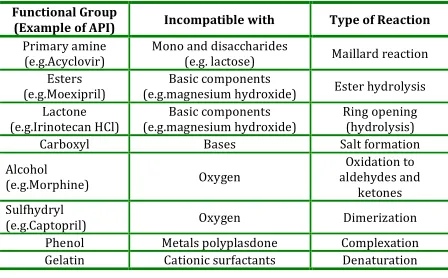
Common solid-state incompatibilities
[30]as shown in
Table No.1.
Table 1:
List of Common Solid-State Incompatibilities
Functional Group
(Example of API) Incompatible with Type of Reaction Primary amine
(e.g.Acyclovir)
Mono and disaccharides
(e.g. lactose) Maillard reaction Esters
(e.g.Moexipril)
Basic components
(e.g.magnesium hydroxide) Ester hydrolysis Lactone
(e.g.Irinotecan HCl)
Basic components (e.g.magnesium hydroxide)
Ring opening (hydrolysis) Carboxyl Bases Salt formation
Alcohol
(e.g.Morphine) Oxygen
Oxidation to aldehydes and
ketones Sulfhydryl
(e.g.Captopril) Oxygen Dimerization Phenol Metals polyplasdone Complexation Gelatin Cationic surfactants Denaturation
Incompatibilities
of
APIs
with
different
pharmaceutical excipients are summarized in Table
No.2
[30]Table 2:
Incompatibilities of APIs with Pharmaceutical Excipients
Excipient API and its Therapeutic Class
Saccharides
Lactose
Acyclovir - Antiviral; Aceclofenac and Ketoprofen - Anti-inflammatory; Metformin -Antidiabetic; Amlodipine , Ceronapril , Lisinopril and Oxprenolol - Antihypertensive; Fluconazole - Antifungal; Primaquine - Antimalarial; Promethazine - Antiemetic; Fluoxetine and Seproxetine Maleate – Antidepressant; Picotamide – Anticoagulant; Etamsylate - Antihemorrhagic; Aminophylline and Clenbuterol – Bronchodialator; Baclofen - CNS Drug; Ranitidine - GI Agent; Doxylamine – Antihistaminic; Thiaminechloride HCL – Vitamin Lactose/meglumine/ Tris
Buffer Blend Glipizide – Antidiabetic Mannitol, Pearlitol (80%
Mannitol +20% Maize Starch)
Quinapril – Antihypertensive; Primaquine - Antimalarial; R-omeprazole – GI Agent; Promethazine –Antiemetic
Starch Seproxetine Maleate– Antidepressant; Clenbuterol – Bronchodialator Sodium Starch Glicollate Seproxetine Maleate – Antidepressant; Clenbuterol – Bronchodialator Dextrose Pefloxacin– Antibiotic
Stearates
Magnesium Stearate
Acyclovir – Antiviral; Aspirin , Ibuproxam , Indomethacin and Ketoprofen - Antiinflammatory; Glipizide, Chlorpropamide, Glimepiride and Glibenclamide - Antidiabetic; Captopril , Fosinopril , Moexipril , Oxprenolol and Quinapril - Antihypertensive; Cephalexin , Erythromycin, Nalidixic Acid , Oxacillin and Penicillin G - Antibiotic; Primaquine - Antimalarial; Promethazine - Antiemetic; Albendazole - Antiamoebic; â-lapachone - Anticancer; Clopidogrel- Anticoagulant; Doxylamine – Antihistaminic; Temazepam – Hypnotic
Stearic Acid Doxylamine – Antihistaminic Polyvinyl Pyrolidone
(PVP)
Indomethacin , Ibuproxam and Ketoprofen – Anti-inflammatory; Atenolol and Oxprenolol- Antihypertensive; Sulfathiazole – Antibiotic; Haloperidol - Antipsychotic; Ranitidine - GI Agent; Doxylamine - Antihistaminic; Temazepam - Hypnotic; Clenbuterol – Bronchodialator Dicalcium Phosphate
Dihydrate
Ceronapril , Oxprenolol and Quinapril - Antihypertensive; Metronidazole – Antiamoebic; âlapachone and Parthenolide - Anticancer; Famotidine - GI Agent; Temazepam – Hypnotic
Eudragit Polymers Eudragit RS and Rl Diflunisal , Flurbiprofen and Piroxicam – Anti-inflammatory Eudragit RL100 Ibuprofen – Anti-inflammatory
Eudragit E100 Ranitidine– GI Agent
Celluloses Microcrystalline Cellulose
(MCC), Avicel PH 101 Enalapril - Antihypertensive; Isosorbide Mononitrate – Antiangina; Clenbuterol – Bronchodialator Cellulose Acetate Isosorbide Mononitrate – Antiangina
Hypromellose Acetate
Succinate (HPMCAS) Dyphylline – Bronchodialator Hydroxypropyl Cellulose Trichlormethiazide – Diuretic
PEG Ibuprofen , Ibuproxam and Ketoprofen -Anti inflammatory ; Phosphomycin - Antibiotic; Clopidogrel – Anticoagulant Polysorbate 80 Ibuprofen – Anti-inflammatory
Sodium Lauryl Sulfate Chlorpropamide – Antidiabetic; Clopidogrel – Anticoagulant; Chlordiazepoxide – Hypnotic Chitosan Diclofenac and Piroxicam– Anti-inflammatory
Magnesium Oxide Ibuprofen – Anti-inflammatory Silicon Dioxide Enalapril – Antihypertensive
Carbonates Sodium Carbonate Adefovir , Dipivoxil – Antiviral
Sodium Bicarbonate Ibuprofen – Anti-inflammatory
Miscellaneous Plasdone Glimepiride – antidiabetic
Ascorbic acid Atenolol – antihypertensive Citric acid Atenolol – antihypertensive Butylated hydroxyanisole Atenolol – antihypertensive Succinic acid Phosphomycin – antibiotic Na dioctylsulfocuccinate Phosphomycin – antibiotic Ca and Mg salts Tetracyclins – Antibiotic
Natural
polysaccharides
and
their
derivatives
represent a group of polymers widely used in
pharmaceutical dosage forms. Various kinds of natural
gums are used in the food industry and are regarded
as
safe
for
human
consumption.
These
polysaccharides are obtained usually as plant
exudates containing various sugars other than glucose
and having significant quantities of oxidized groups in
adjunct to their normal polyhydroxy format. In many
cases, water-soluble polysaccharides generally similar
to the exudates are components of land and marine
plants and their seeds. These materials result from
normal metabolic processes, and many times, they
represent the reserve carbohydrate in that system
[31].
Gums have a variety of applications in pharmacy. They
are used in medicine for their demulcent properties
for cough suppression. They are ingredients of dental
and other adhesives and can be used as bulk laxatives.
The hydrophilic polymers are useful as tablet binders,
disintegrant, emulsifiers, suspending agents, gelling
agents, stabilizing agents, thickening agents, film
forming agents in transdermal and periodontal films,
buccal tablets as well as sustaining agents in matrix
tablets and coating agents in microcapsules including
those used for protein delivery. Various gums with
their common names, biological sources, family and its
pharmaceutical applications are listed in Table No.3.
Table 3:
Applications of Gums and Mucilages in Novel Drug Delivery Systems
Common
Name Botanical Name Family Pharmaceutical Applications Reference
Acacia Acacia Senegal Leguminosae Osmotic drug delivery [6,32 ]
Bhara gum Terminalia bellerica
roxb Combretaceae Microencapsulation
[33]
Chitosan Colon specific drug delivery,microspheres, carrier for
protein as nanoparticles [34, 35].
Cordia gum Cordia obliqua willed Boraginaecae Novel oral sustained release matrix forming agent in
tablets [36]
Cactus
mucilage Opuntia ficus-indica Gelling agent in sustained drug delivery [37]
Guar gum Cyamompsis
tetraganolobus Leguminoseae
Colon targeted drug delivery, cross-linked
microspheres [38-41]
Hakea Hakea gibbosa Sustained release and peptide Mucoadhesive for buccal
delivery [42]
Ispagol Plantago psyllium Plantago ovate
Hydrogels,colon drug delivery, gastroretentive drug
delivery [43-45]
Karaya gum Sterculia urens Sterculiaceae Mucoadhesive and buccoadhesive [46] Locust bean
gum Ceratania siliqua Leguminoseae Controlled release agent [47]
Mucuna gum Mucuna flagillepes Papillionaceae Microspheres [48]
Common
Name Botanical Name Family Pharmaceutical Applications Reference
Okra Hibiscus
esculentus Malvaceae
Hydrophilic matrix for controlled
release drug delivery [49]
Tamarind Tamarindus
indica Leguminoseae
Hydrogels, mucoadhesive drug delivery for ocular purposes,
spheroids, nasal drug delivery [50, 51] Xanthan
gum
Xanthomonas lempestris
Pellets, controlled drug delivery
System [52, 53]
Gellan gum Pseudomonas
elodea Ophthalmic drug delivery, sustaining agent,beads, [54-59]
Pectin Citrus
aurantium Rutaceae
Beads, floating beads, colon drug delivery, pelletization by extrusion/spheronization, microparticulate delivery, transdermal
delivery, Iontophoresis, hydrogels
[60-67]
It is established that the hydrophilic polymers release freely
soluble drugs at a fairly constant rate [68]. Various synthetic
polymers (e.g., cellulose ethers, polyalkyl-methacrylates,
etc.) used for various pharmaceutical purpose have been
reviewed [69-71]. These polymers, when come in contact with
in the form of beads and konjac in the form of cylinders)
have also been examined as matrices for the sustained
release of drugs [72].When natural gums in the form of
compressed tablets are placed in water, they are expected to
absorb water from the medium and form a gel before they
dissolve in the medium. If a drug is contained in the tablet, it
is expected to be released through the gel layer, and
sustained release may be achieved. It should be noted that
many ‘‘old’’ materials compete successfully today after
almost a century of efforts to replace them. It is the usual
balance of economics and performance that determines the
commercial realities. Natural gums have been modified to
overcome certain drawbacks, like uncontrolled rate of
hydration, thickening, drop in viscosity on storage, microbial
contamination [73]. Chemical modification of gums not only
minimizes these drawbacks but also enables their use for
specific drug delivery purposes. Various modifications made
on gums to make them suitable for modified drug delivery
applications [74].
CONCLUSION
Gums are abundantly found in nature. They are cheaper
than the synthetic polymers available for various purposes.
In addition natural gums are promising biodegradable
polymeric materials. It is clear that gums and mucilages
have many advantages over synthetic materials. Various
applications of gums and mucilages have been established in
the field of pharmaceuticals. There is a need to develop
other natural sources as well as with modifying existing
natural materials for the formulation of novel drug delivery
systems. The abundance of gums, their economic cost and
biodegradability have compelled formulation scientists to
design approaches for making them suitable for modifying
the drug release of dosage forms.
REFERENCES
1. Jani, G. K., Shah, D.P., Prajapati, V.D., Jain, V. C. Gums
and mucilages: versatile excipientsh for
pharmaceutical formulations . Asian J Pharm. Sci.
2009; 4(5), 309-323.
2. Banker ,G.S., Anderson, N.R. Tablets, in: Lachman, L.,
Lieberman, H.A., Kanig, J.L., (Eds.), The theory and
practice of industrial pharmacy. third edn., Mumbai:
Varghese Publishing House, 1987; pp. 336.
3. Bhardwaj, T.R., Kanwar, M., Gupta, A. Natural gums
and modified natural gums as sustained-release
carriers. Drug. Dev. Ind. Pharm., 2000; 26(10),
1025-1038.
4. Quadry J.S., In: Shah and Qudry’s Pharmacognosy,
B.S. Shah Prakashan, Ahmadabad India, 2008, pp 65.
5. Evans, W.C. Trease and Evans Pharmacognosy ,
Wbsaunders, New York , 2004; pp. 206.
6. Beneke, C.E., Viljoen, A. M. , Hamman, J. H. Polymeric
Plant-derived Excipients in Drug Delivery. Molecules.
2009;14, 2602-2620.
7. Pandey ,R., Khullar, G. K. Polymer based drug
delivery systems for mycobacterial infections. Cur.
Drug Deli. 2001; 195-201.
8. Alosono-Sande , M., Teijeiro, D., Remunan-Lopez , C.,
Alosono, M.J. Glucomannan a promising
polysaccharide for biopharmaceutical purpose. Euro.
J. Pharm Biopharm . 2009; 72, 453-462.
9. Kokate, C. K.,. Purohit, A. P, Gokhale, S. B.,
Pharmacognosy. Nirali Prakashan, Pune, India, 2006.
10. Rangari V. D. Pharmacognosy & Phytochemistry.
Career Publication Nashik, India, 2006.
11. Wallis T. E. Text Book of Pharmacognosy. C B S
Publishers and Distributors, New Delhi, India,
2004pp. 472.
12. Ali M. Text Book of Pharmacognosy. New Delhi,India:
C B S Publishers and Distributors, 2005.
13. Ansari S. H. Essential of Pharmacognosy. Birla
Publications Pvt. Ltd. New Delhi, India, 2006.
14. Venkata, R. E. Chemical and biological aspects of
selected polysaccharides. Ind. J. Pharm. Sci.1992; 54:
90-97.
15. Chang, R. K., Shukla, A. J. Polymethacrylates, in:
Raymond ,C.R., Paul, J.S., Paul, J.W., (Eds.), Handbook
of Pharmaceutical Excipients. The Pharmaceutical
Press and The AmericanPharmaceutical Association,
2003; pp. 462-468.
16. Hizawa, K., Horoshi, I., Sumio, N., Hisashi, O., Keisuke,
I.. Subcutaneous pseudosarcomatous PVP
granuloma. Amer. J. Surg. Path. 1984; 8(5), 393-398.
17. Kolen, J. J., McGinity, J. W., Wilber, W. R. Carbomer–
934P, in: Raymond C.R., Paul J.S., Paul J.W., (Eds.),
Handbook of Pharmaceutical Excipients, fifth edn.,
The Pharmaceutical Press and The American
Pharmaceutical Association, 2003, pp. 89-92.
18. Weller, P. J., Owen, S. C. Polyvinylalcohol, in:
Raymond, C.R., Paul, J.S., Paul, J.W., (Eds.), Handbook
of Pharmaceutical Excipients, fifth edn., The
Pharmaceutical Press and The American
19. Marini, A., Berbenni, V., Pegoretti, M. Drug-excipient
compatibility studies by physico-chemical
techniques: The case of Atenolol. J. Ther. Ana. Calo.
2003; 73: 547-561.
20. Allen L. V., Luner P. E. Mg-stearate, in: Raymond C. R.,
Paul J. S., Paul J. W.,(Eds.) Handbook of
Pharmaceutical Excipients, fifth edn., The
Pharmaceutical Press and The American
Pharmaceutical Association, 2003; pp. 354-357.
21. Byrn, S. R., Xu, W., Newman, A., W. Chemical
reactivity in solid-state pharmaceuticals:
formulation implications. Adv. Drug Del. Rev. 2001;
48, 115–136.
22. Jackson, K., Young, D., Pant, S. Drug–excipient
interactions and their affect on absorption. PSTT.
2000; 3, (10), 336-345.
23. Monkhouse, D.C., Maderich, A. Whither compatibility
testing? ,Drug Dev. Ind. Pharm. 1989; 15, 2115-2130.
24. Crowley, P.J. Excipients as stabilizers. Pharm. Sci.
Technol. Today. 1999; 2, 237-243.
25. Maulding, H.V. Zoglio, M.A.; Pigois, F.E., Wagner ,M.,
Pharmaceutical heterogeneous systems IV: A kinetic
approach to the stability screening of solid dosage
forms containing aspirin. J. Pharm. Sci. 1969; 58,
1359-1362.
26. Kontny, M.J., Grandolfi, G.P., Zografi, G. Water vapor
sorption of water-soluble substances: studies of
crystalline solids below their critical relative
humidities. Pharm. Res. 1987; 4, 104-112.
27. Callahan, J.C., Cleary, G.W., Elefant, M., Kaplan ,G.,
Kensler, T., Nash, R. A.Equilibrium moisture content
of pharmaceutical excipients. Drug Dev. Ind. Pharm.
1982; 8, 355.
28. Hancock, B.C., Shamblin, S.L. Water vapor sorption
by pharmaceutical sugars. Pharm. Sci. Technol.
Today. 1998; 1, 345–351.
29. Kontny, M.J. Distribution of water in solid
pharmaceutical systems. Drug Dev. Ind. Pharm.
1988; 14, 1991-2027.
30. Bharate ,S.S., Bharate, S.B., Bajaj, A.N. Interaction and
incompatibilities of pharmaceutical excipients with
active pharmaceutical ingredients: a comprehensive
review. J. Excipients and Food Chem., 2010; 1(3),
3-26.
31. Bhardwaj, T.R., Kanwar, M., Gupta, A. Natural gums
and modified natural gums as sustained-release
carriers. Drug. Dev. Ind. Pharm., 2000; 26(10),
1025-1038.
32. Lu, E. X., Jiang. Z. Q., Zhang. Q. Z. A water-insoluble
drug monolithic osmotic tablet system utilizing gum
Arabic as an osmotic, suspending and expanding
agent. J. Cont. Rel. 2003; 92, 375-382.
33. Nayak, B. S., Nayak, U. K., Patro, K. B., Rout, P.K.
Design and evaluation of controlled release Bhara
gum microcapsules of famotidine for oral use.
Research J. Pharm. and Tech. 2008; 1, 433-437.
34. Zhang, J., Zhang, S., Wang, Y., Wang, Y., Zeng ,J., Zhao,
X., Composite magnetic microspheres of Tamarind
gum and Chitosan: Preparation and Characterization.
J. Macromolecular Sci. Part A: Pure and Applied
Chemistry. 2007; 44, 433–437.
35. Wang, C., Xiong, F. U., Lian, Sheng, Y. Water-soluble
chitosan nanoparticles as a novel carrier system for
protein delivery. Chinese Science Bulletin. 2007; 52.
7, 883-889.
36. Mukherjee, B., Dinda ,S. C., Barik , B. B. Gum Cordia: A
novel matrix forming material for enteric resistant
and sustained drug delivery - A Technical Note. AAPS
Pharm.Sci. Tech, 2008; 9, 1.
37. Cárdenas, A., Higuera-Ciapara, I., Goycoolea, F. M.
Rheology and aggregation of Cactus (Opuntia
ficus-indica) mucilage in solution. J PACD. 1997; 152- 159.
38. Krishnaiah, Y. S. R., Devi, S., Rao, N., Karthikeyan,
R.S., Bhaskar, P., Satyanarayana, V. Guar gum as a
carrier for colon specific delivery; influence of
Metronidazole and Tinidazole on In Vitro release of
Albendazole from Guar gum matrix tablets. Pharm.
Pharmaceut. Sci. 2001; 4, 235–243.
39. Krishnaiah, Y.S.R., Latha, K., Rao, N., Karthikeyan,
R.S., Bhaskar ,P., Satyanarayana ,V. Development of
colon targeted oral Guar gum matrix tablets of
Albendazole for the treatment of helminthiasis. Ind.
J. Pharm. Sci. 2003; 65: 378–385.
40. Chourasia, M. K., Jain, S. K. Pharmaceutical
approaches to colon targeted drug delivery systems.
J. Pharm. Pharm. Sci. 2003; 6, 33–66.
41. Chourasia, M. K., Jain, S. K., Potential of guar gum
microspheres for target specific drug release to
colon. J. Drug Target. 2004; 12, 435-442.
42. Alur , H. H., Beal, J. D., Pather, S. I., Mitra, A.K.
Evaluation of a novel, natural oligosaccharide gum as
calcitonin buccal tablets. J. Pharm. Sci. 1999; 88,
1313-1319.
43. Chourasia, M. K., Jain, S. K. Polysaccharides for colon
targeted drug delivery. Drug Deliv. 2004; 11, 129–
148.
44. Chavanpatil, M. D., Jain, P., Chaudhari, S. Novel
sustained release, swellable and bioadhesive
gastroretentive drug delivery system for ofloxacin.
Int. J Pharm. 2006; 316, 86-92.
45. Singh, B., Chauhan, G. S., Sharma ,D. K. The release
dynamics of salicylic acid and tetracycline
hydrochloride from the psyllium and polyacrylamide
based hydrogels (II). Carbo. Polym. 2007; 67, 559–
565.
46. Park ,C. R., Munday, D. L. Evaluation of selected
polysaccharide excipients in buccoadhesive tablets
for sustained release of nicotine. Drug Develop. Ind.
Pharm. 2004; 30, 609-617.
47. Xiaohong, M. G., Michae, J. T., John, N. S. Influence of
physiological variables on the in-vitro drug-release
behavior of a polysaccharide matrix
controlled-release system. Drug Dev. Ind. Pharm. 2003; 29,
19-29.
48. Anthony, A. A., Nwabunze, O. J. Mucuna gum
microspheres for oral delivery of glibenclamide: In
vitro evaluation. Acta Pharm. 2007; 57, 161–171.
49. Kalu, V. D., Odeniyi, M. A., Jaiyeoba, K. T. Matrix
properties of a new plant gum in controlled drug
delivery. Arch. Pharm. Res. 2007; 30, 884-889.
50. Kulkarni ,G. T., Gowthamarajan, K., Dhobe, R. R.
Development of controlled release spheroids using
natural polysaccharide as release modifier. Drug Del.
2005; 12: 201-206.
51. Datta, R., Bandyopadhyay, A. K. A new nasal drug
delivery system for diazepam using natural
mucoadhesive polysaccharide obtained from
tamarind seeds. Saudi Pharm. J. 2006; 14, 115-119.
52. Santos, H., Veiga, F., Pina, M. E., Sousa, J. J.
Compaction compression and drug release
properties of diclofenac sodium and ibuprofen
pellets comprising xanthan gum as a sustained
release agent. Int. J Pharm. 2005; 295, 15-27.
53. Vendruscolo, C. W., Andreazza, I. F., Ganter, J. L.
Xanthan and galactomannan (from M. scabrella)
matrix tablets for oral controlled delivery of
theophylline. Int. J Pharm. 2005; 296, 1-11.
54. Rozier, A., Mazuel, C., Grove, J., Plazonnet, B.
Functionality testing of gellan gum: a polymeric
excipient material for ophthalmic dosage forms. Int. J
Pharm. 1997; 153,191-198.
55. Coviello, T., Dentini, M., Rambone, G.,Desideri, P.,
Carafa, M., Murtas, E. A novel co-cross linked
polysaccharide: studies for a controlled delivery
matrix.J Control. Rel. 1998; 55, 57-66.
56. Kedzierewicz F., Lombry C., Rios R. Effect of the
formulation on the in-vitro release of propranolol
from gellan beads. Int. J Pharm. 1999; 178, 129-136.
57. Miyazaki, S., Kawasaki, N., Kubo, W., Endo, K.,
Attwood, D. Comparison of in situ gelling
formulations for the oral delivery of cimetidine, Int. J
Pharm. 2001; 220, 161-168.
58. Agnihotri , S. A., Jawalkar . S. S., Aminabhavi, T. M.
Controlled release of cephalexin through gellan gum
beads: Effect of formulation parameters on
entrapment efficiency, size, and drug release. Eur. J
Pharm. Biopharm. 2006; 63, 249–261.
59. Rajnikanth, P. S., Balasubramaniam, J., Mishra, B.
Development and evaluation of a novel floating in
situ gelling system of amoxicillin for eradication of
Helicobacter pylori. Int. J Pharm. 2007; 335,
114-122.
60. Pornsak, S. Investigation of pectin as a carrier for
oral delivery of proteins using calcium pectinate gel
beads. Int. J Pharm. 1998; 169: 213-220.
61. Giunchedi, P., Conte, U., Chetoni, P., Saettone, M. F.
Pectin microspheres as ophthalmic carriers for
piroxicam: Evaluation in vitro and in vivo in albino
rabbits. Eur. J Pharm. Sci. 1999; 9, 1-7.
62. Sungthongjeen, S., Pitaksuteepong, T., Somsiri, A.,
Srimornsak, P. Studies on pectins as potential
hydrogel matrices for controlled release drug
delivery. Drug Dev. Ind. Pharm. 1999; 12,
1271-1276.
63. Tho, I., Sande, S. A., Kleinebudde, P. Pectinic acid: A
novel excipient for production of pellets by
extrusion/ spheronisation: Preliminary studies Eur. J
Pharm. Biopharm. 2002; 54, 95-99.
64. Vandamme Th , F., Lenourry, A., Charrueau, C.,
Chaumeil, J.C. The use of polysaccharides to target
drugs to the colon. Carbohy. Polym. 2002; 48,
219-231.
65. Musabayane, C. T., Munjeri, O., Matavire, T. P.
pectin hydrogel matrix patch in the rat. Ren. Fail.
2003; 25, 525-534.
66. Cheng, K., Lim, L. Y. Insulin-loaded calcium pectinate
nanoparticles: Effects of pectin molecular weight and
fohrmulation pH. Drug Dev. Ind. Pharm. 2004; 30,
359-367.
67. Pornsak, S. Investigation of pectin as a carrier for
oral delivery of proteins using calcium pectinate gel
beads. Int. J Pharm. 1998; 169: 213-220.
68. Baveja, S. K., Ranga Rao, K. V., Padmalatha Devi, K.
Zero order release hydrophilic matrix tablets of beta
adrenergic blockers. Int. J. Pharm. Sci. 1987; 39,
39-45.
69. Khar, R. K., Ahuja A., Ali J., in Controlled and Novel
Drug Delivery (N. K. Jain, Ed.), CBS Publishers and
Distributors, New Delhi, 1997, pp. 353-375.
70. Jayakrishnan A.and Latha M. S., in Controlled and
Novel Drug Delivery (N. K. Jain, Ed.), CBS Publishers
and Distributors, New Delhi, 1997, pp. 236-251.
71. Murthy, R. S. R., in Controlled and Novel Drug
Delivery (N. K. Jain, Ed.), CBS Publishers and
Distributors, New Delhi, 1997, p. 27-48.
72. Nakano, M., Kouketsu , M., Nakamura, Y., Juni, K.,.
Sustained release of sulfamethizole from agar beads
after oral administration to humans, Chem. Pharm.
Bull. 1980; 28, 2905.
73. Durso, D. F. Handbook of Water Soluble Gums and
Resins.New York, NY: McGraw Hill, Kingsport Press,
1980; pp.12.
74. Rana, V., Raia, P., Tiwarya, A.K., Singh, R.S., Kennedy,
J.F., Knill, C.J. Modified gums: Approaches and
applications in drug delivery. Carbo. Poly. 2011;
83,1031–1047.
How to cite this article: Bharat W. Tekade*, Yogita A. Chaudhari; Gums and Mucilages: Excipients for modified Drug Delivery System; J. Adv. Pharm. Edu. & Res. 2013: 3(4): 359-367.