Mohan V.R
V. O. Chidambaram College, Tuticorin Email- [email protected]
Address for correspondence
Access this article online www.japer.in
Anticancer activity of ethanol extract of
Asystasia travancorica
Bedd (Acanthaceae) whole plant against Dalton Ascites
Lymphoma
INTRODUCTION
Cancer is a group of diseases caused by loss of cell cycle control. Cancer is associated with abnormal uncontrolled cell growth.[1] Cancer may be
uncontrollable and incurable, and may occur at any time at any age in any part of the body. It is caused by a complex, poorly understood interplay of genetic and environmental factors. It continues to represent the largest cause of mortality in the world and claims over 6 million. Cancer kills annually about 3500 per million populations around the world.[2] Cancer is a significant
worldwide health problem generally due to the lack of widespread and comprehensive early detection methods, the associated poor prognosis of patients diagnosed in later stages of the disease and its increasing incidence on a global scale. Indeed, the struggle to combat cancer is one of the greatest challenges of mankind.[3]
The National Cancer Institute collected about 35,000 plant samples from 20 countries and has screened around 114,000 extracts for anticancer activity.[4]
Over 3000 species of plants with antitumour properties have been reported.[5] Cancer is one of the
most prominent diseases in humans and currently there is considerable scientific and commercial interest in the continuing discovery of new anticancer agents from natural product sources.[6]
Chemoprevention is recognized as an important approach to control growth and recent studies have focused on the search for desirable chemopreventive agents. Natural products, particularly dietary substances, have played an important role in creating new chemopreventive agents.[7] In any cancer drug
discovery program, a theory based on ethnobotanical and ethnopharmacological data would be more economical and beneficial in identifying potential anticancer molecules than mass screening of plant species.[8] Natural products have been regarded as
important sources of potential chemotherapeutic agents and many anticancer drugs have originated from natural sources.[9]
The present study aims to evaluate the antitumor activity of ethanol extract of whole plant of Asystasia travancorica Bedd on DAL induced tumor in Swiss Albino mice. Evaluation of the antitumor effect of ethanol extract of whole plant of
Asystasia travancorica on tumor growth and host survival time was made by the study of the following parameters: tumor volume, viable and non viable cell count and life span of host. The results showed decrease in tumor volume and viable cell count. Hematological studies revealed that, the Hb count decreased in DAL treated mice, whereas it was induced by the drug treated animals and showed an increase in Hb near to normal levels. The results suggested that the extract of whole plant of Asystasia travancorica exhibited significant antitumor activity on DAL bearing mice.
Keywords: Asystasia travancorica, antitumor, lifespan, WBC, DAL, HB.
ABSTRACT Komalavalli.T1,Packia Lincy. M2,
Muthukumarasamy. S3 Mohan V.R2*
1Obsteterics & Gynecology
Department Government Siddha Medical College,
Palayamkottai-627002, Tamilnadu.
2Ethnopharmacology Unit,
Research Department of Botany, V. O. Chidambaram College, Tuticorin, 628 008, Tamil Nadu, India.
3Department of Botany, Sri K.G.S.
Arts College, Srivaikuntam, Tamil Nadu, India.
According to Cragg and Newman [10] over 50 % of the
drugs in clinical trials for anticancer properties were isolated from natural sources or are related to them. Several natural products of plant origin have potential value as chemotherapeutic agents. Some of the currently used anticancer agents derived from plants are podophyllotoxin, taxol, vincristine and camptothecin.[11] The areas of cancer and infectious
diseases have a leading position in utilization of medicinal plants as a source of drug discovery.
Asystasia includes approximately 70 species of
perennial herbs and subshrubs from tropical Africa, India and Asia. Asystasia belongs to the family Acanthaceae.Paste of leaves and flowers of Asystasia
travancorica mixed with honey is taken orally, twice a
day, for three weeks for the treatment of rheumatism.[12] Taking into consideration of the
medicinal importance of A. travancorica, the ethanol extract of the whole plant A. travancorica were analyzed for their anticancer activity against Dalton Ascites Lymphoma (DAL) tumor model.
MATERIALS AND METHODS Collection of plant sample
Whole plant of Asystasia travancorica Bedd was collected from Agasthiarmalai Biosphere Reserve, Western Ghats, Tamil Nadu. With the help of local flora, the specimens were identified and preserved in the Ethnopharmacology Unit, Research Department of Botany, V.O. Chidambaram College, Tuticorin, Tamil Nadu.
Preparation of plant extract for anticanceractivity The whole plants of Asystasia travancorica were cut into small pieces, washed dried at room temperature; the dried whole plant was powdered in a Wiley mill. Hundred grams of powdered whole plant was separately packed in a Soxhlet apparatus and extracted with ethanol. The ethanol extract was concentrated in a rotary evaporator. The concentrated ethanol extract of whole plant was used for anticancer activity.
Animals
Healthy male adult Swiss Albino mice (20-25gm) were used for the study. The animals were housed in microlon boxes in a controlled environment (temperature 25±20c) and 12 hr dark/eight cycle) with standard laboratory diet (Sai Durga feeds and foods, Bangalore) and water ad libitum. The mice well segregated based on their gender and quarantined for 15 days before the commencement of the experiment. They were fed on healthy diet and maintained in hygienic environment in our animal house.
Tumor cells
Dalton Ascites Lymphoma (DAL) cells were obtained from Division of Oncology Department of Biotechnology, Tamil Nadu, Veterinary and Animal Husbandry, Chennai, Tamil Nadu, India. The DAL cells were maintained in vivo in Swiss albino mice by weekly intra peritoneal (i. p) inoculation of 106cells /
mouse after every ten days. DAL cells 9 days old were used for the screening of the anticancer activity. Acute oral toxicity study
Acute oral toxicity was performed by following OECD guideline – 420 [13] fixed dose procedure for ethanol
extract of whole plant of A. travancorica and it was found that dose increasing up to 2000 mg / kg body weight, shown no toxicity or mortality in experimental mice.
Antitumor activity
Healthy Swiss albino mice were divided in to five groups of five animals (n=5) each. The test samples were dissolved in isotonic saline (0.9% NaCl W/V) and used directly in the assay. DAL cells were collected from the donor mouse and were suspended in sterile isotonic saline. The viable DAL cells were counted (Trypan blue indicator) under the microscope and were adjusted at 1 X 10⁶ cells/ ml. 0.1 ml of DAL cells
administrated orally and continued for 14 consecutive days respectively. Group V served as tumor induced animal administrated with vincristine (80mg/kg body weight) for 14 consecutive days. On day15, half of the animals (n=3) in each case were sacrificed and the remaining animals were kept to observe the life span study of the tumor hosts. The effect of ethanol extract of A. travancorica on tumor growth and host’s survival time were monitored by studying parameters like tumor volume, tumor cell count, viable tumor cell count, nonviable tumor cell count, mean survival time and increase in life span.[14-15]
Determination of tumor volume
The mice were dissected and the ascitic fluid was collected from the peritoneal cavity. The volume was measured by taking it in a graduated centrifuge tube. Packed cell volume was determined by centrifuging the ascitic fluid at 1000 rpm for 5min.
Determination of tumor cell count
The ascitic fluid was taken in a WBC pipette and diluted 100 times. Then a drop of the diluted cell suspension as placed on the Neubauer counting chamber and the number of cells in the 64 small squares was counted.
Estimation of viable and non viable tumor cell count (Tryphan blue dye assay)
The cells were then stained with tryphan blue (0.4% normal saline) dye. The cells that did not take up the dye were viable and those that took the stain were non viable. These viable and non viable cells were counted.
Percentage increase of life span (% ILS)
The percentage increase in life span (% ILS) was calculated from the following equation.
Increase in life span = T – C X100 C
Body weight
Body weights of the experimental mice we rerecorded both in the treated and control group at the beginning of the experiment (zero day) and sequentially on every 5th day during the treatment period.
Haematological studies
At the end of the experimental period, all mice were sacrificed by cervical dislocation. Blood was collected from freely flowing tail vein and used for the estimation of Hemoglobin content(Hb), Red blood cell count (RBC) and White blood cell count (WBC). WBC differential count was carried out from Leishman stained blood smears.[16]
Statistical analysis
The data were analyzed using student’s t- test statistical methods. For the statistical tests, p values of less than 0.01 and 0.05 were taken as significant.
RESULTS AND DISCUSSION
The acute toxicity study, ethanol extract of A. travancorica whole plant did not show any toxic effect upto the dose of 2000mg/kg body weight, according to 100mg/kg and 200mg/kg were taken as low and high dose of whole plant of A. travancorica for the experiment. The present investigation indicates that ethanol extract of whole plant of A. travancorica showed significant antitumor activity in DAL bearing mice.
treated groups, whereas the standard drug vincristine (80mg/kg) treated group had a mean survival time of 34.90±0.55days. The percentage increase in survivals, it was found to be 42.12%, 80.05% and 76.26% respectively as compared to DAL control group. Treatment with ethanol extract of A. travancorica whole plant at the doses of 200mg/kg significantly (P<0.01) reduced the packed cell volume and viable tumor cell count in a dose dependent manner as compared to that of the DAL control group. Furthermore, nonviable cell counts at different doses of ethanol extract of A. travancorica were increased in a dose dependent manner.
As shown in (Table-4) RBC, HB, lymphocytes were decreased and WBC count, Neutrophil, Eosinophill were significantly increased in the DAL control group compared to the normal control group. Treatment with ethanol extract of whole plant of A. travancorica at the dose of 100 and 200mg/kg significantly increases in the HB count and RBC significantly decreased the WBC count to about normal level. All these results suggest the anticancer nature of the extract. However, the standard vincristine at the dose of 80mg/kg body weight produced better result in all these parameters.
The alternative system of medicines like Ayurvedic, Siddha, Unani and other tribal folklore medicines have significantly contributed to the health care of the population of India. Today these systems are not only complementary but also competitive in the treatment of various diseases. Plants have served as a good source of antitumor agents. Several studies have been conducted on herbs under a multitude of ethanobotanical grounds. A large number of plants possessing anticancer properties have been documented.[17-22] The present investigation was
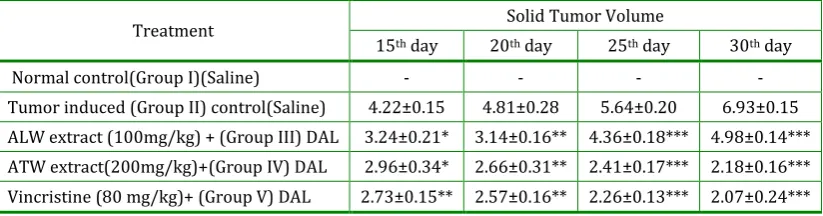
carried out to evaluate the antitumor activity of ethanol extract of A. travancorica in DAL tumor bearing mice. The ethanol extract of A. travancorica treated animals at the doses of 100 and 200 mg/kg significantly decreased the tumor volume, packed cell volume, tumor (viable) cell count and brought back
the hematological parameters to more or less normal levels.
In DAL tumor bearing animals a regular rapid increase in ascitic tumor volume was observed. Ascitic fluid is the direct nutritional source for tumor cells and a rapid increase in ascitic fluid with tumor growth would be a means to meet the nutritional requirement of tumor cells.[23]
Treatment with ethanol extract of A. travancorica inhibited the tumor volume, viable tumor cell count and increased the life span of the tumor bearing mice. The reliable criteria for judging the value of any anticancer drug are the prolongation of the lifespan of animals. [24] It may be concluded that ethanol extract
of A. travancorica by decreasing the nutritional fluid volume and arresting the tumor growth increases the life span of DAL bearing mice. Thus ethanol extract of A. travancorica have antitumor activity against DAL bearing mice.
Usually, in cancer chemotherapy the major problems that are being encountered are myelosuppression and anemia. [25-26] The anemia encountered in tumor
bearing mice is mainly due to reduction in RBC or Hb and this may occur either due to iron deficiency or due to hemolytic or myelopathic conditions.[27] In DAL
control group, a differential count the presence of neutrophils increased, while the lymphocyte count decreased, the observed leucocytopenia indicates a common symptom of immunosuppression in many types of cancer[28-29] and one of the causes of
neutrophilia is myeloid growth factors which are produced in malignant process as part of a paraneoplastic syndrome. In addition to this another factor granulocyte colony stimulating factor produced by the malignant cells has also been attributed to be the cause of neutrophilia because of its action on bone marrow granulocytic cells in cancer. After the repeated, ethanol extract of A. travancorica able to reverse the changes in altered neutrophils and lymphocytes count.[30-31] Treatment with both doses of
levels significantly. This clearly indicates that ethanol extracts of A. travancorica possess protective action on the haemopoietic system.
Plant derived compounds have played an important role in the development of several clinical useful
anticancer agents.[32] Phytol,
Tetrahydrospirilloxanthin and levo-á-Elemene were reported in the ethanol extract of A. travancorica whole plant by GC-MS analysis. These compounds may play a role in anticancer activity.[33]
CONCLUSION
The present study concluded that the ethanol extract has shown a remarkable anticancer activity against the experimental cells namely Dalton’s Ascitic Lymphoma (DAL). This holds great promise for future research in human beings.
ACKNOWLEDGEMENT
The Authors wish to thank Dr. R. Sampatharaj, Honorary Advisor, Samsun Clinical Research Laboratory, Tirupur, for their assistance in animal studies.
Table 1: Effect of ATW on relative organ weights of tumor induced (DAL) and drug treated mice
Treatment Body weight Relative Organ Weight (g/100g body wt.)
(g) Spleen Thymus Liver Kidney Lungs
Normal control(Group I)(Saline) 19.28±0.56 0.39±0.014 0.21±0.013 3.18±0.64 0.91±0.04 0.54±0.011
Tumor induced (GroupII) control(Saline) 41.64±1.93** 0.58±0.026* 0.39±0.026* 4.93±0.29ns 1.74±0.05* 0.87±0.053ns
ATW extract (100 mg/kg)+(GroupIII)
DAL 30.26±1.42aa 0.38±0.023a 0.29±0.012a 3.92±0.20 1.21±0.04ns 0.55±0.021a
ATW extract(200mg/kg)+(GroupIV)DAL 18.91±0.65aa 0.29±0.022aa 0.24±0.037a 3.24±0.25 0.89±0.03ns 0.47±0.018a
Vincristine (80 mg/kg)+ (GroupV)DAL 20.43±0.22aa 0.28±0.019 0.23±0.014a 3.81±0.18 0.98±0.07 0.54±0.027a
Each Value is SEM of 6 animals Significance between normal control, tumor induced control vs drug treated group * P <0.05; ** P < 0.01; NS :Not significant : a P <0.05 ; aa P < 0.01- Significance between tumor induced control vs drug treated group
Table 2: Antitumor activity of ATW extracts on solid tumor volume in tumor(DAL)induced mice
Treatment Solid Tumor Volume
15th day 20th day 25th day 30th day
Normal control(Group I)(Saline) - - - -
Tumor induced (Group II) control(Saline) 4.22±0.15 4.81±0.28 5.64±0.20 6.93±0.15
ALW extract (100mg/kg) + (Group III) DAL 3.24±0.21* 3.14±0.16** 4.36±0.18*** 4.98±0.14***
ATW extract(200mg/kg)+(Group IV) DAL 2.96±0.34* 2.66±0.31** 2.41±0.17*** 2.18±0.16***
Vincristine (80 mg/kg)+ (Group V) DAL 2.73±0.15** 2.57±0.16** 2.26±0.13*** 2.07±0.24***
Table 3: Antitumor activities of ATW on the survival time, life span, tumor volume and viable and non-viable cell count in tumor Induced mice
Treatment Mean Survival time (Days) Increase of life span (%) Packed cell
volume
Viable cell count
X 106 cells/ml
Non-viable tumor cells count X
106cells/ ml
Normal control(Group I)(Saline) - - - - -
Tumor induced (Group II)
control(Saline) 19.80±0.11 - 3.83±0.016 16.91±0.93 0.93±0.016
ATW extract (100mg/kg)+
(Group III) DAL 28.14±0.21** 42.12 2.45±0.014** 9.28±0.18** 1.42±0.021**
ATWextract(200mg/kg)+(GroupIV)DAL 35.65±0.47** 80.05 1.45±0.023** 6.19±0.25** 2.18±0.034**
Vincristine (80 mg/kg)+ (Group V)DAL 34.90±0.55** 76.26 1.64±0.018** 6.26±0.13** 2.26±0.011**
Each Value is SEM of 6 animals Significance between tumor induced control vs drug treated group * P < 0.05 ;** P < 0.01 ; NS :Not significant
Table 4: Anticancer activity of ATW extracts on hematological parameters in tumor (DAL) bearing mice
Parameter Hb (gm%) (million/mmRBC 3) (10WBC 3 cells/
mm3)
Differential count
Lymphocytes Neutrophils Eosinophil
Normal control(Group I) (Saline) 11.96±0.12 3.13±0.27 9.16±0.88 52.12±2.11 43.16±1.13 4.72±0.14
Tumor induced (Group II) control
(Saline) 8.12±0.16* 2.57±0.12* 13.86±0.36* 43.84±1.26 50.18±1.12* 5.98±0.26
ATW extract (100mg/kg)+ (Group
III) DAL 12.14±0.12a 3.84±0.06a 11.32±0.24a 48.24±1.14 46.24±1.08 4.76±0.12
ATW extract (200mg/kg)+ (Group
IV) DAL 14.06±0.21a 4.14±0.46a 8.31±0.13a 55.28±1.16 41.13±0.62 3.59±0.26
Vincristine (80 mg/kg)+ (Group V)
DAL 13.76±0.36a 4.05±0.74a 7.84±0.17a 53.13±0.91 44.28±0.76 2.59±0.15a
Each Value is SEM of 6 animals Significance between normal control, tumor induced control vs drug treated group * P < 0.05 ;** P < 0.01;
NS: Not significant: a P <0.05 ; aa P < 0.01- Significance between tumor induced control vs drug treated group
REFERENCES
1. Krishnamurthy K. Screening of natural products for
anticancer and antidiabetic properties. Healt. Admin. 2007; 1&2: 69-75.
2. Umadevi M, Sampath Kumar K.P., Debjit Bhowmik.,
Duraivel S. TraditionallyUsedAnticancer HerbsIn
India. J.Med.Plants.Studies. 2013;1:56-74.
3. Divisi D, Di T.S., Salvemini S, Garramone M, Crisci R.
Diet and cancer. Acta. Biomed. 2006; 77: 118-123.
4. Mohammad S. Anticancer agents from medicinal
plants. Bangladesh J. Pharmacol. 2006; 1: 35-41.
5. Hartwell J.L. Plants used against cancer. A survey.
Quarterman Publications, Lawrence; 1982.
6. Kinghorn A.D., Farnsworth N.R., Soejarto D.D.,
Cordell G.A., Swanson S.M., Pezzuto J.M., Wani M.C., Wall M.E., Oberlies N.H., Kroll D.J., Kramer R.A., Rose W.C., Vite G.D., Fairchild C.R., Peterson R.W., Wild R. Novel strategies for the discovery of plant derived anticancer agents. Pharmaceut Biol. 2003; 41: 53-67.
7. Surh Y.J. Cancer chemoprevention with dietary
phytochemicals. Nature. Rev. Cancer 2003; 3: 768-780.
8. Nair P.K.R., Melnickb S.J., Wnukc S.F, Rapp M.,
Escalon E., Ramachandran C. Isolation and characterization of an anticancer catechol compound
from Semecarpus anacardium. J. Ethnopharmacol.
2009; 122: 450-456.
9. Tan G, Gyllenhaal C, Soejarto D.D. Biodiversity as a
source of anticancer drugs. Curr Drug Targets 2006; 7: 265-277.
10. Cragg G.M., Newman D.J. Antineoplastic agents from
natural sources: achievements and future directions. Expet Opin Investig Drugs. 2000; 9: 1-15.
11. Pezzuto J.M. Plants derived anticancer agents.
Biochem. Pharmacol. 1997; 53: 121-133.
12. Sutha S, Mohan V.R, Kumaresan S, Murugan C,
of rheumatism. Indian. J. Trad .Knowledge. 2010; 9: 502-509.
13. OECD,2002.( Organization for Economic co-operaion
and Development).OECD guidelines for the testing of chemicals /Section 4: Health Effects Test No. 423; Acute oral Toxicity –Acute Toxic Class method. OECD. Paris.2002.
14. Gothoskar S.V., and Ranadive K.J. Anticancer
screening of SAN-AB; an extract of marking nut,
Semicarps anacardium. Indian. J. Exp. Biol.1975; 9: 372- 375.
15. Mazumder U.K., Gutpa M., Maiti S. and Mukherjee D.
Antitumor activity of Gygrophila spinosa on Ehrlich
Acsites Carcinoma and Sarcoma -180 induced mice, Indian. J. Exp. Biol. 1997; 35: 473-477.
16. Dacie J.V and Lewis S.M. Practical Haematology 2nd
ed. J and A Churchill, London 1958; 38-40.
17. Jasmine M., Ali M.M., Biswas A.K., Habib M.R.,
Khanam J.A. Antineoplastic activity of Nickel (II) – Cystine complex against Ehrlich Ascites Carcinoma in Swiss Albino mice. Medical Journal of Islamic World Academy of Science. 2008; 16:135–142.
18. Abeeu L.A., Abeeu R.R. Changes induced by Ehrlich
Ascites carcinoma in hepatic Fumarase and Aconitase activities. RJ (Brazil). 1979. p. 1536.
19. Radha R., Kavimani S., Ravichandran V. Antitumor
activity of methanolic extract of Plumeria Alba Linn
leaves against Dalton’s Lymphoma sascites in mice. Int. J. Health. Res.2008; 1:79–85.
20. Dauod M, Nihat D, Hatice G, Muharren B. Antitumor
activity of Ethanol Extract of Nigella sativa seeds. Bilogia Bratisiava. 2004; 59: 735-740.
21. Rajkapoor B, Jayakar B, Murugesh N. Antitumor
activity of Indigofera asphalathoides on Ehrlich
Ascites Carcinoma in mice. Indian. J. Pharmacol. 2004; 36: 38-40.
22. Durairaj A., Vaiyapuri T., Mazumder U.K., Gupta M.
Antineoplastic and antioxidant activities of Oxystelma esculentum on Swiss albino mice bearing Ehrlich’s ascites carcinoma. Pharmaceutic. Biol. 2009; 47:195-202.
23. Prasad S.B., Giri A. Anti tumor effect of cisplatin
against Murine Ascites Dalton’s lymphoma. Indian J. Exp. Biol. 1994; 32:155-62.
24. Clarkson B.D., Burchenal J.H. Preliminary screening
of antineoplastic drugs. Prog. Clin. Cancer. 1965; 1:625-9.
25. Price V.E., Greenfield R.E. Anemia in cancer. Adv.
Cancer Res. 1958; 5:199-200.
26. Hogland H.C. Hematological complication of cancer
chemotherapy. Semin. Oncol. 1982; 9:95-102.
27. Fenninger L.D., Mider G.B. Energy and nitrogen
metabolism in cancer. Adv. Cancer Res.1954; 2: 229-253.
28. Rashid F., Waraich N., Bhatti I., Saha S., Khan R.N.,
Ahmed J., Leeder P.C., Larvin M., Iftikhar S.Y. A pre-operative elevated neutrophil lymphocyte ratio does not predict survival from oesophageal cancer reaction. World. J. Sur. Oncolo. 2010; 6: 1-10.
29. Ropponen K.M., Eskelinen M.J., Lipponen P.K., Alhava
E., Kosma V. Prognostic value of tumour-infiltrating lymphocytes (TILs) in colorectal cancer. J. Pathol. 1997; 182: 318–24.
30. Ulich T.R., Del Castillo J., Watson L.R., Yin S.M.,
Garnick M.B. In vivo hematologic effects of
recombinant human macrophage colony stimulating factor. Blood. 1990; 75: 846-850.
31. Uchida T., Yamagiwa A. Kinetics of Rg-CSF induced
neutrophila in mice. Experi. Hematol. 1992; 20: 152-155.
32. Newman D.J., Cragg G.M., Sredei K.M. Natural
products as sources of new drugs over the period
1981- 2002, J. Nat. Prod. 2006; 66: 1022-1037.
33. Komalavalli T., Packia Lincy M., Muthukumarasamy
S., Mohan V.R. Determination of Bioactive
Components of Asystasia travancorica Bedd
(Acanthaceae) by GC-MS Analysis. Inter. J. Pharmaceu. Clini. Res. 2014; 6: 155-158.
How to cite this article: Komalavalli.T1,Packia Lincy.
M2, Muthukumarasamy.S3 Mohan V.R2*; Anticancer
activity of ethanol extract of Asystasia travancorica Bedd (Acanthaceae) whole plant against Dalton Ascites Lymphoma; J. Adv. Pharm. Edu. & Res. 2014: 4(2): 240-246.