9 Language
Šarolta Godnič Vičič
university of Primorska Slovenia
2015, Vol. 12 (2), 9-28(244) revije.ff.uni-lj.si/elope doi: 10.4312/elope.12.2.9-28 uDC: 811.111’42:338.48
Variation and Change in the Grammatical
Marking of Stance: The Case of
That
-Complement
Clauses in Research Articles
abStraCtVariation in the genre of research articles has been extensively studied across different disciplines and languages; however, diachronic change and intradisciplinary variation in this academic genre have received less attention. Therefore this paper aims to shed light on change and variation in research articles within a multidisciplinary field of research by focusing on the use of that -complement clause constructions which are known to mark stance. The corpus-based study uses tourism studies as an example, and covers the time span from 1995 to 2010. Diachronic change in the use of that-complement clause constructions was found in instances when they are marked by a verb as well as in the kinds of stance meanings conveyed. Significant intradisciplinary variation was also found across the journals.
Keywords: research articles; that-complement clause constructions; stance; variation; diachronic change
Variiranje in spremembe slovnične označenosti
vrednotenja propozicij: Primer stavčnih struktur
z “that” v znanstvenih člankih
PoVzetekznanstveni članki so kot žanr dobro preučeni po posameznih vedah in v različnih jezikih, vendar raziskave redkeje načenjajo vprašanja diahronega spreminjanja in intradisciplinarnega variiranja tega akademskega žanra. Cilj tega prispevka je razkriti spreminjanje in variiranje znanstvenih člankov v angleškem jeziku na multidisciplinarnem raziskovalnem polju turističnih študij z vidi-ka vrednotenja propozicij s pomočjo stavčne strukture z besedo “that”. korpusna analiza besedil se osredotoča na obdobje med 1995 in 2010. Izsledki raziskave kažejo na diahrono spreminjanje rabe te stavčne strukture vrednotenja v primerih, ko trditve vrednotijo glagoli, pa tudi v po-menih, ki jih vrednotenja izražajo. ugotovljeno je bilo tudi variiranje v rabi stavčne strukture vrednotenja med revijami.
10 Šarolta godnič Vičič Variation and Change in the Grammatical Marking of Stance: The Case of That-Complement ...
Variation and Change in the Grammatical
Marking of Stance: The Case of
That
-Complement
...Clauses in Research Articles
11 Introduction
This paper deals with intradisciplinary variation and diachronic change in the use of that -complement clauses. Such clauses are known to provide a rich source of stance expressions in research articles (RAs). Stance has been identified as one of the most important aspects of academic discourse and numerous studies have investigated it across various disciplines, focusing on hedging and boosting devices (Hyland 1996, 1998), adverbials (biber and Finegan 1988), reporting clauses (Charles 2006), complement clauses (biber 1999, 2004; Hyland and Tse 2005a, 2005b; Charles 2007), and highlighting the many ways in which these linguistic expressions allow writers to convey their personal feelings and assessments.
This study is part of a larger corpus-based and corpus-driven exploration of variation and recent change in RAs of a rapidly evolving multidisciplinary research field – tourism studies – over a time span of 15 years. The word that has been preliminarily identified as one of the key grammatical words in the tourism RA corpus when compared to the british National Corpus, with a log likelihood (LL) value of 55.36 (p<0.0000000001); its frequency increased significantly between 1995 and 2005 (LL 85.33). The number of 2-, 3- and 4- word clusters including that which were used at least 5 times in the individual yearly tourism studies subcorpora increased as well.2 Clusters
with the word that were thus used significantly less often in 1995 than in more recent years (LL values ranged from 76.74 to 306.33), which seems to suggest that the academic community is, increasingly, using some of the phraseology with that more often than before. Finally, the most frequent left collocates included suggest, indicate, show, argue, the fact, which all govern that -complement clause constructions that are typical stance expressions in RAs. Therefore it seemed reasonable to expect that the analysis of that-complement clauses would reveal relevant findings about variation and change in the genre of RAs in the field of tourism studies.
The following review of the literature will provide a short overview of research on variation and change in the genre of RAs, stance in RAs, and tourism studies as a field of scholarly inquiry. In the next section, the materials and methods used in the study will be outlined, followed by the presentation of the results of the corpus-based analysis of that-complement clause constructions. In the final part of this paper, the findings will be discussed together with their contribution to our understanding of intradisciplinary variation and diachronic change in RAs and their implications for further research.
2 Literature Review
2.1 Variation and Change in RAs
Academic genres, especially the genre of RAs, have been extensively explored over the past four decades or so. While the early studies focused mainly on the typical linguistic features
11 LANgUAgE and rhetorical structures of research articles or their parts in a single discipline or a range of undifferentiated disciplines (see Swales 1990 for an overview), later studies have been increasingly focusing on rhetorical organisations (Paltridge 1997; Ozturk 2007; Lin and Evans 2012) and the linguistic realisations of discoursal features that display specificity of individual disciplines (gledhill 2000; Hyland 2000, 2008; Hyland and Tse 2005a, 2005b; Hu and Cao 2015). This has placed variation across disciplines at the heart of linguistic research. Since genres are perceived as communicative events that serve particular communicative purposes shared and recognised by members of discourse communities (Swales 1990), variation in the genre of RAs is generally attributed to the values, epistemology and research practices as well as varying communicative purposes of individual discourse communities (Hyland 2000; Hyland, 2005; Samraj 2005; Ozturk 2007; Mcgrath and Kuteeva, 2012). However, connecting variation in linguistic and discourse features of RAs with variation in meaning at the level of epistemology is not possible without an understanding of the contexts in which the texts were created and used. This is probably why studies of academic literacies which aim to provide insight into the contexts of academic communication (Harwood 2009; Lillis et al. 2010; Jarc and godnič Vičič 2012; Mcgrath 2014) have recently gained in importance.
Yet, variation in the genre of RAs does not only occur across disciplinary divides, but also within individual disciplines. Although intradisciplinary variation is rarely the object of linguistic inquiry, research has nevertheless shown that it is affected by authors’ various linguistic and cultural backgrounds (Salager-Meyer et al. 2003; Peterlin Pisanski 2005; bondi 2009; Mur Dueñas 2010; Lorés Sanz 2011), the existence of different research paradigms within a discipline (gray 2013; godnič Vičič and Jarc 2015), the types of research paper written (Harwood 2009), specificities of subdisciplines (Samraj 2005; Maswanaa et al. 2015) and the degree to which they are established within the discipline (Ozturk 2007), multidisciplinarity, not to mention interdisciplinarity in the field of study (Samraj 2005; godnič Vičič 2013, 2015; Tessuto 2014) and the niches occupied by individual journals (godnič Vičič 2013; godnič Vičič and Jarc 2015).
Diachronic change in the genre of RAs has been addressed even less often. Halliday (1988) and bazerman (1988) were among the first to trace the origins of this genre – the former by exploring the diachronic evolution of scientific language and the latter by investigating scientists’ quest for objectivity and accountability in writing and the changing formats of research articles. Later studies (Atkinson 1992; Salager-Meyer1999; Taavitsainen and Pahta 2000) also revealed the shift in the history of scientific discourse from author-centred to object-centred narratives that are highly informational and abstract. The stylistic changes in the genre have been attributed to the increasingly competitive nature of discourse communities (Salager-Meyer 1999; godnič Vičič 2013), globalisation processes (Salager-Meyer et al. 2003), changes in writing, publishing and reading practices (Solaci and Pereira 2004; Li and ge 2009; godnič Vičič 2013), as well as the development of information technologies and online environments (Li and ge 2009; Pérez-Llantada 2013; godnič Vičič 2013).
2.2 Stance in RAs
12
it from different angles almost simultaneously, each building on different earlier works and using different terms and theoretical frameworks to explain the same phenomenon.3 However,
these terms that range from stance (biber and Finnegan 1988), hedging and boosting (Hyland 1996, 1998) to appraisal (Martin 2000; Martin and White 2005) and evaluation (Hunston and Thompson 2000), all distinguish meanings that “(a) indicate a speaker/writer’s personal attitudes, emotions and assessments, and (b) comment on the epistemic status of an entity or, more commonly, a proposition containing a piece of information” (gray and biber 2012, 19). These two meanings are not equally important in all genres: stance expressions vary to some degree from genre to genre not only in their frequencies (they are far more frequent in spoken language than in RAs) but also in their preferred lexical realisations and their functions (biber et al. 1999, biber 2006). The linguistic realisation of stance in English ranges from grammatical to lexical, while in speech, paralinguistic features can also express stance-related meanings (biber et al. 1999). grammatical markings of stance include modal and semi-modal verbs, stance adverbials, complement clause constructions (that- and to-complement clauses) and stance noun + prepositional phrase constructions (biber et al. 1999). While the first two groups have been explored quite extensively (e.g., biber and Finegan 1988; Hyland 1996, 1998), researchers’ interest in the latter two has arisen more recently.
That-complement clause constructions,4 which are the focus of this study, often mark the
main argument, summarize the purpose of the research, form an assessment of the validity of information presented and comment on the writer’s own work (Hyland and Tse 2005b). They do so by allowing writers to thematize attitudinal meanings and present the proposition as new information (Hyland and Tse 2005a). The evaluation of the proposition can be attributed to humans (the writer or other researchers), an abstract entity (e.g., results) or to a concealed source (Charles 2003, 2006, 2007; Hyland and Tse 2005a, 2005b) (e.g., “It is well known that Antalya is the most globally-connected and dense tourism area of Turkey.”).
That-complement clause constructions comprise an expression of stance and a proposition which is marked by that stance. For example, if we compare
“tourist behavior is different from regular consumer behavior in several ways” with
“gitelson and Crompton (1984) claimthat tourist behavior is different from regular consumer behavior in several ways”,
we can see that the former statement is presented as a fact while the second, which is marked by the communication verb claim, is attributed to gitelson and Crompton, which allows the writer to avoid taking responsibility for the proposition’s truth value. The choice of the verb in this construction is meaningful in itself: by choosing a particular reporting verb, the writer chooses to convey a particular attitude or assessment.
That-complement clauses can be marked by different categories of verbs: communication (e.g., argue, reveal, suggest), attitudinal (e.g., ensure, expect, feel) and epistemic, i.e., factive (e.g., find, note, show) and likelihood verbs (e.g., assume, believe, indicate) (biber 2004, 2006). They can also be governed by nouns and adjectives:
3 See Hunston and Thompson (2000) and Hyland and guinda (2012) for an oveview. 4 Hyland and Tse (2005a) call them “evaluative that-structures”.
13 LANgUAgE “Place dependence is derived from a transactional viewthat suggests people evaluate places against alternatives.”
“Hence, it is not surprisingthat public transport supply is not affected by the average prices of a passenger per km.”
That-complement clauses can be governed by communication nouns (e.g., comment, proposal, report), attitudinal (e.g., fear, reason, view) and epistemic nouns – i.e., factive (e.g., conclusion, fact, result), and likelihood nouns (e.g., expectation, idea, perception). The adjectives controlling that-complement clauses are attitudinal (e.g., aware, concerned, surprising), evaluative (e.g. essential, noteworthy) and epistemic adjectives (e.g., clear, likely, possible) (biber 2004, 2006).5
Research has been consistent in that that-complement clauses governed by verbs are most frequent in RAs while those governed by nouns and adjectives are far less common (biber 1999, 2004, 2006; biber et al. 1999; Hyland and Tse 2005a, 2005b). There is also agreement that there is variation in the frequencies of individual grammatical markings (i.e., verbs, nouns, adjectives) of stance across disciplines and genres (biber 1999, 2004, 2006; biber et al. 1999; Hyland and Tse 2005a, 2005b; Charles 2007; gray and biber 2012) and that these change in time (biber 2004). The complementizer that is almost always retained in RAs (biber 1999; Hyland and Tse 2005a), although it is frequently omitted in spoken language. Finally, that-complement clauses governed by nouns are most typical of written academic genres but largely absent from spoken language (even from spoken academic genres (biber 2006)).
2.3 Tourism Studies
Tourism is perceived by tourism professionals as a business activity that can bring economic benefits to countries around the world, and by academics as an object of serious scholarly inquiry. Tourism studies, as academics often call it, is a dynamic multidisciplinary research field that has been expanding and evolving from the 1960s onward, buttressed by sociology, geography, economics, anthropology, philosophy, psychology, etc., each bringing their theories, paradigms, methodologies and languages into the study, extending existing concepts from their original fields to the field of tourism studies (Tribe 2010). While some perceive this field as an emerging new discipline (Leiper 2000), others claim it is but a field of studies in which knowledge is created through multidisciplinary, interdisciplinary and extradisciplinary approaches (Tribe 2004, 2010). The status of tourism studies remains a contested issue of great importance to the academic community (Tribe 1997, 2010; Franklin and Crang 2001; Pritchard et al. 2011; Tribe et al. 2015). Research in the field has either a strong business focus (e.g., management, marketing) or deals with non-business issues altogether (Tribe 2004, 2010). The different traditions and schools of thought coexist, and research focuses on a wide range of themes and uses a broad range of methodological approaches. While quantitative research approaches prevailed in the beginning, qualitative methodologies started to gain a stronger footing in the late 1990s.
The academic community is rather diverse and largely employed at universities. While universities can stimulate research, they can also adversely affect it with organisational, time and funding constraints as well as requirements to publish in top-tier journals (Tribe 2010). Research is too
14
often driven by tourism industry needs (Franklin and Crang 2001); however, as tourism research can be relatively inexpensive, the academic community can find their ways to academic freedom (Tribe 2010).
As regards membership, the community has a long way to go in terms of gender balance (Aitchison 2001). Furthermore, while the community is multinational, the great majority of the 100+ scholarly journals in the field is published in English. About 80% of tourism studies journals are published in the USA, UK, Canada or Australia (Cheng et al. 2011). It comes as no surprise, therefore, that English is the ‘lingua franca’ of the field and that research published in other languages mostly goes unnoticed (Dann 2011).
The range of topics explored by tourism research has widened since the 1970s. However, recently-established journals are increasingly specialised compared to earlier ones (Cheng et al. 2011). Annals of Tourism Studies was the first journal included in Thomson Reuters’ Social Sciences Citation Index (SSCI), in 1982, while others were slow to join. A special category called “Hospitality, leisure, sport and tourism” was created within SSCI in 2008, with only eleven tourism journals in it at present (Yuan et al. 2014).6 The most prominent among these are Annals of Tourism Research, Tourism Management, Journal of Sustainable Tourism and Journal of Travel Research as assessed by SSCI impact factor and by quality ratings of scholars themselves (Pechlaner et al. 2004; McKertcher et al. 2006; Yuan et al. 2015).
3 Materials, Methods and Tools
Variation and change in the use of that-complement clause constructions to mark stance in RAs is explored using a corpus and a combination of qualitative and quantitative methods of analysis (McEnery et al. 2006). The material for the Tourism Studies Corpus was compiled based on journal quality and prominence in the tourism studies discourse community as well as the time of publication.
The corpus thus comprises RAs from the following journals: Annals of Tourism Research (ATR), Journal of Sustainable Tourism (JST), Journal of Travel Research (JTR) and Tourism Management (TM) (Table 1).
Table 1.Details of the journals.
in other languages mostly goes unnoticed (Dann 2011).
The range of topics explored by tourism research has widened since the 1970s. However, recently-established journals are increasingly specialised compared to earlier ones (Cheng et al. 2011). Annals of Tourism Studies was the first journal included in Thomson Reuters’ Social Sciences Citation Index (SSCI), in 1982, while others were slow to join. A special category called “Hospitality, leisure, sport and tourism” was created within SSCI in 2008, with only eleven tourism journals in it at present (Yuan et al. 2014).6 The most prominent among these are Annals of Tourism Research, Tourism Management, Journal of Sustainable Tourism and
Journal of Travel Research as assessed by SSCI impact factor and by quality ratings of scholars themselves (Pechlaner et al. 2004; McKertcher et al. 2006; Yuan et al. 2015).
3 Materials, Methods and Tools
Variation and change in the use of that-complement clause constructions to mark stance in RAs is explored using a corpus and a combination of qualitative and quantitative methods of analysis (McEnery et al. 2006). The material for the Tourism Studies Corpus was compiled based on journal quality and prominence in the tourism studies discourse community as well as the time of publication.
The corpus thus comprises RAs from the following journals: Annals of Tourism Research
(ATR), Journal of Sustainable Tourism (JST), Journal of Travel Research (JTR) and Tourism Management (TM) (table 1).
TABLE 1: Details of the journals
Although all four journals publish papers dealing with topics such as tourism marketing and management (Yuan et al. 2015), they manage to occupy distinct niches within the field of tourism studies that are recognized by experienced scholars. Thus ATR is the only journal that targets the academic community alone, while the remaining journals’ intended audiences include academics, practitioners and educators alike, which reflects the emphasis that the academic community places on practical relevance of research. ATR is also a distinct social sciences journal with a multidisciplinary approach to tourism research. TM and JTR publish papers with a stronger business orientation, the former covering a more diverse range of topics than the latter. JST is a more recent and highly specialized journal publishing research on the topic of sustainable tourism development only. It welcomes papers with economic, social, organisational, environmental as well as interdisciplinary approaches. Finally, ATR and TM are both published by the same publisher, Elsevier. JST was published by Channel View Publications until 2008, when Taylor and Francis (Routledge) bought it, continuing its publication. This coincided with the journal’s inclusion in SSCI. JTR is supported by the Travel
6 The category includes more journals; however, scholars agree that tourism studies are far too different from
hospitality, leisure and sport to be included in the same group. As a result, Jamal et al. (2008) suggest that SSCI’s ratings of journals do not reflect tourism journals’ relevance correctly.
Although all four journals publish papers dealing with topics such as tourism marketing and management (Yuan et al. 2015), they manage to occupy distinct niches within the field of tourism studies that are recognized by experienced scholars. Thus ATR is the only journal that targets the
6 The category includes more journals; however, scholars agree that tourism studies are far too different from hospitality, leisure and sport to be included in the same group. As a result, Jamal et al. (2008) suggest that SSCI’s ratings of journals do not reflect tourism journals’ relevance correctly.
15 LANgUAgE academic community alone, while the remaining journals’ intended audiences include academics, practitioners and educators alike, which reflects the emphasis that the academic community places on practical relevance of research. ATR is also a distinct social sciences journal with a multidisciplinary approach to tourism research. TM and JTR publish papers with a stronger business orientation, the former covering a more diverse range of topics than the latter. JST is a more recent and highly specialized journal publishing research on the topic of sustainable tourism development only. It welcomes papers with economic, social, organisational, environmental as well as interdisciplinary approaches. Finally, ATR and TM are both published by the same publisher, Elsevier. JST was published by Channel View Publications until 2008, when Taylor and Francis (Routledge) bought it, continuing its publication. This coincided with the journal’s inclusion in SSCI. JTR is supported by the Travel and Tourism Research Association and published by Sage.
The corpus includes yearly volumes of RAs from the four journals at five-year intervals from 1995 till 2010. The corpus comprises 723 RAs and about 4.5 million words in all (Table 2). The corpus was split into smaller subcorpora when needed for the analysis of variation and change in the use of that-complement clause constructions across the journals and time periods.
Table 2.Details of the tourism studies corpus.
and Tourism Research Association and published by Sage.
The corpus includes yearly volumes of RAs from the four journals at five-year intervals from 1995 till 2010. The corpus comprises 723 RAs and about 4.5 million words in all (table 2). The corpus was split into smaller subcorpora when needed for the analysis of variation and change in the use of that-complement clause constructions across the journals and time periods. TABLE 2: Details of the tourism studies corpus
Biber’s (2004) extensive list of stance words7 was used for the analysis. This list of stance words is not perfect, as Biber himself acknowledges (Gray and Biber 2012). However, expanding it with other stance expressions is difficult as these do not tend to be used in explicit lexico-grammatical patterns which would allow large-scale analysis (Gray and Biber 2012). The list’s expansion, therefore, remains beyond the scope of this paper. Following Biber (1999) and Hyland and Tse (2005a), cases where the complementizer that is omitted were disregarded. WordSmith Tools 5 (Scott 2008) was used to retrieve frequencies of words and clusters with
that, to compare words across time and journals and inspect concordances. Clusters of words with that and individual categories of stance meanings were compared with the Online log likelihood calculator of Lancaster University (http://ucrel.lancs.ac.uk/llwizard.html). There are some differences in the way log likelihood is calculated by WordSmith Tools 5 and University Lancaster’s Online log likelihood calculator; however, at a p-value threshold of 0.001, these seem of minor importance.
4 Findings
4.1 Diachronic Change in the Use of that-Complement Clause Constructions
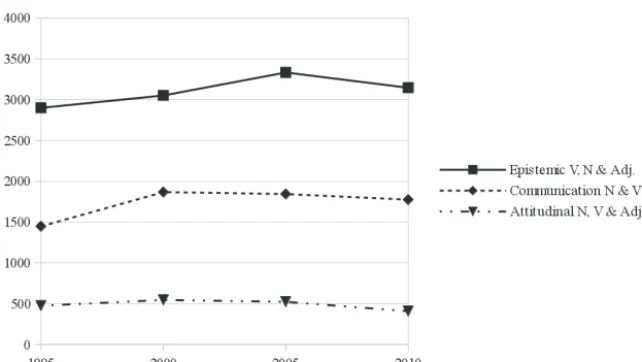
That-complement clauses governed by verbs, nouns and adjectives were significantly less frequent in 1995 than in 2000, 2005 or 2010 (LL 33.84, 67.93 and 23.04, respectively).8 The average number of these stance expressions per paper has increased from 25 in 1995 to 33 in 2000 and 37 in 2005, while decreasing slightly in 2010 to 36. This drop (expressed in actual frequencies of that-complement clauses), however, was statistically relevant (LL 19.68). As figure 1 shows, the change was not equal across the groups of grammatical words that govern
that-complement stance expressions. In line with other research (Biber 1999, 2004, 2006; Biber et al. 1999; Hyland and Tse 2005a, 2005b), the verb group was the most frequent and the adjective group the least. The overall increase in the use of that-complement clauses to express stance is exclusively due to the increase in complement clauses governed by verbs (the comparison of the 1995 subcorpus with the 2000 subcorpus produced LL 44.28, the comparison
7 Only that part of the list which covers the verbs, nouns and adjectives which govern that-complement clauses was used for the analysis.
8 The higher the value of LL is, the less likely it is that the result is due to chance. The threshold value of p < 0.001, which is used in this study, indicates that at the critical value of 10.83 there is 99.9% confidence that the difference is significant and not due to chance fluctuation.
biber’s (2004) extensive list of stance words7 was used for the analysis. This list of stance words is
not perfect, as biber himself acknowledges (gray and biber 2012). However, expanding it with other stance expressions is difficult as these do not tend to be used in explicit lexico-grammatical patterns which would allow large-scale analysis (gray and biber 2012). The list’s expansion, therefore, remains beyond the scope of this paper. Following biber (1999) and Hyland and Tse (2005a), cases where the complementizer that is omitted were disregarded.
WordSmith Tools 5 (Scott 2008) was used to retrieve frequencies of words and clusters with that, to compare words across time and journals and inspect concordances. Clusters of words with that and individual categories of stance meanings were compared with the Online log likelihood calculator of Lancaster University (http://ucrel.lancs.ac.uk/llwizard.html). There are some differences in the way log likelihood is calculated by WordSmith Tools 5 and University Lancaster’s Online log likelihood calculator; however, at a p-value threshold of 0.001, these seem of minor importance.
4 Findings
4.1 Diachronic Change in the Use of
That
-Complement
Clause Constructions
That-complement clauses governed by verbs, nouns and adjectives were significantly less frequent
16
in 1995 than in 2000, 2005 or 2010 (LL 33.84, 67.93 and 23.04, respectively).8 The average
number of these stance expressions per paper has increased from 25 in 1995 to 33 in 2000 and 37 in 2005, while decreasing slightly in 2010 to 36. This drop (expressed in actual frequencies of that-complement clauses), however, was statistically relevant (LL 19.68).
As Figure 1 shows, the change was not equal across the groups of grammatical words that govern that-complement stance expressions. In line with other research (biber 1999, 2004, 2006; biber et al. 1999; Hyland and Tse 2005a, 2005b), the verb group was the most frequent and the adjective group the least. The overall increase in the use of that-complement clauses to express stance is exclusively due to the increase in complement clauses governed by verbs (the comparison of the 1995 subcorpus with the 2000 subcorpus produced LL 44.28, the comparison to the 2005 subcorpus LL 78.15, and the comparison to the 2010 subcorpus LL 46.11). The instances of that -complement clause constructions governed by nouns and adjectives decreased between 1995 and 2010, but this change was not statistically significant. The fall in the frequency of that-complement clauses governed by nouns between 2005 and 2010 was, however, statistically relevant (LL 17.48). Since stance expressions are also categorized along the cline from epistemic (i.e., expressing certainty and likelihood), communication (style of speaking/writing) to attitudinal meanings, these three categories of stance meanings were also explored separately. While the use of verbs, nouns and adjectives expressing attitudinal meanings decreased slightly between 1995 and 2010, their drop between 2005 and 2010 was distinct and statistically relevant (LL 20.39) (Figure 2). While the increase in the frequencies of that-complement clauses controlled by verbs, nouns and adjectives with epistemic meanings was statistically relevant only when the 1995 and 2000 subcorpora were compared to the 2005 subcorpus (LL 28.00 and 13.26, respectively), the increase in the use of that -complement clause constructions with a communication meaning was statistically relevant when 1995 was compared to 2000, 2005 and 2010 (LL was 44.77, 44.08 and 31.80, respectively). The decrease in the frequency of this stance meaning between 2005 and 2010 is not relevant.
to the 2005 subcorpus LL 78.15, and the comparison to the 2010 subcorpus LL 46.11). The instances of that-complement clause constructions governed by nouns and adjectives decreased between 1995 and 2010, but this change was not statistically significant. The fall in the frequency of that-complement clauses governed by nouns between 2005 and 2010 was, however, statistically relevant (LL 17.48).
Since stance expressions are also categorized along the cline from epistemic (i.e., expressing certainty and likelihood), communication (style of speaking/writing) to attitudinal meanings, these three categories of stance meanings were also explored separately. While the use of verbs, nouns and adjectives expressing attitudinal meanings decreased slightly between 1995 and 2010, their drop between 2005 and 2010 was distinct and statistically relevant (LL 20.39) (figure 2). While the increase in the frequencies of that-complement clauses controlled by verbs, nouns and adjectives with epistemic meanings was statistically relevant only when the 1995 and 2000 subcorpora were compared to the 2005 subcorpus (LL 28.00 and 13.26, respectively), the increase in the use of that-complement clause constructions with a communication meaning was statistically relevant when 1995 was compared to 2000, 2005
FIGURE 1: Frequencies of stance verbs, nouns and adjectives per 1,000,000 words
Figure 1. Frequencies of stance verbs, nouns and adjectives per 1,000,000 words.
8 The higher the value of LL is, the less likely it is that the result is due to chance. The threshold value of p < 0.001, which is used in this study, indicates that at the critical value of 10.83 there is 99.9% confidence that the difference is significant and not due to chance fluctuation.
17 LANgUAgE
FIGURE 2: Frequencies of that-complement clause constructions according to meaning expressed per 1,000,000 words
and 2010 (LL was 44.77, 44.08 and 31.80, respectively). The decrease in the frequency of this stance meaning between 2005 and 2010 is not relevant.
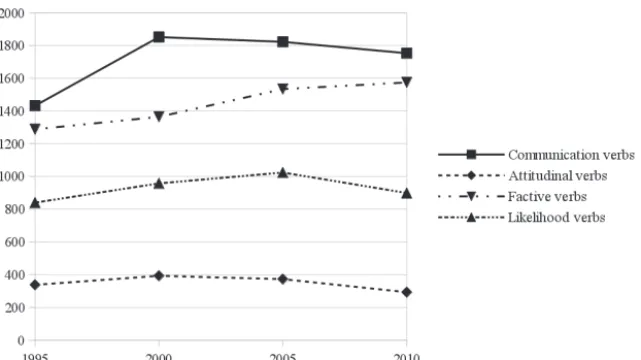
A closer look at the nouns and verbs from the communication meaning group (figures 3 and 4) reveals that the increase in the use of communication meanings is entirely due to the verbs: firstly, because communication nouns represent a tiny fraction of the total number of nouns controlling that-complement clauses, and, secondly, the number of communication nouns is relatively stable while the number of communication verbs has increased significantly in the 2000 subcorpus (LL 44.94) and remained significantly higher in both 2005 and
FIGURE 3: Frequencies of nouns controlling that-complement clause constructions by meaning per 1,000,000 words
Figure 2. Frequencies of that-complement clause constructions according to meaning expressed per 1,000,000 words.
A closer look at the nouns and verbs from the communication meaning group (Figures 3 and 4) reveals that the increase in the use of communication meanings is entirely due to the verbs: firstly, because communication nouns represent a tiny fraction of the total number of nouns controlling that-complement clauses, and, secondly, the number of communication nouns is relatively stable while the number of communication verbs has increased significantly in the 2000 subcorpus (LL 44.94) and remained significantly higher in both 2005 and 2010 (LL 32.43). In the attitudinal meaning group, both attitudinal verbs and attitudinal nouns exhibited similar trends in change over the years; however, the change was relevant only in attitudinal verbs – i.e., the fall in the frequencies of attitudinal verbs between 2005 and 2010 (LL 13.17). Whereas the number of factive nouns in the epistemic meaning group dropped after 2005, the number of factive verbs showed a steady increase throughout the period studied – a statistically relevant increase between
FIGURE 2: Frequencies of that-complement clause constructions according to meaning
expressed per 1,000,000 words
and 2010 (LL was 44.77, 44.08 and 31.80, respectively). The decrease in the frequency of this stance meaning between 2005 and 2010 is not relevant.
A closer look at the nouns and verbs from the communication meaning group (figures 3 and 4) reveals that the increase in the use of communication meanings is entirely due to the verbs: firstly, because communication nouns represent a tiny fraction of the total number of nouns controlling that-complement clauses, and, secondly, the number of communication nouns is relatively stable while the number of communication verbs has increased significantly in the 2000 subcorpus (LL 44.94) and remained significantly higher in both 2005 and
FIGURE 3: Frequencies of nouns controlling that-complement clause constructions by meaning
per 1,000,000 words
18
1995 and 2010 (LL 30.32). The frequency of likelihood verbs in this group increased until 2005 (the difference is relevant: LL is 16.82) and then fell (LL 11.25). The frequency of likelihood nouns, on the other hand, fluctuated, but the differences were not statistically relevant. All in all, the most relevant changes in the use of that-complement clause construction seems to be related to the use of verbs in this stance device.
Interestingly, none of the individual nouns or adjectives that can mark that-complement clauses showed any relevant increase or decrease in the period studied. As regards the individual verbs, three groups were identified: verbs with no relevant change in frequencies (the great majority of verbs were in this group), verbs whose frequency increased between 1995 and 2000 (the difference was statistically relevant) and then dropped by 2010, such as state, assume and indicate, and verbs whose frequency increased between 1995 and 2005 and went on increasing in 2010 as well, such as contend, reveal, demonstrate, find and show. A detailed analysis of their meanings and textual functions will have to be left for future research.
4.2 Variation and Change in the Use of
that
-Complement
Clause Constructions across the Journals
Variation and change in the use of that-complement clauses to mark stance across the tourism journals was studied only in instances where the complement clause was controlled by a verb. The frequencies of nouns and adjectives controlling this stance device were so low (e.g., in 1995, the number of communication nouns in JST and JTR was 0 and 1, respectively) that it would be difficult to draw meaningful conclusions. As the comparisons between the 1995 and 2005 subcorpora showed the most relevant results so far, the verbs in the 1995 subcorpora of the individual journals were compared only to the 2005 subcorpora.
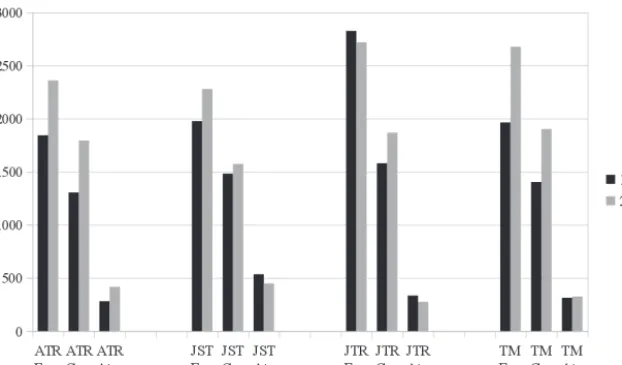
The overall frequencies of verbs controlling that-complement clauses increased in all four journals between 1995 and 2005 (Figure 5). While the change was only slight in the two journals with the highest number of that-complement clause constructions – JST and JTR – the increase in the use of this stance device was statistically relevant in ATR and TM (LL 48.49 and 55.69, respectively).
FIGURE 4: Frequencies of verbs controlling that-complement clause constructions by meaning per 1,000,000 words
2010 (LL 32.43). In the attitudinal meaning group, both attitudinal verbs and attitudinal nouns exhibited similar trends in change over the years; however, the change was relevant only in attitudinal verbs – i.e., the fall in the frequencies of attitudinal verbs between 2005 and 2010 (LL 13.17). Whereas the number of factive nouns in the epistemic meaning group dropped after 2005, the number of factive verbs showed a steady increase throughout the period studied – a statistically relevant increase between 1995 and 2010 (LL 30.32). The frequency of likelihood verbs in this group increased until 2005 (the difference is relevant: LL is 16.82) and then fell (LL 11.25). The frequency of likelihood nouns, on the other hand, fluctuated, but the differences were not statistically relevant. All in all, the most relevant changes in the use of that -complement clause construction seems to be related to the use of verbs in this stance device. Interestingly, none of the individual nouns or adjectives that can mark that-complement clauses showed any relevant increase or decrease in the period studied. As regards the individual verbs, three groups were identified: verbs with no relevant change in frequencies (the great majority of verbs were in this group), verbs whose frequency increased between 1995 and 2000 (the difference was statistically relevant) and then dropped by 2010, such as state, assume and indicate, and verbs whose frequency increased between 1995 and 2005 and went on increasing in 2010 as well, such as contend, reveal, demonstrate, find and show. A detailed analysis of their meanings and textual functions will have to be left for future research.
4.2 Variation and Change in the Use of that-Complement Clause Constructions across the
Journals
Variation and change in the use of that-complement clauses to mark stance across the tourism journals was studied only in instances where the complement clause was controlled by a verb. The frequencies of nouns and adjectives controlling this stance device were so low (e.g., in 1995, the number of communication nouns in JST and JTR was 0 and 1, respectively) that it would be difficult to draw meaningful conclusions. As the comparisons between the 1995 and 2005 subcorpora showed the most relevant results so far, the verbs in the 1995 subcorpora of the individual journals were compared only to the 2005 subcorpora.
The overall frequencies of verbs controlling that-complement clauses increased in all four
Figure 4. Frequencies of verbs controlling that-complement clause constructions by meaning per 1,000,000 words.
19 LANgUAgE A closer look at the groups of stance meanings conveyed by these verbs reveals a slightly different view on these changes (Figure 6). There was a slight downward trend in the use of attitudinal verbs controlling that-complements in JST and JTR as well as in the use of epistemic verbs in JTR. All the remaining categories of stance verbs in these two journals show an upward trend, as do all categories of stance verbs in ATR and TM. Nevertheless, statistically relevant change was found only in that-complement clauses governed by epistemic and communication verbs in ATR (LL 18.87 and 23.02, respectively) and TM (LL 34.98 and 23.98, respectively). 9
9 Ep – epistemic; Co – communication; At – attitudinal
journals between 1995 and 2005 (figure 5). While the change was only slight in the two journals with the highest number of that-complement clause constructions – JST and JTR – the increase in the use of this stance device was statistically relevant in ATR and TM (LL 48.49 and 55.69, respectively).
A closer look at the groups of stance meanings conveyed by these verbs reveals a slightly different view on these changes (figure 6). There was a slight downward trend in the use of
FIGURE 5: Overall frequencies of that-complement clause constructions governed by stance
verbs in 1995 and 2005 per 1,000,000 words
FIGURE 6: Variation and change in that-complement clause constructions governed by verbs
across journals per 1,000,000 words9
attitudinal verbs controlling that-complements in JST and JTR as well as in the use of epistemic verbs in JTR. All the remaining categories of stance verbs in these two journals show an upward trend, as do all categories of stance verbs in ATR and TM. Nevertheless, statistically relevant change was found only in that-complement clauses governed by epistemic and communication verbs in ATR (LL 18.87 and 23.02, respectively) and TM (LL 34.98 and 23.98, respectively).
9 Ep – epistemic; Co – communication; At – attitudinal
0 1000 2000 3000 4000 5000 6000
ATR JST JTR TM
1995 2005
Figure 5. Overall frequencies of that-complement clause constructions governed by stance verbs in 1995 and 2005 per 1,000,000 words.
journals between 1995 and 2005 (figure 5). While the change was only slight in the two journals with the highest number of that-complement clause constructions – JST and JTR – the increase in the use of this stance device was statistically relevant in ATR and TM (LL 48.49 and 55.69, respectively).
A closer look at the groups of stance meanings conveyed by these verbs reveals a slightly different view on these changes (figure 6). There was a slight downward trend in the use of
FIGURE 5: Overall frequencies of that-complement clause constructions governed by stance
verbs in 1995 and 2005 per 1,000,000 words
FIGURE 6: Variation and change in that-complement clause constructions governed by verbs
across journals per 1,000,000 words9
attitudinal verbs controlling that-complements in JST and JTR as well as in the use of epistemic verbs in JTR. All the remaining categories of stance verbs in these two journals show an upward trend, as do all categories of stance verbs in ATR and TM. Nevertheless, statistically relevant change was found only in that-complement clauses governed by epistemic and communication verbs in ATR (LL 18.87 and 23.02, respectively) and TM (LL 34.98 and 23.98, respectively).
9 Ep – epistemic; Co – communication; At – attitudinal 0
1000 2000 3000 4000 5000 6000
ATR JST JTR TM
1995 2005
20
The analysis of frequencies of individual verbs in the communication and epistemic categories of stance verbs in ATR and TM identified two communication verbs whose frequencies changed significantly in ATR – i.e., argue and reveal (LL 11.43 and 20.26, respectively); a communication verb – i.e., reveal (LL 13.30); and three epistemic verbs in TM – i.e., find (LL 14.12), show (LL 28.46) and indicate (LL 16.72). These were further studied in detail in the contexts of the individual journals. Individual functions or categories of use of these verbs, however, have not yet shown statistically relevant changes. Consequently, the following comparisons are descriptive only. In ATR, it seems that the number of authors using that-complements governed by argue is increasing (55% in 1995 and 78% in 2005). This verb is mainly used in the corpora either to comment on the writer’s own work, e.g.,
“It is argued here that a feminist approach to the study of tourism is equally appropriate.” (ATR 1995)
or the work of other researchers, e.g.,
“In a seminal work on this topic, boorstin (1992) argued that contemporary Americans are unable to experience reality, but that they thrive on ‘pseudo-events,’ i.e., on images or illusions that veil the real world.” (ATR 1995)
Such examples can be found in all RA sections. This construction allows writers to build their arguments especially when they are developing their theoretical frameworks as in the examples above. The construction also allows writers to interpret evidence from their data or draw conclusions based on evidence, e.g.,
“Returning to the weak correlations between representations and perceptions, it is argued that this is explained by the homogeneity of contemporary media productions about Tibet in popular culture.” (ATR 2005)
About half of the instances of the propositions in these stance constructions is clearly attributed to other researchers in both 1995 and 2005. About a quarter of instances of this stance device in both subcorpora is used with an it-extraposition, which puts the proposition in focus and gives it an objective appearance (Charles 2006), regardless of whether it is attributed to the writer or to someone else; i.e.,
“It is argued here that Jafari’s framework is inadequate for the 21st century because it fails to consider ethics and the concept of sustainable development.” (ATR 2005)
“It has been argued that regulating the inflow and taxing tourists may remedy the problem (bird 1992; Clarke and Ng 1993; Hughes 1981).” (ATR 2005)
That-complement clauses governed by the verb reveal are most frequent in the results section in both journals and in both time frames. The ways in which that-complement clauses controlled by reveal are used in the two journals’ corpora seem similar. They can nevertheless be found in the other sections of the RA too – mainly attributing propositions to some evidence: results, findings, data, studies, analysis and the like; e.g.,
“The study revealed that American representations of India were embedded with colonial discourse, as the country was portrayed as timeless and primitive.” (ATR 2005)
21 LANgUAgE Again, the instances of this stance construction are so few in the 1995 subcorpora that it is not possible to draw significant conclusions regarding diachronic change in the way the construction is used.
The epistemic verbs which control that-complement clause constructions and showed significant increase in TM between 1995 and 2005 – i.e., find, indicate and show – are most often used in the results section of RAs. However, they can also be used in other parts of RAs, which is most evident in the larger 2005 subcorpus.
That-complement clauses controlled by the verb find are most frequently used in literature reviews and the results sections of RAs. both are equally frequent in the 1995 subcorpus. However, the 2005 subcorpus shows that the number of instances of this stance device is increasing in the literature review – mainly to report the findings of other researchers, i.e.,
“Similarly, Kippendorf (1987) found that tourists are motivated by ‘going away from rather than going toward something’ and that tourist motivation is self oriented.” (TM 2005) However, instances of that-complement clauses marked with find can also attribute the propositions to the writer, especially following it-extrapositions, e.g.,
“It was found that each destination has unique knowledge needs and, therefore, the knowledge map structure should be built to meet the needs and preferences of destination knowledge users.” (TM 2005)
Obviously, this is one of the ways in which writers can create an appearance of objectivity when reporting their own findings.
Although that-complements controlled by indicate can be found in all parts of the RA, they are by far most frequent in the results sections. The propositions in the complement clauses are attributed most often to some research evidence of the writer such as results/findings, analysis, study and respondents, e.g.,
“The results indicate that tourists to the balearics are not satisfied with the prices of complementary holiday services and the germans, above all, are critical of the urban and environmental setting.” (TM 2005)
Interestingly, this stance construction is also used to attribute propositions to other researchers in the 2005 subcorpus but not in that of 1995, i.e.,
“bartos (1982) indicated that women who were employed were more likely to participate in the pleasure vacation decision-making process than women who did not work outside of their home.”
Finally, the verb show governs that-complement clauses when research evidence is the evaluative source, too, e.g.,
“The results showed that 74.9% of total visitors’ expenditures (US$43,689) were spent outside Carbondale, while 25.1% were spent locally.” (TM 2005)
It comes as no surprise then that the most frequent left collocates of this stance verb are research, results, findings, analysis, table #,10 and figure #.
22
While that-complement clauses controlled by show can be found in various parts of the RA, they are most frequent in the results section. The propositions can be attributed to the writer’s own research, findings by other researchers and to other sources of data. In the 2005 TM subcorpus, the number of propositions attributed to the writer’s own research increased quite substantially. The number of propositions attributed to other researchers has risen, too. They were generally unnamed in the 1995 TM subcorpus (e.g., “A number of other studies have shown that” or “Research has shown that...”) but attributed to specific researchers and their publications in the 2005 subcorpus.
5 Discussion and Conclusion
The aim of this study was to explore variation and recent diachronic change in the genre of RAs within a multidisciplinary field of research. Since the word that had been recognized as a salient word in the tourism studies RA corpus and its most frequent collocates included stance verbs and nouns, that-complement clause constructions were selected for further analysis. This stance device is believed to be highly relevant for academic discourse (biber 1999, 2004; Hyland and Tse 2005a, 2005b).
Some of the changes in the tourism studies academic community may have affected the ways in which stance expressions are used in RAs. First of all, the circumstances in which researchers in the field of tourism studies work are increasingly challenging and competitive. The formation of the “Hospitality, leisure, sport and tourism” category in SSCI in 2008 not only affected the status of the journals newly included in this index category, but also the impact factors of those that had been in SSCI prior to 2008 – ATR and TM. Publishing opportunities in top-tier journals increased for the community as a result.
Changes were also found in the number of RAs published per journal volume, increasing between 1995 and 2010 in all four journals, as did the average number of words per RA. While the increase in the number of RAs per volume was small in JTR and ATR, it was much more substantial in TM from 2005 onward and in JST in 2010. The average length of the articles increased most in the business oriented journals – i.e., JTR and TM – and the least in the social sciences journal – ATR. As it is the editorial boards that determine the maximum length of RAs, just like the number of issues published per year, we can conclude that it is likely that the changes in RA length and number of RAs published were due to editorial decisions made in increasingly competitive circumstances. With higher impact factors and enhanced visibility of the journals, the number of manuscripts submitted for publication probably increased.11 As a result, editorial
boards could select RAs for publication based on more stringent criteria.
Stance may be an important aspect of academic discourse but it is also relatively infrequent, as gray and biber (2012) suggested. Nevertheless, diachronic change in the use of that -complement clause constructions as well as variation in their use among the journals were both confirmed. While the frequency of this stance device increased significantly between 1995 and 2010, a detailed analysis showed that this change was entirely due to the significantly higher frequencies of that-complement clauses marked by verbs. The frequencies of that-complement clauses marked by nouns and adjectives did not show any significant change until 2005, when their frequencies decreased significantly. This finding is dissimilar to findings by biber (2004)
11 The number of submissions and acceptance rates are most often treated as internal quality control benchmarks; therefore, journals do not publish them on their website.
23 LANgUAgE for medical scholarly discourse for the time before 1990. The discrepancy in the results may be attributed to a couple of factors. Firstly, there may be differences in the ways that that -complement clause constructions are used in the two fields. Secondly, the ARCHER corpus used by biber (2004) comprises only 10 medical RAs for each 50-year period, which is probably sufficiently large and reliable when general trends are studied but less so when the focus is on details, as in this study.
Change was also identified in the individual meaning categories of that-complement clause constructions. Significant increase in the use of stance expressions with an epistemic meaning was found between 1995 and 2005 as well as a significant and steady increase in the use of stance expressions with a communication meaning throughout the period studied. The increased use of epistemic stance expressions is in line with biber’s (2004) findings.
When types of grammatical words controlling that-complement clauses within individual groups of stance meanings were studied separately, only the use of verbs with communication, likelihood and factive meanings increased significantly. The analysis of the frequencies of individual words within the meaning groups revealed that the great majority of words in biber’s list of words controlling that-complements did not show any relevant change. The frequencies of the few that did either went on increasing throughout the time frame studied or increased until 2005 and then dropped.
The big drop in the number of instances of that-complement clause constructions that took place between 2005 and 2010 affected all categories of word types marking that-complement clauses and stance meanings. However, a closer look at the stance meaning groups revealed that the decrease was significant in that-complement clause constructions with attitudinal meanings, as well as that-complement clauses marked by nouns and likelihood verbs. What circumstances caused this significant downturn is difficult to determine. At this moment we can only suspect that it may be somehow connected with the status changes of tourism journals in 2008. If so, the significantly more frequent use of that-complement clauses marked by communication and factive verbs suggests that, more frequently than before, the authors of the RAs that withstood the scrutiny of peer-review in 2010 used these two particular stance constructions to elaborate on the knowledge claims and findings of their community as well as their own. Attitudinal and likelihood that-complement clause constructions were obviously less valued by the disciplinary gatekeepers.
Significant variation was detected among the journals. ATR and TM were identified as the journals in which the overall frequencies of that-complement clauses significantly increased. Furthermore, it is in these two journals only that the number of epistemic and communication verbs marking that-complement clauses rose significantly. both journals are published by Elsevier and have been included in SSCI the longest. However, they also operate in different topical niches: one has a theoretical and multidisciplinary focus while the other has an applicative and business focus. It seems that the journals’ publishing and editorial practices were more influential than the topical niches the journals occupy. The strength of publishing practices has also been recognized by other researchers (Solaci and Pereira 2004; biber 2005; Li and ge 2009).
24
clause constructions play important roles when shared knowledge, research findings, and their interpretations are discussed. The increased use of factive verbs in TM is in line with Hyland and Tse’s (2005a) finding that these verbs are more frequent in business studies than in social sciences. Last but not least, a word or two about the corpus. The time frame used to study change in the use of stance expressions was felt to be too short. Significant change seems to happen slowly even in rapidly evolving fields of study. What is more, when linguistic phenomena are studied that are not very frequent, significant change is even more difficult to determine. Nevertheless, dividing the corpus into subcorpora based on the sources of RAs appears to be a good decision. Variation among journals is something scholars take for granted when they write RAs. This should be recognized when corpora are designed. Corpora have to allow for reliable cross journal comparisons when discourse within a discipline is studied.
All in all, we can establish that the increased use of communication and epistemic stance expressions implies that knowledge is probably negotiated more often in RAs than it was before. The communication verbs marking that-complement clauses allow writers to present their own propositions and the propositions of other researchers with different degrees of support for their truth value while the epistemic verbs allow writers to ground findings in research practices and lend them greater credibility. However, as suggested above, connecting these findings with the realities of the academic community remains rather difficult. The writing and publishing practices of the community and the editorial practices of journals, which may all affect writers’ stylistic choices, remain an under-researched topic.
This study alone cannot provide a full account of change and variation in the use of stance in tourism studies RAs. Future studies would have to address the remaining types of stance expressions if we are to gain a more thorough understanding of how stance changes over time in RAs and how it varies within individual disciplines or research fields. Finally, further research on publishing and writing practices of scholars engaged in tourism studies would also be needed if changes in linguistic expression identified by research were to be grounded in actual scholarly practices in the field.
Acknowledgement
This study is funded by the “Innovative scheme for the co-financing of PhD studies to promote social challenges – generation 2012” of the EU Structural Funds and the Cohesion Fund.
References
Aitchison, Cara. 2001. “gender and Leisure Research: The ‘Codification of Knowledge’.” Leisure Sciences 23 (1): 1–19. doi:10.1080/01490400150502216.
bazerman, Charles. 1998. “Emerging Perspectives on the Many Dimensions of Scientific Discourse.” In Reading Science, edited by James Martin in Robert Veel, 15–30. London: Routledge.
biber, Douglas. 1999. “A Register Perspective on grammar and Discourse: Variability in the Form and Use of English Complement Clauses.” Discourse Studies 1 (2): 131–50. doi:10.1177/1461445699001002001.
––. 2004. “Historical Patterns for the grammatical Marking of Stance: A Cross-Register Comparison.” Journal of Historical Pragmatics 5 (1): 107–36. doi:10.1075/jhp.5.1.06bib.
––. 2006. “Stance in Spoken and Written University Registers.” Journal of English for Academic Purposes 5 (2): 97–116. doi:10.1016/j.jeap.2006.05.001.
25 LANgUAgE
biber, Douglas, and Edward Finegan. 1988. “Adverbial Stance Types in English.” Discourse Processes 11: 1–34. doi:10.1080/01638538809544689.
biber, Douglas, and bethany gray. 2013. “being Specific about Historical Change: The Influence of Sub-Register.” Journal of English Linguistics 41 (2): 104–34. doi:10.1177/0075424212472509.
biber, Douglas, Stig Johansson, geoffrey Leech, Susan Conrad, and Edward Finegan. 1999. Longman Grammar of Spoken and Written English. Harlow: Longman.
bondi, Marina. 2009. “Polyphony in Academic Discourse: A Cross-Cultural Perspective?” In Cross-Cultural and Cross-Linguistic Perspectives on Academic Discourse, edited by Eija Suomela-Salmi and Fred Dervin, 83–108. Amsterdam: John benjamins.
Charles, Maggie. 2003. “‘This Mystery. . .’: A Corpus-based Study of the Use of Nouns to Construct Stance in Theses from Two Contrasting Disciplines.” Journal of English for Academic Purposes 2 (4): 313–26. doi:10.1016/S1475-1585(03)00048-1.
––. 2006. “The Construction of Stance in Reporting Clauses: A Cross-Disciplinary Study of Theses.” Applied Linguistics 27 (3): 492–518. doi:10.1093/applin/aml021.
––. 2007. “Argument or Evidence? Disciplinary Variation in the Use of the Noun That Pattern in Stance Construction.” English for Specific Purposes 26 (2): 203‒18. doi:10.1016/j.esp.2006.08.004. Cheng, Chia-Kuen, Xiang (Robert) Li, James F. Petrick, and Joseph T. O’Leary. 2011. “An Examination
of Tourism Journal Development.” Tourism Management 32 (1): 53‒61. doi:10.1016/j. tourman.2009.11.004.
Dann, graham. 2011. “Anglophone Hegemony in Tourism Studies Today.” Enlightening Tourism. A Pathmaking Journal 1 (1): 1‒30.
Franklin, Adrian, and Mike Crang. 2001. “The Trouble with Tourism and Travel Theory?” Tourist Studies 1 (1): 5–22. doi:10.1177/146879760100100101.
gledhill, Christopher. 2000. Collocations in Science Writing. Tübingen: gunter Narr.
godnič Vičič, Šarolta. 2013. “The Difference a Word Can Show: A Diachronic Corpus-based Study of the Demonstrative ‘this’ in Tourism Research Article Abstracts.” In Variation and Change in Spoken and Written Discourse: Perspectives from corpus linguistics, edited by Julia bamford, Silvia Cavalieri and giuliana Diani, 223‒38. Amsterdam: John benjamins.
godnič Vičič, Šarolta, and Mojca Jarc. 2015. “The Long and Winding Road to International Academic Recognition: The Case of Slovene Social Sciences Authors.” In Akademski jeziki v času globalizacije / Academic Languages in the Era of Globalisation, edited by Sonja Starc, 229‒41. Koper: Annales. gray, bethany. 2013. “More than Discipline: Uncovering Multi-Dimensional Patterns of Variation in
Academic Research Articles.” Corpora 8 (2): 153‒81. doi:10.3366/cor.2013.0039.
gray, bethany, and Douglas biber. 2012. “Current Conceptions of Stance.” In Stance and Voice in Written Academic Genres, edited by Ken Hyland and Carmen Sancho guinda, 15‒33. basingstoke: Palgrave Macmillan.
Halliday, Michael A. K. 1998. “Language and Knowledge: The ‘Unpacking’ of Text.” In The Language of Science, edited by Jonathan J. Webster, 24–48. London: Continuum.
Harwood, Nigel. 2009. “An Interview-based Study of the Functions of Citations in Academic Writing across Two Disciplines.” Journal of Pragmatics 41 (3): 497‒518. doi:10.1016/j.pragma.2008.06.001.
26
Hunston, Susan, and geoff Thompson. 2000. Evaluation in Text: Authorial Stance and the Construction of Discourse. Oxford: Oxford University Press.
Hyland, Ken. 1996. “Writing without Conviction? Hedging in Science Research Articles.” Applied Linguistics 17: 433–54. doi:10.1093/applin/17.4.433.
––. 1998. “boosting, Hedging and the Negotiation of Academic Knowledge.” Text 18: 349–83. doi:10.1515/ text.1.1998.18.3.349.
––. 2000. Disciplinary Discourses: Social Interactions in Academic Writing. Harlow: Pearson.
––. 2005. “Stance and Engagement: A Model of Interaction in Academic Discourse.” Discourse Studies 7: 173–91.doi:10.1177/1461445605050365.
Hyland, Ken, and Polly Tse. 2005a. “Evaluative that Constructions: Signaling Stance in Research Abstracts.” Functions of Language 12 (1): 39–63. doi:10.1075/fol.12.1.03hyl.
––. 2005b. “Hooking the Reader: A Corpus Study of Evaluative that in Abstracts.” English for Specific Purposes 24 (2): 123–39. doi:10.1016/j.esp.2004.02.002.
Hyland, Ken, and Carmen Sancho guinda. 2012. Stance and Voice in Written Academic Genres. Houndmills: Palgrave Macmillan.
Jamal, Tazim, brian Smith, and Elizabeth Watson. 2008. “Ranking, Rating and Scoring of Tourism Journals: Interdisciplinary Challenges and Innovations.” Tourism Management 29 (1): 66–78. doi:10.1016/j. tourman.2007.04.001.
Jarc, Mojca, and Šarolta godnič Vičič. 2015. “Research Articles in Sociology: Variation within the Discipline.” In English for Academic Purposes: Approaches and Implications, edited by Paul Thompson and giuliana Diani, 79–101. Newcastle: Cambridge Scholars Publishing.
Leiper, Neil. 2000. “An Emerging Discipline.” Annals of Tourism Research 27 (3): 805–9. doi:10.1016/S0160-7383(99)00118-8.
Li, Li-Juan, and guang-Chun ge. 2009. “genre Analysis: Structural and Linguistic Evolution of the English-Medium Medical Research Article (1985–2004).” English for Specific Purposes 28 (2): 93–104. doi:10.1016/j.esp.2008.12.004.
Lillis, Theresa, Ann Hewings, and Dimitra Vladimirou. 2010. “The geolinguistics of English as an Academic Lingua Franca: Citation Practices across English-Medium National and English-Medium International Journals.” International Journal of Applied Linguistics 20 (1): 111–35. doi:10.1111/j.1473-4192.2009.00233.x.
Lin, Ling, and Stephen Evans. 2012. “Structural Patterns in Empirical Research Articles: A Cross-Disciplinary Study.” English for Specific Purposes 31 (3): 150–60. doi:10.1016/j.esp.2011.10.002.
Lorés-Sanz, Rosa. 2011. “The Construction of the Author’s Voice in Academic Writing: The Interplay of Cultural and Disciplinary Factors.” Text & Talk - An Interdisciplinary Journal of Language, Discourse & Communication Studies 31 (2): 173–93. doi:10.1515/text.2011.008.
Martin, James R. 2000. “beyond Exchange: APPRAISAL Systems in English.” In Evaluation in Text: Authorial Stance and the Construction of Discourse, edited by Susan Hunston and geoff Thompson, 142–75. Oxford: Oxford University Press.
Martin, James R., and Peter R. White. 2005. The Language of Evaluation. London: Palgrave Macmillan. Maswanaa, Sayako, Toshiyuki Kanamarub, and Akira Tajino. 2015. “Move Analysis of Research Articles across
Five Engineering Fields: What They Share and What They Do Not.” Ampersand 2: 1–11. doi:10.1016/j. amper.2014.12.002.
McEnery, Tony, Richard Xiao, and Yukio Tono. 2006. Corpus-Based Language Studies: An Advanced Resource Book. Abingdon: Routledge.
27 LANgUAgE
Mcgrath, Lisa. 2014. “Parallel Language Use in Academic and Outreach Publication: A Case Study of Policy and Practice.” Journal of English for Academic Purposes 13: 5–15. doi:10.1016/j.jeap.2013.10.008. Mcgrath, Lisa, and Maria Kuteeva. 2012. “Stance and Engagement in Pure Mathematics Research Articles:
Linking Discourse Features to Disciplinary Practices.” English for Specific Purposes 31 (3): 161–73. doi:10.1016/j.esp.2011.11.002.
McKercher, bob, Rob Law, and Terry Lam. 2006. “Rating Tourism and Hospitality Journals.” Tourism Management 27 (6): 1235–52. doi:10.1016/j.tourman.2005.06.008.
Mur-Dueñas, Pilar. 2012. “Exploring generic Integrity and Variation: Research Articles in Two English-medium International Applied Economics Journals.” In Insights into Academic Genres, edited by Carol berkenkotter, Vijay K. bhatia and Maurizio gotti, 107–26. bern: Peter Lang.
Ozturk, Ismet. 2007. “The Textual Organisation of Research Article Introductions in Applied Linguistics: Variability within a Single Discipline.” English for Specific Purposes 26: 25–38. doi:10.1016/j. esp.2005.12.003.
Paltridge, brian. 1997. Genre, Frames and Writing in Research Settings. Amsterdam: John benjamins. Pechlaner, Harald, Anita Zehrer, Kurt Matzler, and Dagmar Abfalter. 2004. “A Ranking of
International Tourism and Hospitality Journals.” Journal of Travel Research 42 (4): 328–32. doi:10.1177/0047287504263026.
Pérez-Llantada, Carmen. 2013. “The Article of the Future: Strategies for genre Stability and Change.” English for Specific Purposes 32 (4): 221–35. doi:10.1016/j.esp.2013.06.004.
Pisanski Peterlin, Agnes. 2005. “Text-Organising Metatext in Research Articles: An English–Slovene Contrastive Analysis.” English for Specific Purposes 24 (3): 307–19. doi:10.1016/j.esp.2004.11.001.
Pritchard, Annette, Nigel Morgan, and Irena Ateljevic. 2011. “Hopeful Tourism: A New Transformative Perspective.” Annals of Tourism Research 38: 941–63. doi:0.1016/j.annals.2011.01.004.
Salager-Meyer, Françoise. 1999. “From ‘Mr. gunthrie is Profoundly Mistaken...’ to ‘Our Data Do Not Seem to Confirm the Results of a Previous Study on...’: A Diachronic Study of Polemicity in Academic Writing (1819–1995).” Iberica 1: 5–28.
Salager-Meyer, Françoise, María Ángeles Alcaraz Ariza, and Nahirana Zambrano. 2003. “The Scimitar, the Dagger and the glove: Intercultural Differences in the Rhetoric of Criticism in Spanish, French and English Medical Discourse (1930–1995).” English for Specific Purposes 22 (3): 223–47. doi:10.1016/ S0889-4906(02)00019-4.
Samraj, betty. 2005. “An Exploration of a genre Set: Research Article Abstracts and Introductions in Two Disciplines.” English for Specific Purposes 24 (2): 141–56.doi:10.1016/j.esp.2002.10.001.
Scott, Mike. 2008. WordSmith Tools Version 5. Liverpool: Lexical Analysis Software.
Sollaci, Luciana b., and Mauricio g. Pereira. 2004. “The Introduction, Methods, Results, and Discussion (IMRAD) Structure: A Fifty-Year Survey.” Journal of the Medical Library Association 92 (3): 364–67. Swales, John. M. 1990. Genre Analysis: English in Academic and Research Settings. Cambridge: Cambridge
University Press.
Taavitsainen, Irma, and Päivi Pahta. 2000. “Conventions of Professional Writing: The Medical Case Report in a Historical Perspective.” Journal of English Linguistics 28 (1): 60–76.doi:10.1177/00754240022004875.
Tessuto, girolamo. 2014. “generic Structure and Rhetorical Moves in English-Language Empirical Law Research Articles: Sites of Interdisciplinary and Interdiscursive Cross-Over.” English for Specific Purposes 37: 13–26. doi:10.1016/j.esp.2014.06.002.
28
––. 2004. “Knowing about Tourism: Epistemological Issues.” In Qualitative Research in Tourism: Ontologies, Epistemologies and Methodologies, edited by Jenny Phillimore and Lisa goodson, 46–62. London: Routledge.
––. 2010. “Tribes, Territories and Networks in the Tourism Academy.” Annals of Tourism Research 37 (1): 7–33. doi:10.1016/j.annals.2009.05.001.
Tribe, John, graham Dann, and Tazim Jamal. 2015. “Paradigms in Tourism Research: A Trialogue.” Tourism Recreation Research 40 (1): 28–47.
Yuan, Yulan, Ulrike gretzel, and Yuen-Hsien Tseng. 2015. “Revealing the Nature of Contemporary Tourism Research: Extracting Common Subject Areas through bibliographic Coupling.” International Journal of Tourism Research 17 (5): 417–31. doi:10.1002/jtr.2004.
Yuan, Yulan Y., Yuen-Hsien Tseng, and Chun-Yen Chang. 2014. “Tourism Subfield Identification via Journal Clustering.” Annals of Tourism Research 47: 77–80. doi:10.1016/j.annals.2014.05.009.