The Silences Framework: A Method for researching
sensitive themes and marginalized health perspectives
(English version)
ROSSETTO, Maíra, BRAND, Évelin Maria, TEIXEIRA, Luciana Barcelos, DE
OLIVEIRA, Dora Lucia Leidens Correa and SERRANT, Laura
<http://orcid.org/0000-0002-9382-9859>
Available from Sheffield Hallam University Research Archive (SHURA) at:
http://shura.shu.ac.uk/17336/
This document is the author deposited version. You are advised to consult the
publisher's version if you wish to cite from it.
Published version
ROSSETTO, Maíra, BRAND, Évelin Maria, TEIXEIRA, Luciana Barcelos, DE
OLIVEIRA, Dora Lucia Leidens Correa and SERRANT, Laura (2017). The Silences
Framework: A Method for researching sensitive themes and marginalized health
perspectives (English version). Text & Context Nursing | Texto & Contexto
Enfermería, 26 (4).
Copyright and re-use policy
See
http://shura.shu.ac.uk/information.html
Original Article
THE SILENCES FRAMEWORK
:
METHOD FOR RESEARCH OF SENSITIVE
THEMES AND MARGINALIZED HEALTH PERSPECTIVES
Maíra Rossetto1, Évelin Maria Brand2, Luciana Barcelos Teixeira3, Dora Lucia Leidens Correa de Oliveira4,
Laura Serrant5
1 Ph.D. in Nursing. Professor, Medical School, Universidade Federal da FronteiraSul. Chapecó, Santa Catarina, Brasil. E-mail: maira.
2 Undergraduate student in Nursing, Universidade Federal of Rio Grande do Sul (UFRGS). Porto Alegre, Rio Grande do Sul, Brazil.
E-mail: [email protected]
3 Ph.D. in Epidemiology. Professor, Graduate Program in Public Health, UFRGS. Porto Alegre, Rio Grande do Sul, Brasil. E-mail:
4 Ph.D. in Education. Professor, Graduate Program in Nursing, UFRGS. Porto Alegre, Rio Grande do Sul, Brasil. E-mail: dora@enf.
ufrgs.br
5 Ph.D. in Nursing. Professor of Nursing in the Faculty of Health and Wellbeing at Sheffield Hallam University.England, United
Kingdom. E-mail: [email protected]
ABSTRACT
Objective: to describe the experience of applying of The Silences Frameworkto underpin health research investigating Tuberculosis/ HIV/AIDS coinfection.
Method: the Silences Framework originally developed following a study exploring the decisions and silences surrounding black Caribbean men living in England, discussing the themes ‘sexual health’ and ‘ethnicity’. Following this study, a conceptual theory for research on sensitive issues and health care of marginalized populations was developed called ‘Screaming Silences’, which forms the foundation of The Silences Framework. ‘Screaming Silences’ define research areas and experiences that are poorly studied, little understood or silenced.
Results: the Silences Framework supports researchers in revealing “silences” in the subjects they study - as such, results may reflect how beliefs, values, and experiences of some groups influence their health. This framework provides the application of four complementary
stages: working the silences, hearing silences, voicing silences and working with the silences. The analysis occurs cyclically and can be repeated as long as the silences inherent in a study are not revealed.
Conclusion: this article presents The Silences Framework and the application of the notion of “sounds of silence”, mapping an antiessentialist theoretical framework for its use in sensitive research in health and nursing areas, being a reference for other researchers in studies involving marginalized populations.
DESCRIPTORS: Inequalities in health. Methods. Nursing. Coinfection. Research. Tuberculosis. Acquired immunodeficiency syndrome.
THE SILENCES FRAMEWORK:
METODOLOGIA PARA PESQUISAS DE
TEMAS SENSÍVEIS E PERSPECTIVAS MARGINALIZADAS NA SAÚDE
RESUMO
Objetivo: descrever a utilização da metodologia The Silences Framework em uma pesquisa na área da saúde, envolvendo a temática da coinfecção tuberculose/HIV/aids.
Método: a metodologia foi originalmente utilizada para estudar decisões e silêncios de homens negros do Caribe que viviam na Inglaterra, problematizando-se os temas ‘saúde sexual’ e ‘etnicidade’ e resultando em uma teoria para a pesquisa de questões sensíveis e de cuidados de saúde de populações marginalizadas. The Silences Framework define áreas de pesquisa e experiências que são pouco estudadas,
compreendidas ou silenciadas.
Resultados: os “silêncios” podem refletir aspectos não compartilhados sobre como crenças, valores e experiências de alguns grupos influenciam sua saúde. Esse referencial prevê a aplicação de quatro estágios complementares: trabalhando os silêncios, ouvindo os silêncios,
dando voz aos silêncios e trabalhando com os silêncios. A análise ocorre de modo cíclico e pode ser repetida enquanto os silêncios não forem desvelados.
Conclusão: este artigo apresenta a noção de “sons do silêncio”, mapeando um quadro teórico antiessencialista para sua utilização em pesquisas sensíveis na area da saúde e da enfermagem, podendo ser referência para outros investigadores em estudos envolvendo populações marginalizadas.
DESCRITORES: Desigualdades em saúde. Métodos. Enfermagem. Coinfecção. Pesquisa. Tuberculose. Síndrome de imunodeficiência
adquirida.
Rossetto M, Brand EM, Teixeira LB, Oliveira DLLC, Serrant L 2/9
THE SILENCES FRAMEWORK
: METODOLOGÍA PARA INVESTIGACIONES
DE TEMAS SENSIBLES Y PERSPECTIVAS MARGINALIZADAS EN LA
SALUD
RESUMEN
Objetivo: describir la utilización de la metodología The Silences Framework en una investigación en el área de la salud, involucrando la temática de la co-infección Tuberculosis/VIH/SIDA.
Método: la metodología fue originalmente utilizada para estudiar decisiones y silencios de hombres negros del Caribe que vivían en Inglaterra, problematizándose los temas ‘salud sexual’ y ‘etnicidad’ y resultando en una teoría para la investigación de cuestiones sensibles y de cuidados de la salud de las poblaciones marginadas. The Silences Frameworkdefine áreas de investigación y experiencias que son poco
investigadas, comprendidas o silenciadas.
Resultados: Los “silencios” pueden reflejar aspectos no compartidos de cómo las creencias, valores y experiencias de algunos grupos influencian su salud. Este referencial prevé la aplicación de cuatro etapas complementarias: trabajando los silencios, oyendo los silencios,
dando voz a los silencios y trabajando con los silencios. El análisis ocurre de modo cíclico y puede ser repetido mientras los silencios no se desvelan.
Conclusión: este artículo presenta la noción de “sonidos del silencio”, mapeando un cuadro teórico anti-esencialista para su utilización en investigaciones sensibles en el área de la salud y de la enfermería, pudiendo ser referencia para otros investigadores en estudios involucrando poblaciones marginadas.
DESCRIPTORES: Desigualdades en salud. Métodos. Enfermería. Co-infección. Búsqueda. Tuberculosis. Síndrome de Inmunodeficiencia
Adquirida.
INTRODUCTION
In the health field, researching sensitive issues
and marginalized perspectives requires the develop-ment of methodologies that capture a universe of complex and often hidden meanings.1 This increases
the importance of making appropriate methodologi-cal choices.
The present article aims to support research-ers in health and nursing conducting such research by outlining The Silences Framework originally proposed in England and still little known in Brazil. The article illustrates the potential for this conceptual framework to aid in the development of Brazilian studies in these areas. The article presents the framework as used in a research study focus-ing on the politically sensitive and problematic issues related to why AIDS and tuberculosis (TB) continues to affect so many people in Brazil. The Silences Framework facilitated the use of a new methodological approach, exploration of the re-search problem, data collection processes, analysis and validation of results.
In 2012, there were 1.4 million new TB cases among those infected with HIV worldwide, lead-ing to a mortality rate of 456,000 individuals.2 In
that same year, in Brazil, the coinfection rate for TB and HIV was 9.9% and the mortality rate was 6%, which is three times higher than the mortality rates for other diseases.3
Rio Grande do Sul is the Brazilian state with the highest percentage of TB/HIV/AIDS coinfec-tion, with 20.3% of TB cases affecting people with HIV/AIDS. This percentage is almost twice higher
than the national average of 10.4%.4 Porto Alegre
is the Brazilian capital with the highest incidence and mortality of TB and HIV/AIDS individually, with the coinfection percentage reaching 28.0% of TB cases, which highlighted it as an example of the challenges associated with combating TB/HIV/ AIDS coinfection.4
Members of the scientific community, interna
-tional organizations and leaders in the fight against
AIDS and TB agree that combating coinfection from these diseases is a public health issue. As such, it
should also incorporate the fight against stigmas
and the promotion of human rights, with an em-phasis on reducing the vulnerability of marginalized populations.5
Historically, TB and HIV/AIDS illness have been marked by stigma and prejudice. Since its inception, AIDS has initiated discourses concern-ing the behavior of infected individuals, who are often accused of being negligent or irresponsible.6
be-havioral experiences that have their own meaning
specific to each individual.7
Among advances and setbacks, Brazilian public health policies are perceived as disregard-ing these issues in dealdisregard-ing with TB and HIV/AIDS coinfection. There is a permanent tension between “expanding the supply of exams and medicines and addressing the stigma and discrimination experi-enced for vulnerable populations”.8:296 The focus
of health policies in compliance with the drug use and more effective treatments has as a result often disregarding the social, cultural and economic
fac-tors that influence the failure/success of treatments
for HIV/AIDS, TB coinfection .
The research developed in Brazil using The Silences Framework method was associated with a series of politically sensitive concerns related to gender, schooling, race/color, territory and sexual behavior. Exploring these issues may help us to understand why TB/HIV/AIDS coinfection still af-fects so many subjects. This article aims to describe the use of the The Silences Framework in health research, concerning TB/HIV/AIDS coinfection.
METHOD
The Silences Frameworkwas applied in four
stages. In the first, a broad literature review was per -formed using national and international databases with a range of search criteria, review of sources included identifying the nature of researched and possible silencing groups in the studies.
This provided the foundations for the
devel-opment of the project “The Influence of Gender on
the Care Pathways of Men and Women Coinfected With Tuberculosis and HIV/AIDS”, which was con-ducted in Porto Alegre, Rio Grande do Sul, Brazil, between 2014 and 2017. This project gave rise to two subprojects: “Epidemiological Study of TB/HIV/ AIDS Coinfection and Risk Factors for Hospitaliza-tion and Mortality in Porto Alegre, Rio Grande do
Sul, Brazil”; and “Influence of Gender and Other
Markers on The Care Pathways of Men and Women Coinfected With TB/HIV/AIDS in Porto Alegre, RS,
Brazil”. The first subproject resulted in a doctoral
dissertation9 that applied the second stage of the
method, using a quantitative approach.
In this second stage, data from three Brazilian
national databases were unified: Sistema Nacional de Agravos de Notificação (SINAN) for AIDS and for TB, Sistema de Internações Hospitalares (SIH), and
Sistema de Informação sobre Mortalidade (SIM) of the National Health System of Brazil. The aim was to
explore which population groups were missing
(si-lenced) from the profile and the district management
records, which illustrated where the coinfection cases, deaths and hospitalizations were located. The
results from the first and second stages enabled the
silenced groups to be located and indicated possible other research questions, participants and scenarios that could produce new insights into illness experi-ences of people coinfected with TB and HIV/AIDS.
The second subproject used a qualitative ap-proach, interviewing men and women currently coinfected and undergoing treatment at reference centers’ The focus here was to explore the experi-ences of the participants and care management in areas with higher frequency of cases. In the last stage, the integrated data analysis was developed, indicating not only the silences present in the re-searched area, but also other relevant conclusions relating to the experiences and care of people with coinfection.
A critical perspective guided the creative process of writing, based on the assumption that, considering the multiplicity of conditions in which women live, there is, on one hand, the issue of dif-ferences and inequalities among women and, on the other hand, the differences and inequalities among them and men.10 The criticalist theories that guide
The Silences Framework provide a basis for meth-odological strategies guiding the data collection and the concepts and theories that supported the analy-sis. The argument arising from the analysis was that gender, class and race are daily interrelated and potentiate elements which resulted in inequalities that affected the health experiences and outcomes of the coinfected men and women who participated in the study.9
THE THEORY UNDERPINNING ‘THE
SILENCES FRAMEWORK’
The method was developed by the English researcher Laura Serrant and was originally used to study the decisions and silences of black Carib-bean men in England in relation to sexual health, considering the importance of gender and ethnic differences in this context. The research resulted in the development of The Silences Framework to guide research on sensitive issues and health care of marginalized populations.10
Rossetto M, Brand EM, Teixeira LB, Oliveira DLLC, Serrant L 4/9
HIV/AIDS. The use of The Silences Framework in this study aims to challenge the view that people
should adopt specific health behaviors regarding the
use of protection methods or intake of medicines, without consideration of other social, cultural and
economic influences.
The Framework is supported by antiessential-ist standpoints, which challenge the idea that the world is constituted in terms of “essences” (abso-lutes). Essence refers to the sphere of being, it is the ultimate composition or reality of something, which is unchanging and without it such thing would cease to be what it is.11
Antiessentialism questions essentialist theo-ries and its conviction in the determination of be-ing, and belief in the biological paradigm as being the determinant of the subject’s essence.11 In this
sense, antiessentialism contradicts the existence of binarisms, constituted in superiority terms of the
first in relation to the second, e.g., man/woman, het
-erosexual/homosexual, etc. One of the arguments
of the essentialist current is that sex and sexuality rest on a biological conceptual basis, whereas, in the antiessentialist perspective, neither biological sex nor sexuality are conceptually free of social and
cultural influences.12 Although they are biologically
based, gender and sexual identity can thus be seen as no more than social interpretations.13
The challenging of the essentialist view of the world allows exploration of the experiences of people who are rendered invisible and voiceless in society, suggesting that things are not always as they seem to be. This essentialist view of the world is evidenced in the way in which people living with HIV/AIDS and TB are seen and treated in Brazil. They live with their illnesses alongside challenges such as deprivation of freedom, living on the street, informal jobs, insecure sexual practice, lower levels of education and living in areas with high levels of violence. These social situations often makes the per-son invisible, with ‘silences’ around their situation little explored. As a result, care strategies remain focused only determining the care considered ef-fective for the illness recovery, without considering other aspects that may impact on his or her illness.
APPLYING ‘THE SILENCES FRAMEWORK’
TO RESEARCH ON COINFECTION IN
BRAZIL
The Silences Framework is proposed as a method for research on subjects that remain under
researched, little understood or silenced; reflect
-ing the unspoken or unshared aspects of the ways as beliefs, values and experiences of some groups affect their chances of life and health.9 By pointing
out gaps in the research field, the unsaid aspects of certain realities may contribute to the identification
of marginalized discourses in health.12-13
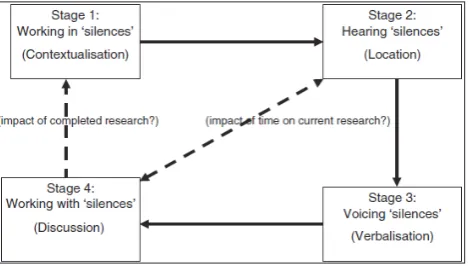
The method is divided into four main stages,10
[image:5.595.306.541.177.310.2]organized according to Figure 1.
Figure 1 - Theoretical framework of The Silences Framework method.
The following four stages of the method are described according to its use in a health research study on coinfection in Brazil.
Stage 1 -
Working in ‘silences’
This first stage consists of a contextualized
exploration of the literature. It must be situated in the research subject or object and may include ex-ploration of cultural, clinical, psychosocial, or moral context of the proposed research. By doing that, the
research project is defined, proposed and located within a certain period and in a specific society.
Concluding this stage, the researcher should seek to answer, “why research this topic at this particular
time?” based on their identification of “what do we
not know?” or “what stories are yet to be told?”.
In this research, this first step sought to iden -tify in the literature review, which groups of people affected by HIV/AIDS and TB coinfection that are missing (silenced). This search was performed in national and international databases, identifying the range and scope of current research. A preliminary analysis showed that studies on coinfection area were mostly quantitative and were dedicated to
the identification of risk factors for coinfection and
that coinfected men were the people predominantly
included in such research. Thus, it was identified
that, among the coinfected groups of people, there was a greater probability of silenced voices or questions little explored existing among women, as coinfection appears to affect more men.14-16
The literature review also showed that there were few qualitative studies exploring the factors impacting on adherence to HIV/AIDS treatment,
which have a significant impact on the develop -ment of TB and coinfection. Adherence has been a major challenge in combating TB, and treatment is
even more difficult to maintain when TB is associ -ated with HIV. This suggests that there is a need to develop psychosocial education strategies, which consider the multidimensionality of adherence to treatment, if we are to reduce dropout rates and break the transmission chain of tuberculosis,17 and
improve the communication between professionals and non-adherent users.18 Moreover, few studies
have addressed the relationship between different cultural or social risk factors that could lead to the development of TB and HIV/AIDS coinfection. Dis-covering the ‘silences’ in the research on TB/HIV/ AIDS coinfection provided a way by which ‘risk chances ‘ could be seen through the intersection of the political, social and personal contexts that affect the health decisions of coinfected people. Thus, chal-lenging the view of coinfection as a generic subject requiring a singular response.
Stage 2 - Haring ‘silences’
The “silences” were defined based on the
identification of research areas or experiences poorly
investigated, understood, undervalued or silenced in the context of TB/HIV/AIDS coinfection. After Stage 1, a process of silence analysis was started in order to better focus and plan the study itself. Through his process, three interconnected aspects are considered: the researcher identity and its rela-tionship with the study, the research theme is, and the participants involved.
Identity of the researcher
The identity of the researcher influences sig
-nificantly the delimitation of silences to be heard in the research. They especially influence his or her
relationship with the theme and the reasons that
led him or her to study these silences. In the specific
case of the current research, the interests originated in the authors’ identity as women, nurses and re-searchers of gender relations in society. As there is
already robust scientific evidence of the relationship
between gender and HIV/AIDS among women,16
the researchers were interested in exploring whether such a relationship also existed in the trajectories of those coinfected with TB and HIV/AIDS, which is still an under-researched area in the literature.
Research topic
The researcher must identify the specific as -pects of the study context that makes it “sensitive”,
by analyzing the nature of the subject at that specific
moment in society. At the beginning of this study,
the TB/HIV/AIDS coinfection as identified in Porto
Alegre, RS, Brazil, was sensitive due to issues relat-ing to: sexual health, gender, race, schoolrelat-ing, and territory. During the study, this city was the leading Brazilian city in terms of incidence and mortality due to TB, HIV/AIDS coinfection, with high rates of treatment non-adherence and an increasing num-ber of HIV/AIDS cases among women and vertical virus transmission.4
In this research, the second stage of the Frame-work used a quantitative approach, to produce a
comparative profile of HIV/AIDS and TB coinfec -tion, between males and females. In addi-tion, the districts within the city with the highest prevalence
of cases by sex and by race/color were identified.
In forming the database, the following asso-ciations were included: cases of TB and AIDS from the years 2009 to 2013, reported in SINAN; deaths occurring from 2009 to 2013 recorded in the SIM and hospitalizations from 2009 to 2013, recorded in the SIH. The city of Porto Alegre, RS, Brazil, was divided into eight district managements, following the Municipal Health Plan. The Statistical Package for Social Science (SPSS) (version 19) was used to undertake the analyses and description of average prevalence rates
Data analysis suggested that there are dif-ferences between the sexes in the distribution of cases among management district in relation to race/color, age and in TB and HIV/AIDS coinfec-tion cases recorded in SINAN. All these variables
showed statistically significant results in compari -son between males and females.
The analysis also showed differences in the prevalence of coinfection cases between the district and local management of the individuals from
this study. Only District Management A showed
Alegre-Rossetto M, Brand EM, Teixeira LB, Oliveira DLLC, Serrant L 6/9
RS. Finally, District Management C had a higher
proportion of non-white population. These find -ings highlighted a need to a better understanding of the coinfection dynamics in the three manage-ment districts (A, B and C), due to the average prevalence rates by general population, by gender, and by race/color.
Participants and research subjects
The research subjects are all the persons who participate in the research and are directly affected by the issues being researched. Following the analysis performed, the participants were men residing in District Management B, women resid-ing in District Management A, non-white residents from District Management C, and white residing in District Management B.
The analysis also enabled identification of the
locations in Porto Alegre, RS, Brazil, with a higher prevalence of TB/HIV/AIDS coinfection, which showed differences between men and women. This
finding changed the focus of the research to study
coinfected men and women as once the characteriza-tion of individuals by sex showed differences, it is possible that the care trajectories of men and women were also different.
In short, this phase incorporated more than a
descriptive identification of the existing “silences”.
Through a critical analysis of results from the research’s quantitative phase, it was possible to question: “why do these silences exist?” and “what cultural, clinical, psychosocial or moral aspects
influence them?”
Stage 3 - Voicing ‘silences’
This stage encompasses the active data col-lection phase of the research. The exact nature of the participants will depend on the study and may include service users, community groups, indi-viduals and professionals as research subjects. Some studies may also include the perspectives of people in social networks of the research participants, thus requiring the collection of evidence from those not directly affected by an issue, but whose clinical,
political or cultural outcomes and roles influence
the participants’ experience.
The stage utilized a qualitative approach, in-corporating semi-structured interviews that sought to deepen the understanding of the care trajectories
of men and women. In this stage, the gender influ -ences and other markers were analyzed in order
to reveal the care trajectories followed by men and women in the range of health services. Understand-ing the impact of experiences in the care trajectory may be fundamental for supporting coinfected in-dividuals, since TB (coinfection) could be avoided by adhesion to HIV treatment.
A total of 22 interviews were conducted in private rooms at Reference Centers for TB Treat-ment (RCTBs) from the district manageTreat-ments A, B and C of Porto Alegre, RS, Brazil. RCTBs were places where users underwent their treatments. Participants were selected by reviewing medical records to identify TB/HIV/AIDS coinfection, sex, and race/color of the individuals. The interviews were recorded and transcribed for later analysis. The interview had an average duration of 30 min and the data was individually validated with each interviewee at the end of each interview, as pre-dicted by the Framework. All participants gave signed consent. The project was approved by the Ethics Committee of the Federal University of Rio Grande do Sul, the City Hall of Porto Alegre and the Hospital Sanatorium Partenon.
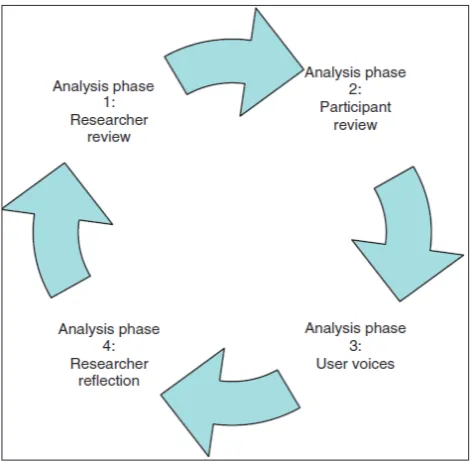
[image:7.595.304.540.425.656.2]The third stage of the Framework includes the beginning of the data analysis, which is expected to occur cyclically and in four phases. Figure 2 il-lustrates this process.
Figure 2 - The cyclical character of The Silences Framework method phases10
objec-tives as a reference, and seeking contextualization
of findings in the literature.
In phase 2, the participant review can ratify, refute or contest the study results, leading to
iden-tification of issues which may be poorly explored
and what else should be followed up from the data collection, Thus providing valuable information on the research impact, importance and results. It is the moment to review what was said in the literature (at Stage 1), the scenario analysis and the subject (at Stage 2), and the information coming from hear-ing silences (Stage 3). The methods, processes and strategies used to conduct a study will depend on the overall study design and should be planned in advance. Here is a draft of the results from this study comparing the information gathered from the three stages.
In study the Influence of Gender on the Care
Pathways of Men and Women Coinfected With Tuberculosis and HIV/AIDS, it was time to look at
what had already been produced, the first draft of
the results suggested that the source of HIV infection differed in men and women, for example whether due to not using condoms or not recognizing infec-tion risks posed by their partner . The development of TB/HIV/AIDS coinfection shows that men and women face barriers to diagnosis and accessing treatment, dependent on the problems in the health services and the professionals who care for them. There are related factors that create a framework of vulnerability: poor education, employment and income problems, lack of home and food, violation of the human rights of homeless people or those incarcerated, among other situations. The results
showed that gender could influence the illness and
the care trajectories, due to its association with these other markers and so creating a programmatic, individual, and social vulnerability framework, including a violation of human rights.9,19-20
In phase 3, ‘silenced voices’ are included, where the individuals, social networks or cultural
groups of the participants that can influence the
research question are heard. An additional aspect
of exploring the findings may include reflection
by the group (family members, professionals, and social movements that advocate for the rights of coinfected groups) regarding the “silences” that they consider still exist or remain unchanged as a result of the study.
In this study, the inclusion of voices occurred through participation in the I Fórum Gaúcho Chal-lenges for Combating TB/HIV/AIDS held at the Hospital Sanatorium Partenon, in Porto Alegre, RS,
Brazil. In the event, professionals, users, managers and social organizations participated in discussions about the limits and potential of actions developed in the State. They highlighted the need to treat TB/ HIV/AIDS coinfection through intersectoral ac-tions and with the expansion of public policies that guarantee housing, income, food, access to social
benefits, exercise of sexuality and fight problems
related to alcohol and drug abuse.
In phase 4, the researcher reflects critically on
the results of the previous phases of analysis and
presents them as the final study results. The action
of continually revisiting and reviewing the results of research in development, integrating users and public perspectives, is one of the essential compo-nents of this Framework.
In this stage of the research on “Gender cross-ings in the care trajectories of men and women coinfected by TB and HIV/AIDS”, it was possible to
conclude that gender influences the care trajectories of men and women, but its influence is associated
with other markers, such as race/color, income, territory, schooling and the age of affected subjects. The subjects’ statements demonstrated that these markers compose their life and care trajectories, composing frameworks of social, individual and programmatic vulnerability.9,20
The researcher can repeat the analysis cycle
as long as necessary, following his or her reflection
on the data integrity. When no new information relevant to the research question is revealed, stage 3 ends and stage 4 begins.10
Stage 4 - Working with ‘silences’
This phase incorporates the final aspects and
the elaboration of the study conclusion, besides
including a detailed reflection on the theoretical
contribution and the pragmatic gains of the study results. The key question to be answered by the researcher is “what has changed with this study results?”.
The care trajectories of men and women are
influenced by different markers that make up a
framework of individual, social, and program-matic vulnerabilities that have their starting point in situations of basic right violation, such as access to education, housing, income, public transportation, basic sanitation and health services. The assumption
that coinfected subjects are first diagnosed HIV and
Rossetto M, Brand EM, Teixeira LB, Oliveira DLLC, Serrant L 8/9
pathologies that subsequently reveal their sero-positivity status in a hospital setting. Furthermore,
many women receive confirmation of HIV infection
during pregnancy or in routine gynecological ex-ams. This reveals that there is a need to change the focus of actions only to the administration of drug therapies, as there are factors related to the living conditions of people that interfere with their illness and care trajectories. In addition, it must be consid-ered that it is necessary to review the participation of the State in guaranteeing the rights of access to health, education, income, and citizenship, which is very precarious in this scenario.
Final considerations may reveal limitations to inform other studies or any other generalization of the completed research. Thus, by accepting that “silences” are an inherent part of all societies, The Silences Frameworkalso recognizes that, in conclu-sion, some “silences” are changed, exposed or even newly created because of the research.
In the research illustrated here, some
chal-lenges had to be faced, such as the difficulty of
entering health services due to the social context of the research sites, making it sometimes necessary to
return another day. Another difficulty was the inclu -sion of new participants in the study due to initially foreseen ethical issues, which required in advance description of the nature and number of research subjects. The issue was resolved by providing an additional list in the research project.
CONCLUSION
The development of TB/HIV/AIDS
coinfec-tion is strongly influenced by the social, cultural and
economic conditions of the people. As much as we seek to expand our understanding of the wide range of factors affecting their life and health, research possibilities tend to be increasingly directed at ex-ploring sensitive issues experienced by vulnerable communities.
Analytical processes that aim to study health phenomenon are complex. Such complexity is relat-ed to the understanding that health goes beyond the absence of disease and the assumption that ‘health’ is closely related to the multiple relationships es-tablished between people and environment in a given geographic space and in a certain historical time. The search for broadening our understanding of health-related issues requires the use of diverse approaches in order to account for the need to grasp the different experiences about what is health and to understand why people become ill.
The Silences Framework makes a contribution in this sense, since it uses different research proce-dures simultaneously: literature review, location of the most silenced groups (quantitative approach), hearing people who have unveiled questions
(quali-tative approach) and identification of the main study contributions for the researched field. Data analysis
integrates all research phases and allows including new participants (people, groups or organizations) that have relationships with the research subjects and that can contribute to the unveiling of silences.
The development of this study was based on assumptions that recognize and seek to voice experi-ences, themes and issues often hidden, devalued or
“silenced”. Nursing can benefit from the application
of this Framework, expanding its research objects, differentiating itself by the collection and analysis of integrated data, investigating sensitive issues and historically marginalized populations.
ACKNOWLEDGEMENTS
To CAPES for the funding of the scholarship for the Sandwich Doctorate Program at the Univer-sity of Wolverhampton, UK, case no. BEN 9231/14-5, which allowed learning of the method proposed by Prof. Dr. Laura Serrant and the achievement of this research.
REFERENCES
1. Minayo MCS. O desafio do conhecimento: pesquisa
qualitativa em saúde. São Paulo (SP): Hucitec; 2013.
2. World Health Organization. Global tuberculosis report 2012. Geneva (CH): WHO report; 2012.
3. Ministério da Saúde (BR). Secretaria-Executiva Recomendações para o manejo da coinfecção TB-HIV em serviços de atenção especializada a pessoas vivendo com HIV/AIDS. Brasília (DF): Ministério da Saúde; 2013.
4. Ministério da Saúde (BR). Boletim epidemiológico:
Especial TB. Perspectivas brasileiras para o fim da
TB como problema de saúde pública. Secretaria de Vigilância à Saúde. 2016; 47(13):1-15.
5. World Health Organization. Global tuberculosis report. Geneva (CH): WHO report 2016.
6. Pupo RL, Ayres JRCM. Contribuições e Limites do Uso da Abordagem Centrada na Pessoa para a Fundamentação Teórica do Aconselhamento em DST/ Aids. Temas Psicol. 2013; 21(3):1089-106.
7. Oliveira DL. The use of focus groups to investigate
sensitive topics: an example taken from research on adolescent girls’ perceptions about sexual risks. Ciênc Saúde Coletiva. 2011; 16(7):3093-102.
e precarização da vida: momento político contemporâneo da resposta brasileira à aids. Interface (Botucatu). 2016; 20(57):293-304.
9. Rossetto M. Estudo epidemiologico sobre coinfecção TB/HIV/aids e fatores de risco para a internação e mortalidade em Porto Alegre [tese]. Porto Alegre (RS): Universidade Federal do Rio Grande do Sul, Escola de Enfermagem; 2016
10. Serrant-Green L. The sound of ‘silence’: a framework for researching sensitive issues or marginalised perspectives in health. J Res Nurs. 2010; 16(4):347-60. 11. Pinafi T. Do Paradigma essencialista para o
pós-estruturalismo: uma reflexão epistemológica sobre
sexualidade. Temas Psicol. 2015; 23(3):693-700. 12. Foucault M. A arqueologia do saber. 7 ed. Rio de
Janeiro (RJ): Forense Universitária; 2008.
13. Scott JW. Gênero: uma categoria útil de análise histórica. Educ Realidade. 1990; 16(2):186-98.
14. Maffacciolli R, Hahn GV, Rossetto M, Almeida CPB, Manica ST, et al. Using the notion of vulnerability in the production of knowledge about tuberculosis: integrative review. Rev Gaúcha Enferm. 2015; 36(esp):247-53.
15. O’Connell R, Chishinga N, Kinyanda E, Patel V,
Ayles H, Weiss HA, Seedat S et al. Prevalence and correlates of alcohol dependence disorder among TB
and HIV infected patients in Zambia. PLoS One; 2013;
8(9):e74406.
16. Teixeira LB, Pilecco FB, Vigo A, Knauth DR. Sexual and reproductive health of women living with HIV in Southern Brazil. Cad Saúde Pública. 2013; 29(3):609-20. 17. Chirinos NEC, Meirelles BHS, Bousfield ABS.
Relationship between the social representations of health professionals and people with tuberculosis and treatment abandonment. Texto Contexto Enferm [Internet] 2017 [cited 2017 Aug 30]; 26(1):e5650015. Available from: http://www.scielo.br/pdf/tce/ v26n1/pt_0104-0707-tce-26-01-5650015.pdf
18. Oliveira RA, Lefevre F. Communication on disclosure
of tuberculosis diagnosis and adherence to treatment: social representations of professionals and patients. Texto Contexto Enferm [Internet] 2017 [cited 2017 Aug 30]; 26(2):2e06790015. Available from: http://www.scielo.br/scielo.php?pid=S0104-07072017000200332&script=sci_arttext
19. Paiva V, Ayres R, Buchalla CM. Vulnerabilidade e Direitos Humanos: prevenção e promoção da saúde: da doença a cidadania. Curitiba (PR): Juruá; 2012.
20. Maffacciolli R, Oliveira DLLC, Brand EM.
Vulnerabilidade e direitos humanos na compreensão de trajetórias de internação por tuberculose. Saúde Soc. 2017; 26(1):286-99.
Correspondence:Maíra Rossetto Rua Travessa Tijucas, 109e, apt 802 89801-307 - Chapecó, SC, Brasil E-mail: [email protected]