evaluation of student and tutor experiences
LAUGHTON, DavidAvailable from Sheffield Hallam University Research Archive (SHURA) at:
http://shura.shu.ac.uk/7621/
This document is the author deposited version. You are advised to consult the publisher's version if you wish to cite from it.
Published version
LAUGHTON, David (2013). Using audio feedback to enhance assessment practice - an evaluation of student and tutor experiences. Student Engagement and
Experience Journal, 2 (2).
Copyright and re-use policy
See http://shura.shu.ac.uk/information.html
Research Article
Using audio feedback to enhance assessment practice - an evaluation
of student and tutor experiences
David Laughton1
Sheffield Business School, Sheffield Hallam University
Copyright © 2013 David Laughton. This is an open access journal article distributed under the Creative Commons Attribution License, which permits the unrestricted use, distribution, and reproduction in any medium, provided the original work is properly cited.
Abstract
The massification of higher education has presented a challenge to traditional pedagogical approaches in terms of delivering a high quality student experience which effectively supports individual learners in their personal educational journey. This is particularly the case with regards to assessment practice. This article examines a particular method of providing assessment feedback to 50 BA (Honours) Business Economics studying a level 5 Microeconomics module – via MP3 audio files – and explores both the efficiency and effectiveness dimensions of this approach. In addition the article evaluates student reactions to different forms of assessment feedback (written comments and audio feedback) on the same assignment in the same module in consecutive years of delivery, thus providing a comparative evaluation of practice involving audio feedback, and the tutor experience. The article concludes that the provision of audio feedback to students is no less efficient compared to the use of traditional written feedback sheets, but has the capacity to enhance student satisfaction with the feedback their tutors provide.
1 Corresponding author: [email protected]
Laughton, D. (2013). Using audio feedback to enhance assessment practice - an evaluation of student and tutor experiences. Student Engagement and Experience Journal, 2(2),
http://dx.doi.org/10.7190/seej.v2i2.68 ISSN (online) 2047-9476
2 Introduction
Sizeable increases in student numbers have meant that traditional pedagogical approaches have been under strain in terms of delivering a high quality student
experience which effectively supports individual learners in their personal educational journey. HESA data indicates there were 946,919 full time undergraduates in the UK in academic year 1994-95 and this had grown to 1,312,115 first degree students by 2011-12 (HESA 2013). Although the ‘supply side’ of UK higher education has expanded to accommodate this growth, by the early years of the new millennium concerns were being expressed about the quality of the student experience. This prompted the Higher Education Policy Institute to publish a baseline report in 2006 on ‘The Academic Experience of Students in English Universities’, which surveyed (inter alia) class
3
England, questions relating to ‘assessment’ in the National Student Survey receive the
lowest satisfaction scores compared to all other categories of questions.
This article will examine a particular method of providing feedback to students on assessed work – via MP3 voice files – and will explore both the efficiency and effectiveness dimensions of this approach. Previous studies (e.g. Lunt and Curran 2010; Gould and Day 2013) that have explored this topic have reviewed the efficiency
dimension in relation to other possible feedback practices and student satisfaction with receiving feedback on assessed work in this form. In addition to adding further to these insights, the present study evaluates student reactions to different forms of assessment feedback on the same assignment in the same module in consecutive years of delivery (29 students in the 2010-11 cohort, 50 in the 2011-12 cohort), thus providing a
comparative evaluation of feedback practice involving audio feedback, and a different methodological approach to previous studies. Student evaluations of their assessment feedback on an Intermediate Mircroeconomics module (level 5 in the UK system, year 2 of an undergraduate degree) are compared and evaluated: in 20010-11 written feedback was provided to students on a paper they submitted using a standard feedback sheet; in 2011-12 oral feedback was provided via the use of an audio file. Descriptive statistics will be used to compare the ways in which these two forms of feedback were received by students, and the qualitative comments of students provide more detailed insights into the extent to which oral feedback was perceived as being supportive to student learning on the module.
Literature review and background
4
Feedback should help the student understand more about the learning goal, more about their own achievement status in relation to that goal, and more about the ways to bridge the gap between their current status and the desired status.
In a somewhat cybernetic formulation Ramaprasad has defined feedback as
‘information about the gap between the actual level and reference level of a system parameter which is used to alter the gap in some way’, (Ramaprasad 1983, quoted in
Tong 2011, E152). Feedback is usually divided into summative feedback, that substantiates or justifies a mark or grade, or formative feedback, that which guides students to understand the strengths and weaknesses of their assessed submission or activity with the aim of promoting learning and improvement. Recently there has been an interest in the notion of ‘feedforward’ (Brown 2007) i.e. guidance provided to
students on how they can make continuing and enhancing actions to improve the quality of their work in relation to defined learning objectives, reflecting the purpose and importance of formative feedback in affecting the learner as they progress.
In terms of designing assessment feedback, Nicol and Macfarlane-Dick (as cited in Juwah et al. 2004, 2) have identified seven principles of good feedback; it:
1. facilitates the development of self-assessment (reflection in learning); 2. encourages teacher and peer dialogue around learning;
3. helps clarify what good performance is (goals, criteria, standards); 4. provides opportunities to close the gap between current and desired
performance;
5. delivers high quality information to students about their learning; 6. encourages positive motivational believes and self-esteem; and,
7. provides information to teachers that can be used to help shape the teaching.
Gibbs (2010) has also identified the qualities which are important in effective feedback in a different articulation which covers similar themes to those above. Summarising literature from Race (2006), Irons (2008), Juwah et al. (2004), Race (2001) and Hatziapostolou and Paraskakis (2010, 111) conclude that in order to be effective, feedback on formative assessment ‘needs to possess a number of qualities: it needs to be
timely, constructive, motivational, personal, manageable and directly related to
assessment criteria and learning outcomes’, and suggest that a feedback strategy should
5
students. Price et al. (2010, 285) suggest that 'Clear, unambiguous, instructional and directive feedback is generally welcomed by students.' Ferguson (2011) finds that students value feedback that is personalised in some way.
Higher Education Institutions gather information on the experience of their students in a myriad of ways but the National Student Survey (NSS) in the UK provides a sector-wide insight into the perceptions and experiences of students in the English higher education sector, and indicates their relative dissatisfaction with assessment practice. The survey invites students in all English universities to respond to a standard questionnaire of 21 questions plus some additional questions that are selected and framed by each institution in relation to their specific and individual priorities. Questions are linked to particular themes e.g. ‘Teaching on My Course’, ‘Academic Support’, ‘Learning Resources’, and there is a category of questions on the theme of ‘Assessment and Feedback’. The latter group of questions has consistently received the
lowest satisfaction scores since the NSS began and in 2011(for example) the lowest scoring of all NSS questions was: Feedback on my work has helped me clarify things I did not understand. Such findings present damning general insights into the ‘fitness for
purpose’ of feedback i.e. with its usefulness in helping students clarify things they did
not understand so that they can enhance their learning and make progress in their studies. This is not simply a UK phenomenon; for example Krause et al. (2005) cited in Ferguson (2011) report ongoing student dissatisfaction with assessment feedback in an Australian context. There is a growing research literature which aims to provide a deeper understanding of the student experience in relation to assessment feedback. Studies have identified issues with both the quantity and quality of feedback (e.g. Higgins et al. 2002; Ivanic et al. 1998; Price 2010). Price et al. (2010) report students experiencing problems with vague, ambiguous feedback, feedback which is difficult to understand or interpret, and feedback not being timely. In his study Ferguson (2011) finds that students experience difficulty in reading the comments of tutors which are handwritten. Higgins et al. (2002, 56) draw similar conclusions from earlier research:
...students in our study perceive feedback negatively if it does not provide enough information to be helpful, if it is too impersonal, and if it is too general and vague to be of any formative use. Handwriting also seems to be a common problem.
6
feedback in science subjects in the UK (part of the FAST project):
The overall conclusion from this study is stark. If feedback does not aid learning and understanding and does not feed forward, it has limited value, even if crafted carefully and provided quickly (Brown et al. 2005, 7).
And Glover et al. (2005), reflecting on findings from a different group of students at Sheffield Hallam University, UK, which was part of the same (FAST) project reflected:
Feedback often consisted of unhelpful comments which they did not understand. There was a general lack of detailed explanation of what students had done wrong, and sometimes tutors provided no explanation. Purely negative, or non-constructive remarks (e.g. poor; lazy), were not helpful to students at all (Glover et al. 2005, 3).
Walker (2009) concludes that there are many ways in which students may not find tutor feedback useful and focuses on the ‘usability of comments’ in her study, with students
reporting a lack of understanding of tutor comments or a need for explanation in more detail (i.e. the problematical nature of the content of comments). She finds that skills development comments were perceived as most useful in relation to feed forward and that comments that included aspects of explanation were more understandable. Furthermore, motivational comments were appreciated by students.
It is within this context that researchers have started to explore the use of digital audio feedback as a means of providing feedback to students on their assessed work. The technology to produce this form of feedback is now widely available (e.g. MP3 recorders, Smart phones), cheap and easy to use and access. Studies have evidenced positive student experiences with audio feedback (Gould and Day 2013; Ice 2007; King et al. 2008; Lunt and Curran 2010; Nortcliffe and Middleton 2011; Rotherham 2007).
Both efficiency and effectiveness perspectives have been explored. With respect to the former, Lunt and Curran (2010) suggest that it takes on average 5 minutes to deliver audio feedback for a 2,000 word piece of assessed coursework, compared to (typically) 30 minutes to write comments on a cover sheet and annotate a script. In an experiment they conducted it took tutors 3 minutes to type a sample piece of feedback, 4 minutes to write it by hand, and 40 seconds to record it, concluding that the ratio is roughly 1 minute of talking equals 6 minutes of writing. It is recognised however that this will be influenced by the confidence that tutors have with the process and the technology used. Audio feedback can be distributed to students via e mail or a virtual learning
7
problematical. Ferguson (2011), for example, reports that significant numbers of students fail to collect formative feedback, and Lunt and Curran (2010) found that students are at least ten times more likely to open audio files in comparison to collecting written feedback. Nortcliffe and Middleton (2011) found that Smart phone technology was suitable for the production and distribution of audio feedback and helped save time in the process. Lunt and Curran (2010) also found that students perceived audio
feedback to be more helpful than written comments. This effectiveness dimension has been explored by a number of researchers. Rotherham (2008) found that audio feedback was more effective than written feedback as it allowed richer (especially in relation to vocabulary), more detailed, more personalised and nuanced feedback. Ice et al. (2007) reported similar properties of audio feedback but found, in addition, that lecturers who provided feedback in this form were characterised as ‘caring’ by students. The
proceedings of the Sheffield Hallam University conference ‘A Word in Your Ear’
(2009) compile a similar list of audio feedback characteristics from a variety of
institutions and disciplinary contexts. In a review of the extant literature Gould and Day (2013, 562) summarise the beneficial attributes of this medium of communication: the ability to provide more detailed information in a conversational style, the provision of richer feedback, the inclusion of tone, expression, and emphasis which adds depth to communication, the incorporation of nuance and inflection to enhance interpretation and understanding, and the positive emotional and motivating impact of spoken feedback. In reviewing data obtained from students they summarise the main benefits of audio feedback as '...its greater personalisation, detail and perceived potential to improve student work.'
8
relation to assessment feedback can be enhanced by the use of audio feedback. The study mainly focuses on student but also includes tutor and external examiner
perspectives to produce a rounded evaluation of experiences which can be considered holistically as a case study (Yin 2008). It draws inspiration from Lunt and Curran’s suggestion of linking the use of audio feedback with the outcomes of student surveys (although not in this case the NSS) to enhance the evidence base for this form of assessment feedback practice.
Method
The focus of the evaluation was the written assignment required in a level 5
Intermediate Microeconomics module (year 2 of an undergraduate degree) in semester one of 2011-12. The assignment brief encouraged students to identify and analyse a current issue or problem that could be explored using microeconomic concepts and theory. The word count for the assignment was 2,000 words, and students were guided by an assignment brief and assessment criteria. All 50 student written papers were read and graded by the tutor. Feedback comments were then dictated to a voice recorder which produced an MP3 file. The tutor had previously had a short training session with a learning technologist which focused on how to use the voice recorder. Subsequent to this the tutor experimented with the technology and approach by marking and providing feedback on several assignments from another module in the form of a voice file. This feedback was not distributed to students, but the exercise helped the tutor to develop and hone a personal approach and modus operandi with respect to producing voice file feedback. This preparation involved around 4 hours’ work.
Comments were made in relation to assessment criteria which had been distributed to students as a guide to writing their paper as well as more generally with regard to strengths and weaknesses, and specific ‘feed forward’ comments were
9
both the relevant MP3 file and completed assessment matrix were e mailed to students using the Blackboard virtual learning environment. The population of audio files (50) was analysed to establish their average duration and the average number of words they contained (this latter exercise was based on a randomly chosen sample of 10 files), and some reflections on the ‘production process’ were made by the tutor.
In the final week of the module students completed a module evaluation
questionnaire. This questionnaire incorporates a standard set of questions (see below), is used by all modules in the faculty, and incorporates both quantitative and qualitative responses. The questionnaire results were processed and evaluated in a number of ways:
1. Rank order of Intermediate Microeconomics module score in question 6 (“In this module the feedback I received on assessment tasks was helpful to my
learning”) in all 79 modules delivered by the faculty in the same semester
(comparative dimension: the rank order measure provides insights on comparative satisfaction with this approach vis a vis methods used in other modules).
2. Comparison of positive responses to question 6 in 2011-12 compared to 2010-11 when the same assignment was used in the module but feedback was provided via typed feedback sheets rather than audio files (comparative dimension; written versus verbal feedback).
3. All qualitative comments that made reference to the voice files were extracted (33 questionnaires included such statements out of a total of 50) and a word cloud produced to illustrate the key words used to convey the feelings and sentiments of students in this context.
Finally, the External Examiners reported was accessed to seek any specific references to the use of voice files in the assessment process.
Findings
Tutor perspective
10
450 words for a random sample of assignments marked in the same module in 2010-11 which were provided with written as opposed to audio feedback. It is acknowledged that these word counts are not directly comparable as the language of spoken grammar is less dense and includes fillers such as ‘I think it would have been useful to’, ‘I mean...’, ‘As I’ve mentioned previously’ etc; nevertheless this expanded communication may be
linked to the student experience of and reaction to their feedback which is discussed below. The 5 minutes it took to create the audio files is considered to be (at a minimum) half the time it takes to produce typed feedback on assignments in the author’s
experience. In terms of distributing feedback to students, this was done in an identical manner in 2010-11 and 2011-12 i.e. via e mail and file attachment, and therefore there was no difference in the time consumed. An interesting reflection by the marker during the process relates to the psychological intensity (degree of concentration, stress, and marking ennui) experienced in this activity: this was much lower when producing audio files over a prolonged marking period compared to producing typed feedback for a significant number of papers. As this was an individual and personal experience it will be interesting to see if further research produces similar findings.
External examiner perspective
Extremely positive comments were received from the External Examiner for the
module, who commented in his report: 'An excellent level of individual feedback given through the use of sound files – very helpful to the students in terms of identifying the strengths and weaknesses of their work. The criteria set were clear and the feedback addressed these explicitly – well done.'
Student perspective
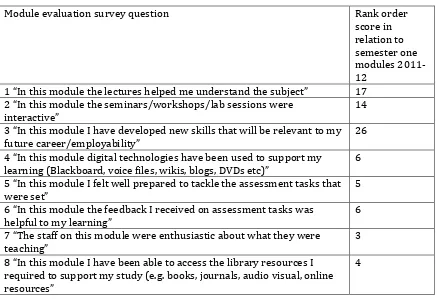
In semester one of academic year 2011-12 there were 68 modules in Sheffield Business School that reported student experiences via a module evaluation questionnaire. The rank order score for the Microeconomics module for each question/response in relation to the scores of all modules which received student feedback in semester one is
11
Table 1: Rank order of Microeconomics module evaluation responses compared to all semester one modules at Sheffield Business School, 2011-12
Module evaluation survey question Rank order
score in relation to semester one modules 2011-12
1 “In this module the lectures helped me understand the subject” 17
2 “In this module the seminars/workshops/lab sessions were interactive”
14
3 “In this module I have developed new skills that will be relevant to my
future career/employability” 26
4 “In this module digital technologies have been used to support my learning (Blackboard, voice files, wikis, blogs, DVDs etc)”
6
5 “In this module I felt well prepared to tackle the assessment tasks that
were set” 5
6 “In this module the feedback I received on assessment tasks was helpful to my learning”
6
7 “The staff on this module were enthusiastic about what they were
teaching” 3
8 “In this module I have been able to access the library resources I required to support my study (e.g. books, journals, audio visual, online resources”
4
The rank order scores for the Microeconomics module show a generally good level of student satisfaction in relation to other modules, but this is especially the case in relation to question 6 which concerns the usefulness of assignment feedback. These scores also suggest there was no ‘halo effect’ in the module, with one element of the module
experience setting the pattern for other elements.
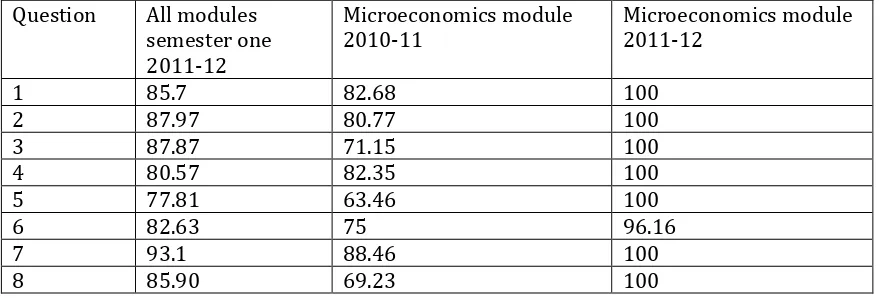
The positive responses for all 68 modules in semester one 2011-12 are
12
Table 2: Comparison of positive responses of Microeconomics module with other indicators
Question All modules
semester one 2011-12
Microeconomics module
2010-11 Microeconomics module 2011-12
1 85.7 82.68 100
2 87.97 80.77 100
3 87.87 71.15 100
4 80.57 82.35 100
5 77.81 63.46 100
6 82.63 75 96.16
7 93.1 88.46 100
8 85.90 69.23 100
These results demonstrate a higher level of satisfaction than the average score for all modules in question 6 for semester one 2011-12 and a higher score for the Microeconomics module than in 2010-11 when written feedback (rather than voice files) was used for the student written paper. The limitations of generalising from this data are acknowledged given the different response rates within modules. To gain deeper insights students were invited to provide comments in the module evaluation form in relation to the following questions:
1. What two things have had the most positive impact on your learning experience in the module?
2. What two things could be done to improve your learning experience in this module?
Where comments made reference to audio files in 2011-12 these were extracted and analysed. The analysis focused on identifying keywords or sentiments that students had used or expressed which indicated their experience of, and reaction to audio feedback, its characteristics and utility. The keyword/sentiment with the largest number of references (13 in total) was ‘helpful/help/helped’ e.g.: 'Voice files very helpful and personal, more comprehensive than written feedback.'
The keyword/sentiment with the second largest number of references (7 in total) was ‘good feedback’ e.g.: 'Very good feedback on assignment. Voice files were clear
13
The keyword/sentiment with the third largest number of references (5 in total) was ‘understand’ e.g.: 'The voice file with the feedback from the assignment was
extremely useful. I was able to gain a deeper understanding of my report than if it had been written on paper.'
A number of other words/sentiments were used by students to express their experience of, and reaction to, receiving feedback in audio format but in smaller
frequencies e.g. beneficial, positive, informative, personal, clear and detailed. All of the qualitative comments made by students were fed into a word cloud which produced the representation below. This has been included to indicate some of the more common and populous words that appeared in student written comments. It is emphasised here that the word cloud is included merely as a presentation device, rather than as a fundamental part of the research method, due to the limitations associated with their use (e.g. the decontextualisation of language and narrative):
It was noteworthy that no negative comments in relation to the audio feedback were reported by students.
Discussion
14
providing written feedback: more efficient due to the production of more words of feedback and electronic distribution to students within a similar timeframe, more effective due to students finding this form of feedback more helpful to their learning, and being endorsed by the External Examiner for the module. Sadler (2010) notes that tutors who provide extensive written feedback generally find the process cognitively demanding, and although this may be a personal issue, the psychological intensity (degree of concentration, stress, and marking ennui) of producing audio feedback over a prolonged marking period was experienced as much lower compared to producing written feedback for a significant number of papers. From a student perspective, narrative comments gleaned from module evaluation questionnaires and a comparison of quantitative scores from questionnaires compared with the previous year indicate a much higher degree of student satisfaction with the quality and usefulness of feedback provided in this form, findings which correspond with those of Gould and Day (2013), and Lunt and Curran (2010). In particular, students commented upon the
communicative features of the audio file feedback and how they received these. Written feedback often incorporates summary statements and academic ‘buzz words’ which students find difficult to comprehend and make sense of e.g. ‘needs to include more critical analysis’, ‘needs to be more discursive’, whereas producing feedback in verbal
form appears to allow a more detailed and communicative approach to ‘unpacking’ these terms and issues for students which enhances the ability to interpret key elements of feedback (see Bloxham and Campbell 2010, for another interesting technique in this context). Although this approach falls short of a ‘relational and dialogic’ approach to the provision of feedback advocated by Price et al. (2010), which is perceived as a powerful way to support students in the development of their understanding, and can be classified as an ‘information transmission model’ of providing feedback (Sadler 2010) with its associated limitations in supporting improvement in complex learning, it appears to go some way to bridging a commonly acknowledged communication divide in this context – 'Also I liked that it seemed personal' (student comment). In addition it appears to offer the possibility of embodying principles 3, 5 and 6 of Nicol and
15
However, given the increasing internationalisation of higher education and the
complexity of cross-cultural communication this is clearly an important topic for further research.
The findings in the main are derived from data obtained from standard quality assurance and enhancement processes used commonly in the university sector (module evaluation questionnaires, external examiner reports). The methods employed therefore suggest an approach that can be replicated to demonstrate quality enhancement through the introduction of pedagogical innovation that has currency within the institutional framework occupied by academic staff, and complement approaches adopted by other researchers in this context. Whilst these can provide some support and legitimacy for developments in assessment practice it is also recognised that stakeholder satisfaction on its own is not sufficiently robust evidence to produce confident conclusions about the impact of assessment feedback, which is a limitation of the case study. For many
16 Conclusion
This evaluation study has demonstrated the power and usefulness of providing verbal feedback for students on their written work and framed this in terms of efficiency and effectiveness perspectives. The implications of the findings are for a wider adoption and use of audio feedback in the assessment process as this form of feedback appears to have benefits for both students and tutors. It would be useful for further research and evaluation work to explore how and why this form of communication is received positively by students by examining the language of assessment feedback, the nature of the vocabulary used in written and oral feedback, and the lexicon of assessment
feedback drawn upon by tutors to enhance understanding concerning the linguistic properties of good feedback. In addition, this study has not focused on how students actually used or acted upon their voice file feedback to support and enhance their learning. The formative dimensions of feedback can only be such if they are absorbed by the learner and enacted in the form of cognitive and behavioural change with respect to future tasks and activities. It would be useful if future research could explore in a granular fashion the ways that students utilise and draw upon audio feedback in preparation for future assessed tasks (e.g. how many times do students listen to audio files, when and where, how does this compare with how other forms of feedback are drawn upon?), whether or not the nature of this feedback is considered by students to be more useful that other forms of feedback when preparing future assessed work, and the ease of use of audio files (storage, accessibility etc.) in comparison to other forms of feedback. And finally, further research could address the utility and effectiveness of using audio feedback with students with specific learning needs (e.g. students with dyslexia, visual impairment), preferred learning styles and different linguistic and cultural backgrounds to gauge the extent to which they can support an inclusive approach to feedback practice.
References
Behradnia, B. and Darian, L. (2013) The Academic Experience of Students in English Universities, Higher Education Policy Institute.
17
Black, P. and William, D. (1998). Inside the Black Box: Raising Standards Through Classroom Assessment. Phi Delta Kappan, 80 (2), 139-144.
Bloxham, S, and Campbell, L. (2010). Generating Dialogue in Assessment Feedback: Exploring the Use of Interactive Cover Sheets. Assessment and Evaluation in Higher Education, 35 (3), 291-300. CrossRef
Brown, E., Glover, C., Freake, S. and Stevens, V. (2005). Evaluating the effectiveness of written feedback as an element of formative assessment in science. In ‘Studying
the impact of assessment on student learning in physical science and bioscience
courses’. Proceedings of the 2004 12th International Symposium Improving
Students Learning: Diversity and Inclusivity, Birmingham 6-8 September 2004,
Oxford: Alden Press, 471-479. [Online]. Last accessed 13 August 2013 at:
http://www.open.ac.uk/fast/
Brown, R. and Carasso, H. (2013). Everything for Sale? The Marketisation of UK Higher Education, Society for Research into Higher Education, Routledge.
Brown, S. (2007). Feedback and Feedforward. Centre for Bioscience Bulletin, The Higher Education Academy, 22.
Ferguson, P. (2011). Student Perceptions of Quality Feedback in Teacher Education. Assessment and Evaluation in Higher Education, 36 (1), 51-62. CrossRef Gibbs, G and Simpson, C. (2004). Conditions under which assessment supports
students' learning, Learning and Teaching in Higher Education, 1, 3-31. [Online]. Last accessed 13 August 2013 at:
http://www.londonmet.ac.uk/library/r71034_39.pdf
Gibbs, G. (2010). Assessment Patterns that Fail, and that Work. [Online] Last accessed 13 August 2013 at:
http://www.testa.ac.uk/resources/best-practice-guidelines/96-revised-assessment-patterns-that-work
Glover, C., Macdonald, R., Mills, J. and Swithenby, S. (2005) Perceptions of the value of
different modes of tutor feedback. In Studying the impact of assessment on student learning in physical science and bioscience courses. Proceedings of the 2004 12th International Symposium Improving Students Learning: Diversity
and Inclusivity, Birmingham 6-8 September 2004, Oxford: Alden Press,
18
Gould, J. and Day, P. (2013). Hearing You Loud and Clear: Student Perspectives of Audio Feedback in Higher Education. Assessment and Evaluation in Higher Education, 38 (5), 554-566. CrossRef
Hattie, J.A. (1987). Identifying the Salient Facets of a Model of Student Learning: a synthesis of meta-analyses. International Journal of Educational Research, 11, 187-212.
Hatziapostolou, T. And Paraskakis, I. (2010). Enhancing the Impact of Formative Feedback on Student Learning Through an Online Feedback System. Electronic Journal of e-Learning, 8 (2), 111-122.
Henkel, M. (2000). Academic Identities and Policy Change in Higher Education, Jessica King Publishers Ltd.
HESA (Higher Education Statistics Agency) (2013) Data on student numbers. [Online]. Last accessed 13 August 2013 at:
http://www.hesa.ac.uk/index.php/content/view/1973/239/
Higgins, R., Hartley, P. And Skelton, A. (2002) The Conscientious Consumer:
Reconsidering the Role of Assessment Feedback in Student Learning. Studies in Higher Education, 27 (1), 53-64. CrossRef
Hughes, G. (2011) Towards a Personal Best: a case for Introducing Ipsative Assessment in Higher Education. Studies in Higher Education, 36 (3), 353- 367. CrossRef Ice, P., Curtis, R., Phillips, P., & Wells, J., (2007). Using asynchronous audio feedback
to enhance teaching presence and student sense of community. Journal of Asynchronous Learning Networks, 11 (2), 3-25.
Irons, A. (2008). Enhancing Learning Through Formative Assessment, Routledge, London.
Ivanic, R., Clark, R. and Rimmershaw, R. (2000). What am I Supposed to Make of This? The Messages Conveyed to Students by Tutors’ Written Comments in
Lea, M.R and Sterrer, B. (eds) Student Writing in Higher Education: New Contexts, Buckinghamshire, Open University Press.
Juwah, C., Macfarlane-Dick, D., Matthew, B., Nicol, D. and Smith, B. (2004). Enhancing Student Learning Through Effective Formative Feedback. York:
19
King, D., McGugan, S., and Bunyan, N. (2008). Does it Make a Difference? Replacing Text with Audio Feedback, Practice and Evidence of Scholarship of Teaching and Learning. Higher Education, 3 (2), 145-163.
Krause, K., Hartley, R., James, R. and McInnis,C. (2005). The First Year Experience in Australian Universities: Findings From a Decade of National Studies,
Melbourne: University of Melbourne. Centre for the Study of Higher Education. Lunt, T. And Curran, J. (2010). ‘Are You Listening Please? The Advantages of
Electronic Audio Feedback Compared to Written Feedback. Assessment and Evaluation in Higher Education, 35 (7), 759-769. CrossRef
Nicol, D. (2010). Four Recent Papers on Assessment and Feedback with Significant Implications for Practice, QAA Scotland Enhancement Themes: Graduates for
the 21st Century”. [Online] Last accessed 13 August 2013 at:
http://www.reap.ac.uk/reap/public/Papers/DN Assessment Feedback
230210.pdf
Nortcliffe, A. and Middleton, A. (2011). Smart Phone Feedback: Using an Iphone to Improve the Distribution of Audio Feedback. International Journal of Electrical Engineering Education, 48 (3), 280-293. CrossRef
O’Leary, Z. (2005). Researching Real World Problems, Sage.
Price, M., Handley, K. Millar, J. and O’Donovan, B. (2010). Feedback: All That Effort, But What is the Effect? Assessment and Evaluation in Higher Education, 35 (3), 277-289. CrossRef
Race, P. (2001). Using Feedback to Help Students Learn, the Higher Education Academy. [Online]. Last accessed 13 August 2013 at:
http://www.heacademy.ac.uk/resources/detail/id432_using_feedback
Race, P. (2006). The Lecturer’s Toolkit – a Practical Guide to Assessment, Learning
and Teaching, 3rd edition. Routledge, London.
Ramaprasad, A. (1983). On the Definition of Feedback. Behavioural Science, 28 (1), 4-13. CrossRef
Ramsden, P. (2003). Learning to Teach in Higher Education, Abingdon, Oxon, UK: Routledge Falmer.
Ricketts, C. and Wilks, S. J. (2002). Improving Student Performance Through
20
Rotherham, B, (2008). Sounds Good: Quicker, Better Assessment Using Audio Files. [Online]. Last accessed 13 August 2013 at:
http://www.jisc.ac.uk/search/sounds%20good
Sadler, D. R. (2010). Beyond Feedback: Developing Student Capability in Complex Appraisal. Assessment and Evaluation in Higher Education, 35 (5), 535-550.
CrossRef
Sheffield Hallam University (2009). A Word in Your Ear, conference proceedings. [Online]. Last accessed 13 August 2013 at:
http://research.shu.ac.uk/lti/awordinyourear2009/
Tong, C.H. (2011). Linking Summative Assessments? Electronic Feedback and
Feedforward in Module Design. British Journal of Educational Technology, 42 (6), E152-E155. CrossRef
Walker, M. (2009). An Investigation into Written Comments on Assignments: Do Students Find Them Useful? Assessment and Evaluation in Higher Education, 34 (6), 67-78. CrossRef