DE CAMPOS, Ana Paula and DANTAS, Denise
Available from Sheffield Hallam University Research Archive (SHURA) at:
http://shura.shu.ac.uk/509/
This document is the author deposited version. You are advised to consult the
publisher's version if you wish to cite from it.
Published version
DE CAMPOS, Ana Paula and DANTAS, Denise (2009). M+D: conceptual guidelines
for compiling a materials library. In: Undisciplined! Design Research Society
Conference 2008, Sheffield Hallam University, Sheffield, UK, 16-19 July 2008.
Copyright and re-use policy
See http://shura.shu.ac.uk/information.html
M+D:
conceptual guidelines for compiling a materials library
Ana Paula de Campos, Centro Universitário Senac, Brazil.
Denise Dantas, Centro Universitário Senac, Brazil.
Abstract
This article proposes to present a study conducted by the Raw Materials research group, the results of which comprise the conceptual guidelines for compiling an M+D material library. The study includes the topic, materials and
design taking the impact of the changes that came into being in the post industrial era on project methodologies and the search for information regarding materials.
Taking into account the importance and complexity that these relationships have taken on currently, we have studied the issue of materials based on Manzini (1983) and Ashby and Johnson (2002). Afterward different databases and materials libraries located in the Brazil, the United States, France and Italy geared toward design professionals and students were analyzed to
understand what information and means of access to them were available. The project methodologies were approached based on Löbach (1991), Bürdeck (1994), Schulmann (1994), Baxter (1998), Dantas (1998 and 2005) and Papanek (1995 and 2000). This study sought to identify the key elements of the role of materials in the project process today, to serve as a parameter for the analysis of the models studied.
A comparative analysis of the models investigated enabled identification of positive and negative aspects to adapt to the needs previously mentioned and identify conceptual guidelines for compiling a collection of materials for use in design projects.
Keywords
Design, Materials, Project Methodology, Library
Since the entire purpose is based on the use of materials, it seems inherent to any design project that the question of materials arises. Recognition of the constructive potential of a material seems to be the starting point of primitive man for preparation of our current artificially built surroundings. In this regard, design, as a legitimate activity instituted at the beginning of the Industrial Era, became an unprecedented agent in the definition of materials that comprise the products with which we live and interact. There are several aspects which could be regarded within the universe of materials selection for a product, which encompass technical, aesthetic, sensory and cultural issues. Over the last few decades, the transformation in the technical productive and
changes that enable a frightening expansion in the number of materials available to the designer. In addition to this multitude of materials, Manzini points out the new perceptive relations that have begun to ensconce themselves between real materials, for example wood and the simulated materials, as for example standard wood laminates/plywood. New possibilities of materials reflected by means of project assistance software (CAD) have also entered the scene which enables construction within a virtual context. These contexts benefit the sense of sight to the detriment of other sensorial elements present in relation to materiality. Ashby and Johnson (2002) have focused specifically on the choice and use of materials for design in their book, “Material and Design: the art and science of material selection in product design.” The authors have emphasized that in addition to the physical and technical features of the materials, there are social and
perceptive issues to contend with since the ability to recognize these materials has become more complex, thus making it difficult to catalogue them
according to our ancestral instincts. When “candy wrappers” are in fact plastic and a “metal faucet” is in reality nylon, it can be said that materials have entered the era of appearances. Therefore, without understanding exactly what it is, it is necessary to seek other references to navigate through this territory that has boundaries on two extremes: the layman’s terms, which convey past meanings and that conveyed by the engineering technical data which are often abstract in nature and oftentimes not completely understood by the designer. Add to this the issues of performance, customized materials, trademarks and patents, trade names, recycling and sustainability that make even more complex the whole picture. In this regard, we can also include changes in the manufacturing processes, since these materials often do not change, but rather the technological possibilities, processing, shaping, cutting, soldering, joining with other materials and so on, do change. In answer to the urgent need to understand more about the subject, there has been a trend recently toward the emergence of initiatives such as the Material Connexion (since 1997) “MateriO” (since 2002), “Materiali e Design” from Politecnico di Milano (since 1999), in addition to the IF materials award (since 2005)
Interzumm Award (since 2007) and trade fairs such as the 100% material, which is part of the annual 100% design expo (since 1994). In this information age, initiatives devised to meet designers’ needs are focused on in building databases and sample collections. The objective is to enable quick access to information. However, the investigation proposed in this article began on the basis of questioning what information is available, how it is presented and how the growing universe of materials is related to the project process. The final objective was to index conceptual parameters to compile a materials library for the Centro Universitário Senac especially for design students and
professionals as well as other related areas. The methodological procedures adopted include a bibliographical study, review and analysis of theoretical content followed by field research and a critical analysis of similar
undertakings found in Brazil, the United States, France and Italy.
proposed object. Therefore at the beginning of the 20Th century, when modernism dictated the rules, materials were chosen on the basis of the
precept of honesty. Without adornment endeavoring to meet the principles of the universal project, the choice of material took into account its suitability to the product to enable its real identification. The most important feature of the products in this period was a long useful life. Created to last, to be passed on from one generation to next, industrialized products brought with them the stigma of eternal life and durability was its most important quality. Material in this context was selected on the basis of its performance in these matters. With the expansion of the markets that took place after the Second World War, it became important to enable increased production that could meet these new demands. Studies of the method were then supported on the production engineering precepts. At first they sought to deal with the
productive process where mass consumption was the main objective. Making it more and better, minimizing errors and organizing procedures were the major goals of the authors who studied the methodology question in the 1960s and 70s. Many graphs and linear models were proposed during this period emphasizing procedures by which to arrive at a good product. According to Dantas (1998) the main authors of this period are Archer (1973), Jones (1976), Alexander (1973), Gregory (1967), Asimow (1977) and afterward Munari (1986), Lobach (1981) and Bonsiepe (1978, 1983, 1992, 1997). Since this was a period in which plastic materials gained popularity and were developed as the big novelty, we can say that the study of materials sought to make the new products economically feasible and introduce them on the market based on their semantic and communicational appeal. Plastics were the material most suitable for mass consumption. They are moldable and easily produced in series enabling a number of applications in a wide range of sectors of society. At the end of the 70s and the beginning of the 80s we saw abandonment of the design project methods. Burdeck (1994) points out the gain in importance of communications and semantics of the product. In his thinking, the methods were seen as elements that inhibit the creativity of the designer and created hindrances to the development of good products. This is why this period benefited from creative discourse instead of production. Therefore any and all elements that could in some way interfere negatively in this process were summarily discarded.
assure quality of life for man and that would preserve nature. Later in his book, “The Green Imperative: Ecology and Ethics in Design and Architecture” (1985) he once again discusses the importance of materials and sustainability
policies for the development of ethically correct products including the selection of materials and the conscientious use of productive technologies and processes.
In the 21th century, changes in consumer relations, faster paced technology and planned obsolescence in addition to new productive processes and globalization created an enormous impact on the design process. Today, the main changes are associated with the product conception stages.
Another question that interferes in the materials selection process is the growing trend of materials bearing “a first and last name”. There have also been “contaminators” by the “world of brands”; several worldwide
companies that are engaged in the production of raw materials and materials for the industry have “christened” their new products. This has
occurred especially in relation to compound products, the existence of which was created in laboratories and those with which we have been most
perceptively deluded. The technical data as well as their composition are “camouflaged” under fanciful names in order to protect their industrial patents. This way, the comparative process which is indispensable for the choice of a product is jeopardized since the data are not presented equally in all cases.
In view of this context, we have sought to expand upon the role, contribution and suitability of a materials library in relation to the design process today. The objective here is to act strategically to enhance creativity and invention and optimize the engagement of the designer in the materials research and selection process according to the different bases for the project such as: 1 – Product for the material: restrict the choice of material owed to the semantics or category of the project, technical productive characteristics of the manufacturer. This is the most conventional method of producing objects in society. E.g.: to develop a project for metal flatware for a metal works company.
2 – Material for the product: the selection of material is the stating point for the project, the development of which is owed to the inherent features of the material. This is based on history, since the projects by Alvar Aalto and Marcel Breuer. E.g.: to develop a project using Corian, manufactured by DuPont. 3 – Upholstering materials: selection of material for a project taking into account the material already specified. This has a direct relation to the products associated with fashion trends and updating collections. E.g.: a couch manufactured in its 2008 version, results not from a change in the
model, but rather from its upholstery; a new collection of fabrics for an already manufactured couch.
4 – Customized materials: providing or performing a fundamental role in the definition of the material which could be developed specifically for the
There are different requirements to fulfill from each one of the instances cited above in relation to the selection of materials. In the first case, there is the presumption that the collection can provide information regarding the material that will enable a comparison of information and suppliers, to improve upon innovations. The second case presupposes that the materials library will enable a sensorial exploration and be an inspiration or serve as a type of “toolbox” where the physical properties of the materials such as structure, shine, color, etc. can be perceived. The third case presupposes a collection including up-to-date catalogues from manufacturers and/or suppliers and new materials that are suitable for this purpose. The fourth case presupposes the development of material as a project related to the product project by means of a specialized team. In this last instance a collection of materials would serve no purpose.
Based on these suppositions, the field research sought to establish how current initiatives deal with the situations described above.
Materials libraries and databases
The field research endeavored to map out the means of making information in existing materials libraries available, by making technical visits and
subscriptions to on-line libraries. A study of the data enabled a sampling of the materials collections in different formats, of an academic and commercial nature, set up as physical collections and/or on-line databases. Once
identification of the means of organization had been made and the
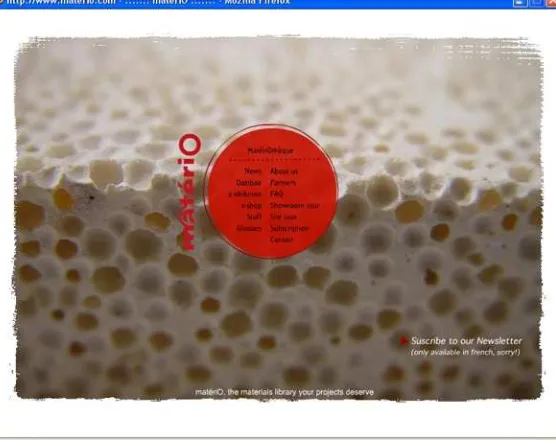
[image:6.595.125.403.511.734.2]construction of the models found as well as their respective importance for the category that they represented, in loco research was conducted. In the event of on-line data bases, subscriptions to two restricted access models were made – paid subscription – (Material Connexion and MateriO (fig.1)) and four free models were investigated (MatWeb (fig.2), Feevale (fig.3), Polimerica (fig.4), Materioteca (fig.5)).
Fig.2 – MatWeb homepage
Fig.3 – Feevale homepage – website
Fig.5 – Materioteca homepage website
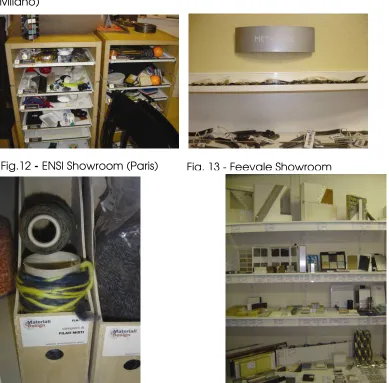
Two materials research centers were also visited (LSDM - Laboratório de Design e Seleção de Materiais – NdSM - at the Universidade Federal do Rio Grande do Sul (www.ufrgs.br/ndsm) and the materials center at the Centro São Paulo de Design – CSPD (associated with the São Paulo State government) and seven materials collections (Materioteca Feevale (fig.6) ; Poli.teca – Materiali e Design do Politecnico di Milano, Materioteca ENSI da École Nationale Supérieure de Création Industrielle - Les Ateliers (fig.7);
Materiotèque de l’École d’ Architecture Paris-Val de Seine (fig. 8); New York Material Connexion Nova and the Milan Material Connexion; MateriO – Paris (fig.9)). The “Material Sense” Project coordinated by Simone De Waart and in association with the “Eindhoven Design School”, in Holland, was presented on the basis of images at the Senac Materials Symposium 2006 conference, but no visit to the physical space itself was conducted.
The research procedure into the physical archives included observation, photographic records and descriptive report of the environment, space size and furnishings, means of organization, availability and consolation of samples, dynamic use of the space, analysis of the classification and cataloguing
system proposed and its relation to the arrangement of the space, a
Fig. 6 – Feevale’s Showroom (BRAZIL)
Fig.8 – Paris Val-de-Seine showroom (Paris)
Fig.9 – MateriO showroom (Paris)
In relation to the on-line databanks, a routine was developed for analyzing that regarded as he relevant aspects such as reliability of data (sources, bibliography, technician responsible), the available information categories (technical, perceptive/sensorial, production, commercial) search means, type of access, possibility of cross referencing information and graphic interface. The data were systematized, selected, organized into categories and
because we perceived that the objective for setting up a collection
determines its manner of organization and the criteria for selecting materials that will comprise the space. An analysis of the objectives that guide the concept and basis for this sampling revealed three distinct models: academic, commercial and independent.
We envisage the academic model as one that is associated with an
institution of higher learning (University), where pedagogical questions are the underlying guidelines for compiling the collection. Additionally, the
environments in this case offer free access to students, professors and visitors which enable dissemination of knowledge in a more democratic manner. These models offer a closed physical collection and search system,
emphasizing the need to encourage the design student to frequent the space and perceive the sensory materials, which is one of its most positive aspects. Only the Feevale Materioteca (BR) out of all the academic models studied through 2007, also features an open on-line collection including graphic interface and a cross referenced search system. The need to meet the demand of future professionals can be seen from all of the models which implies in the predominant presence of traditional materials and a concern with reliability of available information. When the collection provides
technical information, such as the Feevale and Politecnico di Milano models, reliability of data is conveyed by the presence of the professors-coordinators. The link between these initiatives and universities and research centers imbues them with a sense of competence owed to the expertise of those responsible for them. Production and commercial information, when available, is not given any particular emphasis and the information does not reflect any preferences in relation to brand or company. This can be seen in the Feevale site, for example which features all company brands in relatively the same size. It can be observed in this group that the inclusion of new materials and data is determined more by the initiative of the docents and the students than by pre-established dynamics for updating them.
Fig. 10 - Tiles- Samples of Paris Vall-de-Seine
Fig. 11 - Stones- Samples of Materiali e Design Showroom (Politecnico di
Milano)
Fig. 14 (left) – Samples of Materiali e Design Showroom (Politecnico di Milano) Fig. 15 (right) - Samples of Paris Vall-de-Seine Showroom
[image:12.595.121.510.294.677.2]can be found (fig.12 and13). This results in a wide rage of sizes and formats which make it difficult to store them and systematize samples (fig. 14 and 15). In some cases access is restricted and the materials are stored on closed shelves owed to the possibility of loss of collection items.
Moreover, the presence of objects and products suggests the use of the materials, which jeopardizes the perception of them. Therefore, the physical layout of the collections does not always function as a research space during project development. We can say that these collections are more illustrative in nature rather than investigative and creative. Of the models studied through 2007, only the Feevale’s Materioteca (BR) also offers an on-line collection.
The purpose of the commercial model is to meet the needs of the market and its professionals, regardless of whether access is free or subscriptions are sold to access the on-line databanks and the physical collection. We found a large range of proposals in this category. They may be for the purpose of selling space to certain industries, taking on marketing commitments and creating mechanisms for the inclusion of materials in their collections and databases. We have observed in these models a variation in the
transparency of these commercial relations. Some databanks, especially the free ones, only offer on-line collections and are sponsored by corporate groups, which makes them a type of business portal, as for example the
Polimerica and Materioteca1 banks. While the commercial motivation in other
databanks relates mainly to the subscribers, such as in the case of Material Connexion and Materio2, which have both physical and on-line collections.
These last two mentioned offer through their on-line databanks, technical and use information, in addition to that of a more commercial nature, based on a planned graphic interface, but which do not always take into consideration the more exploitative research process which the users may require.
Oftentimes the search process proposed guides the application of the material, by specifying the use categories. One example of this is the
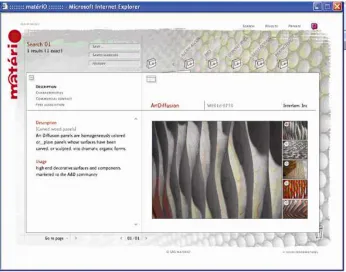
Advandec Search used in the material Connexion databank when a field is specified in the “select application” area, as for example: toys. They state that they include materials based on their merit, which may be assigned by a team of a single person. One cannot expect that this model to offer unreliable information. However, we have noted a commercial influence on these
collections as well (fig.16 and 17). The on-line data base has an enormous importance in the models and a trend toward working with more
contemporary materials that are in the field of innovation can be seen. The most positive aspect of these models is in relation to the greater ease with which the information is updated. However, in both cases the information is often “contaminated” 3 by marketing which jeopardizes its reliability.
1 Site Polimerica: http://www.polimerica.it ; site Materioteca: http://www.materioteca.com 2 Site Material Connexion: http://www.materialconnexion.com ; site MateriO:
http://www.materio.com
3 The term “contaminates” is used here because we believe that the availability of information
Fig. 16 MateriO data-base – material from Interlam
[image:14.595.120.471.91.617.2]Fig. 17 Material Connexion data-base – material from Interlam
The independent model endeavors to focus exclusively on the interest of those who are looking for information about materials and prioritize technical content, without necessarily presenting the suppliers. Such is the case of Mat-web4, which is an information portal that does not make different space
available based upon payment. Its area limited to subscribers offers a differential in the free space in relation to quantity and quality of information based on the search criteria.
When analyzing the matter of the differences among the physical collections of the on-line databases two important points of comparison can be noted: the volume of information and the perceived relations with the materials. The existing volume of materials and information about them is such that it is only possible to store them and make them available only in databases. Otherwise, an enormous physical space would be required to house the diversity that it presents today. However, to use them as an efficient project tool, the
information must be systematized based on the creation of content filters of the material. The organization of these filters must be related to the specific needs of the designer, to promote optimization of access to the data available in digital means. Lima (2000) emphasizes that currently a
gatekeeper, element designed to filter information available on any given subject, is absolutely necessary so as to enable greater objectivity in the research and selection of data. The study also reinforces the need of this action owed to the predominantly technical direction and bias arising from the engineering of the materials found in the classification and cataloguing of several materials from the databanks analyzed.
The sensory relations from physical contact with the materials are determining factors for understanding them and in this respect the main problem with databases is the impossibility of touching them – a presumption inherent in the virtual aspect of the consultation – as well as the distortions resulting from the image of the material displayed. The photos used to illustrate the appearance of the material are often produced as advertising images, i.e., they are
designed to captivate the observer up close with magnificent lighting, incredible lighting and all this does not correspond to the material which is in reality outside photographic studio. A study conducted by a group based on the selection on the data base and afterward compared to the sample of the material received, showed that the distortion is often so great that it hinders understanding of the structures (fig. 18)
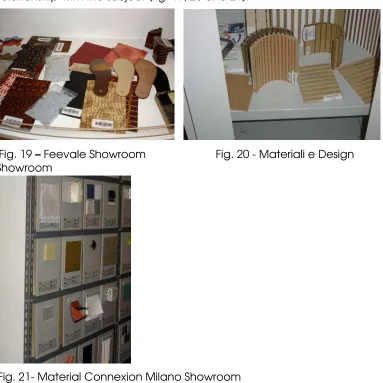
However, inasmuch as concerns the physical space the most important aspect is related to the size of the samples since this determines its perceptive relationship with the subject (fig. 19, 20 and 21).
[image:16.595.122.437.84.271.2]
Fig. 21- Material Connexion Milano Showroom
Considering the analyses of the systems studied and debating them with the methods projected in the cited designs, it can be seen that there is still an enormous tendency to privilege technical information as a way of organizing collections and materials classification and cataloguing systems. Therefore, Fig. 19 – Feevale Showroom Fig. 20- Materiali e Design
Showroom
[image:16.595.123.506.315.698.2]discussion about the undertaking losses out to models which are based on logic that is very different from current design: the exact sciences. This is
understandable in part, due to the fact that it is very difficult to break with that which has already been sustained. However the analysis invite though as to the new materials classification and cataloguing models as well as the new ways to physically arrange them to build materials libraries.
Conclusion: conceptual guidelines for compiling a materials
library M+D
The guidelines for the M+D collection are shown here as conclusions extracted on the basis of the analysis of data obtained from the research. They are based on the key elements of constructing the “spirit of the place”, while the investigation space in the materials area and the modusoperandi which should unite with the specific needs of the designers’ operations. Adapting reality at the Centro Universitário Senacthe institution that gives rise to this study, the collection proposes to be an independent space, for non commercial purposes, committed to scientific research and disclosure of knowledge expectation of profits or any economic advantage from the information availed. The project was conceived to meet the needs of the undergraduate and post-graduate students, research, extension courses and professional design studies as other related areas and its main object is to encourage research in the area, promoting formation from a more
conscientious, sensitive and creative eye in relation to the materials. Add to this the proposal to provide reliable and current information in relation to materials and productive domestic and international processes, enabling a comparative analysis among different suppliers.
The M+D library will comprise a physical environment and a virtual one so as to meet the different consultation needs and the types of information about materials and productive processes. However, any conception would seek to prioritize access to physical space so that the user can enter into contact with the samples and the sensory information is shown to reveal its most relevant aspect. The databanks will have a distinctive function and will complement the physical collection, since the quantity of materials currently available would require very large space and proportions. It will hold technical and process information, commercial information about suppliers and other cross referenced information with the materials available about the subject. Therefore, the physical environment must be built along the following guidelines:
The “spirit” of the place
This is geared toward the sensory study and handling of the materials. It should serve as a type of sensorial playground that has a vast capacity to encourage creativity and invention.
It should be characterized as an immersion environment and be dynamic, where the relevance of it can be seen and not just the samples displayed, but also in a special spatial layout.
purposes.
The information acquired from this environment is given priority in relation to perceptive order and should encourage investigation and expansion of the materials repertoire.
Selection criteria
This is not a warehouse where any old materials or samples received are relegated without any criteria as to what should be included. The materials inclusion criteria should be put through a research filter to achieve a balance between innovative and traditional materials. A mixture of familiar elements and new ones would enable the space to become recognized as a research environment.
It should comprise samples that avail high quality perceptive information, characterized by clear sensorial distinctions of the variations of the same category. There is no need to repeat samples of several thicknesses of the same material, unless this difference would also construe a perceptive difference to the user.
It should include as well elements and materials for graphic design, fashion design and digital interfaces and any other ones that have could be of potential use in the area.
Physical organization of the space
This is an immersion environment that enables new systematic arrangements on the basis of thematic discussions.
It should enable interaction among a number of design areas in one single environment and not benefit only the traditional product design area.
It should house samples of appropriate sized according to the type of material and in sizes that will enable perceptive and sensorial experiences.
A juxtaposition of materials samples should be facilitated based on the sensory and perceptive features of them, as well as their different physical, chemical classifications that are adopted in other spaces visited.
Type of information
There is a need to distinguish between the types of information (commercial, technical, sensorial, environmental) which will be offered to users of the environment according to their specific goals.
Thus, the user can make a better comparison of the information categories of the different types of materials.
Replacement and disposal policy
It is of the utmost importance that the inclusion criteria and disposal criteria be programmed for the samples, catalogues and information.
Replacement should take place whenever a sample is in poor condition or worn-out from handling. The exclusion criteria for a sample in the physical collection would be based on its no longer being made available on the market by the manufacturer.
It is not the objective of this project to implement an historic collection. The databank information should reflect the current status of the physical collection. Therefore, samples of materials that have been withdrawn will remain in the data base with the notice: out of production since (data). Taking the importance of the investigative spirit involved in the training of a designer, it is believed that project possibilities restricted on the basis of research conducted in one single environment could be highly prejudicial to the student’s education and therefore the search for information and
materials in other locations should be encouraged by the institution’s docents and researchers. Assembling this type of initiative within a university setting should serve as an incentive to research.
References
Ashby, M., Johnson, K. (2002). Materials and design: the art and science of material selection in product design. Kidlinton: Elsevier.
Baxter, M. (1998). Projeto de produto. Guia prático para o desenvolvimento de novos produtos [Product Design: Practical Methods for Systematic
Development of New Products] São Paulo: Edgard Blücher.
BONSIEPE, G. (1997) Design: do material ao digital [Design:from object to interface] Florianópolis: FIESC/CIEL.
BONSIEPE, G.(1978) - Teoría y Practica del Diseño Industrial; Elementos para una manualística crítica. [Theory and Practises of the Industrial Design].Trad. Santiago Pey. Barcelona: Gustavo Gili.
Bürdek, B.E. (1994). Diseño. Historia, teoria y práctica del diseño industrial [Design: Geschichte, Theorie und Praxis der Produktgestaltung ]. Barcelona: Gustavo Gili.
Dantas, D. (1998). Parâmetros para avaliação da qualidade de embalagens de consumo: o caso das embalagens de água sanitária [Parameters for evaluating the quality of consumption packaging] São Paulo: s.e. FAU_USP [Master Thesis]
Dantas, D. (2005).Design orientado para o futuro, centrado no indivíduo e na análise de tendências [Future oriented design, based in tendency analisis and user centered] . São Paulo:s.e. FAU_USP [PhD Thesis].
from http://www.revistadesignemfoco.com.br/ojs211/index. php/rfdoco/index.
Forghieri, Y. C. (1993). Psicologia fenomenológica. Fundamentos, métodos e pesquisa. [Phenomenological psychology. Fundamentals, methods and research]. São Paulo: Pioneira.
Lima, M. A. M. (2006). Introdução aos materiais e processos para designers [Introduction to materials and processes for designers]. Rio de Janeiro: Ciência Moderna.
Lobach, B.(1981). Diseño industrial: bases para la configuración de los productos industriales [Industrial design: basis for industrial products configuration] Barcelona: Gustavo Gili.
Manzini, E. (1993). A matéria da invenção [The material of invention: materials and design] Porto: Centro Português de Design.
Material Connexion. Retrieved February 21, 2006,
from http://www.materialconnexion.com [subscribe access]
MateriO. Retrieved February 21, 2006, from http:// www.materio.com [subscribe access]
Materioteca. Retrieved February 21, 2006, from http://www.materioteca.com
Materioteca Feevale. Retrieved February 21, 2006,
from http://materioteca.feevale.br:8080/webmaterioteca/externo/index.jsp
Matweb. Retrieved February 21, 2006, from http://www.matweb.com
Papanek, V. (1995). Arquitetura e Design [The Green Imperative: Ecology and Ethics in Design and Architecture]. Lisboa: Edições 70.
Papanek, V. (1985). Design for the real world : human ecology and social change. (2nd ed.) Chicago: Academy Chicago Publishers.
Polimérica. Retrieved February 21, 2006, from http://www.polimerica.it
Schulmann, D. (1994). O Desenho industrial [The industrial design]. Campinas: Papirus (Coleção ofício de arte e forma).
Universidade Federal do Rio Grande do Sul. Retrieved February 21, 2006, from http://www.ufrgs.br/ndsm
Ana Paula de Campos
Ph.D. student at University of Campinas, Brazil. Holds a master degree by University Mackenzie. She is a researcher in materials design, design education and jewelry design and author of several papers about this themes. Has
experience in industrial design, with emphasis in product design, especially jewelry design and package design. She has more than 10 years of
Denise Dantas
Holds a Ph.D. granted by the Graduate Program on Architecture and
Urbanism at the University of São Paulo. Her Ph. D. Thesis was awarded the 2nd best theoretical work on design by Museu da Casa Brasileira Annual Design Prize in 2006. She is the author of many papers about design methodology and education, experimental design and materials for design. Has experience in industrial design, with emphasis in product design, acting mainly in the following themes: package design, user centered design, productive