Students’ perceptions of the accounting profession : a
work values approach
TOURNA GERMANOU, Eleni, HASSALL, Trevor and TOURNAS, Yanni
Available from Sheffield Hallam University Research Archive (SHURA) at:
http://shura.shu.ac.uk/11684/
This document is the author deposited version. You are advised to consult the publisher's version if you wish to cite from it.
Published version
TOURNA GERMANOU, Eleni, HASSALL, Trevor and TOURNAS, Yanni (2009). Students’ perceptions of the accounting profession : a work values approach. Asian Review of Accounting, 17 (2), 136-148.
Copyright and re-use policy
See http://shura.shu.ac.uk/information.html
Students’ Perceptions
of Accounting Profession: Work Value Approach
Eleni Germanoua, Trevor Hassalla and Yanni Tournasb
a
Sheffield Hallam University, School of Business and Finance, City Campus, Howard Street, effield, S1 1WB, U.K.
b
City University of New York, New York, USA,
Abstract
Purpose – This study introduces a new theoretical framework to examine similarities and differences between accounting major Malaysian and English students. It concerns attributes and outcomes associated with the accounting profession, and the relationship between students’ perceptions and intentions to pursue an accounting career.
Design/methodology/approach – A survey research approach has been adopted to investigate students’ perceptions regarding the accounting profession. The data for this study were collected via questionnaires completed by Malaysian exchange students visiting a university in England and students of a major university in England. The results of the questionnaire were then quantitatively analyzed.
Findings – The results indicate that both groups hold positive perceptions of the accounting profession and there is a significant correlation between students’ perceptions and their intention to pursue a career in the profession. The study also identifies that Malaysian and English students hold differing perceptions concerning the accounting profession’s attributes and outcomes.
Originality/value – This is one of the first accounting education papers using the work value theory to investigate perceptions regarding the accounting profession by Malaysian students of Chinese ethnicity and compare these perceptions with the perceptions of students of a major university in England of English ethnicity.
Keywords: Perception of the accounting profession; work values; accounting career choice. Paper type Research paper
Corresponding author. Tel.: +1212 220 8209,
1. Introduction
Technology, globalisation, new business relationships and the multidisciplinary economic environment have changed the accounting profession (hereafter AP) (Walker, 2004). The AP today requires a new type of professional accountant with diverse knowledge, skills and competences quite different from those in previous decades. Yet stereotypes of accountants and the perceptions of, and attitudes towards, the AP, have not changed. In recent years there has been a continual decline in enrolments in accounting programmes. The AP has lost its ability to attract top students resulting in concerns about the future of the AP (Albrecht and Sack, 2001; Marriott and Marriott, 2003; Byrne and Willis, 2005). Several accounting academics argue that the perceptions students hold about the AP influence them toward pursuing an accounting career (Horowitz and Riley, 1990; Cohen and Hanno, 1993; Felton et. al., 1995 ). Hofstede (1998) has argued that students from countries with different cultural and stage of economic development backgrounds have different perceptions of the profession that may affect their career choice.
There is a scarcity of empirical investigations utilising relevant theoretical frameworks and systematically developed instruments to measure this perception of the AP. This is the first research to investigate differences between accounting students from different countries concerning their perceptions of the AP. The theory of work values is used to examine the potential students’ perceptions of attributes and outcomes associated with the AP.
This paper, involving students from Malaysia and England, has the following objectives: to explore Malaysian and English accounting students’ perceptions concerning
attributes and outcomes associated with the AP;
to identify similarities and differences in the perceptions between the two groups; to investigate Malaysian and English students’ overall perception of the AP; and to examine the relationships between students’ perceptions and their intention to
pursue an accounting career.
The remainder of this work is structured with an exploration of prior research on the perception of the AP, an outline of the theoretical framework and hypotheses for the study, followed by the research methods used. The results of the statistical analysis are examined and conclusions drawn.
Cory (1992), Fisher and Murphy (1995), and Pollock et al. (2002) have argued that the perception of the AP is a fundamental factor in students’ selection of accounting as an academic major and as a career. Hermanson and Hermanson (1995) investigated top business students’ perceptions of the AP and found that the nature of accounting work, its work environment and associated lack of creativity, were the most important negative perceptions that influenced their decision not to major in accounting. Other US studies found that students perceive accounting work as highly precise and thorough, deterring interest and discouraging creative individuals from pursuing an accounting major (Saeman and Crooker, 1999; Coate et al., 2003). Chen, et al., (2008) found that student perceptions about accounting change over time during their education, the perceptions being differentially associated with benefits and costs. Byrne and Willis (2005) investigated the perceptions of Irish secondary school students, reporting a negative view of the nature of accounting employment, perceiving it as boring, definite, precise and compliance-driven. In contrast, Hartwell et al. (2005) reported more positive views of accounting, claiming that students believed an accounting degree would be useful to individuals who wanted challenging work and aspired to be president or CEO of a large company. Sugahara and Boland (2006) found that Japanese accounting students hold more positive perceptions of their proposed profession compared to those of non-accounting business students. Sugahara et al. (2008) found that differences in students’ creativity and procedural images of the AP may have influenced students’ choice of an accounting major in Australia.
Pollock et al. (2002) investigated high school counsellors’ perceptions of the profession and found it perceived as uninteresting, stressful, time-consuming and not particularly rewarding financially. Barsky and Catanach (2001) noted that many students and their parents do not understand how the role of accountants has changed from advisor on micro accounting matters to a consultant on broad-based management issues.
Many researchers in the field of vocational decision making in other disciplines, advocate the use of work values as a theoretical framework (e.g., Brown, 1995; Kinnier, 1995; Rokeach, 1973, 1977; Super, 1990; Super and Sverko, 1995).
Work values are regarded as broad tendencies to prefer certain job characteristics, outcomes or features of work environments (Lofquist and Dawis, 1971; Super, 1973; Pryor, 1983; Hofstede, 1998), or as desirable modes of vocational behaviour (Meglino and Ravlin, 1998). Dose (1997, p.2) summarised and defined work values as: “...standards or criteria for choosing goals or guiding actions relating to work or the work environment ....that are....relatively enduring and stable over time”. This paper uses the theory of work values (Super, 1973) to measure accounting students’ perceptions concerning attributes and outcomes that are associated with the AP.
Several vocational studies have identified different attributes/work values that influence individuals when selecting their ideal job. Work values researchers have concluded that the number and type of relevant attributes is associated with the specific population under research (Pryor, 1983; Elizur et al., 1991; Hofstede, 1998).
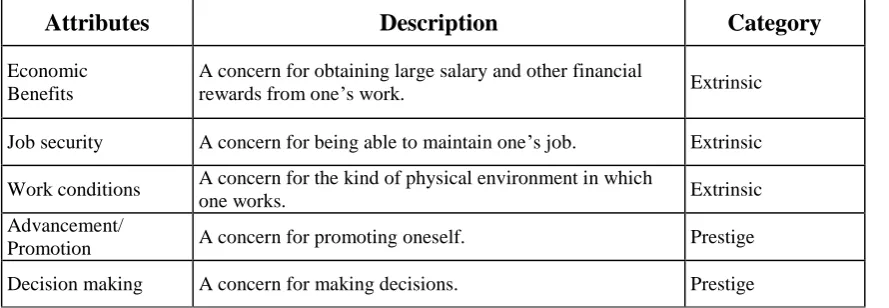
[image:5.595.67.512.596.750.2]Zytowski (1970), outlined a range of relevant attributes/work values. Subsequent researchers have identified a set of general categories to classify the attributes/work values (Elizur et al., 1991; Ros et al., 1999). Ros et al. (1999), classifies the attributes/work values into four distinct general categories: extrinsic, intrinsic, prestige (or image) and social (or altruistic). In the present study these categories have been selected to measure perceptions associated with the AP, based on prior accounting research of perceptions (Hartwell et al., 2005; Byrne and Willis, 2005; Sugahara and Boland, 2006; Tan and Laswad, 2006) and on the theory of work values. These attributes are outlined in Table 1, within each of the four categories.
Table 1 Attributes, description, and categories of attributes
Attributes Description Category
Economic Benefits
A concern for obtaining large salary and other financial
rewards from one’s work. Extrinsic
Job security A concern for being able to maintain one’s job. Extrinsic
Work conditions A concern for the kind of physical environment in which
one works. Extrinsic
Advancement/
Promotion A concern for promoting oneself. Prestige
Attributes Description Category
Social status A concern for recognition and status in the eyes of others. Prestige
Interesting nature of
job A concern for doing something interesting. Intrinsic
Personal growth A concern for learning new things. Intrinsic
Achievement A concern for accomplishing something important. Intrinsic
Autonomy A concern for being free from imposed constraints in the
work environment. Intrinsic
Self esteem A concern for doing something worthwhile. Intrinsic
Contribution to
society A concern for assisting others and contributing to society. Social
Work with others A concern for friendship and understanding from those with
whom one works. Social
3. Hypotheses
It has been suggested by previous authors that students’ perceptions about the accounting profession may differ based on cultural or ethnic origins. To measure students’ perceptions of the AP and to identify similarities and differences between two ethnic groups, the following null hypotheses were proposed:
H1-H4 There is no statistically significant difference between Malaysian and English accounting students in their perception of the AP associated with:
H1: the extrinsic category of attributes.
H2: the intrinsic category of attributes.
H3: the prestige category of attributes.
H4: the social category of attributes.
H5: There is no statistically significant difference in the overall perception of the AP between Malaysian and English accounting students.
H6: There is no statistically significant relationship between students’ intention to pursue an accounting career and their overall perception of the AP.
H7: There will not be a significant positive relationship between students’ intention to pursue the AP and the different categories.
4.1 Data collection
The data for this study were collected via questionnaires that were administered to two different groups of accounting major students attending their final year of study. The data collection was anonymous. The students participating in the study were given class time to complete the questionnaires and these were collected immediately upon completion. The first group consisted of full time students who identified themselves as being of Chinese ethnicity attending the Tunku Abdul Rahman College (TARC) on exchange during their summer visit at a major university in England. The questionnaire was also administered to another group of full time students attending a major university in England, and who identified as being of English ethnicity. Of the total 357 questionnaires collected, 224 were usable. The unusable questionnaires were completed by students who identified themselves as belonging to another ethnicity, or the questionnaires were incomplete. The gender, ethnic and age structure of the sample population is shown in the following tabulation.
Table 2: Structure of Gender, Ethnicity and Age of Sample
English Students
Malaysian
Students Total
Number 87 137 224
Male 41 78 119
Female 46 59 105
Average Age (Min-Max) 21.1 (20-25) 21.6 (21-27) 21.4 (20-27)
4.2 The instrument
The instrument used in this study to measure the students’ perceptions and intention was developed by Tourna et al for business students (2006).
The instrument is divided into two sections, as follows:
Part I gathered students’ demographic information, i.e., gender, age, ethnicity and family status.
attributes and outcomes associated with the accounting profession (Accounting Perception Scale, hereafter APS). An additional five items assessed students’ intentions to follow the accounting profession as a career (Accounting Intention Scale, hereafter AIS).
4.3 Measures
Intention to pursue a career in the AP was measured using the AIS scale. The variable of intention was created using the sum of scores for the five items related to the students’ intention to pursue a career in accountancy. The range of possible scores for this, and all following measures, was 1 to 5, midpoint 3. The Cronbach for the present sample was 0.91. The four categories were operationalised as the perceptions that students held for the AP’s attributes and outcomes as follows:
Extrinsic category - of a material nature - mean value of 13 item scores. Cronbach for the present sample was 0.77.
Intrinsic category- feelings that are produced inherently by the accounting job itself - mean value of 23 item scores. Cronbach for the present sample was 0.84.
Prestige category - of a prestige (image) nature - mean value 12 item scores. Cronbach for the present sample was 0.83.
Social category - a social/affective nature - mean value of 4 item scores. Cronbach for the present sample was 0.69.
The overall perception was created using the mean value of scores for the 52 items (APS) related to students’ perceptions associated with extrinsic, intrinsic, prestige and social attributes and outcomes of the AP. Cronbach for the present sample was 0.91.
5. Results
5.1 Descriptive analysis of questionnaires
The analysis of questionnaires suggests that there is positive intention to pursue a career in accounting and a positive overall perception of the AP for the entire sample, and for each ethnic group separately.
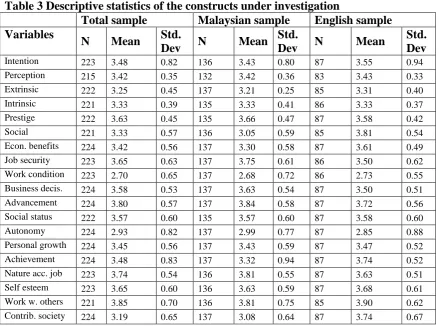
TABLE 3 SOMEWHERE HERE
than the mid point of the scale 3.00 (p<0.000). However, 16% and 15% of Malaysian and English students respectively, indicated a neutral to negative overall perception of the profession, and 33% and 28% of Malaysian and English students respectively, indicated a neutral to negative intention to follow a career in the AP.
Furthermore, these descriptive statistics show that the four general categories, and the perceptions about all attributes associated with the AP, are above the midpoint of the scales excepting work conditions and autonomy for both ethnic groups. However, the mean scores of variables between the two groups are highly variable.
5.2 Similarities and differences between groups
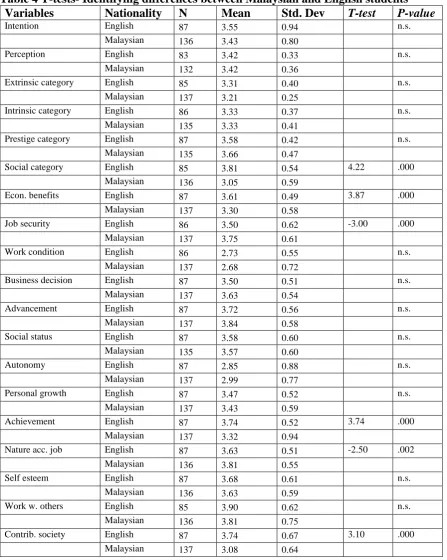
To examine whether these differences between the two groups are statistically significant, a series of t-tests was performed. The results (Table 4) show no statistically significant differences in overall perception, or in the three categories extrinsic, intrinsic and prestige, between accounting students from Malaysia and England. However, there is a statistically significant difference in the score of the social category. Therefore the hypotheses H1, H2, H3 and H5 are not supported, whereas the hypothesis H4 is fully supported.
TABLE 4 SOMEWHERE HERE
Regarding differences between the two ethnic groups in the scores of thirteen attributes, the patterns of the results accord with the literature (Auyeung and Sands, 1997; Tan and Laswad, 2006). Statistically significant differences were identified between the two groups concerning the scores of the attributes ‘economic benefits’, ‘job security’, ‘achievement’, ‘nature of accounting job’ and ‘contribution to society’. English students perceive that the AP provides the opportunity for economic rewards, and offers valuable achievement and contribution to businesses and to society. Malaysian students associate the AP more with job security, indicating more positive perceptions for the interesting nature of the accounting job, than did the English students.
5.3 Relationships between accounting vocational constructs
intention and perception for the Malaysian sample, and a medium positive correlation for the English sample. Therefore hypothesis H6 is not supported.
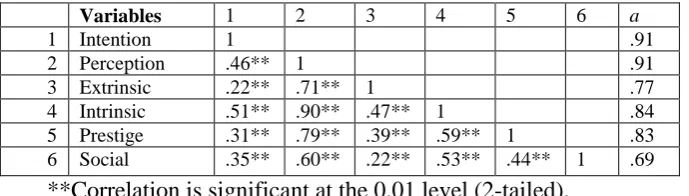
TABLES 5a, 5b, 5c SOMEWHERE HERE
Hypothesis H7 regarding students’ intentions and the extrinsic, intrinsic, prestige and social categories, was also tested using Pearson’s r. The results (Table 5a), indicate a large positive correlation between intention and the intrinsic category, a medium positive correlation between intention and the prestige and social categories, and a small positive correlation between intention and the extrinsic category for the total sample. The results for Malaysian students (Table 5b) show a strong positive relationship between intention and the intrinsic category, a medium positive relationship between intention and the prestige and extrinsic categories, and a small positive relationship between intention and social category for the Malaysian sample. The results for English students (Table 5c) show a medium positive correlation between intention and the intrinsic and the social categories for the English sample. There were no statistically significant relationships between English students’ intention and the extrinsic and prestige categories. Therefore hypothesis H7 is partially supported.
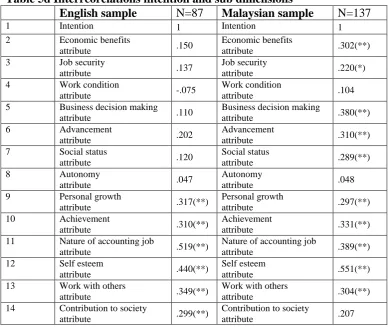
TABLE 5d SOMEWHERE HERE
intentions are statistically significant only with the intrinsic and social categories, and with six attributes.
6. Conclusion
In general the study indicates that if a student has a positive perception of the AP then that student will be highly likely to have a positive intention to pursue an accounting career, consistent with the findings of Cohen and Hanno (1993), Felton et. al. (1995), Marriott and Marriott (2003) and Sugahara et al., (2008). The study provides further evidence of the importance of students’ perceptions of different attributes in making an accounting career choice. Specifically, the intrinsic and social category of attributes were found to relate significantly with the English students’ intentions and all four categories were related significantly to the Malaysian students’ intentions.
The findings reveal important similarities and differences between the two ethnic groups concerning the attributes associated with the AP. Accounting students from both countries are motivated to pursue the profession mainly based on their perceptions about the opportunities for work with others, career advancement and the interesting nature of the accounting job, confirming the emphases of Saeman and Crooker (1999), Coate et al. (2003) and Byrne and Willis (2005). Furthermore, perceptions concerning business decision making, self esteem and job security seemed to be important motivators. Interestingly, both Malaysian and English students perceive the accounting job as stressful, that accountants work under difficult working conditions (pressure and stress), follow instructions from others and work with strict deadlines for the completion of accounting assignments (Pollock et al., 2002). An interesting direction for future research would be to investigate the reasons for this common negative perception among groups of students with diverse geographical and cultural backgrounds.
The research confirms the expectation that students will be influenced by a broad range of perceived attributes and outcomes of the profession. This suggests the importance of accounting educators and practitioners actively promoting the whole range of outcomes (extrinsic, intrinsic, prestige and social) to prospective and current students in order to positively influence their overall perception, thereby attracting individuals with creative, analytical and leadership skills into the AP.
There are some limitations in this study. Participants used in the present study comprise a relatively small sample of accounting students, and the study was based on self-reported answers which may be subject to social desirability bias.
References
Albrecht, W. S. and Sack, R. J. (2001), “The perilous future of accounting education.” The CPA Journal, 71(3), pp.17-24.
Auyeung, P., and Sands, J. (1997), “Factors influencing accounting students’ career choice: a cross-cultural validation study.” Accounting Education, 6(1), 13-23.
Barsky, N. P., and Catanach, A. H. (2001), “Perception is reality.” Management Accounting Quarterly, Fall, 22-32.
Brown, M. T. (1995), The career development of African Americans: Theoretical and
empirical issues. In F. T. L. Leong (Ed.), Career development and vocational behaviour of racial and ethnic minorities (pp. 7-30). Mahwah, NJ: Erlbaum.
Byrne, M. and Willis, P. (2005), “Irish Secondary Students’ Perceptions of the Work of an Accountant and the Accounting Profession.” Accounting Education, 14(4), 367-381. Coate, C. J., Mitshow, M. C., and Schinski, M. D. (2003), “What students think of CPAs: Is
the stereotype alive and well?” CPA Journal, 3(8), 52-56.
Chen C., Jones K., and Mcintyre D. D. (2008), “Analyzing the Factors Relevant to Students’ Estimations of the Benefits and Costs of Pursuing an Accounting Career.” Accounting Education, 17, 3, 313 -326
Cohen, J., and Hanno, D. (1993), “An analysis of underlying constructs affecting the choice of accounting as a major.” Issues in Accounting Education, 8(2), 219-238.
Cory, S. (1992), “Quality and quantity of accounting students and the stereotypical accountant: is there any relationship?” Journal of Accounting Education, 10, 1-24. Dose, J. (1997), “Work values: An integrative framework and illustrative application to
organizational socialization.” Journal of Occupational and Organizational Psychology, 70, 219-240.
Elizur, D., Borg, I., Hunt, R., and Beck, I. M. (1991), “The structure of work values: A cross cultural comparison.” Journal of Organizational Behaviour, 12, 313-322.
Felton, S., Dimnik, T. and Northey, M. (1995), “A Theory of Reasoned Action Model of the Chartered Accountant Career Choice.” Journal of Accounting Education, 13 (1), 1-19. Fisher, R., and Murphy, V. (1995), “A pariah profession? Some students’ perceptions of
accounting and accountancy.” Studies in Higher Education, 20(1), 45-58.
Hartwell, C. L., Lightle, S. S., and Maxwell, B. (2005), “High School Students’ Perceptions of Accounting.” The CPA Journal, January, pp. 62-67.
Hofstede, G. (1986), “Cultural Differences in Teaching and Learning.” International Journal of Intercultural Relations, 10(3), 310-320.
Hofstede, G. (1998), “Attitudes, values and organizational culture: disentangling the concepts.” Organization Studies, Vol.19, pp. 477-492
Horowitz, K., and Riley, T. (1990), “How do students see us?” Accountancy, Sept., 75-77. Kinnier, R. T. (1995), “A reconceptualization of values clarification: Values conflict
resolution.” Journal of Counselling and Development, 74, 18-24.
Marriott, P. and Marriott, N. (2003), “Are we turning them on? A longitudinal study of undergraduate accounting students’ attitudes towards accounting as a profession.”
Accounting Education, 12 (2), 113-133.
Meglino, B. M. and Ravlin, E. C. (1998), “Individual values in organizations: concepts, controversies, and research.” Journal of Management, 24, 351-389.
Mladenovic, R. (2000), “An investigation into ways of challenging introductory accounting students’ negative perceptions of accounting.” Accounting Education, 9 (2), 135-155. Pollock, K. S., Papiernik, J. C., and Slaubaugh, M. D. (2002), “High school guidance
counsellors’ perceptions of the profession.” The CPA Journal, May, 73-75.
Pryor, R. G. L. (1983),Manual for the Work Aspect Preference Scale. Sydney, Australia: Australian Council for Educational Research.
Rokeach. M. (1973), The nature of human values. New York: Free Press.
Rokeach. M. (1977), The nature of human values and value systems. In M. Smith, A practical guide to value clarification (pp. 222-245). La Jolla, CA: University Associates.
Ros, M., Schwartz, S. H. and Surkiss, S. (1999), “Basic Individual Values, Work Values and the Meaning of Work.” Applied Psychology, 48(1), 49-71.
Saeman, P. G., and Crooker, K. J. (1999), “Student perceptions of the profession and its effect on decisions to major in accounting.” Journal of Accounting Education, 17 (1), 1-22. Sugahara, S., Boland, G. and Cilloni, A. (2008), “Factors Influencing Students’ Choice of an
Accounting Major in Australia.” Accounting Education, 17, S37 –S54.
Sugahara, S. and Boland, G. (2006), “Perceptions of the certified public accountants by accounting and non-accounting tertiary students in Japan.” Asian Review of Accounting, 14, 1/2, 149-167.
Super, D. E. (1990), A life-spa, life-space approach to career development. In D. Brown, L. Brooks, and Associates, Career choice and Development (2nd ed., pp. 197-261). San Francisco: Jossey-Bass.
Super, D. E., and Sverko, B. (1995), Life role, values and careers: International findings of the work importance study. San Francisco: Jossey-Bass.
Tan, L.M. and Laswad, F. (2006), “Students’ beliefs, attitudes and intentions to major in accounting.” Accounting Education, 15(2), pp.167-187.
Tourna, E., Hassall, T., and Germanos, G. (2006), “Constructing and Validating an Instrument for Measuring Attitudes towards the Accounting Profession.” The Southeuropean Review of Business, Finance and Accounting, 4, (2), 5-33.
Walker, M. (2004), “Recovering accounting: an economic perspective”, Critical Perspectives on Accounting, Vol.15, pp. 519-527.
Table 3 Descriptive statistics of the constructs under investigation
Total sample Malaysian sample English sample Variables
N Mean Std.
Dev N Mean Std.
Dev N Mean
Std. Dev
Intention 223 3.48 0.82 136 3.43 0.80 87 3.55 0.94
Perception 215 3.42 0.35 132 3.42 0.36 83 3.43 0.33
Extrinsic 222 3.25 0.45 137 3.21 0.25 85 3.31 0.40
Intrinsic 221 3.33 0.39 135 3.33 0.41 86 3.33 0.37
Prestige 222 3.63 0.45 135 3.66 0.47 87 3.58 0.42
Social 221 3.33 0.57 136 3.05 0.59 85 3.81 0.54
Econ. benefits 224 3.42 0.56 137 3.30 0.58 87 3.61 0.49
Job security 223 3.65 0.63 137 3.75 0.61 86 3.50 0.62
Work condition 223 2.70 0.65 137 2.68 0.72 86 2.73 0.55
Business decis. 224 3.58 0.53 137 3.63 0.54 87 3.50 0.51
Advancement 224 3.80 0.57 137 3.84 0.58 87 3.72 0.56
Social status 222 3.57 0.60 135 3.57 0.60 87 3.58 0.60
Autonomy 224 2.93 0.82 137 2.99 0.77 87 2.85 0.88
Personal growth 224 3.45 0.56 137 3.43 0.59 87 3.47 0.52
Achievement 224 3.48 0.83 137 3.32 0.94 87 3.74 0.52
Nature acc. job 223 3.74 0.54 136 3.81 0.55 87 3.63 0.51
Self esteem 223 3.65 0.60 136 3.63 0.59 87 3.68 0.61
Table 4 T-tests- Identifying differences between Malaysian and English students Variables Nationality N Mean Std. Dev T-test P-value
Intention English 87 3.55 0.94 n.s.
Malaysian 136 3.43 0.80
Perception English 83 3.42 0.33 n.s.
Malaysian 132 3.42 0.36
Extrinsic category English 85 3.31 0.40 n.s.
Malaysian 137 3.21 0.25
Intrinsic category English 86 3.33 0.37 n.s.
Malaysian 135 3.33 0.41
Prestige category English 87 3.58 0.42 n.s.
Malaysian 135 3.66 0.47
Social category English 85 3.81 0.54 4.22 .000
Malaysian 136 3.05 0.59
Econ. benefits English 87 3.61 0.49 3.87 .000
Malaysian 137 3.30 0.58
Job security English 86 3.50 0.62 -3.00 .000
Malaysian 137 3.75 0.61
Work condition English 86 2.73 0.55 n.s.
Malaysian 137 2.68 0.72
Business decision English 87 3.50 0.51 n.s.
Malaysian 137 3.63 0.54
Advancement English 87 3.72 0.56 n.s.
Malaysian 137 3.84 0.58
Social status English 87 3.58 0.60 n.s.
Malaysian 135 3.57 0.60
Autonomy English 87 2.85 0.88 n.s.
Malaysian 137 2.99 0.77
Personal growth English 87 3.47 0.52 n.s.
Malaysian 137 3.43 0.59
Achievement English 87 3.74 0.52 3.74 .000
Malaysian 137 3.32 0.94
Nature acc. job English 87 3.63 0.51 -2.50 .002
Malaysian 136 3.81 0.55
Self esteem English 87 3.68 0.61 n.s.
Malaysian 136 3.63 0.59
Work w. others English 85 3.90 0.62 n.s.
Malaysian 136 3.81 0.75
Contrib. society English 87 3.74 0.67 3.10 .000
[image:17.595.76.524.79.640.2]Table 5a Total Sample and intercorrelations (N = 224)
Variables 1 2 3 4 5 6 a
1 Intention 1 .91
2 Perception .46** 1 .91
3 Extrinsic .22** .71** 1 .77
4 Intrinsic .51** .90** .47** 1 .84
5 Prestige .31** .79** .39** .59** 1 .83 6 Social .35** .60** .22** .53** .44** 1 .69
**Correlation is significant at the 0.01 level (2-tailed).
Table 5b Malaysian Students and intercorrelations (N = 137)
Variables 1 2 3 4 5 6 a
1 Intention 1 .90
2 Perception .53** 1 .91
3 Extrinsic .28** .68** 1 .81
4 Intrinsic .53** .90** .44** 1 .83
5 Prestige .41** .80** .32** .63** 1 .79 6 Social .22** .45** .20** .50** .48** 1 .70 **Correlation is significant at the 0.01 level (2-tailed).
Table 5c English Students and intercorrelations (N = 87)
Variables 1 2 3 4 5 6 a
1 Intention 1 .88
2 Perception .36** 1 .91
3 Extrinsic X .79** 1 .75
4 Intrinsic .50** .89** .56** 1 .85
5 Prestige X .79** .57** .56** 1 .86
[image:18.595.65.410.96.194.2]Table 5d Interrcorelations intention and sub dimensions
English sample N=87 Malaysian sample N=137
1 Intention 1 Intention 1
2 Economic benefits
attribute .150
Economic benefits
attribute .302(**)
3 Job security
attribute .137
Job security
attribute .220(*)
4 Work condition
attribute -.075
Work condition
attribute .104
5 Business decision making
attribute .110
Business decision making
attribute .380(**)
6 Advancement
attribute .202
Advancement
attribute .310(**)
7 Social status
attribute .120
Social status
attribute .289(**)
8 Autonomy
attribute .047
Autonomy
attribute .048
9 Personal growth
attribute .317(**)
Personal growth
attribute .297(**)
10 Achievement
attribute .310(**)
Achievement
attribute .331(**)
11 Nature of accounting job
attribute .519(**)
Nature of accounting job
attribute .389(**)
12 Self esteem
attribute .440(**)
Self esteem
attribute .551(**)
13 Work with others
attribute .349(**)
Work with others
attribute .304(**)
14 Contribution to society
attribute .299(**)
Contribution to society
attribute .207
** Correlation is significant at the 0.01 level (2-tailed). *Correlation is significant at the 0.05 level (2-tailed).