Methodology for Creating a FairShares Lab (Full Report)
RIDLEY-DUFF, Rory <http://orcid.org/0000-0002-5560-6312>,
SCHMIDTCHEN, Roger, ARNOLD-SCHAARSCHMIDT, Martin, VUKOVIĆ,
Sonja, WENDLING, Nika, KLERCQ, Jumbo, SOUTHCOMBE, Clıff,
TRZECINSKI, Stefanie, PATAKI, Veronika, WREN, David and KÁROLY, Judit
Available from Sheffield Hallam University Research Archive (SHURA) at:
http://shura.shu.ac.uk/22723/
This document is the author deposited version. You are advised to consult the
publisher's version if you wish to cite from it.
Published version
RIDLEY-DUFF, Rory, SCHMIDTCHEN, Roger, ARNOLD-SCHAARSCHMIDT, Martin,
VUKOVIĆ, Sonja, WENDLING, Nika, KLERCQ, Jumbo, SOUTHCOMBE, Clıff,
TRZECINSKI, Stefanie, PATAKI, Veronika, WREN, David and KÁROLY, Judit (2018).
Methodology for Creating a FairShares Lab (Full Report). Project Report. FairShares
Labs for Social and Blue Innovation (Erasmus+ Project).
Copyright and re-use policy
See
http://shura.shu.ac.uk/information.html
Methodology for Creating a
FairShares Lab
A report for the FairShares Labs for Social and Blue Innovation project
co-authored by:
Dr Rory Ridley-Duff, Roger Schmıdtchen, Martin Arnold-Schaarschmidt, Sonja Vukovıć, Jumbo
Klercq, Clıff Southcombe, Stefanıe Trzecınskı, Karin Oparaocha, Judıt Bedőné Károly, David Wren and Veronika Pataki.
Edited by: Dr Rory Ridley-Duff, Professor of Cooperative Social Entrepreneurship, Sheffield Hallam University.
(IO1 - Methodology - Final)
Final Version (with Annexes) – 2nd August 2018
Creative Commons Copyright, 2018, International 4.0 Licence, BY-NC-SA.
You are free to copy, adapt, distribute and re-use this material under the terms of the authors’ Creative Commons Licence. Commercial reproduction rights have been granted to
Methodology for Creating a FairShares Lab
Table of Contents
Prolog ... 1
1. Introduction ... 2
1.1 Background to the FairShares Labs Project ... 2
1.2 Country Contexts ... 4
1.2.2 ICSEM Project Country Papers ... 4
1.3 Project Drivers ... 5
1.3.1 Problem-based drivers (Saving the World) ... 5
1.3.2 Aspiration-based drivers (Make a Better World) ... 6
1.4 Objectives ... 7
1.4.1 Project Goals and Impact ... 7
1.4.2 Outcomes ... 8
1.5 Means ... 9
1.6 Definitions/Key aspects ... 10
1.6.1 Blue Economy and Innovation ... 10
1.6.2 Social Enterprise and the Social Economy ... 13
1.6.3 Four Approaches to Social Enterprise ... 15
1.6.4 Living Labs ... 19
1.7FairShares Labs ... 20
1.7.1 FairShares learning ... 21
1.7.2 FairShares enterprises ... 22
2. The Components of a FairShares Lab... 23
2.1 Models, processes and methods ... 23
2.1.1 Five values and principles (model) ... 24
2.1.2 Six key questions (process) ... 25
2.1.3 Five learning and development methods (process) ... 29
2.1.4 Four legal identities ... 31
2.1.5 Seven ICT platforms (method) ... 36
Methodology for Creating a FairShares Lab
3.1 Differences between learning and training ... 40
3.1.1 Coaches: Advisers/Consultants versus Adult Educators ... 41
3.1.2 Key competences for adult learning professionals... 41
3.2 Experiential learning... 43
3.3 FairShares learning ... 46
3.3.1 Approach: Exchange Platform + Workshops + (online) Coaching ... 47
3.3.2 Target groups ... 52
3.3 FairShares: Train-the-Trainer Programme ... 52
4. Running Living Lab events ... 53
4.1 Accessibility ... 53
4.2 Generating ideas, teams and formulating projects ... 56
4.2.1 The “Start-up Weekend” ... 56
4.2.2 Design thinking task for two ... 56
4.2.3 Search, offer, match ... 57
4.3 Building the FairShares Lab... 58
4.3.1 Five dimensions ... 58
4.3.2 Five phases... 58
5. Marketing the FairShares Labs ... 64
5.1 Marketing actions ... 64
5.1.1 Key words ... 66
5.1.2 Messages ... 66
5.2 Market segmentation ... 66
5.2.1 What are the main target groups? How to reach them? ... 67
5.3 Market approach ... 67
5.4.1 Marketing communication tools ... 68
6. Annexes ... 72
Annex 1 - Country contexts ... 72
Methodology ... 72
Croatia... 73
Definitions and State of the Art... 73
Legal Framework ... 75
Trends ... 76
Methodology for Creating a FairShares Lab
Opportunities ... 78
Germany ... 79
Definitions and State of the Art... 79
Legal Framework ... 82
Trends ... 85
Challenges ... 87
Opportunities ... 88
Hungary ... 91
Definitions and State of the Art... 91
Legal Framework ... 93
Trends ... 94
Challenges ... 95
Opportunities ... 96
Netherlands ... 97
Definition ... 97
State of the Art ... 98
Trends ... 100
Challenges ... 101
Opportunities ... 103
UK ... 105
Definitions and State of the Art... 105
Legal Framework ... 109
Trends ... 112
Challenges ... 113
Opportunities ... 113
Annex 2 - FairShares Early Adopters ... 115
Annex 3 - FairShares IP Users ... 116
Annex 4 - FairShares Association Members ... 118
Applied to Labour Membership ... 118
Applied to user membership ... 118
Annex 5 - FairShares Institute Panels ... 120
Annex 6 – Relevant Practice Cases ... 121
Methodology for Creating a FairShares Lab
Cases from the Croatian Partner (SLAP) ... 124
Croatia-01-CAMARG, Osijek... 124
Croatia-02-SIL, Zagreb ... 126
Croatia-03-MivaART, Belišće ... 128
Cases from the English Partner (SEi) ... 130
English-01-Resonate ... 130
English-02-EvoluteSix ... 133
English-03-AnyShare Society... 135
English-04-Locosoco Group plc ... 137
Cases from German Partners ... 139
Germany-01-Gemeinsam eG LK Regensburg ... 139
Germany-02-MutmacherMenschen Augsburg ... 141
Germany-03-Next Hamburg ... 143
Germany-04-StreetLab Paris ... 145
Germany-05-Betterplace ... 147
Germany-06-Enterability ... 149
Germany-07-Sozialhelden ... 151
Cases from the Hungarian Partner ... 153
Hungary-01-Blue Economy Innovation Cluster ... 153
Hungary-02-Simonyi Center (University of Pécs) ... 155
Hungary-03-Recycling Factory ... 157
Cases from the Netherlands Partner ... 159
Netherlands-01-Ujuizi International B.V ... 159
Netherlands-02-Hoogeloon Care Coopertiv ... 161
Netherlands-03-Van Hulley ... 163
Annex 7 - Checklist for starting a physical FairShares Lab ... 165
7. Glossary ... 167
Methodology for Creating a FairShares Lab
Table of Figures
Figure 1.1 - FairShares learning and development overview ... 10
Figure 1.2 – Combined interests in models of social enterprise ... 15
Figure 1.3 - Positioning FairShares in the field of social enterprise ... 18
Figure 1.4 - Common elements in Living Labs ... 20
Figure 2.1 - Overview for developing a FairShares Lab ... 23
Figure 2.2 - A model, process and method driven by values and principles ... 25
Figure 2.3 - Who can answer the key questions needed to plan an enterprise? ... 28
Figure 2.4 - Legal identities and FairShares branding ... 36
Figure 3.1 - Activities of adult learning professionals ... 41
Figure 3.2 - Key competencies of adult learning professionals ... 42
Figure 3.3 - Kolb’s learning cycle ... 44
Figure 3.4 - Critical appreciation as an evolution of Kolb’s learning cycle ... 46
Figure 3.5 - Competency framework for social economy management ... 47
Figure 3.6 - Overview of FairShares Lab workshops ... 48
Figure 4.1 - Differentiating exclusion, separation, integration and inclusion ... 53
Figure 4.2 - FairShares Lab process overview ... 59
Figure 4.3 - A learning cycle for product prototyping ... 61
Figure 5.1 – Value chain and main drivers ... 69
Figure 6.1 – Social economy breakdown (Germany) ... 85
Figure 6.2 – Social enterprise Netherlands definition ... 98
Figure 6.3 – Priority sectors for social enterprise (Netherlands) ... 103
Figure 6.4 – Sampling process in UK government SE survey 2017... 107
Figure 6.5 – Understanding legal forms for SE in the UK ... 110
Methodology for Creating a FairShares Lab
Table of Tables
Table 1.1 - Summary of approaches to social enterprise development ... 17
Table 2.1 - Most popular legal forms for SE in each partner country ... 32
Table 4.1 - Helping people with mobility, visual, hearing and learning issues ... 54
Table 5.1 – Target groups, drivers and messages ... 65
Table 5.2 - Integrated marketing tools ... 70
Table 6.1 – Key social economy support organisations (Croatia) ... 74
Table 6.2 - Main characteristics of Hungarian SE models ... 95
Table 6.3 – Social enterprises and socially-oriented SMEs, UK 2017 data ... 107
Table 6.4 – Co-operative economy, UK 2017 data ... 108
Table 6.5 – Social Enterprise International definitions and links to FairShares ... 109
Table 6.6 – Changes in incorporation for UK social enterprises ... 111
Table 6.7 – FairShares early adopters (pre-project) ... 115
Table 6.8 – FairShares IP users (pre-project)... 116
Table 6.9 – FairShares practice panel ... 120
Table 6.10 – FairShares academic panel ... 120
Table 6.11 - FairShares grading key ... 122
Table 6.12 - FairShares values and principles (for grading) ... 122
Methodology for Creating a FairShares Lab
1
Prolog
Welcome to the first intellectual output (IO1) of the Erasmus+ projectFairShares Labs for Social and Blue Innovation Project (Project 2016-1-DE02-KA204-003397). IO1 has been prepared by project partners to describe their methodology for creating FairShares Labs. Work started in Erfurt, Germany (7-9 December 2016) and progressed in four transnational meetings in Sheffield (26-28 June 2017), Berlin (27-28 August 2017), Osijek (19-22 February 2018) and Deventer (23-25 May 2018). In this prologue, we set out the purpose of IO1 together with a summary of each chapter.
The partners all have a connection to the field of social enterprise either as hosts of existing co-working spaces, as partners in EU social enterprise projects, as academics
teaching/researching the field, as consultants working on regional/international development projects or as adult educators supporting social entrepreneurship. We have organised our expertise into five chapters, supported by four Annexes and a bibliography. They describe the rationales, choices and implementation strategies for virtual and physical FairShares Labs.
Chapter 1 provides background information on country contexts, project objectives and planned outcomes. It contains a ‘Definitions’ section to explain our perspectives on social enterprise, blue economics, Living Labs and FairShares - key bodies of knowledge that will be integrated when FairShares Labs are created. Chapter 2 provides an overview of five components that will support the success of a FairShares Lab. Three come from the FairShares Model of social enterprise development: values and principles; key questions; legal choices. Two further components (social and technical support systems) have been developed during this project. Technical support is provided through ‘platforms’ described in this document, plus the project’s own FairShares Platform. They help with learning and planning, document creation, auditing democratic decision-making, manufacturing, exchanging goods and services, providing access to finance, managing payments and preparing accounts. Social support is provided through learning and development methods (elaborated further in Chapter 3) to generate ideas, improve the effectiveness of teams and enable stakeholders to make decisions together.
Chapters 4 and 5 focus more on the practicalities of creating and marketing FairShares Labs. In Chapter 4, we take a detailed look at the process of establishing a lab, inviting people to it, running activities, selecting projects, producing prototypes of goods and services, planning and
incorporating (social) enterprises. In Chapter 5, we consider who FairShares Labs are for, what needs they serve, what messages should be communicated to target groups (and future lab organisers) so they understand the challenges of establishing a lab on a sustainable basis.
Lastly, there are five annexes and a bibliography. The annexes provide details of country contexts, opportunities for FairShares development, information on early adopters and members, and relevant practice cases. The final Annex (5) is a checklist of the actions needed to get a FairShares Lab established and running. We look forward to receiving your feedback.
Methodology for Creating a FairShares Lab
1. Introduction
1.1 Background to the FairShares Labs Project
The European FairShares Labs for Social and Blue Innovation (FairShares Labs) project seeks to develop novel solutions to economic and environmental challenges, and to assist the reform of welfare systems and job markets. Traditional welfare and social services have not yet adjusted to the global rise of cooperative social entrepreneurship (CSE) that has evolved as a response to the neo-liberalism of the 1990s, and the austerity policies of the last decade. Moreover,
socio-structural changes brought about by the widespread use of the internet make it imperative to develop new forms of democratic social enterprise that promote wider participation and sustainable development.1
The FairShares Labs project brings together four bodies of knowledge and practice to develop new pedagogies and support systems for entrepreneurial learning and enterprise creation. These pedagogies are rooted in the commitments of the partner organisations to cooperative learning, socially inclusive entrepreneurship and sustainable development goals. The four drivers of our collective endeavour are:
● Social enterprise
● Blue economics
● Living Labs
● FairShares Model
Each of these concepts will be more fully developed and described later in section 1. Initially, we provide a short overview of each.
Social enterprise- in the context of this project - is a term used to cover four approaches to enterprise development recognised by a world leading social enterprise research community.2
Each approach combines elements of past economic thinking to create new hybrid enterprise forms that foster improvements to socio-economic outcomes. The language used by EMES researchers to describe variations in social enterprise has been adapted to reflect the experience of one of the project partners - Social Enterprise International Ltd.3 The four approaches
recognised are: 1) Co-operative and mutual enterprises (CMEs), which favour inclusive
governance, wealth and power-sharing through democratic member control; 2) Charitable trading activities (CTAs) whereby voluntary associations, benevolent societies and charitable companies trade for public and community benefit; 3) Socially responsible businesses (SRBs) in which social and environmental goals have become central to the way entrepreneurs engage private sector
1 See http://www.un.org/sustainabledevelopment/sustainable-development-goals/ for more information. 2 See EMES International Research Network - http://emes.net/
3 The EMES concept of ‘enterprising non-profits’ (ENPs) is represented as ‘charitable trading activities’ (CTAs) to
Methodology for Creating a FairShares Lab
institutions in market development, and 4) Public service social enterprises (PSSEs) which work with, or are formed by, state institutions to deliver public services in new ways.
The blue economy is a development of the concept of the green economy4 that seeks to go
beyond the idea of corporate social responsibility to reduce carbon emissions and tackle climate change to a fundamental re-examination of the way entrepreneurs learn from land-based and marine ecosystems.5 The essence of the blue economy is promoting entrepreneurship that
eliminates waste and the additional costs of waste management. Günter Pauli, who founded the concept, focused on using knowledge of natural systems to improve the production and
consumption of materials by firms. In natural ecosystems there is no waste. Pauli believed that the application of design principles based on knowledge of nature would reduce costs and improve the way firms address social needs.
Living Labs are part of a global movement of networks that engage in enterprise development through innovative user-centric learning processes to co-create goods and services for local communities.6 Citizen involvement is central to the innovation process combined with openness to
using new ICT solutions to build the creative capacities of citizens and transform local cultures. In our project context, the Living Lab will be a place to build relationships between citizens and social entrepreneurs to design social enterprises that harness their commitment. Five concepts feature strongly in Living Labs: co-creation; multi-method learning; multi-stakeholder organising; real-world settings, and; active user-involvement.
These concepts align strongly with a social enterprise development initiative pioneered by Social Enterprise International Ltd (SEi) - the FairShares Model. FairShares frames four stakeholders (founders, workers, users and investors) as primary participants in enterprise development. SEi directors assisted the formation of FairShares Association Ltd, which now maintains and develops support tools and legal models for social entrepreneurs and enterprise consultants applying the FairShares Model. In 2017, Sheffield Business School7 seed funded the
FairShares Institute for Cooperative Social Entrepreneurship. This has offered additional support to integrate FairShares intellectual property (IP)8 into Living Labs and continues to support pilot
FairShares Labs that are part of this project.
In summary, this document sets out how partners have developed the FairShares Model concept so that it aligns more fully with blue economy thinking and the entrepreneurial work of Living Labs. The result is a methodology for FairShares Labs in which FairShares IP and Living Labs techniques deliver social and blue innovation through an ecosystem for social enterprise development. Pilot projects are helping us refine guidance and learning materials so that others can create and run their own FairShares Labs.
In the rest of section 1, we elaborate our thoughts on social enterprise, the blue economy, Living Labs and the application of the FairShares Model to social enterprise development. In section 2, we set out our initial thoughts on developing FairShares Labs by reviewing FairShares Model values and principles, key questions and choices of legal forms. We add discussions on
4 Pauli, G. (2010) ‘The Blue Economy’, Resurgence, Issue 263, November/December.
5 UN (2014) Blue Economy Concept Paper, https://sustainabledevelopment.un.org, 2978BEconcept.pdf 6 http://www.openlivinglabs.eu/ has had 395 members in 9 years - currently 170 members in 20 EU states. 7 Part of Sheffield Hallam University, one of the largest modern universities in the UK.
Methodology for Creating a FairShares Lab
technological platforms and learning methods that will help to apply them to practice. In section 3, we describe the process for preparing learning materials, the learning platform and the philosophy applied to training. In section 4, we turn our attention to Living Lab events and the ways in which people can be attracted to them. We discuss design issues to maximise participant engagement and the coaching that will be needed to bring ideas to fruition. In this section, we also consider how to make them inclusive for women, men and marginalised groups in society. Section 5 sets out initial thoughts on marketing FairShares Labs to external supporters (politicians and business networks) and internal members (founders, workers, users and investors). Finally, we provide annexes with country contexts, early adoption information on FairShares (FS), relevant practice case studies and a checklist for FairShares Lab creation. A glossary and bibliography are provided to help people understand the terms and sources that guide this work.
1.2 Country Contexts
Annex 1 (p. 72) contains summaries prepared by each partner regarding their country context. Each country report answers questions about the development challenges facing the social economy, including opportunities for developing the blue economy, Living Labs and applying the FairShares Model to social enterprise development. Questions include:
1. To what extent do social enterprises exist in your country and what understanding is there about them? What are the most popular definitions? (1 page)
2. What legal framework exists for the social economy to operate? Is there useful data relating to social/blue economy, (e.g. number of businesses (entrepreneurs), employed staff, involved employees, customers, turnover and evidence of any new developments)? 3. What significant trends are relevant to the FairShares Labs (FSLs) project? What makes
the FSLs innovative, interesting and necessary in your country?
4. What are the main challenges for FSLs (and social, blue, FS enterprises) in your country? 5. What are the opportunities for FSLs (for social, blue and FS enterprises) in your country?
What goals can be achieved within this project?
6. In what regions and areas will FSLs be located and why? What will be the target groups and how will they be attracted in terms of their location, demographics or economic activity?
1.2.2 ICSEM Project Country Papers
The country context reports consider working papers produced by the EMES social enterprise research community on social enterprise models. These are written by social enterprise
researchers to support the International Comparative Social Enterprise Models (ICSEM) study.9
We found working papers for Croatia, Germany, Hungary and the UK:
● Vidović, D. and Baturina, D. (2016) “Social Enterprise in Croatia: Charting New Territories”, ICSEM Working Papers, No. 32.
● Birkhölzer, K., Göler von Ravensburg, N., Glänzel, G., Lautermann, C. and Mildenberger, G. (2015) “Social Enterprise in Germany: Understanding Concepts and Context”, ICSEM Working Papers, No. 14.
Methodology for Creating a FairShares Lab
● Birkhölzer, K. (2015) “Social Enterprise in Germany: A Typology of Models”, ICSEM Working Papers, No. 15.
● Fekete, É. G., Hubai, L., Kiss, J. and Mihály, M. (2017) “Social Enterprise in Hungary”, ICSEM Working Papers, No. 47.
● Spear, R., Teasdale, S., Lyon, F., Hazenberg, R., Aiken, M., Bull, M. and Kopec, A. (2017) “Social Enterprise in the UK: Models and Trajectories”, ICSEM Working Papers, No. 40.
1.3 Project Drivers
Organisation theory is divided on the question of how development occurs. We found this was reflected in early deliberations of project partners on the drivers for social entrepreneurs who might be attracted to a FairShares Lab. On the one hand, all partners are aware of social entrepreneurs motivated by a desire to ‘save the world’, fuelled by ethical concerns for the people, places and communities they care about. In these instances, people are often driven to help others (rather than themselves) and to focus on social ‘problems’ they see as important.10 However, project
partners were also able to identity people who were driven by a generic desire to ‘making the world a better place’. For this reason, we identified a need to distinguish problem-based drivers of social enterprise (that attract people determined to tackle social problems) and aspiration-based drivers (that attract people who want to create ‘better’ enterprises and outcomes all the time).
In the language of organisation development, these differences reflect variations in the way people learn. Whilst some are critical inquirers (learners who notice, reveal and seek solutions to ‘deficits’ and ‘problems’) others engage in appreciative forms of inquiry (learners driven by a curiosity to find ‘what works’ or ‘what works better’).11 The significance for this project is that the
communications and learning techniques needed to attract and engage critical and appreciative learners are different. Partners need to provide guidance that will sensitise learners and organisers about ‘critical appreciation’12 and the cycle of learning that speaks to different constituencies and
draws on different skills. Organisers of FairShares Labs will then be in a better position to link social entrepreneurs to stakeholders and projects that engage and sustain their interest.
1.3.1 Problem-based drivers (Saving the World)
When viewed from a social entrepreneurial perspective, actors who are driven by a concern for well-defined social problems (or specific moral concerns) will seek to create enterprises that solve just those problems and achieve specific goals.13 The specific nature of the issue they are trying to
tackle affects their thinking regarding organisation. Whilst they may take their lead from others, they are often ‘driven’ people who have clear ideas about how to tackle a problem or achieve a goal. For this group, FairShares Labs are vehicles for forming relationships with funders and
10 See Bull, M. and Ridley-Duff, R. (2018) ‘Towards an appreciation of ethics in social enterprise business models’,
Journal of Business Ethics, downloaded from https://link.springer.com/article/10.1007%2Fs10551-018-3794-5.
11 SeeRidley-Duff, R. and Grant, S. (2017) ‘Asset-based co-operative management: OPERA as a form of critical
appreciation’, Journal of Co-operative Studies, 50(2): 29-44.
12 SeeRidley-Duff, R. J. and Duncan, G. (2015) “What is critical appreciation? Insights from studying the critical turn in
an appreciative inquiry”, Human Relations, 68(10), 1579-99.
13 See Bull, M. and Ridley-Duff, R. (2018) ‘Towards an appreciation of ethics in social enterprise business models’,
Methodology for Creating a FairShares Lab
investors who may be attracted to their idea, and user communities who will benefit from their proposed social enterprise (or who need its services).
Examples of this motivation can be found in large scale social enterprises. For example,
Muhammad Yunus’s specific concern for poor Bangladeshi women trapped in debt by loan sharks guided the working practice of the Grameen Bank. The accumulation of capital in the bank (and the Grameen Foundation) funded other projects such as Grameen Phone, Grameen Energy and Grameen-Danone.14 Similarly, Tim Smit founded the Eden Project to address under-investment
problems in the South West of the UK. He used a charity to run a visitor attraction that invested its surpluses into sustainable development projects within the region.
1.3.2 Aspiration-based drivers (Make a Better World)
Social entrepreneurs motivated by finding ‘better ways’ will be less focussed on specific social problems or improving the lives of narrowly defined demographic groups. Instead, they will be more motivated by ‘frame breaking’ thinking that produces new organisation designs, particularly those that facilitate progressive/participatory management, human transformation and
emancipatory outcomes. For this group, FairShares Labs are vehicles for learning about inclusive approaches to ownership, governance and management. They will seek opportunities to apply them across a range of entrepreneurial ventures or project ideas to test which work best in practice.15
There are many notable examples of (social) entrepreneurs who have focussed on testing the viability and integrity of co-operative ventures to improve outcomes for a whole community of people. The ‘Case for FairShares’16 discusses the influence of Robert Owen who advanced the
concept of a cooperative commonwealth at New Lanark (in the UK) and Harmony (in the US).17
His work influenced John Spedan Lewis (who transformed John Lewis Stores into the John Lewis Partnership)18 as well as Fr Arizmendiarietta in Spain who founded a co-operative school out of
which developed a network of industrial enterprises supported by community banking, cooperative retailing, an education sector and social insurance provider. All these enterprises have taken 50 or more years to mature and gain recognition for the way they provide alternative models of economic development.
In practice, when these examples are subject to critical scrutiny, enduring success can be attributed to balancing individual and collective efforts, and the presence of ‘critical appreciation’ amongst social enterprise leaders. They all showed a capacity to deconstruct, identify and address social problems (i.e. be critical) whilst working with people to develop ‘the best of what is’ (i.e. be appreciative). Muhammed Yunus may be recognised as a figurehead for global social
14 See Dowla, A. (2006) ‘In credit we trust: building social capital by the Grameen Bank in Bangladesh’, Journal of
Socio-Economics, 35(1): 202–22.
15 See Whyte, W. and Whyte, K. (1991) Making Mondragon, Ithaca, NY: Cornell University Press/ILR Press to learn
about the attitude and entrepreneurial efforts of a priest called Fr Arizmendiarietta in northern Spain.
16 Ridley-Duff, R. J. (2015) The Case for FairShares: a new model for social enterprise development and the
strengthening of the social and solidarity economy, Charleston: CreateSpace Independent Publishing Platform.
17 Harrison, J. (1969) Robert Owen and the Owenites in Britain and America. London: Routledge and Kegan Paul. 18 Cathcart, A. (2009) ‘Directing democracy: the case of the John Lewis Partnership’, PhD thesis, Leicester: University
Methodology for Creating a FairShares Lab
entrepreneurship - credited with inventing the concept of social business19 - but his Nobel Prize
Winning achievement was to build a member-owned co-operative, a rural bank owned by 6 million people, mainly women. Similarly, Fr Arizmendi (in Spain) and John Spedan Lewis (in the UK) may have been determined to build worker co-operatives (and often shunned credit for doing so), but their standing as social entrepreneurs is now assured by the movements that were built in their name and the number of organisation developers, researchers and policy makers who invite us to apply their ideas.20 Project partners encountered these attitudes amongst early adopters of the
FairShares Model (see Annex 2, p. 115) and report more fully on them through a relevant cases (Annex 6, p. 121).
Now we have identified the need to communicate with both ‘problem-solvers’ and ‘better-world seekers’, we turn our attention to project goals and outcomes, the means by which these will be achieved and the resources needed to support the project.
1.4 Objectives
1.4.1 Project Goals and Impact
In our bid document, we set out the goal of empowering people through training and the goal of building the capacity of communities to engage in cooperative social entrepreneurship (CSE). This means that there is a strong adult education component, facilitated by activities that will bring experts in various fields together in a FairShares Lab. They will offer a learning environment that extends both professional development and entrepreneurial opportunities by evolving practices that support CSE.
We can extrapolate from these commitments the following four project goals:
1) To develop and refine the process for creating, replicating and expanding FairShares Labs in support of social/blue projects and enterprises;
2) To create a range of learning tools for FairShares hubs, labs, learning groups, coaches and trainers that support CSE;
3) To create an online FairShares Planner and e-Learning and Exchange Platform to facilitate the sharing and dissemination of knowledge;
4) To build a ‘train-the-trainer’ network to propagate both the FairShares Model and FairShares Labs so that a global network of social/blue projects and enterprises can develop.
FairShares Labs concepts, tools and platforms will motivate and equip the project partners and civil society stakeholders to establish FairShares Labs as learning centres that foster CSE in their neighbourhoods. They will also be able to collaborate and interact with other centres across Europe using a web platform. They will acquire both social and civic competences and develop a cooperative approach to initiative generation. Furthermore, they will learn about different forms of
19 See Yunus, M. (2007) Creating A World Without Poverty: Social Business and the Future of Capitalism (Kindle edn).
New York: Public Affairs.
20 See Wilkinson, R. and Pickett, K. (2010) The Spirit Level: Why Equality Is Better for Everyone. London: Penguin;
Methodology for Creating a FairShares Lab
interaction through contracting, social licenses and new forms of exchange. The application of the FairShares Model enables the sharing of both power and the benefits of enterprise.
Within this project, partners will exchange relevant practice examples (Annex 6, p. 121) to understand more about what works in which country and why. They will also develop ideas and guidelines on how to implement social/blue economy ideas in different contexts and regions efficiently and effectively. The project has a target group that will develop over time - “FairShares Labs users”. This group will get the chance to participate in innovative projects (which may be their own) supported by new FairShares Labs. The labs will help people from disadvantaged or
marginalised groups (like people with disabilities/limitations, seniors and migrants) to discover and employ their hidden potential and talents. The philosophy underpinning the FairShares Labs concept is special in the sense that it changes social power relations. Usually, professionals create inventions and services for disadvantaged groups. In this case, all professional efforts are aimed at supporting the creation of services by them. This new participatory integrated way of learning will work to innovate on different levels.
Civil society and community leaders will be empowered to act as experts in their own affairs, with learning and support materials made available to help develop them as blue and social innovators. They will be involved in shaping the entire process, involved at different levels to act with people in their neighbourhoods, as participants in local and virtual workshops, as participants able to develop innovative ideas alone or in a group, with the goal of creating blue/social
enterprises through their efforts. The emphasis is on informal, non- or semi- formal learning processes that foster entrepreneurial mind-sets and skills. Rooted in the values of both citizenship and entrepreneurship, the goal is impact for participants and wider society.
Finally, by sharing project ideas in the FairShares Planner and uploading learning materials to the FairShares e-Learning and Exchange tool, we will create a platform for people all over Europe to build virtual spaces in which to develop their social and blue economy ideas. The FairShares Platform will support searching for and building relationships with potential partners through an interactive landscape that offers a database of supportive mentors and coaches. This platform’s impact will be to create a new European cooperative platform for learners that is designed to remove barriers that affect segregated and disadvantaged groups. Using the platform, they can share and participate in the development of socially innovative ideas, projects and enterprises that can be replicated and adapted in other European countries. The long-term vision is to impact the development of the social economy, promote social inclusion and create both employment and self-employment through the application of the FairShares Model to CSE.
1.4.2 Outcomes
In the first instance, this effort is supported by the production of five intellectual outputs:
● Methodology for Creating a FairShares Lab (IO1)21
● A FairShares Planner for hubs, labs and groups to prepare FairShares Plans (IO2)
● A FairShares e-Learning and Exchange tool for social enterprise (business) planning (IO3)
● Train-the-Trainer tools for FairShares Lab coaches and trainers (IO4)
● Final reports on the implementation of FairShares Labs in each national context (IO5)
Methodology for Creating a FairShares Lab
1.4.2.1 Target Outcomes
Number of implemented local labs: 6 Number of implemented virtual labs: 1 Number of implemented pilots/trainings:
● IO2: 6 national
● IO3: 15 transnational
● IO4: 1 transnational, 6 national Number of learners:
● IO2: 15 national each (90)
● IO3: 90 international
● IO4: transnational pilot 18 / national (5 learners per lab - total 30) Number of original entrepreneurial ideas:
● 10 per lab (60)
● 10 from virtual platform
Number of developed entrepreneurial ideas:
● 5 per lab (30)
● 5 from virtual platform
Number of social enterprises start-ups / founded
● 2 per lab (12)
● 3 from virtual lab
1.5 Means
Methodology for Creating a FairShares Lab
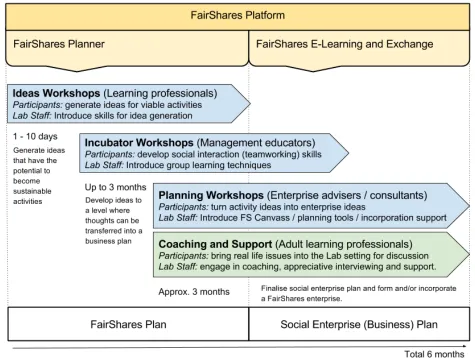
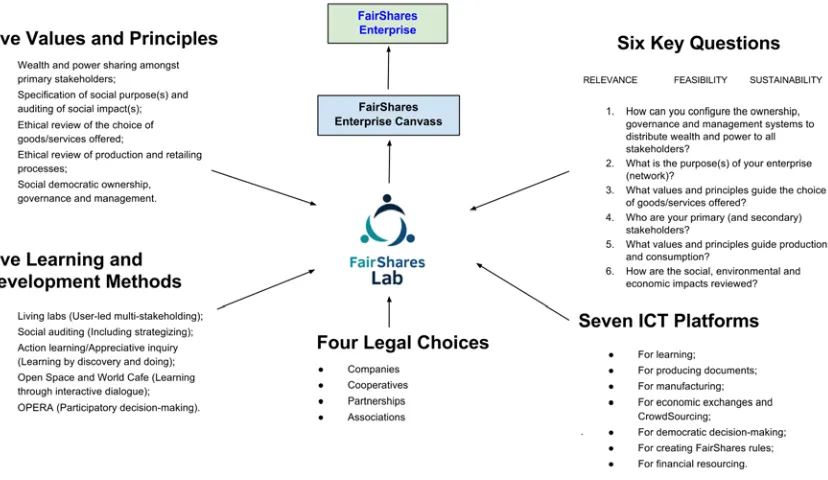
Figure 1.1 - FairShares learning and development overview
Copyright Rory Ridley-Duff 2017, Creative Commons 4.0 International Licence, BY-NC-SA Commercial rights granted to FairShares Labs Project Partners and the FairShares Institute at Sheffield Business School
1.6 Definitions/Key aspects
1.6.1 Blue Economy and Innovation
The blue economy concept originates from the work of Günter Pauli, sometimes called the “Steve Jobs of sustainability”.22 Gunter Pauli was born in 1956. He is a graduate from St. Ignatius Loyola's
University in Belgium in Economics (1979) and obtained his MBA from INSEAD (1982) in
Fontainebleau, France. He also has an honorary Masters in Systemic Design from the Politecnico di Torino (Italy) and an honorary PhD in Economics from the University of Pécs (Hungary). He has been active as an entrepreneur setting up a dozen companies, as a lecturer at the Politecnico di Torino and the University of Pecs, and as a commentator on culture, science, politics,
22 Pulakkat, H. (2017) ‘The Belgian entrepreneur who has unique ideas for solid waste management’, The Economic
Methodology for Creating a FairShares Lab
sustainability, innovation and the environment. He is a member of The Club of Rome, The Young President's Organization, and Chairman of Novamont SpA. He built the first ecological factory in the world when a shareholder, Chairman and CEO of Ecover. Under his leadership, this building became a worldwide acclaimed ecological building.
His book The Blue Economy - originally a report to the Club of Rome - became a commercial book with the twin aims of stimulating entrepreneurship while setting up new and higher standards towards sustainability. However, his work focussed on how good health and environmental
management could be done without increasing overall costs and consumer prices. The book describes the principles of the blue economy and provides one hundred business cases that illustrate these principles. The targets he sets are high: to create 100 million jobs and substantial capital value through 100 innovations in the 2010-2020 decade. A few years later, he reviewed progress in The Blue Economy 2.0, to discuss the evolution of what is being realised worldwide.23
The essence of the concept is to eliminate waste and the additional costs of waste management. His thinking is less about pollution and more about improving the utilisation of materials. In the natural ecosystem there is no waste at all, because secondary products created by one life form are the inputs (or ‘foods’) for another living process. These principles can be applied to the operation of other ecosystems so that they become sustainable from all points of view. Businesses could be designed to use what is already available, drawing on what occurs (and is replenishable) in nature, using energy sources that arise out the physics of the natural
environment and its systems. Another important highlight in Pauli’s work is efficient
entrepreneurship, which is regarded as necessary for a healthy (sustainable) economy. Without new, socially – economically – environmentally balanced enterprises, the result is stagnation.
With this main concept, the blue economy has created over 200 projects which attracted approximately $4 billion in investments by 2016 and generated some 3 million jobs. These innovative pilots were summarised in case studies to show a new basis for entrepreneurial innovation, with a new innovative mindset. The success of these investments were based on the blue economy concept as adopted by innovative entrepreneurs. Pauli argues that merging these have been the key to success.
The blue economy is ZERI´s philosophy in action.24 The best ideas for health and the
environment are those based on the cheapest ways of producing the necessities for life, potentially offering them free through local systems of production and consumption that work with resources already abundant in a community. This philosophy is governed by an Innovative Business Model capable of realising products and services (within and beyond commercial markets) by responding to basic needs. This can be done by building social capital and combining it with mindful living25 in
harmony with natural systems. The mixture of the philosophy with innovative business models results in more effective (and competitive, in traditional market terms) economic, social and natural development. For this project, we organised and interpreted the claims of Pauli’s work on the blue economy26 as follows:
23 For more information see https://en.wikipedia.org/wiki/Gunter_Pauli
24 See http://www.zeri.org/. ZERI stands for Zero Emission Research and Initiatives.
25 Langer, E. and Moldoveanu, M. (2000) ‘Mindfulness research and the future’, Journal of Social Issues, 56(1): 129-39. 26 See http://www.theblueeconomy.org/principles.html for the original list. In this work, it is helpful to organise the list in
Methodology for Creating a FairShares Lab
1.6.1.1 Implications for economic thinking
● Respond to the basic needs of all with what you have, deploying innovations inspired by nature, generating multiple benefits, creating jobs and spreading social capital. It offers more with less.
● Substitute ‘something’ with ‘nothing’ where possible – question whether resources are necessary for continued production.
● Nature provides examples that eco-entrepreneurs can use to argue that it is possible to do more with less.
● Nature responds to basic needs and then evolves from sufficiency to abundance. The present economic model relies on scarcity as a basis for making choices about production and consumption (to maximise opportunities for profit).
● In Nature water, air, and soil are the commons, free and abundant.
● Nature searches for economies of scope (not scale).
● Nature is efficient. Sustainable business can focus on maximising use of abundantly available material and energy to reduce the unit price to the consumer.
● Innovation in nature is oriented towards benefits for all.
1.6.1.2 Implications for scientific orientation/thinking
● Solutions are first and foremost based on physics. Deciding factors are pressure and temperature in the local environment.
● Natural systems cascade nutrients, matter and energy – waste does not exist. Any by-product should seen as the source for a new by-product.
● Gravity is the main source of energy.
● Solar energy is the second renewable fuel.
● Water is the primary solvent (no complex, chemical, toxic catalysts).
● In nature, change is constant - innovations take place every moment.
● In nature, everything is biodegradable – it is just a matter of time.
● In nature, one process generates multiple benefits.
1.6.1.3 Implications for organisation and management
● Nature works with what is available locally. Sustainable businesses evolve when local resources, cultures and traditions are prioritised and respected.
● Nature evolved from a few species into a rich biodiversity. Wealth is diversity. Industrial standardisation is contrary to this principle - it systematically diminishes our wealth.
● Nature - as an ecosystem - does not encourage monopolisation. It encourages diversification.
● In natural systems everything is connected and evolving towards symbiosis.
● Natural systems are non-linear.
● Natural systems share risks. Risks motivate innovation.
● Nature optimises through grouping/organising elements within a canopy or envelope.
● In nature, negatives are converted into positives. Problems are opportunities.
Methodology for Creating a FairShares Lab
innovative models based on these assumptions by applying them to social, economic and natural systems. We can use and develop our environment in the most innovative and collaborative way (to compete in market-based system, when necessary) without ignoring social facts.
1.6.2 Social Enterprise and the Social Economy
In this section, we describe three interests and four approaches that shape our understanding of social enterprise. At present, many social enterprise researchers from around the world are participating in a global study of social enterprise models. To help them, the lead researchers (members of the EMES research network) have developed a theory that social enterprise involves serving two or more interests concurrently.27 The theory advances a typology and set of logics that
are consistent with the works of one of the project partners.28 In both cases, the theory moves well
beyond popular text descriptions of social enterprise (such as those adopted by governments or the European Union) to outline four distinctive approaches to social enterprise that each create social value in specific identifiable ways. As social value creation is framed as a by-product of interests that bring social enterprises into existence and shape its development, we set out what those interests are (general, mutual and private) and then relate them to options available in the FairShares Model. In doing so, we integrate our comments with the assumptions behind a blue economy.
1.6.2.1 The General Public Interest
We all share an interest in some things. Everyone would like to drink clean water, to breathe clean air, to eat food that is healthy and tasty, and to live in dwellings that provides shelter and security. In blue economy thinking, these elements of life can be regarded as commons resources that are needed for the benefit of all (as occurs in nature).29 Enterprises that offer a desired product or
service to everyone (universal access) - or which seek to produce health outcomes for everyone’s benefit - are operating in the public interest.
For many years, especially in Europe after World War II, there has been an expectation that public goods - goods needed by everyone - will be organised by the state and made abundant to all who need them. The state organised and owned enterprises to provide everyone within their jurisdiction with clean water and air, food that is affordable and healthy, social housing for those unable to build or buy a home, and welfare in the form of education, health and social care services. In the last 30 years, there has been a significant change. Under the influence of neo-liberal doctrine, many governments have pursued policies to reform public services so that
27 See Defourny, J. and Nyssens, M. (2016) ‘Fundamentals for an International Typology of Social Enterprise Models,
ICSEM Working Papers, No. 33, Liege: The International Comparative Social Enterprise Models (ICSEM) Project.
28 See Ridley-Duff, R. and Bull, M. (2016) Understanding Social Enterprise: Theory and Practice, London: Sage
Publications. (The first author is a director of Social Enterprise International Ltd).
29 Ostrom, E.(1990) Governing the Commons: The Evolution of Institutions for Collective Action. Cambridge: Cambridge
Methodology for Creating a FairShares Lab
they are created or run by organisations that are not owned by the state.30 This is one of the
drivers for social enterprise creation in the field of public services.31
1.6.2.2 Mutual Interests and Cooperative Action
Sometimes, a group of people have a shared interest. Perhaps they all want to play or watch a particular sport (such as baseball or football). Perhaps they all share an interest in making and consuming a particular thing (such as a type of music or organic food). In this case, there is no general public interest. There is a combination of mutual and private interests in the production and use of specific goods and services. The parties to a mutual project - as in nature - respond to their environment or use local resources to create something that satisfies their mutual interests. Mutual interests can be advanced by creating a members’ association or co-operative society to share the work and benefits arising from a shared interest.
Over the last 170 years, there has been a steady increase in the creation of co-operative and mutual societies. This happened rapidly in places like Japan, China, India and South Korea where they have also grown large. Co-operatives remain popular in parts of Europe dominated by
Franco-Spanish-Portuguese traditions, but - for a while - became less popular in Anglo-American cultures (because of the rise of neo-liberal economic thinking contrary to the principles of the blue economy). The co-operative movement has proved resilient and new forms of cooperation
continue to develop and thrive as it benefits from the loss of confidence in traditional approaches to business,32 particularly in the wake of the global financial crisis of 2008.
Co-operative enterprises are designed to promote shared responsibility for production and consumption and are therefore aligned with blue economy principles. They tend to respond to local needs first, then share surpluses equitably for the benefit of all. With the growth of the internet, it is easier and cheaper to create them. Co-operative societies can organise the creation, exchanging, swapping, sharing, buying and selling of goods amongst their members to move beyond
commercial markets (regulated by commodity prices) to ethical markets (regulated by needs and ethics). They can also produce goods for sale to the general public through supermarkets. Mutual societies organise services such as social insurance and banking to protect their ecosystem from shocks and unexpected events. For the purposes of this project, we regard all co-operative and mutual enterprises (CMEs) as social enterprises if they observe ICA Values and Principles.
1.6.2.3 Private Interests Advancing a Public Benefit
Lastly, there are individuals who pursue social change through proactive business creation activities.33 For the last 20 years, these have been studied through the new discipline of social
entrepreneurship.34 For motivated individuals, pursuing a private interest by creating public or
30 See Hood, C. (1995) ‘The new public management in the 1980s: variations on a theme’, Accounting, Organisation
and Society, 20(2/3): 93–109 for changes in public sector management.
31 See Ridley-Duff, R. and Bull, M. (2016) Understanding Social Enterprise: Theory and Practice, London: Sage
Publications, Chapter 3 has details of the application of New Public Management (NPM) to social enterprise.
32 See Restakis, J. (2010) Humanizing the Economy: Cooperatives in the Age of Capital. Gabroila Island, BC: New
Society Publishers.
33 See Yunus, M. (2007) Creating A World Without Poverty: Social Business and the Future of Capitalism (Kindle edn).
New York: Public Affairs
Methodology for Creating a FairShares Lab
social benefits leads to a more diversified and satisfying working life. The private interests of social entrepreneurs are different to those of commercial entrepreneurs because they find more
satisfaction in charitable trading than the accumulation of money. Early writings in this field alerted both academic institutions and governments to a new movement of entrepreneurs who undertake business activities to bring about community or public benefits.35 Some industries are well suited to
this ‘blended-value’ social entrepreneurship36 that combines social change goals with commercial
skills acquired in the private sector. Industries such as waste management (recycling and
upcycling), clean energy production, financial services in poor communities, low cost housing and construction all offer opportunities for skilled social entrepreneurs to pursue private interests while creating goods that produce a public benefit.
1.6.3 Four Approaches to Social Enterprise
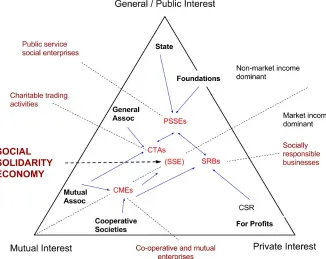
[image:23.612.158.484.320.579.2]Figure 1.2 shows how each combination of interests produces an approach to social enterprise.
Figure 1.2 – Combined interests in models of social enterprise
Interpreted from works by Ridley-Duff and Bull (2016) and Defourny and Nyssens (2017)
Copyright Rory Ridley-Duff 2017, Creative Commons 4.0 International Licence, BY-NC-SA Commercial rights granted to FairShares Labs project partners and FairShares Institute at Sheffield Business School
35 Leadbeater, C. (1997) The Rise of the Social Entrepreneur. London: Demos.
36 Emerson, J. (2000) ‘The nature of returns: a social capital markets inquiry into elements of investment and the
Methodology for Creating a FairShares Lab
The first approach comes from the desire of people in the public sector and state institutions to rethink how public services and public benefits can be created. Whilst there may be a motivation to cut the cost of state activities, this is not the only motivation. There are public servants convinced that enterprising individuals can create social enterprises that produce better outcomes for the public than state industries and monopolies on their own. Public service social enterprises
(PSSEs) develop out of a commitment to the public or general interest. They are supported mainly by the state and private charitable foundations but may also engage in trade with the public. A good example is the Grameen Bank in Bangladesh which started with public funding and the backing of the Grameen Foundation. Gradually its membership grew until members became majority owners. It is now – effectively - a mutual society. The Grameen Foundation won a Nobel Prize in 2007 for the way it provides services to millions of people in rural communities. It has expanded to provide other public infrastructure such as telecommunications (Grameenphone) and renewable energy (Grameen Shakti). In other countries, these may be state-owned industries, but in Bangladesh they are being developed as PSSEs.
Foundations and associations can also promote social enterprise through charitable trading activities (CTAs) that support their primary missions. In the EMES network these are referred to as enterprising non-profits (i.e. non-profit enterprises that rely on trading rather than grants and donations). There is another good example in Bangladesh called BRAC. This switched from 90% donor funding to 80% trading income between 1990 and 2000.37
Co-operative and mutual enterprises (CMEs) build on the history and values of the co-operative movement by emphasising the 2nd, 6th and 7th co-operative principles (democratic participation,
inter-cooperation and concern for community). A particularly good example is the social
co-operative movement in Italy. In social co-operatives, work is seen as a health and well-being issue. Carers, medical professionals and patients form a co-operative society to work on improving members’ health.38 Of course, the co-operatives also meet social and economic needs, but their
focus is on ensuring health and well-being. For example, in Italy, people who need to improve their mental health can learn both technical and social skills over a 3-year period whilst receiving
medical care. More than half (65%) find another job before their training ends.39
Lastly, private individuals committed to advancing public benefit are creating socially
responsible businesses (SRBs). These go well beyond the limited aspirations of corporate social responsibility (CSR). A good example of this is Toms Shoes40 which makes a pair of shoes (or
other locally needed product) for a poor child each time one in purchased in a developed country. Similarly, Tim Smit’s Eden Project generates additional income by exporting its expertise in green technology and zero-waste management. Whilst the former example partially meets blue economy principles (satisfying a local need), the latter zero waste consultancy does so more fully.
By combining private, mutual and public interests, four distinct approaches to social enterprise development have been identified. When taken together, they provide four starting points for
37 Jonker, K. (2009) “In the Black with Brac”, Stanford Social Innovation Review, Winter 2009.
38 The documentary ‘Together’ contains a segment devoted to the national network of social co-operatives in Italy. See
http://www.together-thedocumentary.coop/
39 See Borzaga, C. and Depedri, S. (2014) ‘When social enterprises do it better: efficiency and efficacy of work
integration in Italian social co-operatives’, in S. Denny and F. Seddon (eds), Social Enterprise: Accountability and Evaluation Around the World. London: Routledge, pp. 85–101.
Methodology for Creating a FairShares Lab
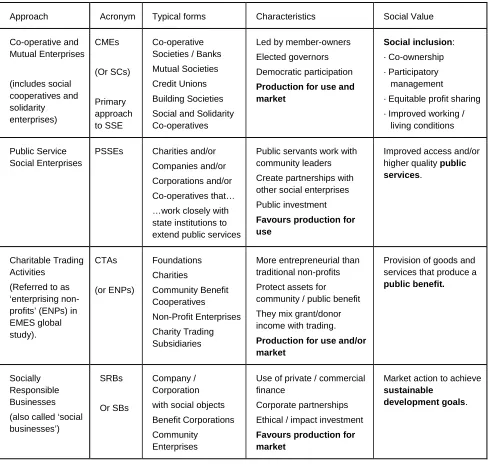
building a social solidarity economy (SSE). How can these approaches be expressed and described more fully? Table 1.1 gives further details of the four approaches in terms of their
[image:25.612.73.562.162.628.2]dominant legal forms, organisational characteristics and social value propositions. The social value created is different in each case and is also different from the financial value created.
Table 1.1 - Summary of approaches to social enterprise development
Approach Acronym Typical forms Characteristics Social Value
Co-operative and Mutual Enterprises (includes social cooperatives and solidarity enterprises) CMEs (Or SCs) Primary approach to SSE Co-operative Societies / Banks
Mutual Societies
Credit Unions
Building Societies
Social and Solidarity Co-operatives
Led by member-owners
Elected governors
Democratic participation
Production for use and market
Social inclusion: ·Co-ownership
·Participatory management
·Equitable profit sharing
·Improved working / living conditions
Public Service Social Enterprises
PSSEs Charities and/or
Companies and/or
Corporations and/or
Co-operatives that…
…work closely with state institutions to extend public services
Public servants work with community leaders
Create partnerships with other social enterprises
Public investment
Favours production for use
Improved access and/or higher quality public services.
Charitable Trading Activities
(Referred to as ‘enterprising non-profits’ (ENPs) in EMES global study). CTAs (or ENPs) Foundations Charities Community Benefit Cooperatives Non-Profit Enterprises Charity Trading Subsidiaries
More entrepreneurial than traditional non-profits
Protect assets for
community / public benefit
They mix grant/donor income with trading.
Production for use and/or market
Provision of goods and services that produce a
public benefit.
Socially Responsible Businesses
(also called ‘social businesses’)
SRBs
Or SBs
Company / Corporation
with social objects
Benefit Corporations
Community Enterprises
Use of private / commercial finance
Corporate partnerships
Ethical / impact investment
Favours production for market
Market action to achieve
sustainable
development goals.
Copyright Rory Ridley-Duff 2017, Creative Commons 4.0 International Licence, BY-NC-SA Commercial rights granted to FairShares Labs project partners and FairShares Institute at Sheffield Business School
1.6.3.1. Summary
Methodology for Creating a FairShares Lab
one of the challenges in setting up a FairShares Lab. An enterprise applying the FairShares Model may exist within the SSE, but it is not exempt from the challenges of deciding between different legal forms and wrestling with competing logics and interests. There will be no one definition or approach that can satisfy all contexts.
[image:26.612.155.485.337.617.2]The challenge in preparing a FairShares Lab is advancing knowledge amongst social enterprise advisers in consultancies and infrastructure bodies who are not yet familiar with (or prepared to recognise) all four approaches. Beyond that lies the challenge of FairShares education and training that prepares advisers to embrace the variations provided for in the FairShares Model that cope with the complexities of making an informed choice (see Figure 1.3). Not every law to regulate social enterprise, and not every trade mark and strategy developed to promote it, is cognisant of the knowledge required to pursue different (combinations of) social enterprise thinking. However, the FairShares Model both recognises and accommodates this framework for understanding the diversity of social enterprises. Rather than seek to define new laws, it offers ways to adapt existing company, co-operative, association and partnership laws to enfranchise multiple stakeholders and offer them member-ownership.
Figure 1.3 - Positioning FairShares in the field of social enterprise
In finalising this section, we draw attention to the issue that the definition of a social enterprise is not an abstract intellectual exercise. It is an unfolding process that dynamically updates the field as new practices are adopted by communities.41 The FairShares Model, and the FairShares Labs that
41 See Wenger, E. (1998) Communities of Practice: Learning, Meaning and Identity. Cambridge: Cambridge University
Methodology for Creating a FairShares Lab
will embed it, represents a new chapter in the development of the social/blue economy. To make it work effectively, project partners will seek to move beyond choosing one approach to social enterprise development to focus on building communities of practice in ‘living labs’ that foster social/blue economy projects and enterprises.
1.6.4 Living Labs
1.6.4.1. FairShares Labs and its relation to the Living Lab movement
The FairShares Labs project is not only an attempt to integrate blue economy concepts into the FairShares Model, it is also an attempt to organise and incubate new ventures by deploying the main principles of the Living Lab Movement (LLM). The European Network of Living Labs (ENoLL), founded in 2006, has registered nearly 400 members in the LLM since its inception (170 are
current). It describes them as:
“user-centred, open innovation ecosystems based on a systematic user co-creation approach integrating research and innovation processes in real life communities and settings. In practice, living labs place the citizen at the centre of innovation and have thus shown an ability to better mould the opportunities offered by new ICT concepts and solutions to specific needs and aspirations of local contexts, cultures, and creative potentials”42
The project partners look at the LLM in two ways. On one hand, they see organisations or structures in which open and collaborative innovations are situated. On the other hand, they are activities that occur in real life settings and environments. In both cases they represent examples of “open innovation, and user innovation processes, [which] can be studied and subject to
experiments, and where new solutions are developed.”43 To describe it a different way, Living Labs
are attempts to “generate concrete, tangible innovations based on user and community contributions, and at the same time to advance (academic) understanding of open and user innovation principles and processes.”44
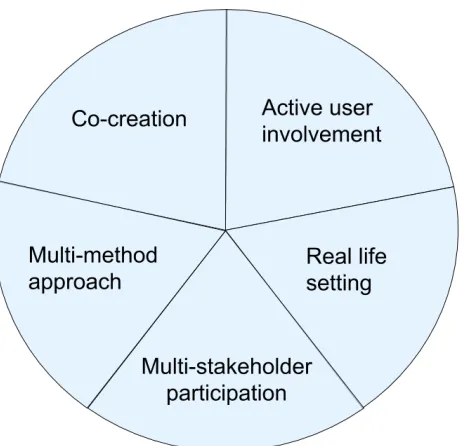
The five principles of the LLM (see Figure 1.4) are: co-creation; multi-stakeholder
participation; active user involvement through a multi-method approach in real life settings. These are all consistent with FairShares (Lab) principles and the learning methods/platforms we describe later in sections 2.1.1 to 2.1.5. The real-life intervention element - the fourth Living Lab principle - is realised through locally organised, community-based FairShares Labs. In our
conception of FairShares Labs, all groups of involved stakeholders are asked to describe the value proposition of a new project and commit to the equitable distribution of power, benefits and surplus wealth across all groups. This is why FairShares Labs promote (and are oriented towards)
cooperative economics, approaches and structures.
42 Robles, A., Hirvikoski, T., Schuurman, D.and Stokes, E. (eds) (2015) Introducing ENoLL and its Living Lab
Community. ©ENoLL, p. 12.
Methodology for Creating a FairShares Lab
Figure 1.4 - Common elements in Living Labs
Based on image sourced from: http://www.openlivinglabs.eu/node/1429
Copyright Roger Schmidtchen 2017, Creative Commons 4.0 International Licence, BY-NC-SA Commercial rights granted to FairShares Labs Project Partners
The LLM is constantly evolving its multi-method approach through different learning and
development methods. FairShares Labs will focus on informal/non-formal learning settings so that different stakeholder groups can offer specific (and local) knowledge to each other. Two outputs from this project (IO2 and IO3) will this potential. FairShares Labs will build and integrate a
FairShares Platform that offers a FairShares Planner and FairShares e-Learning and Exchange tool. This will make it possible to initiate and track innovations to disseminate them to practitioner and academic communities. The FairShares Platform will aid replication of working practices and results in other locations. Key innovations that an ICT-driven FairShares Platform will offer include: tools to involve a wide range of external experts; tools to reach a broader community of capital providers (i.e. future investor members); tools to create cross-border social innovation projects.
Now that we have a grasp of the field of social enterprise and the principles of the LLM we can position FairShares Labs more clearly. They are vehicles for realising action based on the
integration of blue economy, social economy and LLM through the application of the FairShares Model to social enterprise development (for full details see Section 2.1). This endeavour will create collaborative developmental processes - CSE in action - to support the creation and conversion of social and blue enterprises that distribute wealth and power more fairly.
1.7 FairShares Labs
Methodology for Creating a FairShares Lab
economies. Real FairShares Labs are co-working spaces organised as locally based centres in which training opportunities, communications, workshops and social enterprise conversions and start-ups will be supported. FairShares Labs can also be situated where four primary stakeholder groups meet for specific projects (either face-to-face or online). The virtual environment allows any stakeholder to place offers, find each other and use FairShares learning tools to create a virtual FairShares Lab. External and internal business experts will provide coaching to people who participate in face-to-face (real) FairShares Labs and the (virtual) FairShares Platform.
FairShares Labs will be incubation spaces (breeding grounds) where the principles are applied to foster equitable relationship and cooperative learning45 amongst the future Founder, Labour,
User and Investor members/shareholders of a social enterprise. Customer/user-oriented initiatives will proactively link their efforts to sustainable development goals on the one hand and social inclusion on the other. Citizens will work together with experts to initiate, organize and implement social enterprises that innovate to tackle problems in their working and living environments. Adult educators will improve their skills and competences by moderating activities.
1.7.1 FairShares learning
In this section, we describe two relevant training tools for adult learners and for adult trainers (coaches/mentors) that will help us fulfil our aim of providing guidelines for “self- and blended learning tools for FairShares hubs, labs and learning groups” and “FairShares Labs train-the-trainers tool for coaches and mentors”. The project partners deploy learning and development methods in FairShares Labs that draw on blended-learning courses, learning options and activities that support co-operative learning.46 The learning approach is strictly non-formal because the
expertise of the people themselves must be the main source of empowerment.
1.7.1.1 Tools for FairShares hubs, labs and learning groups
The learning content will be made available through the FairShares Platform in the form of a FairShares Planner (a series of questions to guide the initial stages of developing a FairShares Plan) and an e-Learning and Exchange tool that supports more detailed work on a social enterprise (business) plan. Both will be integrated with a curriculum for the different phases of developing social projects/enterprises that distinguishes idea generation, incubation and planning/coaching phases. Labs members will be able to populate the pages of an interactive FairShares Planner, in which they - as adult learners - are guided individually or collectively through the entire process of developing a FairShares Plan. Once this is published, coaches will support founders to fill out a FairShares Canvass and incorporate a FairShares Enterprise.