Student Audio Notes Project: lessons from autonomous
use of MP3 recorders by students to enhance their
learning
NORTCLIFFE, Anne <http://orcid.org/0000-0001-6972-6051> and
MIDDLETON, Andrew
Available from Sheffield Hallam University Research Archive (SHURA) at:
http://shura.shu.ac.uk/14525/
This document is the author deposited version. You are advised to consult the
publisher's version if you wish to cite from it.
Published version
NORTCLIFFE, Anne and MIDDLETON, Andrew (2010). Student Audio Notes Project:
lessons from autonomous use of MP3 recorders by students to enhance their
learning. In: MOORE, Ivan, ELVING-HWANG, Jo, GARNETT, Kenisha and
CORKER, Chris, (eds.) CPLA Case Studies. Centre for Promoting Learner
Autonomy, Sheffield Hallam University, 151-164.
Copyright and re-use policy
See
http://shura.shu.ac.uk/information.html
Student Audio Notes Project: lessons from the autonomous use MP3 recorders by students to enhance their learning
Anne Nortcliffe (Faculty of Arts, Computing, Engineering and Sciences) and Andrew Middleton
(Learning and Teaching Institute)
Sheffield Hallam University
Abstract
Ongoing and successful development work around the design and delivery of audio feedback and audio lecture note-making at Sheffield Hallam University, together with an awareness of how digital audio might be used to empower disabled students, led to the proposal for the Student Audio Notes project. The idea of digital audio-enhanced learner autonomy had emerged from earlier work by the authors which had suggested that feedback could be more meaningful if the learner takes responsibility for gathering it and feeding it forward into their studies and indeed, later, into their employment. This learner responsibility provided an important focus for The Student Audio Notes Project (SANP): a year-long investigation into how students might use MP3 recording devices to enrich their own experiences of learning. SANP gave out MP3 recorders to participating students and aimed to encourage and challenge these students to explore how the devices could be used so that good practice might emerge and be shared. It was hoped that they would identify and record any encounters involving verbalised communication that they felt helpful in deepening and reflecting upon their learning. In this way the act of audio recording would ideally become an essential, ever-present, autonomous learning habit for them.
A strand of this investigation sought to find out, in particular, whether the recording of digital audio by disabled students could bring benefits to disabled learners. As the study by Healey et al. (2006) showed, 51% of disabled
students (n=276) responded well to tutor support aimed at improving the standard of their academic work, as opposed to the 43% of non-disabled students (n=272). It as e pe ted, therefore, that stude t’s use of audio note-making would result in similar beneficial impacts. When note-making systems are used effectively, as previous research by Intons-Peterson and Fournier (1986) has also shown, note-making can increase memory encoding in the learner and so enhance their ability to recall the information later. Therefore, it was hoped that SANP would show how audio note-making could be effective in empowering students with disabilities
.
Findings from SANP demonstrate that all participating students discovered benefits from using recording devices and that they found it useful to capture a range formal, semi-formal and informal situations. These findings raise questions for further research and support and some recommendations are made to ensure such activity is properly undertaken and supported.
Introduction
The recording of face-to-face student-tutor feedback conversations by the tutor and their subsequent distribution back to the student has been shown to be an effective and attractive method of encouraging greater formative engagement with learning (Nortcliffe and Middleton, 2007). Audio, in this approach, provides the opportunity to capture an otherwise ephemeral experience and increases the extent to which students are able to feed forward conversational outcomes into their learning without seeking further clarification and confirmation from the academic.
(Nortcliffe and Middleton, 2008). Further research into the strategic and selective audio recording of lectures and other learning events has been shown to be beneficial for disabled students (Nortcliffe and Middleton, 2006). If recordings are not made available quickly the formative affect of learning conversations decreases with the passing of time, with the conversation becoming a vague memory (Waterfield et al., 2006). However, this is true for all students, whether they are disabled or not.
One of the aims of Higher Education is to help students to become autonomous learners (Race, 2001). However, learner autonomy is contentious in some quarters where there are concerns that it may engender inequality for disabled students (Goodley, 2007). For example, dyslexic students are dependent upon their tutors and third parties to review their material more than once (Madriaga, 2007). Under the Special Educational Needs and Disability Act 2001 every educational establishment is required to make reasonable adjustment in providing equivalent access to the curriculum. Some stakeholders may interpret reasonable adjustment as being an "academic crutch" for disabled students, even to the extent that it actually hinders the development of additional student skills that enable them to cope with their disability. As Riddick (2003) observed, students who didn't declare their learning disability were able to develop effective coping strategies. Higher Education needs to enable students to develop a range of transferable skills for self-support and so give them the ability to work with minimum supervision (Race, 2001).
However, when audio notes are produced by the academic, learner control is removed and the potential meaning and affect on learning is likely to be diffused too. Recordings made and distributed by academics in the form of audio lecture notes and formative conversations have been shown to increase learner autonomy (Fidler et al., 2006). In this study, student memory was refreshed when the recordings were played back, re-engaging them cognitively. It would seem logical, therefore, to give students the responsibility of making their own audio 'notes', including the responsibility to gather audio feedback. Such a shift may offer a more learner-centred and autonomous approach to the selection, generation and management of audio learning resources, thereby instilling greater meaning and a sense of ownership over the learning process.
Methodology
Student volunteers were sought from across Sheffield Hallam University. Each student was supplied with a simple to use MP3 recording device with a built in microphone and 4GB memory, costing approximately £30. A total of 52 students signed up for the Student Audio Notes Project. Students were encouraged to take more responsibility for their learning by generating their own personalised learning recordings; to do this, they were invited to record interventions that they felt would be useful, whether those interventions were formal, semi-formal or informal encounters.
being encouraged to record any verbalised learning opportunity involving interactions with peers, tutors, and placement supervisors, as well as making personal notes.
During the brief induction meeting the students were also briefed on recording etiquette. Specifically, students were advised to ask permission of those who they wished to record and to explain to them why they thought making the recording would be useful. They were advised to reassure respondents and participants that the audio recordings would only be used to assist their learning and would not be shared beyond the University. However, students were encouraged to share their recordings with their peers in order to develop further learning opportunities through peer conversation; previous research had indicated that the sharing of audio recordings amongst peers was valuable (Middleton and Nortcliffe, 2009). The students were also advised to respect the wishes of staff and their fellow students if they were not happy to be recorded. Each student was required to sign a project protocol agreement that defined their role in the project and the appropriate use of the audio device during their studies.
The students were further supported throughout the project via email and the Virtual Learning Environment (VLE), where an online project organization site was set up that included podcasts and discussion boards. These were intended to enable all project staff and student members to support one another.
Evaluation
A mix of quantitative and qualitative resear h ethods ere e plo ed to apture the stude ts’ aried experiences. Some students were interviewed about their expectations of the project at induction; online surveys were conducted after the first semester of the project and again at the end of the project. Also, many students took part in mid-project review focus group discussions and end of project focus groups. Results from all activities were fed back to all participants through the VLE site at the earliest opportunity so that knowledge could be shared to further impact the project.
Initial Student Perceptions
A sample interview of student volunteers indicated that their initial rationale was varied as to why they were personally attracted to take part in the Student Audio Notes project. However, initial perceptions of the project were that it would increase their learning:
“tude t A, “uper ised fi al ear proje t, re ordi g the hats ith super isors.
“tude t B, I group ork I so eti es forget other people's ideas. It would be good to go ba k a d re e er the .
“tude t D, I ha e fou d I lear liste i g ore tha a thi g else. Also light bulb moments, I always forget things I think of, so if I can record it I will remember it etter
“tude t E, I ha e ee asked to interview industrial professionals towards my research project, so obviously having a recording device for interview purposes is ideal.
“tude t F, I ha e had a Di tapho e efore. Ne er ee sure ho to use it or ho to make the most it though I meant to learn new techniques for how to use it … etter otes for le tures.
“tude t G, I used to re ord le tures last ear …stude ts i group benefited from it by borrowing them from me and re-listening to what I recorded. [The Student Audio Notes project] gives me the opportunity to feedback on how I use the device and at the same time discuss my own ideas [for using the device]. I thought it ould ope i d ore.
Student H, I thought it ould e er i teresti g to see ho taki g audio notes ould help people lear .
Initial Survey
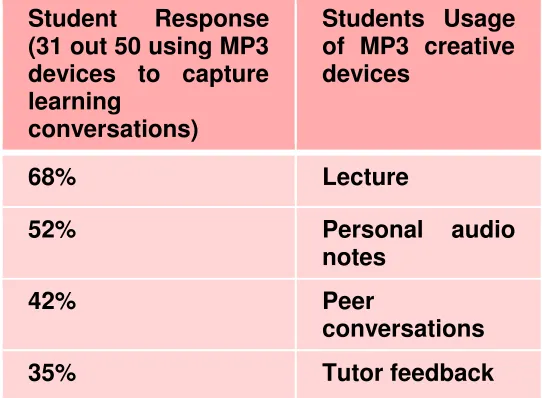
[image:5.612.163.434.493.692.2]As reported by Nortcliffe et al (2009), 31 out of 50 students enrolled on the Blackboard project support site and completed the initial online questionnaire three months after the project's launch. The results (see Table 1) indicate that the majority of the students intended to use the device for one purpose, i.e. recording of lectures.
Table 1: Initial Survey Results
Student
Response
(31 out 50 using MP3
devices to capture
learning
conversations)
Students Usage
of MP3 creative
devices
68%
Lecture
52%
Personal audio
notes
42%
Peer
conversations
6%
Work placement
3%
Interviewing
As commented by Nortcliffe et al. (2009), half the students reported using the recorder to make personal audio notes, despite this approach not featuring in the student's own initial perceptions of the project. Typically personal audio notes involve the use of the device as an external memory aid use to capture personal actions and thoughts, ideas for assessment, and observations to support their reflections on learning.
The survey results further indicate that over half the students followed up listening back to the recordings typically within a few days of making the audio interventions. Respondents believed that listening back enabled them to cognitively reconnect with the material. Concurring with the findings of Rossiter et al. (2009), the majority of the students agreed or strongly agreed that they found the recordings useful and had helped to improve their learning:
Mai l re ordi g le tures a d assig e t orkshops. I ha e fou d this de i e EXTREMELY useful as it is much better than recording notes by hand only, and eradi ates the pro le s I ha e ith ad ha d riti g.
Importantly, over half the students agreed that the Student Audio Notes project had helped them to become more autonomous as learners. This is demonstrated by the follo i g stude t’s free comments in the survey,
...liste to the routi el ...dig the out he e er I eed to refresh e or , or eed to re all so ethi g for the assig e ts.
Mid-project focus group
The first focus groups took the form of semi-structured conversations, an approach that is outlined in Cohen et al., 2000. This involved interviews with nine students from the project, who talked about their experience in pairs or individually. The interviews indicated that the students were deploying the devices in a variety of ways and had a variety of methods for managing and using the audio recordings. In particular, the focus groups revealed that the initial student ideas for how the devices could be used had changed and multiplied. There were more creative and constructive uses beyond the initial idea of simply recording lectures; however, this approach is still the most common application. A number of students indicated they were now recording feedback and personal notes:
Use it i u erous differe t a s, i first se ester… I re orded le tures… its I eeded to re ord that I thought I ould ot u dersta d… then I used it to listen to oppose to usi … to try revise a subject.
I a usi g pho e… my phone recorder and it is much better … I make recordings o e to t i e a eek… [re ord] le tures …group eeti gs, maybe supervisor for project."
It eets the eeds… h I got it i the first pla e… I record things as opposed to them falling straight back out of my head or if I am in class I can record it.
Mai l i le tures, I ha e 't used it for other thi gs… I do realise it has pote tial to be used for other stuff.
It has got less a d less. I fi d re ordi g le tures is poi tless… I can't really hear what the lecturer is saying …group eeti gs and discussions, random thoughts I record quite a lot.
Second survey
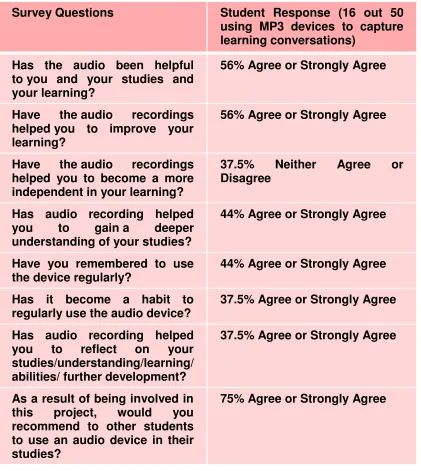
16 out of 50 students enrolled on the Student Audio Notes Project Blackboard site completed the second survey at the end of the academic year. The highlights of the survey (see Table 2) illustrate that the majority believed that using the audio device in their studies has been beneficial to their learning and that they would recommend its use to other students as a way to enhance their learning. However, the stude ts’ respo se to hether it has helped the e o e ore i depe de t i their lear i g is mixed, and the rationale of those who felt that it has helped them to become more autonomous as learners was that:
I a refer a k to the re ordi g for i for atio rather tha aski g others.
If there as so ethi g I'd issed out he riti g le ture otes, I'd or all have to go to friends to get that information from them (and visa versa), though with the audio device I've been able to seek out that information for myself through liste i g to the audio fro those le tures.
It ope ed e es a little to taki g o trol of lear i g rather tha just tur i g up to a le ture e ause I’ supposed to.
Table 2: Highlights of the Second Survey
Survey Questions
Student Response (16 out 50
using MP3 devices to capture
learning conversations)
Has the audio been helpful
to you and your studies and
your learning?
56% Agree or Strongly Agree
Have
the audio
recordings
helped you to improve your
learning?
56% Agree or Strongly Agree
Have
the audio
recordings
helped you to become a more
independent in your learning?
37.5%
Neither
Agree
or
Disagree
Has audio recording helped
you
to
gain a
deeper
understanding of your studies?
44% Agree or Strongly Agree
Have you remembered to use
the device regularly?
44% Agree or Strongly Agree
Has it become a habit to
regularly use the audio device?
37.5% Agree or Strongly Agree
Has audio recording helped
you
to
reflect
on
your
studies/understanding/learning/
abilities/ further development?
37.5% Agree or Strongly Agree
As a result of being involved in
this
project,
would
you
recommend to other students
to use an audio device in their
studies?
75% Agree or Strongly Agree
The response to questions concerning the device's impact on deepening their learning is mixed. However, the majority agree or strongly agree that the use of the device has helped in this way. This is explained as follows:
The otes I took highlighted thi gs I had e er realised efore.
I a al se studies fro a ore professio al ie poi t. Whether this was brought on by the audio recordings or just my progression of learning and maturity I a ot e sure.
It has enabled me to retain information in a different format than the traditional pen and paper which was useful, and is easily accessible so one could listen to recordings whilst going for a run in the morning and give my brain and subconscious mind to work on things whilst doing something else - hence saving ti e!
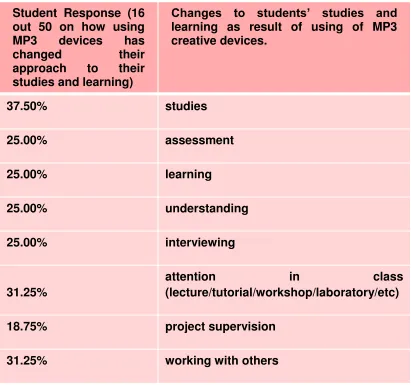
[image:9.612.101.512.307.692.2]The final survey indicates that use of MP3 devices has had a wide impact on their learning (Table 3), feedback being the commonest approach identified. Feedback is critical to student learning and in supporting their ongoing progress (Gibbs and Simpson, 2004), and therefore any method that encourages student engagement with the feedback cycle is positive.
Table 3: Impact on students studies
Student Response (16
out 50 on how using
MP3
devices
has
changed
their
approach
to
their
studies and learning)
Changes to students’ studies and
learning as result of using of MP3
creative devices.
37.50%
studies
25.00%
assessment
25.00%
learning
25.00%
understanding
25.00%
interviewing
31.25%
attention
in
class
(lecture/tutorial/workshop/laboratory/etc)
18.75%
project supervision
25.00%
ideas
25.00%
skills
50.00%
feedback
37.50%
presentation
12.50%
learning with others
6.25%
abilities
6.25%
confidence
18.75%
performance
12.50%
communication
6.25%
placement
6.25%
placement/employment preparation
Final Focus Group
A focus group approach was again used, and involved three students from the project. The discussion between students revealed that they had discovered even more practical applications for the device in order to support their learning and its potential for further personal development in the working practice:
I' e used it for se i ars, group ork a d le tures as ell. A d I used it o placement as a kind of diary record... It's useful with your supervisor because your supervisor will tell you stuff and you're not having to write stuff down all the time. You' e a tuall got a re ord of it ithout ha i g to [i terrupt the o ersatio ].
I use it for little groups he e're doi g group ork seminars, meetings with my supervisor. I find it really useful for revising. I record my [written] notes and the liste a k to it agai a d agai a d agai .
I’ e go e a k a d liste ed to thi gs a d it’s ade ore se se e ause I understand things better. Ma e as I’ e got a it ore e perie e.
This suggests that audio devices have not only supported their immediate learning needs, but have the potential to continue to make an impact in supporting the i di idual’s professio al de elop e t where audio notes can be used as a tool for reflective practice and for logging Continuous Practice Development (CPD) activities:
It as useful for refle ti e pra ti e e ause ou a re ord stuff a d the go back ...later in the day and see what happened. And that's what you need to do for our CPD.
Practical applications in learning could be useful as professionals too, for example:
I' e used it to rite dissertatio he I' e had ideas a d put it eside ed and when I've woken up and I've had an idea 'and I must do that... write this bit like this or '... so I' e used it like this as ell.
Conclusions and project reflection
A central question for this project was concerned with the extent to which our students were ready to exploit the devices they own in making audio notes, in their many forms, so that they can effectively learn from them. The evidence generated during the project indicates that students increasingly own devices that are capable of making recordings of lectures, conversations and personal reflections, and that the ubiquity of this technology is likely to develop, especially through mobile phone ownership. Such audio devices can provide continued access to valuable formal, semi-formal and informal learning opportunities, and the challenge now is to disseminate the positive experiences of the student partners in this project to all students who could benefit from engaging with these technologies. It is also important to ensure that academic staff, systems administrators, and managers appreciate the value of this technology-enhanced method of autonomous learning so that systems, policies and protocols do not conflict with the practice of audio recording.
It was remarkable, and this should be stressed, that all students discovered greater benefits for themselves from using the audio devices. It can also be suggested that recording lectures might be only the tip of the iceberg to how they might exploit audio.
The audio recorders were discrete and highly mobile, arguably becoming a 21st century 'pen' for some learners who began to make notes in situations that hitherto had been ephemeral. This is demonstrated in the use of the device by the students on work placement who explored how it could enhance their professional abilities and CPD.
Students recommend regularly using the audio device and carrying it at all times, saying they would replace it if they lost is,
Yes, it's ee alua le a d I ould repla e it. I a use it for pra ti e o e I get a job.
Yes, I'll defi itel keep re ordi g stuff... I defi itel ould do it. If I had to start my undergrad again I definitely would start recording from the beginning. I wish I'd used it earlier.
I ish I'd used i e earlier as ell.
Some recommendations
The use of audio recorders by students has until now been a grey area. There appears to be a lack of literature on the subject, including on the practice of students taking recorders into lectures. In order for the benefits that have been revealed through this study to have wider impact we recommend that,
students are encouraged to make notes using their own MP3 recorders or mobile phone voice memo technology (as long as they are switched to flight mode to avoid interference);
students record feedback conversations with tutors and peers so they can be more attentive at the time and reflective later;
students are supported in listening back to the notes they make, reflecting on and developing the information they have captured, perhaps in written form;
students are guided in seeking permission from those who they wish to record;
students consider sharing their notes with others on their modules and using the recordings as a focal point for further conversation;
students copy their recordings from their mobile devices to avoid loss and back up their audio note files, especially in the absence of written notes;
students rename their files systematically and meaningfully;
students are discouraged from sharing their recordings of other people beyond those involved with their module;
students are discouraged from editing their recordings unless doing so helps them to actively engage with what was said. Editing can add a significant layer of work to the practice;
academics are open to lectures, seminars, tutorials and the conversations they have with their students being recorded;
academics challenge their students to regularly review their recordings and share them with their fellow learners;
institutions are proactive in extending network storage capacity so that students can safely manage their digital media artefacts.
The practice of audio note making requires a proactive response in order that those involved are clear about what is useful and acceptable. It also provides a new opportunity to discuss digital literacy for the twentyfirst century learner with those learners and their peers.
References
Cohen, L., Manion, L., and Morrison, K. (2000) Research methods in education. 5th edition.Routledge and Falmer, London and New York.
Fidler, Adam, Middleton, Andrew and Nortcliffe, Anne, (2006) Providing added value to Lecture materials to an ipod generation, 6th Conference of the International Consortium for Educational Development, Sheffield, UK
Gi s, G., & “i pso , C. 00 . Co ditio s u der hi h assess e t supports stude ts’ lear i g. Learning and teaching in higher education, 1, 3–31. Retrieved June 5, 2005, from http://www.glos.ac.uk/departments/clt/lathe/issue1/index.cfm
Goodley, D. (2007) Towards socially just pedagogies: Deleuzoguattarian critical disability studies, International Journal of Inclusive Education, 11(3): 317-334.
Healey, M., Bradley, A., Fuller, M. and Hall, T. (2006) Listening to students: The experiences of disabled students of learning at university, in M. Adams and S. Brown, (ed.) Towards Inclusive Learning in Higher Education, Oxon: Routledge, pp. 32-43.
Intons-Peterson, M. J. and Fournier, J. (1986) External and internal memory aids: when and how often do we use them? Journal of Experimental Psychology: General, 115(3), pp. 267-280
Madriaga, M. (2007) Enduring disablism: students with dyslexia and their pathways into UK higher education and beyond, Disability & Society, 22 (4), 399–412
Middleton, A. and Nortcliffe, A. (2009) Effective assignment feedback through timely and personal digital audio engagement, in John O'Donoghue (ed) Technology Supported Environment for Personalised Learning: Methods and Case Studies (forthcoming)
Nortcliffe, A. L and Middleton, A. (2006) Audio Lecture Notes - supplementary lecture materials with added value, NADO News The Official newsletter of the National Association of Disability Officers Ltd, Summer 2006
Nortcliffe, A. L. and Middleton, A. (2008) Understanding effective models of audio feedback in Ed Rajarshi Roy (ed.) Engineering Education, to be published
Nortcliffe, A., and Middleton, A., (2009) Students audio notes, Eighth CLTR Learning & Teaching Research Conference, Edge Hill University: Ormskirk, UK
Nortcliffe, A., Rossiter, J.A. Middleton, A., (2009) Students using digital audio interventions to enhance their learning experience, HEA annual conference, Manchester, UK
Race, P. (2001) A Briefing on Self, Peer and Group Assessment in LTSN Generic Centre Assessment Series No 9 LT“N York. Ra e P. 006 The le turer’s toolkit rd editio Lo do : Routledge.
Rossiter,J. A., Nortcliffe, A., Griffin, A. and Middleton, A. (2009) Using student generated audio to enhance learning Engineering Education Journal, 2009, accepted