inorganic papers
Acta Cryst.(2006). E62, i109–i111 doi:10.1107/S1600536806011044 Nakatsukaet al. CoGa
2O4
i109
Acta Crystallographica Section E
Structure Reports
Online
ISSN 1600-5368
Inversion parameter of the CoGa
2O
4spinel
determined from single-crystal X-ray data
Akihiko Nakatsuka,* Yuya Ikeda, Noriaki Nakayama and Tadato Mizota
Department of Advanced Materials Science and Engineering, Faculty of Engineering, Yamaguchi University, Ube, Yamaguchi 755-8611, Japan
Correspondence e-mail: [email protected]
Key indicators
Single-crystal X-ray study T= 296 K
Mean(Co/Ga-O) = 0.002 A˚ Disorder in main residue Rfactor = 0.017 wRfactor = 0.023
Data-to-parameter ratio = 23.9
For details of how these key indicators were automatically derived from the article, see http://journals.iucr.org/e.
Received 21 March 2006 Accepted 27 March 2006
#2006 International Union of Crystallography All rights reserved
Single crystals of cobalt digallium tetraoxide, CoGa2O4, have
been grown by cooling slowly a 1:1 mixture of CoO and Ga2O3
from 1473 K to room temperature under the presence of a PbF2 flux. The compound crystallizes with the cubic spinel
structure (space group Fd3m). The occupancy refinement based on single-crystal X-ray diffraction data shows CoGa2O4
to be a largely normal spinel with an inversion parameter of 0.575 (4), resulting in a structural formula of IV(Co
0.425
-Ga0.575) VI
[Co0.575Ga1.425]O4, where IV
() and VI[] represent the tetrahedral and the octahedral sites, respectively.
Comment
Typical cation arrangements of spinels,IV(A1xBx) VI
[AxB2x
]-O4, are normal-type (x= 0) and inverse-type (x= 1), where IV() andVI[] represent the tetrahedral and the octahedral sites,
respectively. The inversion parameter (x) depends on the species of constituent cations and temperature of equilibrium; its value approaches2
3, corresponding to a completely random
cation distribution between the two sites, with increasing temperature. In many spinels, the x values observed at ambient conditions are in the range 0 <x<2
3or 2
3<x< 1; the
former case is termed ‘largely normal spinel’ and the latter ‘largely inverse spinel’.
Physical properties of spinels are known to depend largely on their cation distributions (e.g. Gorter, 1950; Schulkes & Blasse, 1963; Blasse, 1966). Moreover, investigations of cation distributions in spinels can provide an insight into the relative stability of cations in tetrahedral and octahedral coordination. From these points of view, the crystal chemistry of spinels has been intensively systematized (Hill et al., 1979; Sickafus & Wills, 1999). However, as to the cation distributions of some spinel compounds, there have been disagreements between different studies. CoGa2O4 is one such example [x = 0.6
(largely normal spinel) at 40 K (Soubeyrouxet al., 1986),x’1 (largely inverse spinel) for the sample synthesized hydro-thermally at 703 K (Christensenet al., 1995),x= 0.72 (largely inverse spinel) for the sample quenched from 1473 K (Porta & Anichini, 1980)]. These disagreements may be because displacement parameters, correlated greatly with occupancies, were not determined in these previous studies, which were performed on the basis of powder diffraction data. We report here the inversion parameter of the CoGa2O4 spinel
deter-mined from a full structure refinement based on single-crystal data, including anisotropic displacement parameters.
The refinement resulted in an inversion parameter of x = 0.575 (4), which shows that CoGa2O4is a largely normal spinel
with a structural formula of IV(Co0.425Ga0.575) VI
-[Co0.575Ga1.425]O4. This result shows that Ga
3+
in the CoGa2O4
site, in contradiction to every effect of cation size (rGa< rCo;
Shannon, 1976), electronegativity (Co= 1.47 < Ga = 2.10;
Sanderson, 1967) and the ligand field of Co2+. Such a peculiar cation distribution was also reported in MgAl2O4 (e.g.
Maekawaet al., 1997; Itoet al., 2000; Nakatsukaet al., 2004), CoAl2O4(Greenwaldet al., 1954; Toriumiet al., 1978; Porta &
Anichini, 1980; O’Neill, 1994; Nakatsukaet al., 2003), FeAl2O4
(Larsson et al., 1994; Harrison et al., 1998) and MnGa2O4
spinels (Garcı´a Casado & Rasines, 1982).
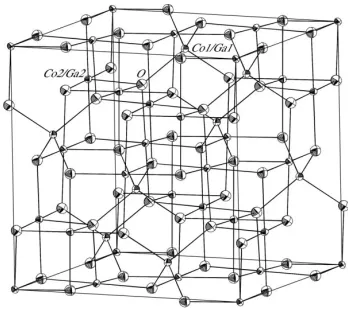
Displacement ellipsoids and selected interatomic distances of the title compound are given in Fig. 1 and Table 1, respectively.
Experimental
Single crystals of the CoGa2O4spinel were grown using a PbF2flux.
Special grade reagents (99.99%) of CoO and Ga2O3were used as
starting materials and mixed together with the PbF2flux in the molar
ratio CoO:Ga2O3:PbF2= 1:1:9. This mixture was placed in a 30 cm3
platinum crucible and heated slowly to 1473 K. The melt of the mixture was then cooled at rates of 5 K h1from 1473 to 973 K and of 10 K h1from 973 to 573 K. Subsequently, the heating was turned off
and the samples were removed from the furnace at room tempera-ture.
Crystal data
CoGa2O4
Mr= 262.37
Cubic,Fd3m a= 8.3281 (3) A˚
V= 577.61 (4) A˚3
Z= 8
Dx= 6.034 Mg m
3
MoKradiation
Cell parameters from 38 reflections
= 20.0–24.7
= 24.01 mm1
T= 296 K Prism, dark blue 0.130.110.09 mm
Data collection
Rigaku AFC-7Rdiffractometer !–2scans
Absorption correction: scan (Northet al., 1968)
Tmin= 0.060,Tmax= 0.115
613 measured reflections 248 independent reflections 215 reflections withF> 3(F)
Rint= 0.023
max= 60.0
h= 0!20
k= 0!20
l= 0!20
3 standard reflections every 100 reflections intensity decay: 1.0%
Refinement
Refinement onF R[F> 3(F)] = 0.017
wR(F) = 0.023
S= 1.72 215 reflections 9 parameters
w= 1/2
(F) (/)max< 0.0001
max= 0.84 e A˚ 3
min=0.43 e A˚ 3
Extinction correction: isotropic Type I (Becker & Coppens, 1974a,b)
Extinction coefficient: 3.06 (6)
104
Table 1
Selected interatomic distances (A˚ ).
Co1/Ga1—O 1.9245 (16) Co2/Ga2—Oi
2.0144 (16) O Oii 3.143 (3)
O Oiii
2.746 (3) O Oiv
2.9478 (16)
Symmetry codes: (i)xþ1;yþ1 4;zþ
1 4; (ii)xþ
1 4;y;zþ
1
4; (iii)xþ 3 4;yþ
3 4;z;
(iv)x1 4;yþ
1 4;zþ
1 2.
The occupancies of the cations at the tetrahedral and the octa-hedral sites were constrained on the basis of the structural formula
IV
(Co1xGax) VI
[CoxGa2x]O4; consequently, the variable occupancy
parameter was only the Ga3+occupancy at the tetrahedral site,i.e.the
inversion parameter (x).
Data collection: WinAFC (Rigaku Corporation, 1999); cell refinement: WinAFC; data reduction: RADY (Sasaki, 1987); program(s) used to solve structure:TEXSAN(Molecular Structure Corporation, 1999); program(s) used to refine structure: RADY; molecular graphics:ATOMS(Dowty, 2000); software used to prepare material for publication:TEXSAN.
This work was partly supported by a Grant-in-Aid for Scientific Research (No. 15740317) from the Ministry of Education, Culture, Sports, Science and Technology of the Japanese Government.
References
Becker, P. J. & Coppens, P. (1974a).Acta Cryst.A30, 129–147. Becker, P. J. & Coppens, P. (1974b).Acta Cryst.A30, 148–153. Blasse, G. (1966).J. Phys. Chem. Solids,27, 383–389.
Christensen, A., Norby, P. & Hanson, J. C. (1995).Powder Diffr.10, 185–188. Dowty, E. (2000).ATOMS for Windows. Version 5.1. Shape Software, 521
Hidden Valley Road, Kingsport, TN 37663, USA.
Garcı´a Casado, P. & Rasines, I. (1982).Z. Kristallogr.160, 33–37. Gorter, E. W. (1950).Nature(London),165, 798–800.
Greenwald, S., Pickart, S. J. & Grannis, F. H. (1954).J. Chem. Phys.22, 1597– 1600.
Harrison, R. J., Redfern, S. A. T. & O’Neill, H. S. C. (1998).Am. Mineral.83, 1092–1099.
Hill, R. J., Craig, J. R. & Gibbs, G. V. (1979).Phys. Chem. Miner.4, 317–339. Ito, T., Yoshiasa, A., Yamanaka, T., Nakatsuka, A. & Maekawa, H. (2000).Z.
Anorg. Allg. Chem.626, 42–49.
Larsson, L., O’Neill, H. S. C. & Annersten, H. (1994).Eur. J. Mineral.6, 39–51. Maekawa, H., Kato, S., Kawamura, K. & Yokokawa, T. (1997).Am. Mineral.
82, 1125–1132.
Molecular Structure Corporation (1999).TEXSAN. Version 1.10. MSC, The Woodlands, Texas, USA.
Nakatsuka, A., Ikeda, Y., Yamasaki, Y., Nakayama, N. & Mizota, T. (2003).
Solid State Commun.128, 85–90.
Nakatsuka, A., Ueno, H., Nakayama, N., Mizota, T. & Maekawa, H. (2004).
Phys. Chem. Miner.31, 278–287.
North, A. C. T., Phillips, D. C. & Mathews, F. S. (1968).Acta Cryst.A24, 351– 359.
O’Neill, H. S. C. (1994).Eur. J. Mineral.6, 603–609.
Porta, P. & Anichini, A. (1980).J. Chem. Soc. Faraday Trans. 1,76, 2448–2456. Rigaku Corporation (1999). WinAFC. Version 1.03. Rigaku Corporation,
Tokyo, Japan.
inorganic papers
i110
Nakatsukaet al. CoGa [image:2.610.352.526.69.224.2]2O4 Acta Cryst.(2006). E62, i109–i111
Figure 1
The crystal structure of the CoGa2O4spinel with displacement ellipsoids
Sanderson, R. T. (1967). Inorganic Chemistry. New York: Van Nostrand-Reinhold.
Sasaki, S. (1987).RADY.National Laboratory for High Energy Physics, Japan. Schulkes, J. A. & Blasse, G. (1963).J. Phys. Chem. Solids,24, 1651–1655. Shannon, R. D. (1976).Acta Cryst.A32, 751–767.
Sickafus, K. E. & Wills, J. M. (1999).J. Am. Ceram. Soc.82, 3279–3292. Soubeyroux, J. L., Fiorani, D. & Agostinelli, E. (1986).J. Magn. Magn. Mater.
54–57, 83–84.
Toriumi, K., Ozima, M., Akaogi, M. & Saito, Y. (1978).Acta Cryst.B34, 1093– 1096.
inorganic papers
Acta Cryst.(2006). E62, i109–i111 Nakatsukaet al. CoGa
supporting information
sup-1 Acta Cryst. (2006). E62, i109–i111
supporting information
Acta Cryst. (2006). E62, i109–i111 [https://doi.org/10.1107/S1600536806011044]
Inversion parameter of the CoGa
2O
4spinel determined from single-crystal X-ray
data
Akihiko Nakatsuka, Yuya Ikeda, Noriaki Nakayama and Tadato Mizota
cobalt digallium tetraoxide
Crystal data
CoGa2O4
Mr = 262.37
Cubic, Fd3m
Hall symbol: -F 4vw 2vw 3
a = 8.3281 (3) Å
V = 577.61 (4) Å3
Z = 8
F(000) = 968
Dx = 6.034 Mg m−3
Mo Kα radiation, λ = 0.71069 Å
Cell parameters from 38 reflections
θ = 20.0–24.7°
µ = 24.01 mm−1
T = 296 K
Prism, dark blue 0.13 × 0.11 × 0.09 mm
Data collection
Rigaku AFC-7R diffractometer
ω–2θ scans
Absorption correction: ψ scan
(North et al., 1968)
Tmin = 0.060, Tmax = 0.115 613 measured reflections 248 independent reflections
215 reflections with F > 3σ(F)
Rint = 0.023
θmax = 60.0°
h = 0→20
k = 0→20
l = 0→20
3 standard reflections every 100 reflections intensity decay: 1.0%
Refinement
Refinement on F
R[F2 > 2σ(F2)] = 0.017
wR(F2) = 0.023
S = 1.72
215 reflections 9 parameters
w = 1/σ2(F)
(Δ/σ)max = 0.00008
Δρmax = 0.84 e Å−3 Δρmin = −0.43 e Å−3
Extinction correction: isotropic Type I (Becker & Coppens, 1974a,b)
Extinction coefficient: 3.06 (6)×10-4
Special details
Refinement. Refinement using reflections with F > 3.0 σ(F). The weighted R-factor (wR), goodness of fit (S) and R -factor (gt) are based on F, with F set to zero for negative F. The threshold expression of F > 3.0 σ(F) is used only for calculating R-factor (gt).
Fractional atomic coordinates and isotropic or equivalent isotropic displacement parameters (Å2)
x y z Uiso*/Ueq Occ. (<1)
supporting information
sup-2 Acta Cryst. (2006). E62, i109–i111
Ga1 0.1250 0.1250 0.1250 0.00373 0.575 (4)
Co2 0.5000 0.5000 0.5000 0.00353 (1) 0.288
Ga2 0.5000 0.5000 0.5000 0.00353 0.712
O 0.25842 (19) 0.25842 0.25842 0.00760 (4)
Atomic displacement parameters (Å2)
U11 U22 U33 U12 U13 U23
Co1 0.00373 (12) 0.00373 0.00373 0.00000 0.00000 0.00000
Ga1 0.00373 0.00373 0.00373 0.00000 0.00000 0.00000
Co2 0.00353 (9) 0.00353 0.00353 −0.00040 (7) −0.00040 −0.00040
Ga2 0.00353 0.00353 0.00353 −0.00040 −0.00040 −0.00040
O 0.0076 (3) 0.0076 0.0076 0.0002 (4) 0.0002 0.0002
Geometric parameters (Å, º)
Co1/Ga1—O 1.9245 (16) Co2/Ga2—Oix 2.0144 (16)
Co1/Ga1—Oi 1.9245 (16) O—Oii 3.143 (3)
Co1/Ga1—Oii 1.9245 (16) O—Oiii 3.143 (3)
Co1/Ga1—Oiii 1.9245 (16) O—Oix 2.746 (3)
Co2/Ga2—Oiv 2.0144 (16) O—Oviii 2.746 (3)
Co2/Ga2—Ov 2.0144 (16) O—Ox 2.9478 (16)
Co2/Ga2—Ovi 2.0144 (16) O—Oxi 2.9478 (16)
Co2/Ga2—Ovii 2.0144 (16) O—Oxii 2.9478 (16)
Co2/Ga2—Oviii 2.0144 (16) O—Oxiii 2.9478 (16)
O—Co1/Ga1—Oi 109.47 (10) Oviii—Co2/Ga2—Oiv 94.06 (9)
O—Co1/Ga1—Oii 109.47 (10) Ovii—Co2/Ga2—Ovi 94.06 (7)
O—Co1/Ga1—Oiii 109.47 (10) Ovii—Co2/Ga2—Ov 94.06 (9)
Oii—Co1/Ga1—Oi 109.47 (10) Ovii—Co2/Ga2—Oiv 180.00
Oiii—Co1/Ga1—Oi 109.47 (10) Ovi—Co2/Ga2—Ov 85.94 (7)
Oiii—Co1/Ga1—Oii 109.47 (10) Ovi—Co2/Ga2—Oiv 85.94 (7)
Oix—Co2/Ga2—Oviii 85.94 (7) Ov—Co2/Ga2—Oiv 85.94 (7)
Oix—Co2/Ga2—Ovii 85.94 (7) Co1/Ga1—O—Co/Ga2xiv 122.44 (8)
Oix—Co2/Ga2—Ovi 179.97 Co1/Ga1—O—Co/Ga2xv 122.44 (8)
Oix—Co2/Ga2—Ov 94.06 (7) Co1/Ga1—O—Co/Ga2xvi 122.44 (8)
Oix—Co2/Ga2—Oiv 94.06 (7) Co2/Ga2xiv—O—Co/Ga2xv 93.92 (7)
Oviii—Co2/Ga2—Ovii 85.94 (7) Co2/Ga2xiv—O—Co/Ga2xvi 93.92 (7)
Oviii—Co2/Ga2—Ovi 94.06 (7) Co2/Ga2xv—O—Co/Ga2xvi 93.92 (7)
Oviii—Co2/Ga2—Ov 179.97
Symmetry codes: (i) x, −y+1/4, −z+1/4; (ii) −x+1/4, y, −z+1/4; (iii) −x+1/4, −y+1/4, z; (iv) −x+1, y+1/4, z+1/4; (v) x+1/4, −y+1, z+1/4; (vi) x+1/4, y+1/4, −z+1; (vii) x, −y+3/4, −z+3/4; (viii) −x+3/4, y, −z+3/4; (ix) −x+3/4, −y+3/4, z; (x) x−1/4, y+1/4, −z+1/2; (xi) x+1/4, y−1/4, −z+1/2; (xii) x+1/4, −y+1/2,