This content has been downloaded from IOPscience. Please scroll down to see the full text.
Download details:
IP Address: 148.88.244.227
This content was downloaded on 22/05/2016 at 22:29
Please note that terms and conditions apply.
Putative resolution of the EEEE selectivity paradox in L-type Ca2+ and bacterial Na+
biological ion channels
View the table of contents for this issue, or go to the journal homepage for more J. Stat. Mech. (2016) 054027
J.
St
at.
Mec
h.
(
201
6
)
054027
Putative resolution of the EEEE
selectivity paradox in L-type Ca
2
+
and
bacterial Na
+
biological ion channels
I Kh Kaufman
1, D G Luchinsky
1,2,
W A T Gibby
1,P V E McClintock
1and R S Eisenberg
3 1 Department of Physics, Lancaster University, Lancaster LA1 4YB, UK 2 Mission Critical Technologies Inc., 2041 Rosecrans Ave.Suite 225 El Segundo, CA 90245, USA
3 Department of Molecular Biophysics and Physiology, Rush Medical College,
1750 West Harrison, Chicago, IL 60612, USA
E-mail: [email protected], [email protected], p.v.e.mcclintock@ lancaster.ac.uk, [email protected] and [email protected]
Received 21 October 2015
Accepted for publication 9 November 2015 Published 20 May 2016
Online at stacks.iop.org/JSTAT/2016/054027
doi:10.1088/1742-5468/2016/05/054027
Abstract. The highly selective permeation of ions through biological ion channels can be described and explained in terms of fluctuational dynamics under the influence of powerful electrostatic forces. Hence valence selectivity, e.g. between Ca2+ and Na+ in calcium and sodium channels, can be described
in terms of ionic Coulomb blockade, which gives rise to distinct conduction bands and stop-bands as the fixed negative charge Qf at the selectivity filter
of the channel is varied. This picture accounts successfully for a wide range of conduction phenomena in a diversity of ion channels. A disturbing anomaly, however, is that what appears to be the same electrostatic charge and structure
(the so-called EEEE motif) seems to select Na+ conduction in bacterial channels but Ca2+ conduction in mammalian channels. As a possible resolution of this paradox it is hypothesised that an additional charged protein residue on the permeation path of the mammalian channel increases | |Qf by e, thereby altering
the selectivity from Na+ to Ca2+. Experiments are proposed that will enable the hypothesis to be tested.
Keywords: Brownian motion, stochastic processes (theory), dynamics (theory), diusion
I Kh Kaufman et al
Identification problems for calcium ion channels
Printed in the UK 054027
JSMTC6
© 2016 IOP Publishing Ltd and SISSA Medialab srl 2016
2016 J. Stat. Mech.
JSTAT
1742-5468
10.1088/1742-5468/2016/05/054027
Special Issue on Unsolved Problems of Noise in Physics, Biology and Technology
5
Journal of Statistical Mechanics: Theory and Experiment
© 2016 IOP Publishing Ltd and SISSA Medialab srl
ournal of Statistical Mechanics:
J
Theory and Experiment
IOP
J.
St
at.
Mec
h.
(
201
6
)
054027
1. Introduction
Biological ion channels [1] are natural nanopores through cellular membranes. They provide for the fast and highly selective permeation of physiologically important ions like Na+ , K+ and Ca2+ . The conduction and selectivity of e.g. voltage-gated Ca2+
[2] and Na+ channels [3] are known to be determined by the ions’ fluctuation-driven movements and interactions inside a short, narrow selectivity filter lined with nega-tively-charged protein residues4 It is known that permeation may sometime involve the
correlated motion of more than one ion [4–6]. Mutation studies [3, 7–9] and simulations
[10–15] show that the fixed charge Qf provided by the residues is a determinant of the
channel’s conductivity and valence selectivity. Both nanopores [16] and ion channels
[17] exhibit the phenomenon of ionic Coulomb blockade, closely analogous to electronic Coulomb blockade in mesoscopic systems [18–20].
Building on earlier work by Zhang et al [21] on ionic transport in water-filled peri-odically-charged nanopores, we used Brownian dynamics simulations of permeation in Ca2+ channels to reveal the existence of discrete conduction and selectivity bands as
functions of Qf [22, 23]. These were not only consistent with earlier speculations [19,
24] but were able to explain both the anomalous mole fraction eect (AMFE) [2] and a number of the puzzling mutation-induced transformations of selectivity in Ca2+ /
Na+ channels. More recently, we generalized the electrostatic analysis of the multi-ion energetics of conduction bands [23] by introducing an ionic Coulomb blockade model of conduction and selectivity in biological ion channels thereby bringing them into the context of mesoscopic phenomena [17, 25].
Although the Coulomb blockade theory [17, 25] seems to provide convincing explanations of a wide range of ion channel phenomena, it appears to be in direct
Contents
1. Introduction 2
2. Electrostatic permeation theory 3
2.1. Generic model of calcium channel . . . 3 2.2. Coulomb blockade model of ionic permeation . . . 3 2.3. Mechanisms of blockade and permeation . . . 5 2.4. Apparently anomalous EEEE selectivity in the mammalian Ca2+ channel . 7
3. Proposed resolution of the EEEE Paradox in calcium channels 7
4. Conclusions 9
Acknowledgments 9
References 9
4 The protein residues are amino acids, of which aspartate (D) and glutamate (E) have negatively charged side
Identification problems for calcium ion channels
3 doi:10.1088/1742-5468/2016/05/054027
J.
St
at.
Mec
h.
(
201
6
)
054027
contradiction to the experimental observation that the same electrostatic charge and structure (the so-called EEEE motif) at the selectivity filter seems to select Na+ con-duction in bacterial channels but Ca2+ conduction in mammalian channels. We will refer to this apparent anomaly as the EEEE paradox. The aim of the present paper is to develop an idea introduced by Cheng et al [26] leading to a plausible resolution of the paradox.
To set the scene, we start by summarising the generic electrostatics and Brownian dynamics model of calcium/sodium channels (section 2), including a short description of the Coulomb blockade model of permeation (section 2.2), and a classification of permeation mechanisms (section 2.3), also commenting on the success of the Coulomb blockade theory in accounting for AMFE. We then point out (section 2.4) that the EEEE paradox appears to cast doubt on the whole Coulomb blockade picture. In sec-tion 3 we propose a way in which the EEEE paradox may be resolved and we also sug-gest ways in which the corresponding hypothesis can be tested. Finally, we summarise and draw conclusions in section 4
In what follows, with SI units, e is the proton charge, z the ionic valence, ε0 the
vacuum permittivity, T the temperature, and kB Boltzmann’s constant.
2. Electrostatic permeation theory
2.1. Generic model of calcium channel
The generic electrostatic model of the SF of a Ca2+ /Na+ ion channel used in earlier electrostatic modelling is shown in figure 1. The channel is described as an axisymmet-ric, water-filled, cylindrical pore of radius R = 0.3 nm and length L = 1.6 nm through a protein hub in the cellular membrane. A centrally-placed, uniform, rigid ring of nega-tive charge Qf in the range 0⩽| |Qf ⩽7e is embedded in the wall at RQ = R. The
left-hand bath, modeling the extracellular space, contains non-zero concentrations of Ca2+ and/or Na+ ions. We take both the water and the protein to be homogeneous continua with relative permittivities εw =80 and εp=2, respectively, but describe the ions as
discrete charges qi = ze within the framework of the implicit hydration model moving
in single file within the channel, with bulk values of diusion coecients Di. The BD
simulations solve the coupled 3D axisymmetrical Poisson electrostatic equation and 1D overdamped Langevin stochastic equation numerically and self-consistently at each simulation step [5, 10, 22, 23, 27].
Although the model represents a simplification of the actual electrostatics and dynamics of ions and water molecules within the selectivity filter [28], we may note that reduced models can successfully reproduce significant properties of real biological channels [10, 12] and artificial nanopores [16, 21, 28]. Details of the model, its range of validity, and its limitations, have been presented and discussed elsewhere [22, 23].
2.2. Coulomb blockade model of ionic permeation
J.
St
at.
Mec
h.
(
201
6
)
054027
for pure baths of dierent concentration. Figure 2(a) shows narrow conduction bands
M0, M1, M2 separated by stop-bands of almost zero-conductance centred on the
block-ade points Z1, Z2, Z3. Figure 2(b) shows that the Mn peaks in J correspond to transition
[image:5.595.125.447.117.312.2]regions in channel occupancy, where P jumps from one integer value to the next, and that the stop-bands correspond to saturated regions with integer P = 1, 2, 3....
Figure 1. Electrostatic model of a Ca2+ or Na+ channel, after [22, 23]. Ions move
in single file along the channel axis. See text for details.
Figure 2. Brownian dynamics simulations of multi-ion conduction and occupancy in a Ca2+ channel model versus the eective fixed charge Q
f; (a),(b) are reworked
from [22] and (c) from [17]. (a) Plots of the Ca2+ current J for pure Ca2+ baths of dierent concentration (20, 40 and 80 mM as indicated). (b) The occupancy P. (c) The excess self-energy Un and ground state energy UG versus Qf for channels with
n = 0, 1, 2 and 3 Ca2+ ions inside. The conduction bands M
n and the blockade/
[image:5.595.123.445.355.567.2]Identification problems for calcium ion channels
5 doi:10.1088/1742-5468/2016/05/054027
J.
St
at.
Mec
h.
(
201
6
)
054027
Coulomb blockade appears in low-capacitance systems from quantization of the quadratic energy form at a grid of discrete states, provided that the Coulomb energy gap ∆Un=Us is large enough (∆Unk TB ) to block transitions between neighbouring
{n} states; that is a strong electrostatic exclusion principle. Figure 2(c) plots Un and
the ground state potential energy UG as functions of Qf. We see a periodic pattern with
two kinds of UG singular points in, marked as Mn and Zn. The minima of UG (and the
blockade regions) appear around the neutralisation points Zn = −zen where QG=0
and the occupancy Pc is saturated at an integer value [21, 23]. For divalent Ca2+ ions ∆Un≈20k TB and hence the blockade is strong. The crossover points Mn (Un=Un+1)
allow barrier-less { } ⇆ {n n+1} transitions; they correspond to the Pc transition regions
and to the conduction peaks in J [23].
The positions of the singular Qf points in figure 2(c) can be written as:
zen Z e e e
ze n M e e e
Z 0 , 2 , 4 ... Coulomb blockade
M 1/2 1 , 3 , 5 ... Resonant conduction
n n
n n
( )
( ) ( )
δ
δ
= − ± ≈ − −
= − + ± ≈ − − − (1)
where δZn, δMn are possible corrections for the singular part of anity and ion-ion
interactions, not accounted for here.
2.3. Mechanisms of blockade and permeation
The Coulomb blockade model predicts a very strict and clearly-defined pattern of ionic blockade and conduction [17, 25] where the physical processes occurring at the various conduction and blocking points (see below) are sketched in figure 3.
Figure 4 presents the sequence of singular points that appear for Ca2+ ions in the generic model as a function of Qf, as predicted by (1). The sequence starts from the
Coulomb blockade point Z0 = 0e, i.e. the neutralized channel is impermeable for
[image:6.595.128.430.114.347.2]diva-lent ions due to strong Coulomb blockade by the induced charges. This blockade point
J.
St
at.
Mec
h.
(
201
6
)
054027
than repeats itself with period ≈ 2e as Z1, Z2 etc with growing number of blocking ions
(1 for Z1, and 2 for Z2).
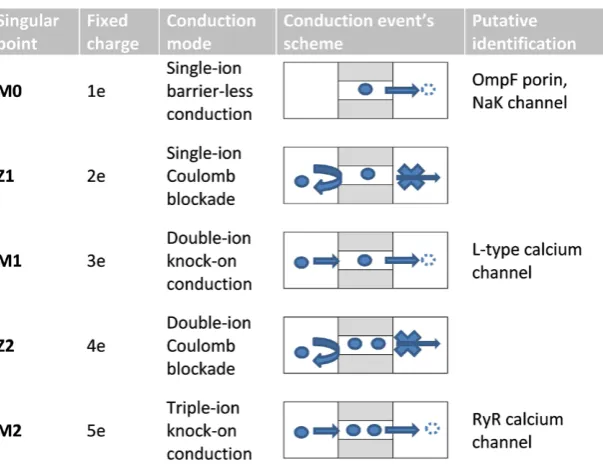
The resonant point M0 shows single-ion resonant (barrier-less) conduction
mech-anism (see [23] for details) when induced charges balance the charge of the moving ion. The M1 resonant point represents conduction via double-ion knock-on (figure 3). In our
previous papers we identified M1 with the L-type calcium channel assuming that
proto-nation might account for the charge discrepancy. We will propose below an alternative explanation in which the L-type channel is actually an M2 channel. Note that in the
absence of a crystal structure for the calcium channel all such explanations are inevi-tably putative. The M2 point represents conduction via triple-ion knock-on (figure 3).
We have already connected this point with RyR calcium channel. The highest reso-nances are probably related to large-charge mutants of the bacterial sodium channels CaChBac and CavAB [3, 8].
All these mechanisms can be described in terms of single-vacancy conduction
[29, 30]. Evenly-charged Zi loci provide divalent block while oddly-charged Mi points
provide AMFE, i.e. divalent block plus fast multi-ion barrier-less conduction. In addi-tion, the Coulomb blockade model predicts exponential growth of binding strength with the net charge Qf, which agrees well with experiment [17].
[image:7.595.122.450.117.265.2]Thus the ionic Coulomb blockade model predicts a universal, valence-dependent, periodic pattern of stop/conduction bands similar to the electronic Coulomb blockade oscillations of conductance in quantum dots [18, 20]. It allows us to identify conduction bands with real calcium-conductive channels/mutants. Unlike its electronic counter-part, ionic Coulomb blockade is valence-dependent: the bands Mn shift in proportion to z due to (1) and broaden/narrow in proportion to z2 [31].
Figure 4(a) plots the energy Un of an n-occupied channel against n for the blockade/
neutralisation points Zn. For divalent Ca2+(full curve)Un has a sharp minimum for state
{n}, separated from neighbouring {n±1} states by an impermeable barrier of 20k TB .
This is strong blockade closely similar to electronic Coulomb blockade in quantum dots
[18, 32]. The same plot for Na+ ions (dashed curve) reveals a permeable 5k TB barrier,
that is weak ionic Coulomb blockade. Figure 4(b) show a similar plot for the resonant
Figure 4. Valence-selective Coulomb blockade and resonant conduction. (a) Coulomb blockade. Plots of the self-energy Us for Zn points versus n, with Ca2+
(blue), Na+(green), and quantization points (filled circles). (b) Resonant conduction. Plots of the self-energy Us plots for the Mn points versus n with Ca2+ (blue), Na+
Identification problems for calcium ion channels
7 doi:10.1088/1742-5468/2016/05/054027
J.
St
at.
Mec
h.
(
201
6
)
054027
conduction points Mn. Again, it is strong ionic Coulomb blockade (∆ ≈U 40k TB ) for
Ca2+ ions and weak ionic Coulomb blockade (∆ ≈U 10k TB ) for Na+ ions.
The ionic Coulomb blockade approach can be also applied to a mixed Ca2+–Na+ bath at the Qf = −3e point, which is M1 for Ca2+ and Z3 for Na+ ions. The
combina-tion 1Ca2+ + 1Na+ (with +3e charge) inside the SF is neutralized (Qn = 0) and so the
channel is asymmetrically blocked due to ionic Coulomb blockade (figure 4(a))—which is strong for Ca2+ and weak for Na+. Similarly 3Na+ (with +3e) also blocks the channel by weak ionic Coulomb blockade at the Z3 point for Na+ ions. Otherwise, a channel
con-tents of 2Ca2+(+4e) gives Qn = +1e and resonant conduction (figure 4(b)). Hence ionic
Coulomb blockade provides a natural explanation of AMFE in Ca2+ channels consistent with experiment and with analysis in terms of a potential energy landscape [23, 31].
2.4. Apparently anomalous EEEE selectivity in the mammalian Ca2+ channel
Notwithstanding the great success of the Coulomb blockade model in explaining many dierent, previously puzzling, features of ion channel conduction, the EEEE paradox
(see above) represents a serious concern: for the same Qf = −4e at the selectivity filter
to give rise to both Na+ and Ca2+ resonances is clearly impossible, and therefore the paradox threatens the whole edifice of understanding that has been developed around electrostatics and Coulomb blockade. If we are to retain the Coulomb blockade theory of selectivity, then we are obliged to find an explanation of what we may choose to regard as the anomalous properties of the L-type Ca2+ channel. We propose such an explanation in section 3.
3. Proposed resolution of the EEEE Paradox in calcium channels
Table 1 lists comparable alignments of the P—and S—segments in Cav.1.2 mammalian
[image:8.595.121.519.145.256.2]calcium [26] and NaChBac bacterial sodium [8] channels. It is usually supposed [2] that the selectivity filter of the mammalian calcium channel is based upon a 4-gluta-mate EEEE locus and hence has a total charge Qf = −4e. This locus is known to be
Table 1. Alignment of the protein P-loops near the selectivity filters of Ca2+ [26] and Na+ [8] channels.
Channel Segment First residue
Cav1.2 p41 p51
IP 379 L T V F Q C I T M E G W T D V L Y IIP 722 L T V F Q I L T G E D W N S V M Y IIIP 1132 M A L F T V S T F E G W P E L L Y IVP 1432 L L L F R C A T G E A W Q D I M L
NaChBac p1 p11
IP–IVP 182 L T L F Q VV T L E S W A S G V M Note: The charged glutamate (E) and aspartate (D) resides that form the
J.
St
at.
Mec
h.
(
201
6
)
054027
highly conserved, meaning that the sequence has remained the same over many gen-erations despite the vagaries of evolution and speciation, and implying that the struc-ture is important because any small mutation makes the organism significantly less fit. However this proposition not only leads to structural problems [15], but it is also inconsistent with expectations based on the Coulomb blockade model (see above). If we have pseudo-similar loci with similar Qf but dierent function, this directly contradicts
our central idea of valence selectivity being of electrostatic origin. Secondly, and in particular, the evenly-charged EEEE locus corresponds to the blockade point Z1 rather
than to any of resonant conduction points Mi (figures 2–4). Note that similar EEEE
loci in the ChNaBac and NavAB bacterial channels provide for sodium selectivity and divalent block, rather than calcium selectivity.
It always was clear that dierences will exist between formally identical loci, and that these dierences do not necessarily follow from the structure itself. In the absence of struc-tural data, information related to the positions of particular residues comes mainly from mutagenesis results. One possible source of dierences could be protonation [33], which is able to change the eective charge of the selectivity filter, but there is no confirmation from structure simulations, so that this explanation seems speculative and ad hoc.
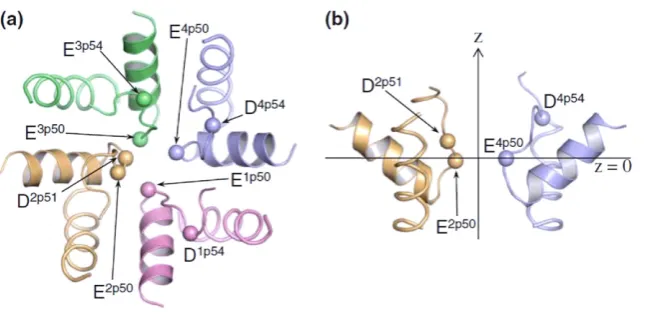
We note, however, that an aspartate D2p51 residue exists in the structure; no asso-ciated mutagenesis data are available, so some authors have supposed that it is not located at the selectivity filter [34]. Yet it provides a possible resolution of the EEEE paradox [26]. Repeat II of α-unit of the calcium channel has this D2p51 residue at a position next to the EEEE, and it is highly conserved, so that the locus can be thought as EEEED [26] with nominal charge Qf = −5e. Figure 5 shows the results of
[image:9.595.123.448.113.270.2]Monte-Carlo simulations of the putative molecular structure by Cheng et al [26]. The addi-tional D2p51 aspartate side chain is evidently located very close to the main 4-glutamate EEEE (E(1−4)p50) ring both in both the radial (a) and axial (b) directions, and must thus play an equal role in the electrostatic interactions. Following their suggestion [26], we conclude that the calcium channel’s locus is actually EEEED, with a charge of −5e, rather than the EEEE with −4e which correctly describes the sodium channel.
Figure 5. The Cav1.2 outer pore model with repeats I, II, III, and IV colored pink, orange, green, and blue, respectively. Alpha-carbons of the selectivity filter glutamates Ep50s, D2p51, and acid residues in positions p54 are shown as spheres.
Identification problems for calcium ion channels
9 doi:10.1088/1742-5468/2016/05/054027
J.
St
at.
Mec
h.
(
201
6
)
054027
This would correspond to conduction at the triple-ion M2 resonant point (figure 3)
[17]. Such an identification would dier from our previous conclusion that the L-type channel conducts at the M1 = −3e singular point [22, 23], but it appears more likely to
be correct. From this viewpoint, there is no EEEE paradox at all, and we are able to include both channels within the Coulomb blockade classification scheme (1).
Finally, we emphasise that both the old and new Mi identifications for the L-type
channel are speculative, and that our tentative conclusions need to be confirmed by mutation studies of the D2p51 side chain using D → E, D → K and D → A point muta-tions. We may anticipate: that a D → E mutation giving an EEEEE locus will leave the channel properties unchanged; that a D → A mutation leading to an EEEEA mutant will result in a Na+ -selective channel exhibiting divalent block similar to the NaChBac channel; and that a D → K mutation leading to EEEEK (Qf = − ⇒3e M1) will yield a
new Ca2+ -selective channel.
4. Conclusions
The conclusions are to be considered within the context of our model, which embodies many simplifications. In particular, the permanent charge that we discuss is an eective variable bearing an unknown relationship to the full three-dimensional distribution of permanent charge in the channel protein. This reality reflects (1) many contributions of three-dimensional details of structure not captured in models of reduced dimensionality,
(2) protein flexibility and dynamics over an enormous range of times (10−15–10−6 s, for example) that are not present in our model, and (3) possible additional sources of excess free energy. What is important is that the model reproduces important behavior for some specific choices of permanent charge that are not changed from condition to condition.
Within this context, we have suggested a possible resolution of the EEEE selectivity paradox for calcium/sodium channels, using the Coulomb blockade model to reinforce an idea proposed by Cheng et al [26]. The explanation supposes that the D2p51 resi-due is ionized, and that it is on the permeation path and part of the selectivity filter, very close to the EEEE ring. Hence the eective locus for calcium channels is actually EEEED implying Qf = −5e, and providing for a triple-ion knock-on mechanism at the M2 resonance. This inference awaits experimental confirmation.
Acknowledgments
We gratefully acknowledge valuable discussions with Aneta Stefanovska, Olena Fedorenko and Stephen Roberts. The research was supported by the Engineering and Physical Sciences Research Council UK (grant No EP/M015831/1). No new data were created during this study.
References
[1] Hille B 2001 Ion Channels Of Excitable Membranes 3rd edn (Sunderland, MA: Sinauer Associates)
[2] Sather W A and McCleskey E W 2003 Permeation and selectivity in calcium channels Ann. Rev. Physiol.
65 133–59
J.
St
at.
Mec
h.
(
201
6
)
054027
[5] Roux B, Allen T, Berneche S and Im W 2004 Theoretical and computational models of biological ion channels Q. Rev. Biophys. 37 15–103
[6] Kharkyanen V N, Yesylevskyy S O and Berezetskaya N M 2010 Approximation of super-ions for single-file diusion of multiple ions through narrow pores Phys. Rev. E 82 051103
[7] Heinemann S H, Teriau H, Stuhmer W, Imoto K and Numa S 1992 Calcium-channel characteristics conferred on the sodium-channel by single mutations Nature 356 441–3
[8] Yue L X, Navarro B, Ren D J, Ramos A and Clapham D E 2012 The cation selectivity filter of the bacterial sodium channel, NaChBac J. Gen. Physiol. 120 845–53
[9] Miedema H, Meter-Arkema A, Wierenga J, Tang J, Eisenberg B, Nonner W, Hektor H, Gillespie D and Meijberg W 2004 Permeation properties of an engineered bacterial OmpF porin containing the EEEE-locus of Ca2+ channels Biophys. J. 87 3137–47
[10] Corry B, Vora T and Chung S H 2005 Electrostatic basis of valence selectivity in cationic channels Biochim. Biophys. Acta—Biomembr. 1711 72–86
[11] Boda D, Nonner W, Henderson D, Eisenberg B and Gillespie D 2008 Volume exclusion in calcium selective channels Biophys. J. 94 3486–96
[12] Boda D 2014 Monte Carlo simulation of electrolyte solutions in biology: in and out of equilibrium Annual Reports in Computational Chemistry vol 10, ed D Gillespie and N Baker (Elsevier: Amsterdam) chapter 5, pp 127–64
[13] Corry B 2013 Na+ /Ca2+ selectivity in the bacterial voltage-gated sodium channel NavAb PeerJ 1 e16
[14] Csányi E, Boda D, Gillespie D and Kristf T 2012 Current and selectivity in a model sodium channel under physiological conditions: dynamic Monte Carlo simulations Biochim. Biophys. Acta—Biomembr. 1818 592–600 [15] Shuba Y M 2014 Models of calcium permeation through T-type channels Pflügers Arch.—Eur. J. Physiol.
466 635–44
[16] Krems M and Di Ventra M 2013 Ionic Coulomb blockade in nanopores J. Phys.: Condens. Matter 25 065101 [17] Kaufman I K, McClintock P V E and Eisenberg R S 2015 Coulomb blockade model of permeation and
selec-tivity in biological ion channels New J. Phys. 17 083021
[18] Beenakker C W J 1991 Theory of Coulomb-blockade oscillations in the conductance of a quantum dot
Phys. Rev. B 44 1646–56
[19] Stopa M 2002 Rectifying behavior in Coulomb blockades: charging rectifiers Phys. Rev. Lett. 88 146802 [20] Likharev K K 2003 SET: Coulomb blockade devices Nano et Micro Technol.3 71–114
[21] Zhang J, Kamenev A and Shklovskii B I 2006 Ion exchange phase transitions in water-filled channels with charged walls Phys. Rev. E 73 051205
[22] Kaufman I K, Luchinsky D G, Tindjong R, McClintock P V E and Eisenberg R S 2013 Multi-ion conduction bands in a simple model of calcium ion channels Phys. Biol. 10 026007
[23] Kaufman I K, Luchinsky D G, Tindjong R, McClintock P V E and Eisenberg R S 2013 Energetics of discrete selectivity bands and mutation-induced transitions in the calcium–sodium ion channels family Phys. Rev.
E 88 052712
[24] Eisenberg R S 1996 Atomic biology, electrostatics and ionic channels New Developments in Theoretical Studies of Proteins ed R Elber (Singapore: World Scientific) pp 269–357
[25] Kaufman I, Gibby W, Luchinsky D, McClintock P and Eisenberg R 2015 Coulomb blockade oscillations in biological ion channels IEEE Conf. Proc. 23rd Intern. Conf. Noise and Fluctuations(Xian)
[26] Cheng R C, Tikhonov D B and Zhorov B S 2010 Structural modeling of calcium binding in the selectivity filter of the L-type calcium channel Eur. Biophys. J. 39 839–53
[27] Berti C, Furini S, Gillespie D, Boda D, Eisenberg R S, Sangiorgi E and Fiegna C 2014 Three-dimensional Brownian dynamics simulator for the study of ion permeation through membrane pores J. Chem. Theor. Comput. 10 2911–26
[28] Laio A and Torre V 1999 Physical origin of selectivity in ionic channels of biological membranes Biophys. J.
76 129–48
[29] Hille B and Schwarz W 1978 Potassium channels as multi-ion single-file pores J. Gen. Physiol. 72 409–42 [30] Schumaker M F and MacKinnon R 1990 A simple model for multi-ion permeation. Single-vacancy
conduc-tion in a simple pore model Biophys. J. 58 975–84
[31] Kaufman I K, Tindjong R, Luchinsky D G, McClintock P V E and Eisenberg R S 2013 Resonant multi-ion conduction in a simple model of calcium channels IEEE Conf. Proc. 22nd Intern.Conf.on Noise and Fluctuations(Montpellier, 24–8 June 2013) ed J M Routoure et al(Piscataway, NJ: IEEE)
[32] Alhassid Y 2000 Statistical theory of quantum dots Rev. Mod. Phys. 72 895–968
[33] Furini S, Barbini P and Domene C 2014 Eects of the protonation state of the EEEE motif of a bacterial Na+ -channel on conduction and pore structure Biophys. J. 106 2175–83
![Figure 1. Electrostatic model of a Ca2+ or Na+ channel, after [22, 23]. Ions move in single file along the channel axis](https://thumb-us.123doks.com/thumbv2/123dok_us/890952.601588/5.595.123.445.355.567/figure-electrostatic-model-channel-ions-single-le-channel.webp)

![Table 1. Alignment of the protein P-loops near the selectivity filters of Caand Na2+ [26] + [8] channels.](https://thumb-us.123doks.com/thumbv2/123dok_us/890952.601588/8.595.121.519.145.256/table-alignment-protein-loops-selectivity-lters-caand-channels.webp)