OLDHAM METROPOLITAN BOROUGH
COUNCIL
Chapter Page
1 Introduction 1
2 Background and context 4
3 How the Race Equality Scheme has been produced 10
4 Race Equality Values, Principles and Standards 11
5 Service Delivery and Policy Development 15
5.1 - Assessment of functions and policies 15
5.2 - Assessing and consulting on the likely impact of its proposed policies
17
5.3 - Monitoring existing Council policies for any adverse impact
20
5.4 - Publishing the results of assessment and monitoring
23
5.5 - Ensuring public access to information and services
26
5.6 - Training staff in connection with the general and specific duties.
28
6 Employment 30
7 Complaints 32
8 Summary Action Plan 34
Appendix 1 Corporate Race Equality Policy Statement 40
Appendix 2 Assessment of functions and policies 42
Acknowledgement
CHAPTER 1 - INTRODUCTION
What is this document?
The Race Relations (Amendment) Act 2000 (“the Act”) places new duties on all ‘public authorities’ to promote race equality. In response to this legislation the Council is required to prepare and publish a Race Equality Scheme that shows how we plan to do this, through setting out an action plan for improvement and change, together with identifying clear targets so we can measure our progress. In order to meet this new ‘general duty’ we must ensure that, in carrying out our functions as a council, we take account, in everything that we do, of the need to:
• eliminate unlawful racial discrimination; • promote equality of opportunity; and
• promote good relations between people of different racial groups
As an organisation which employs more than 150 full-time staff, the Council also has to meet a new ‘specific duty’ to ensure our recruitment, selection, training, and promotion arrangements, grievance and disciplinary policies and procedures for our employees operate fairly.
This document is, therefore, the Council’s Race Equality Scheme in which we set out what our priorities are for promoting race equality, so that we can ensure that we are meeting our legal obligations and that we are aiming to improve the way we provide our services to all sections of the community. But it is important that the Council does not simply aim to meet the minimum legal requirements, and so this document also acts as a set of standards for high quality services, delivered fairly by a workforce which reflects the local community.
The document:
• contains background information about the borough of Oldham and the issues it faces;
• sets out our race equality principles and values;
• outlines how we have gone about identifying our priorities;
• provides action plans related to all areas for which the Council is responsible, showing how we will address the issues identified, consult and inform people and train our staff; and
• outlines how we will meet our new duties as a major employer.
Oldham Council
• Education and Cultural Services • Environment and Transportation • Social Services
• Operational and Leisure Services
• Housing, now an Arms Length Management Organisation
• Chief Executive (incorporates Corporate Services Department and Policy, Performance & Regeneration Department from June 2002).
This means that the Council carries out a very wide range of functions, including such things as street cleaning, collecting the Council Tax, providing parks and leisure facilities, administering Housing Benefit, providing home care services, funding and supporting voluntary organisations, and promoting economic development and regeneration. Some of these are services the Council is obliged to carry out (‘statutory’ functions) and some are ones where the Council is able to set its own priorities (‘discretionary’ functions). Also, the Council provides some of these services directly, whilst others are ‘contracted out’ to the private sector, or other organisations, who deliver the services on the Council’s behalf. The Council also provides grant aid to a variety of voluntary organisations in the Borough in order that they can meet a wide range of needs at the local level.
Political and decision-making arrangements
For electoral purposes the Borough is divided into 20 wards, each of which is represented by 3 local councillors - making a total of 60. Councillors are elected for 4 years with one third of the Council due for election every year (except that every fourth year there are no elections). To provide a local focus for decision-making and debate there are 6 Area Committees covering: East Oldham, West Oldham, Chadderton, Failsworth & Hollinwood, Saddleworth & Lees, Shaw & Royton. These are made up of local ward councillors and co-opted members from the community.
Duty to promote race equality
In reviewing the Council’s functions, policies and procedures for their relevance to race equality it is clear that the Council’s responsibilities are very extensive. So this document sets out how the process of assessing those functions for their relevance has been undertaken, outlines what the timetable is for more detailed evaluation of relevant policies and procedures, and provides a clear statement of our values and principles in relation to race equality. This will allow the Council to be sure that it has information about who uses its services (through monitoring, research, etc), has tried to establish what barriers there are to people accessing services, and that it is providing those services fairly to all its citizens, on the basis of identified needs.
CHAPTER 2: BACKGROUND AND CONTEXT
This section provides a context for the Race Equality Scheme. It analyses the demographic, social and economic situation in Oldham and highlights some of the factors which make the promotion of race equality particularly important for Oldham.
Oldham’s population
Oldham’s population of around 219,000 people is ethnically and culturally diverse. In 2002 it is estimated that around 13.7% of Oldham’s population are of minority ethnic origin.1 The roughly 30,000 people of non white ethnic origin include around 15,000 people of Pakistani or Kashmiri ethnic origin, 10,000 people of Bangladeshi origin, 2,000 people of Black African or Caribbean origin, 1,500 people of Indian ethnic origin, and 500 people belonging to various other non white minority groups. These figures are likely to under-estimate the numbers of people of mixed heritage, and also exclude minorities within the white population including significant numbers of people of Irish heritage and of Eastern European origin including recent asylum seekers.
Demographic change
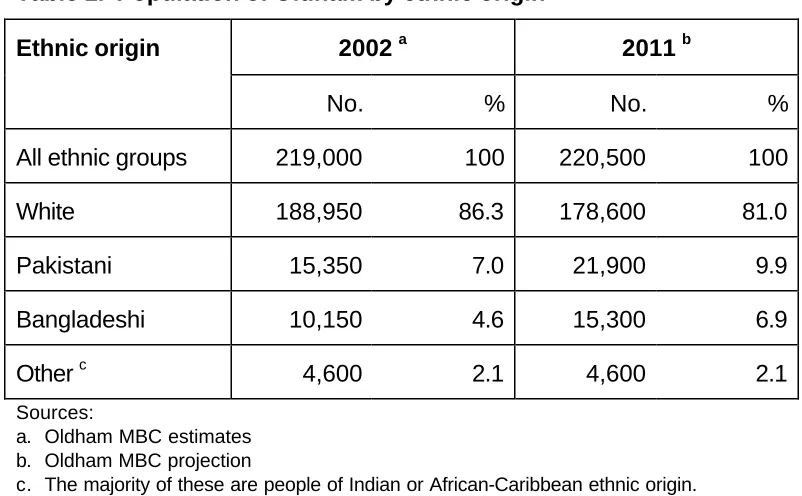
[image:6.596.91.492.463.711.2]Oldham is experiencing extremely rapid demographic change relating to both the ethnic composition and the age structure of the population. The changing ethnic composition of the Borough is shown in Table 1 below.
Table 1. Population of Oldham by ethnic origin
Ethnic origin 2002 a 2011 b
No. % No. %
All ethnic groups 219,000 100 220,500 100
White 188,950 86.3 178,600 81.0
Pakistani 15,350 7.0 21,900 9.9
Bangladeshi 10,150 4.6 15,300 6.9
Other c 4,600 2.1 4,600 2.1
Sources:
a. Oldham MBC estimates b. Oldham MBC projection
c. The majority of these are people of Indian or African-Caribbean ethnic origin.
1
Although the overall size of Oldham’s population is not projected to change substantially in the next decade, there are likely to be substantial changes in its composition, with a falling white population and significant growth in those of Pakistani and Bangladeshi ethnic origin.
The key factors driving these changes are: • out-migration of white people from Oldham;
• higher birth rates within the communities of Pakistani and Bangladeshi ethnic origin;
• the young age composition of the communities of Pakistani and Bangladeshi ethnic origin (so that proportionally more people are of an age where they are marrying and having children);
• in-migration associated with marriage to people from south Asia.
Residential and social segregation
Although some of Oldham's ethnic minority communities are distributed across the Borough, people of Pakistani and Bangladeshi ethnic origin are particularly concentrated in a few neighbourhoods in central Oldham – notably Glodwick, Westwood, Freehold and Coppice.2 While in many other districts ethnic minority communities tend to live in specific areas, the level of residential segregation is particularly marked in Oldham. Academic research following the 1991 Census3 identified Oldham’s communities of Bangladeshi and Pakistani ethnic origin as the most geographically concentrated minority communities in Britain.
In contrast, there are a number of large social housing estates – including Limehurst, Fitton Hill, Holts, Alt, Roundthorn, Derker and Sholver – in which the population is almost exclusively white.
This segregation reduces day-to-day social contact between people from different ethnic groups, and the opportunities this brings to learn about their lives and develop friendships. It tends to encourage a perception that communities have different territories – something which can be exacerbated at times of social tension as occurred in 2001. Of particular concern is the level of ethnic segregation in Oldham’s primary schools, with some schools in central Oldham almost entirely containing children from a single ethnic group. This restricts opportunities to mix with children with a different ethnic and cultural heritage, and can create problems when children make the transition to ethnically diverse secondary schools and as they experience the difficulties of adolescence.
Numbers of young people
Oldham has proportionally more children and young people than does the country as a whole. This is particularly associated with central Oldham and with Oldham’s communities of Pakistani and Bangladeshi ethnic origin. For example, the proportion of the population aged under 16 is 20% in England and Wales, 23% in Oldham as a whole, but 29% in the wards of central Oldham.
The numbers of young people in Oldham are also on the increase, again linked to the growth of Oldham’s communities of Pakistani and Bangladeshi ethnic origin. As a result young people in Oldham are disproportionately of minority ethnic origin. Whereas around one in eight (13%) people in Oldham are from minority ethnic groups, the proportion rises to almost one in four (23%) among people aged under 25 years.
While the growing numbers of young people in central Oldham potentially represent a huge asset, the Borough faces a challenge in ensuring their effective inclusion and in harnessing their energies for positive change.
Deprivation
Oldham is ranked the 38th most deprived district in England on the DETR Indices of Deprivation 2000. However, this ranking on the average level of deprivation across the borough conceals huge variations between different parts of Oldham. Every district has its best and worst parts, but Oldham is particularly highly polarised with huge contrasts between central Oldham and Saddleworth, the more affluent eastern part of the Borough.
Rates of deprivation and poverty are very high throughout central Oldham. Three wards (Alexandra, Coldhurst and Werneth) rank among the most deprived 1% nationally on the Indices of Deprivation 2000, and a further four wards (St. Mary’s, St. James’, Hollinwood and Lees) are among the most deprived 10%. Together these wards comprise a contiguous area with a population of around 77,000 people.
Within this area deprived neighbourhoods broadly divide into one of two types: • areas of predominantly private sector housing, mostly small terraced
properties built in the 1890s and early 1900s, occupied largely by families of South Asian ethnic origin. These include Glodwick, Westwood and Freehold;
Key issues in central Oldham are:
• Poverty, which is widespread across the area. Rates of child poverty are particularly high. In five wards more than 70% of children live in low income households;
• Exclusion from work is one of the underlying causes of levels of poverty, as are the low wages of many of those in work. Like other parts of the North West, very large proportions of residents of working age are excluded from work by ill health or disability, which is effectively a form of hidden unemployment;
• Low educational attainment and the lack of skills of many adults prevent people from securing better jobs. Educational attainment has greatly improved in Oldham in recent years, but GCSE attainment remains significantly below national averages. Of particular concern are the lower rates of attainment of pupils of Pakistani and Bangladeshi ethnic origin, with less than 25% achieving 5 or more GCSEs graded A*-C as compared with 41% of all year 11 pupils in Oldham. Educational under-achievement is particularly marked among young men in these communities;
• Poor health impairs the quality of life of many people in central Oldham and increases the risk of premature death. For example, in Alexandra and Hollinwood wards the Standardised Mortality Ratio for premature death (before age 65) is more than twice the national average;
• Crime rates are high in parts of the area with the domestic burglary rate, for example, exceeding three times the national average in two police beats in 1999/00. In some areas drug misuse is a major cause of acquisitive crime, and drug dealing is also linked to problems of violence some of which is between people from different ethnic groups. The incidence of racially motivated crime is particularly high, and has risen in recent years;
Community relations
Oldham has traditionally had a strong local identity, and many members of the indigenous community have felt threatened by the social and demographic changes which have taken place in the Borough. While overt racism has increasingly been recognised as unacceptable, many local people continue to hold highly prejudiced views - although it should also be emphasised that the majority do not.
The events of 2001, and the way in which they were presented in the media created a climate which legitimised racism and made the views of a few extremists more acceptable to large numbers of people. This was reflected in recent elections. At the 2001 General Election around 14,000 local people – 9% of the electorate – voted for the British National Party (BNP). In the May 2002 local elections the BNP stood in five wards. Although no BNP councillors were elected, they came second in four of the five wards and received around 4,400 votes (27% of those voting in the five wards and 6% of all votes cast).
Disturbances in 2001 and the Oldham Independent Review
Following the disturbances in Oldham in 2001, Oldham Council, Greater Manchester Police and Greater Manchester Police Authority commissioned an Independent Review, which was headed by David Ritchie. The review team gathered evidence over a period of months and published their report in December 2001.5 This was published simultaneously with two national reports in to community cohesion.6
The Oldham Independent Review Team analysed the causes of the disturbances and made a series of recommendations for addressing these. These are built upon a set of principles which include: valuing and celebrating diversity; respect for others' traditions and viewpoints; and commitment to a united Oldham. Many of the recommendations are highly relevant to the Council's role in promoting race equality. These include those relating to:
• Reducing residential segregation and improving housing conditions;
• Raising attainment of ethnic minority pupils, and reducing ethnic segregation of children in schools;
• English language acquisition within some ethnic minority communities, particularly for children and their parents;
• Programmes to assist people into work and increase the acquisition of vocational skills;
5
Oldham Independent Review Panel Report One Oldham One Future, 11 December 2001.
6
Building Cohesive Communities, the report of the Ministerial Group on Public Order and Community Cohesion (Home Office); and
• Achieving a more representative workforce within the Council and other major public sector organisations;
• Cultural awareness training for Council employees; • Improving health and reducing inequalities in health;
• More effective communications with the public to prevent the development of myths and misunderstandings which contribute to resentments and racial tension, including new structures for discussing issues of race and diversity; • Tackling racially motivated crime;
• Leisure and cultural provision, and its potential for bringing together people from different communities;
• A new approach to regeneration which avoids the targeting of small areas; • Analysis of the implications of all significant Council policy recommendations
for diversity and community relations in Oldham.
The Oldham Partnership submitted an interim response to the Oldham Independent Review in February 2002. A further response will be made in June. This will set out how the Partnership is taking forward its response to the Oldham Independent Review, including the development of a Cohesion Action Plan in response to the Government's Independent Review of Community Cohesion. Oldham's Local Strategic Partnership
An extremely positive development in recent months has been the establishment of Oldham's Local Strategic Partnership (LSP). Following a consultation process, this was established in January 2002 and accredited by Government in February 2002. It seeks to be far more inclusive, both in its structure and operation, than the previous Oldham Partnership Board. Its 35 members include representatives from a range of major partnerships (including Oldham Race Equality Partnership), faith communities, voluntary and community groups, and residents from all parts of the Borough.
CHAPTER 3: HOW THE RACE EQUALITY SCHEME HAS BEEN PRODUCED
The Council’s Policy, Performance and Regeneration Department has taken the lead in co-ordinating and preparing the Council’s first Race Equality Scheme, with the Chief Executive’s Department Personnel Team leading on developing a response in relation to the specific duties relating to employment.
The Commission for Racial Equality (CRE) designated Oldham as a pilot authority and provided an officer who has worked closely work with the Council in preparing the Race Equality Scheme.
The process of preparing the Race Equality Scheme has involved:
• An initial seminar for senior officers on the Act 2000 and its implications for the Council;
• Establishment of an Inclusion Task Group involving councillors from the Performance Management Overview & Scrutiny Committee, community representatives from the Council’s Ethnic Minority Panel and the co-ordinator of Oldham Race Equality Partnership. The Task Group has contributed to the development of the Race Equality Scheme and advised on its content; • The Council’s Departmental Liaison Group for Race Equality, which has
responsibility for taking forward work in Departments on race equality matters, held a special meeting to develop proposals for the Race Equality Scheme. Representatives from the joint trades unions were invited to participate in the process to ensure trade union involvement and consultation is built into this work from the outset. Members of the Departmental Liaison Group will play a key role in implementation of the Scheme;
CHAPTER 4 - RACE EQUALITY VALUES, PRINCIPLES AND STANDARDS
The current position
Oldham Council’s current commitment to tackling inequality and promoting good race relations is embodied in a number of documents. The Council’s initial Corporate Race Equality Policy Statement was adopted in 1982, and this was updated in 2000 and incorporated into a more extensive Race Equality Policies and Information booklet which has been widely distributed throughout the authority. A set of Key Principles forms the core of this booklet, and a copy of this Statement is attached at Appendix 1.
Oldham Council’s Corporate Plan also reflects the authority’s commitment to tackling racial inequality in a number of ways. The Corporate Plan is founded upon five core values, with the value of Fairness stating, in particular, that:
‘We will work towards fairness and equality of opportunity for all people regardless of age, culture, disability, economic status, gender, race, religion or sexuality’
and that of Respect stating that:
‘We will treat people with dignity and courtesy in providing services that reflect and celebrate local diversity and provide choice.’
In addition, the Corporate Plan sets out the objectives that drive forward the work of the Council overall. One of the key organisational objectives, cutting across all the Council’s service areas, is tackling discrimination and prejudice. Located under this objective are a number of specific corporate race equality tasks that the Council is already committed to undertaking. These include:
• responding to the Independent Review into the civil unrest in the borough in May 2001 (see Chapter 2 for further details);
• developing a Community Cohesion Strategy;
• revising the Council’s Workforce Strategy with a view to making the workforce more representative, as recommended in the Independent Review; and
What the Council will do
Although all of the above give an indication of the priority the Council already gives to tackling discrimination and promoting good race relations, it is clear that there is still much work to be done in Oldham and that the current principles and objectives do not go far enough to meet the new duties placed on public authorities. There is a now a need for some revising and updating of these key documents.
• Equal Opportunities Policy and introduction of the Generic Equalities Standard for Local Government
The current Corporate Race Equality Policy Statement does not fully reflect the Council’s duties under the Act. There is also a need to set out more clearly how the Council will ensure that the sentiments of the Policy Statement are reflected fully in the way services are delivered and policies implemented.
The Council needs to take account of the recently produced generic Equality Standard for Local Government, jointly prepared by the Commission for Racial Equality, Disability Rights Commission and Equal Opportunities Commission, and the possible introduction of new legislation to prevent discrimination in respect of other characteristics such as age, religion, sexuality.
The Council therefore plans to strengthen its performance in promoting equality more generally, by adopting the new generic equality standard for local government and working towards the highest level (level 5) of this. The timetable for this remains to be agreed, and will be built into the Council’s Race Equality Performance indicators (see below). These targets will replace those relating to the CRE’s Race Equality Means Quality Standards. Existing work on these standards will be built upon in progressing to the higher levels of the generic equality standard. Adoption of the generic standard will ensure the Council is well placed in ensuring compliance with any future strengthening of equalities legislation.
The existing Departmental Liaison Group, responsible for work on the CRE’s Race Equality Means Quality Standards, will lead on the introduction of the Generic Equalities Standard. The existing work on the CRE Standards will be incorporated into this. This widens the remit of this Group, which will need to adopt a phased approach to work on equalities issues. For 2002/03 the priorities will be work on race equality and to review and update the Council’s Equal Opportunities Policy. The Group’s work programme for 2002/03 forms part of the Race Equality Scheme Action Plan in Chapter 8 below.
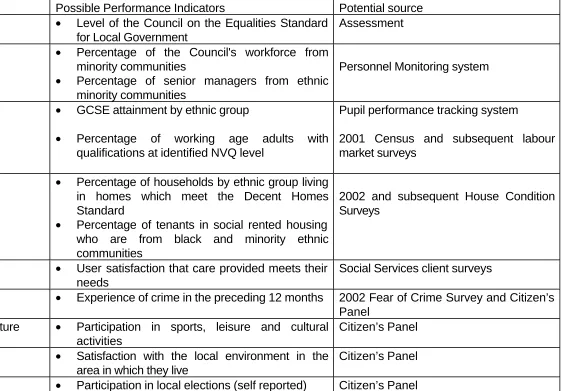
Development of race equality performance indicators and targets
During 2002/03 further work will be carried out to:
• identify and select the most appropriate indicators; • establish baseline measures; and
• agree targets for these indicators over a period of five years, where appropriate on an annual basis.
Community consultation will form part of this process. Once agreed, the indicators will be incorporated into the Best Value Performance Plan and reported on through this. While the intention would be to update these annually, some will need to be based upon survey data and could only be updated when further surveys were carried out - usually within the next five years.
As part of the requirement to develop a Community Cohesion Strategy, work is also in progress to develop community cohesion indicators. Some of these could also potentially be included among the key Race Equality Performance Indicators, and ideas for these will need to be considered as part of the process of selecting the set of appropriate indicators.
TABLE 2 POSSIBLE KEY RACE EQUALITY PERFORMANCE INDICATORS
Issue Possible Performance Indicators Potential source
Corporate equalities • Level of the Council on the Equalities Standard for Local Government
Assessment Employment • Percentage of the Council's workforce from
minority communities
• Percentage of senior managers from ethnic minority communities
Personnel Monitoring system
Education and skills • GCSE attainment by ethnic group
• Percentage of working age adults with qualifications at identified NVQ level
Pupil performance tracking system
2001 Census and subsequent labour market surveys
Housing • Percentage of households by ethnic group living in homes which meet the Decent Homes Standard
• Percentage of tenants in social rented housing who are from black and minority ethnic communities
2002 and subsequent House Condition Surveys
Social Services • User satisfaction that care provided meets their needs
Social Services client surveys
Community Safety • Experience of crime in the preceding 12 months 2002 Fear of Crime Survey and Citizen’s Panel
Sports, leisure and culture • Participation in sports, leisure and cultural activities
Citizen’s Panel Environment • Satisfaction with the local environment in the
area in which they live
CHAPTER 5 - SERVICE DELIVERY AND POLICY DEVELOPMENT
5.1 ASSESSMENT OF FUNCTIONS AND POLICIES
What the Council is required to do
Under the Act the Council must set out in this Race Equality Scheme which of its current and proposed functions and policies are relevant to the general duty to promote race equality. Appendix 2 sets out, for each department of the Council, the full list of those functions and policies with an indication of which part(s) of the general duty are relevant to each. Chapter 3 set out in more detail the process undertaken to assess each of these functions and policies in order to determine its relevance, with available evidence being examined where appropriate.
The Council is then obliged to review these functions and policies at least every three years from 31 May 2002. In undertaking the initial ‘relevance assessment’ each function/policy was allocated a priority from 0-4 to indicate in which year the function/policy would then be reviewed (0 meaning no further review as there is no relevance to race equality; 1 meaning review in the first year of the Race Equality Scheme; 2 meaning review in the second year; 3 meaning review in the third year; and 4 meaning in the next Race Equality Scheme).
The purpose of this requirement is to consider how the reasoning behind rules and decisions of the Council can unintentionally affect people from some racial groups in a way that might have been hidden without further examination. This will allow the Council change the way things are done and improve services to all sections of the community.
What the Council will do
The initial assessment undertaken has only focussed on identifying those Council functions that are relevant to the duty to promote race equality and allocating these a priority. In order to fulfil the duty to eliminate unlawful racial discrimination, promote equality of opportunity and promote good race relations a system is needed for reviewing each of those policies identified in more detail. This, essentially, means asking ‘What action should we take to eliminate unlawful discrimination, promote equality of opportunity and promote good race relations?’ It is planned to build on existing systems and do this in a number of ways:
standards are adopted across the Council. This will include identifying what action is to be taken (which may, in some cases, concentrate on establishing monitoring systems so the effects of a policies can be understood); who is responsible for action; what targets are to be achieved; and what the timescale is. Guidance will also be provided to remind Departments not to overlook the impact of a policy on smaller ethnic groups who may be consistently overlooked when the impact of a policy is being assessed. • An initial programme of training for service managers will also be provided to
assist them with establishing the system of Action Planning and, again, to promote a corporate approach.
• A Best Value Checklist for race equality is already in use across the Authority when reviews are undertaken. This will be revised and updated to ensure that all the requirements of the Act are addressed here, which will also assist with the ‘mainstreaming’ of race equality into routine service reviews.
• Although Departmental Action Plans will identify who is responsible for reviewing and implementing change in relation to individual service areas nominated officers from each Department will also be responsible for reporting progress through the corporate Departmental Liaison Group. This will allow for scrutiny of the progress of each Department in taking their Plans forward and will also provide a forum for debate and support to Departmental contact officers on an ongoing basis.
5.2 ASSESSING AND CONSULTING ON THE LIKELY IMPACT OF ITS PROPOSED POLICIES
What the Council is required to do
This Scheme has already set out in some detail how the Council plans to assess further the impact of its current policies for the promotion of good race relations. But it is important that the Council also has in place a system for assessing the likely effects on different groups in the community of policies it is proposing to introduce. This is because the Council now has a duty to make sure that the policies it introduces promote equality of opportunity and good race relations, and do not lead to direct or indirect discrimination. Clearly, one of the best ways of meeting this duty is to consult with people who will be affected by the policy to ask them about their needs and what impact any new policies might have on race equality.
The Council is constantly changing and updating its policies and acquiring additional functions in response to the introduction of new laws. There is also a need to review policies and the ways in which services are delivered, both in response to a changing environment and in order to bring about improvements in quality. Therefore when such changes are proposed, in order to meet the Council’s responsibilities under the Act, arrangements need to be in place to:
• assess how any proposed policies are likely to affect people from different racial groups;
• consult people who may be affected by new policies; and
• revise proposed policies in response to consultation and the assessment undertaken.
What the Council does now
As new responsibilities are placed on the Council, or proposals are developed to change how services are delivered, there are already a number of mechanisms in place to assess the impact on local people in general. Depending on the type of service or policy this might include:
• undertaking a survey or commissioning research;
• holding consultation meetings in areas affected, or with groups representing those affected;
• holding discussions with key individuals or organisations with particular expertise (e.g. specialist voluntary organisations, local businesses, etc); • taking proposals to the Area Committees for further, local, discussion; or • consulting with trades unions representing Council employees.
Unless a particular policy is specifically addressing services to ethnic minority groups (such as the provision of interpreting and translating services), or where there is a particular requirement (such as being a condition of obtaining funding) there will not necessarily be a specific consideration of the implications for race equality.
The Council has, however, been looking to improve the way it undertakes consultation about a wide range of issue, and has recently introduced a number of important changes. There is now a Consultation Strategy to give best practice guidance on how consultation should be undertaken. This contains eight principles of consultation which state that the Council will:-
1. Respect people. Listen to and value their contributions. 2. Be clear about the scope of consultation.
3. Strive to give people equal opportunity to contribute. 4. Identify the needs of different sectors of the community. 5. Keep people informed.
6. Make effective use of resources. 7. Work with partners.
8. Learn from experience.
This Strategy is supported by a Consultation Guide for Council staff and the Authority’s Consultation Events (ACE) database, which is used to share information about consultation events. A Citizens’ Panel has also been established to allow different parts of the Council to consult with a broadly representative cross-section of the Oldham population on issues, as required. There is also some use of focus groups drawn from the Citizens’ Panel, to allow for more in-depth study of people’s views.
The Council also has an Ethnic Minority Panel whose membership is drawn from Councillors on the People & Communities Overview & Scrutiny Committee and individuals who represent the ethnic minority communities in the Borough. This group are consulted on a range of policy issues relating to race equality issues. What the Council will do
• General steps
It is recognised that support and guidance to managers forms a vital part of ensuring that Oldham’s Race Equality Scheme is implemented effectively. Therefore in order to supplement the guidance already provided to assist with the initial assessment of the Council’s functions for their relevance to race equality (see Chapter 3 – How the Race Equality Scheme has been produced), further guidance will be prepared for service managers on how to assess the impact of new policies and undertake relevant consultation. This will form part of the training for service managers referred to in Section 5.6 below (Training staff in connection with the general and specific duties).
• Assessing the impact of proposed policies
In order to promote the mainstreaming of race equality issues guidance will be given to service managers that, where possible, the race equality implications of policies should be built into planned service reviews (for example Best Value reviews) as a matter of course, rather than establishing separate race equality impact assessments. But the guidance will specifically draw managers’ attention to the duties under the Act and provide suggestions for how impact might be assessed (for example, through the use of ethnic monitoring data, or considering the findings of local or national research on how particular minority groups are known to be affected by particular changes).
In addition, a new format is being introduced for all Council committee reports which will require the author of the report to consider the implications for Community Cohesion of proposed policies (see Section 5.4, below). This will have a number of sub headings which need to be addressed. The detail of these remains to be finalised, but they should include equalities implications (which will include race equality) and the promotion of good race and community relations. The introduction of this will be supported by training and guidance notes, both for officers writing the reports and the elected members involved in assessing and scrutinising them.
• Consulting
As it is clear that there is already substantial consultation taking place routinely throughout the Council, guidance will be provided to service managers that consultation about the race equality implications of a proposed policy should become integral to (and supplement) existing consultation exercises, rather than being separate from them.
The Council’s Consultation Strategy and Guide should still form the basis of advice to staff on how consultation should be undertaken but when these documents are next updated particular attention will be given to ensuring that the requirements of the Act are fully reflected in the best practice guidance given.
In addition to routine staff and trade union consultations on policy changes affecting the Council’s workforce, further consideration will be given to supporting the development of a Council-wide black workers’ group. This will provide an additional, fresh perspective on policy initiatives, with many of these staff also living in the borough and thus being able to comment from a resident’s perspective too.
Finally, further work will be done to ensure that the Council’s website can become a more effective tool for consultation generally, with particular attention being paid to how it can best be used to gather comments on the race equality implications of policies. The Council’s internal intranet could also be used specifically as a tool for staff consultation (whilst bearing in mind that, currently, certain groups of employees may disproportionately lack access to the Council’s intranet).
5.3 MONITORING EXISTING COUNCIL POLICIES FOR ANY ADVERSE IMPACT
What the Council is required to do
The Council must set out in its Race Equality Scheme its arrangements for monitoring relevant policies for any adverse impact on the promotion of race equality.
Monitoring systems are essential tools in measuring whether the Council is complying with legislation against discrimination (the 1976 Race Relations Act as amended by the Race Relations (Amendment) Act 2000 in respect of race) and its own equal opportunities policies. Effective operation of ethnic monitoring systems involves:
• identifying possible inequalities associated with relevant policies or functions;
• investigation of the underlying causes of these inequalities; and • action to remove any unfairness or disadvantage.
What the Council will do
the Race Equality Scheme, with the expectation that systems will be introduced in 2002/03.
In deciding what to monitor the Council will take account of: the assessment of relevance of functions; the recommendations in the guidance provided in the CRE's Guide for Public Authorities on Ethnic Monitoring; the views of elected members on priority areas for monitoring; and assessment of the costs and benefits of introducing monitoring systems. A balance needs to be struck between ensuring that the Council can effectively monitor its performance in relation to race equality and creating undue bureaucracy which impairs the effective delivery of services.
The Council will introduce the ethnic monitoring systems required to comply with the specific duty on employment in the Act relating to monitoring, analysis and publication of data on:
• Staff in post;
• Applicants for employment, training and promotion; • Staff receiving training;
• Disciplinary action;
• Performance appraisal (when this results in benefits or sanctions); and • The number of staff leaving the authority, for whatever reason.
Introducing or enhancing monitoring systems - The Council is keen to ensure that new and existing monitoring systems operate effectively, and that they provide useful tools for improving race equality in employment and service delivery.
In introducing systems, or improving the use of existing systems, key issues to be addressed are:
• Preparation for introducing systems - by providing information to staff and service users about why the information is being collected and how it will be used. This will help to develop the support needed to make the introduction of ethnic monitoring effective. Trades Unions have an important role to play in this, and have already had some involvement in developing the Race Equality Scheme;
Training will be provided for service managers involved in this. This will need to cover a range of issues such as: types of monitoring; systems of data collection; maximising response; ethnic origin classifications; data protection; benchmarking; target setting; and analysis, interpretation and use of monitoring data. Managers will need to ensure staff operating the systems are also fully trained in relation to their new responsibilities.
Training will also be provided for elected members and community representatives from the Ethnic Minority Panel who will be involved in scrutinising the results of ethnic monitoring systems;
• IT implications - Introduction of monitoring systems could sometimes require the introduction of new IT systems. An assessment will be made as early as possible of the IT implications of introducing monitoring systems, both in order to timetable this work and to secure the necessary budgetary provision. Wherever possible existing systems will be utilised, if necessary on a temporary basis, to avoid this becoming a barrier to the introduction of ethnic monitoring;
5.4 PUBLISHING THE RESULTS OF ASSESSMENT AND MONITORING
What the Council is required to do
The Authority has a duty to publish the results of:
• Assessments and consultation on the likely impact of proposed policies on the promotion of race equality; and
• Monitoring of its policies for adverse impact on the promotion of race equality.
The purpose of the duty to publish the results of assessment and monitoring is to increase the accountability of the organisation to the public. This will be achieved by: enabling people to understand the reasons for which decisions have been made, and providing information which enables people to question decisions or existing policies or to raise issues which need to be addressed in the future. What the Council will do
The Council welcomes this duty, which is entirely consistent with its core values, as set out in the Corporate Plan for 2002-03. These include: empowerment of residents to involve them in the decision making process, and openness to ensure that decisions are clear, open and honest. Publication is also a demonstration to the public and staff of the Council’s commitment to the promotion of race equality.
As well as meeting the requirements for publication set out above, the Council will also undertake to publish the results of all assessments of existing functions of policies for their relevance to race equality, including the outcome of such assessments.
• Consultation and assessments of the impact of proposed policies
Full Council is responsible for approving or adopting a set of plans and strategies which are defined as the Council’s policy framework. Other decisions on policy are delegated to the Council’s Executive. Any policy decisions are therefore made on the basis of a report to either Full Council or the Executive. A list of future decisions, and details of how people can submit their views are published in the Council’s Forward Plan which is available both on the Council’s website and through libraries.
poverty/ability to pay for services, and the implications for race and community relations.
As part of the process of introducing Community Cohesion implications, guidance notes and training will be provided for officers on evaluation of equalities implications, and training will also be provided for elected members to assist them in effectively scrutinising officers’ assessments.
The decisions of the Council and the Executive are lodged on the Council’s Executive Decision Recording System, and the decisions and reports on which they are based are publicly accessible on the internet as well as available through public libraries. They are therefore available for public scrutiny.
Outcome of Public Consultation
The Council is seeking to improve its consultation mechanisms, to enable people to participate in decision making without creating an undue burden upon the public and creating “consultation fatigue”. Through the Local Strategic Partnership, the Council and other public bodies are seeking ways of better co-ordinating consultation activity.
An important development is the Council’s ACE consultation database. This provides a central register of consultation activity which is used to co-ordinate consultation work and avoid duplication of effort. This is currently only accessible on the Council’s Intranet, but it is in the process of being made available to partner organisations so that they can also include their consultation exercises on the database and co-ordinate their activities with the Council and each other. As part of this the ACE database will be made accessible to the public on the Council’s database. A further development which it is planned to introduce is to make the reports summarising the findings of consultation exercise part of the ACE database, so that people who have been consulted can access the results. This would be in addition to any other feedback – such as sending participants a summary of results for example.
• Publishing results of monitoring of policies
The Council has a set of existing arrangements for reporting on its performance including, in some cases, the results of ethnic monitoring. It is planned to build on these rather than create new arrangements because of the risk of otherwise creating a disproportionate administrative burden.
to be distributed to all staff. The soon to be published first edition includes, for example, an article on the Race Relations (Amendment) Act.
During 2002/03 arrangements will be agreed for publishing the results from ethnic monitoring systems. This will include various different approaches which will build upon existing performance management systems including: the Best Value Performance Plan; reports to the Executive; reports to the Performance Management Overview & Scrutiny Committee; and analysis of performance in service plans. Key issues to be considered as part of this are:
• Ensuring accountability and openness without creating an undue bureaucratic burden;
• Use of appropriate timescales which allow for meaningful analyses of performance e.g. annual rather than quarterly reporting;
• Providing a contextual analysis to performance management information so that there is an explanation of performance and so that myths are not created about what the Council is doing;
• Providing a level of detail and explanation appropriate to the readership, so that people receive information which is useful and meaningful to them rather than burying them in detail or confusing them with technical language;
• Ensuring consistency in the use of the agreed ethnic group classification (which is consistent with the results of the 2001 Census) while recognising there may sometimes be a need to consider performance in relation to other groups (such as travellers or asylum seekers) in order to reflect the diversity of Oldham’s population; and
5.5 ENSURING PUBLIC ACCESS TO INFORMATION AND SERVICES
What the Council is required to do
The Council is required to ensure that everyone, whatever their ethnic or racial group, can get information about the Authority and its services. This includes information about, for example, policies, services and complaints procedures and about people’s rights in relation to these. Compliance with this duty will help ensure that the Council’s services are accessible to everyone, particularly those who: do not currently know about services; are not confident in using them; or meet barriers when they try to use them.
What the Council will do
• Access to information
Improving communication - The Council is keen to ensure that everyone has access to the information they need at the time that they need it, and improving communication is central to this. The Council recently commissioned a review of its corporate governance arrangements by the consultancy Ecotec which highlighted the need to improve communication – both within the Authority and with the wider community. Improving dialogue with ethnic minority communities is one aspect of this wider communication issue.
In response to this, the Council is developing a corporate Communication Strategy which will be launched in June. This will incorporate good practice guidance on communicating with ethnic minority communities.
Interpreting and Translation Services - The Council's Best Value Review of Services to Ethnic Minority Communities identified the need to conduct a detailed review of Interpreting and Translation Services, including assessment of need and demand and development of a range of options for the organisation of service. Some initial research has been carried out with both people from ethnic minority communities and front-line service providers. This questions the value of translating whole documents into ethnic minority languages, though it is clear that there remains a considerable need for interpreting services. Further work is needed to establish the most effective means of communicating with Oldham's various ethnic minority communities, and different sub-groups within these - such as women or older people. It is planned to commission research into the written and spoken language skills of people in Oldham’s ethnic minority communities, and their preferred methods for communicating with the Council. This research will be very widely relevant to organisations within Oldham, and will be commissioned jointly by the Council with partner organisations – possibly through the Local Strategic Partnership.
translation services, as well as in updating the good practice guidance on communication with ethnic minority communities.
English language acquisition – Linked to this issue of language skills is the development of English language skills among people whose first language is not English. While the Council needs to enable people who cannot speak or read English to access information and services, an inability to communicate in English provides a major barrier to most employment opportunities and to the development of community cohesion. The Oldham Independent Review placed great emphasis on this, particularly in relation to ethnic minority children and their families.
The Council’s Education & Cultural Services Department, in partnership with schools, Oldham College, Oldham Sixth Form College and other members of the Local Learning Partnership, are delivering, and further developing a very substantial programme of support relating to English for Speakers of Other Languages (ESOL), English as an Additional Language (EAL), basic skills development and family learning. This closely links into initiatives benefiting Oldham’s more deprived communities such as: Sure Start, Single Regeneration Budget, New Deal for Communities and Neighbourhood Renewal Fund.
The impact of this programme of work will clearly contribute significantly to the process for improving race equality in relation to access to information, services and employment.
Use of intermediary organisations - Voluntary and community groups working at the "grass roots" provide an important route of communication with ethnic minority groups and other sections of the community. The Council is committed to supporting the contribution of voluntary and community organisations, which is reflected through the provision of grant funding and dedicated officer support, and formalised through the Voluntary Sector Compact. However there is an identified need for capacity development work with the ethnic minority voluntary and community sector to enable them to work more effectively together and participate in wider voluntary sector networks. The Council is working with Oldham Voice (the voluntary and community sector network) to develop this.
Linked to this, funding has been provided through the health sector to support the development and maintenance of a community contacts database. This could be accessed by council members or officers wanting to contact groups working in particular areas or on particular issues, and provide a means of broadening dialogue beyond the "usual suspects". This work is being developed jointly with Oldham Voice and other partners.
• Access to services
Best Value Review links closely into the Council's e-government Strategy. While the use of the internet is one area of activity, there is concern about creating a "digital divide", which would further disadvantage people living in deprived communities.
By contrast, a very high proportion of all sections of the population have access to a telephone, and the current priority is therefore in developing a Council Call Centre. This will have a highly trained customer services team who can deal with the majority of customer enquiries without reference to "back office" staff. This will provide an improved service to local people and make more effective use of staff. Key issues which will be addressed in developing the system are: the customer care training of staff which needs to incorporate issues of cultural awareness; and arrangements for communicating with people who do not speak English or whose preferred language is not English.
A range of issues addressed in other sections of the Race Equality Scheme will also contribute to improving equality of access to services. These include:
• increasing the number of employees with minority language skills as a result of action to make the workforce more representative of the local community; • improving arrangements for accessing interpreters;
• training in cultural awareness and anti-discriminatory practice for all staff.
5.6 TRAINING STAFF IN CONNECTION WITH THE GENERAL AND SPECIFIC DUTIES.
What the Council is required to do
As a public authority this Council must, as part of this Race Equality Scheme, set out its arrangements for training staff on the issues that are relevant to the general duty to promote race equality and the other specific duties placed on the Authority. The Council is committed to promoting race equality in both service delivery and employment, and it is therefore important that employees are properly trained so that promoting race equality becomes a routine part of their work.
What the Council will do
The Council already delivers a variety of forms of race and cultural awareness training to groups of staff in different service areas. But, to date, this has not been done in a co-ordinated way, to common standards or reflecting an explicit set of corporate race equality values. For the Council to fulfil its duties under the Act these gaps need to be addressed and staff training needs to be allocated a higher priority, with core training becoming mandatory for all staff.
• A training programme focussing on race and cultural awareness for all existing Council staff is already in development, as a way of implementing one of the recommendations of the Oldham Independent Review. This will be extended to cover the requirements placed on all public servants by the Act and will be rolled out across the Authority in a co-ordinated manner;
• A programme of training on anti-discriminatory practice will also be developed and delivered, to build upon the more general race and cultural awareness training outlined above. This will emphasise the Council’s commitment to tackling all forms of discrimination, and ways in which people can help contribute to this in their work;
• This training on race and cultural awareness training, the duties of all public servants to promote race equality under the Act, and anti-discriminatory practice will be built into the induction training delivered to all new staff;
• Specific training will be given to service managers with responsibility for implementing the Action Plans forming part of this Race Equality Scheme (see Chapter 5.1 above);
• In order to assist with meeting the specific employment duties (outlined in Chapter 6) managers will be provided with training around promoting fairness and diversity in the workplace. A link will also be made with the Council’s Employee Development Scheme, where employees’ training needs are identified on an annual basis. This will ensure that employees’ training needs in relation to the Act are monitored and reviewed regularly and that all staff are directed towards appropriate training in order to ensure they are able to meet the general duty;
• In the longer term, service specific training programmes will be reviewed to ensure that they fully reflect the Council’s duties under the Act. For example, the range of issues covered in Customer Care training may need to be revisited to ensure that race equality considerations are fully addressed;
CHAPTER 6: EMPLOYMENT DUTIES
What the Council is required to do
The Act introduces a specific duty in relation to employment. This requires the Council to monitor, by reference to racial group:
• Staff in post;
• Applicants for employment, training and promotion; Staff who:
• receive training;
• benefit or are disadvantaged as a result of performance assessment • are involved in grievance procedures;
• are the subject of disciplinary procedures; or • cease employment with the Council for any reason.
The Council is required to publish annually the result of these monitoring procedures.
What the Council will do
The need to make the Council’s workforce more representative of the Borough’s population was identified in the report of the Oldham Independent Review and is a priority for the Council. The Council has a Representative Workforce Working Group, chaired by the Executive Member responsible for Personnel issues, which is leading work on this. This has recently, for example, developed an improved application form and organised a local jobs fair involving the Council and many other public sector organisations. The Group will play a lead role in developing approaches to create a more representative workforce.
Staff in post – A survey of all employees is in progress. This will provide information on their ethnic group using the Council’s agreed classification which is consistent with the results of the 2001 Census. This information will be entered into the Authority’s personnel information systems so that it can be used with other information – such as their age, gender, grade and department – in analysing the composition of the Council’s workforce. It is estimated that 95% or more of employees will supply information on their ethnic group. All new starters will be required to complete the monitoring form, which will ensure that the system is maintained for the future.
analysis and reporting of this information. Since the system will be applicable to all advertised vacancies, it will be capable of monitoring both applications for employment and promotion.
Training – All centrally provided training has been recorded by reference to racial group for some time, but the information has not been input into an computerised system which would enable it to be analysed and reported. An electronic recording system is now being written to address this. Centrally provided training will therefore be monitored.
Departments will need to provide records of other training provided to individuals categorised by ethnic group and a form will be produced as a part of the Employee Development Scheme / Departmental Training Plans for this, in consultation with departments.
Performance assessment - Individual performance assessment is not currently in place across the Council, but a number of areas relating to performance are presently being reviewed. When individual performance assessment is introduced, a recording system which will enable ethnic monitoring and reporting will be developed as part of this.
Discipline and grievances – Serious disciplinary matters and grievances are presently recorded centrally, but previously Departments have not been required to record minor disciplinary or grievance cases by ethnic group.
In future Departments will be asked to report to the central Personnel Team on a quarterly basis on disciplinary and grievance cases, providing the names of individuals involved and the necessary details of the process and its outcome. By cross referencing to information on their ethnic group in the personnel information system it will then be possible to analyse and report on these issues by ethnic group.
Leavers – The Council’s present RASA (Recruitment, Assessment, Selection and Appointment) systems requires managers to hold exit interviews with all staff leaving the Authority. All Departments will be requested to report quarterly to the central Personnel Team on reasons for leaving, and again this will make it possible to analyse and report on these issues by reference to ethnic group.
CHAPTER 7: COMPLAINTS
Powers of enforcement
Oldham Council will do its best to meet the duties placed upon it under the Act and is fully committed to implementing the actions set out in this Race Equality Scheme. But it is recognised that, from time to time, the Council will not get things right or that people may be dissatisfied with the way services are delivered. The Council is therefore committed to ensuring that people know that they have a right to complain and are given information about how to do this.
The Act does not give individuals a right to take legal action against the Council for failing to fulfil its general duty (to tackle racial discrimination; promote equality of opportunity; and promote good race relations), but the Council will attempt to deal with any complaints received about its performance in relation to this duty through the Council’s complaints procedure (see below for further details).
The Commission for Racial Equality (CRE) has the responsibility for enforcing compliance with the specific duties placed on the Council (see Chapter 1). If it is satisfied that a public authority is failing to meet one of its specific duties the CRE has the power to issue a ‘compliance notice’ requiring the authority to provide details to the CRE about what it is doing to obey the notice and meet the duty. Ultimately, the CRE can ask the courts to order the authority to comply with its duty. Again, individuals do not have a direct right to enforce these specific duties but they (or trade unions, voluntary organisations, etc) can inform the CRE if they have concerns or complaints about whether the duties are being met and the CRE can then investigate. But Oldham Council hopes that anyone with concerns will always contact us in the first instance to give the Council the opportunity to discuss the problem and put things right.
The Council’s complaints procedure
The Council has had a Corporate Complaints Procedure since 1994, which was recently revised and updated as a result of a Best Value Review. This allows service users to make complaints, compliments and suggestions about any aspect of the Council’s services or policies. Leaflets about the procedure are made available to the public and details are also set out on the Council’s website. The full procedure allows those with a complaint to move through a series of stages in trying to get the matter resolved and it sets out clear timescales for each stage. Those using the procedure should always begin with person responsible for the service complained about, but every Council Department also has a Complaints Officer and overall responsibility lies with the Assistant Chief Executive – Legal and Democratic Services.
What the Council will do
As with other aspects of this Race Equality Scheme, our intention is to mainstream our responsibilities under the Act by building on our existing Complaints Procedure, rather than establishing a separate one for handling complaints about our compliance with the Act.
Therefore it is our intention that all staff receiving training about meeting our duties under the Act (see Chapter 5.6) will be briefed about the handling of complaints in connection with this Race Equality Scheme. Departmental Complaints Officers will take on responsibility for taking forward and responding to those complaints that cannot be resolved at the initial stage, as well as for recording and monitoring relevant information. The Council’s Complaints Officer (Assistant Chief Executive – Legal and Democratic Services) will carry overall responsibility, as with other aspects of the Corporate Complaints Procedure.
The Procedure itself already makes specific reference to the handling of allegations of racial discrimination, and this section will be expanded as necessary when the Procedure is next revised. Ethnic monitoring also currently forms part of the complaints handling process, and the importance of gathering ethnic origin information in connection with any complaints will also be reinforced as part of the staff training. This data will be collated at the Departmental level, held centrally by the Council’s Complaints Officer and be reported as part of the overall monitoring of the Scheme.
Our intention is then to use this information to identify where we need to make changes to ensure we are meeting our responsibilities under the Act.
CHAPTER 8: ACTION PLAN
The table below summarises the Council's Action Plan for 2002/03.
Action Responsible Deadline
Race Equality Values, Principles & Standards
Update Corporate Equal Opportunities Policy, as part of introducing joint CRE/DRC/EOC Generic Equalities Framework for local government
Inclusion & Research Unit of PPR Department working with Departmental Liaison Group
March 2003
Detailed development of race equality performance indicators and agreement of target outcomes
Inclusion & Research Unit of PPR Department, working with Departmental Liaison Group and Inclusion Task Group
March 2003
Assessment of functions and policies
Preparation of corporate template and guidance notes for use in preparing Action Plans/assessing impact of policies
Inclusion & Research Unit of PPR Department
July 2002
Training Service Managers in how to undertake action planning process, assessing impact of new policies and consulting
Inclusion & Research Unit of PPR Department in conjunction with Personnel Division
July–
September 2002
Development of detailed Departmental annual Action Plans for reviewing identified service/policy areas
Service Managers within Departments in accordance with priorities set out in Appendix 2
September 2002
Updating of Best Value Checklist for race equality
Performance Division of PPR Department in conjunction with Inclusion & Research Unit
July 2002
Action Responsible Deadline
Progress reporting on developing Action Plans and reviewing service areas to the Executive, Performance Management Overview & Scrutiny Committee, Area Committees, Ethnic Minority Panel, and Inclusion Task Group
Individual Departments, co-ordinated by Inclusion & Research Unit of PPR Department
As required
Assessing and consulting on proposed policies
Introduce new format for Council Committee reports, showing Cohesion implications of proposed policies (including race equality), supported by guidance notes for officers and training for members
Inclusion & Research Unit of PPR, and Personnel Division, disseminated via Chief Officers’ management Team
September 2002
Update of Council Consultation Strategy and Guide to reflect the requirements of the Act when consulting, supported by training on consultation.
Performance Division of PPR Department At next scheduled update of these documents Consider support for development
of Council-wide black workers’ group
Personnel Division, in consultation with all Departments and trades unions
May 2003
Extend use of Council website and intranet for consultation on race equality issues
IT Division in conjunction with Performance Division of PPR
Throughout 2003
Monitoring existing Council policies for any adverse impact
Introduce ethnic monitoring systems for service areas, supported by training for staff
Individual Departments (as part of Action Plans), with support from Inclusion & Research Unit of PPR Department
Commencing August/Septe mber 2002 Most in place by March 2003
Ethnic monitoring under the specific employment duty, is included in the Employment Duty section below