Are juries fair?
Cheryl Thomas
Are juries fair?
Cheryl Thomas
This information is also available on the Ministry of Justice website:
Constitution and Access to Justice – Analytical Services supports effective
policy development and delivery within the Ministry of Justice by providing
high-quality social research, statistics and economic analysis to influence
decision-making and encourage informed debate.
© Crown Copyright 2010.
Extracts from this document may be reproduced for non-commercial purposes on condition that the source is acknowledged.
First Published 2010
Acknowledgements
Research with juries rightly carries concerns about protecting the secrecy of
deliberations, and I am especially grateful to Her Majesty’s Courts Service (HMCS) for facilitating my work with jurors at courts in London, Nottingham and Winchester, and to the jury officers, court managers and judges at these courts for their
assistance.
Nigel Balmer, UCL Faculty of Laws and Legal Services Research Centre, played a key role in modelling the analysis of CREST data in this report and made an important contribution to the study.
Given the scope of the study and its implications for the criminal justice system, a special Project Steering Group was convened from the Ministry of Justice (MoJ), HMCS, Office for Criminal Justice Reform (OCJR), the judiciary, Attorney General’s Office and Home Office (HO), and I am grateful to all the members for providing invaluable advice on the research. The report also benefited greatly from advice and comments from: Miranda Hill, Lydia Jonson, Gary Hopper, Mike Ainsworth, John Marais, David Perry QC, Dr David Lagnado, Marc Davies, Tim Strouts, John Samuels QC, Tina Golton and three anonymous peer reviewers. Kevin Dibdin oversaw the provision of CREST data and Rachel Thomas helped collect data in the media reporting study. At MoJ’s Constitution and Access to Justice – Analytical Services (CAJAS), I am especially grateful to Jessica Haskins and Laura
Blakeborough for overseeing the project and to Sally Attwood, Eleanor Brown and Michelle Diver for their assistance.
Author
Professor Cheryl Thomas is a member of the Centre for Empirical Legal Studies
in the Faculty of Laws at University College London. She is the author of Diversity
and Fairness in the Jury System (2007), the precursor to this report. Professor
Thomas is a specialist in judicial studies and has conducted research here and in other jurisdictions on juries, the role of diversity in the justice system, legal decision-making and the appointment and training of judges. She has served as a special consultant on judicial affairs to numerous organisations including Her Majesty’s Crown Prosecution Service Inspectorate, Judicial Studies Board, Commission for Judicial Appointments, Council of Europe and the French government.
Disclaimer
Contents
List of tables
List of figures
Summary i
1. Context 1
1.1 The fairness of jury decision-making 1
1.2 Racial discrimination 2
1.3 Consistency of jury verdicts 3
1.4 Comprehension of legal instructions 3
1.5 Jury impropriety 4
1.6 Impact of media coverage and the internet 5
1.7 Main research questions 6
2. Approach 7
2.1 Multi-method approach 7
2.2 Case simulation 7
2.3 Large-scale verdict analysis (CREST) 10
2.4 Post-verdict surveys 12
3. Results 14
3.1 Race and jury decision-making 14
3.2 General trends in jury trials 2006-08 26
3.3 Juror comprehension 35
3.4 Media reporting and internet use 40
4. Implications 45
5. Further research 51
6. Additional resources 53
References 54
Appendix 1: Demographics of jurors and local populations in case simulations at
Nottingham and Winchester Crown Courts 57
Appendix 3: All pleas and jury verdicts at all Crown Courts 2006–08 by defendant
ethnicity (at charge level) 61
Appendix 4: Relationship between defendant, juror and local population ethnicity
for all Crown Courts in England and Wales 62
Appendix 5: Analytical model for analysis of impact of ethnicity on verdict (court
List of tables
2.1: Sample size in case simulation study 9
2.2: Sample size for CREST data analysis 10
2.3: Sample size for media reporting and internet study 12
3.1: Crown Court charges by ethnicity of defendant and offence type: 2006–08 (n=551,669)
21
3.2: Jury verdicts for White defendants charged with racial offences: 2006–08 25 3.3: All charges, pleas and verdicts in Crown Courts: 2006–08 27
A3.1: All pleas on charges by defendant ethnicity 61
A3.2: All outcomes where juries deliberated by defendant ethnicity 61
A4.1: BME population, jurors and defendants in the London Region 62 A4.2: BME population, jurors and defendants in the South Eastern Region 62 A4.3: BME population, jurors and defendants in the Midlands Region 63 A4.4: BME population, jurors and defendants in the North East Region 63 A4.5: BME population, jurors and defendants in the Northern Region 63 A4.6: BME population, jurors and defendants in the Wales & Chester Region 64 A4.7: BME population, jurors and defendants in the Western Region 64
A5.1: Discrepancy between BME defendants in each court and BME representation in the court catchment area population
List of figures
3.1: Jury verdicts in case simulations by defendant ethnicity 15 3.2: White juror guilty votes for White, Asian and Black defendants at 3 courts 17 3.3: White juror guilty votes by defendant and victim ethnicity 18
3.4: Juror first and final guilty votes by gender 19
3.5: Defendant not guilty pleas by ethnicity and offence type: 2006–08 22 3.6: Jury conviction rates by defendant ethnicity: 2006–08 (n=68,451) 23 3.7: Jury conviction rate by defendant ethnicity and offence type (n=66,889) 24 3.8: Outcomes of all not guilty pleas: 2006–08 (n=191,140) 27 3.9: Proportion of Crown Court charges and jury verdicts by offence type: 2006–08 28 3.10: Jury conviction rates by Blackstone’s criminal offence type (n=66,889) 29 3.11: Jury conviction rates in homicide-related offences: 2006–08 (n=2,040) 29 3.12: Specific offences with highest and lowest jury conviction rates: 2006–08 30 3.13: Jury conviction rates for rape by complainant age and gender (n=4,310) 32 3.14: Jury conviction rates by severity of offence (n=66,801) 34 3.15: Jury conviction rate by number of charges (n=22,907) 35 3.16: Jurors’ self-reported understanding of judge’s directions 36 3.17: Age groups who fully understood oral instructions on the law (n=195) 38 3.18: Juror comprehension with oral and written directions 38 3.19: Jurors’ view of need for information about deliberations (n=196) 39 3.20: Juror recall of pre-trial and in-trial media coverage (n=157) 41
3.21: Where jurors saw or heard media reports (n=265) 42
3.22: Emphasis jurors recalled in media coverage (n=163) 42
Summary
This research asks: How fair is the jury decision-making process? It explores a number of aspects of jury fairness for the first time in this country, and asks specifically:
Do all-White juries discriminate against BME defendants?
Do jurors racially stereotype defendants?
Do juries at certain courts rarely convict?
Do juries rarely convict on certain offences?
Do jurors understand legal directions?
Do jurors know what to do about improper conduct in the jury room?
Are jurors aware of media coverage of their cases?
How is the internet affecting jury trials?The research used a multi-method approach to examine these issues:
case simulation with real juries at Crown Courts (involving 797 jurors on 68 juries);
large-scale analysis of all actual jury verdicts in 2006–08 (over 68,000 verdicts);
post-verdict survey of jurors (668 jurors in 62 cases).The study found little evidence that juries are not fair. However, it identifies several areas where the criminal justice system should better assist jurors in performing this vital role. The study also demonstrates that section 8 of the Contempt of Court Act 1981 does not prevent comprehensive research about how juries reach their verdicts and that research from other jurisdictions should not be relied upon to understand juries in this country.
All-White juries and BME defendants
A key question remained to be answered from a recent jury study: Do all-White juries discriminate against Black and minority ethnic (BME) defendants? A large number of
Nottingham is predominantly White but includes neighbourhoods with high levels of ethnic diversity; the Winchester juror catchment area is overwhelmingly White throughout. The study examined decision-making at the jury verdict level:
The key finding was that verdicts of all-White juries did not discriminate against BME defendants. Jury verdicts at both courts showed no tendency for all-White juries to convict a Black or Asian defendant more than a White defendant.
All-White juries at Winchester had almost identical verdicts for White and BME defendants, but all-White juries at Nottingham had particular difficulty reaching a verdict involving a BME defendant or BME victim.
This suggests that local population dynamics may play a role in jury decision-making.The study also examined the votes of all individual jurors who sat on these juries:
White jurors serving on racially mixed juries and on all-White juries had similar patterns of decision-making for White, Black and Asian defendants. But White jurors on racially mixed juries had lower conviction rates overall.
White jurors in a racially diverse area (Nottingham) appeared sensitive to cases involving inter-racial conflict. These jurors were significantly more likely to convict the White defendant when he was accused of assaulting a BME victim compared to a White victim. No similar trend was found with White jurors in Winchester.
White jurors serving on all-White juries did not racially stereotype defendants as more or less likely to commit certain offences based on race. The same result was found with both White and BME jurors serving on racially mixed juries.
The only other personal characteristic that appeared to affect juror decision-making was gender. Female jurors were more open to persuasion to change their vote in deliberations than male jurors. Male jurors rarely changed their mind.Jury verdicts in Crown Courts in England and Wales 2006–08
This study analysed a large dataset of all charges in all Crown Courts in England and Wales (551,669) where outcomes occurred between 1 October 2006 and 31 March 2008.
Such a large dataset enabled a statistically reliable analysis of trends in jury verdicts.Disproportionality for BME defendants in Crown Court trials
It is already known that members of BME groups are disproportionately represented among those stopped, searched, arrested, charged and in prison. This study found that:
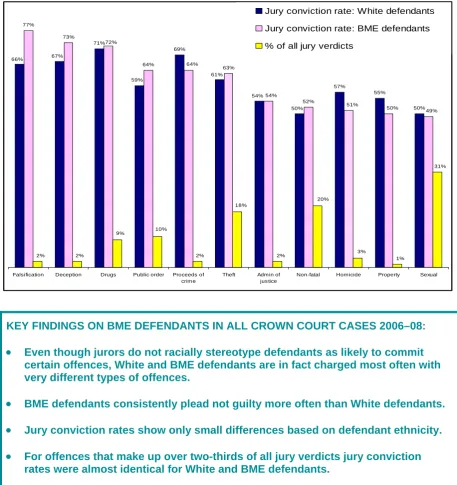
BME defendants are consistently more likely than White defendants to plead not guilty to charges in all of the 12 general offence categories used in this study except one (falsification, forgery and counterfeiting).
BME defendants are three and half times more likely to face a jury verdict in the Crown Court relative to their representation in the general population.
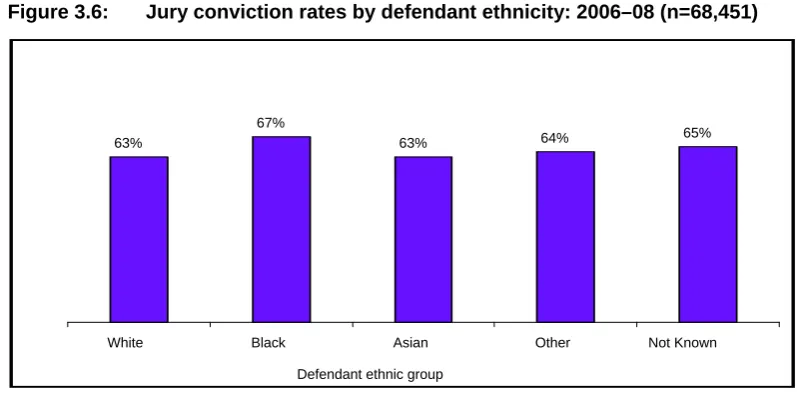
However, jury verdicts showed only small differences based on defendant ethnicity. White and Asian defendants both had a 63% jury conviction rate; Black defendants had a 67% jury conviction rate.This indicates that one stage in the criminal justice system where BME groups do not face persistent disproportionality is when a jury reaches a verdict.
Appearance of jury fairness
While these findings strongly suggest that racially balanced juries are not needed to ensure fair decision-making in jury trials with BME defendants, concerns about the appearance of fairness with all-White juries may still remain.
The study found that in all Crown Courts, the proportion of BME defendants is greater than the proportion of BME groups in the local population or BME jurors at each court.
Concerns about the appearance of jury fairness are likely to arise in courts where all-White juries try substantial numbers of BME defendants or try Whitedefendants accused of racial crimes against BME victims.
To address these concerns, HMCS should ensure that court users understand how jury pools are selected and how representative they are of the locality.Scope and effectiveness of jury trials
Most charges brought against defendants in the Crown Court are not decided by a jury:
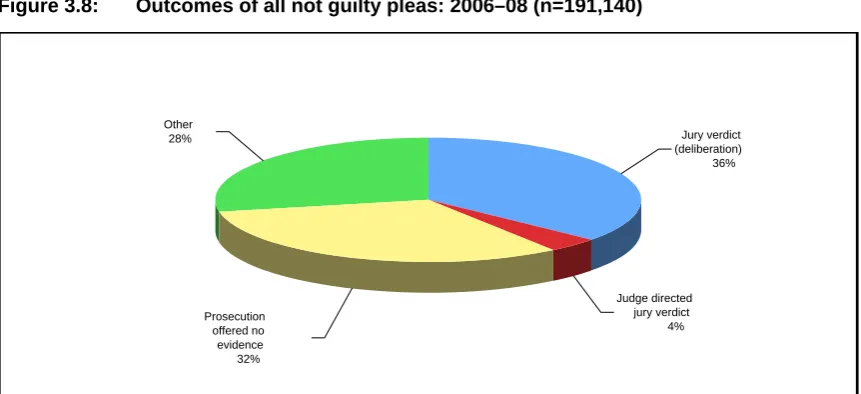
Only 12% of all charges are decided by jury deliberation.
59% of all charges result in a guilty plea by a defendant.Juries overall appear efficient and effective:
Once a jury is sworn it reaches a verdict by deliberation on 89% of all charges (judges direct jury verdicts on 11% of charges).
Once juries deliberate they reach verdicts on virtually all charges (only 0.6% of all verdicts are hung juries).
Juries convict on almost two-thirds (64%) of all charges presented to them.
Juries are rarely discharged (less than 1% of sworn juries).Jury conviction rates
Offence type had an impact on the probability of a jury reaching a guilty verdict.
Falsification, deception, drugs and theft offences are the general offence types most likely to produce a guilty jury verdict.
Non-fatal offences against the person are least likely to result in a jury conviction, although juries still reach guilty verdicts more often than not here (52% conviction rate).Conviction rates for specific offences within general offence types can vary substantially.
The category of homicide-related offences has some of the lowest jury conviction rates (threatening to kill 36%, manslaughter 48%, attempted murder 47%) but also some of the highest jury conviction rates (death by dangerous driving 85%, murder 77%).Differences in jury conviction rates for different specific offences suggest that juries try defendants on the evidence and the law.
Offences where the strongest direct evidence is likely to exist against a defendant appear to have the highest conviction rates (making indecentphotographs of a child 89%, drugs possession with intent to supply 84%, death by dangerous driving 85%).
Misconceptions about jury verdicts in rape cases
Contrary to popular belief and previous government reports, juries actually convict more often than they acquit in rape cases (55% jury conviction rate).
Other serious offences (attempted murder, manslaughter, GBH) have lower jury conviction rates than rape.
A previous Home Office study stating that jury acquittals were more common than convictions was based on a small number of verdicts (181) in a few courts. Current findings cover all jury rape verdicts in all courts in 2006–08 (4,310).
Jury conviction rates for rape vary according to the gender and age of the complainant, with high conviction rates for some female complainants and low conviction rates for some male complainants. This challenges the view that juries’ failure to convict in rape cases is due to juror bias against female complainants.
Juries are not primarily responsible for the low conviction rate on rape allegations.Misconceptions about jury verdicts in certain courts
There are variations in jury conviction rates between Crown Courts.
In courts with over 1,000 jury verdicts in 2006–08, the conviction rate ranged from 69% to 53%. There were no courts with a higher jury acquittal thanconviction rate, and this dispels the myth that there are courts where juries rarely convict.
Variations in court conviction rates could be due to differences in the types of offences presented to juries at different courts; differences in public attitudes to crime and justice in different communities; or variations in police evidence gathering or prosecution or judicial handling of jury trials.
It is recommended that the underlying reasons for substantial variations in jury conviction rates between Crown Courts be examined further.Multiple charges
The number of charges against a defendant affected the likelihood of the jury returning at least one guilty verdict.Juror comprehension of judicial directions
This study involved 797 jurors at three courts who all saw the same simulated trial and heard exactly the same judicial directions on the law.
There is not a consistent view among jurors at all courts about their ability to understand judicial directions. Most jurors at Blackfriars (69%) and Winchester (68%) felt they were able to understand the directions, while most jurors at Nottingham (51%) felt the directions were difficult to understand.Jurors’ actual comprehension of the judge’s legal directions was also examined.
While over half of the jurors perceived the judge’s directions as easy tounderstand, only a minority (31%) actually understood the directions fully in the legal terms used by the judge.
Younger jurors were better able than older jurors to comprehend the legal instructions, with comprehension of directions on the law declining as the age of the juror increased.A written summary of the judge’s directions on the law given to jurors at the time of the judge’s oral instructions improved juror comprehension of the law:
The proportion of jurors who fully understood the legal questions in the case in the terms used by the judge increased from 31% to 48% with written instructions.
The judiciary should reconsider implementing the Auld recommendations for issuing jurors with written aide memoires on the law in all cases.
An assessment should also be made of how many judges already use written instructions, when and how often.
Further research should be conducted as a matter of priority to identify the most effective tools for increasing juror comprehension of judicial directions.Jury deliberations and impropriety
This study involved 196 jurors at Winchester who had served on a jury and therefore should have been instructed by a judge on improper conduct.
Almost half (48%) of all jurors said they either did not know or were uncertain what to do if something improper occurred in the jury deliberating room.
An even larger majority of these jurors (82%) felt it was correct that jurors should not be allowed to speak about what happens in the deliberating room.
This was only a limited exploration of these issues. The findings indicate that further research should be conducted to determine what jurors understand improper jury behaviour to be; how jurors think they should deal with improper jury conduct; and what type of information jurors want about deliberations.Media reporting of jury trials and juror use of the internet
The study was conducted in three different locations (Nottingham, Winchester and London) and included 62 cases and 668 jurors. The sample included both long, high profile cases and standard cases lasting less than two weeks with little media coverage.
Jurors serving on high profile cases were almost seven times more likely to recall media coverage (70%) than jurors serving on standard cases (11%).
Most jurors who recalled media reports of their case saw or heard reports only during the time their trial was going on. This provides the first empirical evidence in this country of the “fade factor” in jury trials (the further away media reports are from a trial the more likely they are to fade from jurors’ memories).
But a third of jurors (35%) on high profile cases remembered pre-trial coverage.
In high profile cases, jurors recalled media reports of their cases from a range of media outlets, with television (66%) and national newspapers (53%) the two main sources. This contrasts with jurors’ recall of media reports in standard cases, where local newspapers accounted for almost all (77%) coverage recalled.
Most jurors (66%) in high profile cases who recalled media coverage either did not or could not remember it having any particular slant. Where jurors did recall any emphasis, almost all recalled it suggesting the defendant was guilty.
In high profile cases, 20% of jurors who recalled media reports of their case said they found it difficult to put these reports out of their mind while serving as a juror.The internet
All jurors who looked for information about their case during the trial looked on the internet.
More jurors said they saw information on the internet than admitted looking for it on the internet. In high profile cases 26% said they saw information on the internet compared to 12% who said they looked. In standard cases 13% said they saw information compared to 5% who said they looked.
In the study jurors were admitting to doing something they should have been told by the judge not to do. This may explain why more jurors said they saw reports on the internet than said they looked on the internet.
Among all jurors who said they looked for information on the internet, most (68%) were over 30 years old. Among jurors on high profile cases, an even higherpercentage (81%) of those who looked for information on the internet were over 30.
The findings raise a number of questions that should be examined further: do jurors realise they are not suppose to use the internet? How do they use the internet: do they just look for information or do they also discuss the case on social networking sites? What type of judicial instruction would be most effective in preventing jurors from looking for information about their case on the internet?
Recommendations
Written juror guidelines
To address both jury impropriety in general and juror use of the internet, the judiciary and HMCS should consider issuing every sworn juror with written guidelines clearly outlining the requirements for serving on a trial.
The written guidelines should acknowledge the value of the juror’s role and clearly explain what improper behaviour is, why it is wrong and what to do about it.
The judge should review the requirements with jurors as soon as they are sworn. This should include a fuller direction to jurors on why they should not use the internet to look for information or discuss their case.
Jurors should be required to keep the guidelines with them throughout the trial.1.
Context
1.1
The fairness of jury decision-making
Even though juries decide less than 1% of all criminal cases in England and Wales,
defendants in these cases are charged with the most serious criminal offences and face the greatest possible loss of liberty. The fairness of jury decision-making is therefore of
fundamental importance to the criminal justice system. Opinion polls consistently show strong public support for jury trials (Bar Council, 2002; ICM, 2007; Thomas, 2007). To preserve this confidence in the justice system it is crucial that allegations of jury bias are systematically explored. Yet in this country, little is known about how juries reach verdicts. This lack of knowledge about jury decision-making is usually incorrectly attributed to section 8 of the Contempt of Court Act 1981. This makes it a criminal offence to “obtain, disclose or solicit any particulars of statements made, opinions expressed, arguments advanced, or votes cast by members of a jury in the course of their deliberations”. This does not, in fact, prevent almost all research about and with juries (Thomas, 2008). But its existence has created confusion about what jury research can and cannot be conducted and has contributed to an information vacuum about juries in this country.
In the absence of empirical evidence, inevitably domestic anecdote and research from other jurisdictions has been relied upon to draw conclusions about jury decision-making here. It has long been claimed for instance that juries in certain Crown Courts hardly ever convict (Hansard, 1982). Anecdotal reports also appear from time to time that juries do not understand legal directions or that improper conduct occurs in the jury room (Daly & Pattenden, 2005). Most jury research has been conducted in the United States. A large amount of this research is concerned with the issue of race1
and juries, some of which has indicated that White jurors discriminate against non-White defendants (Sommers & Ellsworth, 2003). While this research has developed valuable methodologies, there are important differences between juries in America and in this country that mean caution needs to be exercised in drawing similar conclusions about juries here (Thomas, 2007).
In order to provide clear empirical evidence about juries in this country, this study tackles a number of important issues concerning the fairness of jury decision-making, including: discrimination, consistency, comprehension, improper conduct and media reporting.
1
1.2
Racial discrimination
For several decades there have been claims that the racial composition of juries affects jury fairness in this country. Where Black and minority ethnic (BME) defendants are tried by an all-White jury, the concerns are two-fold: that all-White juries may actually treat BME
defendants unfairly and that all-White juries simply appear unfair. Similar concerns can also arise where all-White juries try White defendants accused of racially motivated crimes involving BME victims.
There has been no empirical research in this country to show how often BME defendants or racially motivated crimes are tried by all-White juries, and until recently there has been no research into whether race actually affects jury verdicts. As a result, American research showing White juror bias against non-White defendants has been relied upon to suggest that juries here are likely to be racially biased. Both the Auld Review of the Criminal Courts (2001) and the Runciman Royal Commission on Criminal Justice (1993) based
recommendations for racially mixed juries on this assumption, but both recognised that these recommendations had to be made in the absence of empirical evidence in this country. In 2007, the Ministry of Justice (MoJ) published the findings of the Jury Diversity Project (Thomas, 2007), which revealed that most defendants in most Crown Courts outside London will be tried by an all-White jury. This does not reflect any failure in juror summoning; it is simply the consequence of population dynamics in court catchment areas and the process of random summoning. The Project also conducted the first empirical study here of how race affects jury decision-making. That study at Blackfriars Crown Court in London2
found that racially mixed juries did not discriminate against either BME or White defendants. However, a key question remained to be answered: Do all-White juries outside London discriminate against BME defendants? This study was commissioned to address this question and to determine how often all-White juries try BME defendants and try White defendants in race-related crimes.
As part of the study of racial discrimination, the current research also explores whether jurors in this country racially stereotype defendants. The Macpherson Report (1999) identified racial stereotyping as a sign of institutional racism. Elsewhere, the type of crime a defendant is accused of committing has been found to affect the likelihood of White juror bias. Sunnafrank and Fontes (1983) found that White jurors in America viewed white-collar crimes (such as embezzlement) as consistent with a stereotype of White criminals, but that more violent
2
crimes (such as assault) were associated with a Black criminal stereotype. This research looks at whether similar stereotyping occurs here.
1.3
Consistency of jury verdicts
Juries at certain Crown Courts are commonly thought to have very low conviction rates. Snaresbrook Crown Court, for instance, has long had a reputation for juries that do not convict (Hansard, 1982). It is possible that if jury conviction rates do vary significantly between courts this simply reflects differences in public attitudes to crime and justice in different localities. However, another possibility is that it reflects differences in police
performance in evidence gathering in different areas or differences in prosecution or judicial handling of jury trials in different courts, which would be more problematic.
Claims are also often made that juries have particularly low conviction rates for certain offences, such as rape (Kelly et al., 2005). In all cases, in order to convict a defendant juries must be sure of the defendant’s guilt, and it is possible that some offences may be harder to prove to this standard than others. But in rape cases it is claimed that jurors’ prejudicial attitudes to female complainants are what account for low conviction rates (Temkin & Krahe, 2008).
There has been no systematic examination of jury conviction rates either by court or offence in England and Wales. Where statistics exist on conviction rates by offence in the Crown Court (Marais, 2008), they do not distinguish jury verdicts from other outcomes. This
research explores whether there is consistency in jury decision-making across Crown Courts, or whether differences in jury conviction rates are associated with other factors such as the type of offence, severity of the offence, number of charges against a defendant and
defendant ethnic background.
1.4
Comprehension of legal instructions
Jurors’ ability to understand legal directions is a crucial element in the proper functioning of the jury decision-making process. In a study of more than 7,000 jurors, Zander (1993) found that almost all jurors felt they had little difficulty understanding judges’ legal directions. But there has been no research examining jurors’ actual comprehension of judicial directions. In 2007, Lord Phillips (then the Lord Chief Justice) publicly called for legal directions to juries to be simplified (Phillips, 2007). He also suggested that it might be time to reconsider
aide memoire. After the evidence, the judge would no longer direct the jury on the law but
would provide the jury with written factual questions, the answers to which would lead to a verdict of guilty or not guilty. The current Lord Chief Justice (Judge, 2008) has also
suggested that courts in future might need to present more information visually instead of orally to juries to reflect everyday advances in information technology.
While there have been studies elsewhere examining how certain tools or procedures could aid juror comprehension (Dann et al., 2005), there has been no similar research here. This study includes an initial exploration of how well jurors actually understand judges’ oral instructions on the law and whether certain tools may improve comprehension.
1.5
Jury impropriety
Once a jury has retired to consider its verdict, its discussions and reasons for its decision are sacrosanct. Reports of racist remarks made during jury deliberations in recent years,
although few, have fuelled concerns about the impartiality of juries towards BME defendants (Daly & Pattenden, 2005). Some of these jury verdicts have been challenged on the basis that they infringed the defendant’s right to a fair hearing under Article 6 of the European Convention. The European Court has ruled that sufficient guarantees must exist to exclude any objectively justified or legitimate doubts as to the impartiality of the jury, and stressed that a jury must be impartial from a subjective as well as an objective point of view.3
In 2004, the House of Lords addressed the extent to which section 8 of the Contempt of Court Act 1981 prohibits judges from questioning jurors about deliberations when accusations of jury impropriety arise.4
The court reiterated the longstanding principle that only the trial judge is entitled to investigate issues affecting jury deliberations.5 The effect of
this ruling is that unless jurors bring concerns about improper jury conduct to the trial judg attention before a verdict is returned, it is very difficult for such claims to be investigated after the verdict.
e’s
The judiciary subsequently adopted a new practice direction (55a), in which judges advise jurors at the outset of the trial of the need to bring any concerns about fellow jurors to the judge’s attention immediately and not to wait until the case is concluded.6 The Government
initially suggested providing further information to jurors on what jury impropriety is and how
3
See Gregory v United Kingdom (1997) 25 E.H.R.R. 577 and Sander v United Kingdom (2001) 31 E.H.R.R. 44. 4
R. v. Mirza [2004] UKHL 2 [2004] 1 All ER 925. 5
Except where criminal conduct is suspected.
6
it should be addressed. However, after a consultation process (DCA, 2005) and discussions with the senior judiciary, it concluded that further guidance might only confuse the issue and run the risk of causing jurors unnecessary anxiety about what they can and cannot do. There has so far been no research to determine whether the new practice direction is clearly understood by jurors, and recent cases present conflicting evidence. In the 2007
manslaughter conviction of Keran Henderson, dissenting jurors claimed only after the verdict that the jury majority did not understand the evidence. The jury foreman gave an interview to this effect to the Times newspaper after the verdict, which the newspaper published, and both parties were subsequently found guilty of contempt by the High Court. However, other instances in which jurors have reported fellow jurors’ improper use of the internet to the court before a verdict was returned (see below) suggest that some jurors do understand the impropriety rule.7 This study explores whether jurors believe they know what to do about
improper jury conduct.
1.6
Impact of media coverage and the internet
Concerns are also often raised about juries being unduly influenced by media coverage in high profile cases, but to date there has been no research on this issue here. In reporting jury trials there is inevitably a need to strike a balance between the competing interests of
freedom of the press on the one hand and the administration of justice and right to a fair trial on the other. Under section 2(3) of the Contempt of Court Act 1981, media coverage of active legal proceedings must not create a substantial risk of serious prejudice to the case by unduly influencing jurors.
Legal judgments about whether media coverage amounts to such (strict liability) contempt are usually based on a belief in the “fade factor”.8
This is the idea that media reporting is less likely to affect jurors the further away it is from the actual trial. Psychological studies support this belief (Anderson, 1995),9
but there is no empirical evidence in this country to show whether or not the fade factor is a valid assumption in jury trials. Research in other common law jurisdictions has concluded that jury verdicts are not likely to be influenced by media reporting (Chesterman et al., 2000), but this research is inevitably unique to those
jurisdictions. In 2007, the Government signalled its willingness to consider whether media reporting is likely to affect jury decision-making here (Goldsmith, 2007), and this study provides an initial exploration of this issue.
7
Also see R v Smith and Mercieca [2005] UKHL 12. 8
Archbold 28–74 to 28–76; R. v B. [2006] EWCA Crim 2692.
9
Today’s 24-hour and internet news on demand present new challenges to the jury system. When a jury is sworn on a trial, the judge will tell jurors not to look for information about their case.10
While jurors are deliberating the judge will usually tell jurors at the end of each day not to make any enquiries into the case.11 It is possible that the internet may have affected
the extent to which jurors can reasonably be expected to heed directions about not looking for information about their case. Although there has been no research to substantiate this concern, in 2008 a number of juries had to be discharged or trials abandoned due to jurors’ inappropriate use of the internet.12 The Lord Chief Justice has recently called for a realistic
assessment of the impact of juror access to the internet (Judge, 2008). This study examines the extent to which jurors use the internet during trials and explores juror awareness of media reporting of their cases more generally.
1.7
Main research questions
In order to provide clear empirical evidence about the fairness of jury decision-making in this country, this study tackles a number of fundamental questions:
Do all-White juries discriminate against BME defendants?
Do jurors racially stereotype defendants?
Is there consistency in jury verdicts: do juries rarely convict at certain courts or on certain offences?
Do jurors understand legal directions?
Do jurors know what to do about improper jury conduct?
Are jurors aware of media coverage of their cases?
How is the internet affecting jury trials?These are sensitive and controversial issues, and the research has developed ways of understanding how juries make their decisions without violating the secrecy of the jury room.
10
Jurors are also told not to discuss the case with anyone outside the jury and only to discuss the case when all members of the jury are present in the jury room. Advisory language for initial remarks to the jury is contained in Practice Direction 55a, and draws on the issue of internet use following R v Karakaya [2005] 2 Cr App R 5 (77).
11
Practice Direction 59(2) on jury separation under section 43 of the Criminal Justice and Public Order Act 1994.
12
2.
Approach
2.1 Multi-method
approach
This chapter provides details of the methodology used to address the study’s research questions. A multi-method approach was adopted and included:
case simulation study in which 41 juries involving 478 actual jurors at court decided a single case in a controlled setting;
large-scale quantitative analysis of the outcomes of 551,669 charges against defendants in all Crown Courts in England and Wales from 1 October 2006 to 31 March 2008; and
post-trial survey of 668 jurors in 62 cases.Each approach has its strengths and weaknesses, but the most robust studies of jury decision-making include elements of each method (Sommers & Ellsworth, 2003). This is the approach taken in this study.
Each method is described in the order in which the results appear in chapter 3.
Case simulation was used to address the study’s first and main research question: Do all-White juries discriminate against BME defendants? (chapter 3, 3.1). It was also used to examine whether jurors racially stereotype defendants (chapter 3, 3.1), and to explore juror comprehension of judicial directions (chapter 3, 3.3).
Large-scale analysis of jury verdicts in Crown Courts was used to explore actual case outcomes for BME defendants in all Crown Courts (chapter 3, 3.1). This large-scale verdict analysis also addressed the study’s second key question: Is there consistency in jury verdicts? (chapter 3, 3.2).
Post-trial survey of jurors was used to examine jurors’ recollections of media coverage of their cases and juror use of the internet during trial (chapter 3, 3.4).2.2 Case
simulation
Jurors’ decisions in case simulations do not have real consequences for a defendant. It is crucial, therefore, that the highest level of authenticity is achieved in the simulation in order to replicate the jury experience as closely as possible. Previous case simulations can rightly be criticised for using unrealistic case materials, not providing jury instructions or allowing deliberations, and using students or volunteers as “jurors” (Sommers & Ellsworth, 2003). Extensive efforts were made to bring this simulation as close as possible to conditions normally experienced by juries.13
The case is based on an actual case and contains all elements of a jury trial.14 A real judge, barristers, police, court staff and witnesses
participated in making the case films. And most importantly, the study was run only with actual jurors at Crown Courts.
Each jury was a panel created by Her Majesty’s Courts Service (HMCS) computerised random selection system for a trial at court. When a panel was not needed for a trial and all jurors on the panel were about to be dismissed from jury service, they were asked if they would participate in the study before leaving court. Almost all jurors (98%) agreed. This was crucial to the research success, as it ensured that all juries constituted a legally valid jury (between 9 and 12 jurors). This enabled an analysis of the impact of race on jury decision-making. Most “jury” research looks only at decision-making of individual jurors, not at jury verdicts. But without the jury verdict dimension, findings of individual juror bias can result in misleading conclusions about possible jury bias (Thomas, 2008).
The case was of a male defendant accused of causing actual bodily harm (ABH)15
by
punching another male in the face after a confrontation outside a bar. Each jury was shown a randomly selected version of this same case. In each version, the case was identical except for the race of the defendant or victim. For instance, some juries saw the case with a White defendant, some saw exactly the same case but with a Black defendant and others saw the same case with an Asian defendant. After viewing the case each juror recorded an initial vote of guilty or not guilty and a degree of confidence in that assessment. Jurors then deliberated as a jury in an effort to reach a verdict. After deliberating jurors recorded their final votes, as well as impressions of evidence and witnesses. Any differences in jury verdicts (or individual votes) can therefore be attributed to the influence of the defendant’s or victim’s race.
13
See Thomas (2007) for a full description of the case simulation method used in this study.
14
Prosecution opening, evidence-in-chief and cross-examination of all witnesses, prosecution and defence closings and judge’s instructions on the law.
15
The case simulation was run with all-White juries at two Crown Courts. The Jury Diversity Project established that Crown Courts where BME groups make up less than 10% of the juror catchment area will usually have all-White juries (Thomas, 2007). It also identified two types of courts where all-White juries are the norm. One of each was selected for the study. Winchester is a typical “low ethnicity court”, where the whole juror catchment area is
predominantly White (97%) but there are still BME defendants at court. Nottingham is a typical “ethnicity concentration court”, where the whole juror catchment area is 94% White but there are substantial concentrations of BME groups within the catchment area (as high as 28%) and a substantial proportion of BME defendants at court. The study was designed to replicate the Blackfriars study of racially mixed juries (Thomas, 2007) with all-White juries at these two courts. The Blackfriars study included 319 jurors, 243 of whom were White jurors. A similar sample size of White jurors was achieved at each court (table 2.1). Jurors were closely representative of the local population in all courts (appendix 1).
Table 2.1: Sample size in case simulation study
Size of jury Number of juries Nottingham
Number of juries Winchester
Number of jurors Nottingham
Number of jurors Winchester
12 persons 16 15 192 180
11 persons 3 4 33 44
10 persons 1 1 10 10
9 persons 0 1 0 9
Court total 20 21 235 243
Total: 41 478
The case simulation addressed the main research question “Do all-White juries discriminate against BME defendants?” by addressing several specific issues reported in chapter 3, 3.1. First, the analysis examined two questions about verdicts of all-White juries:
Do verdicts of all-White juries discriminate against BME defendants?
Do verdicts of all-White juries in low ethnicity courts (ie, Winchester) differ from verdicts of all-White juries in ethnicity concentration courts (ie, Nottingham)?Then the individual votes of all jurors who took part in the Nottingham, Winchester and earlier Blackfriars case simulations were analysed to examine three further questions:
Do White jurors on White juries vote differently from White jurors on racially mixed juries?
Do jurors racially stereotype defendants as likely to commit certain crimes?In the case simulations, jurors were also asked questions exploring their impressions and understanding of judicial instructions and the conduct of jury trials. Findings address the questions reported in chapter 3, 3.3:
Do jurors understand the legal directions in the case?
Is juror comprehension of the law improved if written directions are given?
Are jurors aware of what to do if something improper occurs during jury deliberations?
Do jurors want more information about how to conduct deliberations?
How do jurors feel about the existing rule on secrecy of jury deliberations?2.3 Large-scale verdict analysis (CREST)
Analysis of actual jury verdicts has the benefit that it deals with real cases and real juries. However, this also presents an inherent problem. Because no two cases are identical, it is very difficult to isolate the factors that may have led to a verdict and to draw conclusions that can be extrapolated beyond individual cases. As a result, large-scale verdict studies cannot establish causal links between jury verdicts and case factors (such as a defendant’s race) in the way case simulation studies can. The value of large-scale case analysis lies in its ability to identify general trends in verdicts that are consistently associated with specific factors.16
These studies need to be conducted with large datasets to ensure results are not misleading. This research analysed data from CREST,17 the HMCS case management and reporting system for Crown Courts. The dataset covers all cases at all Crown Courts in England and Wales that concluded between 1 October 2006 and 31 March 2008. The dataset includes over half a million charges (table 2.2) and is sufficiently large to conduct reliable analyses of correlations between jury verdicts and case factors such as defendant ethnicity, court, offence type, offence severity and number of charges. The most recent data were used, as these contain the most complete information on defendant ethnicity (Jones & Singer, 2008).
Table 2.2: Sample size for CREST data analysis
Total Not guilty pleas Jury verdicts by deliberation
Charges 551,669 191,140 68,874
Cases 115,671 63,691* 20,378*
Defendants 137,604 75,294* 23,031*
* Where there was at least 1 not guilty plea or verdict by deliberation in each case or per defendant
16
See discussion of this by the United States Supreme Court in McCleskey v. Kemp 481 U.S. 279, 312 (1987).
17
The analysis of CREST examined defendant ethnicity first (chapter 3, 3.1). It explored:
Are BME defendants more or less likely than White defendants to be charged on indictment at Crown Courts?
Are they more or less likely to plead not guilty and opt for a jury trial?Where juries deliberated and reached a verdict (68,874 verdicts), the analysis explored:
Are BME defendants more likely than White defendants to be found guilty by juries?CREST data were also analysed in conjunction with findings from the Jury Diversity Project on juror ethnicity at each Crown Court (Thomas, 2007). This analysis was able to examine:
Where are all-White juries most likely to try large numbers of BME defendants?
Are BME defendants more likely to be found guilty by all-White juries at these courts?
Where White defendants are charged with racially motivated crimes are there different conviction rates with all-White juries and racially mixed juries?A wider analysis of CREST explored trends in jury trials more generally (chapter 3, 3.2). This part of the analysis addressed one of the main research questions:
Is there consistency in jury verdicts?Specifically it examined whether certain case factors are strongly associated with jury
convictions (offence type, severity, court, number of charges in a case). This analysis is able to shed light on the two specific questions about jury consistency:
Do jury rarely convict defendants in certain types of cases?
Do juries rarely convict defendants in certain courts?CREST analysis was also able to address wider questions about the jury system:
Are juries efficient?
How often do they reach a verdict?
How often are they discharged?It is important to point out that this study’s analysis of jury decision-making in Crown Courts differs from government statistics on Crown Court conviction rates in several respects. First, this study focuses on jury conviction rates (ie, only those decisions reached by jury
guilty pleas and directed verdicts. Second, in almost all instances analysis of jury verdicts in this study was conducted at the charge level, whereas government Crown Court conviction rates are calculated at the defendant level. A charge-based analysis was adopted in this study because juries reach verdicts on individual charges and are often asked to return multiple verdicts in a single case. Multilevel analytical models were used to control for clustering of verdicts by case. Third, in this study offences were categorised according to Blackstone’s 12 criminal offence types (Ormerod & Hooper, 2008), which differ slightly from and provide more offence categories than categories used in government Crown Court statistics.18
As a result, this study’s findings on jury conviction rates in the Crown Courts will not be directly comparable to government statistics on Crown Court conviction rates.
2.4 Post-verdict
surveys
Post-verdict questioning of jurors in actual cases, like large-scale verdict analysis, is useful because it deals with real juries and real cases. But it also has similar limitations. Post-verdict studies rely entirely on jurors’ self-reported perceptions and recollections of their time on a jury. It is well documented that individuals often lack the ability to accurately identify the factors that influence their judgement and behaviour (Nisbett & Wilson, 1977). So these types of studies are not particularly useful for understanding why juries reached verdicts. Instead they are most useful when the research is interested in understanding what jurors were aware of and what they did during the time they served on a jury.
A post-trial survey was used here to gain some understanding of what media coverage jurors were aware of in their case and if they used the internet at all during their trial (chapter 3, 3.4). Several specific questions were addressed:
To what extent do jurors recall pre-trial publicity or in-trial publicity of their cases?
What types of media coverage are jurors most likely to recall?
Do jurors recall any emphasis in the reporting of their cases?
Do jurors feel able to put media coverage of their case out of their mind?
Do jurors look for information on the internet about their case while it is going on?Table 2.3: Sample size for media reporting and internet study
Court Jurors Cases Standard cases Longer, high profile
cases
Nottingham 191 20 20 0
Winchester 246 22 17 5
London 231 20 10 10
Total: 668 62 47 15
18
3.
Results
3.1
Race and jury decision-making
The findings on race and jury decision-making in this chapter address the key question the research set out to answer: Do all-White juries discriminate against BME defendants? The case simulation study of all-White juries at Nottingham and Winchester Crown Courts asked:
Do verdicts of all-White juries discriminate against BME defendants?
Do verdicts of all-White juries in Nottingham and Winchester differ?Results of the Nottingham, Winchester and earlier Blackfriars case simulations were then analysed to examine three further questions:
Do White jurors on White juries vote differently than White jurors on racially mixed juries?
Do jurors racially stereotype defendants as likely to commit certain crimes?
Do any other personal characteristics of jurors affect their decision-making?To compliment the case simulation study, a separate large-scale analysis looked specifically at defendant ethnicity in all Crown Court cases in 2006–08 (CREST). This enabled a broader picture to be created of race and jury decision-making by examining:
Whether BME defendants are more or less likely than White defendants to be charged in Crown Courts, and more or less likely to plead not guilty and opt for a jury trial?
Whether BME defendants are more likely to be found guilty by juries?
Whether BME defendants are more likely to be found guilty in overwhelmingly White communities that try a high proportion of BME defendants?
Whether all-White juries are less likely than racially mixed juries to convict White defendants accused of racially motivated crimes?Verdicts of all-White juries
the study presented a large number of juries with an identical case to decide, but where the race of the defendant was systematically varied.
In this study, 41 all-White juries (20 at Nottingham and 21 at Winchester) viewed the same case and then deliberated to reach a verdict. Some juries saw the case with a White
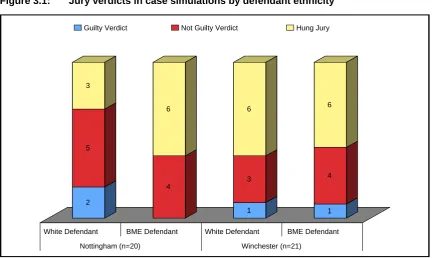
[image:34.595.74.507.271.529.2]defendant while others saw the case with a BME defendant (either a Black defendant or an Asian defendant). The verdicts of these all-White juries showed no evidence of discrimination against BME defendants (figure 3.1). At both courts, where juries reached a verdict, they were not more likely to convict a BME defendant than the White defendant. This applied to both the Black defendant and the Asian defendant.19
Figure 3.1: Jury verdicts in case simulations by defendant ethnicity
2 5 3
4 6
1 3 6
1 4 6
White Defendant BME Defendant White Defendant BME Defendant Nottingham (n=20) Winchester (n=21)
Guilty Verdict Not Guilty Verdict Hung Jury
The large number of hung juries at both Winchester (12 out of 21) and Nottingham (9 out of 20) was expected. The original case on which the simulation is based resulted in a hung jury. This was one of the reasons the case was selected. The original jury’s inability to reach even a majority verdict suggested that the case facts were likely to present an opportunity for jurors’ views about the case to differ. However, an examination of the guilty/not guilty split on these hung juries also indicates a lack of discrimination against BME defendants at both courts. At both courts, all hung juries for the Black defendant and the Asian defendant had more not guilty votes than guilty votes or an equal split.
19
One difference did emerge between the verdicts of all-White juries at Nottingham and at Winchester. Nottingham juries had much more difficulty reaching a verdict when the case involved a BME defendant or victim compared to when the case only involved White participants. When both the defendant and victim were White, juries at Nottingham always reached a verdict. But they were only able to reach a verdict in 4 out of the 10 trials with BME defendants, and two-thirds of all cases with a BME victim resulted in a hung jury. No similar trend was found at Winchester.
One specific issue the study set out to examine was whether all-White juries in courts with different local ethnic profiles showed any differences in decision-making towards BME groups. The juror catchment area for Nottingham is predominantly White but includes a number of neighbourhoods with very large BME populations, while the Winchester juror catchment area is overwhelmingly White throughout. It may be that the more diverse local community in Nottingham is in some way related to all-White juries in Nottingham having difficulty reaching a decision when BME participants are involved in a case.
KEY FINDING ON JURY VERDICTS:
The verdicts of all-White juries did not discriminate against BME defendants.But some differences in jury decision-making emerged. Winchester juries had almost identical verdicts for White and BME defendants, but Nottingham juries had difficulty reaching a verdict involving a BME defendant or BME victim.
White jurors on all-White juries and on racially mixed juries
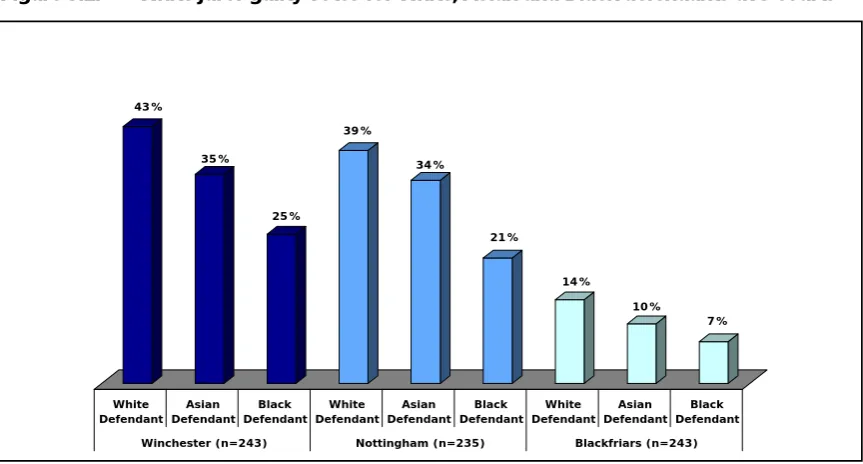
As well as examining jury verdicts, the study was also able to examine the individual decisions of jurors serving on these juries to identify any general decision-making patterns. The votes of all 721 White jurors who took part in the case simulations at Nottingham,
population dynamics may have some influence on White juror decision-making in general, and that there may be a tendency for jury conviction rates to differ by court or region.
Figure 3.2: White juror guilty votes for White, Asian and Black defendants at 3 courts
43%
35%
25%
39%
34%
21%
14%
10% 7%
White Defendant
Asian Defendant
Black Defendant
White Defendant
Asian Defendant
Black Defendant
White Defendant
Asian Defendant
Black Defendant Winchester (n=243) Nottingham (n=235) Blackfriars (n=243)
White jurors and BME victims
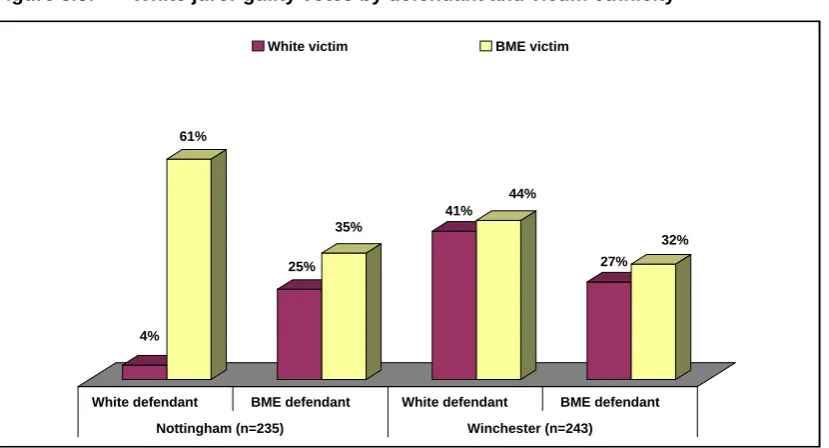
The analysis of jury verdicts suggested that the race of the victim may have been a factor in Nottingham but not Winchester. An analysis of all juror votes at Nottingham compared to Winchester reinforced this. White jurors in Nottingham appeared particularly sensitive to the plight of a BME victim allegedly assaulted by a White defendant (figure 3.3). White jurors at Nottingham were significantly more likely to convict the White defendant when he was accused of assaulting a BME victim (61%) than when he was accused of assaulting a White victim (4%).20 Winchester jurors showed no similar pattern of decision-making.
20
Figure 3.3: White juror guilty votes by defendant and victim ethnicity
4% 61%
25% 35%
41% 44%
27% 32%
White defendant BME defendant White defendant BME defendant
Nottingham (n=235) Winchester (n=243)
White victim BME victim
White jurors at Nottingham were clearly conscious of race in cases involving a White defendant and BME victim: 76% said they thought race was a factor in these cases, compared to only 21% of jurors in Winchester who saw exactly the same case. This
suggests that White jurors living in diverse communities may be more conscious of race and more censorious towards White defendants in cases involving inter-racial conflict compared to White jurors living in predominantly White communities. This is reinforced by findings from Blackfriars, where there is a very high level of diversity in the community. White jurors there were also more likely to convict the White defendant when he was accused of assaulting a BME victim (48%) compared to when he was accused of assaulting a White victim (32%).
Racial stereotyping
All jurors in the case simulation at each court were also asked to express a view of the likelihood (on a scale of 0 to 5) that the defendant in the case would commit certain crimes in the future. The offences were either similar to the offence in the case (assault, causing a disturbance in a public place) or dissimilar (drug possession, theft, sexual assault, handling stolen goods, fraud, domestic violence, burglary). White jurors serving on all-White juries at both Nottingham and Winchester did not stereotype any defendants (White, Black or Asian) as more or less likely to commit certain offences based on their race.
findings. Neither White nor BME jurors racially stereotyped any of these three defendants as likely to commit a certain type of crime.21
Juror gender: a woman’s prerogative to change her mind?
All jurors who took part in the case simulation also completed personal profile forms providing information on gender, age, employment status, profession, income, religion and language. By combining the votes of all 797 jurors (both White and BME) who took part in the case simulations at the three courts, it was possible to see if any other personal
characteristics of jurors (beyond ethnicity) were related to their decision-making in the case. Gender emerged as the only juror characteristic where there were significant differences.22
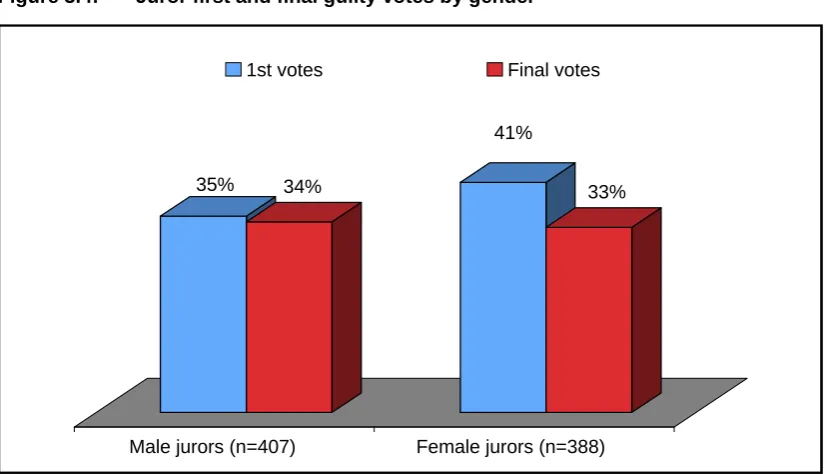
[image:38.595.75.490.458.695.2]Female jurors appeared tougher on defendants than male jurors before jury deliberations started but more open to persuasion to acquit in deliberations (figure 3.4). Female jurors were significantly more likely than male jurors to vote to convict at the start of deliberations (41% guilty votes compared to 35%). But deliberation had the greatest impact on female jurors: after deliberations this gender difference in conviction rates disappears. On final votes after deliberations, female jurors actually had a lower conviction rate than male jurors (33% compared to 34%). Male jurors rarely changed their view; 64% of all jurors that changed their votes during deliberations were women. This pattern of decision-making occurred for all defendants, regardless of race, and at all courts.
Figure 3.4: Juror first and final guilty votes by gender
35% 34%
41%
33%
Male jurors (n=407) Female jurors (n=388)
1st votes Final votes
21
See technical annex 14 for full results for both all-White and racially mixed juries.
22
KEY FINDINGS ON INDIVIDUAL JUROR DECISION-MAKING:
The only difference between White jurors serving on racially mixed and onall-White juries was that all-White jurors on racially mixed juries had lower conviction rates overall.
White jurors on all-White juries in a diverse community appeared particularlysensitive to the plight of a BME victim allegedly assaulted by a White defendant.
Jurors, regardless of ethnic background, do not racially stereotype Black, Asianor White defendants as more or less likely to commit certain crimes.
Female jurors were tougher on defendants at the start of jury deliberations thanmale jurors but more open to persuasion to change their vote during deliberations.
BME defendants in all Crown Court trials 2006–08 (CREST)
While the case simulation study could examine directly whether a defendant’s race affects jury verdicts and individual juror votes, it was necessarily limited to one type of offence (ABH) and juries at three (albeit representative) courts. A separate analysis of all jury verdicts reached at all Crown Courts in England and Wales (CREST) from October 2006 through to March 2008 enriches the picture of how race relates to jury decision-making by exploring how, if at all, a defendant’s ethnic background is related to actual charges and jury verdicts.
Disproportionality
There is currently good evidence that members of BME groups are over-represented at virtually every stage of the criminal justice process relative to their representation in the general population (Jones & Singer, 2008). This is referred to as “disproportionality” in the criminal justice system. Statistics show that members of a BME group are more likely to be stopped, searched, arrested, charged and in prison than their White counterparts. What has not been known is whether BME defendants are disproportionately convicted by juries. CREST data show that members of a BME group are two and half times more likely to be charged in the Crown Court relative to representation in the population (21.7% of all charges compared to 8.7% representation in the population), and Black persons are four times more likely to be charged (10.7% of charges compared to 2.8% of the population). However, this disproportionality varies by offence type (table 3.1).
Members of a BME group are three times more likely to be charged with a drugs offence, offences related to the proceeds of criminal conduct and falsification, forgery and
except damaging property (where they are proportionally charged) and sexual offences (where they are less likely to be charged than a White person relative to their representation in the general population).
Table 3.1: Crown Court charges by ethnicity of defendant and offence type: 2006–08
(n=551,669) Offence type (Blackstone’s) Defendant ethnicity White Defendant ethnicity BME Defendant ethnicity unknown Defendant ethnicity White Defendant ethnicity BME Defendant ethnicity unknown23
Drugs 42,055 20,568 12,078 56% 28% 16%
Falsification, forgery and counterfeiting
6,158 5,784 9,079 29% 28% 43%
Proceeds of
criminal conduct 5,213 2,750 2,794 48% 26% 26%
Theft, handling
stolen goods 83,665 27,533 23,025 62% 21% 17%
Homicide-related 4,419 1,611 1,683 57% 21% 22%
Deception, fraud
and blackmail 7,750 3,761 6,371 43% 21% 36%
Public order 41,313 12,204 11,677 63% 19% 18%
Non-fatal offences against the person
61,890 14,585 13,795 69% 16% 15%
Administration of
justice 10,401 2,579 2,673 66% 17% 17%
Damage to
property 8,090 1,276 1,703 73% 12% 15%
Sexual 68,600 7,584 13,059 77% 8% 15%
Customs and
excise24 221 27 298 40% 5% 55%
Unknown 4,185 4,730 4,482 31% 35% 34%
Total: 343,960 104,992 102,717 62% 19% 19%
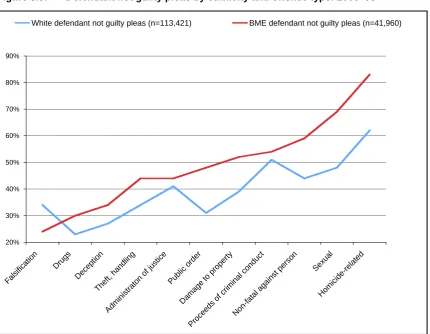
Overall, more BME defendants (43%) pleaded not guilty to charges than White defendants (35%). To explore whether this difference in not guilty pleas occurred across all offence types, a multilevel analysis examined the likelihood of a not guilty plea based on defendant ethnicity and Blackstone’s offence types. The analytical model also controlled for the possibility that pleas may cluster by trial.25 As figure 3.5 shows, BME defendants were
consistently more likely than White defendants to plead not guilty for all offence types except one (falsification, forgery and counterfeiting).
23
For falsification, deception and customs and excise offences, ethnicity is unknown for a large proportion of charges. Some of these defendants are companies, but this does not account for most of the unknown ethnicity.
24
Due to small numbers, customs & excise offences are not included in the subsequent offence-based analysis.
25
Figure 3.5: Defendant not guilty pleas by ethnicity and offence type: 2006–08 20% 30% 40% 50% 60% 70% 80% 90% Fals ificat ion Drug s Decep tion Thef t, handling
Adm inist
raton of jus
tice
Public order
Damage to proper
ty
Proc eeds
of cr imin
al c ondu
ct
N on-fatal agains
t pe rso n Sexua l Homi ci de-relat ed
White defendant not guilty pleas (n=113,421) BME defendant not guilty pleas (n=41,960)
Jury conviction rates for BME defendants 2006–08
Given their disproportionate charges and higher rate of not guilty pleas, it is not surprising that BME defendants are three and half times more likely to face a jury verdict relative to their representation in the general population (29% of all jury verdicts are for BME
defendants), and Black defendants are five times more likely to face a jury verdict (14% of all jury verdicts). Yet jury verdicts showed remarkably small differences based on defendant ethnicity. The analysis found an overall jury conviction rate of 65% for BME defendants and 63% for White defendants.26 Figure 3.6 shows that Black defendants had a 67% conviction
rate compared to 63% for Asian and White defendants. These small differences suggest that factors other than ethnicity are likely to be more relevant to jury verdicts.
26
Figure 3.6: Jury conviction rates by defendant ethnicity: 2006–08 (n=68,451)
63%
67%
63% 64% 65%
White Black Asian Other Not Known
Defendant ethnic group
These conviction rates differ from recent government statistics on Crown Court conviction rates by defendant ethnicity (Jones & Singer, 2008), which reported that White defendants were found guilty more often (75%) than Black (71%) and Asian (69%) defendants. However, unlike this study, government figures do not distinguish between defendants who pleaded guilty and those found guilty by a jury. As this study has shown, White defendants are
consistently more likely to plead guilty than BME defendants, and this appears to account for the higher conviction rate for White defendants in the government statistics.
To explore whether jury conviction rates were similar for defendants from different ethnic groups across all offence ty