A learning programme for your care home
Report of evaluation
Dr Pat Young
Dr Lesley Lockyer
Tina Fear
1 Contents
Executive summary ………. 3
Keys to terms used ………. 9
Introduction ……… 10
Evaluation aims ……… 10
Methodology ……….. 11
The policy context ……….. 15
The need for the learning programmes and networks ……… The development of the learning programmes and networks ………... 16 22 The organization of the learning programmes and networks ……… 24
The philosophy of learning ………. 26
Feedback on the experience of the learning programmes and networks ………... 29
Strategies for disseminating learning in the homes ……….. 34
The impact of the learning programmes and networks ……….. 35
1. Attendance ………... 2. Confidence ……… 3. Networking and sharing good practice ……….. 4. Improving the quality of care ……… 5. Hospital admissions ……….. The future ………. Conclusions ………. 35 37 37 38 40 51 54 Recommendations ……….. Bibliography ……… 56 57 Appendices ……….. 58
1. Key informant interviews schedule ……… 59
2. Knowledge café schedule for learning programmes ……… 60
3. Knowledge café schedule for learning networks ……….. 4. Notes from knowledge café: South Gloucestershire Care home learning programme ……… 5. Notes from knowledge café: Bristol care home learning programme ….. 6. Notes from knowledge café: North Somerset care home learning programme ………. 61 62 66 71 7. Notes from knowledge café: North Somerset care home learning network ………. 76
8. Notes from knowledge café: South Gloucestershire care home learning network ………. 80
9. Action plan feedback: Bristol ……….. 10.Action plan feedback: South Gloucestershire ………... 11.Action plan feedback: North Somerset ……….. 83 84 85 Tables Table 1 Numbers attending knowledge café evaluation events ……… 13
Table 2 Admissions necessitating an overnight stay by medical specialty ……… 41
2 Figures
Figure 1 Factors creating the need for the learning programmes and networks 16
Figure 2 Changing needs of residents ……… 17
Figure 3 Homes and networks ……….. 18
Figure 4 Implementation of learning ………. 25
Figure 5 The philosophy of learning ………. 26
Figure 6 Number of admissions and admission trends for residents from BS postcode care homes: October 2008 to May 2010 ………. 43
Figure 7 Number of attendances and attendance trends for residents from BS postcode care homes: October 2008 to May 2010 ………. 44
Figure 8 Number of admissions and attendances by BS postcode care home residents: October 2008 to May 2010 ……… 45
3
Executive summary
Introduction
The care home programmes of learning and learning networks are an innovative educational initiative led by academic staff at the University of the West of England (UWE). The initiative provides learning to meet the needs of staff working in care homes in North Somerset, Bristol and South Gloucestershire.
The aims of the initiative are to maximise quality of life for residents in care homes and to reduce admissions to hospital. Sustainability is achieved through the development of care home learning networks which continue after the learning programme has been completed.
Aims of the evaluation
• to assess the impact of the care home learning programmes and networks on service delivery in care homes;
• to explore the experiences of staff and trainers involved in the programme; • to monitor any associated changes in hospital admissions;
• to inform further educational developments for the care home workforce.
Methodology
• Analysis of hospital admission data • Visits to learning programs
• Telephone interviews with key informants
• Knowledge café evaluation events with learning programmes and networks participants
• Examination of learning set materials and action plans
Findings
The need for the learning programmes and networks
There was unanimous agreement concerning the need for the learning programmes and networks. This need results from a number of factors:
• The changing needs of residents resulting from longer life expectancy and a national policy drive to support the older person outside of a hospital setting • The isolation of homes and traditional lack of contact with community services • The high turnover of staff in care homes and the lack of educational provision for
staff
• The need for care homes to maintain profit levels
The participants saw the purposes of the learning programmes and networks as • Improving quality of care
4
• Networking with other homes and specialist service providers
The development of the learning programmes and networks
At the time of the evaluation there were are learning programmes running in North Somerset, South Gloucestershire and Bristol, and care home learning networks in North Somerset and South Gloucestershire.
In all areas there was support for the learning programmes and networks. In North Somerset this involved collaborative working between the university, the local authority, the PCT and staff providing specialist services. Specialist staff gave presentations at the learning programme days and links were created between homes and specialist service staff.
The organisation of the learning programmes and networks
The learning is free to care homes. The learning programmes last for 12 months and consist of monthly study days. The sessions are facilitated by UWE lecturers, with presentations from speakers working locally in specialist roles. Typically two members of each home attend. All staff are encouraged to participate. Each home has a folder of relevant materials and maintains action plans developed for the individual care home.
The sessions are held in care homes and follow a standard format:
1. Feedback on the dissemination of each care home’s action plan from the previous topic.
2. Expert presentations on the timetabled topic (e.g. Dementia Care Management, Nutrition, Diabetes, End of Life Care), followed by discussions regarding the application of the material in service settings.
3. Preparing action learning sets and developing an individual action plan for each care home
The Philosophy of Learning
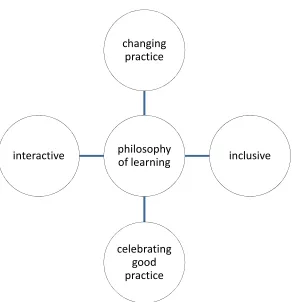
The programme of learning is designed with a very particular approach and in a number of ways is quite different to conventional forms of learning. The key elements of this approach are:
• Emphasis on changing practice • Celebration of good practice • Inclusion of all staff
• Interactive learning
Feedback on the learning experience
There was strongly felt appreciation for:
• The quality of the staff organising the learning programmes • The quality of the speakers
• The relevance of the content
5 • The informal and supportive atmosphere
• The guidance on action planning and changing practice • Networking opportunities with other care home staff • Contacts made with specialist staff
• The locations and timing of the learning days • The portfolios
• The lack of a charge for attending
There was very limited criticism:
• Low attendance at some sessions
• Level of material presented too low or too high • Parking difficulties
• Overcrowding • Cancelled sessions
Strategies for disseminating learning in the homes
The aim of the learning programmes and networks is that the learning will not only be implemented by attendees, but shared with the wider staff group. The main obstacles to this process were thought to be time, and a reluctance of some staff to learn and to make changes. Strategies developed to pass on learning included discussion of the learning at handover meetings, staff team meetings and in one-to-one supervision sessions. Material was displayed on notice boards and the portfolio made accessible to all staff. Some managers used the learning to provide in-house training for their staff group, sometimes including the speakers encountered through the learning programmes and networks.
The impact of the learning programmes and networks
1. Attendance
Despite efforts made to maximise attendance by care homes, it was felt that not all homes were taking advantage of the learning, and that attendance was low at some of the events. The main reason for this was thought be difficulties in releasing staff. Other reasons were lack of commitment to learning by care home managers in some cases, and a belief that the training provided in-house was sufficient. It was felt that homes most in need of the learning were likely to be amongst those not attending.
2. Confidence
The learning programmes and networks have enabled all participating care home staff to feel their work is recognised and their contribution valued. There has been an increase in levels of confidence.
3. Networking and sharing good practice
The learning programmes encouraged a sense of community amongst care staff with long-term benefits in mutually supportive relationships. The learning also built relationships between care homes and staff working in specialist advisory and support roles.
6
The action plans and feedback on the implementation of the actions plans provide numerous example of practical application of learning. Often the changes are small, facilitating implementation, but of significance in improving overall quality of care in the homes and the lives of individual residents. The impact on the quality of care was also evidenced in knowledge cafes where participants were able to provide many examples of the direct and immediate impact of learning on a range of significant aspects of practice.
5. Hospital admissions
There was a feeling amongst key informants and participants that the increased knowledge regarding medication, falls, and infection control had a preventative impact, keeping residents in the home, and avoiding admissions to hospital. The statistical evidence demonstrates there was a reduction in admissions from 2008 to 2010. It has not been possible to obtain more recent data in order to know if the identified trend continued in the following years. There is also a need for caution in attributing a direct causal link, as there are multiple factors influencing hospital admissions.
The future
Although there was support from participants for the continuation of the learning programmes, the current funding runs out at the end of this academic year. It is hoped that the networks can continue with more limited support from the university staff in contacting speakers. Concerns were however expressed regarding the sustainability of the groups without support and leadership.
A further development is proposed for sustaining learning through a system of ‘champions’ within the care homes to lead on best practice in one particular area of care e.g. end of life, medication, dementia care. The champions would be enabled to train and develop allstaff within the care home. They would ensure best practice and act as the named person for the specific area of care for residents, and others involved in the residents’ care.
Conclusions
Demographic trends increasing life expectancy, together with long term policy changes moving care of increasingly needy people from hospital to community settings, have impacted on care homes and the skills required of staff working in these homes. Despite this changing context of care, there continue to be limited opportunities for care home staff to update and improve knowledge and skills.
The learning programmes and networks evaluated in this report are uniquely tailored to meet the needs of this sector. The many strengths of the programme include:
• the passion and commitment of the organisers – creating a positive, welcoming and safe environment in which good practice is celebrated and change encouraged without blame or condemnation
7
• the timing of the sessions – maximising attendance by fitting within timetables of homes and staff with family responsibilities
• the involvement of everyone in a home – managers, nursing staff, care staff, cleaners, cooks, and other support staff learning together in an environment in which all roles are valued equally
• the relevance of the presentations – from well-informed expert speakers working in local health and social care roles, with lively and engaging presentation skils, geared to practical real improvements in care
• the interactive learning – enabling all participants from varying backgrounds and levels of expertise and experience to making an active contribution and believe in the importance of their role and their ability to make a difference
• the facilitation of sharing of ideas and experiences across homes
• the ownership of the folders and their continued use as a resource in the home • the promotion of means of communicating learning from individual attendees to
all staff in the home
• the action planning and feedback - of particular importance is the emphasis on and time and thought given to the process of action planning and feedback which ensures learning is transformed into immediate, practical and effective changes in practice of direct impact on quality of care for residents.
The model for the development of the initiative was one of partnership working, involving local authorities, PCTs and specialist services in a ‘whole systems approach’ to the development of the learning programmes and networks. For a number of reasons, this model was followed through most successfully in North Somerset.
Despite a range of efforts made by staff involved, there was evidence of variable attendance and a suggestion that the homes most needing the learning were least likely to attend.
It is clear that the learning provided through the programmes and networks is relevant, practical, and presented in forms which facilitate changes in practice. The evaluation found evidence of the impact of the learning programmes on staff morale and expertise, changing practices in the homes and improvements in the quality of care. Enduring links were established between individual homes, and between homes and related community services.
The statistical data show a reduction in admissions in the period 2008-10. Although would be hard to prove a direct causal relationship between hospital admissions and the training offered by the learning programme, the evidence on changing practices in the homes also suggests an impact on admissions. For example, changes in practice relating to resuscitation, infection control, use of medication, and eating and drinking were thought to be likely to reduce the need for hospital admissions.
8
the best functioning of the learning programmes. Locally many staff who have played a part in the learning programmed have changed roles.
There was support from all participants in the evaluation for the continuation of the learning programmes, should further funding be made available. It is hoped that the networks will continue, although there was some skepticism over the ability of the networks to be self-sustaining, without some element of outside leadership and continued support.
The organiser of the programme is currently exploring new avenues of training to ensure ideas on best practice are introduced in all homes and accessible all members of staff. These include a proposed initiative for ‘champions’ within individual homes (see recommendations below).
Recommendations
1. The evidence suggests there is likely to be a continued need for learning to up-date and up-skill staff in care homes, to maintain networking between homes and to link homes to changing community-based services.
2. Further consideration needs to be given to issue of attendance. Whilst many efforts were made here, there may be scope for more effective publicity and greater incentives to encourage all homes to send staff. See also recommendation 7.
3. The model of learning presented here is uniquely effective in engaging staff at all levels and in facilitating implementation within the homes. It is suggested that any further educational developments should be based on this model.
4. The care home learning networks are established to continue on from the learning programmes, but are likely to need continued support and leadership from within the health service to be sustainable.
5. There will need to be continued publicity to bring new staff and homes into the existing networks.
6. The experience from North Somerset provides a model of collaborative working. Consideration needs to be given to further development of this ‘whole systems’ approach in other localities
7. Consideration needs to be given to extending collaborative work to include the organisations providing care homes. This may increase the sense of ownership and be effective in improving attendance.
8. A consistent approach to collecting data around hospital admissions and A&E attendance would allow particular trends and problem areas to be identified. This would facilitate policies and protocols, identifying training and education needs so that residents can be care for and treated with greater effect within their homes.
9. The development of champions within care homes, enabled to train and develop all staff within the care home to ensure best practice, and act as the named person for the specific area of care for residents and others involved in the residents’ care.
9
Key to terms used
Care home programmes of learning
(learning programmes)
A series of twelve monthly learning events, attended by care home staff, usually running 9.45am - 3.00pm. Programmes were running in Bristol, North Somerset and South Gloucestershire at the time of the evaluation
Care home learning networks (networks)
Monthly meetings of care home staff, usually lasting two hours, which follow on from participation in a programme of learning. Networks were running in North Somerset and South Gloucestershire, but not Bristol, at the time of the evaluation.
10 Introduction
The care home programmes of learning are part of an innovative educational initiative developed and led by academic staff at the University of the West of England (UWE). The initiative provides learning to meet the needs of staff working in care homes in North Somerset, Bristol and South Gloucestershire.
The overall aims of the initiative are to maximise quality of life for residents in care homes and to reduce admissions from care homes to hospital. This is achieved by improving care home services through the delivery of a comprehensive programme of training, information and advice to care home staff. Key issues in the development of the initiative have been the importance of partnership working and creating sustainability. Sustainability is achieved through the development of care home learning networks which continue after the learning programme has been completed.
Informal feedback to the programme organisers reported increased confidence amongst care staff, with examples of care assistants becoming specialist lead workers on a particular aspect of care. The use of action learning plans in the programmes provided evidence of changes in policies and practices within homes as a result of attendance on the learning programmes. Initial data gathered routinely suggested there was a 20% drop in hospital admissions in the year following the introduction of the programmes. This evaluation sought to provide independently gathered feedback on the impact of the learning programmes and networks.
It is important to note that the initiative and the evaluation took place in a time of great change and uncertainty in the organisation of the health and social care services. Across the country, fundamental changes are taking place within commissioning and provider organisations. Locally many staff who have played a part in the learning programmed have been displaced or switched roles. This has resulted in a challenging environment in which to build and maintain the relationships needed for this work to be fully integrated with the complex web of existing services.
Evaluation Aims
The aims of the evaluation are:
• to assess the impact of the care home learning programmes and networks on service delivery in care homes;
• to explore the experiences of staff and trainers involved in the programme; • to monitor any associated changes in hospital admissions;
11 Methodology
A combination of qualitative and quantitative methods was used to carry out a broad evaluation of the impact of the learning programmes and networks.
The following data was collected and analysed:
Quantitative measures:
An analysis of data routinely collected by NHS Trusts on
• The numbers of admissions of care home residents to hospitals, the number of bed days, and the reasons for admission between October 2008 and May 2010. • Accident and emergency visits by care home residents between October 2008
and may 20120
Qualitative measures
• Visits to the learning programmes and the care home learning networks as part of an initial familiarisation with the learning programme
• Examination of documents such as learning set materials and action plans
• Telephone interviews with key informants, including members of the course team and managers in the Trusts and local authorities
• Knowledge café evaluation events for care home staff to explore reflections on learning, attitudes to the programmes and the networks and implementation of the learning in the workplace.
Key literature informing the development and philosophy of the programme was reviewed.
The methods used are explained in more detail below.
Hospital admission data
Hospital admission data from care homes is collected routinely by NHS Trusts and entered into Excel spreadsheets; however a number of recording methods are used.
The quantitative data supplied to the project team included the following:
• The number of emergency admissions from care homes in the BS postcode area, by month (October 2008 to May 2010)and by medical specialty
• The number of visits by residents from care homes in the BS postcode area, to accident and emergency by month (October 2008 to May 2010)
• The number of admissions from individual care homes in the BS postcode area between April 2009 and January 2010.
It was not possible to obtain data from the years 2011 and 2012.
12
emergency data. The variables for the first data set were date (month and year), NHS Trust attended, medical specialty, and number of bed days. The second had variables date (month and year), accident and emergency department attended, and medical specialty.
The data listing individual care homes and the number of admissions from these care homes was not used in this report.
Descriptive statistics were performed and frequencies calculated to allow a comparison over time for both the SPSS data sets. An ANOVA statistic was calculated for the number of bed days by date and medical specialty for the first data set.
Key informant interviews
Eleven people were interviewed. Nine of the interviews were conducted over the telephone and two face-to-face. The interviews were audio-recorded and transcribed. The interviewees had a range of work roles and had been involved with the programme in differing ways. The participants included: the two tutors from the University of the West of England; three specialist speakers from the learning programme; the manager of the Rapid Response team for North Somerset; three members of North Somerset’s contracts team and a commissioner; member of South Gloucestershire Local Authority.
The interviews were semi-structured. A list of questions had been prepared and checked with the programme leaders. The questions covered various aspects of the programme from the need for the programme to issues of sustainability into the future (see appendix 1). Informants were sent the questions in advance, along with an information sheet. The interviews varied in length from 10 to 30 minutes, as some informants had broader knowledge of the learning programme than others. The interviews were audio-recorded and transcribed and thematically analysed.
Knowledge cafe evaluation events
Knowledge Cafés have been used successfully in a number of recent research projects within the Faculty of Health and Life Sciences at University of the West of England, and has consistently received very positive feedback by participants. A knowledge café aims to enable people to work in informal but focused small groups and to think in non-conventional ways, sometimes using photographs to stimulate ideas.
13
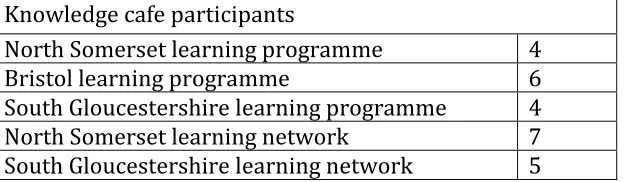
Table 1 Numbers attending knowledge cafe evaluation events
Knowledge cafe participants
North Somerset learning programme 4
Bristol learning programme 6
South Gloucestershire learning programme 4
North Somerset learning network 7
South Gloucestershire learning network 5
A range of staff from managers to care support workers participated. They had all attended at least one session at one of the learning programmes or networks. Although the numbers attending were disappointingly low, the events produced rich in-depth data which would have been difficult to elicit from quantitative methods such as questionnaires. The low numbers also enabled the evaluation team to discuss responses with participants and avoid the need for follow-up interviews seeking clarification.
The events began with the selection of an image by participants to stimulate their thinking and provide a focus for conversation. This was followed up with more specific questions for group discussion. These questions were developed in consultation with the course team (see appendices 2 and 3). Detailed notes were taken and participants used post-its and pages from flip-charts to note their ideas. The notes and post-its were typed up and formed the basis for analysis. Appendices 4 – 8 contain the notes from each of the evaluation events.
Data analysis
The data has been thematically analysed and the various forms of data have brought together in the following account which examines:
1. The policy context
2. The need for the care home learning programmes and learning networks 3. The development of the care home learning programmes and learning
networks
4. The organisation of the care home learning programmes and learning networks
5. The philosophy of learning
6. Feedback on the experience of the learning programmes and networks 7. Strategies for disseminating learning in the homes
8. The impact of the initiative 9. The future
Ethical approval
14
15
The policy context
Within the literature relating to care homes, there is an acknowledgement that the sector has historically worked in isolation, separated from other statutory and independent care sectors and largely excluded from main stream care systems (Fear, 2009). Differing employment status within this independent health and social care system has resulted in a diverse and ad hoc training and education system from either privately funded or internally based from within their own organisation (Fear, 2009).
Government agendas over the last decade (DH, 2001; 2005; 2006) have demanded a shift in thinking around care of older people. The aim is to ensure that services for older people are local and accessible, provide choice and support a variety of housing from living at home to nursing home provision. The independent care system in terms of residential and nursing care is now an essential component of integral health and social provision for older people. Therefore there is a greater need for interagency education and training particularly for older people experiencing long term conditions.
Government agendas are resulting in a shift in care with less hospital beds and an increased more effective care outside hospital for older people. A Sure Start to Later Life
report (DH, 2006) gave examples of housing choices within communities, for older people unable to remain in their own home. This extends from purchased extra care housing to public funded nursing care within nursing homes.
Partnership working has become ‘a central feature of our Social Welfare Policy’ (Dowling et al, 2004 p. 309). The government’s programme has set out the development of a range of services to be delivered in partnership with all health and social care sectors (DH, 2001).This backdrop of current policy agendas raises opportunities for new ways of cross-sector working, to address the needs of the independent sector care homes in their continuing care provision (Fear, 2009).
16
The need for the learning programmes and networks
There are 147 care homes in North Somerset; 146 in Bristol and 94 in South Gloucestershire. All participants in the evaluation were unanimous in seeing the need for the learning programmes and networks.
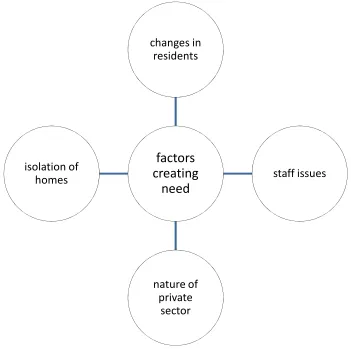
[image:17.595.140.491.279.628.2]As private sector organisations, care homes were considered to fall into a ‘grey area’, in terms of organisational support, while ‘contain(ing) our most vulnerable population’ (key informant interviews). Factors associated with the need for learning were linked to changing resident populations; the characteristics of the staff working in the sector; and the isolation of homes from each other and related service providers.
Figure 1 Factors creating the need for the learning programmes and networks
Respondents noted the changing health care needs of residents in care and nursing homes, as a consequence of government policy drivers affecting hospital and domiciliary care, and of changing demographics:
‘The people (the homes) are getting to look after have changed; ... they’re more poorly than they used to be and it’s about ensuring the staff have the skills to look after those people’ (key informant interview)
factors
creating
need
changes in residents
staff issues
nature of private
sector isolation of
17
This was seen in terms of a domino effect in which each part of health and social care services catered for a needier group of people:
‘... when I trained (as a nurse) in the eighties, the people I looked after in an ITU are now looked after on a ward. People I used to look after on the ward, are now looked after in nursing homes, and people I probably looked after in nursing homes are now in residential homes. And those people in residential homes are probably at home, so I think the acuteness of what they’re looking after has increased’ (key informant interview)
Figure 2 Changing needs of residents
Homes were believed to be characterised by high turnovers of staff, higher proportions of overseas nurses, a need to maintain profit levels, and a corresponding lack of access to education.
‘Some are privately owned companies, very small family-run units that aren’t able to go to training because it’s all an expense. When you’ve got a small home, the margins now of profit are much smaller’ (key informant interview)
Education was thought to be more commonly provided in homes which operate as part of a larger organisation. The standard of this learning was however questioned.
‘ ... if they are in a home as part of a big company ... they do a lot of their own training. But then I don’t know how it’s regulated. A lot of training now is e-learning, or in-house, but it’s not regulated to a standard. It’s all quite hit and miss I think’ (key informant interview)
changing
needs of
residents
changing demographics
changes in hospital services
18
Key informants believed that staff in care homes were often isolated. An important aspect of the learning programmes was enabling staff working at all levels to network with each other, sharing problems and good practice.
‘It was a good network where all the managers ... could get together and have chat about problems that occurred within their home ... some managers felt quite isolated and they didn’t feel supported but going to the networks, they felt that they struck up friendships with other managers’ (key informant interview)
It was also thought that residents in homes tended not to receive the support of specialist services, such as dietary advice. The programmes provided a means of contact between specialist services, who providers speakers for the learning days, and homes.
‘There’s not so much of a focus on visiting nursing homes. Many of the dieticians won’t visit nursing homes ...that’s because it’s so under-funded, not because they don’t want to ... as a result the nursing homes haven’t received that sort of education around nutrition ...I think that there’s definitely a need to do more training’ (key informant interview)
The programmes and networks also provided a means for contracts staff in North Somerset to work with homes and provide constructive support. Contract staff found it useful to monitor attendance on the programme:
‘I know if you were to run the project again, you would have full backup from the other contract compliance officers … we thought the training was really good and … we were able to see which Homes were taking it on.’ (key informant interview)
Figure 3 Homes and networks
homes
19
The need for the programmes and networks was also seen in terms of reducing hospital admissions from homes. This is a key theme in current health policy, both locally and nationally.
Nationally, hospital admissions from care homes are often high for older people who experience multi-diagnoses of long term conditions. This has resulted in different admission avoidance schemes related to specific illnesses and diseases being tested to reverse this trend. The schemes tend to be directly related to exacerbations of a condition such as COPD (Pearce et al 2011). This trial involved collaborated working between GPs and ambulance services as a physical change in service provision as opposed to training. Ouslander (2011) developed a ‘quality improvement intervention that included a set of tools and strategies designed to assist nursing home staff in early identification, assessment, communication, and documentation about changes in resident status’ (p 745). It demonstrated that the specific training package appeared to reduce hospital admissions, although more research was needed to confirm this. Garcia et al (2011) identified a lack of research into management issues such as the voice of the resident with diabetes being heard (as the expert patient). This research identified the need for management education for families, residents and all health and social care providers in this setting.
The importance of reducing hospital admissions was perceived by the key informants in a number of ways. It clearly is related to the need to reduce costs of NHS care. However it was also related to residents’ wishes to remain at home, and not to die in a hospital, and to an awareness of the detrimental impact of hospital admission on many older people, particularly those with dementia.
In the quotation below, a key informant expresses this duality, in terms of benefits to residents but also in reducing costs of hospital admissions:
‘if you’ve got somebody who has dementia and has a urinary tract infection and needs maybe antibiotics and increased fluids ... they might be okay in their own environment in the care home, because they know the people, they know the routine. ... why can’t (the treatment) be given there, rather than actually they’ve got to get in an ambulance, get to a hospital, go onto a ward where there’s no such one- to- one care? ... Also financially, the hospitals don’t want people in that are going to be there for a long time because they end up as what we call ‘bed blockers’ (key informant interview)
Following from this, a key aim of the programme is to enable staff in care home to extend their skills to enable residents to be cared for at home. In the words of one of the organisers:
‘So it was really about enabling staff in the care homes to have the skills to be able to care for people with exacerbations of their condition’ (key informant interview)
Again, this was set in the context of the increasing health needs of people in both residential and nursing homes:
20
philosophy of how nursing homes function ... the majority are functioning like mini- hospitals’ (key informant interview)
Participants in the knowledge cafe evaluation events were asked to express their perceptions of the purposes of the care home learning programmes. A commonly voiced theme was the value of the opportunity to gain up to date knowledge on good practice, to improve standards of care for residents. The learning enabled staff to understand why they were being asked to work in a particular way, and to gain a better understanding of care home policies. A valued purpose was seen in the opportunity to network with staff from other care homes, to share ideas and examples of good practice. The learning programmes also served to improve the reputation of the home, to support contract compliance, provide material for records of training for home and for registered nurses required to undertake CPD.
What are the purposes of the learning programme?
• ‘To improve quality of care’
• ‘To focus on good practice’
• ‘Up to date knowledge’
• ‘The purpose of the learning programme I think is to interact with others and learn other’s ideas and possible improvements’
• ‘To give more information into important subjects within care’
• ‘To give the junior staff the opportunity to learn and realise they are very much an important part of the team’
• ‘For senior staff to realise changes do occur and we must be on top of this’
• ‘Care staff become more aware of the reasons why procedures and policies are in place’
(written responses from learning programmes knowledge café participants)
Participants in the knowledge cafe events feeding back on the care home learning networks were also asked their views on the purpose of the networks. There was a similar emphasis on sharing and networking, gaining contacts with specialist resources as well as learning new information and skills. Audit and inspection purposes also featured.
What are the purposes of the learning network?
• ‘An audit tool to show in inspections
• ‘Makes you realise that you are not alone / isolated. Establish relationships
• ‘Instead of being in competition, feel confident to ring people and ask for information
• ‘Share information and learn more about things we need help with
21
• ‘Encourage relationships between outside professionals and care homes
• ‘Learning new things
• ‘Gaining knowledge, networking, getting to know people and gaining contacts
22
The development of the learning programmes and networks
The current care home learning programmes were preceded by groups known as care home network groups. These were established in North Somerset in 2003 by the UWE lecturer who leads the current programmes. Subsequent funding from the local Primary Care Trust enabled two 12 month programmes of learning to be run to support care homes in North Somerset.
Further development came after the Strategic Health Authority for the region learned of the success of the programmes. It was felt that all the Trusts should make similar provision, with the additional aim of reducing hospital admissions. As a result, Service Improvement Fund (SIF) monies from the three PCTs led to two further programmes in North Somerset, two in South Gloucestershire and two in Bristol. The Bristol programmes were delayed in starting, but began in September 2011 and followed an accelerated programme of twice monthly meetings. All will finish in July 2012, making a total of eight.
After the programmes are completed, groups join together to form networks and continue the learning sets, meeting monthly on Wednesdays. There are currently networks meeting in Bristol, Clevedon, Weston Super Mare and South Gloucestershire. There is no charge to homes for attendance at either the learning programmes or the networks.
In all three areas, there was support for the learning programmes from the local authorities and PCTs. In North Somerset, there was been considerable involvement of the local authority and the PCT in the development and running of the programme. This involvement began in the initial stages when the PCT brought community services key nurses and other specialist staff, already tasked with providing training in nursing and residential homes, together with other interested parties:
‘ I was asked to set up a group of interested parties ... that would include … the UWE trainer ... We had someone from Rapid Response, the out of hours service, district nursing, specialist nurses as well. As a group we met about once every six weeks or two months and went through all the work that everybody had been doing and we also identified which homes we felt were struggling and needed more support.’ (key informant interview)
The ongoing commitment from the PCT was linked to the aim to avoid admissions to hospital and homes with high admission rates were particularly targeted.
‘(we) looked at which homes had the highest admissions to hospital. We’d go out and do a visit with them and talk about their learning needs, go through some of the cases of why they admitted the patients and then talk to them about the learning programme; were they involved; did they attend, you know, and what they were getting out of it so we sort of did a constant evaluation and promotion all the way through really. ... from the PCT point of view our overall aim was to avoid admissions to acute care’ (key informant interview)
23
‘… they would be able to spread the word and really encourage people to take part ... they really worked hard at promoting it’. (key informant interview)
For the course organisers, this involvement provided links to appropriate speakers and integrated the learning programmes and network within the wider context of services in North Somerset:
‘... the PCT has worked with us … We have been able to work with all their organisations so Rapid Response, community matrons. Also the PCT staff that have got specialties like tissue viability or end of life. So they have been very willing to help, and have had a vision really about how this programme could reduce hospital admissions. … they have taken that very seriously and I have regular meetings with the PCT staff’ (key informant interview)
The benefits of enlisting community staff as speakers were seen to work in both directions, also enabling the specialist staff to economically have contact with a number of homes:
‘... in North Somerset the community staff have got on board, the Infection Control Specialist Nurse; Diabetic Specialist Nurse; End of Life, they’ve come in, voluntarily and quite see it as a part of their role ... Because they say, in one visit they can probably see ten, twelve, fifteen care Homes....it’s easier to do that than do fifteen visits to individual homes’ (key informant interview)
The involvement of North Somerset contracts staff included attending some of the learning programme sessions and monitoring attendance.
‘… when we started this, it was the star rating system and there were a lot of care homes that were rated as ‘1’ as poor and ... because it was free training, we felt it would be a really good idea to try and promote the learning project, especially for those care homes … we used to go to several of the groups and note what care homes were there ... (key informant interview)
For the organisers, this was a positive step, designed to support homes.
‘they would actually see which homes were coming regularly, if they weren’t they would ring up and say, “oh come on you know, send somebody because you know you’ve got this safeguarding issue”. Or “this would be really good for you because you know if your resident such and such”. And they also helped us to recruit homes that needed to come, that were scoring poorly around quality from the CQC and things so they have been very proactive and if we say “oh such and such a home I’ve asked but they haven’t come”, they will ring up and “say why haven’t you been?” (key informant interview)
24
The organisation of the learning programmes and networks
The learning programmes last for 12 months and consist of monthly study days, running on Thursdays between 9.45 and 3.00pm. The topics are chosen by the care homes managers at the beginning of the year. The sessions are facilitated by UWE lecturers, typically with speakers from the local PCT. Action learning sets are utilised. Each home has a portfolio of relevant materials and maintains action plans developed for the individual care home, as a result of learning in the sessions. As has been stated, homes are not charged for the materials or for staff to attend.
Typically, around 25 staff attend each session (attendance is discussed later in this report). Two members of staff from each home are invited, although occasionally more attend. Ideally, there should be one senior staff member and one more junior. It is expected that different people attend each month, to ensure sustainability in a sector where there is a high turnover of staff.
Lists of sessions are pinned up in the home and staff sign up to attend. Homes are encouraged to send the most appropriate members of staff to the events. For example, the first meeting will be attended by a manager. The meeting will focus on a ‘SWOT’ analysis, exploring what the home is good at and what needs further development. Later sessions might be on aspects such as nutrition, in which case the cook should attend, or infection control, when the cleaning staff would be encouraged to attend. Some homes have subsequently designated individual staff as lead specialists in particular aspects in which they have developed an interest.
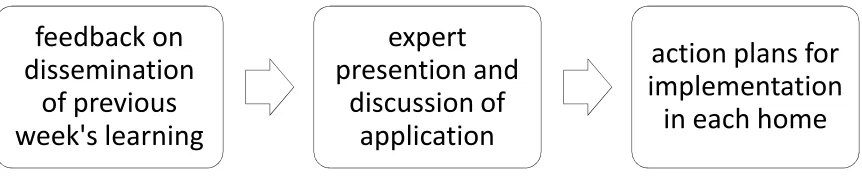
The sessions are held in care homes and follow a standard format:
1. Feedback on the dissemination of each care home’s action plan from the previous topic. This requires person attending to have talked to last week’s attendee. They are expected to bring the folder and to be able to feed back on what has been implemented from the previous session’s learning.
2. Expert presentations on the timetabled topic (e.g. Dementia Care Management, Nutrition, Diabetes, End of Life Care), followed by discussions regarding the application of the material in service settings.
3. Preparing action learning sets and developing an individual action plan for each care home so that participants are able to formulate their feedback from the session and determine how best to present it in their workplace.
25 Figure 4 Implementation of learning
The care home learning networks are developed after completion of each learning programme. Groups in a local area join together to form a network and continue as learning sets, meeting monthly on Wednesdays. Network meetings are less formal, although participants still bring their folders, and action planning continues to be used. The sessions are shorter, just three hours. The topics are requested by the participants, but currently speakers continue to be arranged by the UWE staff. It is hoped that the groups will take on their own facilitation in the future.
Considerable effort is made by the organisers to recruit homes to the learning programmes and to support attendance at the learning programmes and the networks. Each month, a flyer is sent out to homes, two weeks before the session. An email is sent to the manager a week before the session, and then they are phoned by one of the organisers in the week of the session just to remind them. Despite this attendance is variable and further emails are sent to explore reasons for non-attendance. This is explored further in the later section on the impact of the learning programmes and networks.
feedback on
dissemination
of previous
week's learning
expert
presention and
discussion of
application
action plans for
implementation
26
The Philosophy of learning
Although there have been many initiatives set up to address education and learning in the care homes setting, there is little evidence in the literature of a coordinated approach to develop a learning climate, develop partnerships with other health and social care systems and integrate theory to practice. The programme of learning is designed with a very particular approach and in a number of ways is quite different to conventional forms of learning.
The primary aim is practical, rather than academic. The emphasis is on changing practice in care homes:
[image:27.595.172.464.336.638.2]‘We are trying to give the practical application with theory, to enhance care, to change practice’ (key informant interview)
Figure 5 The philosophy of learning
As well as being a stimulus for change, the programme aims to celebrate success - in a sector which is criticised more than praised, and in which staff work hard in challenging circumstances, and for little reward or status.
‘it’s not always about criticism ... they say ‘oh we are doing that already’, and I say ‘well that's wonderful, go back and tell your staff please, put a notice up saying that we have just had an update and you are doing the best practice. You should be congratulating them’. So it isn’t
philosophy of learning
changing practice
inclusive
27
always about changing practice. It’s about changing their approach to their staff and celebrating’ (key informant interview)
An important difference between the learning programmes and networks and conventional education is that the learning is aimed at the whole care home and not just the individual people who attend a particular session. The portfolio plays a key role here:
‘the portfolio is for the whole care home. So that comes with everybody who comes every month … developed and getting bigger with all the articles and the knowledge and their feedback and their actions plans. So it’s really difficult to say who owns that’ (key informant interview)
In the early days of the programme, a certificate of attendance was awarded at an event. This created a dilemma around who should receive the certificate. In the end, the idea of the certificate was dropped. The whole home approach extends beyond care staff. As a key informant comments:
‘I particularly liked that it wasn’t just aimed at managers or lead nurses, the cooks also were there. The handyman was also expected to be there ... and it’s that winning cultural hearts and minds ... Because everybody is important, it’s the same with any team ... there’s nobody more important than somebody else because if somebody isn’t doing their job, the whole team winds down’ (key informant interview)
The learning is highly interactive and designed to involve everyone at every stage in their learning. One of the course organisers explains the way in which participants are involved in identifying their own learning needs:
‘... it’s about them being interactive. It’s about us being interactive. It’s about us saying to them ‘okay, so we’ve got diabetes today; what do you want to know about diabetes?’ … And ensuring we give them what they want … and meeting all their different needs’ (key informant interview)
Participants come to the learning programmes and networks with very differing backgrounds:
‘We will have somebody who’s seventeen, and out of school, and done nothing, and we’ll have somebody who’s done it for thirty years, and we’ll have somebody who’s trained. And we’ll have the cook. So it’s about meeting all those needs’ (key informant interview)
The philosophy of interactive learning informs all aspects of the work of the UWE tutors with the participants. Visiting speakers are also encouraged to involve participants in learning. An example can be found in a session on nutrition which included participants feeding each other, tasting fortified milk, and thinking up ways to increase the nutritional value of foods and drinks served in the homes. This session was memorable enough to be discussed in the evaluation events and managers described repeating the training with full staff teams.
28
29
Feedback on the learning programmes and networks
There was much praise from the key informants and the knowledge café participants for all aspects of the learning programmes. The events were described as ‘well run’ (knowledge café participant) and the emails reminding homes of learning events appreciated. Participants at the knowledge cafes felt the locations worked well: close enough to be easily accessible, comfortable and informal, without conjuring memories of school learning. Visiting another care home was seen by one of the key informants as a source of potential learning in itself:
‘It’s in a Care Home and I think that was an excellent thing as well, because most Managers don’t go to other Care Homes, and I think that is a really good idea to go and look at other Care Homes to see what they’ve got’ (key informant interview)
The timing fitted well with shifts, and busy times in the homes, and enabled people with childcare responsibilities to participate. The breaks between sessions were welcomed and the ‘short sessions which make it easier to remember what we have learned’ (knowledge café participant). The lack of charge was also an ingredient for success.
It was felt that the organisers had the ability to enable everyone to relax and feel confident about participating.
‘The UWE staff make people feel relaxed and comfortable about participating.
The degree of interactivity was enjoyed and valuable to learning.
‘I went to one, and it certainly seemed to me that (the organiser) put an awful lot of thought into how to make it absolutely totally appropriate for the kind of people. It was very interactive, and she managed to get everybody talking’ (key informant interview)
The work of the organisers in supporting the implementation of learning into manageable changes in practice was also recognized.
(The UWE tutors) guide people to see other ways of making changes and make change manageable’ (knowledge café participant)
There was praise for the quality of the guest presenters and, in particular, their specialised knowledge gained from current and credible practical involvement. The opportunities to learn from colleagues working in different homes, and in different roles, were also valued. Participants appreciated the direct practical relevance of all the learning to their work, which enabled immediate implementation into the care setting. There was also benefit in
‘learning what we do already know’ (knowledge café participant)
The knowledge and confidence gained enabled staff to make positive suggestions for change. For one of the managers, an ingredient of the success was that:
30
The level was felt to be appropriate for most staff in most of the sessions.
‘Level excellent for majority, support workers didn’t feel it was over their heads (knowledge café participant)
The role of the action planning was acknowledged,
‘the staff have to sit and listen, they have to come back with something’ (knowledge café participant )
The portfolios (described here as folders) played a key role in the continuity of learning:
‘people have to read them in order to be ready to answer questions about last time. It is good as the folders get used. There is good literature in the folders.’ (key informant interview)
Another participant described the folder (portfolio) as a ‘bible’, and commented that people did not forget to take it along when they attended, generally took it seriously, and by reading the portfolio, could feel involved even if they had not attended before and be able and ready to participate.
The recapitulation of the previous session was useful in consolidating learning, and to bring people who had not attended that session up to date.
What the things that make the learning programme a success?
• ‘You get to meet new people with different experiences that you can learn from as well as getting important information from specialist speakers’
• ‘Comfortable room and comfortable chairs, not having tables and chairs which would make it feel like school’
• ‘Consistency in venue and familiar faces enabling you to open up to talk more easily’
• ‘Interesting and engaging speakers’
• ‘Topics relevant to the work’
• ‘A lot of information has been able to be implemented into work settings’
• ‘Encouraging all staff members to attend, something for everyone’
(written responses from learning programmes knowledge café participants)
31
What the things that make the learning network a success?
• ‘Communication, tutoring in a variety of subjects asked for by the network team’
• ‘Meetings are about topics that are chosen by us as areas we need help with’
• ‘The topics are chosen by us and it’s what we feel is important’
• ‘Good speakers who know their stuff. We find out the roles exist’
• ‘Location and timing is practical for busy managers (short time periods 9.45-12.00; local means can be called back in an emergency)’
• ‘Networking has proved to be valuable in improving the service’
• ‘Listening and learning about how other care homes work’
(written responses from learning networks knowledge café participants)
Participants were also asked to identify ‘the things that (are) not so good about the learning programme’. Here the lists were much shorter. The most commonly expressed theme was the low numbers attending some of the events. On the other hand however, there was a complaint that the venue, although appreciated for its comfort, had been crowded for some sessions. For some of the staff the level was occasionally more appropriate to trained staff. For others it was felt that the learning was pitched at a level which did not stretch trained staff. At some of the events, parking was tight. It was also thought that the there could be a ‘Chinese whispers’ quality to the information passed on, when only one member attended. At one of the evaluation events, there was strongly felt criticism from one participant of the attendance of North Somerset contract compliance staff. It was suggested that the staff made remarks that were
‘not positive and made me feel uncomfortable about attending’ (knowledge café participant)
These remarks were perceived as threats that homes would not be funded if staff did not attend:
‘The programme wasn’t sold on the basis of getting funded, or being inspected, it was training. This was not constructive or positive. They were on the phone in the sessions, phoning homes who hadn’t attended. It was rude to the speakers. We were relieved when they left part-way through the session’ (knowledge café participant)
Whilst this manager was committed to sending staff it was felt that there were times when:
‘in the real world residents come first’ (knowledge café participant)
32
What are the things that are not so good about the learning programmes?
• ‘Sometimes it is hard to follow things if the speaker is talking at a level above you, feel reluctant to ask questions if the jargon is difficult’
• ‘The session was quite difficult today for someone without nursing training’
• ‘The parking here is quite difficult’
• ‘When notes are being passed on to the next person, it’s like Chinese whispers, so could lead to false information’
• ‘Not enough people come. It is a big commitment but homes need to commit to it’
(written responses from learning programmes knowledge café participants)
The feedback from the care home learning networks was a little more critical. As well as the point mentioned above regarding attendance from a larger number of homes, there was some negative feedback regarding the organisation of the learning sessions. It was intended, by the organisers, that this would be a point at which the UWE tutors would take a step back, in the interests of creating sustainable mechanisms for ongoing learning (see also the later section of this report, on the future for care home learning). It was hoped that, in doing so, new leaders would emerge to take on the role of organising events. Perhaps as a result of this attempt at transition, there was more criticism of organisational factors.
What are the things that are not so good about the networks?
• Considering how many homes are in Clevedon, need more to participate’
• ‘I keep falling off the email lists’
• ‘Last minute changes to meetings or topics’
• ‘Speakers not turning up (when ill, but we could have met anyway and had discussion)’
• ‘Cancellations – when (the home used as a venue) was closed due to sickness (but we could have moved to an alternative site)’
• ‘Speakers are sometimes repeated’
• ‘ ‘Not as organised as it could be’
(written responses from learning networks knowledge café participants)
33
sector, another, working in mental health asked for material relating to mental health issues such as mental capacity legislation, safeguarding, deprivation of liberty. One suggested sessions be repeated to enable more staff to access the learning; another said senior staff should be required to attend with another member of staff. Although handouts are often given, and material presented on Powerpoint is always available, it was suggested that
‘It can sometimes be difficult to remember everything covered. Maybe we could have some handouts with good point to take back to the care homes with you to show others’ (knowledge café participant)
Finally, it was felt the sessions could be improved if speakers learned more about the people attending, and geared the level of the information given to the people present.
What could be changed to improve the learning programme?
• ‘More homes to attend regularly’
• ‘May be good to have some handouts or some web addresses for staff to make a folder for themselves, even a smaller folder for each student’
• ‘Not so much changed, but a specific requirement that one or two senior people come with another member’
• ‘The action plans only have the points that the last person thinks were important but there may have been others, print-outs could be given’
• ‘Notes from training to be given to the home as everyone picks up different aspects of things’
(written responses from learning programmes knowledge café participants)
What could be changed to improve the networks?
• ‘Need someone constantly at the helm – organising, since less UWE input there have been more cancellations. Managers need ‘outside’ help (have other priorities)’
• ‘Need more homes to participate (some came once or twice, then not again)’
• ‘More homes to take part’
• ‘Some homes are still not taking part; without a lead it is difficult to organise meetings’
• ‘More information on what the speaker will be covering in detail’
34
Strategies for disseminating learning in the homes
In most cases only one or two members of staff will attend a particular learning session. The aim is however that the learning will be not only implemented by attendees, but shared with the wider staff group. In the knowledge cafés, the main obstacles to this process were thought to be time and a reluctance of some staff to learn and to make changes.
The knowledge cafes explored the means which homes had developed to share learning. A number of strategies were used to pass on learning. These included discussion of the learning at handover meetings, staff team meetings and in one-to-one supervision sessions. Material was displayed on notice boards and the folder made accessible to all staff.
‘Shift handovers – talked about in handover, even when people didn’t themselves attend’ (knowledge café participant)
‘The folder is available, everyone knows where it lives’ (knowledge café participant)
‘We have a notice-board in the staff room on which we have all sorts of information from this programme’ (knowledge café participant)
Some managers used the learning to provide in-house training for their staff group, sometimes bringing in the speakers they met through the learning programmes and networks into the home to work with the staff.
‘After the session on feeding, where we fed each other with yoghurt, I made my staff do this. I had them do it badly and properly and experience what it is like’ (knowledge café participant) ‘I got people to suck on a sweet and work out what they needed to do to swallow’ (knowledge café participant)