Utilizing Linked Open Data for Web Service Selection and
Composition to Support e-Commerce Transactions
Vesyropoulos Nikolaos1, Georgiadis K. Christos1, and Pimenidis Elias2
1
University of Macedonia, Thessaloniki, Greece {nvesyrop,geor}@uom.edu.gr
2
University of the West of England, Bristol, UK [email protected]
Abstract.Web Services (WS) have emerged during the past decades as a means for loosely coupled distributed systems to interact and communicate. Never-theless, the abundance of services that can be retrieved online, often provid-ing similar functionalities, can raise questions regardprovid-ing the selection of the optimal service to be included in a value added composition. We propose a framework for the selection and composition of WS utilizing Linked open Data (LoD). The proposed method is based on RDF triples describing the functional and non-functional characteristics of WS. We aim at the optimal composition of services as a result of specific SPARQL queries and personalized weights for QoS criteria. Finally we utilize an approach based on the particle swarm opti-mization (PSO) method for the ranking of returned services.
Keywords: Web Services ∙ Linked Open Data ∙ RDF
1
Introduction
The Service Oriented Architecture (SOA) paradigm provides the means for the removal of interoperability barriers between heterogeneous systems. As a result, it has been widely adopted by enterprises for the fulfillment of their business needs. WS can both be used as stand-alone components or as parts of a value added composition, comprising of a number of (internal of exter-nal to the enterprise) services. Through the reuse of existing WS as parts of a composition, an enterprise can lower the cost of complex operations and adjust to specific business needs that rise during online transactions with partners or customers [7].
are utilized for the automated process of orchestration rules, thus resulting in the rapid development of compositions.
A recent and promising approach towards the identification of WS which fulfill specific requirements, as well as their selection and composition is the use of LoD [6]. This method, which has been widely adopted in various fields, refers to the utilization of structured data that can be machine understanda-ble [12]. An important aspect of LoD is that data share connections, based on semantic rules. Through these rules linked data form RDF graphs, represent-ing the ties between the interlinked data. Such data can be identified and retrieved by issuing specific queries through an appropriate querying lan-guage, such as SPARQL.
In this work we describe a proposed framework for the selection and compo-sition of WS. This work is organized as follows: In chapter 2, we analyze re-lated works and attempt to highlight the benefits of utilizing LoD for the op-timal WS selection and composition. In section 3, the proposed methodology is analyzed and a framework is demonstrated. In the following section, a case study is presented, based on the proposed framework and pertaining to the composition of services in the context of e-commerce transactions. Finally we conclude with a discussion on the lessons learned and point towards fu-ture research and areas of interest.
2
Related Work
The notion of utilizing LoD in the process of the discovery, selection and composition of WS has recently gained the attention of researchers. None-theless, in contrast to the corresponding semantic approaches, no specific standards have been established and the optimal utilization of this approach is still being debated.
patterns which also aid the construction of the appropriate RDF messages for the exchange of data between WS.
In [13] the concept of Linked Open Services is presented, which is based on the utilization of LoD, RDF and SPARQ queries. Their approach is aiming at the discovery and composition of WS that are described through interlinked data. In addition in [14], authors elaborate on the applicability of SPARQL graph patterns for the description of such services. In more detail they ana-lyze the behavior of registries that are compatible with RESTful calls and LoD, and proceed to the implementation of such an approach using Hadoop.
In [9] authors describe the application of a LoD-as-a-service architecture. They highlight the challenges of applying domain specific datasets in a LoD format and developing appropriate architectures for the retrieval of these data. A dataset regarding WS descriptions can be added into such an imple-mentation, thus providing WS discovery capabilities. We build on this notion as we intent to provide enterprises with a methodology for the selection and composition of WS based on RDF descriptions.
In [1], Linked-OWL a modification to the OWL-S language is proposed which can describe both ontologies and LoD data. The proposed language takes advantage of REST-based WS and is a promising approach towards the com-position of WS utilizing LoD and the dynamic reallocation of involved WS.
Finally, in [5] a service identification methodology is proposed, which enables the application of LoD and semantic links for the discovery of APIs that can be included in web mashups. Authors describe the application of such an approach and demonstrate the affectability on two popular API repositories.
3
Proposed Methodology
In such an approach, information regarding the available WS must be con-verted in an RDF-based format, such as the following tuple structure:
{WS_Name : Property1 : Value}
{WS_Name : Property2 : Value}
….
{WS_Name : PropertyN : Value}
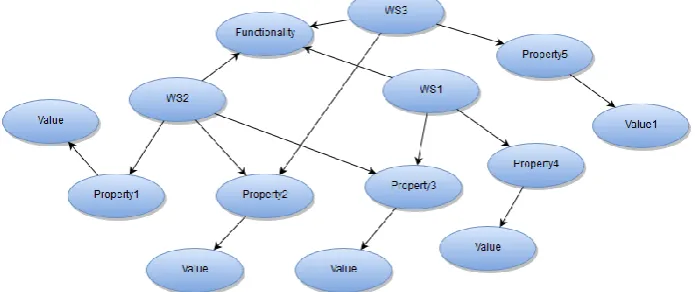
[image:4.595.124.472.330.476.2]By converting the aforementioned information into an RDF format, an RDF graph can be created modeling all the available WS and their interconnec-tions. Such a graph is pictured below:
Fig. 1. The RDF graph describing a set of available WS
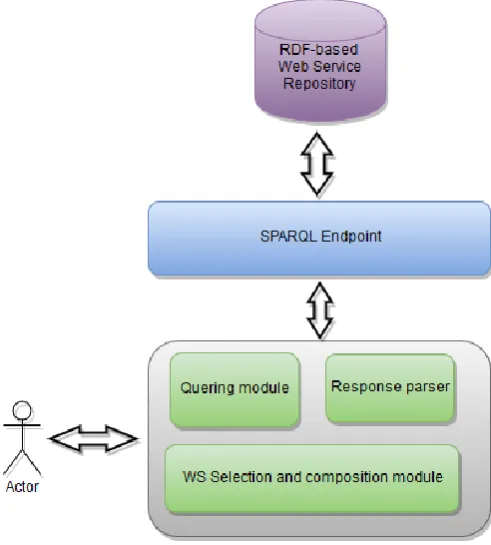
The proposed framework includes a LoD-based repository containing de-scriptions of all available WS. Using a SPARQL endpoint the end-user is capa-ble of issuing queries regarding to specific operations while a number of re-quested QoS characteristics can also be included in such a query. The frame-work’s overall architecture is depicted in figure 2.
Fig. 2. The proposed framework architecture
After the aforementioned transformation, a ranking of alternative solutions is required for the identification of the optimal composition. A number of researchers have utilized the PSO algorithm to adhere to similar problems in a variety of domain specific scenarios. The application of PSO for solving the WS selection and composition problem, based on QoS characteristics, is fea-sible as shown in [8] [17]. In this work we apply this algorithm as a part of the selection process, nonetheless other selection algorithms can also be ap-plied, such as multicriteria decision analysis methods [16] or constraint algo-rithms [4]. The PSO algorithm, was introduced in [10] and is described by authors as an algorithm simulating a social model, and in particular the be-havior of bird flocking and fish schooling. Two important values in the algo-rithm are the personal best and the neighborhood best, pbest and pgbest
of the pbest and pgbest values, all particles are in constant movement trying
to converge to the point of the optimal values. For each iteration, the updat-ed velocity 𝑣 and current position 𝑥 of a particle is being calculated according to the following formulas:
𝑣(𝑡 + 1)𝑖 = 𝑤𝑣(𝑡)𝑖+ 𝑐1𝑟1(𝑝(𝑡)𝑏𝑒𝑠𝑡− 𝑥(𝑡)𝑖) + 𝑐2𝑟2(𝑝(𝑡)𝑔𝑏𝑒𝑠𝑡− 𝑥(𝑡)𝑖) (1)
(𝑡+1)𝑖=(𝑡)𝑖+𝑣(𝑡−1)𝑖 (2)
where 𝑤 is the inertia weight, a variable changing values from a maximum of 0.9 to a minimum of 0.4, thus controlling the influence of a particle’s current velocity to the one it will gain in the following iteration. In addition 𝑐1 and 𝑐2
pertain to the cognition and social weights, allocated to the pbest and pgbest
values accordingly while 𝑟1 and 𝑟2 refer to random values in the [0,1] scale.
After a number of iteration all particles are drawn near to the optimal values [19].
In order to minimize the time required for the selection and composition of requested services, we propose the following series of steps that include the application of PSO:
1.Execute SPARQL query regarding the requested functional characteristics 2.If the number of results is higher than one, issue request regarding to
non-functional characteristics
3.Retrieve a list of appropriate compositions and the values of non-functional characteristics in the predefined format
4.Parse the list and construct the utility function 5.Fetch the above to the PSO method
6.Return the optimal composition along with the corresponding WSDL files.
4
Case Study
The structure of an e-commerce service in the converted RDF dataset is as follows:
─{WS1: Functionality: OrderProductService}
─{WS1: Reliability: 0.58} (value is in a scale of 0-1)
─{WS1: Resp_time: 0.24275} (value in seconds)
─{WS1: Best Practices: 0.84} (value is in a scale of 0-1)
─{WS1: Documentation: 0.38} (value is in a scale of 0-1)
The sum of all involved service comprise the RDF graph. Using the appropri-ate SPARQL queries a number of services can be retrieved by the end-user, that fulfill his given functional requirements. Utilizing the series of steps pro-vided in the previous section, a test case is presented in this section, as proof of concept of the proposed framework. Suppose that an end-user request a composition for an e-commerce application. The user requires services for product ordering, credit card validation and payment, as well as a sms ser-vice in order to be informed of any alterations in his order’s state. After issu-ing the request, and based on the modeled RDF dataset, a list of 96 potential compositions is returned. The user is then prompted to select his requested values in the following QoS characteristics: Reliability, Response Time, Best Practices, and Documentation.
Suggesting that all services follow a serial execution path, the overall Re-sponse time, based on [18,19],is:
RTo = ∑𝑛𝑖=1𝑅𝑇𝑖 (3)
The corresponding best practices value is:
Bpro = ∏𝑛𝑖=1Bpr𝑖 (4)
The score pertaining to documentation is calculated based on:
Doco = ∏𝑛𝑖=1Doc𝑖 (5)
While the overall reliability is:
Relo = ∏𝑛𝑖=1Rel𝑖 (6)
Of= 𝑀𝑖𝑛(( 1 𝐵𝑝𝑟𝑜)+(
1 𝐷𝑜𝑐𝑜)+(
1
𝑅𝑒𝑙𝑜)+𝑅𝑇𝑜) (7)
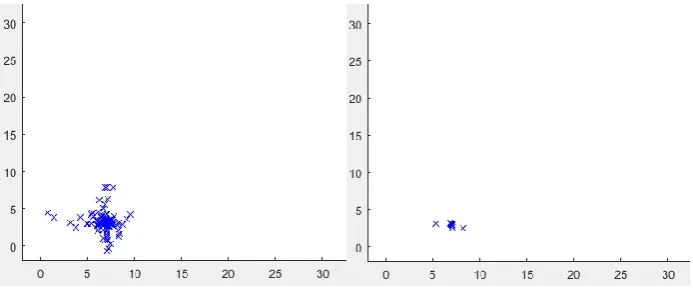
[image:8.595.125.472.257.403.2]For the needs of this simplified case study, the values of the first three pa-rameters were added and stored into a matrix (representing their summed value in all possible compositions), while a similar matrix was used for the response time parameter. The result of executing the, now less complex, objective function is shown figure 3.
Fig. 3. Swarm converges to optimal values after 15 (left) and 30 (right) iterations
5
Conclusion
We have demonstrated an approach for the selection and composition of WS, based on LoD and SPARQL endpoints. Our approach combines the bene-fits of utilizing semantic descriptions as well as those offered by the struc-tured nature of RDF data. Through the application of a case study, we exam-ined the feasibility of the proposed methodology, with promising results. Future work involves the implementation of the framework along with a cor-responding GUI. In addition, we plan to investigate modified versions of the PSO algorithm in order to support both serial and parallel execution flows. Finally, we work towards the automated generation of SPARQL queries, by transforming plain text requests. This will allow the utilization of the pro-posed framework by non-programmers and ease the overall procedure. Fi-nally, we work towards the automated generation of SPARQL queries, by transforming plain text requests. This will allow the utilization of the pro-posed framework by non-programmers and ease the overall procedure.
6
References
1. Ahmad, H., Dowaji, S.: Linked-OWL: A new approach for dynamic linked data service workflow composition. Webology, 10(1), 21-30. (2013)
2. Al-Masri, E., Mahmoud, Q. H.: Discovering the best web service. In: 16th International Conference on World Wide Web, pp. 1257-1258. (2007)
3. Al-Masri, E., Mahmoud, Q. H.: QoS-based Discovery and Ranking of Web Services. In: IEEE 16th International Conference on Computer Communications and Networks, pp. 529-534. (2007)
4. Alrifai, M., Risse, T., Nejdl, W.: A hybrid approach for efficient Web service composition with end-to-end QoS constraints. ACM Transactions on the Web, 6(2). pp 1-31. (2012)
5. Bianchini, D., De Antonellis, V., Melchiori, M.: A linked data perspective for effective ex-ploration of web APIs repositories. In: Daniel, F., Dolog, P., Li, Q. (eds.) LNCS, vol. 7977, pp. 506-509. Springer Berlin Heidelberg. (2013)
6. Chen, W., Paik, I.: Improving efficiency of service discovery using Linked data-based ser-vice publication. Information Systems Frontiers, 15(4), 613-625. (2013)
7. Fahad, M., Moalla, N., Ourzout, Y.: Dynamic execution of a business process via web ser-vice selection and orchestration. Procedia Computer Science, 51, 1655-1664. (2015)
Inter-national Parallel and Distributed Processing Symposium Workshops & PhD Forum,pp. 2280-2285. (2012)
9. Kim, S., Berlocher, I., Lee, T.: RDF based Linked Open Data Management as a DaaS Plat-form. In: First International Conference on Big Data, Small Data, Linked Data and Open Data, pp. 58-61. (2015)
10. Kennedy, J., Eberhart, R.: Particle swarm optimization. In: IEEE International Conference on Neural Networks, 1995, pp. 1942-1948. (1995)
11. Krummenacher, R., Norton, B., Marte, A.: Towards linked open services and processes. In: Berre, A.J., Gómez-Pérez, A., Tutschku, K., Fensel, D. (eds.) LNCS, vol. 6369, pp. 68-77. Springer Berlin Heidelberg. (2010)
12. Neubert, J.: Linked data based library web services for economics. In: International Con-ference on Dublin Core and Metadata Applications, pp. 12-22. Dublin Core Metadata Ini-tiative. (2012)
13. Norton, B., Krummenacher, R., Marte, A., Fensel, D.: Dynamic linked data via linked open services. In: Workshop on Linked Data in the Future Internet at the Future Internet As-sembly, pp. 1-10. (2010)
14. Norton, B., Stadtmüller, S.: Scalable discovery of linked services. In: 4th International Workshop on Resource Discovery, pp. 6-21. (2011)
15. Stadtmüller, S.: Composition of linked data-based RESTful services. In: Philippe Cudré-Mauroux, P., Heflin, J., Sirin, E., Tudorache, T., Euzenat, J., Hauswirth, M., Parreira, J.X., Hendler, J., Schreiber, G., Bernstein, A., Blomqvist, E. (eds.) LNCS, vol. 7650, pp 461-464. Springer Berlin Heidelberg. (2012)
16. Vesyropoulos, N., Georgiadis, C. K.: QoS‐Based Filters in Web Service Compositions: Utiliz-ing Multi‐Criteria Decision Analysis Methods. Journal of Multi‐Criteria Decision Analysis, 22(5-6), 279-292. (2015)
17. Wang, S., Sun, Q., Zou, H., Yang, F.: Particle swarm optimization with skyline operator for fast cloud-based web service composition. Mobile Networks and Applications, 18(1), 116-121. (2013)
18. Wang, W., Sun, Q., Zhao, X., Yang, F.: An improved particle swarm optimization algorithm for QoS-aware web service selection in service oriented communication. International Journal of Computational Intelligence Systems, 3(1), 18-30. (2010)