THE IRISH IN BRISTOL, 1938-1985
by
Nick Conway BA (Swansea) MA (Liverpool)
Submitted for the degree of Doctor of Philosophy
Department of Arts and Cultural Industries,
Faculty of Arts, Creative Industries and Education,
University of the West of England
Contents
List of Tables and Figures – 4 List of Abbreviations - 5 Abstract – 6
Acknowledgements - 7 Introduction - 8
Research Aims - 9
Research Methodology -9
Definition of terms and census data -13 Importance of the research - 14
Historiography - 18
Chapter 1: Irish Emigration and Bristol - 22 1.1: Leaving Ireland - 23
1.2: The Irish in Bristol - 32
1.3: Patterns of settlement in Bristol - 37 1.4: Experiences of Bristol - 45
1.5: Conclusion - 53
Chapter 2: „Factory and building site fodder‟? - 56
2.1: World War Two workers - 58 2.2: Wartime Irish labour in Bristol - 59 2.3: Transport and housing problems - 61 2.4 Building labourers - 67
2.5 Post-War rebuilding - 68
2.6: NSHC Hostels for Irish building labourers - 72 2.7: Irish nurses in Bristol -79
2.8: Nursing shortages - 83 2.9: The Glenside Irish - 86
2.10: Religious affiliation and geography - 87
2.11: Working at Glenside and further migration - 91 2.12: A positive stereotype? - 92
2.13: Conclusion - 95
3.2: The Treaty Ports - 101
3.3: Loyalists and Nationalists - 104 3.4: Fifth column fears - 107
3.5: The American Note - 110 3.6: Volunteers and emigrants - 111 3.7: Condolences and speeches - 113
3.8: The Republic and the Commonwealth - 115 3.9: The Troubles - 117
3.10: Civil rights to Bloody Sunday - 121 3.11 Park Street and Birmingham - 128 3.12: The Prevention of Terrorism Act - 135 3.13: The Mountbatten assassination - 145 3.14: The Hunger Strikes - 147
3.15: The Brighton bombing - 152 3.16: The Hillsborough Agreement - 153 3.17: Conclusion - 155
Chapter 4: Social and cultural developments - 158 4.1: Irish spaces - 159
4.2: The importance of Irish centres -161 4.3: The Catholic church and Irish clubs - 163 4.4: Irish pubs - 168
4.5: Retaining ties with Ireland - 174
4.6: Holidays and „the myth of return‟ - 177 4.7: The second-generation - 185
4.8: Assimilation and integration -191 4.9: Conclusion -196
Conclusion -198
Main findings - 198
Research aims and conclusions - 200 Recommendations for future research – 203
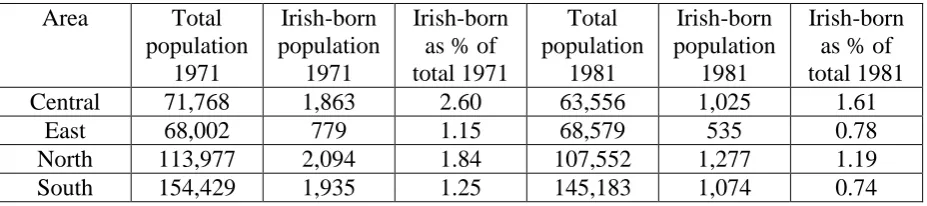
Appendix A: Irish-born population of Bristol by council ward, 1971-1981 - 206 Appendix B: Research Participant Biographies - 207
List of Tables
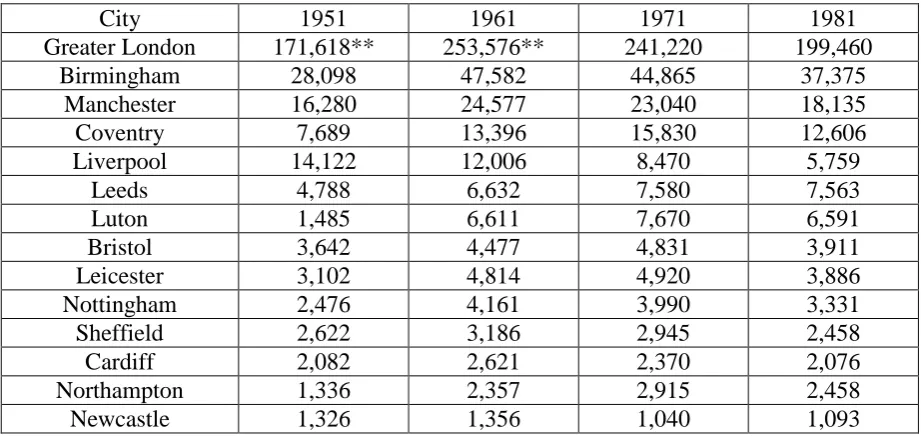
Table A: Irish-born population in England and Wales: selected cities - 18
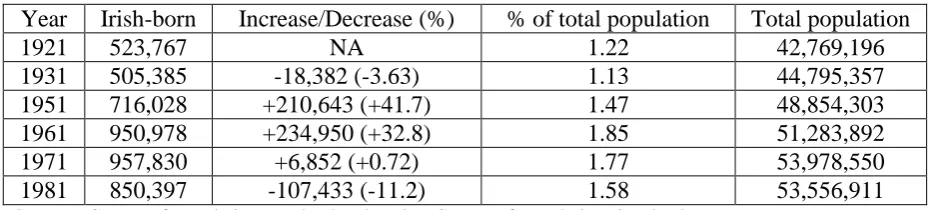
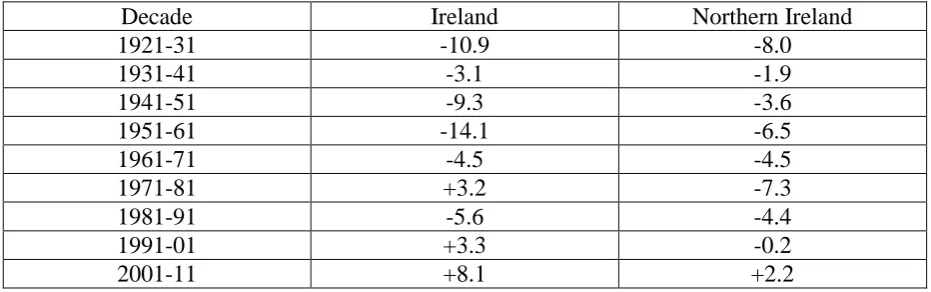
Table 1.1: Irish-born population of Great Britain as a percentage of total population - 33 Table 1.2: Ireland net migration by decade (per 000) - 34
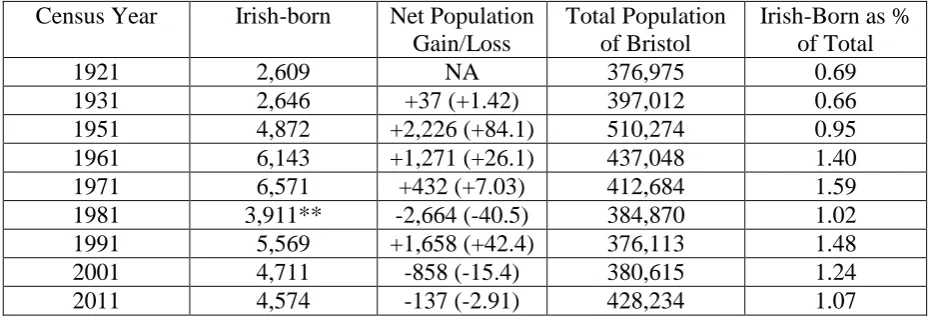
Table 1.3: Irish-Born population of Bristol, 1921-1991 - 35
Table 1.4: Irish-Born Population of Bristol by Gender, 1921-2001 - 36
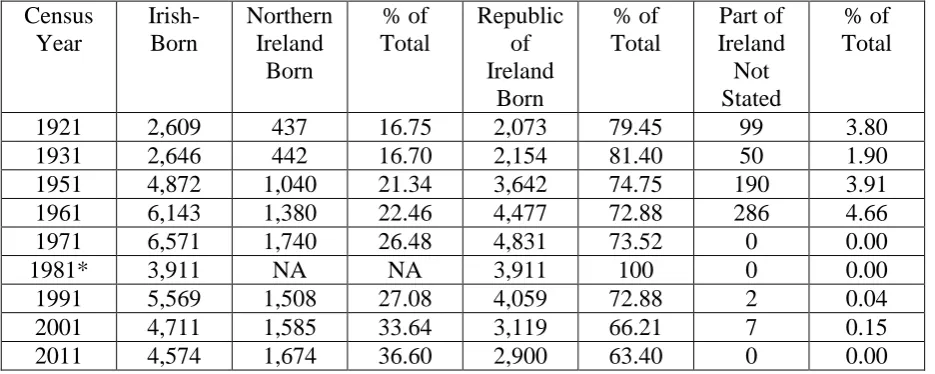
Table 1.5: Irish-Born Population of Bristol by country of birth, 1921-2011 - 36 Table 1.6: Irish-born population of Bristol by area - 40
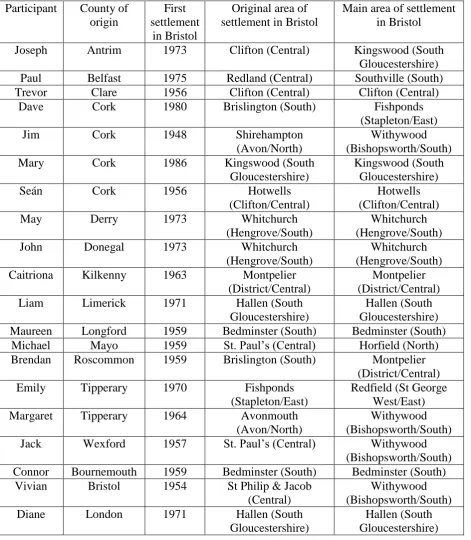
Table 1.7: Original and main areas of settlement in Bristol for the participants of this study - 43
Table 2.1: Direct passenger movement by sea from Ireland to Great Britain and Northern Ireland 1939-1945 - 59
Table 2.2: National Service Hostels Corporation and Ministry of Supply Hostels and capacities, 1944-45 - 64
Table 2.3: Principal Occupations of Irish-born Males in Great Britain, 1961 - 70
Table 2.4: Females in receipt of Irish travel permits and identity cards by last occupation, 1940-46 (%) - 82
Table 2.5: Principal Occupations of Irish-born Females in Great Britain, 1961 - 82
List of Figures
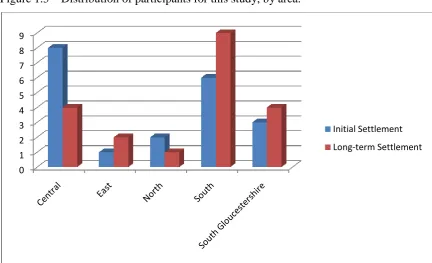
Figure 1.1: Irish-born population of Bristol by council ward, 1971 - 38 Figure 1.2: Irish-born population of Bristol by council ward, 1981 - 39 Figure 1.3: Distribution of participants for this study, by area - 41 Figure 1.4: Initial area of participant settlement - 44
Figure 1.5: Main area of participant settlement - 45
Figure 2.1: Irish-born nurses as a proportion of total nursing staff at Glenside Hospital, 1920-44, 1947-57 - 87
Figure 2.2: Irish-born nurses at Glenside, 1920-44, 1947-57 by country of birth (%) - 88 Figure 2.3: Irish-born nurses at Glenside by country and province of origin, 1920-57, (%) - 89 Figure 2.4: Irish-born nurses at Glenside hospital by county of origin - 90
List of Abbreviations
BBC – British Broadcasting Corporation. BCC – Bristol City Council.
BEP – Bristol Evening Post.
BIS – Bristol Irish Society.
CHAS – Catholic Housing Aid Society. CSI – Chief Sanitary Inspector.
DUP – Democratic Unionist Party. EU – European Union.
G2 – The Directorate of Military Intelligence, Ireland. GAA – Gaelic Athletic Association.
HA – Hillsborough Agreement.
HEC – Bristol City Council Health Committee. HOC – Bristol City Council Housing Committee. IEC – Irish Emigrant Chaplaincy.
INLA – Irish National Liberation Army.
IP – Irish Post.
IRA – Irish Republican Army.
MG – Manchester Guardian.
MI5 – The United Kingdom‟s domestic counter-intelligence and security agency. MOA – Ministry of Aviation.
MOH – Medical Officer of Health. MOL – Ministry of Labour.
MOS – Ministry of Supply.
NICRA – Northern Ireland Civil Rights Association. NSHC – National Service Hostels Corporation. OIRA – Official Irish Republican Army. PIRA – Provisional Irish Republican Army. PTA – Prevention of Terrorism Act.
RTÉ - Raidió Teilifís Éireann. UUP – Ulster Unionist Party.
Abstract
The main focus of this thesis is the Irish population of Bristol from 1938 to 1985. Up to now, the twentieth century Bristol Irish have been largely absent from the historical and
sociological discourse on both Bristol and the Irish in Britain. This thesis seeks to address their absence as well as to locate the experiences of the Bristol Irish within the context of the Irish in Britain through comparisons to similar studies conducted in other British cities. In addition, it seeks to ascertain to what degree the Bristol Irish have integrated or been assimilated into the native populace.
It centres on several key issues such as the lived experience of the Bristol Irish, as well as the homogeneity of the migration process and the Irish experience in twentieth century Bristol. This necessitated an in-depth investigation relating to residential patterns in the city and the predominance of traditional Irish occupational groupings such as nursing for females and building work for males. It was also necessary to ascertain the importance of Irish spaces in the city. These include pubs, clubs and associations as well as the role of the Catholic Church.
This was achieved through several strands of investigation, which included several types of primary and secondary sources, as well as both quantitative and qualitative analysis. As we will see in Chapter Four, Bristol‟s Irish population have not always had the same level of cultural organisation as exists in British cities with higher Irish populations such as
London and Birmingham. As a result of this, individual experiences became vital to the research. In fact, several historians have argued that the true details of migration can only be revealed by the migrants themselves. To this end, new interviews were undertaken with Irish-born people living in Bristol contacted through friend and family links as well as the
snowballing technique. This allowed for a qualitative analysis of individuals‟ experiences of migration, housing and employment as well as social and cultural life in Bristol. This
included an examination of the extent to which the Bristol Irish have integrated or been assimilated into the native populace.
Acknowledgements
It would not have been possible to complete this thesis without the incredible support – both financial and emotional - that I have received from my family, particularly my parents Nick and Ellen, my brother Simon and my Uncle Martin and Auntie Jane. The importance of their patience and belief in me is impossible to quantify.
Immense gratitude is due to my three supervisors. To Madge Dresser and Phil Ollerenshaw for their expertise, constant encouragement, reassurance and invaluable advice throughout. Thanks are also due to Kent Fedorowich for seeing me over the line as my third supervisor and for his feedback and advice throughout my time at UWE. The importance of their kindness, guidance and patience has been immeasurable.
I would like to thank all of the participants for this thesis who gave up their time to talk to me about their experiences in Bristol. Their stories, support and openness made this project possible. Thanks are also due to the Bristol Irish Society, staff at the Bristol Record Office, Bristol Central Library, Gill Hogarth and Canon Harding at the Clifton Diocesan Archives and Fiona Overbeke at BBC Bristol. Joseph Horgan, from „A Memo Regarding Those of Indeterminate Status‟ and „Swift‟, from Slipping Letters Beneath the Sea, (Doghouse, 2008), reproduced by permission of Joseph Horgan. John Hewitt, from „An Irishman in Coventry' and 'The Search' , from John Hewitt: Selected Poems, eds. Michael Longley and Frank Ormsby (Blackstaff Press, 2007), reproduced by permission of Blackstaff Press on behalf of the Estate of John Hewitt.
I would also like to thank staff at UWE, particularly Yasmin Al-Rehani, for their assistance, particularly with the application process what feels like many years ago. Credit is also due to Diane Urquhart of the Institute of Irish Studies at Liverpool University for her supervision of my MA thesis and to Nick Woodward at Swansea University for stoking my interest in Irish emigration. Thanks are also due to Jon Reddiford at Nailsea School for instigating my fascination with history.
To all my friends and family in Bristol, South Wales, Liverpool, Switzerland and beyond, thank you for your understanding in the periods where I have gone AWOL due to a lack of time or funds as well as for your support throughout. Special thanks to Chris Reader for his support and friendly ear in what was, at times, a lonely undertaking.
Introduction: „A very large and unlighted cavern‟
1Now in many ways, the Irish diaspora is similar to a Faberge egg. It is a marvellously complex phenomenon. Details, though fascinating in themselves, are subordinated to the larger picture, since they all interrelate and all are subject to the whole. And, like a Faberge egg, the diaspora has to be viewed as a three-dimensional object if it is to be appreciated.2
In 1996, Donald Harman Akenson fittingly described the literature on the Irish in Britain as a „very few candles in what is a very large and unlighted cavern.‟3
This statement was particularly true of the research on the twentieth century, the extent of which has, to date, been dwarfed by the amount of literature on the nineteenth century. Taking into account the imbalance in research, one could be forgiven for exclusively attributing Irish emigration to Britain to the first-wave emigration of the nineteenth century and particularly with the horror of the Great Famine of 1845-52. However, the study of the Irish in twentieth century Britain has made tremendous strides in recent years, especially since the 1990s. As a consequence, a flowering of new literature, the vast majority of which focuses on specific cities, towns or locations, has been published.
Indeed, migration from Ireland to Britain has never been more relevant since the global financial crisis of 2007-8 brought an abrupt halt to Ireland‟s prosperous „Celtic Tiger‟ period. In the twenty-first century, Irish emigrants can interact with home through new technologies, social media and online hubs such as the Irish Times‟ „Generation Emigration‟ section, now called „Irish Times Abroad‟, which was established in 2011. These ongoing developments have brought the previously under-researched emigration of the twentieth century into focus and will no doubt continue to fuel the growth of literature on second and third wave Irish emigration to Britain.
In spite of these developments, the study of the Bristol Irish has been limited to a handful of essays, journal articles and chapters on the nineteenth century. This thesis is concerned with the Irish experience in Bristol from 1938 to 1985. The city of Bristol is of particular interest as, despite having had a considerable Irish-born population throughout much of the twentieth century, there is an almost-total lack of academic research on the city‟s place in the Irish diaspora.
1
Donald Harman Akenson, The Irish Diaspora. A Primer. (Toronto: P. D. Meany, 1996), p.190. 2 Akenson, The Irish Diaspora, pp.2-3
Research aims
Given the lack of previous research, this thesis is intended to provide an overview of the Irish-born population in Bristol between 1938 and 1985 on economic, political and social lines. This approach has necessitated a focus on several key themes relating to questions of diaspora, identity and belonging. The migration experience is considered, notably
individuals‟ reasons for leaving Ireland, settling and living in Bristol. This thesis also examines experiences of employment, with a particular focus on „navvying‟ and nursing - occupations with which Irish people have been associated in Britain. There is also an examination of Anglo-Irish relations through the period which has been partly achieved through a comprehensive survey of Bristol‟s two main newspapers. In addition to this, the immigrants‟ relationship with their new setting and the development of new communities and social structures in Bristol will be considered. The main research questions for this thesis are: was the migration experience of the Bristol Irish homogenous, and if so, to what extent? To what extent have the Bristol Irish been assimilated into the native populace? Were the Irish concentrated in stereotypical Irish occupations such as „navvying‟ and nursing in Bristol? To what extent were the Irish accepted by their Bristolian neighbours and colleagues, as well as the regional press? What impact have Irish associations, clubs, pubs and events had in shaping and maintaining Irish identities in Bristol? To what extent have ties with Ireland and Irish identities been maintained and passed on to subsequent generations? The overriding purpose behind these questions is to uncover the lived experience of Irish people in twentieth century Bristol.
Research Methodology
Memory, I realize, can be an unreliable thing; often it is heavily coloured by the circumstances in which one remembers, and no doubt this applies to certain of the recollections I have gathered here.4
Original national and local archival material was extensively utilised for this thesis. Student nurse staff data arising from the record books of Glenside hospital facilitated a remarkably detailed analysis of the hospital‟s Irish staff members. The analysis of Bristol City Council [BCC] records, notably those of the Housing and Health Committees uncovered valuable insight into the extent of the migration of Irish building labourers to Bristol in the immediate post-war period. National Archive sources have also shown the demand for and presence in Bristol of Irish labourers during the widespread labour shortages of the Second World War.
In addition to this, local and national radio and television material has been utilised. This thesis also considered material from local and national newspapers, principally the two most prominent Bristol newspapers, the Bristol Evening Post [BEP] and the Western Daily Press
[WDP]. The newspapers were particularly important when analysing key events in Anglo-Irish relations throughout the period. To my knowledge, none of these sources have been studied previously and analysed as has been done in this research.
These original materials were integral to the compilation of this thesis. However, quantitative sources such as those outlined above reveal relatively little about the lived experience of the emigrants. Brendan McGowan has persuasively argued that the answers to these unquantifiable questions cannot be found in „skeletal data‟ or census statistics but in the experiences of the emigrants themselves.5 To this end, 20 new interviews, of which 17 were with Irish people who were born between 1926 and 1952 and came to Bristol in the period 1948 and 1986, as well as three with second-generation Irish people who have lived in the city were undertaken. Given the paucity of literature on the Irish in twentieth century Bristol, this process was essential to the thesis. The value of this method has been illustrated in several of the aforementioned twentieth century studies which have extensively utilised oral material. For example, the work of Lennon, McAdam and O‟Brien on Irish women in London, Louise Ryan on Irish nurses, Sharon Lambert on Irish women in Lancaster, Sean Sorohan on the Irish in London and McGowan on the Irish in Leeds. Oral history has been recognised as an essential element in the study of the Irish in Britain by several commentators including Enda Delaney, who bemoaned the lack of research on the „actual experience‟ of the largest migrant grouping in Britain:
the process of migration involves real people with real stories. A sense of displacement, a desire to return home and the sometimes painful adaptation to the forms of the new society feature prominently in the oral testimony of all migrants.6
The advantages of the oral history approach have also been outlined in recent literature on the Irish in Britain and the discipline of oral history.7 In their pioneering 1988 oral history of
5 Brendan McGowan, Taking The Boat, The Irish in Leeds 1931-1981. (Mayo: Brendan McGowan: 2009), p.11. 6
Enda Delaney, Demography, State and Society, Irish Migration to Britain 1921-1971. (Liverpool: University of Liverpool Press, 2000), p.160.
7 Kathryn Anderson and Dana C. Jack, “Learning to listen, Interview techniques and analyses” in The Oral
History Reader, eds. Robert Perks and Alistair Thomson, (London: Routledge, 1998), 157-171, p.157; Kathy Burrell and Panikos Panayi, “Immigration, History and Memory in Britain” in Histories and Memories, Migrants and their History in Britain, (eds.) Kathy Burrell and Panikos Panayi, (London: Tauris Academic Studies, 2006), 3-17, p.14;Delaney, Demography, State and Society, p.297; Enda Delaney, The Irish in Post-War Britain. (Oxford: Oxford University Press, 2009), p.46; Ronald J. Grele, “Movement without aim,
Irish women in London, Lennon, McAdam and O‟Brien argued that the majority of the historiography of the Irish in Britain had been „written from the outside‟. They also identified that women had been overlooked and therefore turned to oral history „as the prime source of information for this study, so as to enable Irish women‟s history to be written, as far as possible, from their own perspective.‟8
In addition to this, Ann Rossiter has argued that oral history renders „invisible groups and individuals visible, allowing the silenced to speak‟.9
Whilst information arising from interviews forms a vital part of this thesis, it is important to recognise the disadvantages of oral history methods. Chief amongst these is the potentially unreliable nature of memory which has been comprehensively discussed in the literature. 10 Paul Thompson has argued that interviews are inevitably „influenced by subsequent changes in values and norms‟ which can „unconsciously alter perceptions‟ and „distort‟ accurate recollection.11
Another problem is the value of drawing conclusions from a sample of 20 participants. Whilst this qualitative approach has allowed a thorough analysis from the participants‟ own perspective, it is clear that any conclusions arising from a sample size such as this cannot be treated as representative of Bristol‟s entire Irish-born population. This research was not intended to exclude sections of Bristol‟s Irish population; I concede that the vast majority of the participants were Roman Catholics born in the Republic. The main reason for this was that new participants were identified through family and friend links, using „snowballing‟ techniques and social media to recruit further participants. Whilst it was not the intention of the researcher to exclude groups such as individuals born in
Regional Studies, 2001), pp.1-2; McGowan, Taking The Boat, pp.11-12; Mary Muldowney, The Second World War and Irish Women, An Oral History. (Dublin: Irish Academic Press, 2007), pp.2-3; Alessandro Portelli, “What makes oral history different” in The Oral History Reader, eds. Robert Perks and Alistair Thomson, (London: Routledge, 1998), 63-74, p.68; Ann Rossiter, Ireland‟s Hidden Diaspora: the „abortion trail‟ and the
making of a London-Irish underground, 1980-2000. (London: Iasc Publishing, 2009), p.27; Samuel Schrager, “What is social in oral history?” in The Oral History Reader, eds. Robert Perks and Alistair Thomson, (London: Routledge, 1998), 284-299, p.294; Paul Thompson, The Voice of the Past: Oral History. (Oxford: Oxford University Press, 2000), pp.3, 6; John Tosh, The Pursuit of History. (Harlow: Pearson, 2010), pp.313-17; Bronwen Walter, Outsiders Inside, Whiteness, place and Irish women. (London: Routledge, 2001), pp.3-4; Valerie Raleigh Yow, Recording Oral History: A Practical Guide for Social Scientists. (London: Sage Publications, 1994), pp.12-13.
8 Mary Lennon, Marie McAdam and Joanne O‟Brien, Across The Water, Irish Women‟s Lives in Britain, (London, Virago Press, 1988), pp.1-2.
9 Rossiter, Ireland‟s Hidden Diaspora, p.27.
10 Burrell and Panayi, Immigration, History and Memory, p.14;Delaney, Demography, State and Society, p.140; Delaney, The Irish, p.123; Grele, “Movement without aim, p.41; Trevor Lummis, “Structure and validity in oral
evidence” in The Oral History Reader, eds. Robert Perks and Alistair Thomson (London: Routledge, 1998), 273-283, p.280; McGowan, Taking The Boat, pp.11-12; Portelli, “What makes oral history different”, p.68; Joan Sangster, “Telling our stories, Feminist debates and the use of oral history” in The Oral History Reader, eds. Robert Perks and Alistair Thomson (London: Routledge, 1998), 87-100, p.87; Schrager, “What is social in oral history?”, p.294; Seán Sorohan, Irish London During The Troubles. (Dublin: Irish Academic Press, 2012), pp.4-5; Thompson, The Voice of the Past, pp.128-9; John Tosh, The Pursuit of History, pp.313-4.
Northern Ireland, or Irish Protestants, a more substantial sample was beyond the scope of this thesis. It is clear that there is considerable work to be done on these groups in the Irish
diaspora and it is hoped that this thesis will serve as a starting point for further research on the Bristol Irish.
This thesis covers the period from 1938 to 1985 and includes all 32 counties of Ireland: the 26 which make up the Republic and the six which comprise Northern Ireland. 1938 marks an appropriate starting point as this was the year in which the Anglo-Irish Agreement – which caused such consternation during the Second World War – was signed. 1985 represents a fitting end point because this was the year in which the Hillsborough Agreement [HA] was signed by the British Prime Minister Margaret Thatcher and the
Taoiseach of the Republic of Ireland Garret Fitzgerald. Like its predecessor in 1938, the 1985 Agreement is regarded as a watershed event in Anglo-Irish relations. The period 1938 to 1985 also broadly encompasses second wave emigration from Ireland to Britain, which took place between the 1930s and 1970s.
Definition of terms and census data
It is now necessary to clarify some of the terms which appear throughout this thesis. Since the partition of Ireland in 1922, the 26 counties have gone by several names – the Irish Free State, Éire, Ireland, the Irish Republic and Southern Ireland. Conversely, the 6 counties have consistently been referred to as Northern Ireland or Ulster, although the latter designation overlooks the fact that three of Ulster‟s nine counties are in the Republic. For the purposes of this study, the 26-county Irish Republic is referred to simply as „Ireland‟, whilst the six counties are referred to as „Northern Ireland.‟ Where appropriate, such as where statistics do not make a distinction between the two Irelands, the terms „the Republic‟ and „Northern Ireland‟ are utilised for the purposes of differentiation. Interviewees for this study are referred to as „participants‟ rather than the commonly-used „respondents‟ or „informants‟. Whilst both have often been favoured by social scientists conducting oral-based research projects, the term „participant‟ suggests a fuller contribution than „respondent‟ or „informant‟, which both imply that interviewees are simply responding to a proscribed questionnaire. This would not represent a fair reflection of the interview process, nor would it fully recognise the
contribution of participants to the thesis.
Where British census data is utilised, the terms „Republic of Ireland-born‟ and „Northern Ireland-born‟ are used to differentiate individuals born in the 26 counties from those born in the six counties. However, the inclusion of a third – and far more ambiguous - category, „Ireland (part not stated)‟ was addressed by a post-enumeration survey in 1961. This survey found that „practically all these persons were actually born in the Irish Republic.‟12 Another issue with the census figures is the definition of nationality as an individual‟s place of birth. Therefore, an individual born to Irish parents in Britain would be categorised as British rather than Irish. Hickman and Walter, in their 1997 report on anti-Irish discrimination in Britain, have noted the importance of second-and-subsequent-generation Irish individuals and reasoned that their exclusion from the „Irish‟ cohort of the British census has left the size of the Irish community „greatly understated‟.13
They have argued that the Irish figure should be multiplied by three to counter this statistical omission and reveal the true size of Britain‟s Irish population.14
12 McGowan, Taking The Boat, p.9.
13 Mary J. Hickman and Bronwen Walter, Discrimination And The Irish Community In Britain. A report of
research undertaken for the Commission for Racial Equality. (London: Commission for Racial Equality, 1997), p.19.
Fortunately, the restrictions of Irish-born data will have less impact on the study of the Irish in twenty-first century Britain, as a new category of „White Irish‟ was added to the census ethnic groups. This allows individuals born outside of Ireland to claim an Irish identity within the British census data and will no doubt be a valuable resource to future historians of the Irish in Britain. Even with these limitations in mind, the census information is vital in illustrating the size of Bristol‟s Irish-born population and should be regarded as a valuable resource.
Importance of the research
Bristol and Ireland share a hidden history, reaching back 900 years to when Henry II gave Dublin to the men of Bristol. Centuries later, the armies of both Elizabeth I and Cromwell sailed from the city to occupy Ireland. Generations of people leaving Ireland since then have settled in Bristol and, in spite of prejudice, made important contributions to the city‟s life. They now make up a tenth of Bristol‟s population, and they are a diverse and vibrant community, still largely unrecognised here, across the water.15
The lack of research and published material on the Bristol Irish, particularly in the twentieth century, is sufficient justification for this thesis. This lack of focus on the previous century is also not confined to the Bristol Irish. The paucity of study is such that there are only two full-length volumes which attempt to provide an overview of the Irish in Britain in the twentieth century. It is impossible to discuss the secondary literature without first mentioning Jackson‟s 1963 text which was the only lengthy published work on the Irish in twentieth century Britain for an astonishing 43 years.16 Despite its limitations, such as its near-total lack of interest in female emigrants and the fact that it was published before many significant events in Anglo-Irish history such as the Troubles in Northern Ireland, Jackson‟s pioneering work is
unfailingly cited in subsequent studies on the Irish in Britain. The second major treatise, Delaney‟s The Irish in Post-War Britain, was published in 2009. This has been one of the most influential texts in my approach to writing this thesis, not least in terms of Delaney‟s eschewing of the standard chronological approach in favour of a thematic style, which has also been utilised for this study. Delaney addressed some of the shortcomings of Jackson‟s work, most notably by devoting considerable attention to Irish women in Britain. Delaney also challenged the theory that the Irish are readily assimilated into the host British population which has been forwarded by several academics such as Liam Ryan in his
15
BBC Bristol Archive. Here, Across the Water, produced by Liz White and Stephen Frear (1993, Bristol, BBC Bristol, screened 29/4/93).
otherwise excellent article on Irish emigration to Britain after the Second World War. If Delaney‟s book has a fault, it is that the ambitiousness of the project – covering the entire post-war period and all of Britain – left considerably less space to discuss the intricacies of life in Britain then can be found in contemporary local studies. Delaney had previously written another prominent book, Demography, State and Society, an impressively detailed study of Irish migration to Britain from 1921 to 1971. This is particularly strong in terms of wartime emigration and employment and makes effective use of the British Ministries of Labour and Supply records relating to the Irish influx. Another highly influential text for this study is Wills‟ 2015 book on post-war Irish emigration and culture. The Best Are Leaving
examines stereotypes of the Irish experience in Britain such as Catholicism, church and state concerns over the welfare of female emigrants in Britain and „the drunken, fighting
Irishman.‟17
It is no surprise, given her background in literary and cultural studies, that Wills‟ text is also interspersed with passages from contemporary British and Irish publications, as well as drama and literature, which adds great depth to her account.
In spite of these excellent recent studies, the study of the Irish population of twentieth century Britain still represents a significant opportunity for researchers. The bulk of
published work has appeared in the last 30 years and has, for the most part, been confined to journal articles or contributions to edited collections on particular cities or locales. Some are based on areas which have consistently attracted a high number of Irish migrants since at least the mid nineteenth century, such as London, Lancashire, Leeds and Scotland.18 Of these, MacGowan‟s study of the Leeds Irish, as well as Sorohan‟s text on the London Irish have been of particular interest to me. Like Delaney, MacGowan utilised a thematic approach which served as an inspiration to this study. Taking the Boat is heavily based on original oral interviews with 33 individuals. It is therefore very strong in terms of its exploration of „real people‟ and „real stories‟ although MacGowan‟s interest in the experience of emigration and continued contact with Ireland through letters, technology, holidays and the ever-present prospect of return migration somewhat overrides his focus on the Leeds Irish scene. Sorohan‟s book has a particular focus on the impact of the Troubles in Northern Ireland on the London Irish. He has also utilised the fruits of his own oral interviews very well and through this he was somewhat more successful in illustrating life in the receiving city than
17 Clair Wills, The Best Are Leaving. Emigration And Post-War Irish Culture. (Cambridge: Cambridge University Press, 2015), p.xv.
18 T. M. Devine (ed.), Irish Immigrants and Scottish Society in the nineteenth and twentieth centuries,
MacGowan. Sorohan also acknowledged the importance of institutions and organisations such as the Catholic church and the Gaelic Athletic Association [GAA] in the development and maintenance of Irish communities in London. Other studies focus on areas which emerged as important destinations through the Second World War and post-war expansion such as Luton, Birmingham and Coventry.19 It is particularly striking that the only in-depth volumes on the Irish in Birmingham – one of the most important post-war Irish destinations – were only published in the current century.20 Amongst these is James Moran‟s Irish
Birmingham, which focuses on both the nineteenth and twentieth centuries. In spite of less than half of the book being dedicated to the latter century, making it less relevant to this study, Moran compellingly countered Coogan‟s criticism of the Birmingham Irish scene as a „dull tide of grey‟ through his vivid descriptions of the St Patricks Day parades in the city as well as his focus on notable Birmingham Irish playwrights.21
My interest in the Irish in twentieth century Bristol is, at least partly, a result of my status as a third-generation Irishman born in the city. To date there has been no lengthy published work on the Bristol Irish. Indeed, Kaja Ziesler, in her doctoral thesis on the Birmingham Irish, has described Bristol as a „secondary destination‟22
whilst Donall
MacAmhlaigh, in his evocative diary, expressed his surprise at the lack of visible Irishmen in the city centre during the 1950s.23 However, Bristol has been described as having
„connections with Ireland of such longevity and significance‟ that even Liverpool and Glasgow - two British cities with perhaps the most visible and enduring Irish connections - cannot rival.24 Brendan Smith has argued that Bristol‟s trading links with Ireland, as well as the city‟s „intimate‟ involvement in King Henry II‟s 1170 conquest of Ireland and the
19 Henrietta Ewart, “„Coventry Irish‟: Community, Class, Culture and Narrative in the Formation of a Migrant Identity, 1940–1970,” Midland History, Vol. 36, No. 2, Autumn, 2011:
http://docserver.ingentaconnect.com/deliver/connect/maney/0047729x/v36n2/s7.pdf?expires=1337078638&id= 68823523&titleid=75003502&accname=University+of+the+West+of+England&checksum=E9C6E3FEA4C97 E4620BE104D7762E43C (accessed May 15, 2012); Russell King, Ian Shuttleworth and Alan Strachan, “The Irish in Coventry: the Social Geography of a Relict Community,” Irish Geography, Vol. 22, No. 2, 1989: http://www.tandfonline.com/doi/abs/10.1080/00750778909478772 (accessed April 4, 2012); Philip A. McCarvill, “An Examination of Ethnic Identity: A Case Study of Second Generation Irish People in
Birmingham” (PhD Thesis, University of Warwick, 2002); Carl Chinn, Birmingham Irish, Making Our Mark. (Birmingham: Birmingham Library Services, 2003); Moran, Irish Birmingham; Bronwen Walter, “Ethnicity and
Residential Distribution,” Transactions of the Institute of British Geographers, Vol.11, No. 2, 1986, http://www.jstor.org/stable/622001?seq=1 (accessed April 6, 2012); Kaja Irene Ziesler, „The Irish in Birmingham 1830-1970‟, unpublished PhD Thesis, University of Birmingham (1989).
20 Chinn, Birmingham Irish; Moran, Irish Birmingham, p.1 21 Coogan, Wherever Green Is Worn, pp.198-9.
22
Kaja Irene Ziesler, “The Irish in Birmingham, p.1.
thirteenth century rebuilding of Dublin‟s Christ Church Cathedral with Dundry25 stone, grants it a unique place in the history of Anglo-Irish relations.26 Indeed, in the midst of Britain‟s impending exit from the European Union [EU], the Irish Post, a weekly newspaper published in Britain, has identified a charter which dates from Henry II‟s aforementioned campaign and grants Bristolians the right to live in Dublin.27 The contribution made to the city by Irish people was also recognised by the then-Lord Mayor of Bristol Charles Budgett in 1935:
Irishmen have made their contribution to the uplift of this city and to its good features. I am glad you appreciate the city in which you are living, and I think it is safe to say that in Bristol, as in other towns, things are better and conditions of living are higher than at any previous time.28
In addition to this, the size of Bristol‟s Irish-born population in the twentieth century compares favourably with those of other similarly-sized British cities. Traditional Irish strongholds such as London, Liverpool and Manchester have all been well-represented, as well as the new industrial Irish centres in the Midlands and south east such as Birmingham, Coventry and Luton. Nonetheless, the study of the Bristol Irish to date reflects the pattern of the study of the Irish in Britain to a large degree. In his unpublished BA dissertation on Irish criminality in 1881 Bristol, Matthew Smith has noted that „Bristol has been significantly undervalued in the study of the Irish diaspora‟, in spite of the city‟s sizeable Irish
population.29 Given that this has produced a small handful of chapters, essays, articles and unpublished theses which focus principally on the nineteenth century, it is difficult to take issue with Smith‟s argument.30
This thesis seeks to begin to rectify the almost total lack of academic focus on the Bristol Irish, particularly in the twentieth century, itself an under-researched period in terms of the Irish diaspora.
25 Dundry is a village in Somerset, situated on the county‟s northern border with Bristol. 26 Smith, Bristol and Ireland.
27
http://irishpost.co.uk/bristol-people-right-to-live-dublin-thanks-to-850-year-old-law-which-still-applies/ (accessed 3/1/17).
28 “Irish “Exiles” Tributes to Bristol” Bristol Evening World, March 18, 1935. In Clifton Diocesan Archive press cuttings 1931-48, p.96.
29
Matthew Smith, „The readymade nucleus of degradation and disorder: An examination of Irish criminality in Victorian Bristol in 1881‟ unpublished BA Thesis, University of Bristol (2011), p.3.
30
Table A: Irish-born* population in England and Wales: selected cities.
City 1951 1961 1971 1981
Greater London 171,618** 253,576** 241,220 199,460
Birmingham 28,098 47,582 44,865 37,375
Manchester 16,280 24,577 23,040 18,135
Coventry 7,689 13,396 15,830 12,606
Liverpool 14,122 12,006 8,470 5,759
Leeds 4,788 6,632 7,580 7,563
Luton 1,485 6,611 7,670 6,591
Bristol 3,642 4,477 4,831 3,911
Leicester 3,102 4,814 4,920 3,886
Nottingham 2,476 4,161 3,990 3,331
Sheffield 2,622 3,186 2,945 2,458
Cardiff 2,082 2,621 2,370 2,076
Northampton 1,336 2,357 2,915 2,458
Newcastle 1,326 1,356 1,040 1,093
Source: Adapted from Alan Strachan, „Post-War Irish Migration and Settlement in England and Wales‟ in Contemporary Irish Migration. Geographical Society of Ireland Special Publications No.6. (Dublin: Geographical Society of Ireland, 1991). 21-31, p.22. Used with permission of the journal editor. *This table only includes individuals born in the Republic of Ireland.
**Estimated.
Historiography
The following is a brief critical overview of the aforementioned works. David Large‟s census enumeration of the Bristol Irish for 1851 acknowledged the absence of the Irish from
Bristol‟s historical discourses as well as from national discourses, such as the Report on the State of the Irish Poor in Great Britain in 1836.31 The minimal effect of the Famine on the size of Bristol‟s Irish population was examined, and the lack of appeal exerted by the city‟s economy was cited as the key factor in this.32 Birthplace data revealed that Cork was, by a huge margin, the most-represented county, with over four times more returns than the second most represented county, Dublin.33 Large recognised the importance of steam packet services to and from Bristol, and noted that the three most represented counties in the census returns were also the three principal destinations: Cork, Dublin and Waterford.34 Madge Dresser also emphasised the importance of the port, and noted its influence in the early nineteenth century when the surge of British soldiers returning home from the Napoleonic Wars was
31 Large, “The Irish in Bristol”, p.37. 32 Ibid, p.38.
33
Ibid, p.42.
compounded by increasing numbers of poverty-stricken Irish people entering British ports and towns.35
Graham Davis‟ 1989 chapter on Irish ghettoisation in nineteenth century British towns - which he expanded upon on in his later text on the Irish in Britain36 - into so-called „Little Irelands‟ has a particular focus on Bristol and supports Large‟s assertion that there was no „Irish ghetto‟ in the city.37
Davis also emphasised the lack of homogeneity within the Irish in Britain and argued that Irish populations did not share a single common identity and could be divided on religious, county and familial grounds.38 Davis also argued that, despite
Bristol‟s overtly Protestant nature - also identified by Dresser and Steve Poole and illustrated by the „bitter electoral battles‟ over Catholic Emancipation39
- Irish immigrants drew a „liberal response‟ in the city. He cited the comparative lack of anti-Irish antagonism over associations with disease.40 In addition to this, he noted a leniency displayed by magistrates towards Irishmen on charges of drunkenness and even sympathy for those who had been swindled out of their possessions by „sharpers‟ or exploited by prospective employers.41
Davis and Dresser also highlighted the variations in the attitude of the local press towards the Irish. The Bristol Times, which Davis described as „virulently anti-Catholic‟
frequently poked fun at the Irish in court reports but also printed regular updates on the condition of Ireland during the Famine and endorsed the Bristol Irish Relief Fund42 by printing a list of subscribers in 1847.43 Davis argued that this sympathetic attitude grew during the 1850s, and cited several articles which highlighted „the implications of massive depopulation for Ireland‟s future.‟44
Matthew Smith‟s newspaper survey of 1876-1884 also identified that the ambivalence towards the Irish displayed by The Bristol Mercury was often at odds with other local and national newspapers.45 Pamela Gilbert also made this point in her doctoral thesis on Catholics in Bristol, noting that The Bristol Mercury‟s sympathetic tone contrasted sharply with the „damaging‟ anti-Catholicism of The Bristol Times, and the rabid
35 Madge Dresser, “The Irish, 1685-1835” in Bristol, Ethnic Minorities and the City 1000-2001, edited by Madge Dresser and Peter Fleming, (Chichester: Phillimore and Co Ltd, 2007), 73-84.
36 Graham Davis, The Irish in Britain. (Dublin: Gill and MacMillan, 1991). 37 Graham Davis, “Little Irelands”, p.120; Large, “The Irish in Bristol”, p.39. 38
Davis, “Little Irelands”, p.114; Jackson, The Irish, p.129; Kevin O‟Connor, The Irish in Britain. (London: Sidgwick & Jackson Ltd, 1972 ), p.26.
39 Davis, “Little Irelands”,, pp.4, 104-5, 119, 123-4. 40 Davis, “Little Irelands”,, pp. 4, 104-5, 119. 41
Davis, “Little Irelands”, pp.123-4; Davis, The Irish in Britain, pp.4-5, 72-3. 42 This raised £9,000 overall.
43 Davis, “Little Irelands”, pp.120-1; Davis, The Irish in Britain, pp.72-3; Madge Dresser, “Catholics and Jews, 1837-1910” in Bristol, Ethnic Minorities and the City 1000-2001, edited by Madge Dresser and Peter Fleming, (Chichester: Phillimore and Co Ltd, 2007), 117-134, p.119.
44 Davis, The Irish in Britain, pp.75-6.
anti-Catholicism of The Bristol Mirror and Felix Farley‟s Bristol Journal.46 This liberal journalism was also in evidence for much of the twentieth century, even at the zenith of the Troubles and Provisional Irish Republican Army [PIRA] bombing campaigns, as we will see in Chapter Three.
In terms of the twentieth century, there is no academic literature which deals
specifically with the Bristol Irish. However, there was significant Irish emigration to Bristol. Anthony Richmond‟s study of ethnic minorities in the areas of St. Paul‟s and Montpellier47
showed that, by 1966, there were 6,690 Irish-born48 individuals living in Bristol.49 This is significantly greater than the Famine-era 1851 census figure of 4,645 quoted by Large, and is even more striking when one considers that the Irish population in Bristol had dwindled to just 2,511 by 1891.50 Of Richmond‟s sample of 7,261, six per cent of males and three per cent of females were Irish-born and comprised five per cent of the total.51 Given that the corresponding figure for the city as a whole was just 1.45 per cent at this time, the Irish were clearly significantly over-represented in St Pauls and Montpelier. Of these, 58 per cent were aged between 15 and 44 and Richmond acknowledged the under-representation of females in all age groups, particularly given that 59 per cent of all Irish immigrants in 1963 Britain were female.52 Of these 356 Irish participants, 110 were asked a question on when they had arrived in Bristol, and 52 per cent had arrived between 1950 and 1960, with 20 per cent arriving before 1950 and 18 per cent arriving between 1960 and 1965, the remaining ten per cent did not answer.53 Richmond also found that more than half of the Irish heads of household in the survey area were engaged in semi-skilled or unskilled occupations, the majority of which were „general labourers‟.54
Irish males were the highest-earning ethnic group, a fact which Richmond, in spite of there being no data on hours worked, attributed to a high amount of overtime.55
As we will see, the Irish diaspora has very clear and long-standing associations with practices such as remitting money home to relatives and the facilitation of chain-migration. Richmond‟s study found that around a third of the surveyed Irish-born adults sent remittances
46
Gilbert, “In the Midst of a Protestant People”, pp.2, 37-8. 47 Both inner-city areas close to the city centre.
48 Includes all 32 counties.
49 Anthony Richmond, Michael Lyon, Sylvia Hale and Roy King, Migration and Race Relations in an English
City: A Study in Bristol. (London: Oxford University Press, 1973), p.43. 50 Large, “The Irish in Bristol”, p.38.
51 Richmond et al, Migration and Race Relations, p.66. 52 Ibid, pp.71-2.
53
home and that forty per cent had lived with family or friends when they first arrived in the city.56 The study also addressed other Irish stereotypes. A question concerning organisation or association membership found that a quarter of Irish males belonged to a group connected with a public house, compared with a figure of just seven per cent of the adult population of the area as a whole.57
Beyond Richmond‟s study, which represents a useful but far from a comprehensive overview, there is precious little published material on the Irish in twentieth century Bristol. Madge Dresser has referred to the „increased numbers‟ of Irishmen who came to Bristol to work on construction projects such as the M32 in the 1960s, as well as Irish women who „continued to come to the city to work as nursing assistants, teachers, cleaners and midwives.‟58
She has also acknowledged the increased hostility that was directed against the Irish in Britain against the backdrop of the PIRA bombing campaigns in Britain, and in Bristol during the aftermath of the Park Street bombing in December 1974.59 Clearly there is a great deal more to be said for the city‟s twentieth century Irish population, and the principal aim of this thesis is to begin to rectify their absence from the literature.
56
Ibid, pp.93, 119. 57 Ibid, pp.172-3.
58
1. „A mirror in which the Irish nation can always see its true face‟
60: Irish
Emigration and Bristol
People are drowning in floods. Only bodies come ashore. Lives go under, lost.
Names, names, avoid names. Officially, inform all departments. None of this is happening.61
The title chosen for this chapter is from Liam Ryan‟s article on post-war emigration from Ireland to Britain and is perhaps the most apt description of the phenomenon.62 Ryan has asserted that „to discuss Irish emigration in the twentieth century is virtually the same as to discuss Ireland, since there is scarcely a single political, social, economic, intellectual or religious problem which has not been influenced directly or indirectly by emigration.‟ Several commentators have compellingly emphasised the enduring impact of emigration which, as Ryan has observed, „persist[s] with a nineteenth century intensity‟ and „is at the centre of the Irish experience of being modern‟.63 This is illustrated by a participant in Here, Across the Water who left Ireland in the 1980s and recalled that „the general talk‟ amongst her friends in Ireland „was leaving‟:
It was terrible. It was terrible seeing them all leaving. It wasn‟t like it was just a small group, it was just like a mass exodus all of a sudden you know. Just once we all left school all the chat was “where are you gonna head for next” or “are you gonna go to London or are you gonna go to New York” and the thing is it was just inevitable really, you know. It‟s just the faraway hills of green thing again.64
Clair Wills has noted that migration discourses have remained an important element in Irish politics, and has argued that „it was commonplace for the opposition in the Dáil‟ to cite continuing emigration „as proof of the failure of government.‟65 In addition to this, Arnold
Schrier has emphasised the cultural weight of emigration from Ireland, which became part of the nation‟s „daily consciousness‟.66It is frequently argued that the impetus for second-wave
emigration from Ireland to Britain has remained economic. Whilst this is irrefutable, there are often other factors such as chain migration and social or personal reasons for an individual‟s migration which can only be unearthed through oral history. Indeed, this thesis has found that the majority of participants were economically motivated to leave Ireland for Britain. Of the
60 Liam Ryan, “Irish Emigration to Britain Since World War II,” in Migrations. The Irish at Home and Abroad, ed. Richard Kearney (Dublin: Wolfhound Press, 1990), 45-68, p.46.
61
From Joseph Horgan, “A Memo Regarding Those of Indeterminate Status” in Slipping Letters Beneath the Sea. (Tralee: Doghouse, 2008), p.30. Used with the permission of Joseph Horgan.
62 Ryan, “Irish Emigration”, p.46. 63 Ryan, “Irish Emigration”, pp.45-6. 64
BBC Bristol Archive. Here, Across the Water, White and Frear. 65 Dáil Éireann, the Irish Assembly; Wills, The Best Are Leaving, pp.12-3.
17 Irish-born participants, 15 came to Bristol either directly from Ireland or from elsewhere in Britain for economic reasons. In addition to this, some initially left Ireland for other reasons, such as the greater opportunities in Britain or to enter a more tolerant society. This chapter will establish the context for continuing mass emigration, before utilising information arising from participants‟ interviews to explain individuals‟ reasons for choosing Bristol as a destination.
1.1– „The old sow that eats its farrow‟67: Leaving Ireland
On my way home I saw the young red-faced Paddies and the glowing childish Biddies, with their cheap brown suitcases boarding the train at Limerick, bound for Dun Laoghaire. „May God keep you,‟ I said to myself, „you luckless wretches. What an awful inheritance is yours?68
In the first half of the twentieth century, the Irish-born population of Great Britain increased exponentially. Several commentators have concurred with Ryan in viewing emigration from Ireland as a continuation of patterns established by the Great Famine of 1845-52. Indeed, Robert Kennedy has noted that Ireland‟s population declined at every census but one between 1841 and 1961 and Cormac Ó Gráda has described the continuation of mass emigration into the twentieth century as „the Great Famine‟s most enduring legacy.‟69
Great Britain replaced the United States as the principal destination for Irish migrants in the 1930s, and there was an 88 per cent increase in Britain‟s Irish-born population between 1931 and 1961. Immigration quotas in the US and the close proximity of Britain have been cited as the main determining factors in this shift.70 The writer John B. Keane described the scene at Dún Laoghaire in 1951:
Of all the things I‟ve ever felt or seen, nothing ever moved or affected me as the sight of these men and women being torn away from home. [...] For us, as it was then, it was the brink of hell and don‟t think I use the word hell lightly! [...] Watch
67 Raymond Crotty, Ireland in Crisis. A Study in Capitalist Colonial Underdevelopment. (Dingle: Brandon Book Publishers Ltd: 1986), p.106; James Joyce, A Portrait of the Artist as a Young Man. (St Albans: Panther, 1977), p.185.
68 John B. Keane, Self-portrait. (Cork: The Mercier Press, 1964), p.34. 69
Robert E. Kennedy, The Irish. Emigration, Marriage and Fertility. (Berkeley: University of California Press, 1973), p.1; Cormac Ó Gráda, Ireland. A New Economic History 1780-1939. (Oxford: Clarendon Press, 1994), p.213.
70 Tracey Connolly, “Irish workers in Britain during World War Two” in Brian Girvin and Geoffrey Roberts (eds.), Ireland and the Second World War, Politics, Society and Remembrance. (Dublin: Four Courts Press, 2000), 121-132, p.121; Diarmaid Ferriter, The Transformation of Ireland. (Woodstock: The Overlook Press, 2007), p.330; Kennedy, The Irish, pp.74-5; MacGowan, Taking the Boat, p.61. Pauric Travers, “Emigration and
Gender: the Case of Ireland 1922-60,” in Chattel, Servant or Citizen. Women‟s Status in Church, State and Society, eds., Mary O‟Dowd and Sabine Wichert, (Antrim: W & G Baird Ltd, 1995), 187-199, p.190; Gavin Schaffer and Saima Nasar, “The white essential subject: race, ethnicity, and the Irish in post-war Britain,” in
the faces, and, unless you‟re a heartless inhuman moron, you‟ll feel something and your conscience will begin to bother you.71
The theme of exile has also been reflected in Irish literature. One pertinent contemporary example is John McGahern‟s 1965 novel The Dark. In this the central character‟s father was
quite damning of the situation in Ireland. When presented with the view that new
opportunities had been created for young Irish people, he simply replied: “You can go to England, that‟s all I see”72
Another is found in Keane‟s 1988 novel Contractors when the protagonist‟s younger brother insists on accompanying him back to London for the simple reason that: “I‟m alone in the bloody parish[...] Tis all oul‟ men and oul‟ women. There‟s no one of my age left here.”73
In spite of the enduring dominance of Jackson‟s assertion that „the principal and immediate cause of emigration remains economic‟, migration from Ireland to Britain has also been shaped by other factors such as a lack of social mobility, persecution or discrimination in Ireland and even a simple desire for adventure. 74 Irish women in particular have found freedom from second class citizenship by leaving Ireland. Nonetheless, it is clear that the key determinant in movement from Ireland to Britain has been economic. Indeed, Ryan‟s view that „given free access to any country with a standard of living higher than our own‟ the Irish „will readily relocate‟ is difficult to counter.75
This is particularly the case when one considers that per capita income in Ireland had converged on the British level by the end of the twentieth century, when emigration from Ireland had slowed considerably.76 Several others, such as Ellen Hazelkorn, have convincingly attributed the „culture of
migration‟ in Ireland to a combination of „persistent unemployment, poor economic prospects and state initiatives‟.77 Donald MacRaild has described emigration rates as an „economically sensitive indicator‟ of the state of any nation.78
In addition, Clair Wills has argued that the „economic crisis‟ in post-war Ireland „created a situation in which the country was unable to provide for vast numbers of the rural poor.‟79
This had been identified considerably earlier, notably in a June 1968 BBC Radio Four programme on Irish people in Britain. In this, one
71 Keane, Self-portrait, p.34.
72 John McGahern, The Dark. (London: Faber and Faber, 1965), p.25. 73
John B. Keane, Contractors. (Cork: Mercier Press, 1993), p.120. 74 Jackson, The Irish,pp.26-7.
75 Jackson, The Irish, pp.26-7; Ryan, “Irish Emigration”, p.46.
76 Cormac Ó Gráda, A Rocky Road. The Irish economy since the 1920s. (Manchester: Manchester University Press, 1997), p.34.
77 Ellen Hazelkorn, “„We can‟t all live on a small island‟: the political economy of Irish migration,” in Patrick O‟Sullivan (ed.), The Irish World Wide. History, Heritage, Identity. Volume 2, The Irish in the New
Communities. (London: Leicester University Press, 1992), 180-200, p.193. 78
Donald M. MacRaild, Irish Migrants in Modern Britain, 1750-1922. (Basingstoke: Macmillan Press Ltd, 1999), p.11.
contributor who worked with ex-prisoners in his role with The Circle Trust in London noted the huge wage difference between Ireland and Britain from the Irish individuals with whom he had worked:
the boy will seek work on the buildings sites as a labourer, usually paid by the day – it‟s around £4: 10: - or thereabouts per day[...] Quite a lot of money for the average Irish boy, who prior to this has been barely used to dealing with more than £5 per week. In fact, boys coming from country districts who‟ve been working on their fathers‟ small farms would hardly be used to dealing with £1 or 30s. a week.80
This argument was taken up somewhat later by Jim MacLaughlin, who described Ireland as being a „comparatively underdeveloped‟ state with „peripheral‟ global status. He
convincingly reasoned that young adults left simply because „the supply of labour exceeded demand and stifled „opportunities for economic and social advancement.‟81
Another related economic factor has been agricultural changes in Ireland, which have been compellingly cited by several historians and economists. Kennedy and MacLaughlin have noted that new labour-saving agricultural techniques „paved the way for the destruction of the extended family‟ with the result that „large numbers‟ of young people who would formerly have been supported within the family were „banished[...] into seasonal or permanent emigration.‟82 Drudy has
quoted a net loss of approximately 170,500 agricultural jobs in Ireland between 1926 and 1961, and noted that Britain became the „first point of search‟ for many of these individuals.83
These arguments are reinforced by the predominance of rural emigration - much of which was a consequence of unemployment or underemployment - from Ireland which has been comprehensively acknowledged in the literature. 84 Wills has fittingly described this period as one of „exceptional crisis and change‟ in which „Rural communities were failing‟.85
These arguments are supported by the fact that over half of all emigrants between 1936 and 1956 were from just seven of Ireland‟s 32 counties – Cork, Donegal, Galway, Kerry, Limerick, Mayo and Tipperary - all of which are rural in character and all but
80 “The Other Immigrants” – Leslie Smith looks at Irish immigration, BBC Radio 4, 9 June 1968.
81 Jim Maclaughlin, Ireland: The Emigrant Nursery and the World Economy. (Cork: Cork University Press, 1994), p.30.
82 Kennedy, The Irish, pp.108-9; Maclaughlin, The Emigrant Nursery, p.7.
83 P. J. Drudy, “Migration between Ireland and Britain since independence,” in Irish Studies 5, Ireland and
Britain Since 1922, ed. P.J. Drudy (Cambridge: Cambridge University Press, 1986), 107-124, pp.112,119. 84 Mary E. Daly, The Slow Failure, Population Decline and Independent Ireland, 1922-1973. (Wisconsin: The University of Wisconsin Press, 2006), pp.22,78-9; Ferriter, Transformation, p.330; Desmond A. Gillmor, “Land
Tipperary are located on Ireland‟s western seaboard.86
Tracey Connolly has noted that the 1956 Commission on Emigration and Other Population Problems found that most Irish emigrants „came from agricultural occupations or else were unemployed and unskilled‟ during the Second World War.87 Wills has contended that the extent of rural emigration made Ireland‟s post-war exodus unique, as much European movement „was taking place from areas considered to be overpopulated‟ whilst Ireland‟s population decline since the Famine - which had resulted in the loss of over half of the country‟s population by 1926 – „showed no sign of ending – quite the reverse.‟88 The Irish exodus was perpetuated by chain migration, which has
also been described as the “friends and relatives” effect by Timothy Hatton and Jeffrey Williamson:
It has been argued that past migration leads to future migration through the “friends and relatives” effect. These contacts are thought to reduce the uncertainty associated with emigration, to lower emigration costs by the remittance of tickets or fares, and to reduce the costs of a job search on arrival.89
This phenomenon in Irish immigration has been well documented in the literature,90 and its longstanding association with the Irish diaspora has been illustrated by David Fitzpatrick who noted that it had become widespread amongst Irish emigrants to the United States and other destinations by the 1830s.91 For the reasons outlined above, economic factors mark the most appropriate starting point to examine participants‟ experiences and possibly the clearest
indication to the situation in Ireland was given by one of the participants for this study. Jim left Cork in 1945 at the age of 17 and, when questioned as to his motives for leaving, he simply
86
Jackson, The Irish, pp.167-8.
87 Connolly, “Emigration from Ireland to Britain during the Second World War,” p.58. 88 Wills, The Best Are Leaving, p.12.
89 Timothy J. Hatton and Jeffrey G. Williamson, “After the Famine: Emigration from Ireland, 1850-1913,” in
The Journal of Economic History, Vol. 53, No. 3, Sept. 1993, 575-600, pp.582-3.
90 Conrad M. Arensberg and Solon T. Kimball, Family and Community in Ireland. (Cambridge: Harvard University Press, 1968), p.144; Tracey Connolly, “Irish workers in Britain during World War Two”, in Ireland and the Second World War: Politics, Society and Remembrance, eds. Brian Girvin and Roberts, Geoffrey, Roberts 121-132. (Dublin: Four Courts Press, 2000) 121-132, p.127; Delaney, The Irish in Post-War Britain, p.109; Enda Delaney, “Transnationalism, Networks and Emigration from Post-War Ireland,” Immigrants and Minorities, Vol. 23, Nos. 2-3, November 2005, 425-446, pp.433-5; Colin Holmes, John Bull‟s Island,
Immigration and British Society, 1871-1971. (Basingstoke, Macmillan, 1988), p.175; Lambert, Irish Women in Lancashire,pp.24, 28; MacRaild, Irish Migrants in Modern Britain, p.11; Louise Ryan, “Becoming Nurses:
Irish Women, Migration and Identity Through the Life Course,” in Gendering Migration, Masculinity, Femininity and Ethnicity in Post-War Britain., eds. Louise Ryan and Wendy Webster, (Aldershot: Ashgate, 2008), 121-135, p.131; Louise Ryan. “Migrant Women, Social Networks and Motherhood: The Experiences of Irish Nurses in Britain,” in Sociology, Vol. 41, No. 2, 295-312 (2007), p.300; Louise Ryan, “Moving spaces and changing places: Irish women‟s memories of emigration to Britain in the 1930s,” in Journal of Ethnic and Migration Studies, Vol. 29, No. 1, 67-82 (2010), p.73; Schaffer and Nasar, “The white essential subject: race, ethnicity, and the Irish in post-war Britain,” p.212; Schrier, Ireland and the American Emigration, pp.16-7; Sexton, Emigration and immigration, pp.804-5.
replied „No work in Ireland.‟92
Similarly, one of the Here, Across the Water participants attributed the exodus to economic factors:
there was plenty of employment here [in Britain], there was none in Ireland. We came „cos there was plenty of work here and that‟s what we needed. There was work in Ireland if you were prepared to wait around and have it. I was one of the ones who wasn‟t.93
Brendan also came to Bristol for work. He recalled that he had accompanied his neighbours to Bristol after responding to a newspaper advertisement:
English firms were recruiting in Ireland trying to get the labour into this country. They used to go around agencies in every small town recruiting. There was a big advertisement in the paper for plasterers and[…] one day the next door neighbour came in and he said to my Dad, would I be interested in going to England, to labour on them like, you know. Course I said „oh yeah, I want to go to England‟ like you know I‟d read all about it, heard all about it like, lads come home on holidays and all that „Oh yeah I wanna go to England‟.
[Brendan, b.1942, Roscommon].
Emily initially moved to Berkshire after receiving a job offer from a family acquaintance in 1967.94 Trevor moved to Bristol in 1959, having lived in Swindon and Gloucester for the previous seven years, although his circumstances were somewhat different through his vocation as a Catholic priest.95 Caitriona came to Bristol at the age of 15 with her family, although this was also economically motivated:
We just come over. For work more than anything, my Mum was working here, she worked in Southmead hospital, and I went to work in a Laundry.
[Caitriona, b.1948, Kilkenny].
Whilst economic pressure gave - and continues to give - emigration from Ireland huge impetus, other factors such as chain migration have also had a significant impact. For many, the prior migration of family or friends was sufficient to sway them towards a particular destination. These circumstances applied to several of the participants for this study, and those who already had family or friends in Bristol tended to initially stay with them. This practice resulted in many newcomers being relatively unaffected by rent prices in Bristol before becoming economically stable and subsequently able to explore rental or purchase options. Some moved to friends or relatives elsewhere in Britain before arriving in Bristol. Maureen was 16 in 1943 when she moved to Crowthorne in Berkshire after initially visiting her cousin on holiday:
I was just gonna come over on a holiday you know and because the trouble was really my mother died like when I was twelve and I think my cousin sort of, my other cousins wanted me to go to America and my father wouldn‟t let me go.
92 Interview with Jim, b.1928. 93
BBC Bristol Archive. Here, Across the Water, White and Frear. 94 Interview with Emily, b.1948.
[Maureen, b.1928, Longford].
Seán was around 18 when he came to Britain in 1956. Unlike Maureen, he came directly to Bristol from Cork and lived with his brother and sister-in-law who had emigrated in 1954. His description of adding to an already overcrowded house is a common theme in accounts of chain migration when newly arrived migrants would stay with their friends or relatives until finding their own accommodation:
I was there for about 12 months. I was living with me brother, he had a council house, he had four or five children and I didn‟t realise what a struggle it was for him you know, and me putting it on top of him as well, you know.
[Seán, b.1937, Cork].
Margaret also came directly to Bristol from Tipperary at the age of 16. She described her family‟s history of migration to Britain through her uncle, a former labourer who owned a bed and breakfast in Avonmouth, and her father, who had moved to England in search of work and remitted money home to her mother. Margaret came to Bristol in 1966 to live with her uncle before moving out the following year after her marriage:
My father had to leave Ireland and come to work in England because there was no work in Ireland. So my mother basically reared us and my father sent home some money to help. When I was, when I was very young I used to clean houses in the evening after school to help my mother with the bills and whatever and then when I was 16 I left home and I moved to Bristol. And I had an uncle that lived in
Avonmouth, so I went over to live and stay with him[...]He worked in the docks, he was, they were digging trenches, and he got badly hurt in a trench in Avonmouth and he got some money and he bought a bed and breakfast in Avonmouth, so that‟s how I got to go over to him.
[Margaret, b.1950, Tipperary].
In addition to this, one of the participants in Here, Across the Water followed her sister to Bristol in the 1980s and noted that having „a lot of relations in Bristol‟ was a form of „security knowing they‟d be here‟.96
In all of these individual cases, the transition to a new environment was eased by the familiarity of the people with whom they lived. This practice also removed some of the immediate pressure to obtain permanent accommodation or
employment. It is undeniable that the “friends and relatives” effect has exercised considerable influence on an individual‟s choice of destination upon leaving Ireland. It is also clear that some left for greater freedom and opportunity in urban settings, abandoning the „drab and austere nature of rural life‟ described by Delaney.97 One of the Here, Across the Water
participants referenced this freedom, although she conceded that it came at the price of „terrible loneliness‟ in Britain: