Quaternary Science Journal
Abstract: The method of surface exposure dating using in-situ produced cosmogenic nuclides has become an important and widely applied tool in Quaternary science. One application is the dating of erratic boulders on moraines. An important problem however remains: the evaluation of potential pre-exposure time for samples from boulder surfaces. We have tested pre-exposure by sampling all sides of a recently exposed boulder in order to measure inherited nuclides from prior exposure periods. The sampled erratic boulder rests on the right lateral moraine of the most recent advance of the Glacier de Tsijiore Nouve in the Arolla Val- ley, Switzerland. Mapping of the area was done to reconstruct the Holocene fl uctuations of the glacier. This glacier is especially useful for such a test as it is characterized by an ideal geometric relationship between accumulation and ablation area and, therefore, responds rapidly to mass-balance changes. The sampled boul- der was deposited in 1991. Assuming no prior exposure the expected concentration of a given cosmogenic nuclide should be near zero. The 10Be/9Be ratios of the fi ve measured samples were indistinguishable from blank values within the given errors, demonstrating that the samples did not experience pre-exposure. Three samples measured for 21Ne reveal 21Ne/20Ne and 22Ne/20Ne ratios similar to those of air, with no detectable prior cosmogenic Ne accumulation.
[Ein Experiment an einem 1991 abgelagerten erratischen Block: Annäherung an das Problem der Vorbestrahlung in der Oberfl ächendatierung]
Kurzfassung: Die Oberfl ächendatierung mittels in-situ produzierten kosmogenen Nukliden hat sich in den letzten Jahren in der Quartärgeologie zu einer wichtigen und häufi g angewandten Methode entwickelt. Eine An- wendung ist die Altersbestimmung von erratischen Blöcken auf Moränen. Ein wesentliches Problem ist jedoch die Ermittlung einer eventuellen vorherigen Bestrahlungsperiode eines Blockes. Wir haben dies getestet, indem wir alle Seiten eines kürzlich exponierten Blockes beprobten und die Proben auf schon vorhandene Nuklide hin untersuchten. Der untersuchte Block liegt auf der rechten lateralen Moräne des jüngsten Gletschervorstosses des Glacier de Tsijiore Nouve im Val d’Arolla in der Schweiz. Die holozänen Gletscherschwankungen wurden durch eine Kartierung rekonstruiert. Durch die ideale geometrische Verteilung von Akkumulations- und Abla- tionsgebiet reagiert dieser Gletscher schnell auf Änderungen der Massenbilanz. Daher ist er besonders gut für einen solchen Test geeignet. Der beprobte Block wurde 1991 durch den Gletscher abgelagert. Durch die Annah- me, dass er vorher keiner kosmogenen Strahlung ausgesetzt war, sollte seine Nuklidkonzentration annähernd null sein. Die gemessenen 10Be/9Be Verhältnisse der fünf Proben waren innerhalb der Fehler nicht zu unterschei- den von Blindprobenwerten. Dies zeigt, dass die Proben keiner Vorbestrahlung ausgesetzt waren. Gemessene
21Ne/20Ne und 22Ne/20Ne Verhältnisse bei drei Proben sind ähnlich derer in der Luft, mit keiner nachweisbaren vorhergehenden kosmogenen Ne Anreicherung.
Keywords: Surface exposure dating, pre-exposure, Swiss Alps
* Addresses of authors: L. M. Abbühl, N. Akçar, A. A. Graf, C. Schlüchter, University of Bern, Institute of Geological Sciences, Baltzerstr. 1+3, 3012 Bern, Switzerland. E-Mail: [email protected]; S. Strasky, ETH Zurich, Department of Earth Sciences, Sonneggstr. 5, 8092 Zurich, Switzerland; S. Ivy-Ochs, ETH Zurich, Institute of Particle Physics, 8093 Zurich, Switzerland.
A zero-exposure time test on an erratic boulder:
evaluating the problem of pre-exposure in surface exposure dating
LUCA M. ABBÜHL, NAKI AKÇAR, STEFAN STRASKY, ANGELA A. GRAF, SUSAN IVY-OCHS & CHRISTIAN SCHLÜCHTER*)
1 Introduction
The method of surface exposure dating has be- come a useful and widespread tool in Quater- nary science (for a review of the method see GOSSE & PHILLIPS 2001). Surface exposure dat- ing has been most extensively applied to stud- ies directly dating the advance of a glacier from boulders on moraine ridges. By measuring the nuclide concentration resulting from reactions of cosmic ray particles with target elements in the rock surfaces, a surface’s exposure and, therefore, resting time can be determined. Esti- mating the correct exposure age, however, also requires knowledge of previous surface expo- sure histories. There are many possible scenarios for a rock to have been exposed prior to reach- ing its present position, e.g., in a cliff before falling onto the glacier or in an older moraine ridge which became reworked by a more recent advance (BROWN et al. 1991, BROOK et al. 1995).
The eventual case of inherited nuclides from prior exposure is usually neglected in the appli- cation of surface exposure dating and therefore the estimated ages may be incorrect.
The goal of this study is to examine the exposure time of each side of a specifi c boulder of known, very young exposure age. If the samples have no prior exposure history, then concentrations of cosmogenic nuclides should be very low or even undetectable as the exposure time is too short to build up a signifi cant amount of nuclides. To cross-check the possibility of a long-term prior exposure followed by a signifi cant shielding period, we estimated the concentrations of the cosmogenic nuclides 10Be and 21Ne. While the unstable 10Be decays during times of burial, the stable cosmogenic 21Ne records the total accu- mulated exposure time. Thus, the comparison of 21Ne to 10Be is suitable for detecting pre-ex- posure of the surface by revealing a higher 21Ne concentration than expected compared to the
10Be concentration (GRAF et al. 1991).
We sampled a boulder resting on the right lat- eral moraine crest of the maximum stand of the most recent advance (1975-1991) of the debris- rich Glacier de Tsijiore Nouve near Arolla, in the uppermost part of the Val d’Hérens in the
south-western Swiss Alps (Fig. 1). All sides of the boulder were sampled in order to test for possible pre-exposure for all possible past ori- entations of the boulder (Fig. 2). The boulder was identifi ed during careful geological map- ping of the Holocene fl uctuations of the glacier (ABBÜHL et al. 2002). It is very suitable due to its enormous size, its stable position since de- position and its known deposition age (1991).
The Glacier de Tsijiore Nouve has ideal charac- teristics for this test as it reacts rapidly to mass balance changes due to its relatively small ex- tent (and therefore short transport distance of the debris) and to its geometry of accumulation to ablation area.
This case study is the fi rst to test pre-exposure in a high Alpine setting by estimating the con- centrations of cosmogenic nuclides (10Be and
21Ne) in different faces of an individual boul- der. It is a contribution to the question as to whether it is possible to rule out pre-exposure of boulder surfaces whenever sampling boul- ders of unknown age.
2 Overall setting
The uppermost part of the Val d’Hérens, the Val d’Arolla, is characterized by an open basin and steep valley walls. The village of Arolla, situated on the valley fl oor, has an altitude of 2000 m a.s.l. and the highest of the surrounding mountains, the Pigne d’Arolla, reaches 3796 m a.s.l. A relatively steep east and a more open west valley wall terminate the valley. Three glaciers terminate in close distance to Arolla, namely the Glacier de Tsijiore Nouve, the Gla- cier de Pièce and the Glacier d’Arolla. The Gla- cier d’Arolla is the main valley glacier while the others meet the valley of Arolla at approxi- mately 90°. Well-defi ned moraines of glacial advances since the last glaciation cover the area (Fig. 1). In particular the Glacier de Tsijiore Nouve has accumulated moraine ridges of up to 80 m height because of its reduced sediment transfer. Its most extensive, still identifi able, Holocene advance is dated to 8400 ± 200 14C yr BP (e.g. moraines at Hôtel Kurhaus in Fig. 1 (SCHNEEBELI & RÖTHLISBERGER 1976)) while the
Fig. 1: Location of the study area (inset in map of Switzerland): Schematic map of the fl uctuations of the Glacier de Tsijiore Nouve with the geological units in the catchment area. The moraine locations are based on detailed geological mapping during the summer of 2002 (ABBÜHL et al. 2002), while the geological units are drawn after BURRI et al. (1999).
Abb. 1: Lage des Untersuchungsgebietes (Rechteck in der Übersichtskarte der Schweiz): Schematische Zeichnung der Schwankungen des Glacier de Tsijiore Nouve und der in seinem Einzugsgebiet anstehenden geologischen Einheiten. Die Schwankungen (dargestellt durch die Moränen) wurden im Sommer 2002 kar- tiert (ABBÜHL et al. 2002), während die geologischen Einheiten nach BURRI et al. (1999) übernommen wurden.
Fig. 2: Photographs and a fi gure of the boulder deposited on the moraine crest with a side (a), an upvalley (b) and a plane view (c). The white and black circles indicate the exact sampling locations. Note the overhanging part at the base of the glacier-facing side of the boulder where a shielded bottom sample could be taken (sam- ple AU). The circle is a scheme for the shielding of the boulder by the surrounding mountains, measured with an inclinometer. Zero equals north and the numbers in the circle are the shielding values for the particular azimuth segments in degrees. The open valley is refl ected by the low shielding values to the north-northeast.
The shielding factor calculated after DUNNE, ELMORE & MUZIKAR (1999) is presented in Tab. 2.
Abb. 2: Aufnahmen ((a) seitlich und (b) talaufwärts) und eine Figur ((c) von oben) des auf dem Moränenwall abgelagerten Blockes. Die weißen und schwarzen Kreise markieren die exakten Probenlokalitäten. Eine von Bestrahlung abgeschirmte Probe konnte unter dem überhängenden Teil des Blockes auf dessen dem Gletscherbett zugewandten Seite entnommen werden (Probe AU). Der Kreis ist eine Illustration der mittels eines Inklinometers gemessenen Abschirmung des Blockes durch die ihn umgebenden Berge. Null entspricht Norden und die Zahlen im Kreis sind die Abschirmungswerte in Grad für das entsprechende Azimuth. Das offene Tal spiegelt sich in den tiefen Werten im Nord-Nordosten wider. Der nach DUNNE, ELMORE & MUZIKAR (1999) berechnete Abschirmungsfaktor ist in Tab. 2 dargestellt.
most recent and most restricted extent occurred between 1975 and 1991. The other glaciers in the Val d’Arolla show similar moraine systems.
3 Sample data 3.1 Sampling in the fi eld
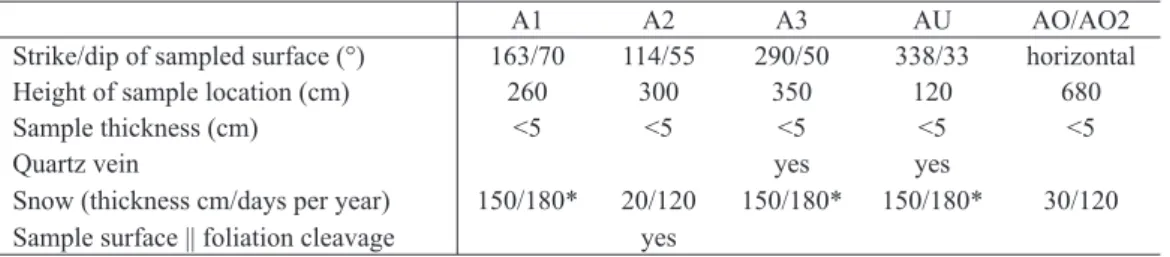
Five sides of the boulder were sampled, includ- ing bottom and top surfaces (Fig. 2). The aim was to sample in the middle part of each sur- face to avoid edge effects due to neutron leakage (MASARIK & WIELER 2003). The rock slabs were taken in the fi eld using dynamite because a large rock sample of 2-3 kg was needed. Small charges were set around a given area and an intact rock plate was blasted free. A large separate of pure quartz is desirable for determining the expected low concentration of 10Be in these samples. Be- fore blasting, strike and dip (Tab. 1), the top po- sition of the sample and the characteristics (e.g.
possible erosion, snow and/or sediment cover, quartz veins) were carefully noted. Shielding by surrounding mountains was measured with an inclinometer (Fig. 2c) and the exact position and altitude of the boulder was recorded by GPS.
After sampling, photographs for documentation were taken (Fig. 2a and b).
3.2 Origin of the boulder
The erratic boulder sampled rests on the crest of the right lateral moraine of the Glacier de Tsijiore Nouve’s advance of 1975 to 1991.
From thin section analysis of sample A1, the lithology is a quartz-rich metadiorite, which crops out in much of the glacier catchment area (Fig. 1). This lithology belongs to the Série d’Arolla in the crystalline basement of the Dent Blanche nappe, which is part of the Austroal- pine units of the Alps (LABHART 1998; BURRI et al. 1999). The incorporation of the boulder into the glacier system was most likely by falling on the glacier’s surface from a collapsing rock cliff, a process, which can be observed today on the rock walls surrounding the steep icefall of the glacier (Fig. 1). Below the icefall, the glacier surface is covered by blocky surface debris, indicating that the production of sediment here mainly occurs by rock fall from the surround- ing rock walls. The shape of the boulder itself is not typical of glacial transport as it lacks smooth surfaces and glacial polish. However on a small- er scale, partial smoothing and polishing are vis- ible. This implies a supra- or englacial transport of the boulder. The possibility of being reworked out of older lateral moraine depositions can not be excluded. Its fi nal deposition on the moraine crest occurred during the formation of the mo- raine. A fi ne- to coarse-grained gravelly till cov- ers depressions on the boulder top as small and irregular patches (5-6 cm thick). No movement of the boulder is observed since deposition.
3.3 Sample data
The elevation of the sampled boulder is 2220 m a.s.l. and the geographical coordi-
A1 A2 A3 AU AO/AO2
Strike/dip of sampled surface (°) 163/70 114/55 290/50 338/33 horizontal
Height of sample location (cm) 260 300 350 120 680
Sample thickness (cm) <5 <5 <5 <5 <5
Quartz vein yes yes
Snow (thickness cm/days per year) 150/180* 20/120 150/180* 150/180* 30/120 Sample surface || foliation cleavage yes
Note: The height of the sample location is above the moraine surface. *Snow height (own observations) is given above the moraine surface, not on the sampled surface of the boulder itself.
Table 1: Characteristics of each sample location on the boulder.
Tabelle 1: Charakteristiken jeder Probenlokalität auf dem Block.
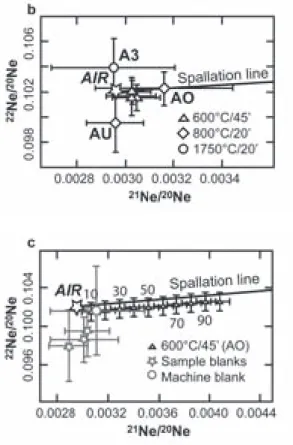
Fig. 3: Diagrams of the cosmogenic nuclides results.
a) Diagram of the 10Be results. The black horizontal lines indicate the 1!-error. The dot is the calculated mean age. See Tab. 2 for all data. b) Neon 3-isotope diagram of the samples A3, AO and AU. The distinct temperature steps maintained a certain time are indi- cated by different symbols. Error bars are at 2!-levels.
After NIEDERMANN (2002), about 90% of the cosmoge- nic 21Ne or more is degassed below 600 °C, and <1.5%
is left above 800 °C. The last step, 1750 °C, was done
to check that all Ne was released and also for the cleaning of the machine. The star displays the Ne air isotopic ratios which are 21Ne/20Ne = 0.002959 and 22Ne/20Ne = 0.102 (NIEDERMANN 2002, and references therein). All samples have isotopic ratios similar to air within the error bars for the crucial temperature steps. See Tab. 3 for all data. c) The required exposure time for a valid Ne exposure age, calculated for the Arolla samples. The 600 °C step of sample AO was used to calculate the required minimal Ne concentrations. The corresponding age is where the error crosses of the sample and of the blanks do not intersect anymore. The large error cross is the machine blank. Ten equals 10,000 years. Accordingly, at least 60,000 years of exposure are required.
Abb. 3: Resultate der gemessenen kosmogenen Nuklide. a) Graphik der 10Be Resultate. Die schwarze horizontale Linie gibt den 1!-Fehler an. Der Punkt ist das berechnete mittlere Alter. Für eine Zusammen- stellung der Daten siehe Tab. 2. b) Neon 3-Isotopengraphik der Proben A3, AO und AU. Die verschiede- nen, jeweils eine bestimmte Zeit beibehaltenen Temperaturschritte sind durch unterschiedliche Symbole gekennzeichnet. Fehlerbalken sind im 2!-Level. Etwa 90% oder mehr des kosmogenen 21Ne entgast unter 600 °C, und <1.5% entgast oberhalb 800 °C (NIEDERMANN 2002). Mit dem letzten Schritt von 1750 °C wurde kontrolliert, ob alles Ne freigesetzt wurde. Auch wird die Maschine dabei gereinigt. Der Stern sym- bolisiert das Ne Verhältnis von Luft von 21Ne/20Ne = 0.002959 and 22Ne/20Ne = 0.102 (NIEDERMANN 2002, und Referenzen darin). In den ausschlaggebenden Temperaturschritten haben alle Proben innerhalb der Fehlerbalken Isotopenverhältnisse ähnlich wie diejenigen von Luft. Siehe Tab. 3 für alle Daten. c) Die für ein zulässiges Ne Alter notwendige Bestrahlungszeit für die Arolla Proben. Der 600 °C Temperaturschritt von Probe AO wurde gebraucht, um die notwendigen minimalen Ne Konzentrationen zu berechnen. Das entsprechende Alter ist da, wo die Fehlerkreuze der Probe und der Blindproben sich nicht mehr schneiden.
Das große Fehlerkreuz ist die Maschinenblindprobe. Zehn entspricht 10‘000 Jahren. Demzufolge sind mindestens 60‘000 Jahre Bestrahlungszeit notwendig.
nates are E 7° 28’ 21.16” and N 46° 1’ 3.08”
(= 602626/096220 in the Swiss grid). Its height is 6.80 m, the length 9.50 m and the width 4.10 m. Based on thin section analysis, the rock consists of 50% quartz, occurring as dynami- cally recrystallized fi ne-grained crystals along- side quartz porphyroclasts. Quartz-rich layers alternate with mica layers. Accessory minerals including apatite, zircon and opaque minerals are also identifi able (BURRI et al. 1999). In addi- tion, a reaction with HCl during the fi rst quartz purifi cation step points to the presence of cal- cite in the rock.
4 Methods
4.1 Production rate systematics and age calculation
Cosmogenic nuclides are produced in the up- per surface of a rock by nuclear reactions in- duced by cosmic rays (LAL & PETERS 1967).
P0 (atoms/yr!g SiO2) is the isotope production rate valid for the exposure time and normal- ized to sea-level, high geomagnetic latitude ("60°) and open sky conditions (GOSSE &
PHILLIPS 2001). A sea level, high latitude 10Be production rate of 5.1 atoms/g SiO2!yr (STONE
2000) and a sea level, high latitude 21Ne pro- duction rate of 20.3 ± 3.7 atoms/g SiO2!yr (NIEDERMANN 2000) were used in this study.
Latitude (geographic) and altitude scaling of P0 follows STONE (2000). As sample thickness did not exceed 5 cm, it was not necessary to correct P0 for thickness (MASARIK & REEDY 1995). Cor- rections were also not made for magnetic fi eld changes, as the exposure time of the boulder is negligible compared to the time scales of mag- netic fi eld fl uctuations (MASARIK et al. 2001).
The surrounding mountain ranges with an ave- rage elevation of ca. 3000 m a.s.l. partially shield the boulder from the incoming cosmic ray fl ux. Therefore, only a fraction of the total incoming fl ux is available for the production of the cosmogenic nuclides. The circle in Fig. 2c illustrates the measured shielding values for sample AO/AO2 in degrees. The dip of the sam- pled surfaces of the other samples reduces their horizon and thus production rates of the cosmo- genic nuclides to even lower values (Tab. 2). To the northeast, the “open valley” allows a higher amount of cosmic rays to pass while, to the south, the Pigne d’Arolla blocks the cosmic ray fl ux. The bottom-boulder sample AU has the lowest production rate as a result of the correc- tions for the overall shielding by the boulder itself. Shielding corrections were calculated following DUNNE, ELMORE & MUZIKAR (1999).
For all samples, no correction due to vegeta- tion cover was necessary. We observed snow on the moraine in winter of about 1.5 m thick- ness. Winter snow cover on the surfaces of the
Sample Production rate (atoms/g SiO2 !yr)
Shielding factor (Topo, dip)
Quartz (g)
Be Carrier (mg)
10Be/9Be Sample (1E-12)
Error Sample
(%)
10Be!104 (atoms/g SiO2)
Age (years)
A1 20.86 0.70 47.15 0.4013 0.014 54.1 0.105 ± 0.456 51 ± 220
A2 24.91 0.84 45.40 0.4034 0.016 44.2 0.198 ± 0.433 75 ± 164
A3 25.85 0.87 91.48 0.4026 0.013 40.4 0.013 ± 0.166 5 ± 60
AU AO2
1.32 28.75
0.04 0.97
62.53 70.73
0.4042 0.4044
0.012 0.016
45.4 28.9
-0.015 ± 0.255 0.128 ± 0.194
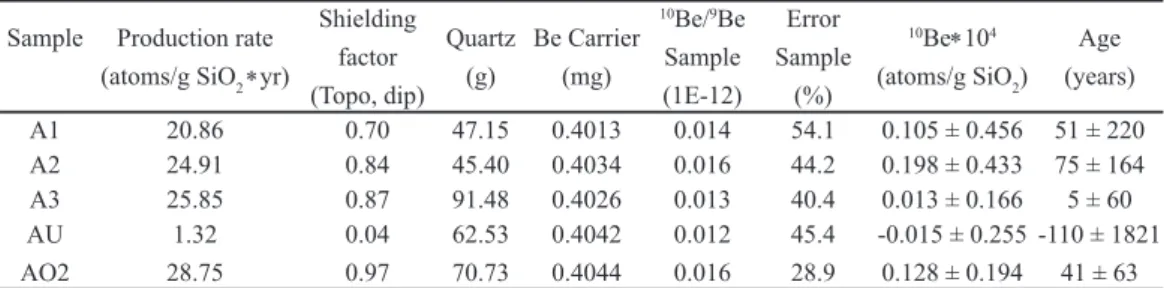
-110 ± 1821 41 ± 63 Note: The AMS measurement uncertainty for sample and blank are at the 1"-level. The error of the used standard (±2.5%) is not included. A weighted mean blank of 10Be/9Be = 0.012*10-12 with an error of 18.3%
was taken for the subtraction step. A sea level, high latitude production rate of 5.1 atoms/g SiO2!yr (STONE 2000) was used.
Table 2: Compilation of Be data.
Tabelle 2: Zusammenstellung der Be Daten.
boulder is 30 cm or less and on the steep sides of the boulder no snow remains. All samples experience less than 30 cm of snow cover (in the case of sample AU location height is 1.20 m above moraine surface while snow cover on the moraine is 1.50 m) (Tab. 1). After the model of MASARIK & REEDY (1995), the cosmogenic production rate on the boulder surface is not af- fected until snow cover exceeds 40 cm (assum- ing a snow density of 0.3 g/cm3). Therefore, no correction for snow cover was performed.
The ages were calculated using the equation in GOSSE & PHILLIPS (2001), assuming no erosion.
4.2 Laboratory analysis
For extracting 10Be from dissolved quartz, the methods described in OCHS & IVY-OCHS (1997) were followed. The pure quartz mineral sepa- rate was produced by selective chemical dis- solution using hydrofl uoric acid, following the procedure of KOHL & NISHIIZUMI (1992). Labo- ratory work was carried out at the Institute of Geological Sciences at the University of Bern.
Measurements of 10Be/9Be ratios of the samples and the necessary blanks were done by accele-
rator mass spectrometry at the ETH/PSI tan- dem facility in Zurich.
Pure quartz was handpicked for Ne analysis.
Noble gas concentrations were measured with a 90° sector fi eld static noble gas mass spectro- meter at the noble gas laboratory at ETH Zu- rich (BEYERLE et al. 2000). This spectrometer features a modifi ed Baur/Signer ion source equipped with a compressor that enhances the sensitivity for helium and neon by two orders of magnitude (BAUR 1999). We applied step- wise heating to enrich the cosmogenic neon fraction in the low-temperature steps.
5 Results and discussion 5.1 Samples
The 10Be ages are shown in Fig. 3a and Tab.2.
All ages are zero within uncertainties. Their relatively high error is due to the low 10Be con- centrations in the samples, which are similar to the measured blank values. The mean age of sample AU is negative and only the upper limit of the age is realistic. This is due to the subtraction of the mean blank value, which has
Sample Step
(°C, min)
20Ne (109 atoms/g)
21Ne/20Ne (10-3)
22Ne/20Ne
A3 600, 45 8.43 ± 0.227 3.05 ± 0.100 0.10 ± 0.001
1750, 20 1.42 ± 0.047 2.95 ± 0.255 0.10 ± 0.002
AO
600, 45 10.40 ± 0.284 3.03 ± 0.078 0.10 ± 0.001
800, 20 1.43 ± 0.048 3.16 ± 0.284 0.10 ± 0.001
1750, 20 1.05 ± 0.032 14.2 ± 0.524 0.11 ± 0.003
AU
600, 45 7.65 ± 0.203 3.03 ± 0.104 0.10 ± 0.002
800, 20 1.70 ± 0.046 2.96 ± 0.119 0.10 ± 0.002
1750, 20 1.95 ± 0.068 3.06 ± 0.199 0.11 ± 0.003
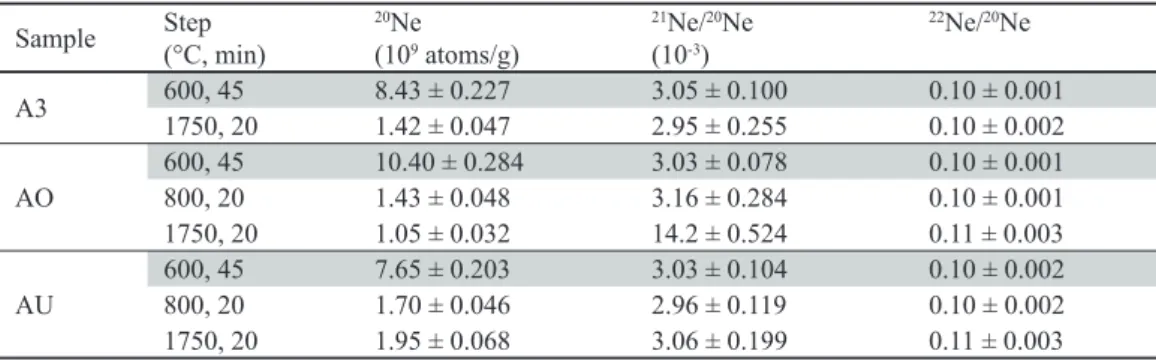
Note: Errors are at the 2"-level. Included are uncertainties in mass discrimination and sensitivity while un- certainties of calibration gas concentrations are not included. They are expected to be smaller than 3%. About 90% of the cosmogenic 21Ne or more is degassed below 600 °C (NIEDERMANN 2002). For sample A3, 41.77 mg of an ultra-pure quartz separate was used for the step-wise heating procedure following NIEDERMANN, GRAF
& MARTI (1993) and NIEDERMANN (2002). For sample AO, 46.66 mg quartz was loaded onto the noble gas mass spectrometer and for AU 43.66 mg. In Fig. 3b, the 21Ne/20Ne and 22Ne/20Ne ratios of all temperature steps are plotted.
Table 3: Compilation of Ne data.
Tabelle 3: Zusammenstellung der Ne Daten.
a higher 10Be/9Be ratio of 0.012*10-12 than the sample ratio. The high shielding effect by the surrounding mountains and the boulder itself and the consequential small production rate also contribute to the particularly low 10Be con- centration of this bottom sample.
The 21Ne/20Ne and the 22Ne/20Ne ratios of the samples A3, AO and AU are similar to air ra- tios (Fig. 3b, Tab. 3). Accordingly, no excess of cosmogenic 21Ne and 22Ne, which would have been produced in a previous period of ex- posure, were detected. No differences between the Ne isotope ratios of the three samples are observed.
5.2 General context
A fi rst test for inherited nuclides was per- formed by DAVIS et al. in 1999. They analyzed eight samples collected from boulders, cobbles and recently uncovered bedrock from the area left after the Tumbling Glacier, Baffi n Island, retreated from its 1976 and 1959 limit. Most samples of this Arctic fjord environment yield- ed 26Al nuclide concentrations equivalent to less than 1000 years of surface exposure; the
10Be measurements were within 2 sigma of their blank value. DAVIS et al. (1999) concluded that glacial erosion must have been suffi cient to remove the nuclide signal gained in a previ- ous period of exposure, e.g. during an intergla- cial or interstadial. In an Alpine environment with a higher relief, data from the Nägelisgrätli in the Grimsel region in Central Switzerland show that nuclide inheritance is also negligible (KELLY et al. 2006). Based on these data and on the fact that at 3 m depth in the rock production of nuclides is only a few percent of the value at the surface (LAL 1991), the authors concluded that at least 3 m of rock was removed during the Last Glacial Maximum (LGM) and that therefore nuclide inheritance originating from exposure prior to the LGM in the Alps is low (IVY-OCHS, KERSCHNER & SCHLÜCHTER 2007).
Sample AO2 of our study would require at least 300 years of pre-exposure to yield a 10Be/9Be ratio clearly outside the uncertainties of the blank value. For the Ne data, at least 60,000
years of exposure to cosmic rays would be re- quired to build up a minimal detectable amount for sample AO (Fig. 3c). Assuming that the clock has been “zeroed” by LGM glacial ero- sion, nuclide inheritance could have only ac- cumulated during low glacial stands following the LGM. In case of the Ne data, time since the LGM was too short to build up a detectable amount of cosmogenic Ne. For 10Be, consider- ing the Holocene glacial history of this region and of the Alps in general (SCHNEEBELI & RÖTH-
LISBERGER 1976; JÖRIN, STOCKER & SCHLÜCHTER
2006), the required time span of at least 300 years of phases with a shorter glacial extent than today would easily be reached. Therefore, it can be concluded that the 10Be concentration of the boulder was zero when it was incorpo- rated into the glacier system.
6 Conclusion
The aim of this work was to test a boulder for inherited nuclides from previous periods of ex- posure. We are aware that we are dealing with one single boulder only; however, in a fi rst ap- proach a multi-isotope and multi-surface study is an absolutely necessary step in evaluating the case of pre-exposure of erratic boulder surfaces.
As the known exposure time of the block is about 12 years, the nuclide concentration built up since exposure should be undetectable if no previous exposure of the surfaces has occurred.
The 10Be and the 21Ne results demonstrate that none of the sides of the boulder that we sampled experienced pre-exposure. The build-up of the cosmogenic nuclides started with its deposition on the moraine crest, as all of the samples show zero exposure ages within error. The uncertain- ties are relatively high due to the high error in the measuring step which again results from the low 10Be concentration in the samples. The several hundred years of pre-exposure required for building up a minimal detectable amount of
10Be would be easily reached in geological time scales, as well as the 60,000 years required for
21Ne. This implies that the concentration of cos- mogenic nuclides in the boulder was zero by the time of its incorporation in the glacier sys-
tem; possible subsequent gain of cosmogenic nuclides is in the undetectable range or was im- mediately lost during transport.
Acknowledgements
Many thanks go to Diego Sanz and Ueli Jörin for their help collecting the samples. The labo- ratory work was done at the Institute of Geo- logical Sciences at the University of Bern. The measuring of the 10Be samples was performed by Peter W. Kubik at the Zurich AMS Facility jointly operated by the Swiss Federal Institute of Technology, Zurich and Paul Scherrer Insti- tute, Villigen, Switzerland. The manuscript was greatly improved by comments from Joerg M.
Schaefer, Vincent Rinterknecht, Rainer Wieler, Sven Lukas and Peter W. Kubik. We thank the Swiss National Science Foundation for support- ing this project.
References
ABBÜHL, L.M., DADIC, R., FISCHER, L., MÜLLER, B.
& ZAHNO, C. (2002): Geomorphologische Kar- tierarbeit in Arolla (VS). – Unpublished geomor- phologic map; ETH Zürich.
BAUR, H. (1999): A Noble-Gas Mass Spectrometer compressor source with two orders of magnitude improvement in sensitivity. – EOS Transactions, 80: Supplement.
BEYERLE, U., AESCHBACH-HERTIG, W., IMBODEN, D.M., BAUR, H., GRAF, T. & KIPFER, R. (2000): A mass spectrometric system for the analysis of noble gases and tritium from water samples. – Envi- ronmental Science & Technology, 34/10: 2042- 2050.
BROOK, E.J., BROWN, E.T., KURZ, M.D., ACKERT, R.P., RAISBECK, G.M. & YIOU, F. (1995): Constraints on age, erosion and uplift of Neogene glacial de- posits in the Transantarctic Mountains using in situ cosmogenic 10Be and 26Al. – Geology, 23:
1063-1066.
BROWN, E.T., EDMOND, J.M., RAISBECK, G.M., YIOU, F., KURZ, M.D. & BROOK, E.J. (1991): Examination of surface exposure ages of Antarctic moraines using in situ produced 10Be and 26Al. – Geochi- mica et Cosmochimica Acta, 55: 2269-2283.
BURRI, M., DAL PAZ, G.V., DELLA VALLE, G., GOUFFON, Y. & GUERMANI, A. (1999): Atlas géologique de
la Suisse, feuille 101. 1346 Chanrion avec par- tie nord de la feuille 1366 Mont Vélan. Notice explicative. – 79 p.; Bern (Federal Offi ce of To- pography).
DAVIS, P.T., BIERMAN, P.R., MARSELLA, K.A., CAFFEE, M.W. & SOUTHON, J.R. (1999): Cosmogenic analysis of glacial terrains in the eastern Cana- dian Arctic: a test for inherited nuclides and the effectiveness of glacial erosion. – Annals of Gla- ciology, 28: 181-188.
DUNNE, J., ELMORE, D. & MUZIKAR, P. (1999): Scaling factors for the rates of production of cosmogenic nuclides for geometric shielding and attenuation at depth on sloped surfaces. – Geomorphology, 27: 3-11.
GOSSE, J.C. & PHILLIPS, F.M. (2001): Terrestrial in situ cosmogenic nuclides: theory and application. – Quaternary Science Reviews, 20: 1475-1560.
GRAF, T., KOHL, C.P., MARTI, K. & NISHIIZUMI, K.
(1991): Cosmic-ray produced neon in Antarctic rocks. – Geophysical Research Letters, 18: 203- 206.
IVY-OCHS, S., KERSCHNER H. & SCHLÜCHTER C.
(2007): Cosmogenic nuclides and the dating of Lateglacial and Early Holocene glacier varia- tions: The Alpine perspective. – Quaternary In- ternational, 164-165: 53-63.
JÖRIN, U.E., STOCKER, T.F. & SCHLÜCHTER, C. (2006):
Multicentury glacier fl uctuations in the Swiss Alps during the Holocene. – The Holocene, 16:
697-704.
KELLY, M.A., IVY-OCHS, S., KUBIK, P.W., VON
BLANCKENBURG, F. & SCHLÜCHTER, C. (2006):
Exposure ages of glacial erosional features in the Grimsel Pass region, central Swiss Alps. – Boreas, 35: 634-643.
KOHL, C.P. & NISHIIZUMI, K. (1992): Chemical iso- lation of quartz for measurement of in-situ pro- duced cosmogenic nuclides. – Geochimica et Cosmochimica Acta, 56: 3583-3587.
LABHART, T.P. (1998): Geologie der Schweiz. – 211 p.; Thun (Ott Verlag).
LAL, D. (1991): Cosmic ray labeling of erosion sur- faces: in situ nuclide production rates and ero- sion models. – Earth and Planetary Science Let- ters, 104: 424-439.
LAL, D. & PETERS, B. (1967): Cosmic ray produced radioactivity on the earth. – Handbuch der Physik, Vol. 46/2: 551-612; Berlin (Springer).
MASARIK, J. & REEDY, R.C. (1995): Terrestrial cos- mogenic-nuclide production systematics calcu- lated from numerical simulations. – Earth and Planetary Science Letters, 136: 381-395.
MASARIK, J. & WIELER, R. (2003): Production rates of cosmogenic nuclides in boulders. – Earth and Planetary Science Letters, 216: 201-208.
MASARIK, J., FRANK, M., SCHÄFER, J.M. & WIELER, R.
(2001): Correction of in situ cosmogenic nuclide production rates for geomagnetic fi eld intensity variations during the past 800,000 years. – Geo- chimica et Cosmochimica Acta, 65/17: 2995- 3003.
NIEDERMANN, S. (2002): Cosmic-ray-produced noble gases in terrestrial rocks: dating tools for surface processes. – Reviews in Mineralogy and Geo- chemistry, 47: 731-784.
NIEDERMANN, S. (2000): The 21Ne production rate in quartz revisited. – Earth and Planetary Science Letters, 183: 361-364.
NIEDERMANN, S., GRAF, T. & MARTI, K. (1993): Mass spectrometric identifi cation of cosmic-ray-pro- duced neon in terrestrial rocks with multiple neon components. – Earth and Planetary Science Letters, 118: 65-73.
OCHS, M. & IVY-OCHS, S. (1997): The chemical be- havior of Be, Al, Fe, Ca and Mg during AMS tar- get preparation from terrestrial silicates modeled with chemical speciation calculations. – Nuclear Instruments and Methods in Physics Research, B123: 235-240.
SCHNEEBELI, W. & RÖTHLISBERGER, F. (1976): 8000 Jahre Walliser Gletschergeschichte. Ein Beitrag zur Erforschung des Klimaverlaufs in der Nach- eiszeit. – 156 p.; Bern (Schweizer Alpen Club (SAC)).
STONE, J.O. (2000): Air pressure and cosmogenic isotope production. – Journal of Geophysical Research, 105: 23,753-23,759.