Each society wishes to create favourable living conditions for its members. Life quality criteria are formulated in different ways by various societies or individuals, depending on the given geographical and socio-economic conditions, living standards; national, ethnical, and religious traditions; history, policy; age, sex, educational level, position in the social hierarchy; etc. However, there is full agree-ment on the need for three eleagree-ments:
– healthy, high quality food, and food security; – clean water;
– pleasant environment.
All three are closely related to the sustainable management of the land resources, including the rational use of soil multifunctionality (Várallyay 1998, 2007, 2003).
Sustainable development
Sustainable development is a global objective: the management and conservation of the natural resource base, and the orientation of technologi-cal and institutional changes in such a manner as to ensure the attainment and continued
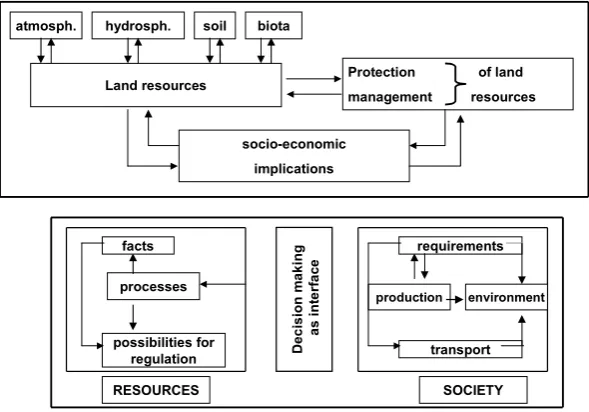
satisfac-tion of human needs for the present and future generations (Láng et al. 1983; Greenland & Szabolcs 1993). Sustainable agricultural de-velopment conserves the land, water, plant, and animal genetic resources, is environmentally non-degrading, technically appropriate, economically viable, and socially acceptable (Várallyay 2003). Sustainable development includes efficient multi-functional agriculture: using environment-friendly, energy- and material-saving technologies and paying special attention to quality; and a socially acceptable rural development, simultaneously. The given land resources (geological formations, relief, atmosphere, surface and subsurface water resources, soil biota, vegetation) have to be used and managed in harmony with the production (satisfy the ever-growing demand of society) and protection (conservation, improvement) aspects (Figure 1) (Várallyay 1994, 2000, 2003).
Soil resources and soil functions
Land (the soil – water – near the surface at-mosphere continuum, with its geology, relief and
Role of Soil Multifunctionality in Sustainable Development
György VÁRALLYAY
Research Institute for Soil Science and Agricultural Chemistry (RISSAC) of the Hungarian Academy of Sciences, Budapest, Hungary
Abstract: Each society wishes to create favourable living conditions for its members. Life quality criteria are formu-lated in different ways by various societies or individuals, depending on the given geographical and socio-economic conditions, living standards; national, ethnical, and religious traditions; history, policy; age, sex, educational level, position in the social hierarchy; etc. Sustainable development is a global objective that includes efficient multifunc-tional agriculture: using environment-friendly, energy- and material-saving technologies and paying special attention to quality; and a socially acceptable rural development, simultaneously. The given land resources have to be used and managed in harmony with the production and protection.
Keywords: soil functions; soil resources; sustainable development
103 Soil & Water Res., 5, 2010 (3): 102–107
biota) represents a considerable part of the nature. Consequently, rational land use and soil manage-ment – guaranteeing normal soil functions – is an important element of sustainable (agricultural) development, having special importance both in the national economy and in the environment protection (Csete & Várallyay 2004; Várallyay 1994, 1998).
The most important soil functions are as follows (Várallyay 2003, 2007):
(a) Soils are the most significant – condition-ally renewable – natural resources. During rational biomass production they do not change irreversibly, their quality does not decrease unavoidably and fundamentally, but their renewal, based on soil resilience does not happen automatically. Soil conservation, the maintenance and increase of soil fertility requires permanent activities, such as rational land use, proper agrotechnique, and in some cases remediation, reclamation or ameliora-tion (Greenland & Szabolcs 1993; Csete & Várallyay 2004).
(b) Soil is a reactor and transformer.Itintegrates the influences of other natural resources, such as solar radiation, atmosphere, surface and subsurface waters, deeper geological strata, and biological resources. Their biogeochemical cycles develop a life medium for microbiological activities, and create ecological environment (standort, landsite) for natural vegetation and cultivated crops.
(c) Soil is the most important medium for bio-mass production(food, fodder, industrial raw
material, alternative energy). Soil, as a four-dimensional [spatial(horizontal and vertical) variability and temporaldynamism], three- (or four-) phase, polydisperse system can simul-taneously satisfy – to a certain extent – the ecological requirements (air, water and nutri-ent supply) of living organisms, the natural vegetation and cultivated crops. This special ability is the unique soil property: soil fertility, which varies greatly and has changed consider-ably depending on natural factors and human activities. Soil is the primary food source of the biosphere, the starting point of the food chain (Várallyay 1994, 2000, 2003).
(d) Soil represents a major natural storage capacity of heat, water, plant nutrients and – in some special, well-controlled cases – wastes and other compounds. The stored water and plant nutrients ensure the continuous water and nu-trient supply of plants (satisfying their uptake dynamics) for shorter or longer periods without any additional supply (rain, irrigation, nutrient application). This soil function is the basis of favourable soil moisture regime (preventing or moderating extreme hydrological situations as flood, water-logging, over-moistening vs. drought) and sustainable plant nutrition (Csete & Várallyay 2004; Várallyay 2006). (e) Soil represents a high capacity buffer medium
of the biosphere, which, within certain limits, may moderate the various stresses caused by environmental factors (extreme temperature; extreme hydrological events: floods, water-logging – droughts) and/or human activities
Land resources Protection of land management resources atmosph. hydrosph. soil biota
socio-economic implications
De
ci
si
on
m
ak
in
g
as
in
te
rf
ac
e
processes
possibilities for regulation facts
production
transport requirements
RESOURCES SOCIETY
environment
[image:2.595.64.359.84.290.2](high input, fully-mechanised and chemically controlled crop production; liquid manure from large-scale livestock farms; wastes and waste waters originating from industry, transport, urban and rural development, etc.). Buffer systems have strict limits and boundary con-ditions. Sometimes this is forgotten by the users, which leads to serious environmental problems. To prevent and avoid unfavour-able side-effects, the tolerance limits must be identified, precisely determined, quantified and evaluated. This requires comprehensive sensitivity (susceptibility, vulnerability) studies and impact analyses. Intensive international, regional, and national studies have been car-ried out to determine these tolerance limits and target conditions.Such evaluations are the scientific basis of documents such as the Soil Resolution of US (accepted by the 110th
Con-gress); the Integrated European Soil Conserva-tion Strategy; and naConserva-tional soil conservaConserva-tion strategies of various countries (Várallyay 2005b). In Hungary, comprehensive studies have identified and quantified the susceptibil-ity/sensitivity/vulnerability of soils to wind and water erosion, acidification, salinisation/ alkalisation/sodification, physical soil degra-dation (compaction, structure destruction, surface sealing) and chemical pollution (Csete & Várallyay 2004; Várallyay 1998). (f) Soil is an efficient natural filter and detoxication
systemthat may prevent the deeper horizons and the subsurface waters from becoming
con-taminated by various pollutants deposited on the soil surface or put into the soil.
(g) Soil is a significant gene reservoir for the biosphere and thus an important element of biodiversity. A considerable proportion of living organisms live in or on the soil or are closely related to (sometimes depending on) the soil.
(h) Soil is the conservator of natural and human heritages.
These functions are all equally important, but the society has used them in different ways (rate, method, efficiency) throughout history, depending on the given natural conditions and socio-economic circumstances. In many cases the character (territo-rial and temporal variabilities, changeability–stabil-ity–controllability, boundary conditions, limitations) of a certain function was not (properly or adequately) taken into consideration during the utilisation of soil resources. In such cases the misguided management resulted in over-exploitation, decreasing the efficiency of one or more soil functions, and – above a certain limit – causing serious environmental deterioration (Várallyay 1994, 2000).
Limiting factors of soil multifunctionality
The major ecological constraints for multipurpose biomass production on the various subcontinents are summarised in Figure 2. Not an optimistic view, but a real fact (Várallyay 2000; Csete & Várallyay 2004).
Figure 1. Relationships between resources and the society
Land resources Protection of land management resources atmosph. hydrosph. soil biota
socio-economic implications De ci si on m ak in g as in te rf ac e processes possibilities for regulation facts production transport requirements RESOURCES SOCIETY environment Drought Mineral stress Shallow depth Water excess Perma-frost Left available Euro pe Wor ld Aver age Cent ral Amer ica North Amer ica Sout h Asia Afric
a South Amer ica Aust ralas ia Sout h East Asia North and Cent ral A
sia
[image:3.595.65.375.548.754.2]% 36 25 22 18 16 15 15 14 10 11
105 Soil & Water Res., 5, 2010 (3): 102–107
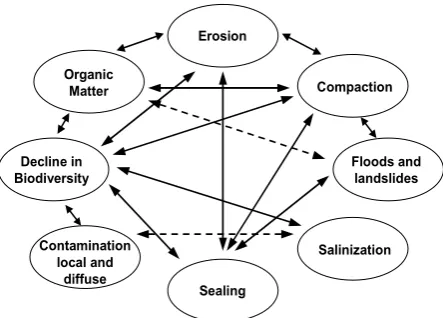
In the European Thematic Strategy of Soil Con-servation, 8 main soil threats get priority attention: Figure 3 (Várallyay 2005b).
In the Carpathian Basin (especially on the Car-pathian plains) the natural conditions are relatively favourable for rainfed biomass production. In spite of this fact, a considerable part ofthe soils are subject to various ecological constraints and unfavourable soil processes (Láng et al. 1983; Csete & Várallyay 2004; Várallyay 2006): – Soil degradation processes: the main soil
degrada-tion processes are: soil erosion by water or wind; soil acidification; salinisation and/or alkalisa-tion; physical degradation (structure destruction, compaction); biological degradation; decrease in natural buffering capacity (Várallyay 1989). – Extreme moisture regime: the simultaneous
hazard of waterlogging or over-moistening and drought sensitivity on large areas, sometimes in the same places within a short period of time (Várallyay 2006).
– Nutrient stresses: the deficiency or accumula-tion and/or toxicity of one or more elements in the biogeochemical cycle.
– Environmental pollution: the accumulation or mobilisation of various, potentially harmful (or even toxic) elements (or compounds) in the soil – water – plants – animals – human beings food chain (Várallyay 2000).
Control of soil functions
The multifunctionality of soil is determined by the combined influences of the soil properties, which are the results of the soil processes: mass
and energy regimes, abiotic and biotic transport and transformation, and their interactions. The control of the soil processes is a great challenge and the main task of the soil science and soil man-agement (Várallyay 1998).
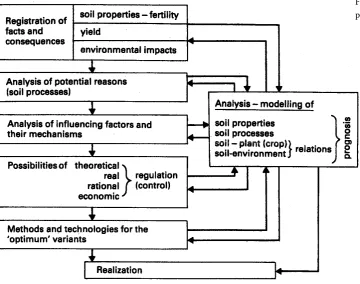
The control of the soil functions requires ad-equate soil information: exact, reliable, detectable (preferably measurable) and accurate, quantitative territorial data on well-defined soil and land proper-ties, including the characterisation of their spatial (vertical, horizontal) and temporal variabilities and pedotransfer functions; on the soil processes and biogeochemical cycles, including their determining and influencing factors and their mechanisms, and on the actual and/or potential impacts of human activities. The schematic model of the strategy of the soil process control is shown in Figure 4.
In Hungary, a large amount of such information is available as a result of long-term observations, and various soil surveys, analytical and mapping activities conducted at the national (1:500 000), regional (1:100 000), farm (1:10 000–1:25 000) and field levels (1:5 000–1:10 000) over the past 60 years. A considerable part of these data were organised into a GISdatabasegiving opportuni-ties for an efficient control of the soil processes and soil functions (Várallyay 2005a; Várallyay
et al. 1985).
Efficient, economically viable, socially acceptable, and environmentally sound sustainable, multi-functional soil management includes the following main elements (Várallyay 2003, 2007):
(1) Territorial coordination of the agroecological conditions (land-site characteristics) and the agro-ecological requirements of the cultivated crops: site-specific land use and cropping pat-tern; selection and breeding of varieties and genotypes for the given conditions; improve-ment of (soil) ecological conditions.
(2) Rationalisation of the structure of agricultural fields: optimisation of the field size; develop-ment of proper infrastructure.
(3) Reduction (minimalisation) of production wastes: plant residues; animal excrements, wastes from yield and food processing, with their most efficient recycling without any harm-ful environmental side-effects.
[image:4.595.69.291.84.243.2](4) Control (prevention, elimination or at least moderation) of undesirable soil degradation processes: Priority must be given to the efficient preventive measures, based on comprehensive prognoses, sensitivity, and impact analyses. Figure 3. Land degradation problems in Europe
Figure 4. Control of soil processes
Organic Matter
Decline in Biodiversity
Contamination local and
diffuse
Erosion
Sealing
Compaction
Salinization Floods and
landslides
Soil & Water Res., 5, 2010 (3): 102–107
(5) Improvement of the efficiency of agricultural water management and soil moisture con-trol:
– increase the water storage within the soil in plant-available form without any unfa-vourable environmental consequences: help infiltration into the soil; increase the water storage capacity; reduce the immobile and not plant-available moisture content; – reduce evaporation, surface runoff and
fil-tration losses;
– improve the vertical and horizontal drainage conditions.
(6) Precision plant nutrient management: – rational use of fertilisers based on crop
re-quirements (dynamics of their nutrient up-take), soil conditions and agroclimate; – efficient recycling of crop residues;
– utilisation of wastes with utilisable plant nutrient content and without potentially harmful chemical compounds.
(7) Soil pollution control:
– emission/imission reduction;
– prevention of the mobilisation of potentially harmful chemical compounds;
– reduction of the vulnerability of soil to vari-ous pollutants.
References
Greenland D.J., Szabolcs I. (eds) (1993): Soil Resil-ience and Sustainable Land Use. CAB International, Wallingford.
Csete L., Várallyay Gy. (eds) (2004): Agroecology, Environmental Relations of Agro-ecosystems and Possibilities of their Control. AGRO-21 Füzetek, No. 37. (in Hungarian)
Láng I., Csete L., Harnos Zs. (1983): The Agro-eco-logical Potential of Hungarian Agriculture in 2000. Mezőgazd, Kiadó, Budapest. (in Hungarian)
Várallyay Gy. (1989): Soil degradation processes and their control in Hungary. Land Degradation and Re-habilitation, 1: 171–188.
Várallyay Gy. (1994): Soil management and environ-mental relationships in Central and Eastern Europe. Agrokémia és Talajtan, 43: 41–66.
Várallyay Gy. (1998): Multifunctional soil management for sustainable development in Hungary. Agrokémia és Talajtan, 47: 7–22.
[image:5.595.74.435.87.371.2]Várallyay Gy. (2000): Soil quality in relation to the concepts of multifunctionality and sustainable de-velopment. In: Wilson M.J., Maliszewska-Ko-rdybach B.: Soil Quality, Sustainable Agriculture and Environmental Security in Central and Eastern Europe. NATO Science Series 2. Environmental
Secu-Figure 3. Land degradation problems in Europe
Figure 4. Control of soil processes
Organic Matter
Decline in Biodiversity
Contamination local and
diffuse
Sealing
Compaction
Salinization Floods and
landslides
107 Soil & Water Res., 5, 2010 (3): 102–107
rity, Vol. 69, Kluwer Academic Publishers, Dordrecht – Boston – London. 17–33.
Várallyay Gy. (2003): Role of soil multifunctionality in future sustainable agricultural development. Acta Agronomica Academiae Scientiarum Hungaricae, 51: 109–124.
Várallyay Gy. (2005a): Soil survey and soil monitoring in Hungary. In: Jones R.J.A., Housková B., Bul-lock P., Montanarella L. (eds): Soil Resources of Europe. ESB Research Report No. 9, 2nd Ed., JRC, Ispra, 169–179.
Várallyay Gy. (2005b): Soil conservation strategy in an extended Europe and in Hungary. In.: Sobocka J. (ed.): 4th Slovakian Pedological Days, Cingov, June 14–16, 2005, 372–379. (CD ROM)
Várallyay Gy. (2006): Soil degradation processes and extreme soil moisture regime as environmental prob-lems in the Carpathian Basin. Agrokémia és Talajtan,
55: 9–18.
Várallyay Gy. (2007): Soil multifunctionality in sus-tainable development. Tessedik Sámuel Főiskola Kö-zlemények, 7: 309–315.
Várallyay Gy. et al. (1985): Soil factors determining the agroecological potential of Hungary. Agrokémia és Talajtan, 34 (Supplement): 90–94.
Received for publication August 14, 2009 Accepted after corrections January 5, 2010
Corresponding author:
Prof. Dr. György Várallyay, Research Institute for Soil Science and Agricultural Chemistry (RISSAC) of the Hungarian Academy of Sciences, Herman Ottó u. 15, 1022 Budapest, Hungary